
Conservation of Mechanical Energy for HSC Physics
Learn how to track transfers between kinetic and gravitational potential energy, decide when mechanical energy is conserved, and avoid common HSC mistakes.
A skateboarder starts from rest at the top of a smooth ramp. At the top, the skateboard isn’t moving. At the bottom, it is moving quickly. No motor has switched on, so where did the kinetic energy come from?
Now make a prediction. Suppose the ramp starts from twice the height. Will the skateboarder’s speed at the bottom also double?
It won’t. Doubling the starting height doubles the energy available, but kinetic energy depends on the square of speed. The final speed only increases by a factor of \(\sqrt{2}\).
Conservation of mechanical energy gives us a clean way to predict changes like this without following every force and acceleration along the path.
01The energy-tracking idea
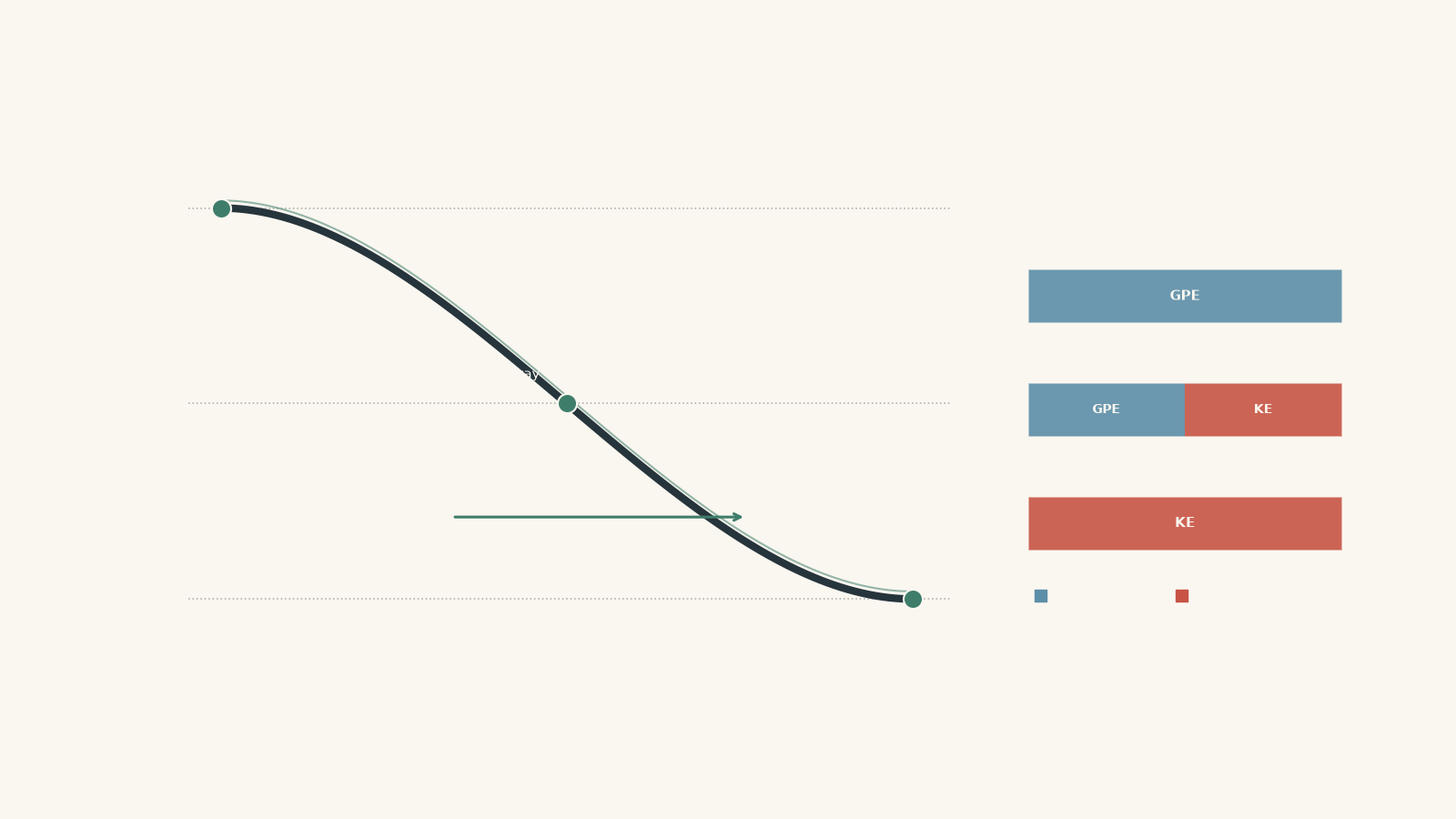
Imagine an object moving down a frictionless hill. There are two quantities we want to track:
- kinetic energy, because the object is moving
- gravitational potential energy, because the object has height
Kinetic energy is
\[
K = \frac{1}{2}mv^2
\]
where \(K\) is kinetic energy in joules (J), \(m\) is mass in kilograms (kg), and \(v\) is speed in metres per second (m/s).
Near Earth’s surface, gravitational potential energy can be written as
\[
U_g = mgh
\]
where \(U_g\) is gravitational potential energy in joules, \(g\) is gravitational field strength, approximately \(9.8\text{ m/s}^2\), and \(h\) is height above a chosen reference level in metres.
If \(mgh\) needs a refresher, see Gravitational Potential Energy Near Earth for HSC Physics.
The object’s mechanical energy is the total of its kinetic and potential energies:
\[
E_{\text{mech}} = K + U_g
\]
For the moment, picture those as two accounts in the same energy budget. Going downhill transfers energy from the height account into the speed account. Going uphill transfers it back.
The analogy has limits. Energy isn’t literally a substance moving between boxes, and gravitational potential energy is more precisely associated with the interaction between the object and Earth. But the two-account model is useful for tracking the numbers.
02When is mechanical energy conserved?
Here is the important condition.
If energy is only being transferred between kinetic and potential energy within the system, then the total mechanical energy stays constant.
For motion under gravity with no friction or air resistance,
\[
E_{\text{mech,i}} = E_{\text{mech,f}}
\]
so
\[
K_i + U_{g,i} = K_f + U_{g,f}
\]
The subscripts \(i\) and \(f\) mean initial and final.
Substituting the equations for kinetic and gravitational potential energy gives
\[
\frac{1}{2}mv_i^2 + mgh_i
=
\frac{1}{2}mv_f^2 + mgh_f
\]
There is another useful way to say the same thing:
\[
\Delta K + \Delta U_g = 0
\]
or
\[
\Delta K = -\Delta U_g
\]
If gravitational potential energy decreases by 40 J, kinetic energy increases by 40 J.
That is what “conserved” means here. The amounts of kinetic and potential energy can change dramatically. Their sum does not.
A force can act without changing mechanical energy
Students sometimes learn the rule as “mechanical energy is conserved when there are no other forces”.
That’s too crude.
Consider a cart travelling along a smooth curved track. The track exerts a normal force on the cart, but that normal force is perpendicular to the cart’s instantaneous motion. It therefore does no work on the cart.
So gravity can still transfer energy between gravitational potential and kinetic energy while the total mechanical energy remains constant.
A better decision rule is this:
| Situation | Is mechanical energy conserved? | Why? |
|---|---|---|
| Object falling with air resistance ignored | Yes | Gravity transfers energy between \(U_g\) and \(K\) |
| Cart on a fixed, smooth track | Yes | Gravity does work; the normal force does no work |
| Object sliding with friction | No | Mechanical energy is transferred to thermal/internal energy |
| Object moving through significant air resistance | No | Mechanical energy is transferred to the surrounding air and thermal energy |
| Motor or person does work on the object | Not generally | Energy is transferred into or out of the mechanical system |
So before writing a conservation equation, ask: what processes are transferring energy?
03Worked example: Dropping down a frictionless track
A \(2.0\text{ kg}\) trolley starts from rest at a height of \(3.2\text{ m}\) above the bottom of a frictionless track. Calculate its speed at the bottom. Use \(g = 9.8\text{ m/s}^2\).
Step 1
The track is frictionless, and we are ignoring air resistance. Gravity is the force transferring energy between gravitational potential and kinetic energy.
So
\[
E_{\text{mech,i}} = E_{\text{mech,f}}
\]
Step 2
At the top, the trolley is at rest, so \(K_i = 0\).
Choose the bottom as \(h = 0\), so \(U_{g,f} = 0\).
Therefore,
\[
mgh_i = \frac{1}{2}mv_f^2
\]
Step 3
\[
(2.0)(9.8)(3.2)
=
\frac{1}{2}(2.0)v_f^2
\]
\[
62.72 = v_f^2
\]
Step 4
\[
v_f = \sqrt{62.72} = 7.9\text{ m/s}
\]
The trolley reaches the bottom at approximately \(7.9\text{ m/s}\).
Its initial gravitational potential energy has been transferred into kinetic energy.
04Why did the mass disappear?
Look again at the equation:
\[
mgh_i = \frac{1}{2}mv_f^2
\]
The mass \(m\) appears on both sides, so it cancels:
\[
gh_i = \frac{1}{2}v_f^2
\]
and therefore
\[
v_f = \sqrt{2gh_i}
\]
This leads to an important prediction.
Drop a 1 kg object and a 10 kg object through the same vertical distance, ignoring air resistance. Which one has the greater final speed?
Neither. They have the same speed.
The heavier object starts with more gravitational potential energy, but it also requires more kinetic energy to reach any particular speed. Both effects depend on mass, so the mass cancels.
Do not turn this into “mass doesn’t affect energy”. It does. The 10 kg object has ten times as much kinetic energy at the same speed. Mass simply does not affect the final speed in this particular gravity-only calculation.
05Worked example: Starting with both kinetic and potential energy
A \(0.60\text{ kg}\) cart moves along a frictionless track. At point A it is \(5.0\text{ m}\) above the reference level and travelling at \(4.0\text{ m/s}\). Point B is \(1.5\text{ m}\) above the same reference level. Calculate the cart’s speed at B.
Step 1
This time the cart starts with both kinetic energy and gravitational potential energy.
Mechanical energy is conserved:
\[
K_A + U_{g,A} = K_B + U_{g,B}
\]
Step 2
\[
E_A
=
\frac{1}{2}(0.60)(4.0)^2
+
(0.60)(9.8)(5.0)
\]
\[
E_A = 4.8 + 29.4 = 34.2\text{ J}
\]
Step 3
\[
U_{g,B} = (0.60)(9.8)(1.5) = 8.82\text{ J}
\]
Since the total mechanical energy is still \(34.2\text{ J}\),
\[
K_B = 34.2 – 8.82 = 25.38\text{ J}
\]
Step 4
\[
25.38 = \frac{1}{2}(0.60)v_B^2
\]
\[
v_B^2 = 84.6
\]
\[
v_B = 9.20\text{ m/s}
\]
The cart is travelling at approximately \(9.2\text{ m/s}\) at B.
Notice what happened physically. As the cart moved lower, its gravitational potential energy decreased. That decrease appeared as additional kinetic energy, on top of the kinetic energy it already had.
06The height zero is your choice
Suppose a ball is on a balcony \(12\text{ m}\) above the ground.
You could define the ground as \(h = 0\), giving the ball positive gravitational potential energy.
Or you could define the balcony as \(h = 0\). Then the ground would have \(h = -12\text{ m}\).
Both choices work.
This is because the physically useful quantity is usually the change in gravitational potential energy:
\[
\Delta U_g = mg\Delta h
\]
where
\[
\Delta h = h_f – h_i
\]
If an object moves downward, \(\Delta h\) is negative, so \(\Delta U_g\) is negative.
The choice of zero level changes the individual values of \(U_g\), but it does not change the energy difference between two positions.
A good habit is to choose \(h = 0\) somewhere that makes the calculation easy, often at the lowest point in the problem.
07The tempting mistake: “energy was lost”
Now put friction on the track.
Suppose an object begins with \(100\text{ J}\) of mechanical energy and later has only \(74\text{ J}\).
It is tempting to say that 26 J of energy disappeared.
It didn’t.
Total energy is still conserved. Mechanical energy isn’t.
The missing \(26\text{ J}\) has been transferred into other forms, such as thermal energy of the surfaces and surroundings.
That distinction matters:
- total energy is conserved
- mechanical energy is only conserved under suitable conditions
When non-conservative forces such as friction do work, a useful equation is
\[
W_{\text{nc}} = \Delta E_{\text{mech}}
\]
where \(W_{\text{nc}}\) is the work done by non-conservative forces.
Equivalently,
\[
W_{\text{nc}}
=
(K_f + U_f) – (K_i + U_i)
\]
If friction removes mechanical energy from the system, \(W_{\text{nc}}\) is negative.
For example, if mechanical energy changes from \(100\text{ J}\) to \(74\text{ J}\),
\[
W_{\text{nc}} = 74 – 100 = -26\text{ J}
\]
The negative sign tells us that the non-conservative force has reduced the system’s mechanical energy.
08A reliable way to solve mechanical-energy problems
Before touching the calculator, use this sequence.
1. Choose the two positions
Label the initial and final positions clearly.
You usually do not need to analyse every point in between.
2. Decide whether mechanical energy is conserved
Look for friction, air resistance, an applied push, a motor, or another process that transfers energy into or out of the mechanical system.
If those effects are absent or explicitly ignored, conservation of mechanical energy is usually appropriate.
3. List the energy present at each position
Ask:
- Is the object moving?
- Does it have height relative to my chosen zero?
- Is one of these quantities zero?
Only remove a term when you have a physical reason for doing so.
For example, “released from rest” means \(v_i = 0\), so \(K_i = 0\).
4. Write the energy equation before substituting
For gravity-only motion,
\[
\frac{1}{2}mv_i^2 + mgh_i
=
\frac{1}{2}mv_f^2 + mgh_f
\]
Then simplify.
This is safer than trying to remember a specialised equation for every possible ramp, drop, hill, or track.
09Why energy can be easier than forces
Suppose a cart follows a strangely curved frictionless track.
Trying to calculate its acceleration at every point could become unpleasant quickly. The direction of the normal force keeps changing, and so does the component of gravity along the track.
Energy asks a simpler question: how much vertical height has changed?
If the cart moves between the same initial and final heights with the same initial speed, conservation of mechanical energy gives the same final speed regardless of the exact shape of the frictionless path.
That does not mean the paths are identical in every way. Travel time, acceleration direction, and normal force can all differ.
Energy tells you something specific: the relationship between the initial and final energy states.
10Questions and solutions
Question 1
A ball is released from rest \(1.8\text{ m}\) above the ground. Ignore air resistance.
Calculate its speed immediately before reaching the ground. Use \(g = 9.8\text{ m/s}^2\).
Solution 1
The ball reaches the ground at approximately \(5.9\text{ m/s}\).
With air resistance ignored, mechanical energy is conserved. Choose the ground as \(h = 0\).
Initially,
\[
K_i = 0
\]
and the gravitational potential energy is
\[
U_{g,i} = mgh
\]
At the ground, the gravitational potential energy is zero and the energy is kinetic:
\[
mgh = \frac{1}{2}mv^2
\]
The mass cancels:
\[
gh = \frac{1}{2}v^2
\]
Substitute \(g = 9.8\text{ m/s}^2\) and \(h = 1.8\text{ m}\):
\[
(9.8)(1.8) = \frac{1}{2}v^2
\]
\[
v^2 = 35.28
\]
\[
v = 5.94\text{ m/s}
\]
So the speed is approximately
\[
\boxed{5.9\text{ m/s}}
\]
The gravitational potential energy lost during the fall becomes kinetic energy.
Question 2
A \(55\text{ kg}\) skateboarder is travelling at \(5.0\text{ m/s}\) when they are \(0.80\text{ m}\) above a chosen reference level. They then coast up a frictionless slope.
Calculate the greatest height above the reference level that they reach.
Solution 2
The skateboarder reaches a maximum height of approximately \(2.08\text{ m}\) above the reference level.
At the highest point, the skateboarder momentarily has zero speed, so \(K_f = 0\).
Mechanical energy is conserved:
\[
\frac{1}{2}mv_i^2 + mgh_i = mgh_f
\]
The mass appears in every term and cancels:
\[
\frac{1}{2}v_i^2 + gh_i = gh_f
\]
Substitute \(v_i = 5.0\text{ m/s}\), \(h_i = 0.80\text{ m}\), and \(g = 9.8\text{ m/s}^2\):
\[
\frac{1}{2}(5.0)^2 + (9.8)(0.80)
=
9.8h_f
\]
\[
12.5 + 7.84 = 9.8h_f
\]
\[
h_f = \frac{20.34}{9.8}
= 2.08\text{ m}
\]
So
\[
\boxed{h_f = 2.08\text{ m}}
\]
The skateboarder’s initial kinetic energy allows them to gain another \(1.28\text{ m}\) of height above their starting position.
A common mistake is to set the starting height to zero in the equation while still treating the final answer as height above the original reference level. You may choose any zero level, but you must use it consistently.
Question 3
Two identical balls start from rest at the same height. Ball A moves down a short, steep frictionless track. Ball B moves down a much longer, gently sloping frictionless track. Both tracks finish at the same height.
A student claims Ball A must reach the bottom faster because gravity accelerates it more strongly down the steeper track.
Compare the speeds of the two balls when they reach the bottom.
Solution 3
The two balls have the same speed at the bottom, provided both tracks are frictionless and the balls begin from rest at the same height.
Both balls lose the same amount of gravitational potential energy because their vertical height changes by the same amount:
\[
\Delta U_g = mg\Delta h
\]
That energy becomes kinetic energy.
For either ball,
\[
mg\Delta h = \frac{1}{2}mv^2
\]
so
\[
v = \sqrt{2g\Delta h}
\]
The equation depends on the vertical height change, not the length or steepness of the path.
The student’s reasoning contains a tempting half-truth. Track shape can affect the component of acceleration along the path and therefore affect how the motion develops over time. It can even affect which ball arrives first.
But that does not change the final speed when only conservative forces change the mechanical energy.
So both balls reach the bottom with the same speed, even though their accelerations and travel times need not be the same.
Question 4
A \(1.5\text{ kg}\) cart moves along a track.
At point A, the cart is \(4.0\text{ m}\) above the reference level and travelling at \(8.0\text{ m/s}\).
At point B, it is \(1.0\text{ m}\) above the reference level and travelling at \(9.0\text{ m/s}\).
The distance travelled from A to B is \(5.0\text{ m}\).
Determine:
- whether mechanical energy is conserved between A and B
- the amount of mechanical energy transferred out of the system
- the magnitude of the average resistive force, assuming it acts opposite the motion
Use \(g = 9.8\text{ m/s}^2\).
Solution 4
Mechanical energy is not conserved. About \(31\text{ J}\) of mechanical energy is transferred out of the system, corresponding to an average resistive force of approximately \(6.3\text{ N}\).
First calculate the mechanical energy at A:
\[
E_A
=
\frac{1}{2}mv_A^2 + mgh_A
\]
\[
E_A
=
\frac{1}{2}(1.5)(8.0)^2
+
(1.5)(9.8)(4.0)
\]
\[
E_A = 48.0 + 58.8 = 106.8\text{ J}
\]
Now calculate the mechanical energy at B:
\[
E_B
=
\frac{1}{2}(1.5)(9.0)^2
+
(1.5)(9.8)(1.0)
\]
\[
E_B = 60.75 + 14.7 = 75.45\text{ J}
\]
The change in mechanical energy is
\[
\Delta E_{\text{mech}}
=
E_B-E_A
\]
\[
\Delta E_{\text{mech}}
=
75.45-106.8
=
-31.35\text{ J}
\]
The negative value shows that mechanical energy has decreased. Therefore, approximately
\[
\boxed{31\text{ J}}
\]
has been transferred out of mechanical energy, most likely into thermal energy if resistance is caused by friction or drag.
For an average resistive force \(F_r\) acting opposite the displacement,
\[
W_r = -F_rs
\]
The resistive work is equal to the change in mechanical energy:
\[
-31.35 = -F_r(5.0)
\]
so
\[
F_r = \frac{31.35}{5.0}
= 6.27\text{ N}
\]
Therefore,
\[
\boxed{F_r \approx 6.3\text{ N}}
\]
A tempting mistake is to notice that the cart speeds up and conclude that its mechanical energy must have increased. It hasn’t. Its kinetic energy increases, but its gravitational potential energy decreases by an even larger amount.
Question 5
A small cart starts from rest at a height \(H\) above the bottom of a frictionless track and enters a vertical circular loop of radius \(R\).
A student uses conservation of mechanical energy and argues that any starting height slightly greater than \(2R\) is enough for the cart to complete the loop because it will still have some kinetic energy at the top.
Explain why this argument is incomplete, and determine the minimum value of \(H\) for the cart to remain in contact with the track all the way around the loop.
Solution 5
The argument is incomplete because having kinetic energy at the top does not guarantee that the cart remains in contact with the track. The minimum starting height is \(H = 2.5R\).
Energy conservation tells us the cart’s speed at the top, but completing the loop also requires a force condition.
Take the bottom of the loop as \(h = 0\). The top of the loop is therefore at height \(2R\).
The cart starts from rest, so its initial mechanical energy is
\[
E_i = mgH
\]
At the top,
\[
E_f
=
\frac{1}{2}mv_{\text{top}}^2 + mg(2R)
\]
Conservation of mechanical energy gives
\[
mgH
=
\frac{1}{2}mv_{\text{top}}^2
+
2mgR
\]
Cancel \(m\):
\[
gH
=
\frac{1}{2}v_{\text{top}}^2
+
2gR
\]
so
\[
v_{\text{top}}^2
=
2g(H-2R)
\]
If \(H\) is only slightly greater than \(2R\), this equation does give a small positive speed. But that is not enough.
At the top of the loop, the required centripetal force points downwards, towards the centre of the circle. Gravity and the normal force can provide this force:
\[
mg + N = \frac{mv_{\text{top}}^2}{R}
\]
where \(N\) is the normal force from the track.
The limiting case occurs when the cart is just about to lose contact. At that instant,
\[
N = 0
\]
so
\[
mg = \frac{mv_{\text{top}}^2}{R}
\]
and therefore
\[
v_{\text{top}}^2 = gR
\]
For the cart to maintain contact,
\[
2g(H-2R) \ge gR
\]
Cancel \(g\):
\[
2H-4R \ge R
\]
\[
2H \ge 5R
\]
\[
H \ge \frac{5}{2}R
\]
Therefore, the minimum starting height is
\[
\boxed{H = 2.5R}
\]
The important idea is that conservation of energy answers the speed question. It does not automatically answer the contact force question.
This is a useful warning for harder mechanics problems: an energy calculation can be perfectly correct while still being only one part of the physical argument.
11What this lets you understand next
Conservation of mechanical energy is most useful once you treat it as a decision tool rather than an equation to use automatically.
If gravity is simply trading energy between height and motion, compare \(K + U\) at two positions. You often do not need the detailed path between them.
If friction, drag, or an external force transfers energy, mechanical energy is no longer constant. That leads naturally to the work-energy theorem, where work measures changes in kinetic or mechanical energy.
And in problems such as vertical circles, energy gives you the speed at an important position, while Newton’s laws then tell you what forces are required there. Combining those two ideas is where conservation of energy becomes especially powerful in harder mechanics.