
Constant Net Force and Acceleration in HSC Physics
Learn how force diagrams lead to net force, constant acceleration, and the correct use of kinematics equations in HSC Physics problems.
A 1200 kg car is moving east at 15 m/s. The engine pushes east with 3000 N, while air resistance and friction together push west with 1000 N.
What happens next?
A tempting answer is, “The car keeps moving at 15 m/s because there are forces in both directions.” But the forces don’t cancel. There is still 2000 N left over to the east, so the car accelerates.
That link is the key idea:
A force diagram tells you the net force. The net force tells you the acceleration. If that acceleration is constant, the constant-acceleration kinematics equations tell you how the motion changes with time.
This gives us a useful chain:
\[
\text{force diagram} \rightarrow F_{\text{net}} \rightarrow a \rightarrow \text{kinematics}
\]
The tricky part is knowing exactly when each arrow in that chain is valid.
01Start with the force diagram
Imagine pushing a shopping trolley across a flat floor. You push forwards. Friction pushes backwards. Gravity pulls down. The floor pushes up.
A force diagram separates those interactions so you can see what is actually causing the trolley to accelerate.
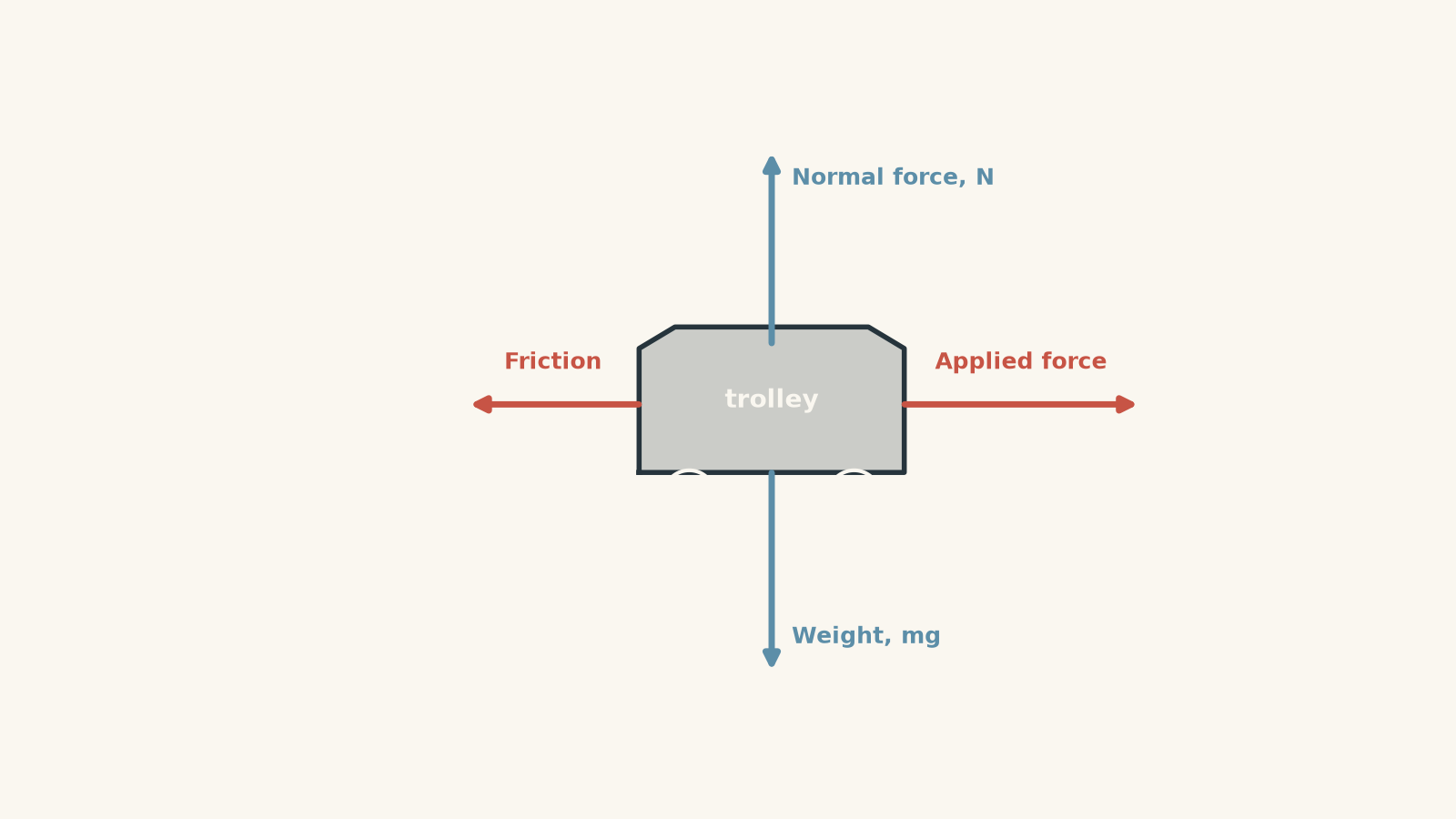
Suppose the forces are:
- applied force: 50 N to the right
- friction: 20 N to the left
- weight: 300 N downward
- normal force: 300 N upward
The vertical forces cancel:
\[
F_{\text{net},y} = 300 – 300 = 0
\]
The horizontal forces do not:
\[
F_{\text{net},x} = 50 – 20 = 30\text{ N}
\]
So the net force is 30 N to the right.
Notice what we did not do. We didn’t add the sizes of every force and call that the net force. Forces have direction, so opposite forces must be given opposite signs or treated as vectors.
Net force, not just “a force”
Newton’s second law is
\[
F_{\text{net}} = ma
\]
where:
- \(F_{\text{net}}\) is the net force on the object, measured in newtons (N)
- \(m\) is the object’s mass, measured in kilograms (kg)
- \(a\) is its acceleration, measured in metres per second squared (\(\text{m/s}^2\))
The equation uses the net force, meaning the vector sum of all forces acting on the object.
If a 10 kg trolley has a net force of 30 N to the right,
\[
a = \frac{F_{\text{net}}}{m}
= \frac{30}{10}
= 3.0\text{ m/s}^2
\]
So its acceleration is \(3.0\text{ m/s}^2\) to the right.
That does not mean its velocity is \(3.0\text{ m/s}\). Acceleration tells us how quickly velocity changes.
An acceleration of \(3.0\text{ m/s}^2\) means the trolley’s velocity changes by \(3.0\text{ m/s}\) every second, provided the acceleration stays constant.
02Why constant net force gives constant acceleration
Before reading on, predict this: a 4 kg object experiences a constant net force of 12 N to the right. After one second its acceleration is \(3\text{ m/s}^2\). What will its acceleration be after five seconds?
It is still
\[
a = \frac{12}{4} = 3\text{ m/s}^2
\]
The object may be moving much faster after five seconds, but its acceleration has not changed.
Why? Because for an object of constant mass,
\[
a = \frac{F_{\text{net}}}{m}
\]
If \(F_{\text{net}}\) and \(m\) stay constant, \(a\) must stay constant too.
This is the bridge to the kinematics equations.
The important condition: mass must also be constant
The simple statement “constant net force means constant acceleration” assumes mass is constant.
That is an excellent assumption for the ordinary cars, blocks, projectiles, and other objects used in most HSC mechanics problems.
It is not universally true. A rocket, for example, can lose substantial mass as it burns fuel. If its net force stayed constant while its mass decreased, \(a = F_{\text{net}}/m\) tells us that its acceleration would increase.
For the standard constant-mass situations in HSC Physics:
\[
\boxed{\text{constant net force} \Rightarrow \text{constant acceleration}}
\]
03From acceleration to kinematics
Once you know acceleration is constant, you can use the constant-acceleration equations.
The most common are
\[
v = u + at
\]
\[
s = ut + \frac{1}{2}at^2
\]
\[
v^2 = u^2 + 2as
\]
where:
- \(u\) is initial velocity in \(\text{m/s}\)
- \(v\) is final velocity in \(\text{m/s}\)
- \(a\) is constant acceleration in \(\text{m/s}^2\)
- \(t\) is time in seconds (s)
- \(s\) is displacement in metres (m)
There is a useful decision process here.
First use the forces to find acceleration:
\[
F_{\text{net}} = ma
\]
Then use the motion information to choose a kinematics equation.
Don’t start searching through kinematics formulas while the acceleration is still hidden inside a force diagram.
04Direction and signs
Suppose a car is moving east, but the net force acts west.
What happens?
Some students see “force west” and predict that the car immediately starts moving west. It doesn’t.
The westward force gives the car a westward acceleration. If the car initially has an eastward velocity, that acceleration first reduces its eastward speed.
Eventually, the car may stop. If the force continues after that, it will begin moving west.
A clean sign convention keeps this under control.
For example, choose east as positive:
- eastward velocity is positive
- eastward force is positive
- westward force is negative
- westward acceleration is negative
Then Newton’s second law and the kinematics equations handle the direction automatically.
A useful mental model
Think of velocity and acceleration as your current relationship status and the advice your friend keeps giving you.
Velocity tells you what is happening right now. Acceleration tells you how that situation is changing.
Your friend saying “move on” doesn’t mean you’re instantly in a new relationship. It means your current situation may change over time. Likewise, acceleration opposite to velocity does not instantly reverse motion. It changes the velocity gradually.
The analogy breaks because real relationships aren’t governed by neat linear equations, which is probably for the best.
05Worked example: accelerating from rest
A 6.0 kg cart starts from rest on a horizontal track. A constant 24 N force acts to the right, while a constant 6.0 N resistive force acts to the left. Find the cart’s acceleration and its velocity after 4.0 s.
Step 1
Choose right as positive.
\[
F_{\text{net}} = 24 – 6.0 = 18\text{ N}
\]
The net force is 18 N to the right.
Step 2
\[
F_{\text{net}} = ma
\]
so
\[
a = \frac{F_{\text{net}}}{m}
= \frac{18}{6.0}
= 3.0\text{ m/s}^2
\]
Because the mass and both horizontal forces are constant, the net force is constant. Therefore the acceleration is constant.
Step 3
The cart starts from rest, so \(u = 0\text{ m/s}\).
Using
\[
v = u + at
\]
we get
\[
v = 0 + (3.0)(4.0)
= 12\text{ m/s}
\]
The cart is moving at 12 m/s to the right after 4.0 s.
The important structure is:
\[
\text{forces} \rightarrow 18\text{ N} \rightarrow 3.0\text{ m/s}^2 \rightarrow 12\text{ m/s}
\]
06What a constant force does to velocity and displacement
Constant acceleration has two different effects on motion.
Velocity changes by equal amounts in equal time intervals:
\[
v = u + at
\]
So a velocity-time graph is a straight line.
Displacement is different. As the object gets faster, it covers more distance during each successive second. This produces the \(t^2\) term in
\[
s = ut + \frac{1}{2}at^2
\]
If an object starts from rest with constant acceleration, doubling the time does not merely double its displacement.
For \(u=0\),
\[
s = \frac{1}{2}at^2
\]
If time doubles from \(t\) to \(2t\),
\[
s_{\text{new}}
= \frac{1}{2}a(2t)^2
= 4\left(\frac{1}{2}at^2\right)
\]
So the displacement becomes four times as large.
That square relationship is easy to miss if you think of acceleration as “just getting a bit faster”.
07Worked example: braking force and stopping distance
A 900 kg car is travelling east at 20 m/s. The driver brakes, producing a constant net force of 4500 N west. Find the car’s acceleration, the time taken to stop, and the distance travelled before stopping.
Step 1
Let east be positive.
The initial velocity is therefore
\[
u = +20\text{ m/s}
\]
and the net force is
\[
F_{\text{net}} = -4500\text{ N}
\]
because it points west.
Step 2
Using
\[
F_{\text{net}} = ma
\]
we get
\[
a = \frac{F_{\text{net}}}{m}
= \frac{-4500}{900}
= -5.0\text{ m/s}^2
\]
The negative sign means the acceleration points west.
Step 3
At the instant the car stops,
\[
v = 0\text{ m/s}
\]
Using
\[
v = u + at
\]
gives
\[
0 = 20 + (-5.0)t
\]
so
\[
t = 4.0\text{ s}
\]
Step 4
Using
\[
s = ut + \frac{1}{2}at^2
\]
gives
\[
\begin{aligned}
s &= (20)(4.0) + \frac{1}{2}(-5.0)(4.0)^2 \\
&= 80 – 40 \\
&= 40\text{ m}
\end{aligned}
\]
The car travels 40 m east before stopping.
Notice that the acceleration was negative, but the displacement was positive. That is not a contradiction. The car was moving east while its eastward velocity was being reduced.
08The most tempting misconception: “constant force means constant velocity”
Suppose you push a box to the right with a constant force.
It is natural to picture it moving along at some steady speed. Everyday experience seems to support that. Push a heavy trolley steadily and it often seems to travel steadily.
But this mixes up two different situations.
If your applied force exactly balances friction,
\[
F_{\text{net}} = 0
\]
so
\[
a = 0
\]
and the trolley can move at constant velocity.
But if your applied force is larger than friction, there is a non-zero net force:
\[
F_{\text{net}} \ne 0
\]
so
\[
a \ne 0
\]
The velocity must change.
The correct rule is:
| Situation | Net force | Acceleration | Possible motion |
|---|---|---|---|
| Balanced forces | \(0\) | \(0\) | At rest or constant velocity |
| Constant non-zero net force | Constant and non-zero | Constant and non-zero | Velocity changes steadily |
| Changing net force | Changes | Usually changes | Requires more careful analysis |
A moving object does not need a net force to keep moving. It needs a net force to change its velocity.
That is Newton’s first law sitting underneath Newton’s second.
09Constant applied force does not always mean constant acceleration
Here is a more subtle trap.
Imagine a car whose engine provides a constant 4000 N driving force. Does it necessarily have constant acceleration?
No.
Suppose air resistance increases as the car speeds up.
At low speed:
\[
F_{\text{net}} = 4000 – 500 = 3500\text{ N}
\]
At a higher speed:
\[
F_{\text{net}} = 4000 – 2000 = 2000\text{ N}
\]
The engine force stayed constant, but the net force changed because the resistive force changed.
Therefore the acceleration changed too.
This distinction matters because the standard kinematics equations above assume constant acceleration.
So before using them, ask:
Is the net force constant, or have I only been told that one particular force is constant?
Those are not the same thing.
10Force diagrams on slopes
The same reasoning works when the forces are not already lined up with the motion.
Consider a block sliding down a slope. Its weight acts vertically downward, not directly down the slope.
To calculate acceleration along the slope, resolve the forces into components parallel and perpendicular to the surface.
For an incline at angle \(\theta\), the component of weight down the slope is
\[
F_{\parallel} = mg\sin\theta
\]
where \(m\) is mass, \(g\) is gravitational field strength, and \(\theta\) is the incline angle.
The perpendicular component is
\[
F_{\perp} = mg\cos\theta
\]
If there is no acceleration perpendicular to the slope, the normal force balances the perpendicular component of weight.
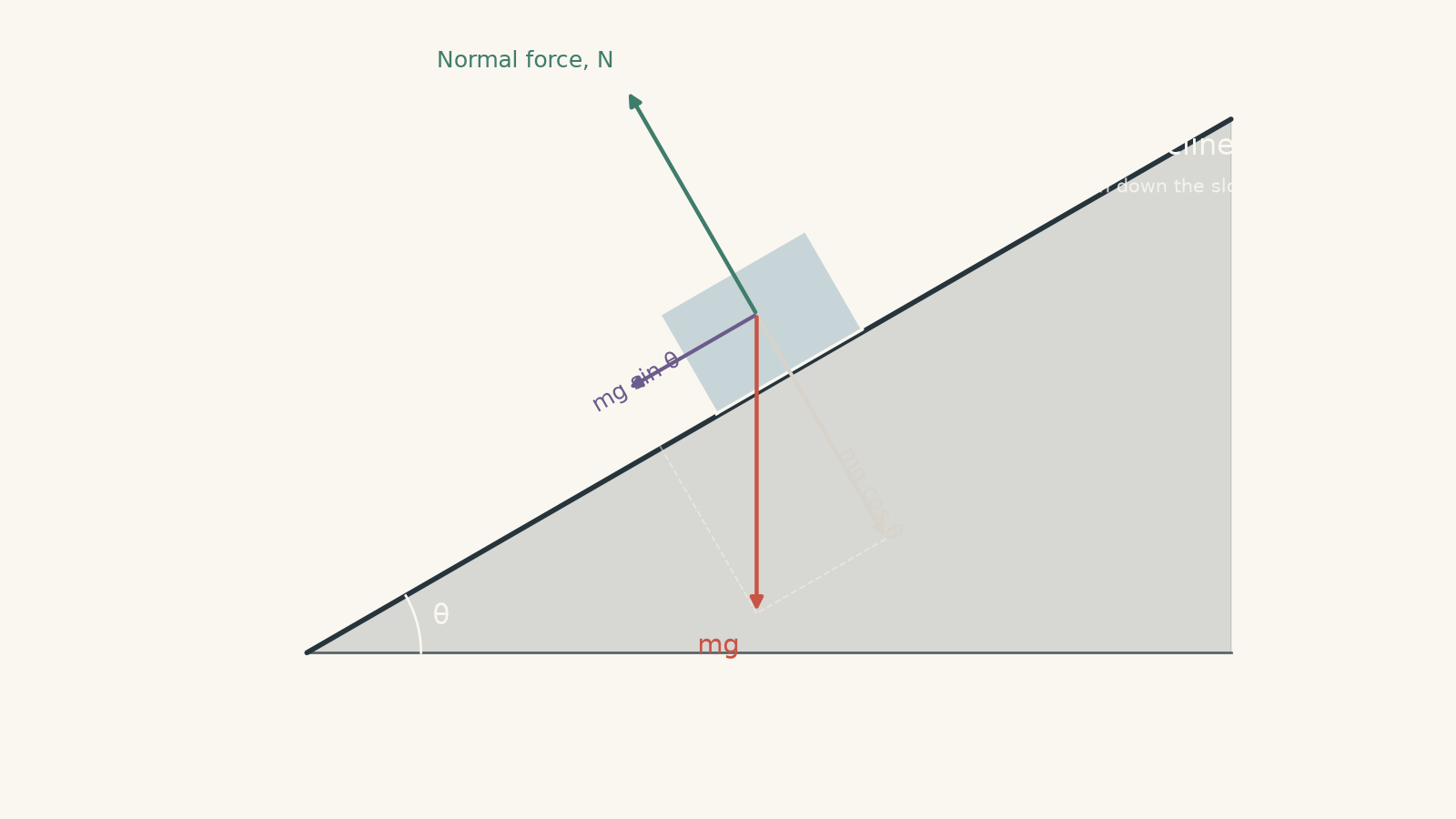
The important point is that Newton’s second law works separately along each axis.
You don’t feed the entire weight \(mg\) into the equation for motion down the slope. Only the component parallel to the slope contributes directly to acceleration along that direction.
11Worked example: constant acceleration down a slope
A 5.0 kg block slides down a \(30^\circ\) slope. A constant friction force of 7.0 N acts up the slope. Use \(g = 9.8\text{ m/s}^2\). The block starts from rest. Find its speed after travelling 4.0 m down the slope.
Step 1
\[
F_{\parallel} = mg\sin\theta
\]
so
\[
F_{\parallel}
= (5.0)(9.8)\sin 30^\circ
= 24.5\text{ N}
\]
Step 2
Take down the slope as positive.
\[
F_{\text{net}}
= 24.5 – 7.0
= 17.5\text{ N}
\]
Step 3
\[
a = \frac{F_{\text{net}}}{m}
= \frac{17.5}{5.0}
= 3.5\text{ m/s}^2
\]
The forces are constant, so the acceleration is constant.
Step 4
We know:
- \(u = 0\text{ m/s}\)
- \(a = 3.5\text{ m/s}^2\)
- \(s = 4.0\text{ m}\)
We want \(v\), and time is not given. So use
\[
v^2 = u^2 + 2as
\]
Substituting,
\[
\begin{aligned}
v^2 &= 0^2 + 2(3.5)(4.0) \\
&= 28 \\
v &= \sqrt{28} \\
&= 5.3\text{ m/s}
\end{aligned}
\]
The block is moving at 5.3 m/s down the slope after travelling 4.0 m.
This example shows why it is useful to separate the problem into two stages. The force analysis gives \(a\). The kinematics analysis then uses \(a\) to describe the motion.
12A reliable method for force-to-motion problems
When a question combines force diagrams with kinematics, work in this order:
- Choose a positive direction.
- Draw or interpret the force diagram.
- Resolve forces into components if necessary.
- Find the net force along the direction of motion.
- Use \(F_{\text{net}} = ma\) to find acceleration.
- Check whether that acceleration is constant.
- List the motion variables you know: \(u\), \(v\), \(a\), \(s\), and \(t\).
- Choose a constant-acceleration equation containing the required variable and the information you know.
- Keep the sign convention consistent all the way through.
- Interpret the sign and size of the final answer physically.
The order matters. A surprising number of errors come from jumping to a kinematics equation before the forces have been dealt with correctly.
13Questions and solutions
Question 1
A 4.0 kg box is pulled horizontally to the right by a constant 18 N force. Friction is 6.0 N to the left. The box begins at \(2.0\text{ m/s}\) to the right.
Find its acceleration and its velocity after 3.0 s.
Solution 1
The box accelerates at \(3.0\text{ m/s}^2\) to the right, and its velocity after 3.0 s is \(11\text{ m/s}\) to the right.
Take right as positive.
The net force is
\[
F_{\text{net}} = 18 – 6.0 = 12\text{ N}
\]
Using Newton’s second law,
\[
a = \frac{F_{\text{net}}}{m}
= \frac{12}{4.0}
= 3.0\text{ m/s}^2
\]
The forces are constant, so the acceleration is constant. We can therefore use
\[
v = u + at
\]
with \(u = 2.0\text{ m/s}\):
\[
\begin{aligned}
v &= 2.0 + (3.0)(3.0) \\
&= 11\text{ m/s}
\end{aligned}
\]
The box was already moving right, and its acceleration is also to the right, so it speeds up.
Question 2
A 1000 kg electric vehicle is travelling north at \(16\text{ m/s}\). A constant net braking force of 4000 N acts south for 2.5 s.
Find the vehicle’s velocity after 2.5 s, including direction.
Solution 2
The vehicle’s velocity is \(6.0\text{ m/s}\) north after 2.5 s.
Take north as positive. The initial velocity is
\[
u = +16\text{ m/s}
\]
and the net force is south, so
\[
F_{\text{net}} = -4000\text{ N}
\]
The acceleration is
\[
a = \frac{F_{\text{net}}}{m}
= \frac{-4000}{1000}
= -4.0\text{ m/s}^2
\]
Using
\[
v = u + at
\]
gives
\[
\begin{aligned}
v &= 16 + (-4.0)(2.5) \\
&= 6.0\text{ m/s}
\end{aligned}
\]
The answer is still positive, so the vehicle is still moving north.
The tempting mistake is to say that a southward acceleration means southward motion. It does not. Here, the southward acceleration is reducing a northward velocity.
Question 3
A 3.0 kg object is initially moving to the right at \(8.0\text{ m/s}\). It experiences a constant net force of 6.0 N to the left.
Find:
a. the time until it first comes to rest
b. its displacement from its starting position at that instant
c. its velocity 6.0 s after the force begins acting
Solution 3
The object first stops after 4.0 s, at a displacement of 16 m to the right, and after 6.0 s it is moving at \(4.0\text{ m/s}\) to the left.
Take right as positive. Then
\[
F_{\text{net}} = -6.0\text{ N}
\]
and
\[
a = \frac{-6.0}{3.0}
= -2.0\text{ m/s}^2
\]
For part a, the object first stops when \(v=0\):
\[
v = u + at
\]
so
\[
\begin{aligned}
0 &= 8.0 + (-2.0)t \\
t &= 4.0\text{ s}
\end{aligned}
\]
For part b,
\[
s = ut + \frac{1}{2}at^2
\]
so
\[
\begin{aligned}
s &= (8.0)(4.0) + \frac{1}{2}(-2.0)(4.0)^2 \\
&= 32 – 16 \\
&= 16\text{ m}
\end{aligned}
\]
The positive displacement means the stopping point is 16 m to the right of where the object began.
For part c, continue the same motion until \(t=6.0\text{ s}\):
\[
\begin{aligned}
v &= 8.0 + (-2.0)(6.0) \\
&= -4.0\text{ m/s}
\end{aligned}
\]
The negative velocity means the object has reversed direction and is now travelling at \(4.0\text{ m/s}\) to the left.
The key conceptual point is that the object does not stop permanently when its velocity reaches zero. The net force is still acting, so the acceleration is still leftward. The object therefore begins moving left.
Question 4
A student analyses a 2.0 kg cart. A motor pulls the cart to the right with a constant force of 10 N. The student writes:
\[
a = \frac{10}{2.0} = 5.0\text{ m/s}^2
\]
and then uses constant-acceleration kinematics to predict the cart’s motion.
During the experiment, however, the resistive force on the cart increases as its speed increases.
Explain why the student’s method is not generally valid, even though the motor force is constant. State what additional information would be required to calculate the cart’s motion accurately.
Solution 4
The student’s method is not generally valid because 10 N is the motor force, not necessarily the net force.
Newton’s second law requires
\[
F_{\text{net}} = ma
\]
The true horizontal net force is
\[
F_{\text{net}} = F_{\text{motor}} – F_{\text{resistance}}
\]
If the resistive force increases with speed, then \(F_{\text{net}}\) decreases as the cart speeds up. Therefore
\[
a = \frac{F_{\text{net}}}{m}
\]
also changes with time.
The constant-acceleration kinematics equations cannot then be applied across the whole motion using one value of \(a\).
To determine the motion accurately, we would need information about how the resistive force depends on speed, time, or position. For example, a relationship such as \(F_{\text{resistance}}(v)\) would allow the net force and acceleration to be determined as the speed changes.
The trap is treating “constant applied force” and “constant net force” as identical. They are only identical if the other relevant forces are constant or absent.
Question 5
A 10 kg block is initially moving up a \(20^\circ\) slope at \(5.0\text{ m/s}\). No driving force acts on it. A constant 8.0 N friction force opposes the block’s motion. Use \(g=9.8\text{ m/s}^2\).
A student argues:
“The force down the slope is constant, so the block has constant acceleration down the slope for its entire motion. We can use that same acceleration even after it turns around.”
Is the student correct? Determine the block’s acceleration while it is moving up the slope, and explain what changes after it reverses direction.
Solution 5
The student is correct only until the block reaches its highest point. The acceleration changes when the block reverses direction because friction reverses direction.
While the block is moving up the slope, both the component of gravity and friction act down the slope.
The component of weight down the slope is
\[
F_g = mg\sin\theta
\]
so
\[
\begin{aligned}
F_g &= (10)(9.8)\sin20^\circ \\
&\approx 33.5\text{ N}
\end{aligned}
\]
While the block moves upward, friction also acts down the slope with magnitude 8.0 N.
Therefore the total force down the slope is
\[
F_{\text{net}} = 33.5 + 8.0 = 41.5\text{ N}
\]
and the acceleration down the slope is
\[
a = \frac{41.5}{10}
= 4.15\text{ m/s}^2
\]
So while the block is moving upward, its acceleration is approximately
\[
\boxed{4.2\text{ m/s}^2\text{ down the slope}}
\]
At the instant the block stops, gravity still acts down the slope. If the block then begins sliding down the slope, friction must oppose that new direction of motion, so friction now acts up the slope.
The net force after reversal becomes
\[
F_{\text{net}} = 33.5 – 8.0 = 25.5\text{ N}
\]
down the slope, giving
\[
a = \frac{25.5}{10}
= 2.55\text{ m/s}^2
\]
So after reversal, the acceleration is approximately
\[
\boxed{2.6\text{ m/s}^2\text{ down the slope}}
\]
The force of gravity did not change, but friction did. That means the net force was not constant across the entire journey.
This is why you cannot automatically use one set of constant-acceleration equations from the start of the upward motion through to a later point on the way back down. The motion must be treated in separate stages.
14What this idea leads to next
The important link is now complete:
\[
\boxed{\text{force diagram} \rightarrow F_{\text{net}} \rightarrow a \rightarrow \text{motion}}
\]
A force diagram tells you how the object’s interactions combine. Newton’s second law turns that net force into acceleration. If the net force and mass remain constant, the acceleration is constant, which allows you to use the standard kinematics equations.
The next useful step is recognising situations where that chain becomes more complicated. On slopes, you may need force components. With drag, the net force may change with speed. In circular motion, acceleration can exist even when speed is constant because the direction of velocity is changing.
In every case, the same question comes first: what is the net force actually doing to the velocity?