
Why Lower-Frequency Sound Diffracts More: HSC Physics
Learn why lower-frequency sound bends around obstacles more noticeably by comparing wavelength with obstacle and opening size.
Stand around the corner from a speaker playing music. The high notes can become faint surprisingly quickly, but the bass often seems to follow you around the corner.
Before reading on, predict why. Is bass better at bending because low-frequency sound travels more slowly, because it has more energy, or because its wavelength is larger?
The important idea is wavelength. Lower-frequency sound has a longer wavelength, and diffraction becomes more noticeable when the wavelength is large compared with the obstacle or opening.
That one comparison, wavelength versus obstacle size, explains most HSC questions about the diffraction of sound.
01What does it mean for sound to “bend”?
Imagine straight water waves travelling towards a post sticking out of the water. After passing the post, the waves don’t leave a perfectly sharp, wave-free shadow. Some of the wave spreads into the region behind it.
Sound does the same thing.
Diffraction is the spreading of a wave as it passes an edge, travels around an obstacle, or passes through an opening.
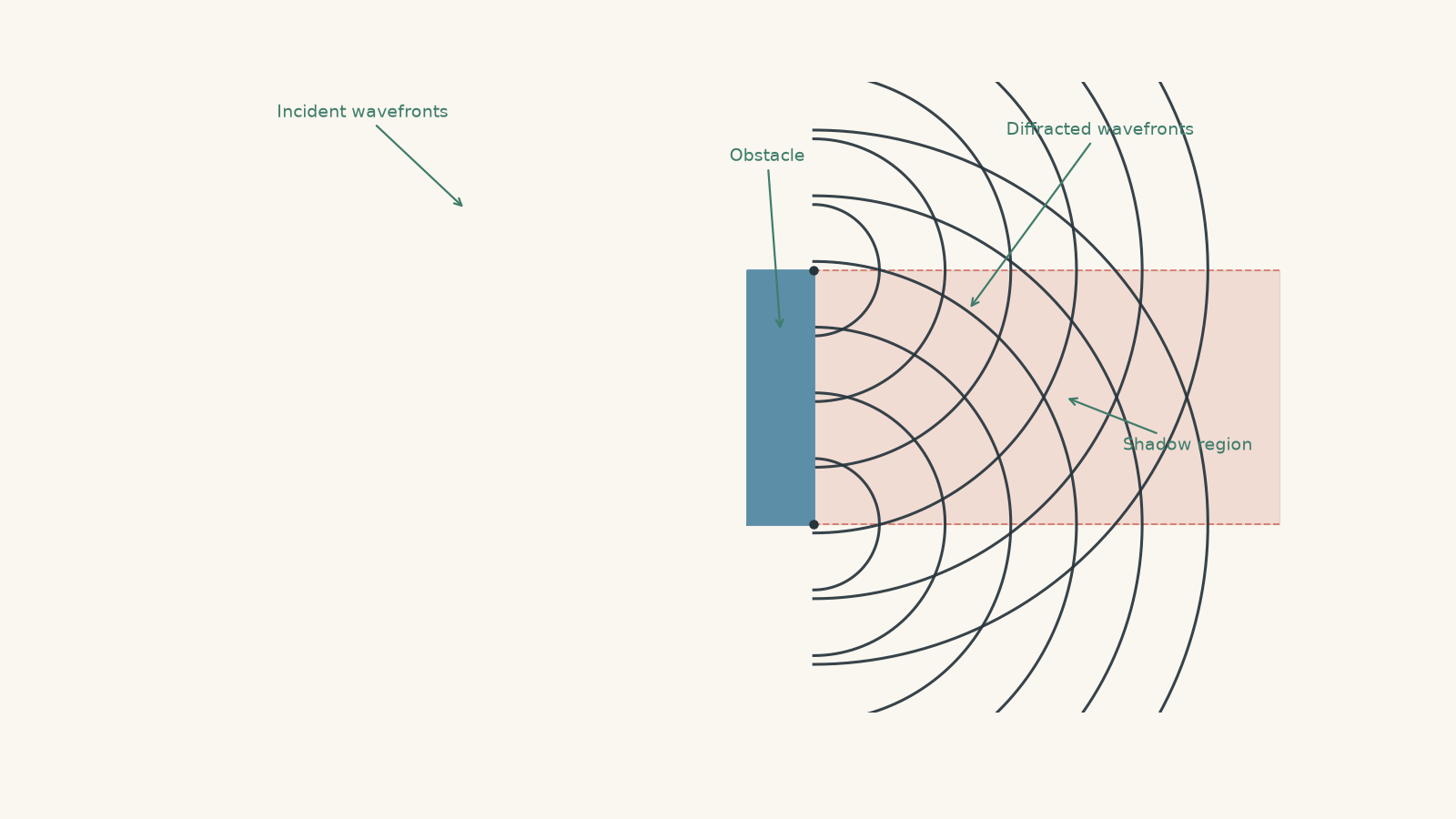
Calling this “bending” is useful, but don’t picture individual air molecules taking curved paths around the obstacle. Air molecules mainly oscillate back and forth around their equilibrium positions. It is the wave disturbance and its energy that spread into the region behind the obstacle.
That distinction matters.
02The size of the wavelength is the key
Suppose a sound wave reaches a one-metre-wide obstacle.
Now compare two wavelengths:
- one sound has a wavelength of \(2\text{ m}\)
- another has a wavelength of \(0.10\text{ m}\)
Which one would you expect to be more affected by the exact shape of a one-metre obstacle?
The short-wavelength wave can “resolve” the obstacle much more clearly. A one-metre object is ten wavelengths across for the \(0.10\text{ m}\) wave, so a relatively distinct sound shadow can form behind it.
For the \(2\text{ m}\) wave, the entire obstacle is only half a wavelength wide. The wave spreads strongly around its edges, so the shadow is much less distinct.
A useful rule is:
Diffraction is most noticeable when the wavelength is comparable to, or larger than, the relevant size of the obstacle or opening.
This is not an on-off rule. There is no exact wavelength at which diffraction suddenly begins. All waves can diffract. The amount of spreading changes gradually.
03Why lower frequency means a longer wavelength
For any travelling wave,
\[
v = f\lambda
\]
where:
- \(v\) is wave speed in metres per second, \(\text{m s}^{-1}\)
- \(f\) is frequency in hertz, \(\text{Hz}\)
- \(\lambda\) is wavelength in metres, \(\text{m}\)
Rearranging,
\[
\lambda = \frac{v}{f}
\]
In the same conditions, different audible frequencies travel through air at approximately the same speed. Using \(340\text{ m s}^{-1}\) as a convenient approximate speed:
| Frequency | Approximate wavelength |
|---|---|
| \(100\text{ Hz}\) | \(3.4\text{ m}\) |
| \(500\text{ Hz}\) | \(0.68\text{ m}\) |
| \(1000\text{ Hz}\) | \(0.34\text{ m}\) |
| \(5000\text{ Hz}\) | \(0.068\text{ m}\) |
So lowering the frequency makes the wavelength longer.
That is why bass notes, which have relatively low frequencies, can diffract strongly around metre-sized objects such as walls, pillars, doorways, and even a person’s body.
High-frequency sounds have much shorter wavelengths. Those same objects are many wavelengths across, so the region behind them can have a much sharper sound shadow.
04A useful way to compare an obstacle with a wave
Instead of asking only, “Is this a low frequency?”, compare the wavelength with the obstacle size.
Suppose \(D\) is the relevant width of an obstacle. The ratio
\[
\frac{\lambda}{D}
\]
is useful for thinking about diffraction.
If \(\lambda/D\) is large, diffraction tends to be more noticeable.
If \(\lambda/D\) is small, a more distinct geometrical shadow can form.
This comparison is more powerful than simply memorising “low frequencies diffract more”, because frequency by itself is not enough. The size of the obstacle matters too.
A \(500\text{ Hz}\) sound might diffract strongly around a thin pole but much less strongly around a huge building.
05Worked example: Which tone bends around a barrier more?
A \(170\text{ Hz}\) tone and a \(1700\text{ Hz}\) tone travel through air at \(340\text{ m s}^{-1}\). Both reach a barrier about \(1.0\text{ m}\) wide. Which sound should show more noticeable diffraction?
Step 1
Using \(\lambda = v/f\),
\[
\lambda
= \frac{340}{170}
= 2.0\text{ m}
\]
So the lower-frequency sound has a wavelength of \(2.0\text{ m}\).
Step 2
\[
\lambda
= \frac{340}{1700}
= 0.20\text{ m}
\]
So the higher-frequency sound has a wavelength of \(0.20\text{ m}\).
Step 3
For \(170\text{ Hz}\),
\[
\frac{\lambda}{D}
= \frac{2.0}{1.0}
= 2.0
\]
For \(1700\text{ Hz}\),
\[
\frac{\lambda}{D}
= \frac{0.20}{1.0}
= 0.20
\]
The \(170\text{ Hz}\) sound has a wavelength larger than the obstacle and will diffract much more noticeably.
The result explains why lower-frequency sound is often still heard clearly after moving behind an obstacle while higher-frequency sound drops away more sharply.
06What is happening at the edge?
There is another useful way to picture diffraction.
According to the wavefront model, points along a wavefront can be treated as sources of new wavelets. In an unobstructed wave, these contributions combine to produce the normal advancing wavefront.
Put an obstacle in the way, and part of that wavefront disappears. Near the edges, the remaining wavelets spread into the region that geometrical straight-line propagation would call the shadow.
This model helps explain why sound reaches behind an obstacle at all.
With a long wavelength, the spreading associated with the edge occupies a larger scale compared with the obstacle. With a very short wavelength, the obstacle can be many wavelengths across, leaving a much more obvious central shadow.
The water-wave picture is useful here, but it has a limit. Water surface waves involve the motion of a surface, while sound in air is a longitudinal pressure wave travelling through a three-dimensional medium. The common feature is the behaviour of waves, not identical motion of the particles.
07Openings behave in the same wavelength-dependent way
Diffraction also occurs when sound travels through a doorway or other opening.
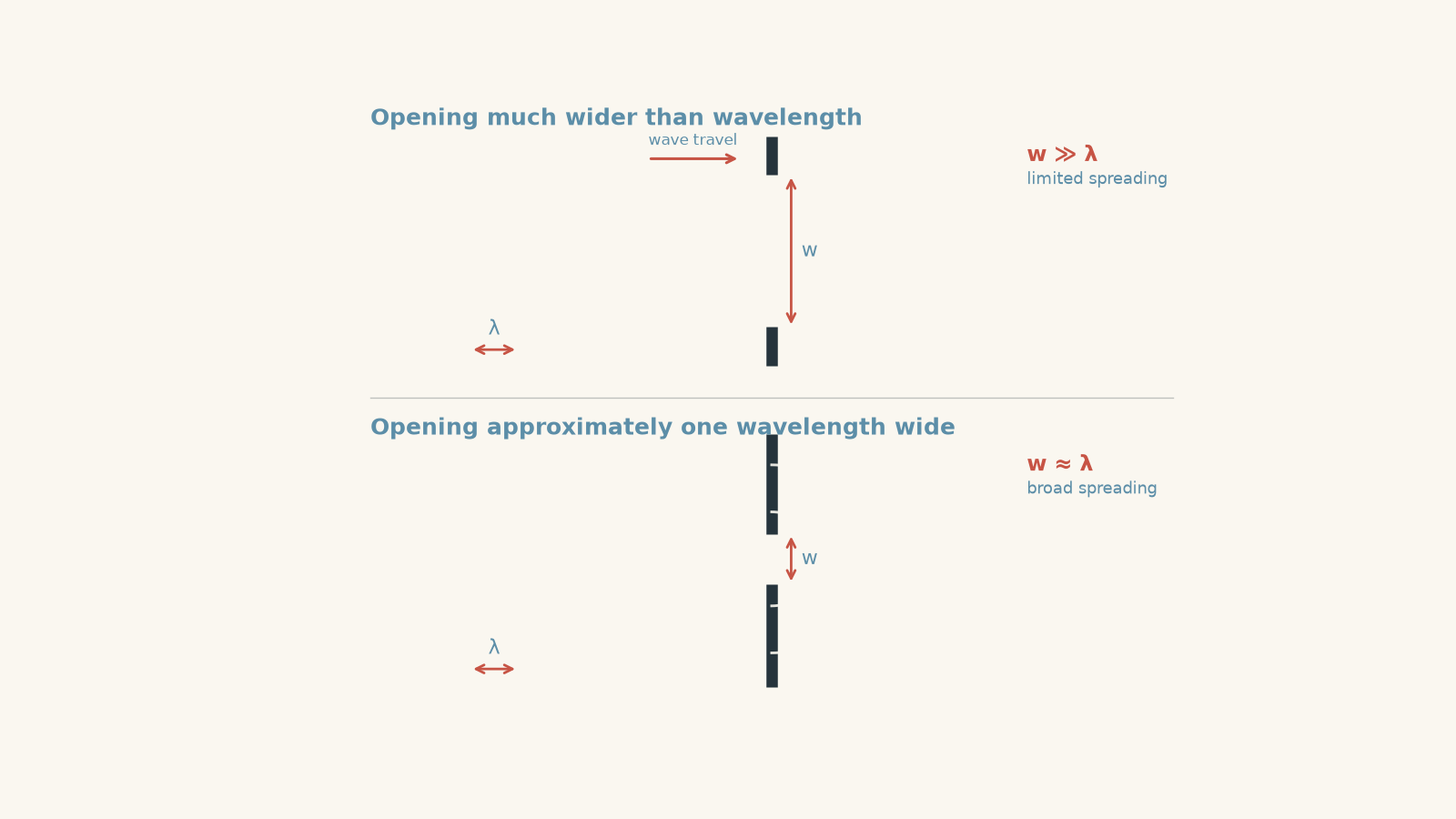
Imagine a wide doorway. If the opening is much wider than the wavelength, most of the wave continues roughly forwards, with noticeable spreading mainly near the edges.
Now shrink the doorway until its width is comparable to the wavelength. The wave leaving the doorway spreads through a much larger range of directions.
This gives another form of the same rule:
The smaller an opening is compared with the wavelength, the greater the diffraction after the opening.
Again, “smaller” means relative to the wavelength, not simply small in metres.
08Worked example: What frequency has a wavelength similar to a doorway?
A doorway is \(0.85\text{ m}\) wide. Estimate the sound frequency whose wavelength in air is equal to the doorway width. Take the speed of sound as \(340\text{ m s}^{-1}\).
Step 1
We are using the doorway width as a useful comparison scale, so
\[
\lambda = 0.85\text{ m}
\]
Step 2
From
\[
v=f\lambda
\]
we obtain
\[
f=\frac{v}{\lambda}
\]
Step 3
\[
f
= \frac{340\text{ m s}^{-1}}{0.85\text{ m}}
= 400\text{ Hz}
\]
So a \(400\text{ Hz}\) sound has a wavelength of about \(0.85\text{ m}\).
Sounds substantially below \(400\text{ Hz}\) have even longer wavelengths, so this doorway is relatively narrow compared with their wavelengths and strong spreading is expected.
Sounds far above \(400\text{ Hz}\) have shorter wavelengths, so the same doorway is relatively wide and the sound travels through more directionally.
The \(400\text{ Hz}\) value is not a cutoff frequency. Nothing suddenly changes at exactly \(400\text{ Hz}\). It is simply a useful scale for comparing wavelength with opening width.
09The tempting misconception: bass diffracts because it moves more slowly
A student might reason like this:
“Low-frequency sound takes longer to oscillate, so maybe it travels more slowly and therefore has more time to bend around the wall.”
It sounds plausible, but it mixes up frequency with wave speed.
For ordinary sound waves travelling through the same air under the same conditions, frequency changes very little about their propagation speed. A \(200\text{ Hz}\) tone and a \(2000\text{ Hz}\) tone both travel at approximately the speed of sound.
What changes strongly is wavelength.
At \(340\text{ m s}^{-1}\),
\[
\lambda_{200}
= \frac{340}{200}
= 1.7\text{ m}
\]
while
\[
\lambda_{2000}
= \frac{340}{2000}
= 0.17\text{ m}
\]
The lower-frequency sound diffracts more noticeably because its wavelength is ten times larger, not because it is travelling more slowly.
10A second trap: “low frequency always diffracts more”
That statement needs one missing phrase:
around the same obstacle, in the same medium.
Consider a \(200\text{ Hz}\) sound trying to pass a four-metre-wide structure and an \(800\text{ Hz}\) sound passing a thin \(0.20\text{ m}\) post.
The \(200\text{ Hz}\) sound has the longer wavelength, but the obstacle is also much larger.
So don’t compare frequencies in isolation. Compare
\[
\text{wavelength} \quad \text{with} \quad \text{obstacle or opening size}.
\]
This is the reasoning HSC questions often test.
11Diffraction is not the only reason bass can be heard
Real rooms are messy.
If you hear low-frequency music from another room, several effects may contribute:
- diffraction around doorways and corners
- reflection from walls and ceilings
- transmission through walls
- absorption that depends on frequency
So “I can hear the bass through the wall” is not, by itself, proof of diffraction.
A cleaner diffraction example is sound reaching you around an open corner or behind an obstacle, where the wave has travelled into a region that would otherwise be a geometrical shadow.
12Questions and solutions
Question 1
A \(250\text{ Hz}\) sound travels through air at \(340\text{ m s}^{-1}\). Calculate its wavelength. Would a \(0.50\text{ m}\) wide post be expected to produce a strong, sharply defined sound shadow?
Solution 1
The wavelength is \(1.36\text{ m}\), so the \(0.50\text{ m}\) post should not produce a very sharp sound shadow because the wavelength is larger than the obstacle.
Use
\[
\lambda=\frac{v}{f}
\]
and substitute:
\[
\lambda
= \frac{340\text{ m s}^{-1}}{250\text{ Hz}}
= 1.36\text{ m}
\]
The comparison is
\[
\frac{\lambda}{D}
= \frac{1.36}{0.50}
= 2.72
\]
The wavelength is about 2.7 times the width of the post. Significant diffraction around the post is therefore expected.
The important reasoning is not simply that \(250\text{ Hz}\) is a “low” frequency. It is that its \(1.36\text{ m}\) wavelength is large compared with this particular obstacle.
Question 2
A \(680\text{ Hz}\) tone and a \(170\text{ Hz}\) tone reach the same \(1.0\text{ m}\) wide obstacle. The speed of sound is \(340\text{ m s}^{-1}\).
Calculate the wavelength of each tone and identify which should be heard more strongly in the geometrical shadow behind the obstacle.
Solution 2
The \(170\text{ Hz}\) tone should be heard more strongly in the shadow because its wavelength is much larger relative to the obstacle.
For \(680\text{ Hz}\),
\[
\lambda
= \frac{340}{680}
= 0.50\text{ m}
\]
For \(170\text{ Hz}\),
\[
\lambda
= \frac{340}{170}
= 2.0\text{ m}
\]
The \(1.0\text{ m}\) obstacle is twice the wavelength of the \(680\text{ Hz}\) tone, but only half the wavelength of the \(170\text{ Hz}\) tone.
The longer-wavelength \(170\text{ Hz}\) wave therefore spreads more substantially around the obstacle’s edges and into the shadow region.
A common mistake is to say that the \(170\text{ Hz}\) tone gets around the obstacle because it travels more slowly. Both tones are travelling through the same air at approximately \(340\text{ m s}^{-1}\). Their wavelengths are different.
Question 3
A corridor opens through a \(1.7\text{ m}\) wide doorway. Estimate the frequency for which the wavelength of sound is equal to the doorway width. Take the speed of sound as \(340\text{ m s}^{-1}\).
Would you describe this frequency as the point below which diffraction occurs and above which diffraction stops?
Solution 3
The comparison frequency is \(200\text{ Hz}\), but it is not a cutoff. Diffraction occurs on both sides of this frequency.
Using
\[
f=\frac{v}{\lambda}
\]
with \(\lambda=1.7\text{ m}\),
\[
f
= \frac{340\text{ m s}^{-1}}{1.7\text{ m}}
= 200\text{ Hz}
\]
At \(200\text{ Hz}\), the wavelength is equal to the doorway width, so substantial spreading is expected.
Below \(200\text{ Hz}\), the wavelength is even larger relative to the doorway, so diffraction generally becomes more pronounced.
Above \(200\text{ Hz}\), the wavelength becomes shorter relative to the doorway, so the sound generally becomes more directional.
However, diffraction does not switch off above \(200\text{ Hz}\). The mistake would be treating the wavelength-equals-opening-width comparison as a strict boundary rather than a useful scale.
Question 4
A student says:
“The speed of sound is \(340\text{ m s}^{-1}\). If a \(100\text{ Hz}\) sound diffracts around a wall more than a \(1000\text{ Hz}\) sound, the \(100\text{ Hz}\) wave must slow down as it bends.”
Evaluate this claim using the wave equation.
Solution 4
The claim is incorrect. Greater diffraction does not require the \(100\text{ Hz}\) wave to slow down.
In the same air, both frequencies travel at approximately the same speed. Using
\[
\lambda=\frac{v}{f},
\]
the \(100\text{ Hz}\) wavelength is
\[
\lambda
= \frac{340}{100}
= 3.4\text{ m}
\]
and the \(1000\text{ Hz}\) wavelength is
\[
\lambda
= \frac{340}{1000}
= 0.34\text{ m}
\]
The low-frequency sound therefore has a wavelength ten times larger.
Its stronger diffraction around the wall comes from this larger wavelength compared with the dimensions of the wall or edge, not from a reduction in propagation speed.
The word “bend” can cause the misconception. It describes the spreading of the wave pattern into the shadow region. It does not mean a sound wave has to slow down to turn a corner.
Question 5
Two diffraction experiments are performed in air at \(340\text{ m s}^{-1}\).
In experiment A, a \(200\text{ Hz}\) sound encounters an obstacle \(4.0\text{ m}\) wide.
In experiment B, an \(800\text{ Hz}\) sound encounters an obstacle \(0.50\text{ m}\) wide.
A student argues that experiment A must show stronger diffraction because \(200\text{ Hz}\) is the lower frequency.
Use wavelength-to-obstacle comparisons to assess the student’s reasoning.
Solution 5
Experiment B can show more noticeable diffraction even though it uses the higher frequency, because its obstacle is much smaller relative to the wavelength.
For experiment A,
\[
\lambda_A
= \frac{340}{200}
= 1.7\text{ m}
\]
so
\[
\frac{\lambda_A}{D_A}
= \frac{1.7}{4.0}
= 0.425
\]
For experiment B,
\[
\lambda_B
= \frac{340}{800}
= 0.425\text{ m}
\]
so
\[
\frac{\lambda_B}{D_B}
= \frac{0.425}{0.50}
= 0.85
\]
The wavelength is a larger fraction of the obstacle size in experiment B:
\[
0.85 > 0.425
\]
so experiment B has the more favourable wavelength-to-obstacle ratio for noticeable diffraction.
The student’s rule, “lower frequency means more diffraction”, quietly assumes the obstacle is unchanged. Once obstacle size changes as well, frequency alone is not enough.
Question 6
Two geometrically similar experimental setups are built. Every length in setup B, including the obstacle width and the distance from the obstacle to the detector, is twice the corresponding length in setup A.
Setup A uses sound of frequency \(800\text{ Hz}\). Both experiments use air with the same sound speed.
What frequency should be used in setup B if the diffraction pattern is to have the same shape relative to the scaled-up apparatus? Explain your reasoning.
Solution 6
Setup B should use \(400\text{ Hz}\), because doubling every geometrical length requires doubling the wavelength to keep the same wavelength-to-size ratios.
For setup A,
\[
\lambda_A
= \frac{340}{800}
= 0.425\text{ m}
\]
Every physical dimension in setup B is twice as large, so for a geometrically similar diffraction pattern the wavelength should also double:
\[
\lambda_B
= 2(0.425)
= 0.850\text{ m}
\]
Using
\[
f=\frac{v}{\lambda},
\]
\[
f_B
= \frac{340\text{ m s}^{-1}}{0.850\text{ m}}
= 400\text{ Hz}
\]
The key is that diffraction depends on relative scale. Setup B has a lower frequency, but that is not the deepest reason the patterns match. The wavelength and every relevant length have been increased by the same factor, so ratios such as \(\lambda/D\) remain unchanged.
This is the more precise version of the rule “lower-frequency sound diffracts more”: lower frequency produces a longer wavelength, and it is the wavelength compared with the size of the obstacle or opening that controls how noticeable the diffraction is.
That same wavelength-to-size idea is the bridge to the next wave behaviour worth studying. Once waves from different parts of a diffracted wavefront overlap, their phase differences determine whether they reinforce or cancel. That takes you directly into interference.