
Dispersion of Light: Wavelength-Dependent Refraction
Learn why white light separates into colours when it passes through a prism, and how wavelength-dependent refractive index changes each ray's path.
A rectangular glass window and a triangular glass prism can be made from the same material. Shine white light through the window and you usually still see white light. Shine it through the prism and you can get a spread of colours.
So what is the prism doing that the window is not?
Before reading on, make a prediction. If every colour travels through the same glass, should every colour refract through the same angle?
They don’t. The refractive index of glass is slightly different for different wavelengths. That small difference in refraction is dispersion, and a prism’s geometry turns it into an obvious separation of colours.
01What actually separates the colours?
Start with ordinary refraction.
Imagine a shopping trolley rolling from smooth concrete onto thick carpet at an angle. One wheel reaches the carpet first and slows first, so the trolley turns. Light does something geometrically similar when its speed changes as it crosses a boundary at an angle.
The analogy has limits. Glass doesn’t slow light through friction, and a light wave doesn’t have wheels. The useful part is simply this: a change in wave speed at a boundary can change the direction of travel.
Now add one extra fact. Different wavelengths of light do not all travel through glass at exactly the same speed.
For common glass in the visible range:
- violet light has a shorter wavelength and usually a slightly larger refractive index
- red light has a longer wavelength and usually a slightly smaller refractive index
- a larger refractive index means a lower speed in the material
- when entering glass from air at the same angle, the colour with the larger refractive index bends more towards the normal
So a white beam does not behave like one single ray inside the glass. Its different wavelength components take slightly different paths.
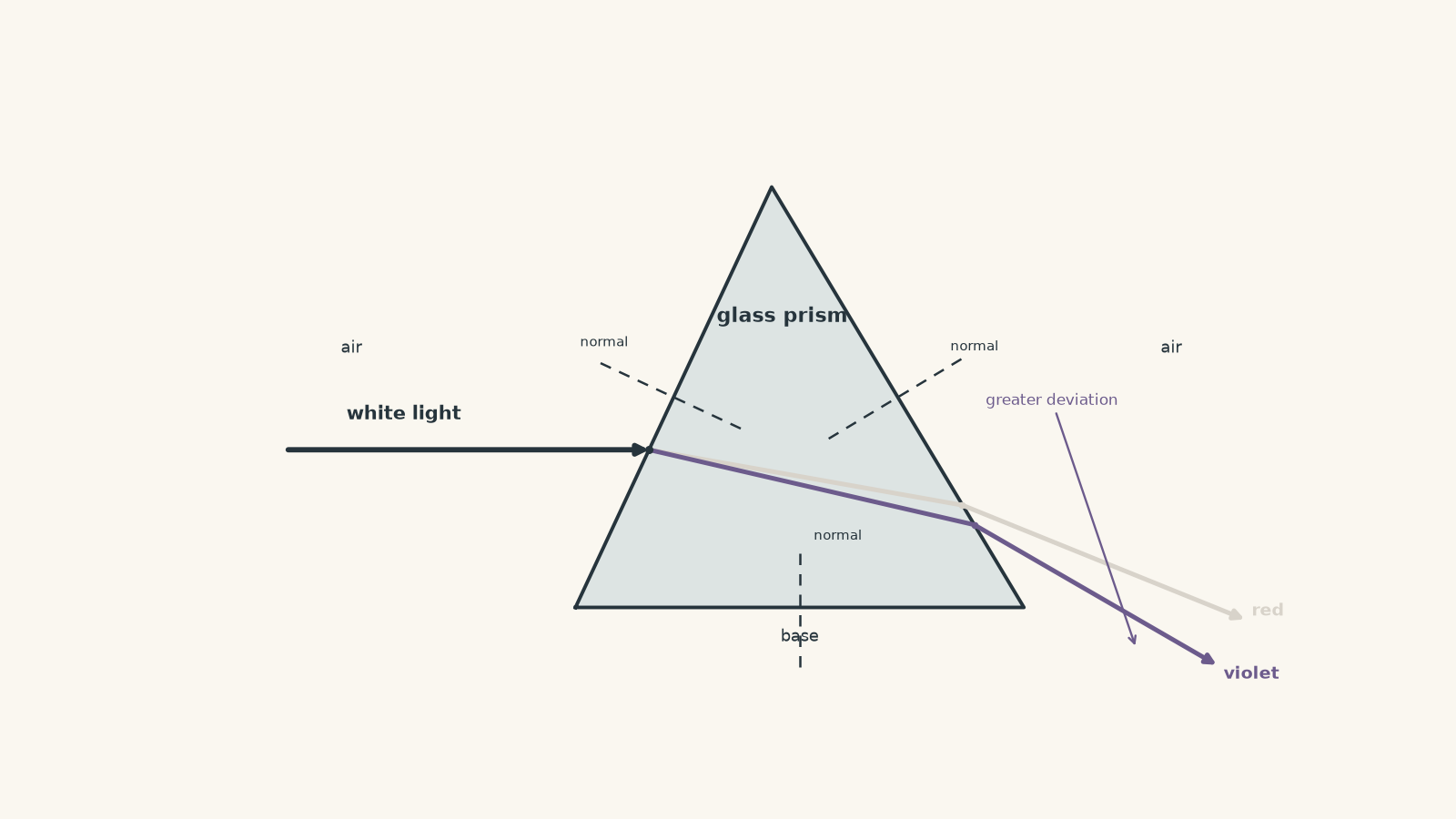
The key prediction
Suppose red and violet light strike a glass surface at the same angle. The glass has a larger refractive index for violet than for red.
Which ray should end up closer to the normal inside the glass?
Violet.
It slows more, in the sense that its wave speed in the material is lower, so Snell’s law gives it the smaller refracted angle. That means it has bent further towards the normal.
This is the basic mechanism behind dispersion.
02From the picture to the equations
The refractive index \(n\) of a material is related to the speed of light in that material:
\[
n = \frac{c}{v}
\]
where:
- \(n\) is the refractive index, with no units
- \(c\) is the speed of light in vacuum, approximately \(3.00 \times 10^8\ \text{m s}^{-1}\)
- \(v\) is the speed of light in the material, in \(\text{m s}^{-1}\)
If two colours have different refractive indices in the same glass, they therefore have different speeds in that glass.
Refraction is described by Snell’s law:
\[
n_1\sin\theta_1 = n_2\sin\theta_2
\]
Here, \(n_1\) and \(n_2\) are the refractive indices on each side of the boundary, and \(\theta_1\) and \(\theta_2\) are measured from the normal, not from the surface.
For dispersion, it is useful to make the wavelength dependence explicit:
\[
n_1\sin\theta_1 = n_2(\lambda)\sin\theta_2
\]
The notation \(n_2(\lambda)\) means that the refractive index depends on wavelength.
For the same incident angle, a larger value of \(n_2\) produces a smaller value of \(\theta_2\). The ray therefore bends further towards the normal.
Worked example: How far apart do red and violet rays bend?
White light travelling in air strikes a glass surface at \(50.0^\circ\) to the normal. The refractive index of the glass is \(1.510\) for red light and \(1.530\) for violet light. Calculate the refracted angle of each colour and their angular separation inside the glass. Take the refractive index of air as \(1.000\).
Step 1
For red light:
\[
n_{\text{air}}\sin\theta_i = n_{\text{red}}\sin\theta_{\text{red}}
\]
so
\[
\sin\theta_{\text{red}}
= \frac{1.000\sin50.0^\circ}{1.510}
\]
Step 2
\[
\theta_{\text{red}}
= \sin^{-1}\left(\frac{\sin50.0^\circ}{1.510}\right)
= 30.5^\circ
\]
Step 3
\[
\sin\theta_{\text{violet}}
= \frac{1.000\sin50.0^\circ}{1.530}
\]
\[
\theta_{\text{violet}}
= \sin^{-1}\left(\frac{\sin50.0^\circ}{1.530}\right)
= 30.0^\circ
\]
Step 4
\[
\Delta\theta = 30.5^\circ – 30.0^\circ = 0.5^\circ
\]
More precisely, the separation is about \(0.44^\circ\).
The violet ray is closer to the normal, so it has refracted more strongly. The angle difference looks tiny, but after the rays travel some distance, that small angular difference can produce a visible separation.
03What happens to frequency and wavelength?
This is where a common misconception appears.
A student might reason:
“If light’s wavelength changes in glass, its colour must change.”
That sounds reasonable because we often identify colours by wavelength. But when light crosses from air into glass, its frequency remains unchanged.
The wave equation is
\[
v = f\lambda
\]
where \(v\) is wave speed, \(f\) is frequency, and \(\lambda\) is wavelength.
At the boundary, the frequency is fixed by the source. If the speed decreases, the wavelength must decrease as well.
Using \(v=c/n\),
\[
\lambda_{\text{material}} = \frac{\lambda_0}{n}
\]
where \(\lambda_0\) is the wavelength in vacuum.
So blue light might have a shorter wavelength inside glass than it had in air, but its frequency has not suddenly become a different visible colour. When it returns to air, its speed and wavelength return to their air values.
A useful rule is:
| Quantity | Crossing from air into glass |
|---|---|
| Frequency \(f\) | unchanged |
| Speed \(v\) | decreases |
| Wavelength \(\lambda\) | decreases |
| Direction | usually changes if incidence is not normal |
| Refractive index \(n\) | depends slightly on wavelength |
04Why does refractive index depend on wavelength?
Saying “different colours travel at different speeds” describes what happens, but it does not yet explain why.
Light is an electromagnetic wave. Its electric field interacts with charged particles in the material, particularly bound electrons. Those charges respond to the oscillating field, and their response affects how the combined electromagnetic wave propagates through the material.
The response depends on frequency. Because different colours have different frequencies, the resulting wave speed can also be different.
That gives a frequency-dependent, or equivalently wavelength-dependent, refractive index.
For many transparent materials across the visible spectrum, shorter wavelengths have larger refractive indices. This behaviour is called normal dispersion. It is why violet light usually refracts more strongly than red light in an ordinary glass prism.
Do not replace this with the story that photons are repeatedly absorbed, stopped, and re-emitted by each atom. That picture can produce misleading ideas about random delays and changing directions. Refraction is better understood as the behaviour of an electromagnetic wave interacting with the material as a whole.
05Why a prism gives a spectrum but a window usually does not
We can now return to the opening puzzle.
A rectangular glass slab has two parallel faces. A prism does not.
That geometric difference matters.
Through a parallel-sided slab
Suppose white light enters a glass slab obliquely.
At the first surface, violet bends more towards the normal than red. The colours begin to separate inside the glass.
At the second surface, each colour travels from glass back into air. It bends away from the normal.
Because the two surfaces are parallel, Snell’s law makes each outgoing colour parallel to its original incoming direction.
For one particular wavelength:
\[
n_{\text{air}}\sin i = n_{\text{glass}}\sin r
\]
and at the second surface:
\[
n_{\text{glass}}\sin r = n_{\text{air}}\sin e
\]
Therefore,
\[
\sin i = \sin e
\]
and, for the ordinary angles involved here,
\[
e=i
\]
So an ideal parallel-sided slab does not produce a fan of colours leaving at different angles. Different wavelengths can have slightly different sideways displacements, but their outgoing directions are parallel to the original incident beam.
Through a prism
A prism’s second surface is tilted relative to its first.
The bending at the second face therefore does not simply undo the angular change at the first face. Instead, the wavelength-dependent differences accumulate into different overall deviations.
For ordinary glass, violet is deviated more than red.
This is why the shape of the glass matters just as much as the fact that its refractive index varies with wavelength.
Worked example: Find the red-violet separation after a prism
A prism has an apex angle of \(60.0^\circ\). White light enters from air at an incident angle of \(50.0^\circ\) to the normal at the first face. The refractive indices are \(1.510\) for red light and \(1.530\) for violet light. Calculate the total deviation of each colour and hence their angular separation after leaving the prism.
For a prism, if the internal angles to the normals are \(r_1\) and \(r_2\), then
\[
r_1+r_2=A
\]
where \(A\) is the prism’s apex angle.
The total deviation is
\[
\delta=i+e-A
\]
where \(i\) is the first incident angle and \(e\) is the final emergence angle.
Step 1
Using Snell’s law:
\[
1.000\sin50.0^\circ = 1.510\sin r_{1,\text{red}}
\]
\[
r_{1,\text{red}}
= \sin^{-1}\left(\frac{\sin50.0^\circ}{1.510}\right)
= 30.49^\circ
\]
Step 2
\[
r_{2,\text{red}}
=60.0^\circ-30.49^\circ
=29.51^\circ
\]
Step 3
At the glass-air boundary:
\[
1.510\sin29.51^\circ
=1.000\sin e_{\text{red}}
\]
so
\[
e_{\text{red}}
=\sin^{-1}(1.510\sin29.51^\circ)
=48.06^\circ
\]
The red ray’s total deviation is therefore
\[
\delta_{\text{red}}
=50.0^\circ+48.06^\circ-60.0^\circ
=38.06^\circ
\]
Step 4
At the first surface:
\[
r_{1,\text{violet}}
=\sin^{-1}\left(\frac{\sin50.0^\circ}{1.530}\right)
=30.05^\circ
\]
At the second surface:
\[
r_{2,\text{violet}}
=60.0^\circ-30.05^\circ
=29.95^\circ
\]
At emergence:
\[
e_{\text{violet}}
=\sin^{-1}(1.530\sin29.95^\circ)
=49.81^\circ
\]
Therefore,
\[
\delta_{\text{violet}}
=50.0^\circ+49.81^\circ-60.0^\circ
=39.81^\circ
\]
Step 5
\[
\Delta\delta
=39.81^\circ-38.06^\circ
=1.75^\circ
\]
The violet light leaves the prism deviated about \(1.75^\circ\) further than the red light.
Notice what the prism has done. At the first face in the earlier example, the red-violet difference was less than half a degree. After refraction at both non-parallel faces, the difference in overall direction is much easier to observe.
06The most tempting dispersion mistakes
A few short decision rules prevent most errors.
| Tempting idea | Better rule |
|---|---|
| “Violet bends more because violet is always special.” | Compare the refractive indices. For ordinary glass, \(n_{\text{violet}}>n_{\text{red}}\), so violet bends more. |
| “A larger refracted angle means more bending.” | Angles are measured from the normal. Entering a higher-\(n\) material, more bending towards the normal means a smaller refracted angle. |
| “The colour changes because its wavelength changes in glass.” | Frequency stays constant at the boundary. Speed and wavelength change. |
| “Any piece of glass should produce a rainbow.” | Wavelength-dependent refraction is required, but the geometry must also leave the colours travelling in different directions. |
| “If light enters normally, dispersion stops existing.” | At normal incidence there is no angular bending at that surface, but the material can still have different refractive indices and speeds for different wavelengths. |
| “Red is always refracted less in every possible material.” | Use the actual \(n(\lambda)\) relationship given. The familiar ordering is typical of normal dispersion, not a rule that overrides the data. |
One especially important habit is to separate two questions:
- Does the material have wavelength-dependent refractive index?
- Does the geometry turn that difference into angular separation?
A prism answers yes to both. A parallel glass slab answers yes to the first but, ideally, no to the second for the final outgoing direction.
07Questions and solutions
Question 1
Red and violet light enter a piece of ordinary glass from air at the same non-zero incident angle. The glass has \(n_{\text{red}}=1.50\) and \(n_{\text{violet}}=1.53\).
Which colour travels closer to the normal inside the glass? Explain without doing a full calculation.
Solution 1
Violet travels closer to the normal inside the glass.
Snell’s law is
\[
n_1\sin\theta_1=n_2\sin\theta_2
\]
Both colours have the same incident angle and begin in the same medium. Violet has the larger glass refractive index, \(1.53\), so its value of \(\sin\theta_2\) must be smaller.
Its refracted angle is therefore smaller, meaning the violet ray lies closer to the normal.
The common trap is to think that a larger amount of bending must mean a larger angle. Here the angle is measured from the normal, so stronger bending towards the normal produces a smaller angle.
Question 2
Blue light has a vacuum wavelength of \(470\ \text{nm}\) and enters glass with refractive index \(1.60\).
Calculate:
a. its speed in the glass
b. its wavelength in the glass
c. whether its frequency increases, decreases, or remains unchanged
Use \(c=3.00\times10^8\ \text{m s}^{-1}\).
Solution 2
The light travels at \(1.88\times10^8\ \text{m s}^{-1}\), its wavelength becomes about \(294\ \text{nm}\), and its frequency remains unchanged.
For the speed,
\[
n=\frac{c}{v}
\]
so
\[
v=\frac{c}{n}
=\frac{3.00\times10^8}{1.60}
=1.875\times10^8\ \text{m s}^{-1}
\]
Therefore,
\[
v\approx1.88\times10^8\ \text{m s}^{-1}
\]
For the wavelength,
\[
\lambda_{\text{glass}}
=\frac{\lambda_0}{n}
=\frac{470\ \text{nm}}{1.60}
=293.75\ \text{nm}
\]
so
\[
\lambda_{\text{glass}}\approx294\ \text{nm}
\]
The frequency remains unchanged because the source determines the frequency, and the oscillations must remain continuous across the boundary.
The result does not mean the blue light has changed into some new colour merely because its wavelength inside the glass is \(294\ \text{nm}\). Its speed and wavelength have changed together while its frequency remains fixed.
Question 3
A narrow beam of white light enters a parallel-sided glass slab at an oblique angle and later emerges back into air.
A student predicts that the emerging light must form a fan-shaped spectrum because red and violet refract through different angles inside the glass.
Is the prediction correct for an ideal parallel-sided slab? Explain.
Solution 3
No. In an ideal parallel-sided slab, each wavelength emerges parallel to the original incident direction, so the slab does not produce the same angular spectrum as a prism.
At the first surface, the different refractive indices do cause red and violet to travel at slightly different angles inside the glass.
However, the second surface is parallel to the first. For each wavelength,
\[
n_{\text{air}}\sin i=n_{\text{glass}}\sin r
\]
on entry, while on exit,
\[
n_{\text{glass}}\sin r=n_{\text{air}}\sin e
\]
Combining the equations gives
\[
\sin i=\sin e
\]
and therefore \(e=i\) for the relevant ray geometry.
Different colours can experience different lateral displacements, but their final directions are parallel.
The student’s reasoning correctly notices dispersion at the first boundary but misses the effect of the second, parallel boundary.
Question 4
White light enters the first face of a triangular glass prism exactly along the normal to that face.
A student says, “There is no refraction at the first surface, so the prism cannot separate the colours.”
Evaluate this claim.
Solution 4
The claim is incorrect. The first surface produces no angular separation, but the second surface can still disperse the light.
At normal incidence,
\[
\theta_i=0^\circ
\]
so Snell’s law gives
\[
n_1\sin0^\circ=n_2\sin\theta_r
\]
and therefore
\[
\theta_r=0^\circ
\]
for every wavelength. No colour changes direction at that first boundary.
However, a prism’s faces are not parallel. After travelling straight into the prism, the light reaches the second face at a non-zero angle of incidence.
At that boundary, the refractive index depends on wavelength, so red and violet can leave at different angles.
The hidden mistake is assuming that because one boundary produces no angular dispersion, the entire prism cannot produce dispersion. The orientation of the second face changes the situation.
Question 5
A transparent material has the following measured refractive indices:
\[
n_{450\text{ nm}}=1.48
\]
and
\[
n_{650\text{ nm}}=1.52
\]
A beam containing both wavelengths enters the material obliquely from air.
A student says the \(450\ \text{nm}\) light must bend more because shorter wavelengths always refract more strongly.
Which wavelength actually bends more towards the normal? Explain what is wrong with the student’s rule.
Solution 5
The \(650\ \text{nm}\) light bends more towards the normal because it has the larger refractive index in the material.
For the same incident angle, Snell’s law gives
\[
\sin\theta_2=\frac{n_1\sin\theta_1}{n_2}
\]
The \(650\ \text{nm}\) component has \(n=1.52\), while the \(450\ \text{nm}\) component has \(n=1.48\).
The larger denominator gives the \(650\ \text{nm}\) light the smaller refracted angle, so it bends further towards the normal.
The student’s mistake is turning a common pattern into an absolute law. In ordinary glass over the visible range, shorter wavelengths usually have larger refractive indices. But if measured data show a different wavelength dependence, Snell’s law follows the actual refractive indices, not the memorised red-violet ordering.
That is the deeper idea behind dispersion: colour separation comes from differences in \(n(\lambda)\), not from colour names themselves.
08What dispersion helps you understand next
Once you can connect wavelength-dependent refractive index to different ray paths, several other optical effects become easier to explain.
A lens can focus different wavelengths at slightly different positions because its refraction is dispersive. This produces chromatic aberration. A spectroscope deliberately uses dispersion to separate wavelengths so that a spectrum can be analysed. Rainbows also involve dispersion, although refraction is combined with internal reflection inside water droplets.
The useful chain to keep is:
\[
\text{wavelength}
\rightarrow
\text{refractive index}
\rightarrow
\text{wave speed}
\rightarrow
\text{refraction angle}
\rightarrow
\text{colour separation}
\]
If you can explain every arrow in that chain, you understand the physics of dispersion rather than just remembering that “violet bends more”.