
Electric Field and Potential Difference Using E = V/d
Learn how to apply E = V/d for uniform electric fields between parallel plates, including direction, units, common mistakes, and HSC-style calculations.
Imagine two parallel metal plates connected to a 600 V power supply. Now move the plates closer together, but keep the voltage at 600 V.
Predict what happens to the electric field between them. Does it stay the same because the voltage is unchanged, or become stronger because the plates are closer?
It becomes stronger.
That result is the main idea behind
\[
E = \frac{V}{d}
\]
For a uniform electric field between parallel plates, the field strength depends on how much the electric potential changes, and how quickly that change happens with distance.
01Start with the physical picture
Suppose the left plate is positive and the right plate is negative.
A positive test charge placed between them experiences an electric force towards the negative plate. By definition, the electric field points in the direction a positive test charge would accelerate.
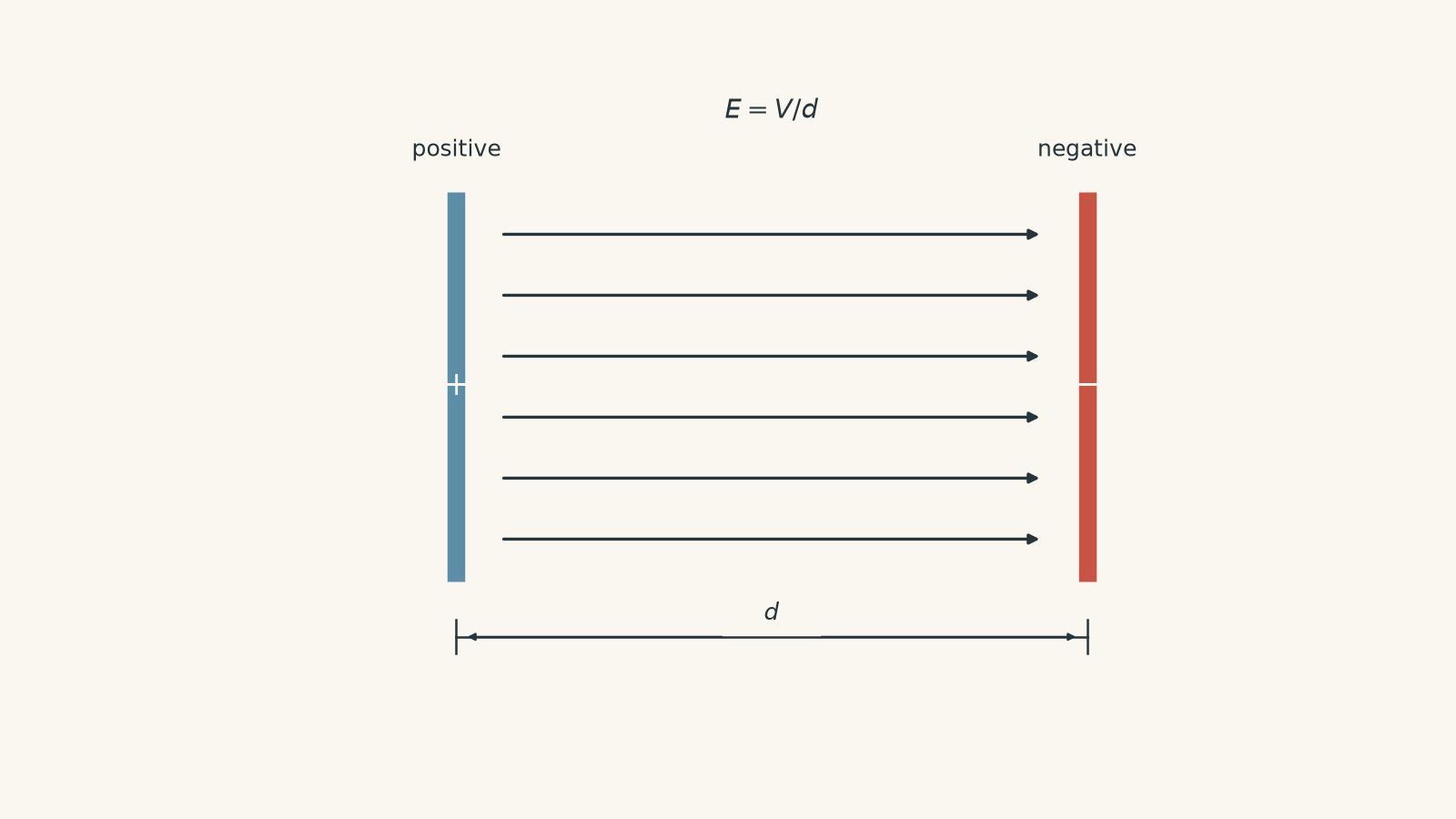
Between large, closely spaced parallel plates, away from the edges, the field is approximately uniform. That means:
- the electric field has the same magnitude at each point,
- the field has the same direction at each point,
- the field lines are parallel and equally spaced.
Real plates have some bending of the field near their edges. This is called fringing. When HSC questions say to treat the field between parallel plates as uniform, they are telling you to ignore that edge effect.
02What does voltage have to do with the field?
You probably already think of voltage as a potential difference. The useful question here is: a difference in what?
Electric potential tells us about the electrical potential energy available per unit charge. A potential difference of 1 volt means a change of 1 joule of potential energy per coulomb of charge:
\[
1\text{ V} = 1\text{ J/C}
\]
Now picture gravitational potential instead. A 10 m drop spread over a long, gentle hill feels different from the same 10 m drop packed into a short, steep hill.
Electric fields behave similarly.
The voltage between the plates tells us the total change in electric potential. The plate separation tells us the distance over which that change occurs. A large voltage change over a short distance means a strong electric field.
That analogy is useful, but incomplete. Electric potential is not literal height, and charged particles do not simply “roll downhill”. Their motion also depends on the sign of their charge and any velocity they already have.
03The relationship \(E = V/d\)
For a uniform electric field between parallel plates, the magnitude of the field is
\[
E = \frac{V}{d}
\]
where:
| Symbol | Meaning | SI unit |
|---|---|---|
| \(E\) | electric field strength | V/m or N/C |
| \(V\) | potential difference between the two points | V |
| \(d\) | separation measured in the direction of the field | m |
The units make the meaning fairly clear:
\[
E = \frac{\text{volts}}{\text{metres}}
\]
So electric field strength tells you how rapidly electric potential changes with distance.
A field of \(20\,000\text{ V/m}\), for example, means the potential changes by 20 000 V for every metre travelled in the field direction.
You usually won’t travel a whole metre between laboratory plates. The relationship still scales normally. Over \(1.0\text{ mm}\), the same field gives a potential change of
\[
\Delta V = Ed = (20\,000)(1.0\times10^{-3}) = 20\text{ V}
\]
04Watch the distance unit
This is one of the easiest places to lose marks.
The equation requires \(d\) in metres.
So:
\[
1\text{ cm} = 1\times10^{-2}\text{ m}
\]
and
\[
1\text{ mm} = 1\times10^{-3}\text{ m}
\]
A plate separation of \(4.0\text{ mm}\) is therefore
\[
4.0\times10^{-3}\text{ m}
\]
not \(4.0\text{ m}\), and not \(4.0\times10^{-2}\text{ m}\).
Worked example: Find the field between two plates
Two parallel plates have a potential difference of \(12\text{ V}\) and are separated by \(4.0\text{ mm}\). Determine the magnitude of the uniform electric field between them.
Step 1
\[
d = 4.0\text{ mm} = 4.0\times10^{-3}\text{ m}
\]
Step 2
\[
E = \frac{V}{d}
\]
Step 3
\[
E = \frac{12}{4.0\times10^{-3}}
= 3.0\times10^3\text{ V/m}
\]
Step 4
The electric field strength is
\[
\boxed{E = 3.0\times10^3\text{ V/m}}
\]
The potential changes by \(3.0\times10^3\text{ V}\) per metre in the field direction. Equivalently, the field strength is \(3.0\times10^3\text{ N/C}\).
05Why making the gap smaller strengthens the field
Return to the 600 V plates from the opening.
Suppose they are initially \(3.0\text{ cm}\) apart:
\[
E = \frac{600}{0.030}
= 2.0\times10^4\text{ V/m}
\]
Now move them to \(1.5\text{ cm}\) apart while keeping the potential difference at 600 V:
\[
E = \frac{600}{0.015}
= 4.0\times10^4\text{ V/m}
\]
Halving the distance doubles the field strength.
Why? The same 600 V change is now squeezed into half the distance.
This is worth understanding rather than memorising. From
\[
E = \frac{V}{d}
\]
if \(V\) stays constant, then \(E\) is inversely proportional to \(d\).
So:
- double \(d\), and \(E\) halves,
- halve \(d\), and \(E\) doubles,
- triple \(V\) while \(d\) stays fixed, and \(E\) triples.
06Rearranging the equation
You should be comfortable moving between three forms:
\[
E = \frac{V}{d}
\]
\[
V = Ed
\]
\[
d = \frac{V}{E}
\]
Don’t choose a version by pattern matching. Ask what each quantity means.
If you know the field strength and want the potential difference across some distance, \(V = Ed\) makes physical sense: field strength is potential change per metre, so multiply by the number of metres.
Worked example: Find the voltage across part of a field
Two parallel plates are \(3.0\text{ cm}\) apart with a potential difference of \(900\text{ V}\). A point \(P\) and a point \(Q\) are \(8.0\text{ mm}\) apart in the direction of the electric field. Determine the magnitude of the potential difference between \(P\) and \(Q\).
Step 1
Convert the plate separation:
\[
3.0\text{ cm} = 3.0\times10^{-2}\text{ m}
\]
Then
\[
E = \frac{V}{d}
= \frac{900}{3.0\times10^{-2}}
= 3.0\times10^4\text{ V/m}
\]
Step 2
\[
8.0\text{ mm} = 8.0\times10^{-3}\text{ m}
\]
Step 3
\[
V_{PQ} = Ed
= (3.0\times10^4)(8.0\times10^{-3})
= 2.4\times10^2\text{ V}
\]
So
\[
\boxed{V_{PQ} = 240\text{ V}}
\]
The full potential difference between the plates is 900 V, but \(P\) and \(Q\) span only part of the plate separation. Because the field is uniform, the potential changes steadily with distance.
07Electric field direction and potential
There is one extra layer of precision that \(E=V/d\) hides.
Electric field points from higher electric potential to lower electric potential.
Between parallel plates:
\[
\text{positive plate} \rightarrow \text{negative plate}
\]
is the direction of the electric field, and electric potential decreases in that direction.
So if you move in the field direction, potential decreases. If you move against the field direction, potential increases.
This is written more formally as
\[
\Delta V = -E\Delta x
\]
when \(\Delta x\) is measured along the electric field direction.
The negative sign describes direction. In many HSC calculations, the question asks only for magnitudes, so you use
\[
E = \frac{V}{d}
\]
with positive magnitudes.
Don’t mix those two jobs. \(E=V/d\) is excellent for magnitudes. The sign in \(\Delta V=-E\Delta x\) tells you whether potential rises or falls as you move.
08A tempting misconception: particles always move towards lower potential
A student might reason:
Electric field points towards lower potential, so every charged particle must move towards lower potential.
That works for a positive charge released from rest.
It does not work for a negative charge.
The electric field direction is defined using a positive test charge. The electric force is
\[
F = qE
\]
where \(q\) is the charge.
For a positive charge, \(q>0\), so the force is in the same direction as the field.
For an electron, \(q<0\), so the force is opposite the field.
Therefore:
- positive charges tend to accelerate from higher potential towards lower potential,
- negative charges tend to accelerate from lower potential towards higher potential.
The field itself has not reversed. The sign of the charge changes the direction of the force.
09Another trap: \(d\) is not always the distance travelled
Suppose a charged particle moves diagonally through a uniform field.
Can you put the full diagonal path length into \(V=Ed\)?
Not necessarily.
The potential change depends only on displacement in the field direction.
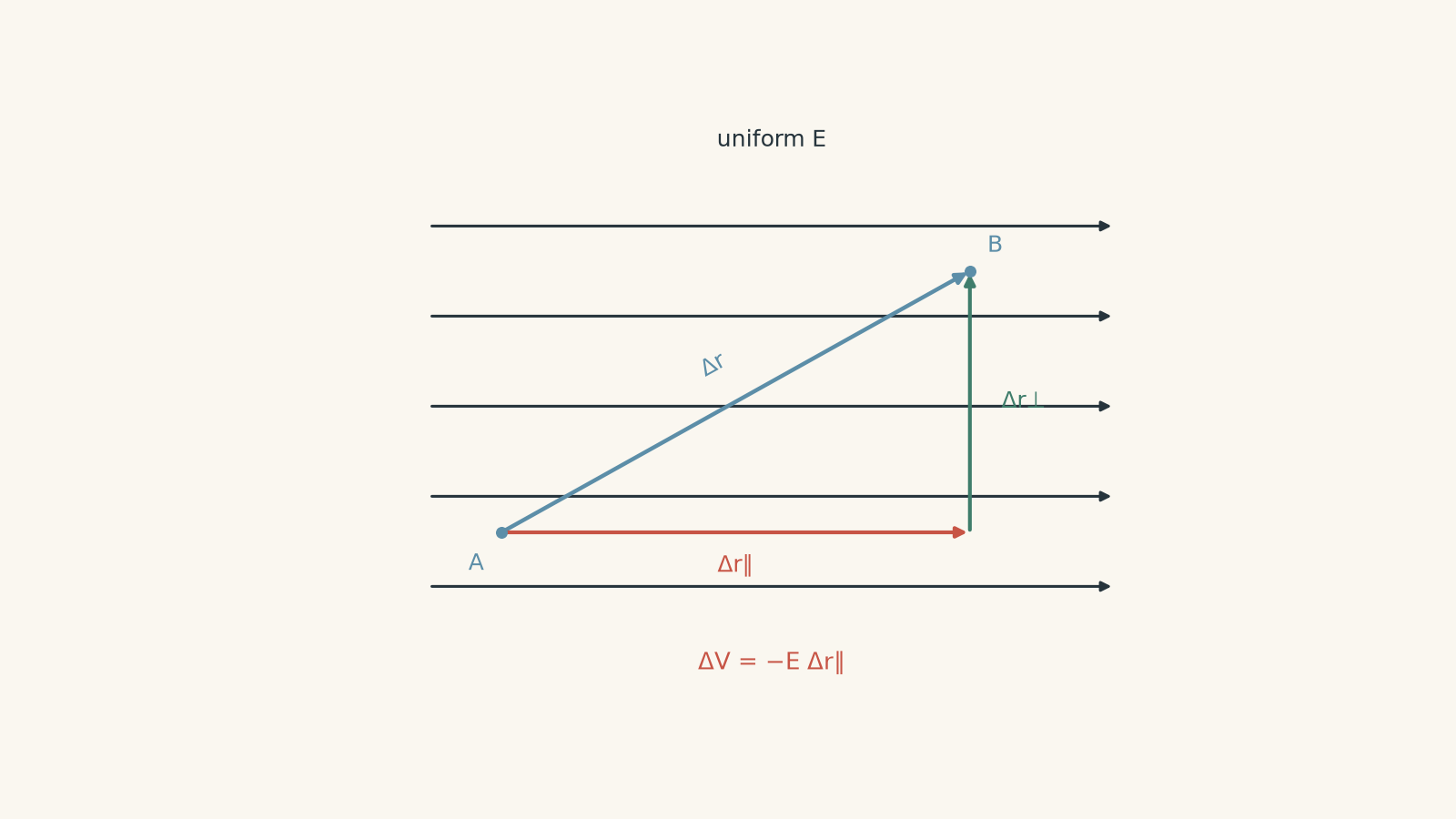
If a particle moves \(5.0\text{ mm}\) diagonally but only \(3.0\text{ mm}\) of that displacement is along the field, then the potential difference is determined by \(3.0\text{ mm}\), not \(5.0\text{ mm}\).
Motion perpendicular to a uniform electric field does not change electric potential.
You can see why by picturing points at the same distance from the positive plate. In the ideal parallel-plate model, those points are at the same electric potential.
These surfaces are called equipotential surfaces.
10Questions and solutions
Question 1
Two parallel plates are separated by \(5.0\text{ mm}\) and have a potential difference of \(150\text{ V}\). Calculate the magnitude of the electric field between them.
Solution 1
The electric field strength is \(\boxed{3.0\times10^4\text{ V/m}}\).
The plate separation must first be converted to metres:
\[
d = 5.0\text{ mm} = 5.0\times10^{-3}\text{ m}
\]
For a uniform field,
\[
E = \frac{V}{d}
\]
so
\[
E
= \frac{150}{5.0\times10^{-3}}
= 3.0\times10^4\text{ V/m}
\]
Therefore,
\[
\boxed{E = 3.0\times10^4\text{ V/m}}
\]
This means the electric potential changes by \(3.0\times10^4\text{ V}\) per metre in the field direction.
Question 2
A uniform electric field between two plates has a magnitude of \(6.0\times10^4\text{ V/m}\). The potential difference between the plates is \(2.4\text{ kV}\). Calculate their separation.
Solution 2
The plates are \(\boxed{4.0\text{ cm}}\) apart.
First convert the potential difference:
\[
2.4\text{ kV} = 2.4\times10^3\text{ V}
\]
Rearrange
\[
E = \frac{V}{d}
\]
to give
\[
d = \frac{V}{E}
\]
Then substitute:
\[
d
= \frac{2.4\times10^3}{6.0\times10^4}
= 4.0\times10^{-2}\text{ m}
\]
Therefore,
\[
\boxed{d = 4.0\times10^{-2}\text{ m} = 4.0\text{ cm}}
\]
The result is reasonable because a field of \(6.0\times10^4\text{ V/m}\) produces a change of 2400 V over 0.040 m.
Question 3
Two parallel plates produce a uniform electric field of \(2.5\times10^4\text{ V/m}\). Point \(B\) is \(6.0\text{ mm}\) from point \(A\), measured directly in the direction of the electric field.
Calculate the magnitude of the potential difference between \(A\) and \(B\), and state whether \(B\) is at a higher or lower potential than \(A\).
Solution 3
The potential difference has magnitude \(\boxed{150\text{ V}}\), and \(B\) is at a lower potential than \(A\).
Convert the displacement:
\[
d = 6.0\text{ mm} = 6.0\times10^{-3}\text{ m}
\]
For the magnitude,
\[
V = Ed
\]
so
\[
V
= (2.5\times10^4)(6.0\times10^{-3})
= 150\text{ V}
\]
Because \(B\) lies in the direction of the electric field from \(A\), electric potential decreases from \(A\) to \(B\).
Therefore,
\[
\boxed{|V_B-V_A|=150\text{ V}}
\]
with \(B\) 150 V lower in potential than \(A\).
The common trap is to calculate 150 V correctly but then assume potential increases in the field direction. It does the opposite.
Question 4
Two parallel plates remain connected to a constant-voltage supply. Their separation is reduced from \(12\text{ mm}\) to \(4.0\text{ mm}\).
A student claims that the electric field becomes three times stronger because the plates are now three times closer together.
Is the student’s claim correct? Explain using the relationship between field strength, voltage, and distance.
Solution 4
Yes. The electric field becomes \(\boxed{3}\) times as strong, provided the potential difference stays constant and the field can still be treated as uniform.
Initially,
\[
E_1 = \frac{V}{d_1}
\]
and finally,
\[
E_2 = \frac{V}{d_2}
\]
The new separation is
\[
d_2 = \frac{1}{3}d_1
\]
so
\[
E_2
= \frac{V}{d_1/3}
= \frac{3V}{d_1}
= 3E_1
\]
Therefore,
\[
\boxed{E_2=3E_1}
\]
The reasoning works because the voltage is explicitly held constant. If the plates were disconnected from the supply before being moved, assuming that the potential difference remained constant would require further justification.
That hidden assumption matters. \(E=V/d\) does not tell you by itself which quantities stay constant when the physical setup changes.
Question 5
A uniform electric field of \(4.0\times10^4\text{ V/m}\) points horizontally to the right.
A particle moves from point \(P\) to point \(Q\) along a diagonal path of length \(10\text{ mm}\). Point \(Q\) is \(6.0\text{ mm}\) to the right and \(8.0\text{ mm}\) above point \(P\).
Determine the change in electric potential from \(P\) to \(Q\).
Solution 5
The electric potential decreases by \(\boxed{240\text{ V}}\), so
\[
\boxed{V_Q-V_P=-240\text{ V}}
\]
Only the displacement parallel to the electric field contributes to the potential change.
The particle travels \(10\text{ mm}\) along its diagonal path, but its displacement in the field direction is only
\[
\Delta x = 6.0\text{ mm}
=6.0\times10^{-3}\text{ m}
\]
The magnitude of the potential change is
\[
|\Delta V|
=E\Delta x
=(4.0\times10^4)(6.0\times10^{-3})
=240\text{ V}
\]
The displacement is to the right, which is the direction of the electric field. Electric potential decreases in the field direction, so
\[
\Delta V=-240\text{ V}
\]
Therefore,
\[
\boxed{V_Q-V_P=-240\text{ V}}
\]
The tempting mistake is to use the full \(10\text{ mm}\) path length in \(V=Ed\). The vertical \(8.0\text{ mm}\) displacement is perpendicular to the field, so it produces no change in electric potential.
11What this relationship lets you do next
The equation \(E=V/d\) connects two ways of describing the same electric situation.
Potential difference describes how electric potential changes between two positions. Electric field strength describes how sharply that potential changes with position.
Once you know \(E\), you can find the force on a charged particle using
\[
F=qE
\]
and once you know a potential difference, you can connect it to a particle’s change in electric potential energy using
\[
\Delta U=q\Delta V
\]
Those relationships are the next step. They let you move from describing the field between the plates to predicting what an electron, proton, or other charged particle will actually do inside it.