
Electric Field Lines Around a Point Charge: HSC Physics Guide
Learn how to read the direction and relative strength of electric fields around point charges, and avoid common mistakes with force and field-line diagrams.
A diagram shows a positive point charge with arrows radiating outwards. One test charge is placed 2 cm away, another 6 cm away. Both sit on field lines, and both arrows point in the same general direction. Which test charge feels the stronger electric effect?
You might predict that the arrows tell you everything. They tell you the direction, but not directly the strength. The closer test charge is in the stronger electric field. Around a point charge, field strength drops rapidly with distance.
That gives us the two skills these diagrams are built to test: read the direction from the arrows, and read relative strength from the density of the field lines and the distance from the source charge.
01Start with what the field diagram is trying to show
A charged object can exert an electric force on another charge without touching it. Instead of drawing a force arrow for every possible location in space, we describe the region around the charge using an electric field.
Picture putting a tiny positive test charge at different positions around a positive source charge.
At every position, the two positive charges repel. So the test charge would be pushed directly away from the source.
Do that at hundreds of positions and you would get a pattern of arrows pointing radially outwards.
That is the idea behind an electric field-line diagram.
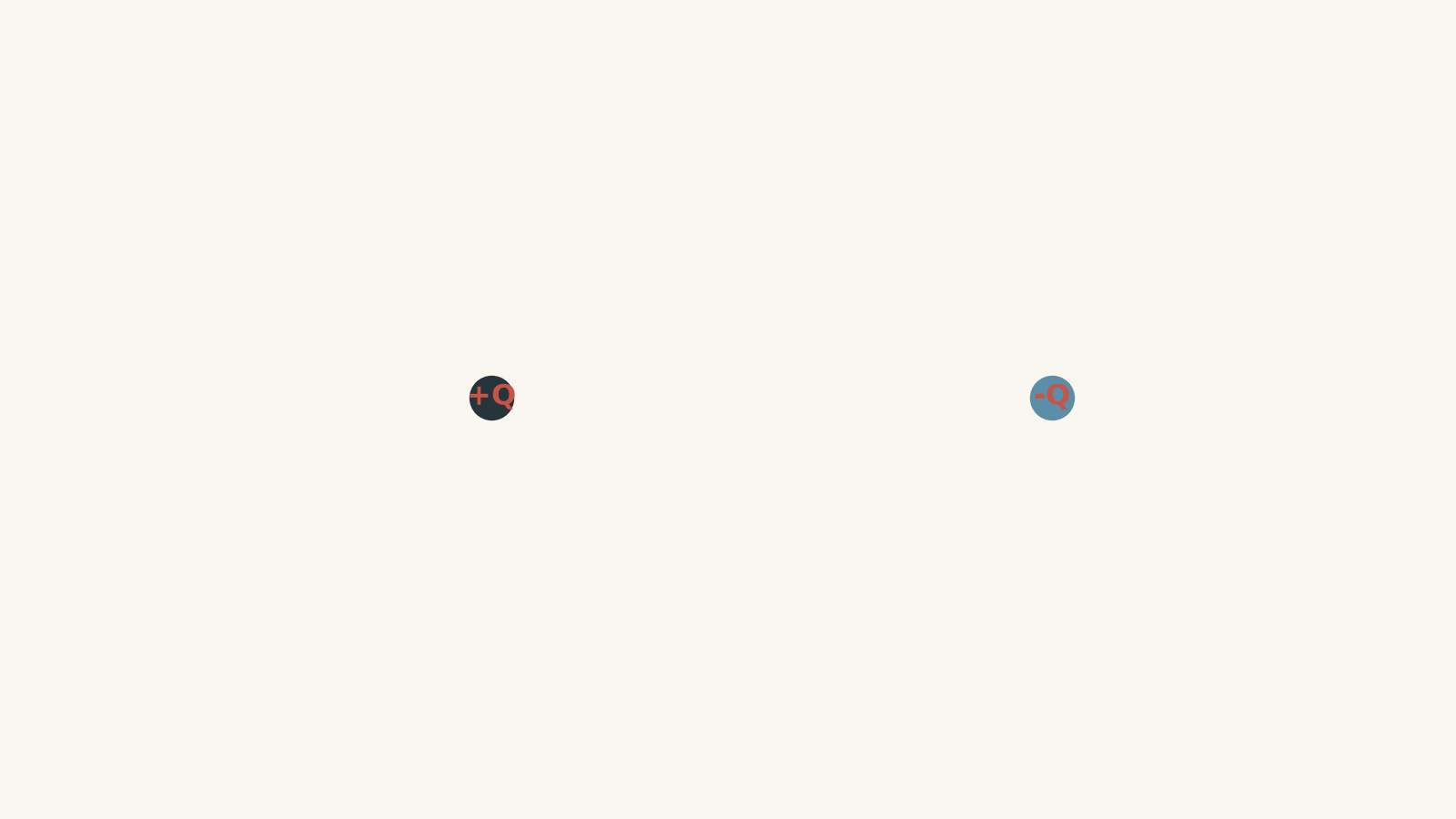
For an isolated point charge:
- field lines point away from a positive charge
- field lines point towards a negative charge
- the lines are radial, meaning they run directly towards or away from the charge
- the field becomes weaker as you move further away
The first two rules come from the definition of electric field direction.
02Direction means the force on a positive test charge
Electric field direction is defined as the direction of the force that would act on a positive test charge placed at that point.
That last part matters.
Suppose you place a tiny positive charge near a positive source charge. It is repelled, so the field points away from the source.
Now place the same positive test charge near a negative source charge. It is attracted, so the field points towards the source.
This gives the rule:
| Source charge | Direction of electric field lines |
|---|---|
| Positive | Away from the charge |
| Negative | Towards the charge |
A useful memory trick is that field lines leave positive and enter negative.
Don’t treat that as a mysterious drawing convention. It comes directly from asking, “Which way would a positive test charge be pushed?”
What if the test charge is negative?
Here is a common trap.
Suppose an electric field arrow points to the right. A negative charge is placed there. Which way is the force on the negative charge?
It is tempting to say right because the electric field points right.
But electric field direction is defined using a positive test charge. A negative charge feels a force in the opposite direction.
The relationship is
\[
\vec{F}=q\vec{E}
\]
where:
- \(\vec{F}\) is the electric force, measured in newtons (N)
- \(q\) is the charge experiencing the field, measured in coulombs (C)
- \(\vec{E}\) is the electric field strength, measured in newtons per coulomb (N C\(^{-1}\))
If \(q\) is positive, \(\vec{F}\) points in the same direction as \(\vec{E}\).
If \(q\) is negative, multiplying by a negative value reverses the vector direction, so \(\vec{F}\) points opposite to \(\vec{E}\).
That distinction is worth keeping separate:
Field direction: always defined using a positive test charge.
Force direction: depends on the sign of the actual charge placed in the field.
03How a diagram shows field strength
Now return to the two test charges from the opening. One is close to the point charge and one is further away.
Why is the closer field stronger?
Imagine radial field lines spreading out from the source like people leaving a concert through an open park. Near the exit, they are crowded together. Further away, the same group has spread over a much larger region.
The field lines behave similarly in the diagram. They become more widely separated with increasing distance.
The analogy is useful because closer field lines indicate a stronger field. But it has a limit: field lines are not physical objects flying out of the charge. They are a drawing tool used to represent the field.
For a point charge, the exact field magnitude is
\[
E=\frac{k|Q|}{r^2}
\]
where:
- \(E\) is electric field strength in N C\(^{-1}\)
- \(k\) is Coulomb’s constant, approximately \(8.99\times10^9\) N m\(^2\) C\(^{-2}\)
- \(Q\) is the source charge in coulombs
- \(r\) is the distance from the source charge in metres
The absolute-value signs around \(Q\) mean that this equation gives the magnitude of the field. The sign of the source charge determines the direction separately.
Notice the \(r^2\).
Electric field strength follows an inverse-square relationship:
\[
E\propto\frac{1}{r^2}
\]
So if the distance doubles,
\[
E_{\text{new}}=\frac{1}{2^2}E_{\text{old}}=\frac14E_{\text{old}}
\]
The field does not halve. It becomes one quarter as strong.
If the distance triples, the field becomes one ninth as strong.
That is much faster weakening than students often expect from the picture alone.
Worked example: How much weaker is the field further away?
A point \(A\) is 0.20 m from a positive point charge. Point \(B\) is 0.60 m from the same charge. Compare the electric field strengths at \(A\) and \(B\).
Step 1
We only need the distance relationship:
\[
E\propto\frac{1}{r^2}
\]
Step 2
\[
\frac{E_A}{E_B}
=
\frac{1/(0.20)^2}{1/(0.60)^2}
=
\frac{(0.60)^2}{(0.20)^2}
=
9
\]
Step 3
The electric field at \(A\) is 9 times stronger than the electric field at \(B\).
The distance only increased by a factor of 3, but the field decreased by a factor of \(3^2=9\).
Both field directions are radially away from the positive source charge. Only the magnitude changes.
04Reading field-line density carefully
You will often hear the rule:
The closer the field lines, the stronger the electric field.
That rule is useful, but it needs precision.
Field lines are invented by whoever draws the diagram. A point charge does not literally have 8, 12, or 24 invisible lines attached to it.
So you cannot look at one diagram containing 12 lines and another containing 6 lines and automatically claim the first field is twice as strong. The diagrams might simply have been drawn differently.
What you can do is compare regions within a consistently drawn field diagram.
If the lines are more densely packed in one region than another, that region represents a larger electric field magnitude.
For a single point charge, this matches the inverse-square law. As distance increases, the same radial pattern spreads across a larger area, and the line density decreases.
05Direction at one particular point
Field diagrams often contain curved lines when more than one source charge is present. This guide is focused on point charges, but one rule is worth learning now because it remains true later:
At any point, the electric field direction is tangent to the field line at that point.
“Tangent” means pointing along the line at that exact location.
For a single isolated point charge, the field lines are straight and radial, so this is easy. The field points directly towards or directly away from the source.
The rule becomes more important once you study fields created by several charges.
06Field lines are not tracks that charges must follow
Suppose a positive particle is already moving sideways when it enters an electric field.
Will it suddenly snap onto the nearest field line and travel along it?
No.
A field line gives the direction of force, and therefore the direction of acceleration, at each point. It does not necessarily give the particle’s velocity.
This is similar to projectile motion. Gravity points down throughout the motion, but a thrown ball does not travel vertically down. It can have sideways velocity while accelerating downwards.
Electric fields work the same way.
A charged particle’s path depends on:
- its initial velocity
- its charge
- its mass
- the electric field along its path
For a positive charge released from rest in the field of a single point charge, its initial acceleration is along the field line. For a negative charge, its initial acceleration is opposite to the field line.
But in general, field line does not mean particle trajectory.
07More source charge means a stronger field
Distance is not the only thing controlling field magnitude.
From
\[
E=\frac{k|Q|}{r^2}
\]
we can also see that
\[
E\propto |Q|
\]
at a fixed distance.
If the magnitude of the source charge doubles while the distance stays the same, the electric field magnitude doubles.
The sign changes the direction, not the magnitude produced by a particular \(|Q|\) at the same distance.
So a \(+4.0\ \mu\text{C}\) charge and a \(-4.0\ \mu\text{C}\) charge produce equal field magnitudes at equal distances. Their fields point in opposite radial directions.
Worked example: Compare two different point-charge fields
Charge \(A\) has a source charge of \(+2.0\ \mu\text{C}\). Point \(P\) is 0.30 m from \(A\).
Charge \(B\) has a source charge of \(-8.0\ \mu\text{C}\). Point \(R\) is 0.60 m from \(B\).
Compare the electric field magnitudes at \(P\) and \(R\), and state the direction of each field relative to its source charge.
Step 1
\[
E=\frac{k|Q|}{r^2}
\]
Remember that \(1\ \mu\text{C}=1\times10^{-6}\ \text{C}\).
Step 2
\[
\begin{aligned}
E_P
&=\frac{(8.99\times10^9)(2.0\times10^{-6})}{(0.30)^2}\\
&=2.00\times10^5\ \text{N C}^{-1}
\end{aligned}
\]
Because the source charge is positive, the field points away from \(A\).
Step 3
\[
\begin{aligned}
E_R
&=\frac{(8.99\times10^9)(8.0\times10^{-6})}{(0.60)^2}\\
&=2.00\times10^5\ \text{N C}^{-1}
\end{aligned}
\]
Because the source charge is negative, the field points towards \(B\).
Step 4
The two field magnitudes are equal:
\[
E_P=E_R
\]
This might look surprising because charge \(B\) has four times the charge magnitude. However, point \(R\) is twice as far away, and doubling the distance reduces the field by a factor of \(2^2=4\).
Those two effects exactly cancel.
This is the sort of comparison where relying only on “bigger charge means stronger field” causes trouble. You must consider both charge magnitude and distance.
08A reliable way to read any point-charge field diagram
When you are given a point-charge diagram, use this order:
- Find the source charge. Is it positive or negative?
- Read the arrow direction. Away means a positive source; towards means a negative source.
- Identify the point being asked about.
- Read field direction there. It follows the field line arrow.
- If an actual charge is placed there, check its sign. A positive charge feels force along the field; a negative charge feels force opposite the field.
- Compare strength using distance or line density. For a point charge, \(E\propto1/r^2\).
- If source charges differ, include \(|Q|\). Use \(E=k|Q|/r^2\), rather than comparing distance alone.
That order prevents several common mistakes from getting tangled together.
09The misconceptions worth catching
| Tempting idea | What is actually true |
|---|---|
| The field points whichever way the actual particle moves | Field direction is defined by the force on a positive test charge |
| A negative charge moves along the field arrow | Its electric force is opposite to the field direction |
| Twice as far away means half the field | For a point charge, twice as far means one quarter of the field |
| More drawn field lines always means a stronger charge | The number of lines is a drawing convention unless the diagram uses a consistent scale |
| A field line is the path a particle must follow | A field line gives field and force direction, not necessarily velocity or trajectory |
| A negative source produces a “negative field strength” | Field magnitude is non-negative; the direction carries the directional information |
One particularly useful habit is to keep magnitude and direction separate.
Calculate or compare how strong the field is first. Then decide which way it points.
That is much safer than trying to make the sign of \(Q\) do both jobs inside the scalar equation.
10Questions and solutions
Question 1
A diagram shows radial field lines pointing directly towards a point charge \(Q\).
What is the sign of \(Q\)? State the direction of the electric field at a point 5 cm to the right of \(Q\).
Solution 1
\(Q\) is negative, and at the point to its right the electric field points left, towards \(Q\).
Electric field direction is defined as the direction of force on a positive test charge. A positive test charge is attracted towards a negative source, so field lines terminate on a negative charge.
The 5 cm distance affects the field magnitude, but it does not change this directional rule.
Question 2
A positive point charge creates an electric field of \(3600\ \text{N C}^{-1}\) at point \(A\). Point \(B\) lies twice as far from the same source charge.
Find the electric field magnitude at \(B\).
Solution 2
The electric field at \(B\) is \(900\ \text{N C}^{-1}\).
For a point charge,
\[
E\propto\frac{1}{r^2}
\]
Point \(B\) is twice as far away, so
\[
\begin{aligned}
E_B
&=\frac{E_A}{2^2}\\
&=\frac{3600}{4}\\
&=900\ \text{N C}^{-1}
\end{aligned}
\]
The trap is to divide by 2 because the distance doubled. Point-charge fields follow an inverse-square relationship, so the field must be divided by \(4\).
Question 3
At point \(P\), an electric field has magnitude \(4.0\times10^3\ \text{N C}^{-1}\) and points east.
A charge of \(-3.0\times10^{-6}\ \text{C}\) is placed at \(P\).
Determine the magnitude and direction of the electric force on the charge.
Solution 3
The force has magnitude \(1.2\times10^{-2}\ \text{N}\) and points west.
Use
\[
\vec{F}=q\vec{E}
\]
For the magnitude,
\[
\begin{aligned}
F
&=|q|E\\
&=(3.0\times10^{-6})(4.0\times10^3)\\
&=1.2\times10^{-2}\ \text{N}
\end{aligned}
\]
Because the charge is negative, its force points opposite to the electric field.
The field points east, so the force points west.
The important distinction is that the field arrow does not automatically give the force direction for every charge. It gives the force direction for a positive charge.
Question 4
Two isolated point charges are considered separately.
Source \(X\) has charge \(+Q\). Point \(A\) is a distance \(r\) from \(X\).
Source \(Y\) has charge \(-2Q\). Point \(B\) is a distance \(2r\) from \(Y\).
Compare the electric field magnitudes \(E_A\) and \(E_B\), and describe their directions relative to their source charges.
Solution 4
The field at \(B\) is half the magnitude of the field at \(A\). The field at \(A\) points away from \(X\), while the field at \(B\) points towards \(Y\).
At \(A\),
\[
E_A=\frac{kQ}{r^2}
\]
At \(B\),
\[
\begin{aligned}
E_B
&=\frac{k(2Q)}{(2r)^2}\\
&=\frac{2kQ}{4r^2}\\
&=\frac12\frac{kQ}{r^2}\\
&=\frac12E_A
\end{aligned}
\]
The larger charge at \(Y\) makes its field stronger, but the larger distance makes it weaker. Doubling \(|Q|\) gives a factor of 2, while doubling \(r\) gives a factor of \(1/4\). Together,
\[
2\times\frac14=\frac12
\]
A common mistake is to notice only that \(Y\) has twice the charge magnitude and conclude that its field must be stronger. Distance matters through \(r^2\), so it can dominate the comparison.
Question 5
A student is shown a field diagram for a positive point charge. Eight radial field lines are drawn from the charge.
The student makes two claims:
- “At twice the distance from the charge, there are still eight field lines, so the field strength is unchanged.”
- “If the diagram had sixteen field lines instead, the electric field would definitely be twice as strong.”
Assess both claims.
Solution 5
Both claims are incorrect.
For the first claim, the number of complete lines drawn does not stay locally concentrated as distance increases. The radial lines spread apart. Around a point charge,
\[
E=\frac{k|Q|}{r^2}
\]
so at twice the distance,
\[
E_{\text{new}}=\frac14E_{\text{old}}
\]
The important feature of the diagram is the local density of field lines, not simply the total number of lines visible on the page.
For the second claim, field lines are a representation rather than physical objects. A diagram can be drawn with eight, sixteen, or many more lines without changing the physical charge being represented.
Only if two diagrams explicitly use the same field-line convention or scale could the relative number or density of lines be used to compare source strengths quantitatively.
The hidden assumption in the student’s second claim is that every diagram uses the same number of lines per unit charge. Unless that convention is stated or clearly maintained, it cannot be assumed.
Question 6
A positive particle passes through point \(P\) moving north. At \(P\), the electric field produced by a nearby positive point charge points east.
A student says, “The particle must turn immediately and travel east along the field line.”
Explain what actually happens at the instant the particle passes through \(P\).
Solution 6
The particle’s acceleration is east at \(P\), but its velocity is still north at that instant, so it does not suddenly begin travelling along the field line.
Because the particle is positively charged,
\[
\vec{F}=q\vec{E}
\]
means its electric force is in the same direction as the electric field. Therefore, both the force and acceleration point east.
However, acceleration changes velocity over time. It does not instantly erase the particle’s existing northward velocity.
Just after passing \(P\), the particle still has a northward component of velocity while gaining an eastward component. Its trajectory therefore begins to curve.
This exposes an important limitation of field-line diagrams: field lines show the direction of the field and electric force on a positive charge, not the trajectory that every charged particle must follow.
11Where this idea leads next
Once you can read direction and relative strength around one point charge, the next useful step is superposition.
With two or more charges, each source creates its own electric field at a point. Those fields must be added as vectors. That is why field lines around multiple charges can curve, why there can sometimes be points where the net field is zero, and why simply choosing the nearest charge is not enough.
The single point-charge field is the foundation: direction comes from the sign of the source, magnitude follows \(E=k|Q|/r^2\), and every more complicated electric-field diagram is built by combining those same ideas.