
Electric Potential Energy and Work in Electric Fields
Learn how electric potential energy changes when charges move through electric fields, and how voltage, work, and kinetic energy connect.
A positive charge is released between two oppositely charged parallel plates. It accelerates towards the negative plate. Nothing is touching it, so where does its increasing kinetic energy come from?
The electric field does work on the charge. As it does, the charge’s electric potential energy decreases. The same energy bookkeeping explains what happens when electrons move through fields, why a voltage can accelerate charged particles, and why the sign of the charge matters.
Before going further, make a prediction. Suppose a positive charge moves naturally in the direction of an electric field. Does its electric potential energy increase or decrease?
It decreases. The field is doing positive work on the charge, so energy is transferred from electric potential energy into other forms, often kinetic energy.
01Start with the energy picture
Think about lifting a ball in Earth’s gravitational field. When you lift it, you do work against gravity and increase its gravitational potential energy. If you release it, gravity does work on the ball and that stored energy becomes kinetic energy.
An electric field behaves similarly, with one important complication: electric charges can be positive or negative.
For a positive charge, the electric force points in the same direction as the electric field.
For a negative charge, the electric force points opposite to the electric field.
That sign difference is why memorising phrases such as “moving with the field means losing potential energy” is dangerous. It works for a positive charge, but not for every charge.
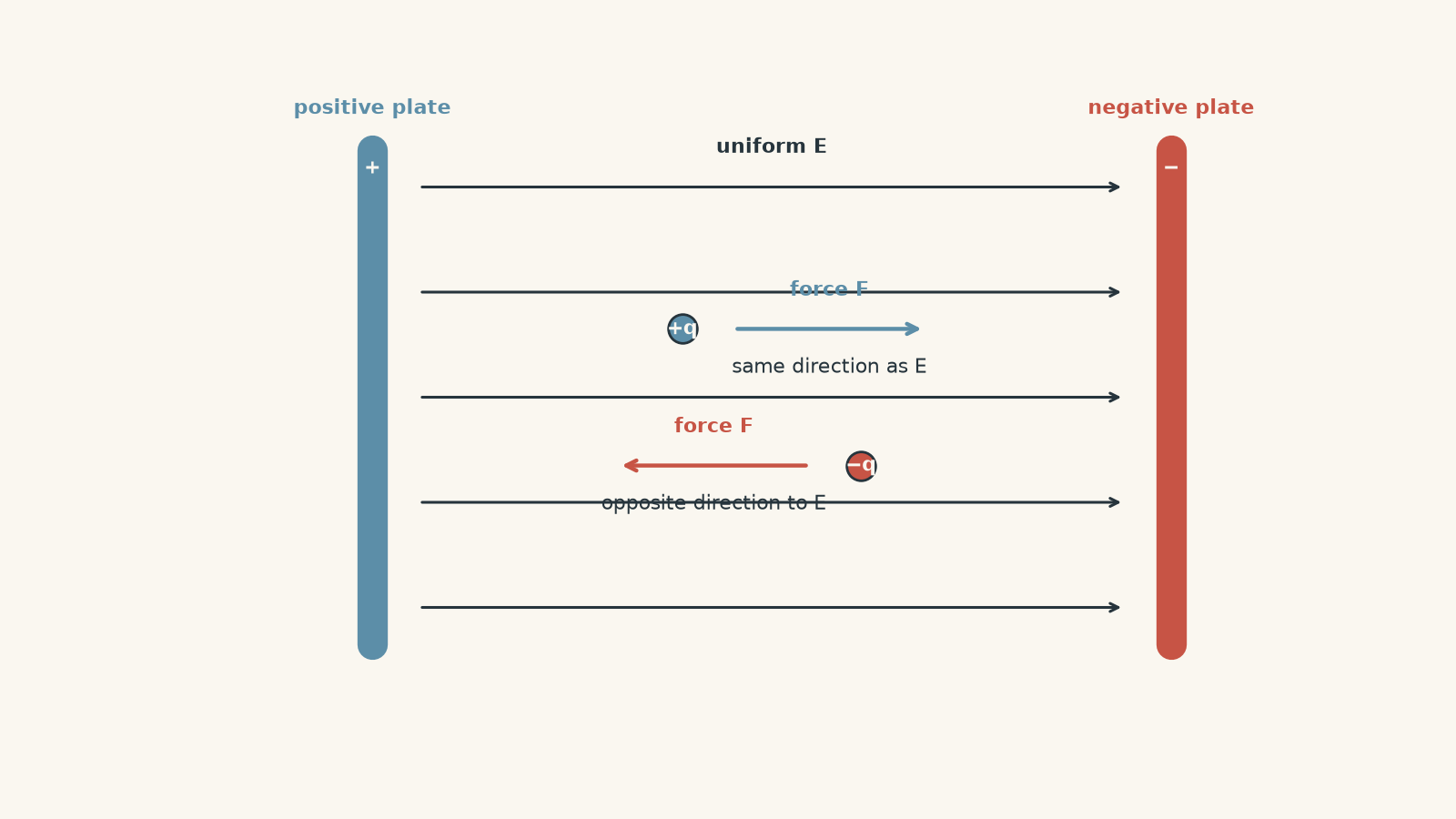
The gravitational analogy is useful because both systems store potential energy through position. It breaks down because mass has only one sign, while electric charge can be positive or negative.
02Work done by an electric field
Work is an energy transfer.
If an electric field does positive work on a charge, the charge’s electric potential energy decreases. If the field does negative work, its electric potential energy increases.
The relationship is
\[
W_{\text{field}} = -\Delta U
\]
where:
- \(W_{\text{field}}\) is the work done by the electric field, measured in joules (J)
- \(\Delta U\) is the change in electric potential energy, measured in joules (J)
Remember that
\[
\Delta U = U_f – U_i
\]
where \(U_i\) is the initial potential energy and \(U_f\) is the final potential energy.
So if \(\Delta U = -4.0\text{ J}\), the charge has lost \(4.0\text{ J}\) of electric potential energy. The field has therefore done \(+4.0\text{ J}\) of work.
This minus sign is not decoration. It tells you that the field doing positive work corresponds to potential energy going down.
03Where voltage enters the picture
Potential energy depends on the charge you place in the field. Electric potential does not.
Electric potential, \(V\), tells us the electric potential energy per unit positive charge at a point:
\[
V = \frac{U}{q}
\]
Rearranging,
\[
U = qV
\]
where:
- \(U\) is electric potential energy in joules (J)
- \(q\) is charge in coulombs (C)
- \(V\) is electric potential in volts (V)
One volt is one joule per coulomb:
\[
1\text{ V} = 1\text{ J C}^{-1}
\]
Usually, we care about a change between two positions rather than the absolute value at one position. That gives
\[
\Delta U = q\Delta V
\]
with
\[
\Delta V = V_f – V_i
\]
Therefore,
\[
W_{\text{field}} = -q\Delta V
\]
This equation is one of the most useful ways to track energy when a charge moves through an electric field.
04The sign of the charge changes the story
Imagine two points, A and B, where
\[
V_A = 100\text{ V}
\]
and
\[
V_B = 20\text{ V}
\]
A charge moving from A to B has
\[
\Delta V = 20 – 100 = -80\text{ V}
\]
For a positive charge, \(q > 0\), so
\[
\Delta U = q\Delta V < 0
\]
Its potential energy decreases.
For a negative charge, \(q < 0\), so the product of two negatives is positive:
\[
\Delta U = q\Delta V > 0
\]
Its potential energy increases.
That result can feel backwards at first. Lower electric potential does not always mean lower electric potential energy.
The missing ingredient is the charge:
\[
U = qV
\]
For a negative charge, multiplying by \(q < 0\) reverses the relationship.
A slightly silly analogy helps. Imagine electric potential as the rating of a date location. A positive charge and a negative charge have completely opposite tastes. Telling you that one restaurant has a “higher rating” isn’t enough to tell you which charge has more potential energy there. You also need to know who’s going.
The analogy stops there, thankfully. Charges do not have opinions, and \(U=qV\) gives the relationship exactly.
Worked example: A proton moves through a potential difference
A proton with charge \(+1.60\times10^{-19}\text{ C}\) moves from a point at \(250\text{ V}\) to a point at \(70\text{ V}\). Calculate the change in its electric potential energy and the work done by the electric field.
Step 1
\[
\Delta V = V_f – V_i = 70 – 250 = -180\text{ V}
\]
Step 2
\[
\Delta U
= (1.60\times10^{-19})(-180)
= -2.88\times10^{-17}\text{ J}
\]
The negative sign means the proton loses electric potential energy.
Step 3
\[
W_{\text{field}}=-\Delta U
= -(-2.88\times10^{-17})
= 2.88\times10^{-17}\text{ J}
\]
The field does \(2.88\times10^{-17}\text{ J}\) of positive work on the proton. If no other energy transfers occur, that energy appears as an increase in the proton’s kinetic energy.
05Connecting work to kinetic energy
The work-energy theorem tells us that the net work on an object equals its change in kinetic energy:
\[
W_{\text{net}} = \Delta K
\]
If the electric force is the only force doing work, then
\[
W_{\text{field}} = \Delta K
\]
Since
\[
W_{\text{field}}=-\Delta U
\]
we obtain
\[
\Delta K=-\Delta U
\]
or
\[
\Delta K+\Delta U=0
\]
This is conservation of mechanical energy for a charge moving under the electric force alone.
In words:
electric potential energy lost = kinetic energy gained
and vice versa.
Be careful with the condition. If another force does work, you cannot automatically say that every joule of lost electric potential energy becomes kinetic energy.
Worked example: An electron accelerated through a voltage
An electron starts from rest and moves from a point at \(-40\text{ V}\) to a point at \(160\text{ V}\). The electron has charge \(-1.60\times10^{-19}\text{ C}\). Ignore all forces except the electric force. Find its final kinetic energy and speed. Use an electron mass of \(9.11\times10^{-31}\text{ kg}\).
Step 1
\[
\Delta V = V_f – V_i = 160-(-40)=200\text{ V}
\]
Step 2
\[
\Delta U
= q\Delta V
= (-1.60\times10^{-19})(200)
= -3.20\times10^{-17}\text{ J}
\]
The electron loses \(3.20\times10^{-17}\text{ J}\) of electric potential energy.
Notice the sign. The electron moved to a higher electric potential, but because its charge is negative, its electric potential energy decreased.
Step 3
The electron starts from rest, so \(K_i=0\). Therefore,
\[
\Delta K=-\Delta U=3.20\times10^{-17}\text{ J}
\]
and
\[
K_f=3.20\times10^{-17}\text{ J}
\]
Step 4
For speeds well below the speed of light,
\[
K=\frac{1}{2}mv^2
\]
where \(m\) is mass in kilograms (kg) and \(v\) is speed in metres per second (m s\(^{-1}\)).
So
\[
v=\sqrt{\frac{2K}{m}}
\]
Substituting,
\[
v
=
\sqrt{\frac{2(3.20\times10^{-17})}{9.11\times10^{-31}}}
=
8.38\times10^6\text{ m s}^{-1}
\]
The electron reaches a speed of approximately
\[
\boxed{8.38\times10^6\text{ m s}^{-1}}
\]
The important physics is not just the speed. The electron accelerated towards a region of higher electric potential while moving to lower electric potential energy.
06Potential difference in a uniform electric field
Between large parallel plates, away from the edges, the electric field can often be treated as uniform.
For motion parallel to the field,
\[
\Delta V=-Ed
\]
where:
- \(E\) is electric field strength in volts per metre (V m\(^{-1}\)), equivalent to newtons per coulomb (N C\(^{-1}\))
- \(d\) is displacement in metres (m), taken as positive in the direction of the electric field
- \(\Delta V\) is the change in electric potential in volts (V)
The minus sign tells us that electric potential decreases in the direction of the electric field.
This statement is about \(V\), not \(U\). It is true regardless of what charge you later place there.
Combining
\[
\Delta U=q\Delta V
\]
with
\[
\Delta V=-Ed
\]
gives
\[
\Delta U=-qEd
\]
for displacement \(d\) parallel to the field.
The work done by the field is therefore
\[
W_{\text{field}}=qEd
\]
for that particular geometry.
Do not use \(W=qEd\) blindly. It assumes the displacement is parallel to a uniform electric field. The potential difference equation \(W_{\text{field}}=-q\Delta V\) is more general.
07What if the charge moves sideways?
Picture a uniform electric field pointing to the right. A positive charge moves straight upwards.
Predict the work done by the field.
The electric force points right, while the displacement points up. They are perpendicular, so the field does no work.
Using the general work expression,
\[
W=Fd\cos\theta
\]
where \(\theta\) is the angle between force and displacement, we have \(\theta=90^\circ\), so
\[
W=Fd\cos90^\circ=0
\]
Therefore,
\[
\Delta U=0
\]
and
\[
\Delta V=0
\]
The charge has moved along an equipotential.
An equipotential is a set of points with the same electric potential. Moving along one requires no work from the electric field.
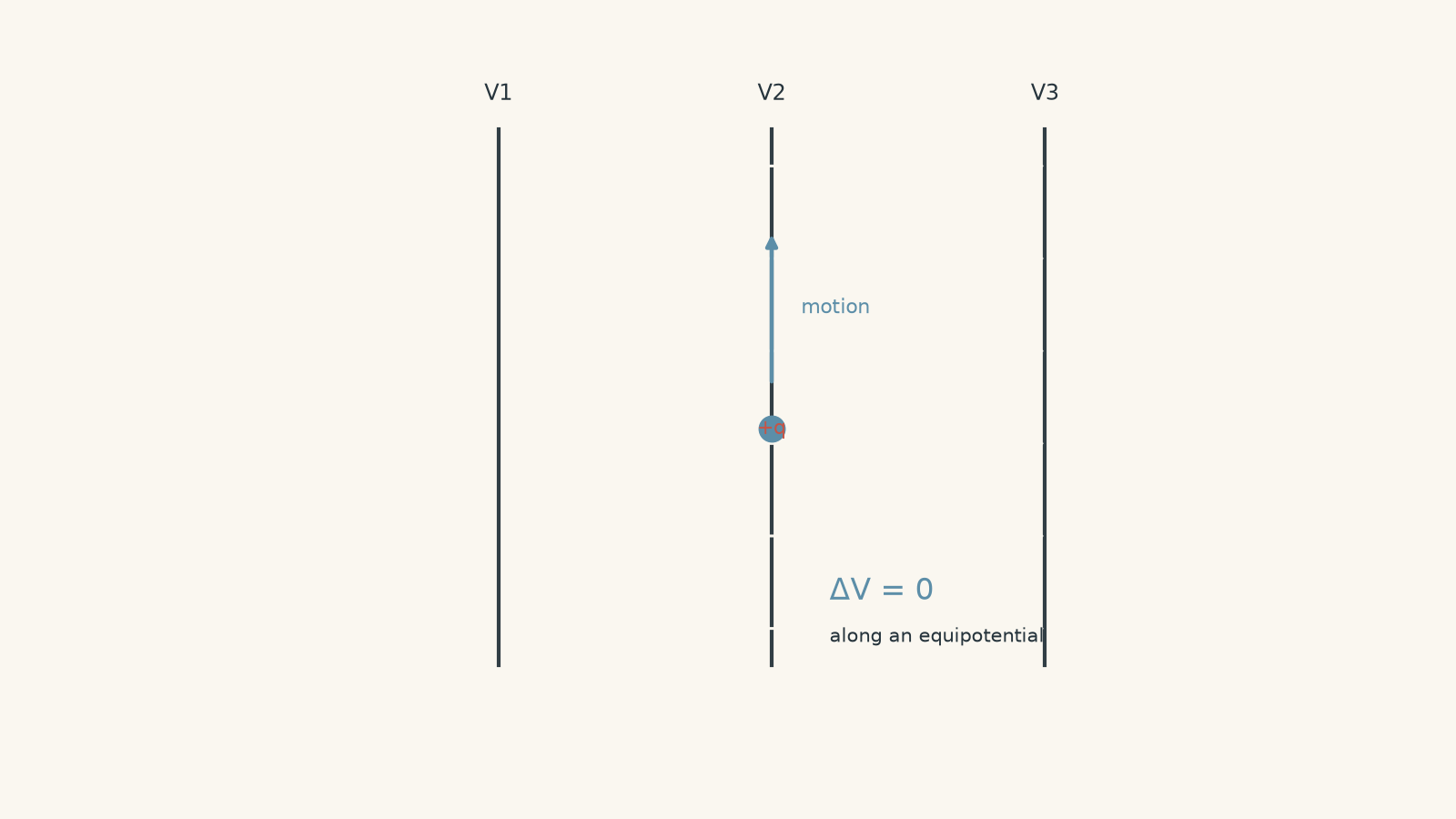
This also gives a useful geometric rule:
electric field lines are perpendicular to equipotential lines or surfaces.
08The most tempting misconception: “Charges move from high potential to low potential”
That statement is incomplete.
A positive charge released from rest accelerates towards lower electric potential.
A negative charge released from rest accelerates towards higher electric potential.
Both naturally move towards lower electric potential energy.
That is the safer energy rule:
\[
\text{a freely accelerating charge moves so that }U\text{ decreases}
\]
Why?
Because the field does positive work on the charge, increasing its kinetic energy:
\[
\Delta K=-\Delta U
\]
The direction of decreasing \(U\) depends on the sign of \(q\).
A second misconception is to treat electric potential and electric potential energy as interchangeable. They are not.
| Quantity | Symbol | Depends on the test charge? | Unit |
|---|---|---|---|
| Electric potential | \(V\) | No | volt (V) |
| Electric potential energy | \(U\) | Yes, through \(U=qV\) | joule (J) |
| Potential difference | \(\Delta V\) | No | volt (V) |
| Change in potential energy | \(\Delta U\) | Yes, through \(\Delta U=q\Delta V\) | joule (J) |
09Work done by the field versus work done by an external force
Suppose you slowly push a positive charge towards a positive source charge.
The electric force tries to push your charge away. You are moving it against that force.
The electric field therefore does negative work, while you do positive work.
If you move the charge slowly enough that its kinetic energy does not change significantly, then
\[
W_{\text{external}}=\Delta U
\]
while
\[
W_{\text{field}}=-\Delta U
\]
This distinction is important.
If a question says “work done by the electric field”, use
\[
W_{\text{field}}=-\Delta U
\]
If it asks for the work required by an external agent to move the charge slowly, with no change in kinetic energy, use
\[
W_{\text{external}}=\Delta U
\]
They have equal magnitudes and opposite signs in that controlled situation.
10Questions and solutions
Question 1
A charge of \(+3.0\times10^{-6}\text{ C}\) moves from a point at \(120\text{ V}\) to a point at \(40\text{ V}\).
Calculate:
a. the change in electric potential energy of the charge
b. the work done by the electric field.
Solution 1
The charge loses \(2.4\times10^{-4}\text{ J}\) of electric potential energy, and the electric field does \(+2.4\times10^{-4}\text{ J}\) of work.
First calculate the potential difference:
\[
\Delta V=V_f-V_i=40-120=-80\text{ V}
\]
Then use
\[
\Delta U=q\Delta V
\]
so
\[
\Delta U
=
(3.0\times10^{-6})(-80)
=
-2.4\times10^{-4}\text{ J}
\]
Therefore,
\[
\boxed{\Delta U=-2.4\times10^{-4}\text{ J}}
\]
The negative sign means electric potential energy decreases.
The work done by the field is
\[
W_{\text{field}}
=
-\Delta U
=
2.4\times10^{-4}\text{ J}
\]
so
\[
\boxed{W_{\text{field}}=+2.4\times10^{-4}\text{ J}}
\]
The positive work means the electric field transfers energy away from electric potential energy. If the electric force were the only force doing work, the charge would gain the same amount of kinetic energy.
Question 2
Two large parallel plates produce a uniform electric field of \(4.0\times10^3\text{ V m}^{-1}\), directed from left to right. A proton moves \(0.060\text{ m}\) from left to right.
The proton has charge \(+1.60\times10^{-19}\text{ C}\).
Calculate the change in electric potential and the change in the proton’s electric potential energy.
Solution 2
The electric potential decreases by \(240\text{ V}\), and the proton’s electric potential energy decreases by \(3.84\times10^{-17}\text{ J}\).
Because the proton moves in the direction of the field,
\[
\Delta V=-Ed
\]
Substituting,
\[
\Delta V
=
-(4.0\times10^3)(0.060)
=
-240\text{ V}
\]
so
\[
\boxed{\Delta V=-240\text{ V}}
\]
Now use
\[
\Delta U=q\Delta V
\]
giving
\[
\Delta U
=
(1.60\times10^{-19})(-240)
=
-3.84\times10^{-17}\text{ J}
\]
Therefore,
\[
\boxed{\Delta U=-3.84\times10^{-17}\text{ J}}
\]
The signs match the physical picture. Electric potential decreases in the direction of the field, and a positive charge moving that way also loses electric potential energy.
Question 3
An electron is released from rest in a uniform electric field. Point A is at \(30\text{ V}\), while point B is at \(90\text{ V}\).
A student argues:
“The electron must accelerate towards A because A has the lower electric potential.”
Determine whether the student is correct. If the electron moves between A and B, calculate the change in its electric potential energy for the physically spontaneous direction of motion. Use \(q_e=-1.60\times10^{-19}\text{ C}\).
Solution 3
The student is incorrect. A released electron accelerates towards B, the point of higher electric potential, and its electric potential energy decreases by \(9.60\times10^{-18}\text{ J}\).
A negative charge experiences a force opposite to the electric field. Since the electric field points from higher potential towards lower potential, the electron accelerates in the opposite direction, towards higher potential.
For motion from A to B,
\[
\Delta V=90-30=60\text{ V}
\]
The change in electric potential energy is
\[
\Delta U=q\Delta V
\]
so
\[
\Delta U
=
(-1.60\times10^{-19})(60)
=
-9.60\times10^{-18}\text{ J}
\]
Therefore,
\[
\boxed{\Delta U=-9.60\times10^{-18}\text{ J}}
\]
The electron moves towards higher \(V\), but lower \(U\).
The student’s mistake is assuming that every charge naturally moves towards lower electric potential. That rule applies to a positive charge released under the electric force. The more general rule is that a freely accelerating charge moves towards lower electric potential energy.
Question 4
A positively charged particle moves through an electric field from X to Y. Measurements show that its speed is the same at X and Y.
A student concludes that X and Y must have the same electric potential.
Is that conclusion necessarily correct? Explain using energy.
Solution 4
No. Equal speeds do not necessarily mean that X and Y have the same electric potential.
If the speed is unchanged, then the particle’s kinetic energy is unchanged:
\[
\Delta K=0
\]
If the electric force were the only force doing work, then conservation of mechanical energy would give
\[
\Delta K=-\Delta U
\]
and therefore
\[
\Delta U=0
\]
Since the particle has positive, non-zero charge,
\[
\Delta U=q\Delta V
\]
would then require
\[
\Delta V=0
\]
In that restricted situation, X and Y would indeed have the same electric potential.
But the question does not say that the electric force is the only force doing work. Another force could add or remove energy while the electric potential energy changes.
For example, if the particle moves towards higher electric potential, its electric potential energy could increase while an external force removes an equal amount of kinetic-energy-equivalent work, leaving its speed unchanged.
The hidden assumption in the student’s conclusion is therefore that no other forces transfer energy. Equal speed alone is not enough to prove equal electric potential.
Question 5
A negative particle moves from P to Q in an electric field. The electric field does \(+6.0\times10^{-15}\text{ J}\) of work on it.
A student makes three claims:
- The particle’s electric potential energy decreases.
- Q must be at a lower electric potential than P.
- If the electric force is the only force doing work, the particle’s kinetic energy increases.
State which claims are correct and justify each one.
Solution 5
Claims 1 and 3 are correct, while claim 2 is incorrect.
For claim 1, work done by the electric field is related to potential energy by
\[
W_{\text{field}}=-\Delta U
\]
Therefore,
\[
\Delta U=-W_{\text{field}}
=-6.0\times10^{-15}\text{ J}
\]
so
\[
\boxed{\Delta U=-6.0\times10^{-15}\text{ J}}
\]
The particle’s electric potential energy decreases, so claim 1 is correct.
For claim 2, use
\[
\Delta U=q\Delta V
\]
The particle is negative, so \(q<0\). We already know that \(\Delta U<0\). For the product \(q\Delta V\) to be negative when \(q\) is negative, \(\Delta V\) must be positive.
Therefore,
\[
V_Q>V_P
\]
Q is at a higher, not lower, electric potential. Claim 2 is incorrect.
For claim 3, if the electric force is the only force doing work,
\[
\Delta K=W_{\text{field}}
\]
so
\[
\Delta K=+6.0\times10^{-15}\text{ J}
\]
The particle gains kinetic energy, making claim 3 correct.
This is the key distinction to keep: electric fields point towards decreasing electric potential, but freely moving charges accelerate towards decreasing electric potential energy. Once that distinction is secure, the next useful step is to connect potential difference with electric field strength and equipotential surfaces in more complicated field geometries.