
Forces on Inclined Planes: Components, Normal Force and Friction
Learn how to resolve forces parallel and perpendicular to a slope, calculate normal force, and apply Newton's laws to HSC inclined-plane problems.
A 10 kg crate sits on a ramp tilted at \(30^\circ\). Gravity pulls it vertically down with a force of \(98\text{ N}\), but the crate cannot accelerate straight down through the ramp.
So how much of that \(98\text{ N}\) actually tries to slide the crate down the slope?
Predict before reading on. Is it all \(98\text{ N}\), half of it, or something else?
It is \(49\text{ N}\). Gravity has not changed, and we have not invented a new force. We have simply split the weight into two components: one parallel to the slope and one perpendicular to it.
That is the central move in inclined-plane problems.
01Choose axes that match the slope
On flat ground, horizontal and vertical axes are convenient. On a slope, they usually make the mathematics harder than it needs to be.
Instead, rotate your axes:
- one axis runs parallel to the slope
- one axis runs perpendicular to the slope
The forces themselves do not rotate. Gravity still points vertically down. We are only changing the directions in which we measure each force.
Think of it like describing a walk through a shopping centre. You could say you walked 20 m north-east, or you could split that same movement into a north part and an east part. The two components describe one movement. They are not two extra walks.
Force components work the same way.
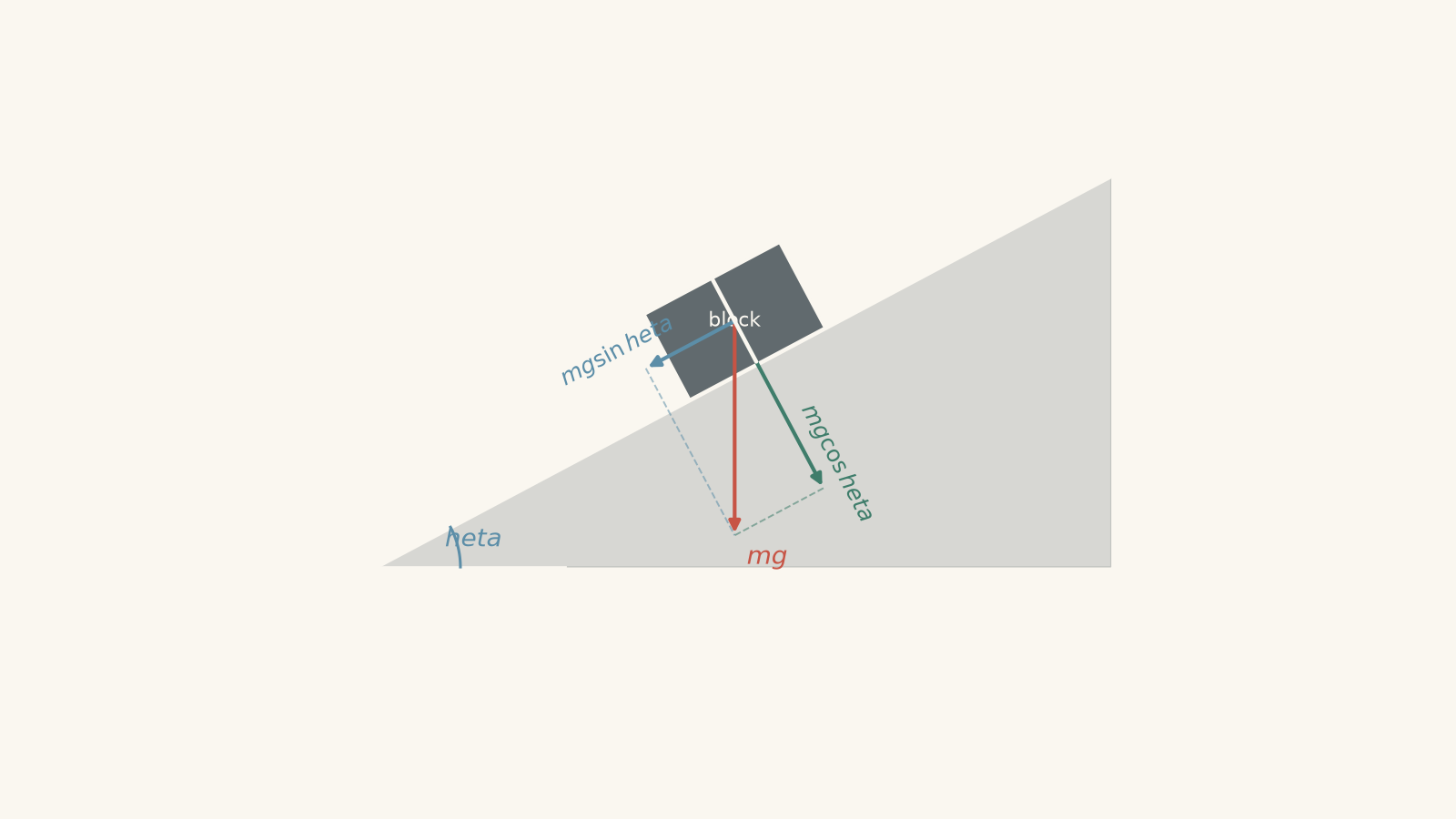
02Resolving the weight force
A block of mass \(m\) has weight
\[
W = mg
\]
where:
- \(W\) is the weight in newtons, \(\text{N}\)
- \(m\) is the mass in kilograms, \(\text{kg}\)
- \(g\) is gravitational acceleration, approximately \(9.8\text{ m s}^{-2}\)
Suppose the slope makes an angle \(\theta\) above the horizontal.
The weight has two useful components:
\[
W_\parallel = mg\sin\theta
\]
down the slope, and
\[
W_\perp = mg\cos\theta
\]
into the slope.
Why is the parallel component the sine one?
The direction perpendicular into the surface is tilted by the same angle \(\theta\) from vertical. In the right-angled force triangle, \(mg\) is the hypotenuse. The perpendicular component sits adjacent to \(\theta\), so it is \(mg\cos\theta\). The parallel component is opposite \(\theta\), so it is \(mg\sin\theta\).
If remembering that diagram feels unreliable, use limiting cases instead.
For a flat surface, \(\theta=0^\circ\):
\[
mg\sin 0^\circ = 0
\]
so gravity has no component trying to slide the object along the surface. That makes sense.
Also,
\[
mg\cos 0^\circ = mg
\]
so the entire weight acts into the surface.
Now imagine increasing the angle towards \(90^\circ\). The component down the surface approaches \(mg\), while the component into the surface approaches zero. Again, that is exactly what we would expect.
This is a much safer check than relying on “sine goes here, cosine goes there” from memory.
03The normal force is not automatically \(mg\cos\theta\)
The normal force \(N\) is the contact force exerted by the surface, perpendicular to the surface.
A common shortcut is
\[
N = mg\cos\theta
\]
but this is only true in a particular situation: the object stays in contact with the slope, and there are no other forces with perpendicular components.
The actual rule is Newton’s second law in the perpendicular direction:
\[
\sum F_\perp = ma_\perp
\]
If the object remains on a straight slope, it normally has no acceleration through or away from the surface, so
\[
a_\perp=0
\]
and therefore the perpendicular forces must balance.
If a rope pulls partly away from the surface, for example, the rope reduces the normal force. If somebody pushes partly into the surface, the normal force becomes larger.
The surface does whatever pushing is required to prevent the object passing through it. It cannot pull the object back towards itself, so a normal force cannot become negative.
04Resolving forces other than weight
Suppose a force \(F\) acts at an angle \(\phi\) above the slope.
Before using sine or cosine, ask: which component sits beside the angle \(\phi\)?
Because \(\phi\) is measured from the slope, the parallel component is adjacent:
\[
F_\parallel = F\cos\phi
\]
The perpendicular component is opposite:
\[
F_\perp = F\sin\phi
\]
If the force is pulling above the slope, that perpendicular component points away from the surface.
If the same force is directed below the line of the slope, the perpendicular component points into the surface.
| Force | Parallel component | Perpendicular component |
|---|---|---|
| Weight \(mg\) | \(mg\sin\theta\) down slope | \(mg\cos\theta\) into slope |
| Force \(F\) at angle \(\phi\) above slope, directed uphill | \(F\cos\phi\) uphill | \(F\sin\phi\) away from surface |
| Force \(F\) at angle \(\phi\) below slope, directed uphill | \(F\cos\phi\) uphill | \(F\sin\phi\) into surface |
| Normal force \(N\) | 0 | \(N\) away from surface |
| Friction \(f\) | Along the surface | 0 |
Notice that the signs have not been included in the table. You choose the signs after deciding which directions you will call positive.
For example, you might define uphill as positive. A force down the slope would then have a negative parallel component.
05A reliable method for inclined-plane problems
For most HSC inclined-plane questions, use the same sequence.
- Draw the actual forces acting on the object.
- Choose axes parallel and perpendicular to the slope.
- Resolve any force that is not already along one of those axes.
- Apply \(\sum F_\perp=ma_\perp\). If the object stays on the surface, this is usually \(\sum F_\perp=0\).
- Apply \(\sum F_\parallel=ma_\parallel\).
Do not resolve the normal force if your axes are already aligned with the slope. It already lies entirely along the perpendicular axis.
The same is true for friction. Friction acts along the contact surface, so it already lies along the parallel axis.
Worked example: How fast does a crate accelerate down a frictionless ramp?
An \(8.0\text{ kg}\) crate is released from rest on a frictionless ramp inclined at \(25^\circ\) to the horizontal. Find the normal force and the crate’s acceleration down the ramp. Use \(g=9.8\text{ m s}^{-2}\).
Step 1
\[
W=mg=(8.0)(9.8)=78.4\text{ N}
\]
The weight acts vertically down.
Step 2
\[
\begin{aligned}
W_\parallel &= mg\sin25^\circ \\
&=(78.4)\sin25^\circ \\
&=33.1\text{ N}
\end{aligned}
\]
So \(33.1\text{ N}\) acts down the slope.
Perpendicular to the slope,
\[
\begin{aligned}
W_\perp &= mg\cos25^\circ \\
&=(78.4)\cos25^\circ \\
&=71.1\text{ N}
\end{aligned}
\]
Step 3
The crate does not accelerate through the surface, so
\[
\sum F_\perp=0
\]
Therefore,
\[
N-W_\perp=0
\]
and
\[
N=71.1\text{ N}
\]
Step 4
There is no friction, so the only parallel force is \(33.1\text{ N}\) down the slope.
\[
\begin{aligned}
F_{\text{net}}&=ma\\
33.1&=(8.0)a\\
a&=4.14\text{ m s}^{-2}
\end{aligned}
\]
The crate accelerates down the slope at \(4.14\text{ m s}^{-2}\).
Notice something useful: because the only parallel force was \(mg\sin\theta\),
\[
ma=mg\sin\theta
\]
so the mass cancels:
\[
a=g\sin\theta
\]
On the same frictionless slope, objects of different masses have the same acceleration.
06A force above the slope changes the normal force
Now imagine pulling a suitcase up a ramp using a handle angled slightly above the surface.
Predict what happens to the normal force. Does pulling harder increase it, decrease it, or leave it unchanged?
It decreases.
Part of the pulling force acts away from the surface. The ground therefore does not need to push outward as strongly.
This matters when friction is present because kinetic friction is
\[
f_k=\mu_kN
\]
where \(\mu_k\) is the coefficient of kinetic friction.
So an angled pulling force can affect the motion twice: it provides an uphill component, and it reduces \(N\), which can reduce friction.
Worked example: A rope pulls a case up a rough ramp
A \(12\text{ kg}\) equipment case is already sliding up a ramp inclined at \(20^\circ\). A rope pulls with a tension of \(75\text{ N}\) at \(15^\circ\) above the ramp. The coefficient of kinetic friction is \(0.18\). Find the acceleration of the case. Use \(g=9.8\text{ m s}^{-2}\).
Step 1
The weight is
\[
W=(12)(9.8)=117.6\text{ N}
\]
Its components are
\[
\begin{aligned}
W_\parallel&=(117.6)\sin20^\circ=40.2\text{ N}\\
W_\perp&=(117.6)\cos20^\circ=110.5\text{ N}
\end{aligned}
\]
The parallel component acts down the slope, and the perpendicular component acts into the slope.
Step 2
The rope is \(15^\circ\) above the ramp, so
\[
\begin{aligned}
T_\parallel&=75\cos15^\circ=72.4\text{ N}\\
T_\perp&=75\sin15^\circ=19.4\text{ N}
\end{aligned}
\]
The parallel component acts uphill. The perpendicular component acts away from the surface.
Step 3
There is no perpendicular acceleration, so
\[
\sum F_\perp=0
\]
Taking away from the surface as positive,
\[
N+T_\perp-W_\perp=0
\]
Therefore,
\[
\begin{aligned}
N&=W_\perp-T_\perp\\
&=110.5-19.4\\
&=91.1\text{ N}
\end{aligned}
\]
This is why simply writing \(N=mg\cos20^\circ\) would be wrong.
Step 4
Because the case is moving uphill, friction acts downhill.
\[
\begin{aligned}
f_k&=\mu_kN\\
&=(0.18)(91.1)\\
&=16.4\text{ N}
\end{aligned}
\]
Step 5
Taking uphill as positive,
\[
\begin{aligned}
F_{\text{net},\parallel}
&=T_\parallel-W_\parallel-f_k\\
&=72.4-40.2-16.4\\
&=15.8\text{ N}
\end{aligned}
\]
Step 6
\[
\begin{aligned}
F_{\text{net}}&=ma\\
15.8&=(12)a\\
a&=1.32\text{ m s}^{-2}
\end{aligned}
\]
The case accelerates uphill at \(1.32\text{ m s}^{-2}\).
The angled rope did more than simply pull uphill. Its outward component reduced the normal force from the value it would otherwise have had, which also reduced the friction.
07Three tempting mistakes
Mistake 1: Treating \(mg\sin\theta\) as another force
The actual gravitational force is still \(mg\), vertically downward.
The quantities \(mg\sin\theta\) and \(mg\cos\theta\) are components of that one force. Do not draw \(mg\), \(mg\sin\theta\), and \(mg\cos\theta\) as three separate forces on the same free-body diagram.
Mistake 2: Assuming \(N=mg\cos\theta\) every time
This only works when the other perpendicular forces do not affect the balance.
A rope pulling away from the slope reduces \(N\). A push into the slope increases \(N\).
Always start from
\[
\sum F_\perp=ma_\perp
\]
rather than treating \(N=mg\cos\theta\) as a definition.
Mistake 3: Assuming friction always acts up the slope
Friction opposes relative motion, or the tendency for relative motion, between surfaces.
An object sliding down a slope experiences friction uphill.
An object being dragged uphill experiences friction downhill.
For static friction, do not automatically write
\[
f_s=\mu_sN
\]
The correct relationship is
\[
f_s\leq\mu_sN
\]
Static friction adjusts to the amount required, up to its maximum value.
08Questions and solutions
Question 1
A \(5.0\text{ kg}\) block is released on a frictionless slope inclined at \(35^\circ\) to the horizontal. Calculate:
- the component of its weight down the slope
- the component of its weight into the slope
- its acceleration
Use \(g=9.8\text{ m s}^{-2}\).
Solution 1
The weight components are \(28.1\text{ N}\) down the slope and \(40.1\text{ N}\) into the slope, and the acceleration is \(5.62\text{ m s}^{-2}\) down the slope.
The total weight is
\[
W=mg=(5.0)(9.8)=49.0\text{ N}
\]
The parallel component is
\[
\begin{aligned}
W_\parallel&=mg\sin35^\circ\\
&=(49.0)\sin35^\circ\\
&=28.1\text{ N}
\end{aligned}
\]
The perpendicular component is
\[
\begin{aligned}
W_\perp&=mg\cos35^\circ\\
&=(49.0)\cos35^\circ\\
&=40.1\text{ N}
\end{aligned}
\]
There is no friction, so the net parallel force is \(28.1\text{ N}\).
\[
\begin{aligned}
F_{\text{net}}&=ma\\
28.1&=(5.0)a\\
a&=5.62\text{ m s}^{-2}
\end{aligned}
\]
The perpendicular component does not make the block accelerate into the surface because the normal force balances it.
Question 2
A \(10\text{ kg}\) block sits on a frictionless \(30^\circ\) slope. A \(50\text{ N}\) force is applied uphill at \(20^\circ\) below the line of the slope, so the force is partly directed into the surface.
Find the normal force and the acceleration of the block.
Use \(g=9.8\text{ m s}^{-2}\).
Solution 2
The normal force is approximately \(102\text{ N}\), and the block accelerates at \(0.202\text{ m s}^{-2}\) down the slope.
The weight components are
\[
\begin{aligned}
W_\parallel&=(10)(9.8)\sin30^\circ=49.0\text{ N}\\
W_\perp&=(10)(9.8)\cos30^\circ=84.9\text{ N}
\end{aligned}
\]
Resolve the applied force. Its uphill component is
\[
F_\parallel=50\cos20^\circ=47.0\text{ N}
\]
Its perpendicular component is
\[
F_\perp=50\sin20^\circ=17.1\text{ N}
\]
Because the force is directed below the line of the slope, this \(17.1\text{ N}\) component pushes into the surface.
There is no perpendicular acceleration, so
\[
N-W_\perp-F_\perp=0
\]
Hence
\[
\begin{aligned}
N&=84.9+17.1\\
&=102\text{ N}
\end{aligned}
\]
Now take uphill as positive. The net parallel force is
\[
\begin{aligned}
F_{\text{net},\parallel}
&=47.0-49.0\\
&=-2.02\text{ N}
\end{aligned}
\]
Therefore,
\[
\begin{aligned}
a&=\frac{-2.02}{10}\\
&=-0.202\text{ m s}^{-2}
\end{aligned}
\]
The negative sign means the acceleration is downhill.
The trap is that an applied force pointing uphill does not guarantee uphill acceleration. Its parallel component must be large enough to overcome the forces acting downhill.
Question 3
A \(6.0\text{ kg}\) block remains at rest on a \(32^\circ\) slope because of static friction. No other applied forces act.
Find the static friction force, the normal force, and the minimum coefficient of static friction needed to prevent slipping.
Use \(g=9.8\text{ m s}^{-2}\).
Solution 3
Static friction is \(31.2\text{ N}\) uphill, the normal force is \(49.9\text{ N}\), and the minimum coefficient of static friction is approximately \(0.625\).
Because the block is stationary,
\[
\sum F_\parallel=0
\]
The weight component down the slope is
\[
\begin{aligned}
W_\parallel
&=mg\sin32^\circ\\
&=(6.0)(9.8)\sin32^\circ\\
&=31.2\text{ N}
\end{aligned}
\]
Static friction must therefore provide \(31.2\text{ N}\) uphill.
The normal force is found from the perpendicular direction:
\[
\begin{aligned}
N&=mg\cos32^\circ\\
&=(6.0)(9.8)\cos32^\circ\\
&=49.9\text{ N}
\end{aligned}
\]
At the minimum coefficient capable of preventing slipping, the friction is at its maximum value:
\[
f_{s,\max}=\mu_sN
\]
Therefore,
\[
\begin{aligned}
\mu_s
&=\frac{f_s}{N}\\
&=\frac{31.2}{49.9}\\
&=0.625
\end{aligned}
\]
Equivalently,
\[
\mu_s=\tan32^\circ
\]
The important distinction is that \(f_s=\mu_sN\) is valid here only because we are finding the minimum coefficient. At that limiting condition, static friction has reached its maximum possible value.
Question 4
A \(4.0\text{ kg}\) block is on a frictionless \(25^\circ\) slope. A cable pulls the block uphill at \(40^\circ\) above the surface.
A student claims that the normal force must remain \(mg\cos25^\circ\) regardless of the cable tension.
Find the cable tension at which the block is just about to lose contact with the slope. Also find its acceleration parallel to the slope at that instant.
Use \(g=9.8\text{ m s}^{-2}\).
Solution 4
The block loses contact when the cable tension reaches about \(55.3\text{ N}\), and its parallel acceleration at that instant is about \(6.44\text{ m s}^{-2}\) uphill. The student’s claim is incorrect because the cable has a component pulling away from the slope.
Before contact is lost, the perpendicular acceleration is zero.
The weight component into the surface is
\[
mg\cos25^\circ
\]
The cable’s outward component is
\[
T\sin40^\circ
\]
So the perpendicular force equation is
\[
N+T\sin40^\circ-mg\cos25^\circ=0
\]
At the instant the block is about to lose contact,
\[
N=0
\]
because the surface can no longer exert a pushing force once contact disappears.
Therefore,
\[
T\sin40^\circ=mg\cos25^\circ
\]
and
\[
\begin{aligned}
T
&=\frac{(4.0)(9.8)\cos25^\circ}{\sin40^\circ}\\
&=55.3\text{ N}
\end{aligned}
\]
Now resolve the forces parallel to the slope.
The cable provides
\[
T\cos40^\circ
\]
uphill, while gravity provides
\[
mg\sin25^\circ
\]
downhill.
Thus,
\[
\begin{aligned}
F_{\text{net},\parallel}
&=(55.3)\cos40^\circ-(4.0)(9.8)\sin25^\circ\\
&=25.8\text{ N}
\end{aligned}
\]
Then
\[
\begin{aligned}
a_\parallel
&=\frac{25.8}{4.0}\\
&=6.44\text{ m s}^{-2}
\end{aligned}
\]
The normal force was not fixed at \(mg\cos25^\circ\). It became smaller as the cable tension increased, eventually reaching zero.
Question 5
A \(6.0\text{ kg}\) block rests on a frictionless incline at angle \(\theta\). A horizontal force \(P\) pushes the block towards the higher end of the slope and into the surface.
Derive expressions for \(P\) and the normal force \(N\) that will keep the block at rest. Then evaluate both forces for \(\theta=60^\circ\).
Finally, explain what your equations predict as \(\theta\) approaches \(90^\circ\).
Use \(g=9.8\text{ m s}^{-2}\).
Solution 5
To hold the block at rest, \(P=mg\tan\theta\) and \(N=mg\sec\theta\). At \(60^\circ\), \(P\approx102\text{ N}\) and \(N\approx118\text{ N}\). Both forces increase without bound as \(\theta\) approaches \(90^\circ\).
The horizontal force \(P\) is not parallel to the slope.
Because the slope is at angle \(\theta\) to the horizontal, the component of \(P\) parallel to the slope is
\[
P_\parallel=P\cos\theta
\]
and the component pushing into the slope is
\[
P_\perp=P\sin\theta
\]
For equilibrium parallel to the slope,
\[
P\cos\theta-mg\sin\theta=0
\]
so
\[
\begin{aligned}
P\cos\theta&=mg\sin\theta\\
P&=mg\tan\theta
\end{aligned}
\]
Now consider the perpendicular direction.
Both \(mg\cos\theta\) and \(P\sin\theta\) push into the surface, so
\[
N=mg\cos\theta+P\sin\theta
\]
Substitute \(P=mg\tan\theta\):
\[
N=mg\cos\theta+mg\tan\theta\sin\theta
\]
Since
\[
\tan\theta=\frac{\sin\theta}{\cos\theta}
\]
we get
\[
\begin{aligned}
N
&=mg\cos\theta+mg\frac{\sin^2\theta}{\cos\theta}\\
&=mg\frac{\cos^2\theta+\sin^2\theta}{\cos\theta}\\
&=\frac{mg}{\cos\theta}\\
&=mg\sec\theta
\end{aligned}
\]
For \(m=6.0\text{ kg}\) and \(\theta=60^\circ\),
\[
\begin{aligned}
P
&=(6.0)(9.8)\tan60^\circ\\
&\approx102\text{ N}
\end{aligned}
\]
and
\[
\begin{aligned}
N
&=(6.0)(9.8)\sec60^\circ\\
&=117.6\text{ N}\\
&\approx118\text{ N}
\end{aligned}
\]
As \(\theta\) approaches \(90^\circ\), both \(\tan\theta\) and \(\sec\theta\) grow without bound.
That limiting case tells us something physical. A \(90^\circ\) frictionless surface is a vertical wall. A horizontal push can press the block against the wall, but it cannot provide any upward force to balance gravity. No finite horizontal push can hold the block stationary against a perfectly frictionless vertical wall.
09What this method unlocks next
Resolving forces parallel and perpendicular to a slope turns most inclined-plane problems into two ordinary one-dimensional Newton’s law problems.
The perpendicular equation usually tells you the normal force. That becomes essential once friction appears because friction depends on \(N\). The parallel equation then tells you whether the object remains in equilibrium or accelerates.
The next useful step is therefore not another formula for slopes. It is learning to combine these components with static and kinetic friction, where deciding whether an object actually moves becomes just as important as calculating the forces.