
Frequency and Period in HSC Physics: Using f = 1/T
Learn how frequency and period describe repeating motion, how to use f = 1/T, and how to interpret cycles per second correctly.
A vibrating object completes one full cycle every 0.20 s. Another completes one every 0.50 s. Which one has the greater frequency?
You can probably tell that the first object is cycling faster. But HSC Physics needs more than “faster”. We need a number that tells us exactly how often the motion repeats.
That is what frequency does. It counts cycles per second. Period looks at the same repeating motion from the other direction: it measures how long one cycle takes.
These two quantities are reciprocals, which gives one of the simplest and most useful relationships in Physics:
\[
f = \frac{1}{T}
\]
The equation is easy. Interpreting it correctly is where students sometimes get caught.
01Start by picturing one complete cycle
Imagine a mass hanging from a spring. Pull it down and release it.
It moves:
- from the bottom,
- through the middle,
- to the top,
- back through the middle,
- and finally to the bottom again.
Only then has it completed one full cycle.
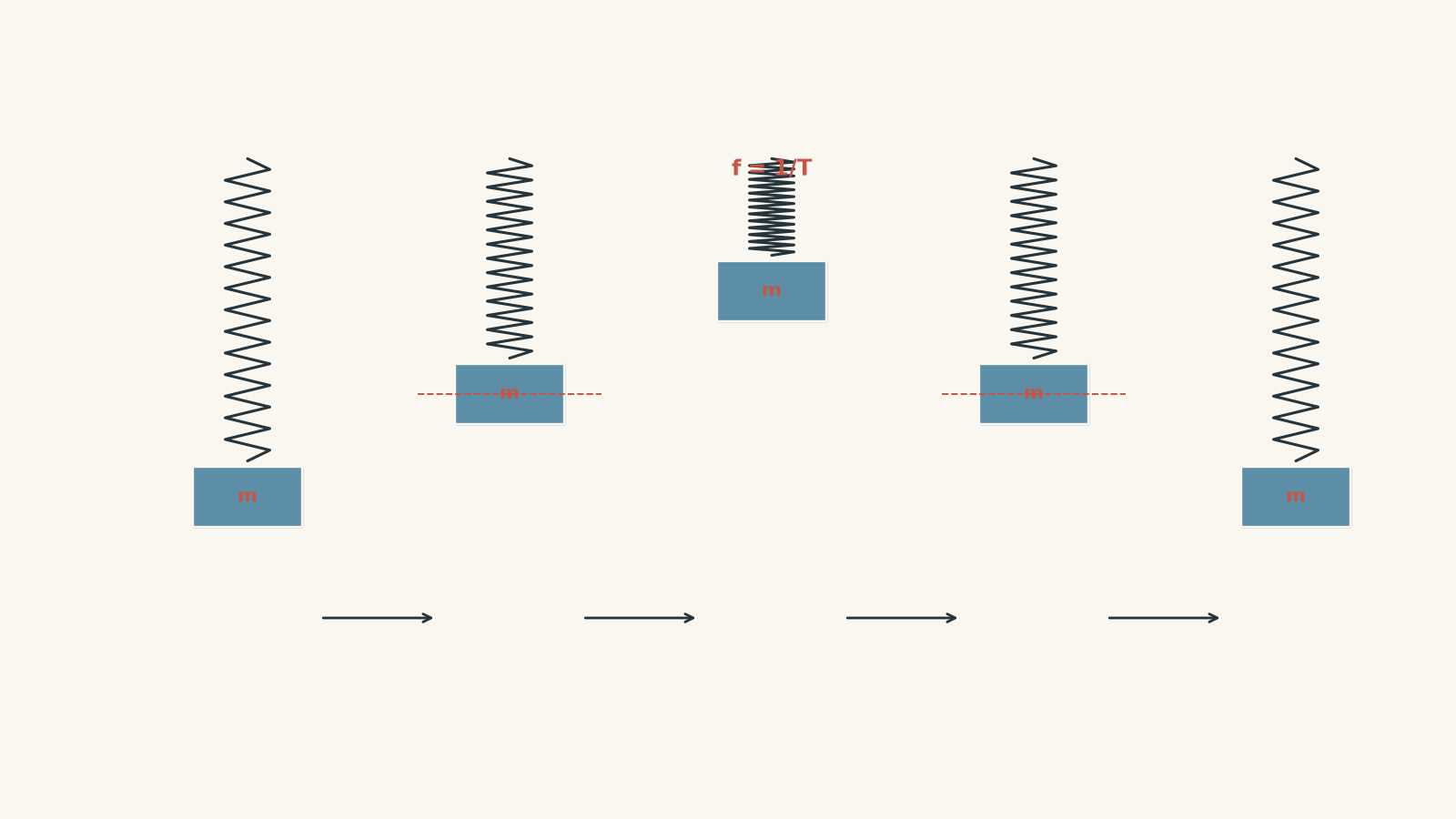
Suppose this full cycle takes 0.40 s.
Before reading on, predict this: how many complete cycles would the mass perform in one second?
One cycle takes 0.40 s, so two cycles take 0.80 s. In one second, it would complete \(2.5\) cycles.
Its frequency is therefore \(2.5\) cycles per second.
We give cycles per second a special unit:
\[
1\text{ Hz} = 1\text{ cycle per second}
\]
So the mass has a frequency of \(2.5\text{ Hz}\).
Notice that a frequency does not need to be a whole number. A frequency of \(2.5\text{ Hz}\) means the motion completes, on average, 2.5 cycles every second.
02Period and frequency describe the same repetition
The period, \(T\), is the time taken for one complete cycle.
The frequency, \(f\), is the number of complete cycles per second.
| Quantity | Meaning | Symbol | SI unit |
|---|---|---|---|
| Period | Time for one complete cycle | \(T\) | second (s) |
| Frequency | Number of complete cycles per second | \(f\) | hertz (Hz) |
These are not two unrelated measurements. They are two ways of describing the same repeating process.
If each cycle takes a long time, not many cycles fit into one second. The frequency is low.
If each cycle takes very little time, many cycles fit into one second. The frequency is high.
That inverse relationship gives:
\[
f = \frac{1}{T}
\]
where:
- \(f\) is frequency in hertz (Hz),
- \(T\) is period in seconds (s).
You can rearrange the same relationship to find period:
\[
T = \frac{1}{f}
\]
There is no new physics in the second equation. It is just the first equation rearranged.
03Why does \(f = \frac{1}{T}\) work?
Suppose one cycle takes \(0.25\text{ s}\).
How many \(0.25\text{ s}\) chunks fit into one second?
\[
\frac{1\text{ s}}{0.25\text{ s per cycle}} = 4\text{ cycles}
\]
So the motion has a frequency of \(4\text{ Hz}\).
The equation \(f = 1/T\) is simply doing that division.
The units also tell the story:
\[
f = \frac{1}{T}
= \frac{1}{\text{s}}
= \text{s}^{-1}
\]
A hertz is equivalent to \(\text{s}^{-1}\). In this context, that means “per second”.
So \(8\text{ Hz}\) means \(8\) cycles per second.
Worked example: Find the frequency of an oscillating spring
A mass attached to a spring takes \(0.80\text{ s}\) to complete one full oscillation. Calculate its frequency.
Step 1
The \(0.80\text{ s}\) is the time for one complete cycle, so it is the period:
\[
T = 0.80\text{ s}
\]
Step 2
\[
f = \frac{1}{T}
\]
Step 3
\[
f = \frac{1}{0.80\text{ s}} = 1.25\text{ Hz}
\]
Step 4
The frequency is \(\boxed{1.25\text{ Hz}}\). The spring completes \(1.25\) oscillations per second.
That does not mean each oscillation takes \(1.25\text{ s}\). That number is the frequency, not the period.
04The most tempting misconception: mixing up the numbers
Suppose a wave has a frequency of \(5\text{ Hz}\).
A student might say, “Its period is \(5\text{ s}\).”
That mistake feels reasonable because both quantities describe repetition. But they describe different things.
A frequency of \(5\text{ Hz}\) means:
five cycles fit into one second.
If five equal cycles fit into one second, each individual cycle must take only one fifth of a second:
\[
T = \frac{1}{f}
= \frac{1}{5\text{ Hz}}
= 0.20\text{ s}
\]
So:
- \(f = 5\text{ Hz}\),
- \(T = 0.20\text{ s}\).
A useful quick check is this:
High frequency should give a short period. Low frequency should give a long period.
If your calculation gives both a very high frequency and a very long period, something has gone wrong.
Think of a rotating ceiling fan. If it somehow completed 20 rotations every second, one rotation clearly could not take 20 seconds. The two numbers move in opposite directions.
05Frequency is about complete cycles
Counting cycles sounds simple until the motion is shown on a graph.
For an oscillation, one cycle is not just “moving from one side to the other”. The object must return to the same stage of its motion.
For example, from one maximum displacement to the next maximum displacement is one full cycle.
So is:
- one minimum to the next minimum,
- one upward crossing of equilibrium to the next upward crossing of equilibrium.
But a maximum to the next minimum is only half a cycle.
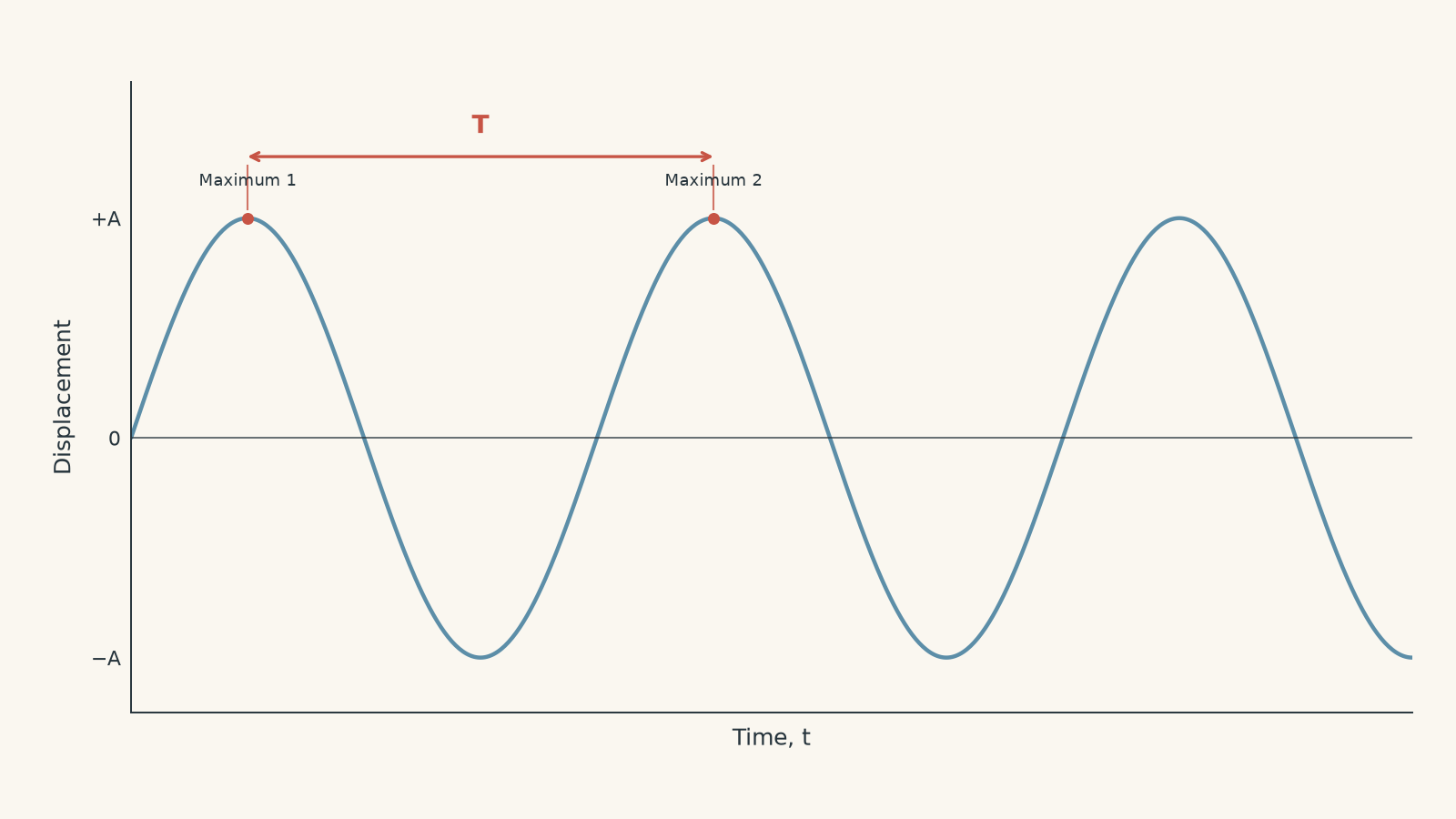
This matters when finding period from a graph. Measure between two equivalent points in consecutive cycles.
Worked example: Find frequency from repeated motion
A buoy rises and falls with passing water waves. It reaches its highest point at \(t=1.2\text{ s}\) and reaches its next highest point at \(t=1.95\text{ s}\). Calculate the period and frequency of the motion.
Step 1
The period is the time between them:
\[
T = 1.95\text{ s} – 1.20\text{ s} = 0.75\text{ s}
\]
Step 2
\[
f = \frac{1}{0.75\text{ s}} = 1.33\text{ Hz}
\]
Step 3
The period is \(\boxed{0.75\text{ s}}\), so each full rise-and-fall cycle takes \(0.75\text{ s}\).
The frequency is \(\boxed{1.33\text{ Hz}}\), so the buoy completes about \(1.33\) cycles each second.
The important step was not the arithmetic. It was recognising which two observations marked one complete cycle.
06Counting several cycles can give a better period
In an experiment, measuring one short cycle can magnify timing error.
Suppose you time ten oscillations of a pendulum and obtain \(16.0\text{ s}\). The period is not \(16.0\text{ s}\), because that was the time for ten cycles.
Instead:
\[
T = \frac{\text{total time}}{\text{number of cycles}}
= \frac{16.0\text{ s}}{10}
= 1.60\text{ s}
\]
Then:
\[
f = \frac{1}{1.60\text{ s}}
= 0.625\text{ Hz}
\]
This is often a more reliable experimental method because a small reaction-time error is spread across many cycles rather than dominating the measurement of one cycle.
There is one assumption hiding here: the motion must be reasonably periodic. If every cycle takes a very different amount of time, a single period is no longer a complete description of the motion.
07A useful decision rule
When a frequency-period question appears, first ask what the number actually describes.
- If you are given the time for one cycle, you have \(T\).
- If you are given cycles per second, you have \(f\).
- If you are given the total time for several cycles, divide by the number of cycles to find \(T\) first.
- If you are reading a graph, identify two points that represent the same stage of consecutive cycles.
Only then choose \(f = 1/T\) or \(T = 1/f\).
This prevents a common problem where a student remembers the formula correctly but feeds the wrong quantity into it.
08Questions and solutions
Question 1
A vibrating ruler completes one oscillation every \(0.125\text{ s}\). Calculate its frequency.
Solution 1
The frequency is \(\boxed{8.00\text{ Hz}}\), meaning the ruler completes eight oscillations each second.
The given time is the period:
\[
T = 0.125\text{ s}
\]
Using the frequency-period relationship:
\[
f = \frac{1}{T}
= \frac{1}{0.125\text{ s}}
= 8.00\text{ Hz}
\]
The result also passes the sense check. A very short period should correspond to a relatively high frequency.
Question 2
A wave source operates at \(40\text{ Hz}\).
Calculate the period of one cycle, and state how many complete cycles occur in \(0.50\text{ s}\).
Solution 2
The period is \(\boxed{0.025\text{ s}}\), and \(\boxed{20}\) complete cycles occur in \(0.50\text{ s}\).
First find the period:
\[
T = \frac{1}{f}
= \frac{1}{40\text{ Hz}}
= 0.025\text{ s}
\]
So each cycle lasts \(0.025\text{ s}\).
The number of cycles in \(0.50\text{ s}\) is:
\[
N = \frac{0.50\text{ s}}{0.025\text{ s per cycle}}
= 20
\]
Equivalently, \(40\) cycles occur each second, so in half a second there are \(20\) cycles.
The trap is to treat \(40\text{ Hz}\) as a time. Hertz describes cycles per second, not seconds per cycle.
Question 3
During an experiment, a student records the time at which an oscillating mass reaches its maximum displacement:
| Maximum number | Time (s) |
|---|---|
| 1 | 2.4 |
| 2 | 3.1 |
| 3 | 3.8 |
| 4 | 4.5 |
Determine the period and frequency of the oscillation.
Solution 3
The period is \(\boxed{0.70\text{ s}}\), and the frequency is approximately \(\boxed{1.43\text{ Hz}}\).
Successive maxima represent the same stage of consecutive cycles, so the time between them is one period:
\[
T = 3.1\text{ s} – 2.4\text{ s}
= 0.70\text{ s}
\]
The same interval appears between the other maxima, confirming that the motion is periodic.
Now calculate frequency:
\[
f = \frac{1}{T}
= \frac{1}{0.70\text{ s}}
\approx 1.43\text{ Hz}
\]
This means the mass completes about \(1.43\) full oscillations each second.
A tempting mistake is to use \(2.4\text{ s}\) as the period because it is the first time listed. It is not. The period is an interval between equivalent points, not necessarily the time measured from \(t=0\).
Question 4
Two oscillators, A and B, are observed.
Oscillator A completes 12 cycles in \(8.0\text{ s}\).
Oscillator B has a period of \(0.80\text{ s}\).
Which oscillator has the greater frequency, and by how much?
Solution 4
Oscillator A has the greater frequency by \(\boxed{0.25\text{ Hz}}\).
For oscillator A, first calculate its frequency directly from cycles per second:
\[
f_A = \frac{12}{8.0\text{ s}}
= 1.50\text{ Hz}
\]
For oscillator B:
\[
f_B = \frac{1}{T_B}
= \frac{1}{0.80\text{ s}}
= 1.25\text{ Hz}
\]
Therefore:
\[
\Delta f = 1.50\text{ Hz} – 1.25\text{ Hz}
= 0.25\text{ Hz}
\]
So oscillator A cycles more frequently.
The useful reasoning check is that oscillator A has an average period of:
\[
T_A = \frac{8.0\text{ s}}{12}
\approx 0.667\text{ s}
\]
That is shorter than oscillator B’s \(0.80\text{ s}\) period, so A should indeed have the greater frequency.
Question 5
A student watches an object undergoing repeating motion. During the first \(6.0\text{ s}\), it completes 12 cycles. During the next \(6.0\text{ s}\), it completes only 8 cycles.
The student states, “The period of the object is \(0.60\text{ s}\), because it completed 20 cycles in 12 seconds.”
Assess this statement.
Solution 5
The value \(\boxed{0.60\text{ s}}\) is the average time per cycle over the full 12 s interval, but it is misleading to call it one fixed period for the motion.
Across the complete observation:
\[
T_{\text{average}}
= \frac{12\text{ s}}{20}
= 0.60\text{ s}
\]
However, the first section gives:
\[
T_1 = \frac{6.0\text{ s}}{12}
= 0.50\text{ s}
\]
while the second gives:
\[
T_2 = \frac{6.0\text{ s}}{8}
= 0.75\text{ s}
\]
The cycle time has changed.
Equivalently, the frequencies are:
\[
f_1 = \frac{12}{6.0\text{ s}} = 2.0\text{ Hz}
\]
and
\[
f_2 = \frac{8}{6.0\text{ s}} \approx 1.33\text{ Hz}
\]
So the motion does not have one constant period over the whole interval.
The student’s calculation is arithmetically correct as an average, but the interpretation is incomplete. The relationship \(f=1/T\) is most straightforward when the repeating motion has a well-defined period. If the rate changes with time, we need to specify whether we mean an instantaneous, local, or average frequency.
09Where frequency and period lead next
Frequency and period become especially useful once you start analysing waves.
A wave source that oscillates at a particular frequency produces repeated disturbances at that same rate. Once frequency is combined with wavelength, you can connect how often wave cycles are produced to how quickly the wave travels:
\[
v = f\lambda
\]
Here, \(v\) is wave speed, \(f\) is frequency, and \(\lambda\) is wavelength.
So \(f = 1/T\) is not just a conversion formula. It is the link between how long one cycle takes and how often cycles occur, which is exactly the language needed to describe oscillations and waves.