
Gyroscopic Precession: How Torque Changes Angular Momentum
Discover why a rapidly spinning gyroscope precesses sideways instead of simply falling. Develop the relationship between torque and angular momentum, derive the steady-precession equation, and apply it through worked examples and challenging extension questions.
A spinning bicycle wheel is held horizontally by one end of its axle. Release the free end, and something unexpected happens: instead of simply dropping, the axle begins sweeping sideways around the support.
Gravity is still pulling down. The wheel has not escaped its weight. So why does it move sideways?
The answer is that gravity produces a torque, and that torque changes the direction of the wheel’s angular momentum. This sideways change in rotational motion is called gyroscopic precession.
Before we work through the physics, make a prediction. If the wheel spins twice as fast, will its axle precess twice as fast, or twice as slowly? Keep your prediction in mind. The answer comes from understanding the relationship between torque and angular momentum.
This article is an extension beyond the required HSC Physics syllabus, not an assessment requirement. It uses the Year 12 Advanced mechanics foundation as a starting point, then develops the additional physics of gyroscopic precession. NESA’s 2025 Physics 11-12 syllabus is scheduled to begin implementation in 2027, with Advanced mechanics included as a Year 12 focus area.
01Start with the familiar model: projectile motion
Before considering a spinning wheel, recall what happens to an ordinary object moving under gravity.
Imagine kicking a football horizontally. Once it leaves your foot, gravity is the only force acting if we ignore air resistance.
The ball continues moving horizontally while accelerating vertically downwards. Its trajectory curves, even though there is no horizontal force.
Why?
Newton’s second law explains the motion. The acceleration of an object depends on the net force acting on it.
Choose:
- The \(x\)-axis as the horizontal direction.
- The \(y\)-axis as the vertical direction, positive upwards.
The only force is the ball’s weight, \(mg\), acting vertically downwards.
Resolving Newton’s second law into components gives:
\[ \sum F_x=0 \quad\Rightarrow\quad a_x=0 \]
\[ \sum F_y=-mg \quad\Rightarrow\quad a_y=-g \]
Here, \(m\) is the ball’s mass, \(g\) is the gravitational field strength, and \(a_x\) and \(a_y\) are its horizontal and vertical accelerations.
Near Earth’s surface, we approximate \(g\) as constant at \(9.8\text{ m s}^{-2}\).
The consequences are:
- Horizontal acceleration is zero, so horizontal velocity remains constant.
- Vertical acceleration is constant and downward, so vertical velocity changes uniformly.
The velocity components are:
\[ v_x=v_{x0} \]
\[ v_y=v_{y0}-gt \]
The ball follows a curved path because its horizontal and vertical motions change independently.
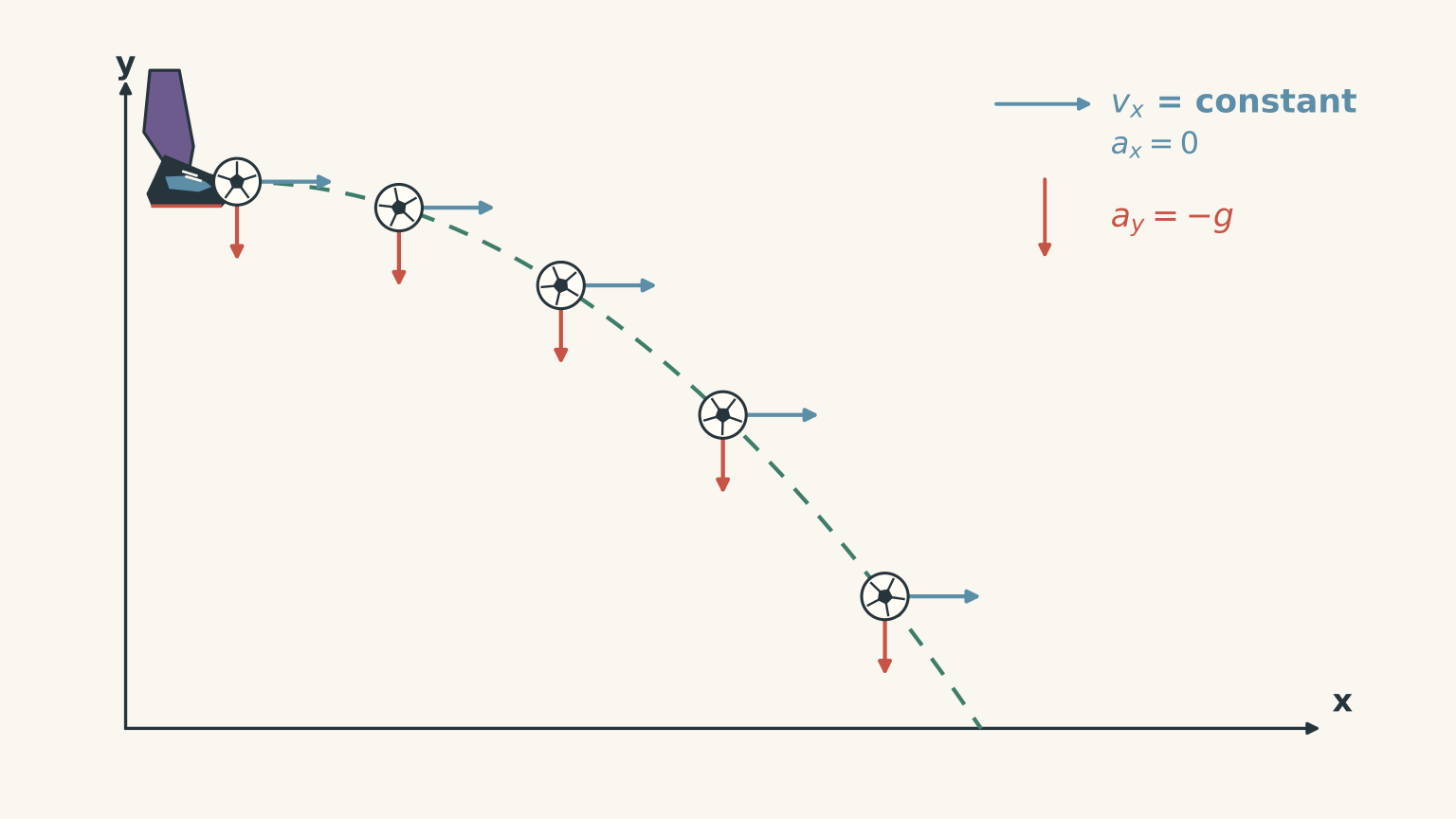
Due to technical limitations, this figure may display incorrectly or contain inaccuracies. Please check key details against your course materials.
This model relies on two important assumptions: the gravitational field is uniform, and air resistance is negligible.
The key idea is that a force determines how momentum changes. With no horizontal force, there is no horizontal acceleration.
We can extend this reasoning to rotation.
Instead of asking how a force changes an object’s linear momentum, we can ask how a turning effect changes its angular momentum.
02From force to torque
Think about opening a classroom door.
Pushing near the handle turns the door easily. Pushing with the same force close to the hinges is much less effective.
The difference is the distance from the pivot.
This turning effect is called torque.
Torque depends on the applied force and its perpendicular distance from the pivot. In vector notation:
\[ \vec{\tau}=\vec r\times\vec F \]
Its magnitude is:
\[ \tau=rF\sin\beta \]
where:
- \(\tau\) is the torque, measured in newton metres (N m).
- \(r\) is the distance from the pivot to the point where the force acts, in metres.
- \(F\) is the force, in newtons.
- \(\beta\) is the angle between the position vector and the force.
The cross product symbol indicates that torque has a direction as well as a magnitude. Its direction is perpendicular to the plane containing the position vector and force, determined using the right-hand rule.
The door analogy helps explain the importance of the lever arm, but it does not yet explain gyroscopic motion. For that, we need angular momentum.
Consider a spinning wheel supported at one end of its axle. Gravity acts on the wheel’s centre of mass, which is some distance from the pivot.
The weight therefore produces a torque about the pivot.
If the axle makes an angle \(\alpha\) with the vertical, the gravitational torque has magnitude:
\[ \tau=Mg\ell\sin\alpha \]
Here, \(M\) is the total mass of the gyroscope and \(\ell\) is the distance from the pivot to its centre of mass.
Notice that the torque depends on the perpendicular distance from the pivot to the line of action of gravity.
There is an important detail here. The support also exerts a force on the gyroscope, but that force acts at the pivot. Its torque about that pivot is zero because its lever arm is zero.
Gravity, however, acts away from the pivot. Its torque is what produces the rotational effect.
03Angular momentum: the missing piece
A spinning wheel possesses angular momentum.
For a rigid rotor spinning about a principal axis, the magnitude of its spin angular momentum is:
\[ L=I\omega \]
where:
- \(L\) is the magnitude of angular momentum, in \(\text{kg m}^2\text{ s}^{-1}\).
- \(I\) is the moment of inertia about the spin axis, in \(\text{kg m}^2\).
- \(\omega\) is the angular velocity of the rotor, in \(\text{rad s}^{-1}\).
The moment of inertia measures how difficult it is to change the object’s rotational motion. It depends on how its mass is distributed around the axis.
Angular momentum is a vector. For a symmetrical flywheel spinning about its central axis, its direction lies along the axle and is determined by the right-hand rule.
This direction is crucial.
A spinning wheel does not merely have a certain amount of rotational motion. It has rotational motion oriented in a particular direction.
The rotational equivalent of Newton’s second law is:
\[ \boxed{\vec{\tau}_{\text{net}} =\frac{d\vec L}{dt}} \]
The net external torque about a fixed reference point equals the rate of change of angular momentum about that point.
This is the central relationship behind gyroscopic precession.
If you want to refresh the broader ideas of angular momentum and conservation, see Angular Momentum: Why Kepler’s Equal-Areas Law Works.
A torque can change direction without changing magnitude
Imagine angular momentum as an arrow.
The length of the arrow represents the magnitude of angular momentum. Its orientation represents the direction of rotation.
Now apply a torque perpendicular to this arrow.
The torque produces a small change in angular momentum, \(\Delta\vec L\), in the direction of the torque.
The new angular momentum is the vector sum:
\[ \vec L_{\text{new}} = \vec L_{\text{old}}+\Delta\vec L \]
Because the change is perpendicular to the original angular momentum, the arrow changes direction.
If the torque remains perpendicular to angular momentum throughout the motion, its magnitude stays constant.
This is different from pushing a stationary object in a particular direction. The torque does not simply make the spinning wheel rotate in the direction of the torque.
It changes the direction of the angular momentum the wheel already possesses.
That distinction explains the apparently strange motion of a gyroscope.
04Why a gyroscope precesses instead of falling
Return to the spinning wheel supported at one end.
There are two different situations to consider.
Situation 1: The wheel is not spinning.
The gravitational torque acts on the wheel and produces angular acceleration. The wheel begins rotating downwards and falls.
There is no substantial pre-existing spin angular momentum to redirect.
Situation 2: The wheel is spinning rapidly.
The wheel already has a large angular momentum vector along its axle.
Gravity still produces torque, but in the idealised gyroscope model this torque is perpendicular to the dominant spin angular momentum.
Consequently, the torque changes the direction of angular momentum rather than its magnitude.
The wheel’s axis begins changing direction sideways.
Instead of simply falling, the axle sweeps around the vertical axis. This motion is called precession.
The wheel continues spinning rapidly about its own axle while that axle slowly rotates around the vertical direction.
These are two different rotations happening simultaneously:
- Spin: the rapid rotation of the flywheel about its own axle.
- Precession: the slower rotation of the axle around the vertical axis.
The important point is that the gyroscope is not avoiding gravity.
Gravity is responsible for its precession.
Without the gravitational torque, there would be no gravitationally driven precession in this setup.
05Calculating the precession rate
We can now develop a relationship between gravitational torque and the speed of precession.
Consider a gyroscope with:
- Total mass \(M\).
- Centre of mass a distance \(\ell\) from the pivot.
- Moment of inertia \(I\) about its spin axis.
- Spin angular velocity \(\omega\).
- Tilt angle \(\alpha\) from the vertical.
Assume the gyroscope spins sufficiently rapidly that its angular momentum is dominated by its rotation about the flywheel axis.
Its angular momentum has magnitude:
\[ L\approx I\omega \]
The gravitational torque is:
\[ \tau=Mg\ell\sin\alpha \]
Now consider what happens as the gyroscope precesses.
Its angular momentum vector sweeps around the vertical axis, tracing a cone. The angle between the angular momentum vector and the vertical is approximately \(\alpha\).
Let \(\phi\) represent the angle through which the vector precesses around the vertical axis.
The tip of the angular momentum vector moves around a circle of radius \(L\sin\alpha\).
For a small change in precession angle \(d\phi\), the magnitude of the change in angular momentum is approximately:
\[ dL=L\sin\alpha\,d\phi \]
Divide by the time interval \(dt\):
\[ \frac{dL}{dt} = L\sin\alpha\frac{d\phi}{dt} \]
Define the precession angular velocity as:
\[ \Omega=\frac{d\phi}{dt} \]
The torque law gives:
\[ \tau=L\sin\alpha\,\Omega \]
Substitute the gravitational torque:
\[ Mg\ell\sin\alpha = L\sin\alpha\,\Omega \]
For a tilted gyroscope, the common \(\sin\alpha\) term cancels.
Therefore:
\[ \Omega=\frac{Mg\ell}{L} \]
Using \(L\approx I\omega\):
\[ \boxed{\Omega\approx \frac{Mg\ell}{I\omega}} \]
This is the approximate angular velocity of steady gyroscopic precession.
What does the equation tell us?
The equation reveals several important relationships.
| Change | Effect on precession rate |
|---|---|
| Increase the gyroscope’s mass | Increases |
| Increase the distance from pivot to centre of mass | Increases |
| Increase gravitational field strength | Increases |
| Increase moment of inertia, with spin speed fixed | Decreases |
| Increase spin angular velocity, with moment of inertia fixed | Decreases |
The relationship answers our opening prediction.
If the wheel spins twice as fast, its angular momentum doubles. The same gravitational torque now takes longer to change its direction by the same angle.
Therefore, its precession angular velocity halves.
A faster-spinning gyroscope precesses more slowly, provided the other quantities remain unchanged.
Symbols and units
| Symbol | Meaning | SI unit |
|---|---|---|
| \(M\) | Total gyroscope mass | kg |
| \(g\) | Gravitational field strength | m s⁻² |
| \(\ell\) | Pivot-to-centre-of-mass distance | m |
| \(I\) | Moment of inertia about spin axis | kg m² |
| \(\omega\) | Spin angular velocity | rad s⁻¹ |
| \(L\) | Spin angular momentum magnitude | kg m² s⁻¹ |
| \(\Omega\) | Precession angular velocity | rad s⁻¹ |
| \(\alpha\) | Angle between axle and vertical | rad or degrees |
When is this equation valid?
The equation is useful, but it is not a complete description of every spinning object.
It assumes:
- The gyroscope is approximately a symmetrical rigid rotor.
- Its spin angular momentum dominates its other rotational angular momentum components.
- Its spin is much faster than its precession, so \(\Omega\ll\omega\).
- The gyroscope undergoes approximately steady precession at a constant tilt angle.
- Friction and air resistance are small enough to neglect over the interval considered.
- The gravitational field is approximately uniform.
The fast-spin assumption is particularly important.
A real spinning top can exhibit another motion called nutation. Nutation is the wobbling or bobbing of the axle as it moves.
If the gyroscope is not in steady precession, or its spin becomes too slow, the simple equation becomes less accurate. A more complete treatment is needed to describe its motion.
There is also a useful boundary case. The derivation cancels \(\sin\alpha\), so it assumes a nonzero tilt. An exactly vertical gyroscope experiences zero gravitational torque about its pivot and has no visible gravitational precession around the vertical.
06Worked examples
Worked example: How quickly does a torque redirect angular momentum?
A spinning rotor has angular momentum of magnitude \(2.4\text{ kg m}^2\text{ s}^{-1}\). A torque of \(0.12\text{ N m}\) acts perpendicular to its angular momentum for \(0.50\text{ s}\).
Calculate the change in angular momentum and estimate the angle through which its direction changes.
Step 1
For a constant torque acting over a short time:
\[ \Delta L=\tau\Delta t \]
Step 2
\[ \begin{aligned} \Delta L &=0.12\times0.50\\ &=0.060\text{ N m s} \end{aligned} \]
Since \(1\text{ N m s}=1\text{ kg m}^2\text{ s}^{-1}\):
\[ \Delta L=0.060\text{ kg m}^2\text{ s}^{-1} \]
Step 3
For a small angular change, the angular momentum vector gives:
\[ \Delta\phi\approx\frac{\Delta L}{L} \]
Substitute:
\[ \Delta\phi = \frac{0.060}{2.4} =0.025\text{ rad} \]
Converting to degrees:
\[ \Delta\phi\approx1.43^\circ \]
The direction of angular momentum changes by approximately \(1.43^\circ\), while its magnitude remains approximately constant.
The important result is that a torque perpendicular to angular momentum can redirect a rapidly spinning object without significantly changing its spin magnitude.
Worked example: Calculate the precession of a spinning top
A gyroscope has a total mass of \(0.80\text{ kg}\). Its centre of mass is \(0.20\text{ m}\) from the pivot, and its flywheel has a moment of inertia of \(0.032\text{ kg m}^2\).
The flywheel spins at \(600\text{ rpm}\), and its axle is tilted \(35^\circ\) from the vertical.
Calculate its angular velocity of steady precession and the time taken for one complete precession.
Take \(g=9.8\text{ m s}^{-2}\).
Step 1
The formula requires angular velocity in \(\text{rad s}^{-1}\), not revolutions per minute.
\[ \begin{aligned} \omega &=600\times\frac{2\pi}{60}\\ &=62.8\text{ rad s}^{-1} \end{aligned} \]
Step 2
\[ L=I\omega \]
Substitute:
\[ \begin{aligned} L&=0.032\times62.8\\ &=2.01\text{ kg m}^2\text{ s}^{-1} \end{aligned} \]
Step 3
\[ \tau=Mg\ell\sin\alpha \]
Substitute:
\[ \begin{aligned} \tau &=0.80\times9.8\times0.20 \times\sin35^\circ\\ &=0.899\text{ N m} \end{aligned} \]
Step 4
Using the relationship:
\[ \Omega=\frac{\tau}{L\sin\alpha} \]
Substitute:
\[ \begin{aligned} \Omega &=\frac{0.899}{2.01\sin35^\circ}\\ &=0.780\text{ rad s}^{-1} \end{aligned} \]
Notice that the angle cancels if we substitute the gravitational torque and angular momentum expressions directly.
We obtain the same result using:
\[ \Omega=\frac{Mg\ell}{I\omega} \]
Step 5
One complete revolution corresponds to \(2\pi\) radians.
The period is:
\[ T=\frac{2\pi}{\Omega} \]
Therefore:
\[ T=\frac{2\pi}{0.780} \]
\[ \boxed{T=8.06\text{ s}} \]
The gyroscope takes approximately \(8.1\) seconds to complete one revolution around the vertical axis.
Notice that its spin angular velocity is \(62.8\text{ rad s}^{-1}\), while its precession angular velocity is only \(0.780\text{ rad s}^{-1}\).
This is consistent with our assumption that the rotor spins much faster than it precesses.
07Common misconceptions
Before attempting the questions, make sure these distinctions are clear.
1. A gyroscope does not escape gravity.
Gravity creates the torque responsible for precession. The pivot constrains the motion of the centre of mass, while gravity changes the rotational state.
2. Angular momentum is not necessarily conserved during precession.
The gyroscope experiences an external torque. Therefore, its angular momentum vector changes.
In the ideal steady-precession model, its magnitude remains approximately constant, but its direction changes continuously.
3. Faster spin does not mean faster precession.
Increasing spin angular velocity increases angular momentum. A larger angular momentum vector changes direction more slowly under the same torque.
4. Torque does not always point in the direction of the object’s motion.
Torque points in the direction of the change in angular momentum. For a gyroscope, this produces a sideways change in the spin axis rather than the straightforward falling motion you might initially expect.
08Questions and solutions
These questions progress from standard applications to more demanding reasoning about angular momentum, torque, and conservation.
Question 1
An ideal gyroscope has a total mass of \(0.50\text{ kg}\), with its centre of mass \(0.15\text{ m}\) from the pivot.
Its flywheel has a moment of inertia of \(0.010\text{ kg m}^2\) and spins at \(50\text{ rad s}^{-1}\).
The axle is tilted \(40^\circ\) from the vertical.
Calculate:
(a) The magnitude of the gravitational torque about the pivot.
(b) The angular velocity of steady precession.
Take \(g=9.8\text{ m s}^{-2}\).
Solution 1
The gravitational torque is \(0.472\text{ N m}\), and the precession angular velocity is \(1.47\text{ rad s}^{-1}\).
Part (a): Gravitational torque
The gravitational torque is:
\[ \tau=Mg\ell\sin\alpha \]
Substitute:
\[ \begin{aligned} \tau &=0.50\times9.8\times0.15 \times\sin40^\circ\\ &=0.472\text{ N m} \end{aligned} \]
Part (b): Precession angular velocity
First calculate angular momentum:
\[ L=I\omega \]
\[ L=0.010\times50 =0.50\text{ kg m}^2\text{ s}^{-1} \]
Now use:
\[ \Omega=\frac{Mg\ell}{I\omega} \]
Substitute:
\[ \begin{aligned} \Omega &=\frac{0.50\times9.8\times0.15} {0.010\times50}\\ &=\frac{0.735}{0.50}\\ &=1.47\text{ rad s}^{-1} \end{aligned} \]
The gyroscope precesses at \(1.47\text{ rad s}^{-1}\).
The tilt angle does not appear in the final expression because it cancels between the gravitational torque and the circular path traced by the angular momentum vector.
Question 2
A gyroscope has a total mass of \(0.60\text{ kg}\), a centre-of-mass distance of \(0.18\text{ m}\), a moment of inertia of \(0.024\text{ kg m}^2\), and a spin angular velocity of \(45\text{ rad s}^{-1}\).
Two experiments are performed:
- Experiment A: The axle is tilted \(30^\circ\) from the vertical.
- Experiment B: The axle is tilted \(60^\circ\) from the vertical.
All other properties remain unchanged.
(a) Calculate the gravitational torque in each experiment.
(b) Determine the precession angular velocity in each experiment.
(c) Explain why changing the tilt angle changes the torque but does not change the predicted precession angular velocity.
Solution 2
The torque increases from \(0.529\text{ N m}\) to \(0.917\text{ N m}\), but the precession angular velocity remains \(0.980\text{ rad s}^{-1}\) in both experiments.
Part (a): Calculate the gravitational torque
Use:
\[ \tau=Mg\ell\sin\alpha \]
For Experiment A:
\[ \begin{aligned} \tau_A &=0.60\times9.8\times0.18 \times\sin30^\circ\\ &=0.529\text{ N m} \end{aligned} \]
For Experiment B:
\[ \begin{aligned} \tau_B &=0.60\times9.8\times0.18 \times\sin60^\circ\\ &=0.917\text{ N m} \end{aligned} \]
The torque is larger when the axle is tilted further from the vertical.
Part (b): Calculate the precession angular velocity
Use:
\[ \Omega=\frac{Mg\ell}{I\omega} \]
The numerator and denominator are identical in both experiments:
\[ \begin{aligned} \Omega &=\frac{0.60\times9.8\times0.18} {0.024\times45}\\ &=\frac{1.0584}{1.08}\\ &=0.980\text{ rad s}^{-1} \end{aligned} \]
Therefore:
\[ \boxed{\Omega_A=\Omega_B =0.980\text{ rad s}^{-1}} \]
Part (c): Explain the result
The gravitational torque increases with \(\sin\alpha\).
However, the radius of the circular path traced by the angular momentum vector also increases with \(\sin\alpha\).
The torque determines how quickly the angular momentum vector moves along this circular path.
Both effects increase by the same factor, so they cancel when calculating the precession rate.
The tempting prediction is that a larger torque must produce faster precession. That ignores the fact that the angular momentum vector also traces a larger circle.
Question 3
A gyroscope has its centre of mass along the positive \(x\)-direction from the pivot. The vertical direction is positive \(z\).
The gravitational torque about the pivot points in the positive \(y\)-direction.
Initially, the spin angular momentum points in the positive \(x\)-direction, and the gyroscope precesses anticlockwise when viewed from above.
The rotor is then reversed so that its angular momentum points in the negative \(x\)-direction. Its spin speed, mass, tilt angle, and pivot position remain unchanged.
Determine:
(a) Whether the precession direction reverses or remains unchanged.
(b) Whether the magnitude of the precession angular velocity changes.
(c) Why the gravitational torque does not need to reverse for the precession direction to reverse.
Solution 3
The precession direction reverses, changing from anticlockwise to clockwise when viewed from above. Its angular speed remains unchanged.
Part (a): Determine the new direction
The original angular momentum points along positive \(x\).
After reversing the rotor, the angular momentum points along negative \(x\).
The gravitational torque still points in the positive \(y\)-direction.
The torque law requires the change in angular momentum to point in the direction of the torque.
For the original positive \(x\)-directed angular momentum, this sideways change corresponds to precession about the positive vertical direction.
When the angular momentum reverses, the precession must also reverse to produce the same positive \(y\)-directed change.
Therefore, the new precession is clockwise when viewed from above.
Part (b): Compare the magnitudes
The precession rate is:
\[ \Omega=\frac{Mg\ell}{I\omega} \]
The mass, centre-of-mass distance, moment of inertia, and magnitude of spin angular velocity have not changed.
Therefore, the magnitude of precession angular velocity remains the same.
Only its direction changes.
Part (c): Explain the torque
The gravitational torque depends on the position of the centre of mass relative to the pivot and the direction of gravity.
Reversing the flywheel’s spin does not change either of these.
Consequently, the torque remains unchanged.
What changes is the direction of the existing angular momentum vector. The same torque must now redirect that vector in the opposite precession direction.
Question 4
A gyroscope initially spins at \(800\text{ rpm}\) and has a steady precession angular velocity of \(0.80\text{ rad s}^{-1}\).
Friction gradually reduces its spin speed to \(500\text{ rpm}\).
Assume:
- The gravitational torque remains constant.
- The moment of inertia remains constant.
- The gyroscope remains in the fast-spin approximation throughout this change.
Calculate:
(a) The new precession angular velocity.
(b) The original and new precession periods.
(c) Explain why the equation for precession cannot be extrapolated all the way to zero spin speed.
Solution 4
The new precession angular velocity is \(1.28\text{ rad s}^{-1}\), and the new precession period is approximately \(4.91\text{ s}\).
Part (a): Calculate the new precession angular velocity
The precession equation is:
\[ \Omega=\frac{Mg\ell}{I\omega} \]
Since the gravitational torque and moment of inertia remain constant:
\[ \Omega\propto\frac{1}{\omega} \]
Therefore:
\[ \frac{\Omega_2}{\Omega_1} = \frac{\omega_1}{\omega_2} \]
Substitute:
\[ \begin{aligned} \Omega_2 &=0.80\times\frac{800}{500}\\ &=1.28\text{ rad s}^{-1} \end{aligned} \]
The precession angular velocity increases as the rotor slows down.
Part (b): Calculate the precession periods
The period of precession is:
\[ T=\frac{2\pi}{\Omega} \]
Initially:
\[ T_1=\frac{2\pi}{0.80} =7.85\text{ s} \]
After friction reduces the spin:
\[ T_2=\frac{2\pi}{1.28} =4.91\text{ s} \]
The precession period decreases from \(7.85\text{ s}\) to \(4.91\text{ s}\).
Part (c): Explain the limitation
It might seem that as the spin approaches zero, the precession angular velocity should increase without limit.
That conclusion is incorrect because the equation relies on the fast-spin approximation:
\[ \Omega\ll\omega \]
As the rotor slows, this assumption eventually fails.
The angular momentum associated with precession can no longer be neglected compared with the spin angular momentum. The gyroscope can develop significant nutation, and its motion becomes more complicated.
Eventually, the simple steady-precession model no longer describes its behaviour.
A slowly spinning top does not continue precessing at an infinitely increasing rate. It wobbles and eventually falls.
Question 5
An ideal gyroscope has the following initial properties:
- Total mass: \(0.60\text{ kg}\).
- Distance from pivot to centre of mass: \(0.15\text{ m}\).
- Tilt angle: \(45^\circ\).
- Moment of inertia about the spin axis: \(0.020\text{ kg m}^2\).
- Spin angular velocity: \(60\text{ rad s}^{-1}\).
While the gyroscope is spinning, an internal mechanism moves several small masses radially outwards within the flywheel. They move symmetrically, so the total mass and centre-of-mass position remain unchanged.
The new moment of inertia becomes:
\[ I_2=0.040\text{ kg m}^2 \]
The mechanism stores the energy extracted from the rotor. There is negligible external torque about the spin axis during the redistribution, and the gyroscope remains in the fast-spin regime.
A student argues:
“The moment of inertia has doubled, so the angular momentum has doubled. The precession rate must therefore halve.”
Another student argues:
“The moment of inertia has doubled, but the spin speed must change because angular momentum is conserved. The precession rate may therefore remain unchanged.”
Determine which student is correct.
Your answer must include:
(a) The new spin angular velocity.
(b) The initial and final spin angular momentum magnitudes.
(c) The initial and final precession angular velocities.
(d) The initial and final rotational kinetic energies.
(e) An explanation of why the change in rotational kinetic energy does not require a change in precession rate.
Solution 5
The second student is correct. The precession angular velocity remains unchanged because the spin angular momentum is conserved during the mass redistribution, and the gravitational torque remains constant.
This question is more subtle than simply substituting a new moment of inertia into the precession equation.
The important constraint is that the system experiences negligible external torque about the spin axis. Therefore, its spin angular momentum cannot simply double when its moment of inertia doubles.
Part (a): Calculate the new spin angular velocity
Angular momentum about the spin axis is conserved during the redistribution.
Therefore:
\[ I_1\omega_1=I_2\omega_2 \]
Rearrange:
\[ \omega_2=\frac{I_1\omega_1}{I_2} \]
Substitute:
\[ \begin{aligned} \omega_2 &=\frac{0.020\times60}{0.040}\\ &=30\text{ rad s}^{-1} \end{aligned} \]
The spin angular velocity halves.
This is the crucial detail missed by the first student.
Part (b): Compare angular momentum
Initially:
\[ \begin{aligned} L_1&=I_1\omega_1\\ &=0.020\times60\\ &=1.20\text{ kg m}^2\text{ s}^{-1} \end{aligned} \]
After redistribution:
\[ \begin{aligned} L_2&=I_2\omega_2\\ &=0.040\times30\\ &=1.20\text{ kg m}^2\text{ s}^{-1} \end{aligned} \]
Therefore:
\[ \boxed{L_1=L_2} \]
The moment of inertia doubles, but angular velocity halves. Their product remains unchanged.
Part (c): Compare precession angular velocities
The gravitational torque remains constant because the total mass, centre-of-mass position, and tilt angle have not changed.
The initial precession angular velocity is:
\[ \Omega_1=\frac{Mg\ell}{I_1\omega_1} \]
Substitute:
\[ \begin{aligned} \Omega_1 &=\frac{0.60\times9.8\times0.15} {0.020\times60}\\ &=\frac{0.882}{1.20}\\ &=0.735\text{ rad s}^{-1} \end{aligned} \]
After redistribution:
\[ \Omega_2=\frac{Mg\ell}{I_2\omega_2} \]
Substitute:
\[ \begin{aligned} \Omega_2 &=\frac{0.60\times9.8\times0.15} {0.040\times30}\\ &=\frac{0.882}{1.20}\\ &=0.735\text{ rad s}^{-1} \end{aligned} \]
Therefore:
\[ \boxed{\Omega_1=\Omega_2 =0.735\text{ rad s}^{-1}} \]
The precession rate does not change.
Part (d): Calculate rotational kinetic energy
Rotational kinetic energy is:
\[ E_k=\frac12 I\omega^2 \]
Initially:
\[ \begin{aligned} E_{k1} &=\frac12\times0.020\times60^2\\ &=36\text{ J} \end{aligned} \]
After redistribution:
\[ \begin{aligned} E_{k2} &=\frac12\times0.040\times30^2\\ &=18\text{ J} \end{aligned} \]
Therefore:
\[ \boxed{E_{k1}=36\text{ J}} \]
\[ \boxed{E_{k2}=18\text{ J}} \]
The rotational kinetic energy decreases by \(18\text{ J}\). That energy is transferred into the internal mechanism, where it is stored.
Part (e): Explain why precession remains unchanged
The two governing relationships describe different properties of the gyroscope.
Angular momentum conservation gives:
\[ I_1\omega_1=I_2\omega_2 \]
The precession equation gives:
\[ \Omega=\frac{Mg\ell}{L} \]
Because the gravitational torque and angular momentum magnitude remain unchanged, the precession angular velocity must remain unchanged.
The first student’s mistake was assuming that angular velocity remained constant while moment of inertia doubled.
That would require an external source of angular momentum. It contradicts the stated condition of negligible external torque about the spin axis.
There is another important distinction here.
Rotational kinetic energy depends on both moment of inertia and the square of angular velocity:
\[ E_k=\frac12 I\omega^2 \]
Angular momentum depends on their product:
\[ L=I\omega \]
Consequently, two gyroscopes can have the same angular momentum but different rotational kinetic energies.
This is why angular momentum, rather than rotational kinetic energy alone, determines the precession rate in this model.
09Where to take this next
Gyroscopic precession is a useful example of a broader idea: a torque changes angular momentum as a vector, and changing a vector’s direction does not necessarily change its magnitude.
The next concept to investigate is nutation.
Precession describes the steady rotation of the spin axis around a vertical direction. Nutation describes the additional wobbling that occurs when the motion is not perfectly steady.
Understanding both allows you to move beyond the idealised fast-spinning gyroscope and explain the behaviour of real spinning tops and rotating systems.
It is also worth distinguishing gyroscopic precession from orbital precession. In orbital precession, gravitational interactions change the orientation of an orbit’s angular momentum vector. In gyroscopic precession, an applied torque changes the orientation of a spinning rotor’s angular momentum vector.
For a deeper mathematical treatment, see OpenStax University Physics: Precession of a Gyroscope and MIT OpenCourseWare: Three-Dimensional Rotations and Gyroscopes.