
How Mechanical Waves Transfer Energy in HSC Physics
Learn how mechanical waves transfer energy through a medium while particles oscillate around equilibrium. Includes wave-speed reasoning, worked examples, misconceptions, and HSC-style questions.
Flick one end of a rope and a pulse can travel several metres along it. Now put a small piece of tape halfway along the rope. What do you predict happens when the pulse reaches the tape: does the tape travel along the rope with the pulse, or does it move briefly and stay near the same place?
The tape stays near the same place. It moves as the rope is disturbed, then returns towards its original position. Yet something definitely travelled from your hand to the far end. The travelling thing was the disturbance and its energy, not a chunk of rope.
That distinction is the key to understanding mechanical waves.
01A wave can move even when the medium does not
Picture a stadium crowd doing a Mexican wave. One person stands up and sits down. Then the next person does the same, then the next. The pattern can travel around the stadium even though nobody has to sprint around the seats with it.
The people represent the particles of a medium. Their local up-and-down motion represents the oscillation of the medium. The moving pattern represents the wave.
The analogy is useful, but it has a limit. People in a stadium choose when to stand. Particles in a mechanical medium do not make decisions. They respond to forces from neighbouring particles.
A mechanical wave is a travelling disturbance in a material medium that transfers energy from one place to another through interactions within that medium.
Three different things are worth separating:
| Quantity | What it does |
|---|---|
| Particles of the medium | Move around an equilibrium position |
| Disturbance or wave pattern | Propagates through the medium |
| Energy | Is transferred through the medium with the wave |
This is what physicists mean when they say waves transfer energy without bulk transport of matter.
“Without bulk transport” does not mean the particles are completely stationary. If they did not move at all, there would be no mechanical wave. It means that the material as a whole does not have to travel from the source to the receiver.
02How does one part of the medium pass energy to the next?
Imagine a taut rope made from many tiny connected sections.
You pull the first section upwards. Because the rope is under tension, that section pulls on the section beside it. The second section accelerates, then pulls on the third, and so on.
The disturbance spreads because neighbouring parts of the rope exert forces on one another.
There are two important ingredients:
- inertia, which means a moving part of the medium does not instantly stop
- a restoring interaction, which tends to bring a displaced part of the medium back towards equilibrium
As each section moves, it has kinetic energy. As the rope is stretched or deformed, energy is also stored as potential energy. Forces between neighbouring sections do work, so energy can move from one region of the rope to the next.
The individual section does not need to follow that energy all the way down the rope.
This same basic idea appears in sound. A vibrating speaker pushes nearby air, producing a region of increased pressure. Those air particles push on neighbouring particles, so the pressure disturbance travels through the room.
The air near the speaker does not have to travel all the way to your ear.
03The medium oscillates around equilibrium
An equilibrium position is the position a part of the medium would occupy when no wave disturbance is passing.
An oscillation is repeated motion around that equilibrium position.
For a continuous periodic wave, particles repeatedly move away from equilibrium and back again. Their motion depends on the type of wave.
Transverse waves
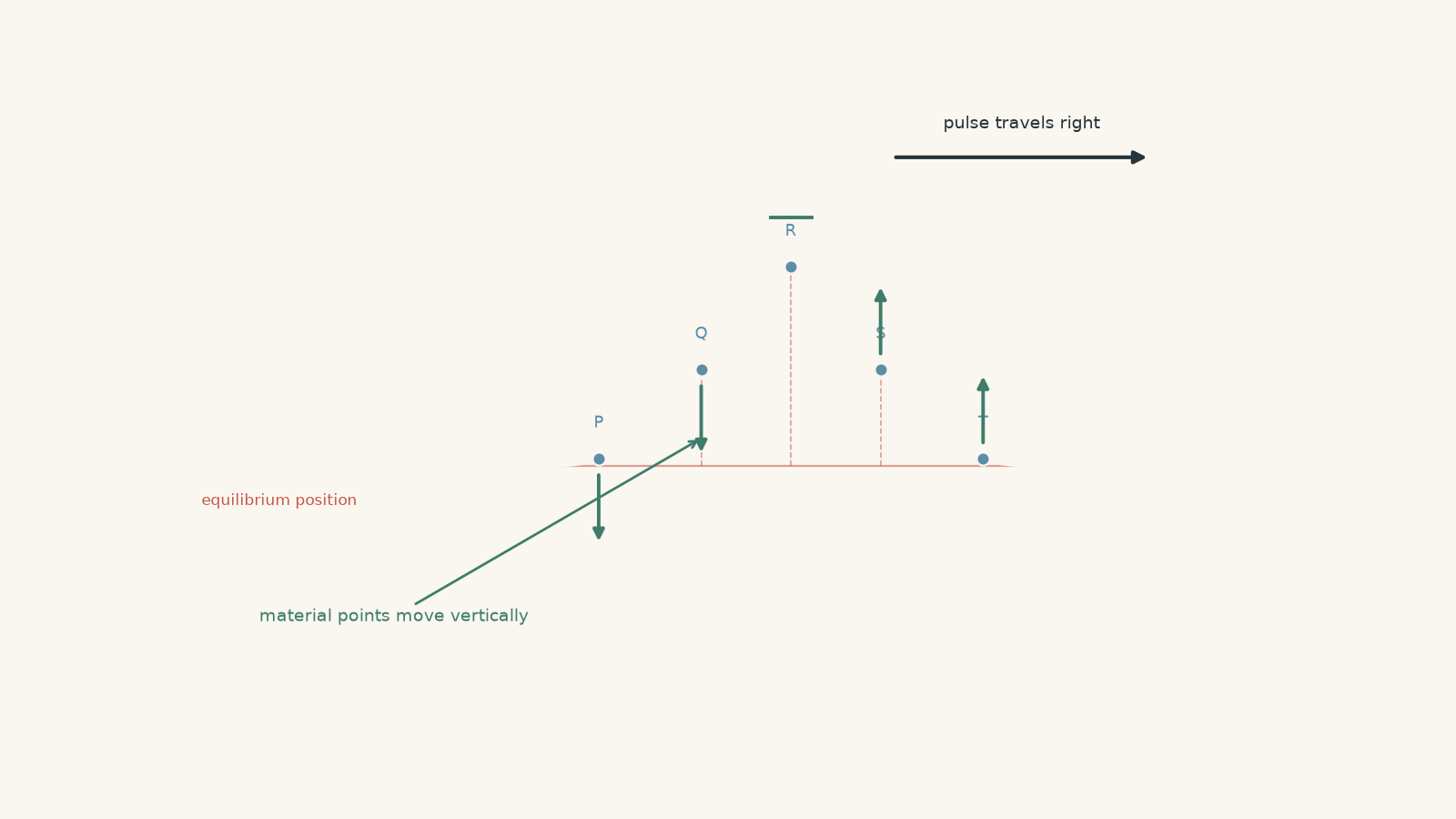
In a transverse wave, the medium oscillates perpendicular to the direction in which the wave travels.
For a wave travelling horizontally along a string:
- the wave might travel to the right
- each small section of string moves mainly up and down
Do not confuse those directions.
A student might see a crest travelling right and imagine that the pieces of string making up the crest must also be moving right. That feels reasonable because, with ordinary objects, a moving shape usually means the material making the shape is travelling with it.
A wave is different. The crest is a pattern formed by different particles at different times.
Longitudinal waves
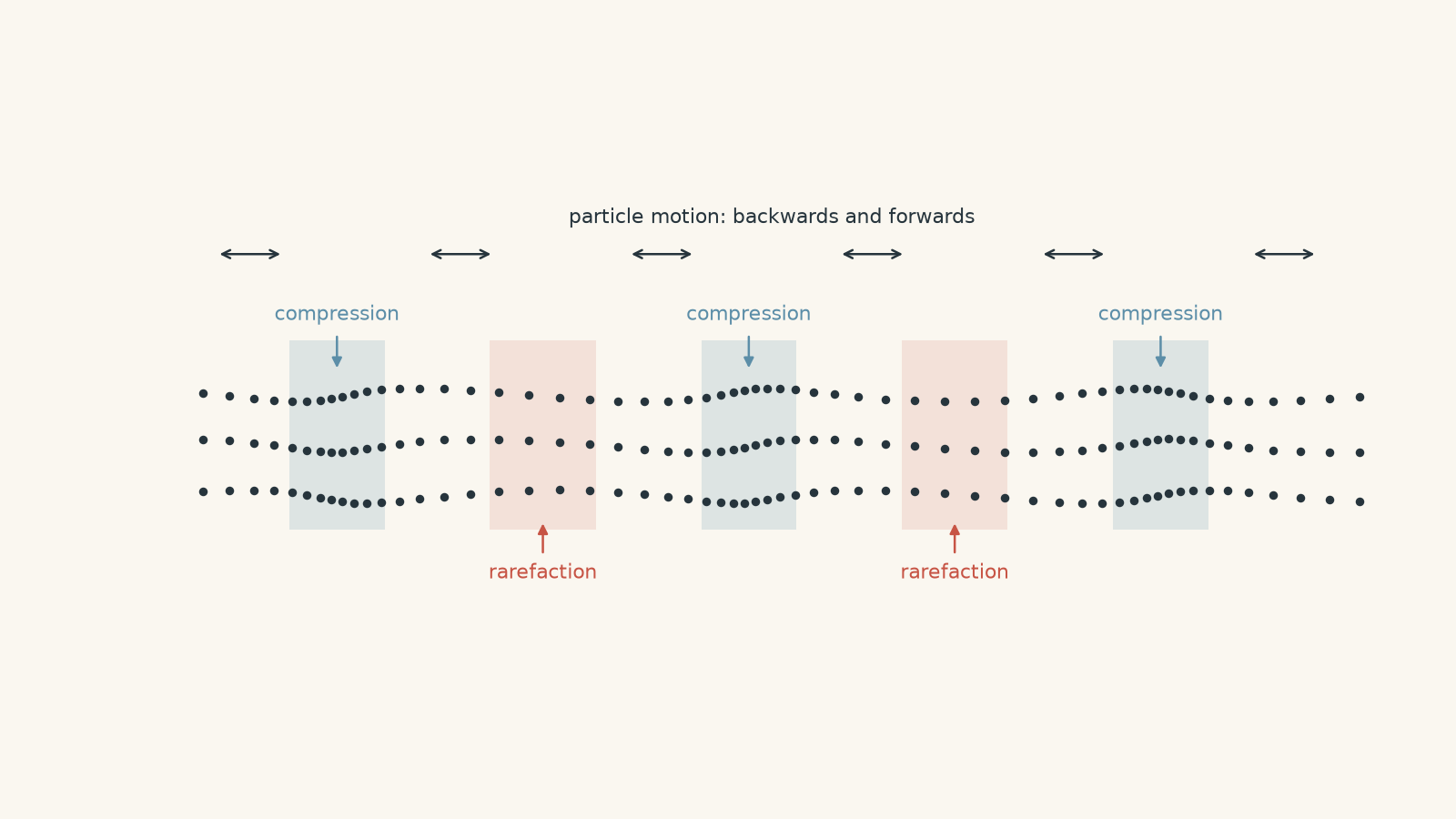
In a longitudinal wave, the medium oscillates parallel to the direction of wave travel.
Sound in air is the standard example.
Suppose a sound wave travels to the right. Small regions of air move backwards and forwards. This produces alternating regions of:
- compression, where particles are temporarily closer together
- rarefaction, where particles are temporarily farther apart
Those compression and rarefaction patterns travel through the air even though each small parcel of air only oscillates around its equilibrium position.
04Wave speed is not particle speed
This distinction causes a lot of mistakes.
The wave speed tells you how quickly a particular feature of the disturbance, such as a crest or compression, propagates through the medium.
For a periodic wave,
\[
v = f\lambda
\]
where:
- \(v\) is wave speed in metres per second, \(\text{m s}^{-1}\)
- \(f\) is frequency in hertz, \(\text{Hz}\)
- \(\lambda\) is wavelength in metres, \(\text{m}\)
The equation describes the speed of the wave pattern. It does not say that every particle in the medium travels forward at speed \(v\).
The frequency \(f\) also tells us how quickly each point in the medium oscillates. If \(f = 4.0\text{ Hz}\), each point completes four oscillations every second.
The period \(T\), which is the time for one complete oscillation, is
\[
T = \frac{1}{f}
\]
where \(T\) is measured in seconds.
Worked example: How fast does the disturbance travel?
A pulse takes \(2.4\text{ s}\) to travel \(6.0\text{ m}\) along a rope. A small piece of tape is attached halfway along the rope. Calculate the pulse speed and describe the motion of the tape as the pulse passes.
Step 1
Speed is distance divided by time:
\[
v = \frac{d}{t}
= \frac{6.0\text{ m}}{2.4\text{ s}}
= 2.5\text{ m s}^{-1}
\]
So the pulse travels along the rope at \(2.5\text{ m s}^{-1}\).
Step 2
The tape marks one particular piece of rope. As the pulse reaches it, that section is displaced from equilibrium. For a transverse pulse, the tape moves mainly perpendicular to the direction of wave travel.
It does not travel \(6.0\text{ m}\) along the rope.
Step 3
The value \(2.5\text{ m s}^{-1}\) is the propagation speed of the disturbance and its energy. It is not the forward speed of the tape or the rope material.
05Wavelength also describes the pattern, not a particle’s journey
The wavelength \(\lambda\) is the distance between two neighbouring points that are at the same stage of an oscillation, such as one crest and the next crest.
Suppose a wave has
\[
f = 3.0\text{ Hz}
\]
and
\[
\lambda = 4.0\text{ m}.
\]
Its wave speed is
\[
v = f\lambda
= (3.0\text{ Hz})(4.0\text{ m})
= 12\text{ m s}^{-1}.
\]
A crest therefore moves \(12\text{ m}\) along the medium each second.
But a particular particle does not move forwards by \(12\text{ m}\). It completes three local oscillations in that second.
This is one reason you should mentally translate \(v=f\lambda\) as:
speed of the pattern = oscillations per second x distance the pattern advances per oscillation
not “speed of the particles”.
06Amplitude tells us something about the energy being transferred
The amplitude \(A\) is the maximum displacement of an oscillating point from its equilibrium position.
If you send a very small pulse down a rope, the rope sections move only a little. If you make a larger disturbance, they move farther and generally have more kinetic and potential energy.
For many linear mechanical waves, when the medium, frequency, and other relevant conditions are unchanged, the rate of energy transfer is proportional to the square of the amplitude:
\[
P \propto A^2
\]
Here \(P\) represents the rate of energy transfer, or power, and \(A\) is amplitude.
This proportionality has an important consequence. Doubling the amplitude does not merely double the energy transfer rate. Under those conditions, it increases it by a factor of
\[
2^2 = 4.
\]
Be careful with the condition attached to this statement. You cannot compare two completely different media or frequencies using amplitude alone and automatically claim an exact energy ratio.
Worked example: A larger wave carries how much more energy?
Two periodic waves travel along the same string with the same frequency. Wave A has an amplitude of \(2.0\text{ mm}\), while wave B has an amplitude of \(6.0\text{ mm}\). Wave B has a frequency of \(4.0\text{ Hz}\) and a wavelength of \(1.5\text{ m}\).
Calculate the speed of wave B and compare its rate of energy transfer with wave A.
Step 1
Use
\[
v = f\lambda.
\]
Substituting the frequency and wavelength,
\[
v = (4.0\text{ Hz})(1.5\text{ m})
= 6.0\text{ m s}^{-1}.
\]
The disturbance and its energy propagate along the string at \(6.0\text{ m s}^{-1}\).
Step 2
The amplitude ratio is
\[
\frac{A_B}{A_A}
=
\frac{6.0\text{ mm}}{2.0\text{ mm}}
= 3.
\]
Wave B has three times the amplitude of wave A.
Step 3
For these waves,
\[
\frac{P_B}{P_A}
=
\left(\frac{A_B}{A_A}\right)^2
=
3^2
= 9.
\]
Wave B transfers energy at nine times the rate of wave A, provided the stated conditions remain the same.
Step 4
The result \(6.0\text{ m s}^{-1}\) describes how quickly the wave propagates. The factor of 9 describes how the energy transfer rates compare. Neither result means that pieces of string are being transported along the string.
07The most tempting misconception: “If energy travels, matter must travel too”
In everyday life, energy often arrives because some object carrying energy arrives.
A moving cricket ball transports both matter and kinetic energy. Hot water flowing through a pipe transports both matter and thermal energy. So it is reasonable to expect that energy transfer requires matter to travel with it.
Mechanical waves show that this is not always true.
The medium can transfer energy through a sequence of local interactions. One region does work on the next. The disturbance propagates while the particles remain near their own equilibrium positions.
Think of a long row of shopping trolleys touching bumper to bumper. Push the first trolley briefly and the effect can be passed along the row even if no single trolley travels from one end of the row to the other. Real waves are more continuous and involve restoring forces and oscillations, so the trolley picture is incomplete, but it captures the important idea: energy can be passed on through interactions.
There is another subtlety. Saying a wave causes “no bulk transport of matter” is a model statement, not a claim that particles can never have any net drift in a real system.
For example, water can contain both surface waves and a current. A floating object might drift while waves pass it. The drift does not mean the wave and the water flow are the same phenomenon. You need to distinguish the oscillatory wave motion from any separate bulk flow.
08A useful way to read any mechanical-wave diagram
When you see a diagram of a rope, spring, water surface, or sound wave, ask these questions in order:
What is the medium?
What material is actually oscillating?Which direction does the wave propagate?
This is the direction in which the disturbance and energy move.Which direction does the medium oscillate?
Compare this direction with the propagation direction.Where is equilibrium?
Each part of the medium moves relative to its own equilibrium position.Am I looking at matter or a pattern?
A crest, trough, compression, or rarefaction is a feature of the pattern. It is not a permanent collection of the same particles.
That last question prevents a surprising number of mistakes.
09Questions and solutions
Question 1
A pulse travels from left to right along a rope. A small marker is attached to the rope at point P. As the pulse passes P, the marker rises \(3.0\text{ cm}\), returns to its original height, and remains close to the same horizontal position.
Explain how the pulse can transfer energy past P even though the marker does not travel along the rope.
Solution 1
The pulse transfers energy because the section of rope at P interacts with neighbouring sections, even though that section does not move along the rope with the pulse.
As the pulse reaches P, the marked section is displaced and accelerated. It temporarily gains kinetic and elastic potential energy. Forces in the rope then do work on neighbouring sections, allowing the disturbance and its energy to continue propagating.
The marker’s \(3.0\text{ cm}\) displacement is local motion around equilibrium. It should not be interpreted as the distance travelled by the wave.
The key distinction is that the medium oscillates locally while the disturbance propagates through it.
Question 2
A periodic mechanical wave has a frequency of \(5.0\text{ Hz}\) and a wavelength of \(0.80\text{ m}\).
Calculate:
a. the wave speed
b. the time taken for the disturbance to travel \(12\text{ m}\) through the medium.
Solution 2
The wave speed is \(4.0\text{ m s}^{-1}\), and the disturbance takes \(3.0\text{ s}\) to travel \(12\text{ m}\).
For part a, use
\[
v=f\lambda.
\]
Substituting,
\[
v=(5.0\text{ Hz})(0.80\text{ m})
=4.0\text{ m s}^{-1}.
\]
For part b, use
\[
t=\frac{d}{v}.
\]
Therefore,
\[
t
=
\frac{12\text{ m}}{4.0\text{ m s}^{-1}}
=
3.0\text{ s}.
\]
The \(4.0\text{ m s}^{-1}\) value is the speed at which the wave pattern and energy propagate. It is not a statement that the particles of the medium travel \(12\text{ m}\) in \(3.0\text{ s}\).
Question 3
A student says:
“The speed of a wave on a string is \(20\text{ m s}^{-1}\), so every small piece of the string must be moving at \(20\text{ m s}^{-1}\).”
The string particles oscillate with amplitude \(0.015\text{ m}\) and frequency \(5.0\text{ Hz}\).
Explain the error. Then determine the total distance travelled by one string particle during one complete oscillation.
Solution 3
The student’s claim is incorrect because wave speed and particle speed describe different motions. One string particle travels a total distance of \(0.060\text{ m}\) during one complete oscillation.
The \(20\text{ m s}^{-1}\) value describes the speed at which the wave pattern travels along the string.
A particular string particle instead oscillates around its own equilibrium position. Its instantaneous speed changes throughout the cycle, so it cannot simply be assigned the wave speed.
With amplitude
\[
A=0.015\text{ m},
\]
the particle travels from one extreme to the other and back during a complete cycle. The total distance is
\[
d=4A.
\]
Substituting,
\[
d
=
4(0.015\text{ m})
=
0.060\text{ m}.
\]
So the particle moves a total of \(0.060\text{ m}\) during one oscillation while remaining centred around essentially the same position along the string.
The tempting mistake is treating the travelling shape of the wave as though it were a travelling piece of material.
Question 4
A loudspeaker produces a sound pulse in still air. A microphone \(6.0\text{ m}\) away detects the pulse \(0.018\text{ s}\) after it is produced.
Calculate the speed of the sound pulse. A student then claims that some of the air originally touching the loudspeaker must have travelled the full \(6.0\text{ m}\) to the microphone. Assess this claim.
Solution 4
The pulse travels at approximately \(3.3\times10^2\text{ m s}^{-1}\), but the air near the loudspeaker does not need to travel \(6.0\text{ m}\) to the microphone.
The wave speed is
\[
v=\frac{d}{t}.
\]
Substituting,
\[
v
=
\frac{6.0\text{ m}}{0.018\text{ s}}
=
333\text{ m s}^{-1}.
\]
To two significant figures,
\[
v=3.3\times10^2\text{ m s}^{-1}.
\]
This is the propagation speed of the pressure disturbance.
In a sound wave, small regions of air oscillate backwards and forwards. One region pushes on the next, producing travelling compressions and rarefactions. Energy is therefore transferred across the \(6.0\text{ m}\) gap through local interactions between neighbouring regions of air.
The student’s mistake is assuming that because energy reaches the microphone, the same matter must also travel there.
Question 5
A transverse pulse is travelling to the right along a string. At one instant, point P lies on a section of the pulse that slopes upwards as you look from left to right.
At that same instant, the piece of string at P is moving downwards.
A student argues that this is impossible because “a wave travelling right should make the string move right”.
Is the observation possible? Explain your reasoning without assuming that the string particles travel with the pulse.
Solution 5
Yes. The observation is completely consistent with a pulse travelling to the right.
Imagine taking a snapshot of the pulse and then shifting the entire pulse shape slightly to the right.
Point P itself stays at the same horizontal location because it marks one particular piece of string. After the pulse shifts right, the displacement now found at P is the displacement that was previously a little to the left of P.
Because the original pulse slopes upwards from left to right, the point just to the left of P has a lower displacement than P. When that lower part of the pulse reaches P, the string particle at P must therefore move downwards.
So:
- the pulse propagates right
- the particle at P moves down
There is no contradiction because propagation direction and particle-motion direction are different quantities.
This is also why a transverse wave can travel horizontally while its medium oscillates vertically. Once those two motions are separated clearly, ideas such as reflection, interference, and standing waves become much easier to analyse.