
How to Distinguish Harmonic Numbers from Overtone Numbers
Learn why the first overtone is the second harmonic in an open pipe but the third harmonic in a pipe closed at one end. Includes standing-wave explanations, resonance-tube calculations, and challenging HSC Physics practice questions with worked solutions.
Raise or lower the water in a resonance tube and the length of the air column changes. At the second strong resonance of a tube closed by water at one end, the air column contains three quarter-wavelengths. That resonance is the first overtone, but the third harmonic.
These labels are not interchangeable. A harmonic number tells you which multiple of the fundamental frequency a sound has. An overtone number tells you how many allowed resonances sit above the fundamental.
The difference becomes especially important when comparing pipes open at both ends with pipes closed at one end.
01The distinction: two different counting systems
Start with the fundamental frequency. It is the lowest natural resonant frequency of the pipe and is always called the first harmonic.
The fundamental is not an overtone. The first overtone is the next allowed resonant frequency above it.
For a pipe open at both ends:
- Fundamental = first harmonic.
- First overtone = second harmonic.
- Second overtone = third harmonic.
- Third overtone = fourth harmonic.
For a pipe closed at one end:
- Fundamental = first harmonic.
- First overtone = third harmonic.
- Second overtone = fifth harmonic.
- Third overtone = seventh harmonic.
The comparison is worth memorising:
| Resonance | Open at both ends | Closed at one end |
|---|---|---|
| Fundamental | 1st harmonic | 1st harmonic |
| First overtone | 2nd harmonic | 3rd harmonic |
| Second overtone | 3rd harmonic | 5th harmonic |
| Third overtone | 4th harmonic | 7th harmonic |
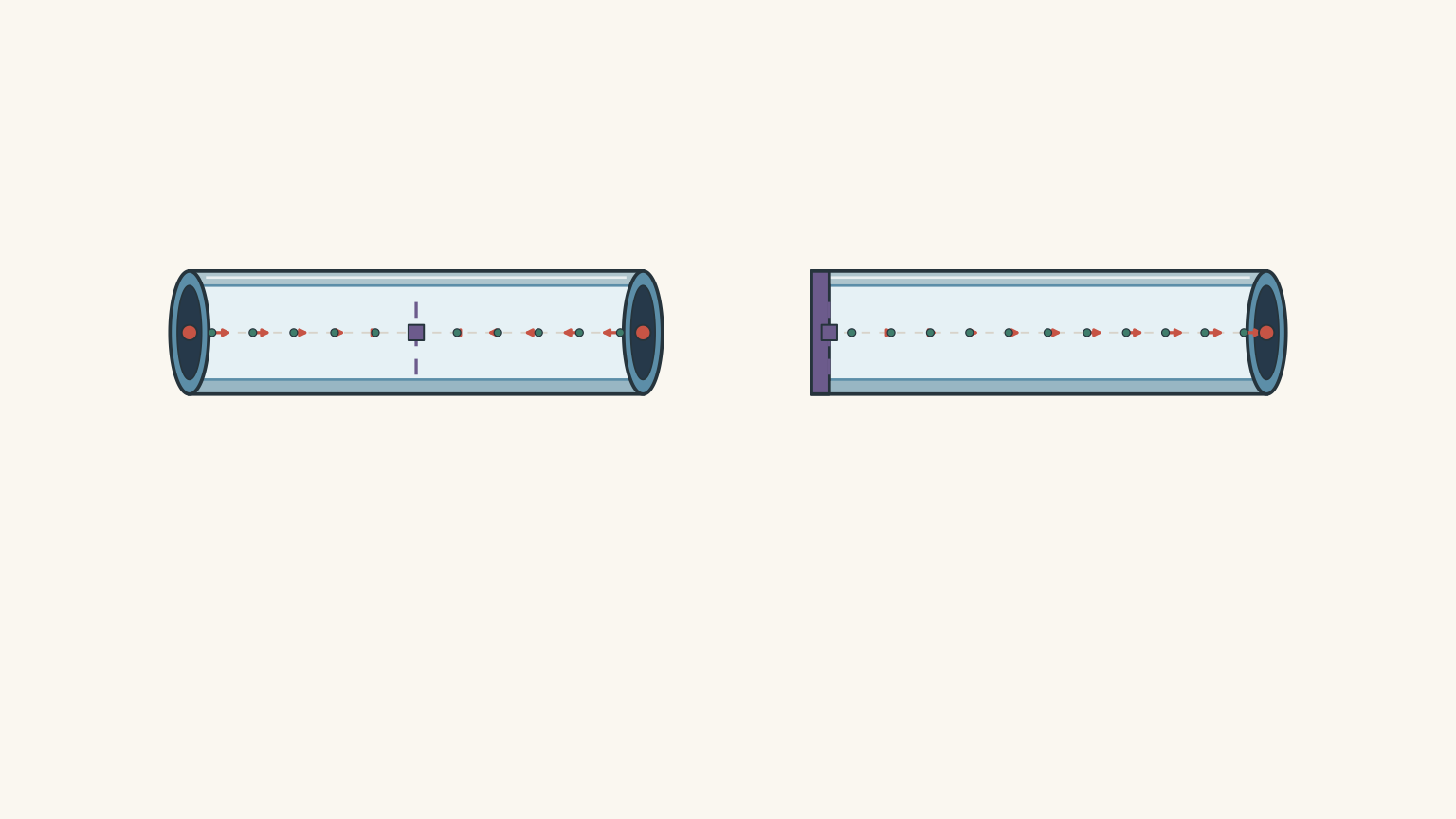
Due to technical limitations, this figure may display incorrectly or contain inaccuracies. Please check key details against your course materials.
The key rule is:
For an open-open pipe:
\[ H=O+1 \]
For a closed-open pipe:
\[ H=2O+1 \]
Here, \(H\) is the harmonic number and \(O\) is the overtone number, where the first overtone has \(O=1\).
Why do the two pipes behave differently? It comes down to how air particles move at each end of the pipe.
02Why the ends of the pipe matter
Air-particle oscillation and standing waves
Sound travels through air as a longitudinal wave. Air particles oscillate backwards and forwards, parallel to the direction in which the sound travels.
They do not travel all the way down the pipe with the sound wave. Instead, each particle oscillates around its equilibrium position.
When an incoming sound wave reflects from a boundary, it can interfere with the reflected wave. At particular frequencies, this produces a standing wave.
A standing wave contains two important positions:
- A displacement node is a position where air particles have zero displacement amplitude. They do not oscillate back and forth.
- A displacement antinode is a position where air particles have maximum displacement amplitude.
The distinction between a node and an antinode is about particle displacement, not whether air is present at that position.
What happens at an open end?
At an open end, air particles can move relatively freely in and out of the pipe.
This creates a displacement antinode.
The pressure variation at the opening is approximately zero because the air pressure remains close to atmospheric pressure. Therefore, the open end is also a pressure node.
What happens at a closed end?
At a rigid closed end, air particles cannot move through the wall.
This creates a displacement node.
Air pressure variations are greatest near this boundary, making it a pressure antinode.
Notice that pressure and displacement have opposite node and antinode positions:
| Boundary | Particle displacement | Pressure variation |
|---|---|---|
| Open end | Antinode | Node |
| Closed end | Node | Antinode |
A pressure node does not mean there is no air pressure. It means there is approximately zero variation in pressure around its equilibrium value.
Why a closed pipe only produces odd harmonics
Now consider the boundary conditions together.
A pipe open at both ends has displacement antinodes at both ends. Its fundamental standing wave fits half a wavelength inside the pipe.
Therefore:
\[ L=\frac{\lambda_1}{2} \]
A pipe closed at one end has a displacement node at the closed end and an antinode at the open end.
Its fundamental standing wave fits only one quarter of a wavelength inside the pipe:
\[ L=\frac{\lambda_1}{4} \]
Here:
- \(L\) is the effective length of the air column, measured in metres.
- \(\lambda_1\) is the wavelength of the fundamental, measured in metres.
The next possible standing-wave pattern must still satisfy the node-at-one-end and antinode-at-the-other condition.
It cannot simply fit another half-wavelength into the pipe. That would put the wrong type of boundary at the open end.
Instead, the next allowed pattern contains three quarter-wavelengths. The following one contains five.
This gives the allowed harmonic numbers:
\[ 1,\ 3,\ 5,\ 7,\ 9,\ldots \]
The second harmonic is missing.
That is why the first overtone of a closed-open pipe is the third harmonic rather than the second.
03How the resonance-tube experiment demonstrates this
A useful way to investigate the difference is with a resonance tube.
The experimental question is straightforward:
Does a pipe closed at one end support every harmonic, or only the odd harmonics?
The apparatus and method
Imagine a long, vertical tube partly filled with water.
The water reservoir is connected to the bottom of the tube, allowing the water level to move up or down. This changes the length of the air column above the water.
A tuning fork or small loudspeaker is positioned just above the open end. A microphone nearby measures the sound response.
The apparatus works as follows:
- The sound source produces a sound of fixed frequency.
- The sound enters the open end of the tube.
- Some of the sound reflects from the water surface.
- The incoming and reflected waves interfere inside the air column.
- The water level is adjusted until the air column resonates.
The water surface acts approximately like a rigid closed boundary for air-particle motion. The top of the tube remains open.
What should the experiment show?
Suppose the source frequency is fixed.
At the first resonance, the fundamental mode fits inside the air column:
\[ L_{\mathrm{eff}}=\frac{\lambda}{4} \]
At the second resonance, the next allowed mode fits:
\[ L_{\mathrm{eff}}=\frac{3\lambda}{4} \]
At the third resonance:
\[ L_{\mathrm{eff}}=\frac{5\lambda}{4} \]
Here, \(L_{\mathrm{eff}}\) is the effective air-column length. The wavelength \(\lambda\) is fixed because the source frequency and speed of sound are unchanged.
Notice the sequence:
| Resonance position | Effective length | Mode |
|---|---|---|
| First | \(\lambda/4\) | Fundamental |
| Second | \(3\lambda/4\) | First overtone, third harmonic |
| Third | \(5\lambda/4\) | Second overtone, fifth harmonic |
The second resonance is not the second harmonic. It is the third harmonic.
Why measuring two resonances is better than measuring one
There is a small complication with a real open-ended tube.
Air just outside the opening also moves during oscillation. This means the displacement antinode is slightly beyond the physical opening.
As a result, the effective length is slightly longer than the measured physical length.
We represent this using an end correction, \(e\):
\[ L_{\mathrm{eff}}=L+e \]
If you measure only the first resonance and assume \(L=\lambda/4\), you will underestimate the wavelength.
A better method is to measure two consecutive resonances.
For the first resonance:
\[ L_1+e=\frac{\lambda}{4} \]
For the second resonance:
\[ L_2+e=\frac{3\lambda}{4} \]
Subtract the first equation from the second:
\[ L_2-L_1=\frac{\lambda}{2} \]
Therefore:
\[ \boxed{\lambda=2(L_2-L_1)} \]
The end correction disappears from the calculation.
This is the important experimental improvement: measuring the spacing between consecutive resonances avoids needing to know the end correction.
An illustrative set of experimental data
Suppose a resonance tube is driven by a 512 Hz sound source.
Two consecutive resonances occur at these measured physical air-column lengths:
| Resonance | Measured length |
|---|---|
| First | 0.160 m |
| Second | 0.495 m |
Assume the speed of sound is \(343\ \mathrm{m\,s^{-1}}\) and the end correction remains constant.
The separation is:
\[ \Delta L=0.495-0.160 \]
\[ \Delta L=0.335\ \mathrm{m} \]
Therefore:
\[ \lambda=2(0.335)=0.670\ \mathrm{m} \]
We can now estimate the speed of sound using \(v=f\lambda\):
\[ \begin{aligned} v&=f\lambda\\ &=512(0.670)\\ &=343.04\ \mathrm{m\,s^{-1}} \end{aligned} \]
The result is approximately \(343\ \mathrm{m\,s^{-1}}\).
We can also calculate the end correction:
\[ e=\frac{\lambda}{4}-L_1 \]
\[ e=0.1675-0.160 \]
\[ \boxed{e=0.0075\ \mathrm{m}} \]
The end correction is 7.5 mm.
The second resonance has an effective length of:
\[ 0.495+0.0075=0.5025\ \mathrm{m} \]
This is exactly \(3\lambda/4\) for the supplied wavelength.
The result supports the closed-open pipe model: the second resonance corresponds to the first overtone, which is the third harmonic.
The measurements are illustrative rather than a record of an actual experiment. Real measurements would also be affected by temperature, sound losses, and the width of the resonance peak.
04A reliable method for HSC Physics questions
When an exam question asks you to identify a harmonic or overtone, follow this sequence.
Step 1: Identify the boundary conditions.
Is the pipe:
- Open at both ends?
- Closed at one end and open at the other?
Don’t calculate anything until you know this.
Step 2: Find the fundamental frequency.
For an open-open pipe:
\[ f_1=\frac{v}{2L} \]
For a closed-open pipe:
\[ f_1=\frac{v}{4L} \]
Here, \(v\) is the speed of sound in metres per second and \(L\) is the effective pipe length in metres.
Step 3: Divide the given frequency by the fundamental.
Calculate:
\[ H=\frac{f}{f_1} \]
This tells you the frequency multiple.
For a closed-open pipe, the result must be an odd integer for an ideal resonant mode.
Step 4: Convert the harmonic number into an overtone number.
For an open-open pipe:
\[ O=H-1 \]
For a closed-open pipe:
\[ O=\frac{H-1}{2} \]
Step 5: Check that the answer makes physical sense.
If a closed-open pipe is supposedly resonating at twice its fundamental frequency, something is wrong.
The second harmonic is not an allowed mode in the ideal closed-open pipe model.
05Worked examples
Worked example: Finding the first overtone in an open pipe
An ideal pipe is open at both ends and has a length of 0.85 m. The speed of sound is \(340\ \mathrm{m\,s^{-1}}\).
Calculate the frequency and harmonic number of its first overtone.
Step 1
Both ends are open, so the fundamental contains half a wavelength:
\[ L=\frac{\lambda_1}{2} \]
Step 2
Using:
\[ f_1=\frac{v}{2L} \]
Substitute the values:
\[ f_1=\frac{340}{2(0.85)} \]
\[ f_1=\frac{340}{1.70} \]
\[ f_1=200\ \mathrm{Hz} \]
Step 3
For an open-open pipe, the first overtone is the second harmonic.
Therefore:
\[ f_2=2f_1 \]
\[ f_2=2(200) \]
\[ \boxed{f_2=400\ \mathrm{Hz}} \]
The first overtone is the second harmonic at 400 Hz.
Notice that we did not need to calculate another wavelength. Once we knew the fundamental, the harmonic relationship gave us the answer directly.
Worked example: Finding the second overtone in a closed pipe
An ideal pipe is closed at one end and open at the other. Its length is 0.45 m, and the speed of sound is \(342\ \mathrm{m\,s^{-1}}\).
Calculate the frequencies and harmonic numbers of its first two overtones.
Step 1
One end is closed and the other is open.
The fundamental contains one quarter of a wavelength:
\[ L=\frac{\lambda_1}{4} \]
Step 2
\[ f_1=\frac{v}{4L} \]
Substitute:
\[ f_1=\frac{342}{4(0.45)} \]
\[ f_1=\frac{342}{1.80} \]
\[ f_1=190\ \mathrm{Hz} \]
Step 3
The first overtone is the third harmonic:
\[ f_{\mathrm{first}}=3f_1 \]
\[ f_{\mathrm{first}}=3(190) \]
\[ \boxed{f_{\mathrm{first}}=570\ \mathrm{Hz}} \]
Step 4
The second overtone is the fifth harmonic:
\[ f_{\mathrm{second}}=5f_1 \]
\[ f_{\mathrm{second}}=5(190) \]
\[ \boxed{f_{\mathrm{second}}=950\ \mathrm{Hz}} \]
The final results are:
| Mode | Harmonic number | Frequency |
|---|---|---|
| Fundamental | 1 | 190 Hz |
| First overtone | 3 | 570 Hz |
| Second overtone | 5 | 950 Hz |
The important point is that the second overtone is not the second harmonic. It is the fifth harmonic because the pipe only supports odd harmonics.
06Questions and solutions
The following questions move from straightforward harmonic identification to problems involving resonance measurements, boundary conditions, and missing frequency data.
Question 1
An ideal pipe is open at both ends and has a fundamental frequency of 220 Hz.
Determine:
(a) The frequency of its first overtone.
(b) The harmonic number of this overtone.
Solution 1
The first overtone is 440 Hz, which is the second harmonic.
Because both ends are open, all integer harmonics are allowed.
The first overtone is therefore twice the fundamental frequency.
Part (a): Frequency
\[ f_2=2f_1 \]
\[ f_2=2(220) \]
\[ \boxed{f_2=440\ \mathrm{Hz}} \]
Part (b): Harmonic number
The frequency is twice the fundamental, so:
\[ \boxed{H=2} \]
It is the second harmonic and the first overtone.
The distinction is that harmonic numbering starts at the fundamental, whereas overtone numbering starts above it.
Question 2
An ideal pipe is closed at one end and open at the other. Its fundamental frequency is 180 Hz.
A sound source produces a resonance at 540 Hz.
(a) Determine the harmonic number and overtone number of this resonance.
(b) Calculate the frequency of the third overtone.
(c) Explain why the pipe does not resonate at 360 Hz.
Solution 2
The 540 Hz resonance is the third harmonic and first overtone. The third overtone occurs at 1260 Hz, and 360 Hz is not an allowed resonance.
Part (a): Identify the harmonic and overtone
First, calculate the frequency ratio:
\[ H=\frac{f}{f_1} \]
\[ H=\frac{540}{180} \]
\[ H=3 \]
Therefore, the resonance is the third harmonic.
For a closed-open pipe, the allowed harmonics are:
\[ 1,\ 3,\ 5,\ 7,\ldots \]
The third harmonic is the first frequency above the fundamental.
Therefore:
\[ \boxed{\text{First overtone}} \]
Part (b): Find the third overtone
For a closed-open pipe:
- Fundamental = first harmonic.
- First overtone = third harmonic.
- Second overtone = fifth harmonic.
- Third overtone = seventh harmonic.
Therefore:
\[ f_{\mathrm{third}}=7f_1 \]
\[ f_{\mathrm{third}}=7(180) \]
\[ \boxed{f_{\mathrm{third}}=1260\ \mathrm{Hz}} \]
Part (c): Explain why 360 Hz is not allowed
The frequency 360 Hz is twice the fundamental:
\[ 360=2(180) \]
It would be the second harmonic.
However, a closed-open pipe cannot support the second harmonic because its standing wave must have a displacement node at the closed end and an antinode at the open end.
A pattern containing half a wavelength would fail to satisfy these two boundary conditions.
Therefore, 360 Hz is not an allowed resonant frequency in the ideal model.
Question 3
A student investigates a resonance tube using a sound source with a fixed frequency of 512 Hz.
The tube is closed at the bottom by a water surface and open at the top. Two consecutive resonances are recorded at the following physical air-column lengths.
| Resonance | Measured air-column length |
|---|---|
| First | 0.160 m |
| Second | 0.495 m |
Assume:
- The speed of sound is \(343\ \mathrm{m\,s^{-1}}\).
- The two resonances are consecutive.
- The end correction remains constant between measurements.
Calculate:
(a) The wavelength of the sound.
(b) The speed of sound using the measured wavelength.
(c) The end correction.
(d) The harmonic and overtone number of the second resonance.
Solution 3
The wavelength is 0.670 m, the calculated sound speed is approximately 343 m/s, the end correction is 7.5 mm, and the second resonance is the first overtone (third harmonic).
Part (a): Calculate the wavelength
The difference between consecutive resonant lengths in a closed-open pipe is half a wavelength.
Therefore:
\[ \lambda=2(L_2-L_1) \]
Substitute:
\[ \lambda=2(0.495-0.160) \]
\[ \lambda=2(0.335) \]
\[ \boxed{\lambda=0.670\ \mathrm{m}} \]
Part (b): Calculate the speed of sound
Use the wave equation:
\[ v=f\lambda \]
Substitute:
\[ v=512(0.670) \]
\[ v=343.04\ \mathrm{m\,s^{-1}} \]
Therefore:
\[ \boxed{v\approx343\ \mathrm{m\,s^{-1}}} \]
This agrees with the supplied value.
Part (c): Calculate the end correction
At the first resonance:
\[ L_1+e=\frac{\lambda}{4} \]
Rearrange:
\[ e=\frac{\lambda}{4}-L_1 \]
Substitute:
\[ e=\frac{0.670}{4}-0.160 \]
\[ e=0.1675-0.160 \]
\[ \boxed{e=0.0075\ \mathrm{m}} \]
The end correction is 7.5 mm.
This explains why the physical air-column length is slightly shorter than one quarter of the wavelength.
Part (d): Identify the second resonance
The first resonance is the fundamental.
The second resonance corresponds to an effective length of three quarter-wavelengths:
\[ L_{\mathrm{eff}}=\frac{3\lambda}{4} \]
This is the third harmonic.
Since it is the first allowed resonance above the fundamental, it is also the first overtone.
\[ \boxed{\text{Third harmonic, first overtone}} \]
The important experimental insight is that the difference between consecutive resonance lengths gives the wavelength without needing to know the end correction.
Question 4
An ideal closed-open pipe has an effective length of 0.50 m. The speed of sound in the air is \(320\ \mathrm{m\,s^{-1}}\).
The pipe is vibrating in a mode with a frequency of 800 Hz.
Determine:
(a) The fundamental frequency.
(b) The harmonic number and overtone number of the observed mode.
(c) The positions of all displacement nodes, measured from the closed end.
(d) The pressure condition at the open end and at \(x=0.20\ \mathrm{m}\).
Take the positive \(x\)-direction from the closed end towards the open end.
Solution 4
The fundamental frequency is 160 Hz, the observed mode is the fifth harmonic and second overtone, and its displacement nodes are at 0 m, 0.20 m, and 0.40 m.
Part (a): Calculate the fundamental frequency
For a closed-open pipe:
\[ f_1=\frac{v}{4L} \]
Substitute:
\[ f_1=\frac{320}{4(0.50)} \]
\[ f_1=\frac{320}{2} \]
\[ \boxed{f_1=160\ \mathrm{Hz}} \]
Part (b): Identify the harmonic and overtone
Calculate the frequency ratio:
\[ H=\frac{f}{f_1} \]
\[ H=\frac{800}{160} \]
\[ H=5 \]
Therefore, this is the fifth harmonic.
For a closed-open pipe, the fifth harmonic is the second overtone.
\[ \boxed{\text{Fifth harmonic, second overtone}} \]
Part (c): Find the displacement nodes
First, calculate the wavelength:
\[ \lambda=\frac{v}{f} \]
\[ \lambda=\frac{320}{800} \]
\[ \lambda=0.40\ \mathrm{m} \]
In a standing wave, consecutive displacement nodes are separated by half a wavelength:
\[ \frac{\lambda}{2}=\frac{0.40}{2} \]
\[ \frac{\lambda}{2}=0.20\ \mathrm{m} \]
The closed end is already a displacement node at \(x=0\).
Moving towards the open end, the nodes occur at:
\[ x=0,\quad 0.20,\quad 0.40\ \mathrm{m} \]
Therefore:
\[ \boxed{x=0,\ 0.20,\ 0.40\ \mathrm{m}} \]
The open end at \(x=0.50\ \mathrm{m}\) is a displacement antinode, not a node.
Part (d): Identify the pressure conditions
Pressure and displacement have opposite node and antinode positions.
At the open end:
- Particle displacement is an antinode.
- Pressure variation is a node.
At \(x=0.20\ \mathrm{m}\):
- Particle displacement is a node.
- Pressure variation is an antinode.
Therefore:
\[ \boxed{\text{Open end: pressure node}} \]
\[ \boxed{x=0.20\ \mathrm{m}:\text{ pressure antinode}} \]
This question combines three ideas: harmonic identification, wavelength calculation, and boundary conditions. Identifying the correct harmonic first makes the spatial pattern much easier to construct.
Question 5
An ideal air column is initially closed at one end and open at the other.
A frequency generator drives the pipe, while a microphone detects resonances. The microphone can only record frequencies between 400 Hz and 1100 Hz.
The following three resonance peaks are recorded:
\[ 450\ \mathrm{Hz},\quad 750\ \mathrm{Hz},\quad 1050\ \mathrm{Hz} \]
There are no other resonance peaks in the microphone’s recording range.
The frequency generator can be swept from 100 Hz to 1200 Hz, but the microphone cannot record below 400 Hz or above 1100 Hz.
The speed of sound is \(330\ \mathrm{m\,s^{-1}}\).
Answer the following:
(a) Determine the fundamental frequency of the original pipe.
(b) Identify the harmonic and overtone number of each recorded resonance.
(c) Calculate the effective length of the pipe.
(d) A rigid cap is now fitted over the previously open end. The effective length is unchanged in the idealised model. Determine the new fundamental frequency and all resonances that would be detected between 400 Hz and 1100 Hz.
(e) Explain why the original three resonance frequencies are no longer resonant after the second cap is fitted.
Assume uniform air properties, ideal boundary conditions, and negligible end corrections.
Solution 5
The original fundamental is 150 Hz, the pipe is 0.55 m long, and its recorded peaks are the third, fifth, and seventh harmonics. After the second end is capped, the new fundamental is 300 Hz, and the microphone detects resonances at 600 Hz and 900 Hz.
This question has an important trap: the lowest frequency recorded by the microphone is not necessarily the fundamental frequency.
Part (a): Determine the fundamental frequency
The pipe is closed at one end and open at the other.
Its allowed frequencies are:
\[ f_1,\quad 3f_1,\quad 5f_1,\quad 7f_1,\ldots \]
The difference between consecutive resonances is therefore:
\[ 3f_1-f_1=2f_1 \]
The same spacing applies between every pair of consecutive resonances.
From the recorded data:
\[ 750-450=300\ \mathrm{Hz} \]
Also:
\[ 1050-750=300\ \mathrm{Hz} \]
Therefore:
\[ 2f_1=300 \]
\[ \boxed{f_1=150\ \mathrm{Hz}} \]
Notice that the fundamental is below the microphone’s lower recording limit of 400 Hz.
This is why the first recorded resonance at 450 Hz is not the fundamental.
The frequency spacing is also not the fundamental frequency. For a closed-open pipe, consecutive resonances are separated by twice the fundamental frequency.
Part (b): Identify the harmonic and overtone numbers
Now compare each recorded frequency with the fundamental of 150 Hz.
For 450 Hz:
\[ H=\frac{450}{150}=3 \]
This is the third harmonic and first overtone.
For 750 Hz:
\[ H=\frac{750}{150}=5 \]
This is the fifth harmonic and second overtone.
For 1050 Hz:
\[ H=\frac{1050}{150}=7 \]
This is the seventh harmonic and third overtone.
The results are:
| Frequency | Harmonic number | Overtone number |
|---|---|---|
| 450 Hz | 3rd | 1st |
| 750 Hz | 5th | 2nd |
| 1050 Hz | 7th | 3rd |
The missing fundamental is still a valid resonance. It simply falls outside the microphone’s recording range.
Part (c): Calculate the effective length
For a closed-open pipe:
\[ f_1=\frac{v}{4L} \]
Rearrange:
\[ L=\frac{v}{4f_1} \]
Substitute:
\[ L=\frac{330}{4(150)} \]
\[ L=\frac{330}{600} \]
\[ \boxed{L=0.55\ \mathrm{m}} \]
The effective length of the original pipe is 0.55 m.
Part (d): Determine the new resonant frequencies
Adding the second rigid cap changes the boundary conditions.
Originally, the pipe had:
- A displacement node at the closed end.
- A displacement antinode at the open end.
After adding the cap, both ends are closed.
Therefore, both ends become displacement nodes.
The fundamental now fits half a wavelength inside the pipe rather than one quarter of a wavelength.
The new fundamental is:
\[ f_1'=\frac{v}{2L} \]
Substitute:
\[ f_1'=\frac{330}{2(0.55)} \]
\[ f_1'=\frac{330}{1.10} \]
\[ \boxed{f_1'=300\ \mathrm{Hz}} \]
A pipe closed at both ends supports all integer harmonics in the ideal model.
Its resonant frequencies are therefore:
\[ 300,\ 600,\ 900,\ 1200,\ldots \]
The microphone only records frequencies between 400 Hz and 1100 Hz.
Therefore, the detected resonances are:
\[ \boxed{600\ \mathrm{Hz}\text{ and }900\ \mathrm{Hz}} \]
The 300 Hz fundamental is below the recording range, while 1200 Hz is above it.
Part (e): Explain why the original frequencies disappear
The original resonances were determined by a pipe with one closed end and one open end.
Its allowed frequencies were odd multiples of 150 Hz:
\[ 150,\ 450,\ 750,\ 1050,\ldots \]
After the second cap is fitted, the pipe has two displacement nodes.
The new fundamental is 300 Hz, and its allowed frequencies are integer multiples of 300 Hz.
Check the original frequencies against this new fundamental:
\[ \frac{450}{300}=1.5 \]
\[ \frac{750}{300}=2.5 \]
\[ \frac{1050}{300}=3.5 \]
None of these ratios is an integer.
Therefore, none of the original three frequencies satisfies the new standing-wave boundary conditions.
The tempting assumption is that the original harmonics should remain because the pipe has not changed length. However, the length is only one part of the problem. The boundary conditions also determine which wavelengths can form standing waves.
Changing an open end into a closed end changes the allowed resonant frequencies, even when the effective length stays constant.
The next useful step in a standing-wave problem is to sketch the particle-displacement pattern before calculating anything. Once you can identify where the nodes and antinodes must occur, you can work out which wavelengths fit, determine the harmonic number, and then convert that into the correct overtone number.