
Impulse and Change in Momentum for HSC Physics
Learn how impulse links force, collision time, and change in momentum. Worked examples show how to handle stopping, rebounds, and average net force.
A cricket ball is travelling towards you at 30 m/s. You can stop it by catching it with stiff hands, or by letting your hands move backwards as you catch it. In both cases, the ball starts with the same momentum and finishes at rest.
Predict this before reading on: does moving your hands backwards reduce the change in momentum of the ball, or does it change something else?
The change in momentum is the same either way. What changes is the time taken to produce that change. A longer stopping time means a smaller average force.
That single idea explains why airbags inflate, why gym mats are soft, why you bend your knees when landing, and why a collision lasting a few milliseconds can produce an enormous force.
01Start with momentum
Before we can talk about impulse, we need the quantity that is changing.
For an object moving in a straight line, momentum is
\[
p = mv
\]
where:
- \(p\) is momentum, measured in \(\text{kg m/s}\)
- \(m\) is mass, measured in \(\text{kg}\)
- \(v\) is velocity, measured in \(\text{m/s}\)
Momentum is a vector, so its direction matters.
Suppose we call motion to the right positive. A 2.0 kg trolley moving right at 3.0 m/s has momentum
\[
p = (2.0)(3.0) = 6.0\text{ kg m/s}
\]
A 2.0 kg trolley moving left at 3.0 m/s has
\[
p = (2.0)(-3.0) = -6.0\text{ kg m/s}
\]
The negative sign does not mean the trolley has “negative momentum” in some mysterious sense. It tells us the momentum points in our chosen negative direction.
02Change in momentum is not always just “final minus initial speed”
The change in any vector quantity is
\[
\Delta p = p_f – p_i
\]
where \(p_i\) is initial momentum and \(p_f\) is final momentum.
If the mass is constant,
\[
\Delta p = mv_f – mv_i
\]
so
\[
\Delta p = m(v_f-v_i)
\]
This means a reversal of direction can produce a much larger momentum change than merely stopping.
Imagine a 0.15 kg ball travelling right at \(20\text{ m/s}\).
If it stops,
\[
\Delta p = (0.15)(0)-(0.15)(20)=-3.0\text{ kg m/s}
\]
But if it rebounds to the left at \(20\text{ m/s}\),
\[
\Delta p = (0.15)(-20)-(0.15)(20)=-6.0\text{ kg m/s}
\]
The rebound produces twice the magnitude of momentum change.
That is a common HSC trap. A student may think, “The speed is still 20 m/s, so not much changed.” But velocity changed from \(+20\text{ m/s}\) to \(-20\text{ m/s}\). Direction matters.
03Where force enters the picture
Newton’s second law can be written in terms of momentum:
\[
F_{\text{net}}=\frac{\Delta p}{\Delta t}
\]
Rearranging gives the relationship you need here:
\[
\Delta p=F_{\text{net}}\Delta t
\]
where:
- \(\Delta p\) is the change in momentum, in \(\text{kg m/s}\)
- \(F_{\text{net}}\) is the net force, in newtons (\(\text{N}\))
- \(\Delta t\) is the time over which the force acts, in seconds (\(\text{s}\))
The product \(F_{\text{net}}\Delta t\) is called impulse.
So:
\[
\text{impulse}=\Delta p
\]
Impulse has units of \(\text{N s}\). These are equivalent to \(\text{kg m/s}\), because
\[
1\text{ N s}
=
1\left(\frac{\text{kg m}}{\text{s}^2}\right)\text{s}
=
1\text{ kg m/s}
\]
This equation gives us a useful mental model. A force changes momentum, but the size of the change also depends on how long the force acts.
A gentle push maintained for several seconds can create the same impulse as a much larger force acting briefly.
04Why collision time changes the force
Return to the cricket ball.
Suppose its change in momentum has magnitude \(6.0\text{ kg m/s}\). If you stop it in \(0.010\text{ s}\),
\[
F_{\text{avg}}=\frac{\Delta p}{\Delta t}
=\frac{6.0}{0.010}
=600\text{ N}
\]
If your hands move backwards so that the stopping time becomes \(0.060\text{ s}\),
\[
F_{\text{avg}}=\frac{6.0}{0.060}
=100\text{ N}
\]
The momentum change is still \(6.0\text{ kg m/s}\). You haven’t somehow negotiated a smaller momentum change with the ball. You have spread that change over six times as much time, reducing the average force to one-sixth of its previous value.
A slightly silly analogy is ending a relationship by delivering one difficult sentence. The “amount of bad news” might be fixed, but receiving it all in half a second feels rather different from having time to process it. Here, the fixed quantity is the momentum change, and the spreading is over time. The analogy breaks because impulse is a precisely measurable physical quantity, while emotional damage very much is not.
The physics decision rule is simpler:
For the same change in momentum, increasing the collision time decreases the magnitude of the average net force.
Mathematically,
\[
F_{\text{avg}}=\frac{\Delta p}{\Delta t}
\]
If \(\Delta p\) is fixed, \(F_{\text{avg}}\) is inversely proportional to \(\Delta t\).
Double the stopping time, and the average force halves.
Triple the stopping time, and the average force becomes one-third as large.
05“Net force” matters
The equation involves net force, not automatically the force exerted by one particular object.
For a horizontal collision where other horizontal forces are negligible, the contact force may be effectively equal to the net horizontal force.
In other situations, you need to consider all forces.
For example, during a vertical landing, gravity continues acting on the person while the ground exerts an upward force. The impulse associated with the person’s change in momentum comes from the net force:
\[
F_{\text{net}}=F_{\text{ground}}-mg
\]
if upward is chosen as positive.
This distinction becomes important in harder questions. You cannot always calculate \(\Delta p/\Delta t\) and immediately call the answer “the force from the ground”.
Worked example: stopping a trolley
A 4.0 kg trolley travels to the right at \(5.0\text{ m/s}\). It is brought to rest in \(0.50\text{ s}\). Calculate the average net force acting on the trolley.
Step 1
Take right as positive.
The initial velocity is \(v_i=+5.0\text{ m/s}\), and the final velocity is \(v_f=0\).
Step 2
\[
\Delta p=m(v_f-v_i)
=(4.0)(0-5.0)
=-20\text{ kg m/s}
\]
The negative sign tells us that the momentum change is to the left.
Step 3
\[
F_{\text{avg}}=\frac{\Delta p}{\Delta t}
=\frac{-20}{0.50}
=-40\text{ N}
\]
So the average net force is
\[
\boxed{40\text{ N to the left}}
\]
The force points opposite the trolley’s initial motion because it is reducing the trolley’s rightward momentum.
Worked example: a ball rebounds from a wall
A \(0.20\text{ kg}\) ball travels towards a wall at \(12\text{ m/s}\). It rebounds directly backwards at \(8.0\text{ m/s}\). The ball is in contact with the wall for \(0.040\text{ s}\). Calculate the average force exerted on the ball during the collision.
Step 1
Take motion towards the wall as positive.
Then
\[
v_i=+12\text{ m/s}
\]
and, because the ball rebounds in the opposite direction,
\[
v_f=-8.0\text{ m/s}
\]
Step 2
\[
\Delta p=m(v_f-v_i)
=(0.20)(-8.0-12)
=(0.20)(-20)
=-4.0\text{ kg m/s}
\]
Notice that we subtract the initial velocity. The calculation is not \(12-8\). Reversing direction makes the velocity change \(20\text{ m/s}\) in magnitude.
Step 3
\[
F_{\text{avg}}
=
\frac{\Delta p}{\Delta t}
=
\frac{-4.0}{0.040}
=
-100\text{ N}
\]
Therefore,
\[
\boxed{100\text{ N away from the wall}}
\]
The wall produces an impulse opposite the ball’s initial momentum, large enough not only to stop the ball but also to give it momentum in the opposite direction.
06Real collision forces are usually not constant
The equation
\[
\Delta p=F_{\text{net}}\Delta t
\]
is exact when \(F_{\text{net}}\) is constant during the time interval.
During a real collision, the force usually changes rapidly. Two objects deform as they meet, the force rises to a peak, and then it falls again as they separate.
In that case, we normally interpret \(F_{\text{net}}\) in the equation as the average net force:
\[
\Delta p=F_{\text{avg}}\Delta t
\]
More generally, impulse is the area under a force-time graph.
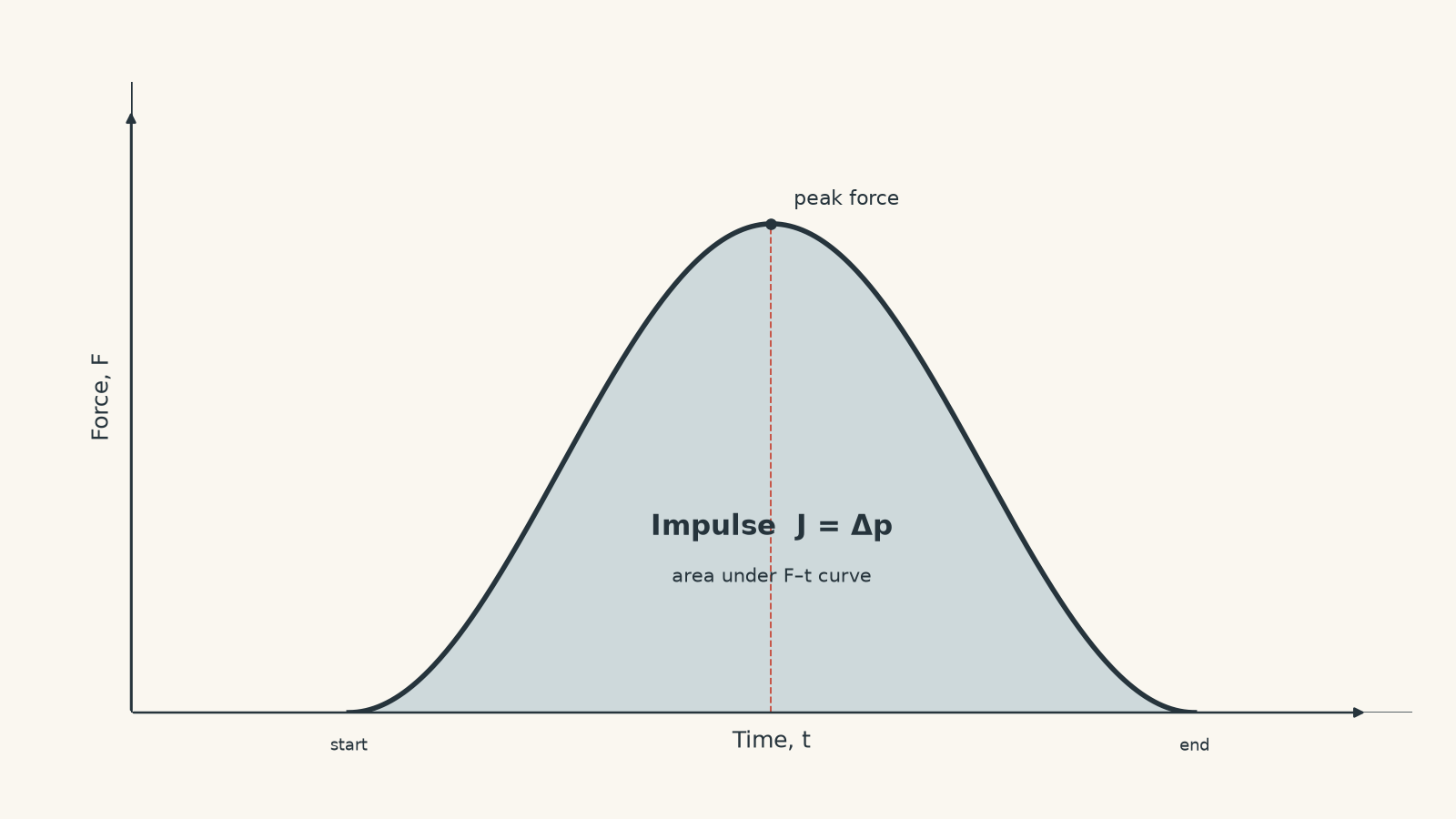
Two collisions can therefore have differently shaped force-time graphs while giving exactly the same change in momentum, provided the areas under the graphs are equal.
That gives you another way to think about safety equipment. A crumple zone does not need to make the impulse disappear. If a car’s momentum must change from its initial value to zero, that momentum change is fixed. Instead, the crumple zone increases the collision time and changes the force-time profile, reducing the average force and often reducing the peak force as well.
07The tempting misconception: “A softer collision means less impulse”
Not necessarily.
Suppose two identical eggs are moving downwards at the same velocity. One lands on concrete and stops almost immediately. The other lands on thick padding and also comes to rest.
Predict the impulse on each egg.
If both eggs have the same initial momentum and both finish with zero momentum, they undergo the same change in momentum. Therefore, they receive the same net impulse.
The padding helps because that impulse occurs over a longer time:
\[
F_{\text{avg}}=\frac{\Delta p}{\Delta t}
\]
Longer \(\Delta t\), smaller average force.
So the key distinction is:
| Quantity | Hard surface | Soft surface |
|---|---|---|
| Initial momentum | Same | Same |
| Final momentum | Same | Same |
| Change in momentum | Same | Same |
| Net impulse | Same | Same |
| Collision time | Shorter | Longer |
| Average net force magnitude | Larger | Smaller |
There is one condition hiding in that table: both objects must genuinely have the same initial and final momenta. If one bounces and the other does not, their momentum changes will not be equal.
08Rebounding can increase the force
Suppose a ball reaches the ground with downward momentum and either:
- comes to rest, or
- rebounds upwards.
Which case requires the larger impulse?
The rebound.
Stopping removes the original downward momentum. Rebounding must first remove that momentum and then create upward momentum.
For example, take upward as positive. A ball initially moving down at \(6\text{ m/s}\) has \(v_i=-6\text{ m/s}\).
If it stops,
\[
\Delta v=0-(-6)=+6\text{ m/s}
\]
If it rebounds upwards at \(4\text{ m/s}\),
\[
\Delta v=4-(-6)=+10\text{ m/s}
\]
With the same mass, the rebound requires the larger change in momentum.
If the contact times were equal, the rebound would therefore require the larger average net force.
09A reliable method for impulse questions
When you see an impulse or collision problem, resist the urge to grab \(F\Delta t=\Delta p\) immediately. First work out what is actually changing.
A dependable sequence is:
- Choose a positive direction.
- Write each velocity with its correct sign.
- Calculate the initial momentum.
- Calculate the final momentum.
- Find \(\Delta p=p_f-p_i\).
- Use \(\Delta p=F_{\text{avg}}\Delta t\).
- Interpret the sign as a direction.
- Check whether the question asks for net force or a particular contact force.
That second step prevents a large fraction of mistakes. If an object rebounds, its final velocity has the opposite sign.
10Questions and solutions
Question 1
A \(0.50\text{ kg}\) cart is travelling east at \(4.0\text{ m/s}\). A net force brings it to rest in \(0.20\text{ s}\).
Calculate:
a) the change in momentum of the cart
b) the average net force acting on it.
Solution 1
The cart’s change in momentum is \(2.0\text{ kg m/s}\) west, and the average net force is \(10\text{ N}\) west.
Take east as positive.
The initial and final momenta are
\[
p_i=mv_i=(0.50)(4.0)=2.0\text{ kg m/s}
\]
and
\[
p_f=(0.50)(0)=0
\]
so
\[
\Delta p=p_f-p_i
=0-2.0
=-2.0\text{ kg m/s}
\]
The negative sign means west.
For the force,
\[
F_{\text{avg}}
=
\frac{\Delta p}{\Delta t}
=
\frac{-2.0}{0.20}
=
-10\text{ N}
\]
Therefore,
\[
\boxed{\Delta p=2.0\text{ kg m/s west}}
\]
and
\[
\boxed{F_{\text{avg}}=10\text{ N west}}
\]
The force is west because the cart needs a westward impulse to remove its eastward momentum.
Question 2
Two identical \(0.060\text{ kg}\) balls hit separate pads at \(15\text{ m/s}\) and come to rest.
Ball A stops in \(0.0030\text{ s}\). Ball B stops in \(0.012\text{ s}\).
Compare:
a) their changes in momentum
b) their average net force magnitudes.
Solution 2
Both balls have the same change in momentum, but Ball A experiences four times the average net force of Ball B.
Each ball has the same mass, initial velocity, and final velocity. Their momentum changes must therefore be identical.
The magnitude of the momentum change is
\[
|\Delta p|
=
m|v_f-v_i|
=
(0.060)|0-15|
=
0.90\text{ kg m/s}
\]
For Ball A,
\[
|F_A|
=
\frac{|\Delta p|}{\Delta t}
=
\frac{0.90}{0.0030}
=
300\text{ N}
\]
For Ball B,
\[
|F_B|
=
\frac{0.90}{0.012}
=
75\text{ N}
\]
Therefore,
\[
\boxed{|F_A|=300\text{ N}}
\]
and
\[
\boxed{|F_B|=75\text{ N}}
\]
Since
\[
\frac{300}{75}=4
\]
Ball A’s average force is four times larger.
The tempting mistake is to say that the softer pad gives Ball B a smaller impulse. It does not. Both balls undergo the same momentum change. Ball B’s pad produces that change over four times as long.
Question 3
A \(0.25\text{ kg}\) ball travels east at \(10\text{ m/s}\), strikes a barrier, and rebounds west at \(6.0\text{ m/s}\). Its contact time is \(0.080\text{ s}\).
Calculate the average net force on the ball.
A student instead calculates the velocity change as \(10-6=4\text{ m/s}\). Explain the error.
Solution 3
The average net force is \(50\text{ N}\) west. The student’s error is treating velocity as though direction does not matter.
Take east as positive.
Then
\[
v_i=+10\text{ m/s}
\]
and
\[
v_f=-6.0\text{ m/s}
\]
because west is negative.
The change in momentum is
\[
\Delta p
=
m(v_f-v_i)
=
(0.25)(-6.0-10)
=
(0.25)(-16)
=
-4.0\text{ kg m/s}
\]
Now apply the impulse relationship:
\[
F_{\text{avg}}
=
\frac{\Delta p}{\Delta t}
=
\frac{-4.0}{0.080}
=
-50\text{ N}
\]
So,
\[
\boxed{F_{\text{avg}}=50\text{ N west}}
\]
The student’s \(10-6\) calculation compares the speeds rather than the velocities. The ball does not simply slow from \(10\text{ m/s}\) to \(6\text{ m/s}\). It changes from \(+10\text{ m/s}\) to \(-6\text{ m/s}\), giving
\[
\Delta v=-6-10=-16\text{ m/s}
\]
A reversal of direction makes the momentum change larger, not smaller.
Question 4
A \(65\text{ kg}\) person lands vertically after moving downward at \(3.0\text{ m/s}\). Their centre of mass comes to rest \(0.25\text{ s}\) after their feet first contact the ground.
Take upward as positive and use \(g=9.8\text{ m/s}^2\).
Calculate:
a) the average net force on the person during the stopping interval
b) the average upward force exerted by the ground.
Solution 4
The average net force is \(780\text{ N}\) upward, while the average force exerted by the ground is approximately \(1.42\times10^3\text{ N}\) upward.
The important trap is that \(\Delta p/\Delta t\) gives the net force, not the ground force by itself.
The initial velocity is downward, so
\[
v_i=-3.0\text{ m/s}
\]
and
\[
v_f=0
\]
The change in momentum is
\[
\Delta p
=
m(v_f-v_i)
=
(65)(0-(-3.0))
=
195\text{ kg m/s}
\]
upward.
Therefore,
\[
F_{\text{net,avg}}
=
\frac{\Delta p}{\Delta t}
=
\frac{195}{0.25}
=
780\text{ N}
\]
So,
\[
\boxed{F_{\text{net,avg}}=780\text{ N upward}}
\]
But two major vertical forces act on the person during contact: the upward ground force \(F_G\) and the downward weight \(mg\).
Using upward as positive,
\[
F_{\text{net}}=F_G-mg
\]
The person’s weight is
\[
mg=(65)(9.8)=637\text{ N}
\]
Therefore,
\[
780=F_G-637
\]
so
\[
F_G=1417\text{ N}
\]
or, to an appropriate number of significant figures,
\[
\boxed{F_G\approx1.42\times10^3\text{ N upward}}
\]
The ground force must be greater than the net force because gravity is simultaneously pulling the person downward.
Question 5
Two identical balls approach two walls with the same speed. Each collision lasts exactly \(0.020\text{ s}\).
Ball X sticks to its wall and finishes at rest.
Ball Y rebounds directly backwards with the same speed it had before the collision.
Without choosing a numerical mass or speed, determine the ratio
\[
\frac{|F_Y|}{|F_X|}
\]
for their average net force magnitudes. Explain why the result does not depend on the actual mass or speed.
Solution 5
The ratio is \(\boxed{2}\): Ball Y experiences twice the average net force magnitude of Ball X.
Let each ball have mass \(m\) and initial speed \(v\). Take the initial direction as positive.
For Ball X,
\[
v_i=+v,\qquad v_f=0
\]
so
\[
\Delta p_X
=
m(0-v)
=
-mv
\]
and therefore
\[
|\Delta p_X|=mv
\]
For Ball Y,
\[
v_i=+v,\qquad v_f=-v
\]
so
\[
\Delta p_Y
=
m(-v-v)
=
-2mv
\]
and
\[
|\Delta p_Y|=2mv
\]
Both collisions last the same time \(\Delta t\), so
\[
|F_X|=\frac{mv}{\Delta t}
\]
and
\[
|F_Y|=\frac{2mv}{\Delta t}
\]
Therefore,
\[
\frac{|F_Y|}{|F_X|}
=
\frac{2mv/\Delta t}{mv/\Delta t}
=
\boxed{2}
\]
The mass, speed, and collision time cancel because they are shared by both situations.
The key idea is that Ball Y must receive enough impulse first to remove its original momentum and then to give it an equal momentum in the opposite direction. Rebounding therefore doubles the momentum change compared with simply stopping.
11What this idea lets you do next
Impulse gives you the bridge between forces during a collision and motion before and after it.
Once you are comfortable with
\[
\Delta p=F_{\text{avg}}\Delta t
\]
you can analyse force-time graphs, compare safety systems, and reason about rebounds without treating collision force as something mysterious.
The next important step is to combine this with conservation of momentum. Impulse tells you how one object’s momentum changes because of a force acting over time. Conservation of momentum lets you track how momentum is transferred between interacting objects across an entire isolated system.