
Sound Interference and Superposition for HSC Physics
Learn how sound waves combine through superposition, constructive interference, and destructive interference, with worked HSC-style examples.
Put two loudspeakers a few metres apart, feed them the same steady tone, and walk across the room. You might expect the sound to stay roughly the same because both speakers are still playing. Instead, you can pass through places where the tone becomes louder, then strangely quiet, then louder again.
Before reading on, predict what is happening at one of those quiet points. Has the sound somehow disappeared, or are two sound waves arriving in a way that makes their effects cancel?
The second idea is the useful one. Sound waves can occupy the same region of air at the same time. When they do, their pressure changes add together. Depending on how the waves line up, that addition can make a larger disturbance or a smaller one.
That is the link between superposition and interference.
01What happens when two sound waves overlap?
A sound wave travelling through air produces alternating regions of slightly higher and lower pressure.
At one fixed point, we can describe a sound wave using the pressure change from normal atmospheric pressure. A compression gives a positive pressure change, and a rarefaction gives a negative pressure change.
Now imagine two sound waves reach your ear at exactly the same moment.
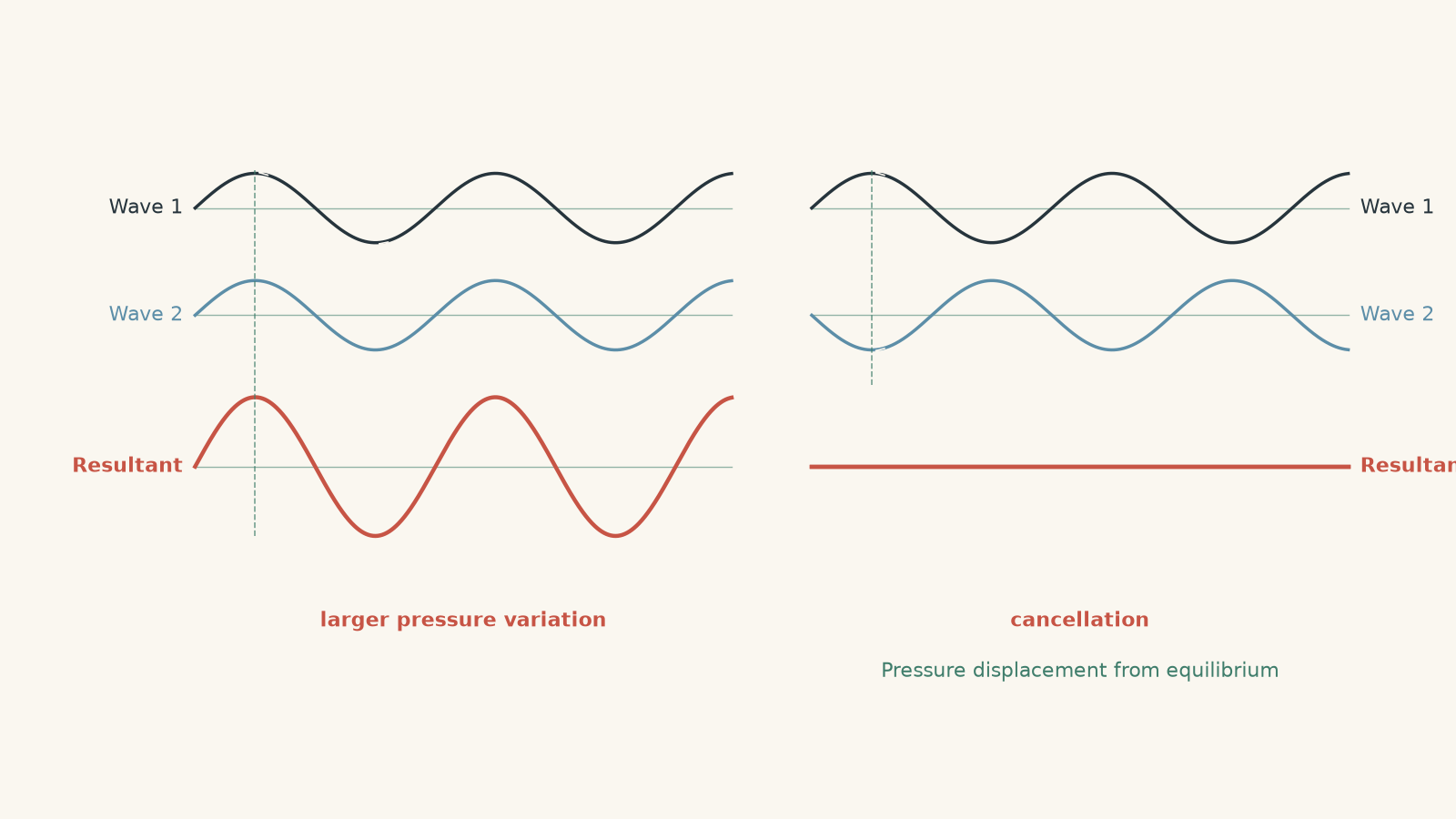
Suppose wave 1 produces a pressure change of \(+2\text{ Pa}\), while wave 2 produces \(+3\text{ Pa}\). The air doesn’t have to choose between them. The pressure changes add:
\[
p_{\text{net}} = p_1 + p_2 = 2 + 3 = 5\text{ Pa}
\]
Here, \(p_{\text{net}}\) is the total pressure change, while \(p_1\) and \(p_2\) are the pressure changes caused by the individual waves.
This is the principle of superposition:
When waves overlap, the resultant disturbance at each point is the algebraic sum of the disturbances caused by the individual waves.
The word algebraic matters. Positive and negative disturbances can cancel.
If one wave produces \(+3\text{ Pa}\) while another produces \(-3\text{ Pa}\),
\[
p_{\text{net}} = 3 + (-3) = 0\text{ Pa}
\]
For that instant and position, the pressure disturbance is zero.
A simple way to picture this is two people changing the balance of the same bank account. One deposits $3 while the other spends $3. The net change is zero even though both transactions happened. The analogy breaks because sound waves are physical disturbances carrying energy, not money, and the waves continue travelling after they overlap.
02Constructive interference makes the resultant wave larger
Consider two identical sound waves.
If their compressions arrive together and their rarefactions arrive together, the waves are in phase.
If each has pressure amplitude \(A\), their pressure changes reinforce one another:
\[
A + A = 2A
\]
This is constructive interference.
The important idea is not simply that “two sounds make a louder sound”. They must arrive with the correct relative phase.
For two equal sinusoidal waves:
| How the waves arrive | Phase relationship | Result |
|---|---|---|
| Compression with compression | In phase | Maximum constructive interference |
| Rarefaction with rarefaction | In phase | Maximum constructive interference |
| Compression with rarefaction | \(180^\circ\) out of phase | Maximum destructive interference |
| Partly misaligned | Between these cases | Partial interference |
For equal-amplitude waves undergoing perfect constructive interference, the pressure amplitude doubles.
That doesn’t mean every measure of sound simply doubles. Sound intensity is proportional to the square of pressure amplitude, so ideal coherent waves with double the pressure amplitude can produce four times the intensity at that position compared with either wave alone.
03Destructive interference can make a sound quieter
Now shift one of the waves by half a cycle.
Whenever one wave produces a compression, the other produces a matching rarefaction. They are \(180^\circ\), or \(\pi\) radians, out of phase.
For equal amplitudes,
\[
A + (-A) = 0
\]
This is complete destructive interference.
There are two important limits on that statement.
First, perfect cancellation requires equal amplitudes. If one pressure wave has amplitude \(0.30\text{ Pa}\) and the other has amplitude \(0.20\text{ Pa}\), opposite phases leave a resultant amplitude of \(0.10\text{ Pa}\), not zero.
Second, cancellation at one position doesn’t mean the waves have been destroyed everywhere. Other positions can have constructive interference. Energy has not simply vanished from the system.
A common mistake is to imagine the two waves crashing into each other and stopping, like two shopping trolleys colliding. That isn’t what ordinary sound waves do. During the overlap, their disturbances add. After the overlap, each wave continues propagating.
04Why walking around changes what you hear
The missing piece is path difference.
Imagine two loudspeakers, \(S_1\) and \(S_2\), are connected to the same signal generator so that they produce the same frequency and begin each cycle in phase.
A listener stands at point \(P\).
If the distances from the speakers to \(P\) are \(r_1\) and \(r_2\), the path difference is
\[
\Delta r = |r_2-r_1|
\]
where:
- \(\Delta r\) is the path difference in metres
- \(r_1\) and \(r_2\) are the distances travelled by the two waves, in metres.
Why should a distance difference matter?
A wave repeats every wavelength. If one wave travels exactly one extra wavelength, it arrives one complete cycle behind the other. A full cycle puts it back into the same phase.
If it travels half a wavelength farther, it arrives half a cycle behind. A compression from one wave then lines up with a rarefaction from the other.
For two sources that begin in phase:
\[
\Delta r = m\lambda
\]
gives constructive interference, while
\[
\Delta r = \left(m+\frac{1}{2}\right)\lambda
\]
gives destructive interference.
Here:
- \(\Delta r\) is path difference in metres
- \(\lambda\) is wavelength in metres
- \(m\) is any non-negative integer: \(0,1,2,3,\ldots\)
So constructive interference occurs for path differences
\[
0,\lambda,2\lambda,3\lambda,\ldots
\]
while destructive interference occurs for
\[
\frac{\lambda}{2},\frac{3\lambda}{2},\frac{5\lambda}{2},\ldots
\]
Notice that \(\Delta r=0\) is constructive only because we have said the sources start in phase. We will return to that assumption shortly.
05Connect the path difference to frequency
You often won’t be given the wavelength directly.
For any wave,
\[
v=f\lambda
\]
where:
- \(v\) is wave speed in metres per second
- \(f\) is frequency in hertz
- \(\lambda\) is wavelength in metres.
Therefore,
\[
\lambda=\frac{v}{f}
\]
Once you know the wavelength, you can compare the path difference with fractions or multiples of \(\lambda\).
Worked example: Is the listener at a loud or quiet position?
Two in-phase speakers produce a \(680\text{ Hz}\) tone. Take the speed of sound to be \(340\text{ m s}^{-1}\). A listener is \(4.00\text{ m}\) from one speaker and \(4.75\text{ m}\) from the other. Determine whether the listener is at a position of constructive or destructive interference.
Step 1
\[
\lambda=\frac{v}{f}
=\frac{340\text{ m s}^{-1}}{680\text{ Hz}}
=0.500\text{ m}
\]
One complete cycle occupies \(0.500\text{ m}\).
Step 2
\[
\Delta r=|4.75-4.00|
=0.75\text{ m}
\]
Step 3
\[
\frac{\Delta r}{\lambda}
=\frac{0.75}{0.500}
=1.5
\]
So
\[
\Delta r=\frac{3}{2}\lambda
\]
Step 4
A path difference of \(\frac{3}{2}\lambda\) is an odd multiple of half a wavelength, so the waves arrive \(180^\circ\) out of phase.
The listener is therefore at a position of destructive interference. For equal amplitudes in the ideal model, this would be a minimum in sound intensity.
06Path difference is really changing phase
The path-difference rules work because travelling an extra distance changes where a wave is in its cycle when it arrives.
For sources that begin in phase, the phase difference caused by path difference is
\[
\Delta \phi = 2\pi\frac{\Delta r}{\lambda}
\]
where \(\Delta\phi\) is the phase difference in radians.
For example:
- \(\Delta r=0\) gives \(\Delta\phi=0\)
- \(\Delta r=\frac{\lambda}{4}\) gives \(\Delta\phi=\frac{\pi}{2}\)
- \(\Delta r=\frac{\lambda}{2}\) gives \(\Delta\phi=\pi\)
- \(\Delta r=\lambda\) gives \(\Delta\phi=2\pi\), which is equivalent to being back in phase.
This gives a useful decision rule:
Don’t ask only how far apart the listener and speakers are. Ask how much farther one wave has travelled than the other, measured in wavelengths.
07The source phase can change the answer
Here is a tempting prediction.
Two speakers are exactly the same distance from you. Surely they must interfere constructively because their path difference is zero.
That is true only if the speakers themselves are producing waves in phase.
Suppose the second speaker begins each cycle half a period later than the first. The sources are already \(180^\circ\) out of phase. Equal path lengths don’t remove that phase difference, so the waves still arrive \(180^\circ\) out of phase and interfere destructively.
This is why a proper interference question should tell you, or allow you to infer, the phase relationship between the sources.
Worked example: Can an extra path length cancel an initial phase difference?
Two coherent speakers produce a \(500\text{ Hz}\) tone. Speaker \(B\) begins each cycle one-quarter of a cycle ahead of speaker \(A\). Take the speed of sound as \(340\text{ m s}^{-1}\). At point \(P\), the sound from \(B\) travels \(0.17\text{ m}\) farther than the sound from \(A\). Determine how the waves arrive at \(P\).
Step 1
\[
\lambda=\frac{v}{f}
=\frac{340\text{ m s}^{-1}}{500\text{ Hz}}
=0.68\text{ m}
\]
Step 2
\[
\frac{\Delta r}{\lambda}
=\frac{0.17}{0.68}
=0.25
\]
So the wave from \(B\) travels an extra quarter-wavelength.
That extra travel causes it to arrive one-quarter of a cycle later than it otherwise would.
Step 3
Speaker \(B\) starts one-quarter of a cycle ahead, but its wave then travels one-quarter of a wavelength farther.
The propagation delay cancels the initial phase lead.
Step 4
The waves arrive in phase, so they undergo constructive interference at \(P\).
The key point is that path difference is not the only possible source of phase difference. You need the total relative phase when the waves arrive.
08Stable interference needs coherent sources
Suppose two phones are each told to play a \(500\text{ Hz}\) tone. Does that automatically produce a neat, stationary pattern of loud and quiet positions?
Not necessarily.
For a stable interference pattern, the sources need to be coherent. Coherent sources have:
- the same frequency, and
- a constant phase difference.
Two speakers driven by the same signal can satisfy this condition well. Two independent sources with phases that drift relative to each other won’t maintain the same interference pattern.
This distinction explains why “two sounds of the same frequency” is not quite enough. Their relative phase must remain predictable.
09Complete cancellation is an ideal case
Students often learn destructive interference as “the amplitudes subtract”, then quietly start assuming destructive interference always means silence.
It doesn’t.
For complete cancellation, several conditions need to line up:
- the waves must have the same frequency
- their phase difference at the point must be \(180^\circ\)
- their amplitudes at that point must be equal.
If the amplitudes are unequal, cancellation is only partial.
If the phase difference is not exactly \(180^\circ\), cancellation is only partial.
Real rooms also contain reflections from walls, floors, furniture, and ceilings. That means the sound reaching your ear may contain more than two simple waves. The ideal two-source model is still extremely useful, but it is a model of the main physics rather than a promise that a real room contains perfectly silent points.
10Questions and solutions
Question 1
Two in-phase speakers produce a \(425\text{ Hz}\) sound. Take the speed of sound as \(340\text{ m s}^{-1}\). A listener is positioned so that one sound wave travels \(0.40\text{ m}\) farther than the other.
Determine whether the listener is at a constructive or destructive interference position.
Solution 1
The listener is at a position of destructive interference.
First find the wavelength:
\[
\lambda=\frac{v}{f}
=\frac{340\text{ m s}^{-1}}{425\text{ Hz}}
=0.80\text{ m}
\]
The path difference is
\[
\Delta r=0.40\text{ m}
=\frac{0.80}{2}\text{ m}
=\frac{\lambda}{2}
\]
For two sources that begin in phase, a path difference of half a wavelength makes the waves arrive \(180^\circ\) out of phase.
The waves therefore interfere destructively. If their amplitudes at the listener are equal, the ideal model predicts complete cancellation.
Question 2
Two coherent, in-phase speakers produce sound with wavelength \(0.60\text{ m}\). At point \(P\), the distances from the two speakers are \(3.20\text{ m}\) and \(4.40\text{ m}\).
Determine the type of interference at \(P\), and explain your reasoning.
Solution 2
The waves undergo constructive interference at \(P\).
The path difference is
\[
\Delta r=|4.40-3.20|
=1.20\text{ m}
\]
Compare this with the wavelength:
\[
\frac{\Delta r}{\lambda}
=\frac{1.20}{0.60}
=2
\]
Therefore,
\[
\Delta r=2\lambda
\]
The second wave has travelled exactly two complete wavelengths farther than the first. Two complete cycles do not change its relative phase, so the waves still arrive in phase.
They therefore reinforce one another, producing constructive interference.
Question 3
Two sound waves of the same frequency arrive \(180^\circ\) out of phase at a microphone. Their pressure amplitudes are \(0.30\text{ Pa}\) and \(0.20\text{ Pa}\).
A student says, “They are out of phase, so the microphone must record zero sound pressure amplitude.”
Evaluate the student’s claim and calculate the resultant pressure amplitude.
Solution 3
The student’s claim is incorrect. The resultant pressure amplitude is \(0.10\text{ Pa}\).
For complete destructive interference, the waves must be both \(180^\circ\) out of phase and equal in amplitude.
Here, the pressure disturbances oppose each other, so their amplitudes subtract:
\[
A_{\text{resultant}}
=|A_1-A_2|
=|0.30-0.20|
=0.10\text{ Pa}
\]
The waves interfere destructively, but the cancellation is only partial.
The tempting mistake is to treat “destructive interference” as another name for “complete cancellation”. Destructive interference means the waves reduce the resultant amplitude. Zero amplitude is only the special case where their opposing amplitudes are equal.
Question 4
Two coherent speakers are connected so that they produce the same frequency but are exactly \(180^\circ\) out of phase at the sources.
For each case, determine whether the interference is constructive or destructive.
(a) A listener is the same distance from both speakers.
(b) The listener moves to a position where the path difference is \(\frac{\lambda}{2}\).
Solution 4
At equal distances the interference is destructive, while at a path difference of \(\frac{\lambda}{2}\) it is constructive.
For part (a), equal distances give
\[
\Delta r=0
\]
so propagation introduces no extra relative phase. The waves therefore retain their original \(180^\circ\) phase difference and arrive out of phase.
The interference is destructive.
For part (b), one wave travels an extra half-wavelength. This introduces another \(180^\circ\) phase shift.
The total relative phase change is therefore equivalent to
\[
180^\circ+180^\circ=360^\circ
\]
and a \(360^\circ\) difference is equivalent to being in phase.
The interference is therefore constructive.
This question exposes an important assumption in the familiar path-difference rules. The rules \(\Delta r=m\lambda\) for constructive interference and \(\Delta r=(m+\frac12)\lambda\) for destructive interference assume the sources themselves begin in phase. If the sources begin \(180^\circ\) out of phase, the conditions swap.
Question 5
Two in-phase speakers produce a \(680\text{ Hz}\) tone. Take the speed of sound as \(340\text{ m s}^{-1}\). At a particular position, the path difference is \(0.25\text{ m}\).
(a) Classify the interference at this position.
The speakers and listener then remain fixed, but the frequency is increased to \(850\text{ Hz}\).
(b) Is the same position now a point of maximum constructive interference, maximum destructive interference, or neither?
Solution 5
At \(680\text{ Hz}\), the position gives maximum destructive interference. At \(850\text{ Hz}\), it gives neither a maximum nor a minimum.
For part (a), the original wavelength is
\[
\lambda=\frac{v}{f}
=\frac{340\text{ m s}^{-1}}{680\text{ Hz}}
=0.500\text{ m}
\]
The path difference is
\[
\Delta r=0.25\text{ m}
=\frac{\lambda}{2}
\]
For in-phase sources, a half-wavelength path difference gives maximum destructive interference.
For part (b), the new wavelength is
\[
\lambda=\frac{340\text{ m s}^{-1}}{850\text{ Hz}}
=0.400\text{ m}
\]
The physical path difference has not changed, so
\[
\frac{\Delta r}{\lambda}
=\frac{0.25}{0.400}
=0.625
\]
Thus,
\[
\Delta r=0.625\lambda
\]
This is neither an integer number of wavelengths nor an odd multiple of half a wavelength.
The waves therefore arrive partially out of phase, producing partial interference rather than a maximum or minimum.
The hidden trap is assuming that a quiet location remains quiet when the frequency changes. The geometry is unchanged, but the wavelength changes, so the phase relationship changes as well.
Question 6
Two speakers are driven by the same signal and are intended to produce equal-amplitude sound in phase. A student finds a position where the distances to the speakers differ by exactly one-half of the calculated wavelength. The measured sound is quieter than nearby positions, but it is not close to zero.
The student concludes that the principle of superposition must have failed.
Give two physically reasonable explanations for the observation without rejecting superposition.
Solution 6
Superposition has not failed. The most likely explanation is that the conditions for complete cancellation are not actually satisfied by the total sound reaching the measurement point.
One possibility is that the two waves have unequal amplitudes at the measurement point. A path difference of \(\frac{\lambda}{2}\) can make the two waves \(180^\circ\) out of phase, but unequal opposing amplitudes leave a non-zero resultant.
For example, if the arriving pressure amplitudes were \(A_1\) and \(A_2\),
\[
A_{\text{resultant}}=|A_1-A_2|
\]
rather than zero unless \(A_1=A_2\).
A second possibility is that reflected sound is also reaching the measurement point. Reflections from walls, the floor, or other surfaces create additional waves with different path lengths and phases. The microphone therefore measures the superposition of more than just the two direct waves.
Other reasonable experimental effects could include a small error in the assumed sound speed, speaker phase differences, or an imperfectly single-frequency signal.
The crucial idea is that superposition says all disturbances add. It does not guarantee cancellation unless the required amplitudes and phases are present.
11From two-wave interference to standing waves
Once you can track phase and path difference, a much bigger piece of HSC wave physics becomes easier to understand.
If two coherent waves of the same frequency travel in opposite directions, their repeated constructive and destructive interference can produce fixed positions of maximum and minimum amplitude. Those positions are the antinodes and nodes of a standing wave.
That is the next useful step: the same superposition rule that explains why two speakers can create loud and quiet regions also explains standing waves, resonance, and the patterns formed by sound in pipes.