
Mechanical Power with P = Fv cos θ for HSC Physics
Learn how to apply P = Fv cos θ in lifting, propulsion, and resistive-force problems, including how to choose the correct force and angle.
A crane is lifting a steel load. At one moment the load is moving upward at \(2.0\ \text{m s}^{-1}\). Later, the crane pulls with the same force, but the load is moving upward at \(4.0\ \text{m s}^{-1}\).
The force hasn’t changed. So is the crane transferring energy at the same rate?
Predict before reading on. The second load is moving twice as fast, so during each second it travels twice as far in the direction of the lifting force. The crane therefore does twice as much work each second. Its mechanical power is twice as large.
That idea leads to one of the most useful power equations in HSC Physics:
\[
P = Fv\cos\theta
\]
The equation is simple. The tricky part is deciding which force, which velocity, and which angle belong in it.
01Power is the rate of energy transfer
Recall that work measures energy transferred by a force:
\[
W = Fs\cos\theta
\]
where:
- \(W\) is work in joules (\(\text{J}\))
- \(F\) is the magnitude of the force in newtons (\(\text{N}\))
- \(s\) is the displacement in metres (\(\text{m}\))
- \(\theta\) is the angle between the force and the displacement
Power asks a different question: how quickly is that work being done?
Average power is
\[
P_{\text{avg}} = \frac{W}{\Delta t}
\]
where \(P_{\text{avg}}\) is average power in watts (\(\text{W}\)) and \(\Delta t\) is the time interval in seconds.
One watt means one joule transferred each second:
\[
1\ \text{W} = 1\ \text{J s}^{-1}
\]
Now suppose a force \(F\) acts while an object moves at velocity \(v\). In a short time \(\Delta t\), the object travels approximately
\[
s = v\Delta t
\]
Substitute this into the work equation:
\[
W = F(v\Delta t)\cos\theta
\]
Divide by \(\Delta t\):
\[
P = \frac{W}{\Delta t}
= \frac{Fv\Delta t\cos\theta}{\Delta t}
\]
so
\[
\boxed{P = Fv\cos\theta}
\]
This is the instantaneous mechanical power supplied by a particular force when the force and velocity at that instant are known.
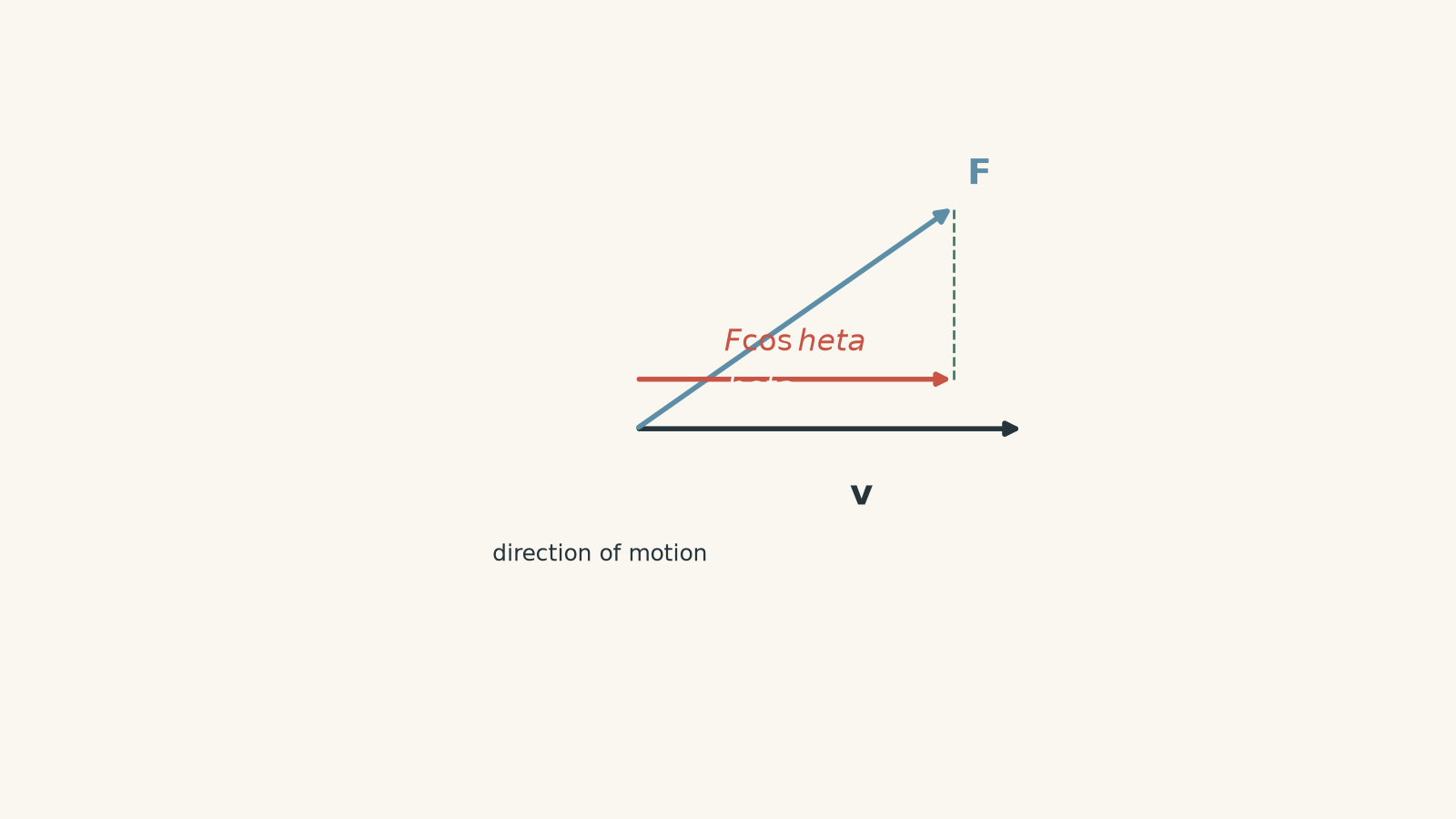
02Why the angle matters
Picture someone pulling a suitcase with a handle angled upward.
Only part of the pulling force points in the direction the suitcase is moving. If the force has magnitude \(F\), its component parallel to the velocity is
\[
F_{\parallel} = F\cos\theta
\]
So the power can also be thought of as
\[
P = F_{\parallel}v
\]
This gives a useful mental model:
Power depends on how much force points along the motion, multiplied by how quickly the object is moving.
Suppose you pull with \(100\ \text{N}\) while the suitcase moves at \(3.0\ \text{m s}^{-1}\).
If you pull directly forward, \(\theta = 0^\circ\), so
\[
P = (100)(3.0)\cos 0^\circ = 300\ \text{W}
\]
If the force is at \(60^\circ\) to the motion,
\[
P = (100)(3.0)\cos 60^\circ = 150\ \text{W}
\]
Same force. Same speed. Half the mechanical power, because only half the force acts along the motion.
What happens at \(90^\circ\)?
Predict it from the equation.
Since \(\cos 90^\circ = 0\),
\[
P = 0
\]
A force perpendicular to the velocity transfers no energy to the object’s kinetic energy at that instant.
Uniform circular motion gives a useful example. A centripetal force points towards the centre of the circle, while the velocity is tangent to the circle. The two vectors are perpendicular. The centripetal force changes the direction of the velocity but not its magnitude, so its instantaneous power is zero.
03Positive, negative, and zero power
The sign of power tells you whether a force is adding mechanical energy to an object or removing it.
| Angle between force and velocity | \(\cos\theta\) | Power | Meaning |
|---|---|---|---|
| \(0^\circ\) | \(+1\) | positive | force transfers energy to the object |
| between \(0^\circ\) and \(90^\circ\) | positive | positive | force partly assists the motion |
| \(90^\circ\) | \(0\) | zero | force transfers no energy at that instant |
| between \(90^\circ\) and \(180^\circ\) | negative | negative | force partly opposes the motion |
| \(180^\circ\) | \(-1\) | negative | force acts directly against the motion |
This sign becomes especially important for resistive forces.
If a car moves forward while air resistance acts backwards, then \(\theta = 180^\circ\):
\[
P_{\text{drag}} = F_{\text{drag}}v\cos 180^\circ
\]
Since \(\cos 180^\circ=-1\),
\[
P_{\text{drag}} = -F_{\text{drag}}v
\]
The negative sign means drag is removing mechanical energy from the car.
04Don’t automatically use the net force
This is the most common trap.
Suppose a car travels along a level road at constant speed. Its engine provides a \(900\ \text{N}\) driving force, while resistive forces total \(900\ \text{N}\) backwards.
The net force is zero.
A student might therefore write
\[
P = F_{\text{net}}v = 0
\]
and conclude that the engine provides no power.
That can’t be right. The engine is still burning fuel and transferring energy while the car moves.
The issue is that \(P = Fv\cos\theta\) calculates the power associated with the force \(F\) you choose.
For the engine force,
\[
P_{\text{engine}} = F_{\text{engine}}v
\]
which is positive.
For the resistive force,
\[
P_{\text{resistance}} = -F_{\text{resistance}}v
\]
which is negative.
For the net force,
\[
P_{\text{net}} = F_{\text{net}}v
\]
which is zero.
All three statements can be true at once.
The engine adds mechanical energy at exactly the same rate that resistance removes it. The car’s kinetic energy therefore remains constant.
It is a bit like putting $20 into an account at the same moment $20 is taken out. The balance doesn’t change, but it would be wrong to say no money moved. The analogy breaks because energy transfer is governed by forces and displacement rather than bank transactions, but it captures the difference between individual contributions and the net change.
05Lifting at constant speed
Suppose an object of mass \(m\) is lifted vertically upward at constant speed \(v\).
Because the speed is constant, the acceleration is zero. Therefore the net force is zero:
\[
F_{\text{lift}} – mg = 0
\]
so
\[
F_{\text{lift}} = mg
\]
The lifting force and velocity point in the same direction, giving \(\theta=0^\circ\). The lifting power is therefore
\[
P_{\text{lift}} = F_{\text{lift}}v
\]
and hence
\[
\boxed{P_{\text{lift}} = mgv}
\]
This connects directly to gravitational potential energy. Near Earth’s surface,
\[
\Delta U = mg\Delta h
\]
so if the object rises at constant vertical speed,
\[
P = \frac{\Delta U}{\Delta t}
= mg\frac{\Delta h}{\Delta t}
= mgv
\]
If you need to refresh why gravitational potential energy near Earth’s surface takes the form \(U=mgh\), see Gravitational Potential Energy Near Earth for HSC Physics.
Worked example: lifting a stage light
A \(35\ \text{kg}\) stage light is raised vertically at a constant speed of \(1.8\ \text{m s}^{-1}\). Calculate the mechanical power supplied by the lifting cable. Use \(g=9.8\ \text{m s}^{-2}\).
Step 1
The acceleration is zero, so the upward cable force equals the weight:
\[
F_{\text{cable}} = mg
\]
Step 2
\[
F_{\text{cable}}
= (35)(9.8)
= 343\ \text{N}
\]
Step 3
The cable force and velocity both point upward, so \(\theta=0^\circ\):
\[
P = Fv\cos\theta
= (343)(1.8)\cos0^\circ
= 617.4\ \text{W}
\]
Therefore,
\[
\boxed{P \approx 6.2\times10^2\ \text{W}}
\]
The cable transfers about \(620\ \text{J}\) of mechanical energy to the light each second. Because the speed is constant, this energy appears as increasing gravitational potential energy rather than increasing kinetic energy.
06Lifting while accelerating
The shortcut \(P=mgv\) does not work for every lift.
Suppose the object is speeding up while moving upward. The upward force must now be greater than its weight.
From Newton’s second law,
\[
F_{\text{lift}}-mg=ma
\]
so
\[
F_{\text{lift}}=m(g+a)
\]
The instantaneous power supplied by the lifting force becomes
\[
P_{\text{lift}}=m(g+a)v
\]
for upward velocity and upward acceleration.
Notice what has changed. Some of the energy supplied by the lifting force increases gravitational potential energy, while some increases kinetic energy.
Worked example: an accelerating construction lift
A construction lift of total mass \(520\ \text{kg}\) is moving upward at \(2.4\ \text{m s}^{-1}\). At that instant it has an upward acceleration of \(0.65\ \text{m s}^{-2}\).
Calculate:
- the upward cable force
- the instantaneous mechanical power supplied by the cable
Use \(g=9.8\ \text{m s}^{-2}\).
Step 1
Taking upward as positive,
\[
F_{\text{cable}}-mg=ma
\]
Therefore,
\[
F_{\text{cable}}=m(g+a)
\]
Substitute:
\[
F_{\text{cable}}
=(520)(9.8+0.65)
=(520)(10.45)
=5434\ \text{N}
\]
Step 2
The cable force and velocity are both upward, so \(\theta=0^\circ\):
\[
P_{\text{cable}}
=F_{\text{cable}}v\cos0^\circ
=(5434)(2.4)
=13041.6\ \text{W}
\]
Therefore,
\[
\boxed{P_{\text{cable}}\approx1.30\times10^4\ \text{W}}
\]
or about \(13.0\ \text{kW}\).
The important point is that using \(mgv\) here would underestimate the cable’s power. The cable isn’t merely lifting the load against gravity. It is also increasing the lift’s speed.
07Propulsion at constant speed
Now consider a boat travelling horizontally at constant speed.
Its propeller produces a forward thrust \(T\). Water and air resistance provide a backward resistive force \(R\).
Since the boat’s velocity is constant,
\[
T=R
\]
The propeller’s mechanical power is
\[
P_{\text{thrust}}=Tv
\]
The resistive force has power
\[
P_{\text{resistance}}=-Rv
\]
Since \(T=R\),
\[
P_{\text{net}}=Tv-Rv=0
\]
This does not mean no energy is being transferred. It means the boat’s kinetic energy is not changing.
The propulsion system continuously supplies energy, while resistive forces continuously transfer that mechanical energy into other forms, mainly internal energy in the boat, water, and surrounding air.
08What if the force is angled?
Suppose a small aircraft is moving horizontally while an applied force of \(4.0\ \text{kN}\) acts \(25^\circ\) above its direction of motion. Its speed is \(70\ \text{m s}^{-1}\).
The full \(4.0\ \text{kN}\) force does not contribute to power associated with horizontal motion. Only the component parallel to the velocity does.
Convert kilonewtons to newtons:
\[
4.0\ \text{kN}=4000\ \text{N}
\]
Then
\[
P=Fv\cos\theta
=(4000)(70)\cos25^\circ
\]
\[
P\approx2.54\times10^5\ \text{W}
\]
so
\[
\boxed{P\approx254\ \text{kW}}
\]
The perpendicular component can affect the aircraft’s motion in another direction, but it contributes no power through the aircraft’s horizontal velocity at that instant.
09A reliable method for \(P=Fv\cos\theta\) questions
Before substituting numbers, make three decisions.
Which force am I finding the power of?
It might be thrust, tension, gravity, drag, or the net force. These are not interchangeable.What is the object’s velocity at that instant?
\(P=Fv\cos\theta\) uses speed at that instant, not acceleration.What is the angle between that force and the velocity?
Don’t use an angle merely because it appears in the diagram. It must be the angle between the two relevant vectors.
Then check the sign:
- force mostly along velocity: positive power
- force perpendicular to velocity: zero power
- force mostly opposite velocity: negative power
That sign is physical information, not an inconvenience to remove.
10Questions and solutions
Question 1
An electric cart moves along a horizontal corridor at a constant speed of \(5.0\ \text{m s}^{-1}\). Its motor provides a forward force of \(240\ \text{N}\).
Calculate the mechanical power supplied by the motor.
Solution 1
The motor supplies \(\boxed{1.2\ \text{kW}}\) of mechanical power because its force acts in the same direction as the cart’s velocity.
The angle between force and velocity is \(0^\circ\), so
\[
P=Fv\cos\theta
\]
\[
P=(240)(5.0)\cos0^\circ
=1200\ \text{W}
\]
Therefore,
\[
\boxed{P=1.2\times10^3\ \text{W}=1.2\ \text{kW}}
\]
The result means the motor transfers \(1200\ \text{J}\) of mechanical energy each second. The cart’s constant speed does not make the motor power zero. It tells us that another force must be removing energy at the same rate.
Question 2
A \(72\ \text{kg}\) equipment platform is moving vertically upward at a constant speed of \(1.5\ \text{m s}^{-1}\).
Calculate:
a. the power supplied by the lifting force
b. the power supplied by gravity
Use \(g=9.8\ \text{m s}^{-2}\).
Solution 2
The lifting force supplies \(\boxed{1.06\ \text{kW}}\), while gravity supplies \(\boxed{-1.06\ \text{kW}}\).
Because the platform moves at constant velocity, its acceleration is zero. Therefore the lifting force equals its weight:
\[
F_{\text{lift}}=mg=(72)(9.8)=705.6\ \text{N}
\]
For the lifting force, the force and velocity are both upward:
\[
P_{\text{lift}}
=F_{\text{lift}}v\cos0^\circ
=(705.6)(1.5)
=1058.4\ \text{W}
\]
Thus,
\[
\boxed{P_{\text{lift}}\approx1.06\ \text{kW}}
\]
Gravity points downward while the platform moves upward, so the angle is \(180^\circ\):
\[
P_g
=mgv\cos180^\circ
=(705.6)(1.5)(-1)
=-1058.4\ \text{W}
\]
Therefore,
\[
\boxed{P_g\approx-1.06\ \text{kW}}
\]
The equal magnitudes explain why the platform’s kinetic energy stays constant. The lifting force adds mechanical energy, while gravity removes kinetic-energy-changing power at the same rate, with the supplied energy instead appearing as increased gravitational potential energy for the platform-Earth system.
Question 3
A towing vehicle moves at \(12\ \text{m s}^{-1}\). The tension in its tow cable is \(1.8\ \text{kN}\), and the cable makes an angle of \(35^\circ\) to the direction of the vehicle’s velocity.
Calculate the instantaneous power associated with the tension force acting on the vehicle if the cable pulls backwards and sideways relative to its motion.
Solution 3
The tension does approximately \(\boxed{-17.7\ \text{kW}}\) of power on the vehicle because its component along the direction of motion points backwards.
A tempting mistake is to use \(35^\circ\) directly in \(P=Fv\cos\theta\). But the question says the tension pulls backwards relative to the motion. The angle between the forward velocity and the tension force is therefore
\[
\theta=180^\circ-35^\circ=145^\circ
\]
Convert the force:
\[
1.8\ \text{kN}=1800\ \text{N}
\]
Now calculate:
\[
P=Fv\cos\theta
=(1800)(12)\cos145^\circ
\]
\[
P\approx-1.77\times10^4\ \text{W}
\]
Therefore,
\[
\boxed{P\approx-17.7\ \text{kW}}
\]
The negative sign is essential. The cable force on the towing vehicle opposes its motion, so it removes mechanical energy from that vehicle.
Question 4
A \(900\ \text{kg}\) electric vehicle travels up a straight road inclined at \(8.0^\circ\) above the horizontal. At one instant its speed is \(20\ \text{m s}^{-1}\), and it is increasing its speed at \(0.80\ \text{m s}^{-2}\).
The total resistive force from air resistance and rolling resistance is \(620\ \text{N}\), acting directly opposite the vehicle’s motion.
Calculate the instantaneous mechanical power supplied by the driving force. Use \(g=9.8\ \text{m s}^{-2}\).
Solution 4
The driving force supplies approximately \(\boxed{70\ \text{kW}}\) of mechanical power.
Three forces have components along the slope:
- the driving force \(F_D\), uphill
- resistance \(620\ \text{N}\), downhill
- the component of gravity \(mg\sin8.0^\circ\), downhill
Because the vehicle is accelerating uphill, the forces do not balance.
Apply Newton’s second law along the slope:
\[
F_D-620-mg\sin8.0^\circ=ma
\]
Rearrange:
\[
F_D=ma+620+mg\sin8.0^\circ
\]
Substitute:
\[
F_D
=(900)(0.80)+620+(900)(9.8)\sin8.0^\circ
\]
\[
F_D
=720+620+1227
\approx2567\ \text{N}
\]
The driving force acts in the same direction as the velocity, so
\[
P_D=F_Dv
\]
\[
P_D=(2567)(20)
\approx5.13\times10^4\ \text{W}
\]
Therefore,
\[
\boxed{P_D\approx51\ \text{kW}}
\]
The power is larger than would be required merely to overcome resistance. Part of the driving power works against resistance, part increases gravitational potential energy as the vehicle climbs, and part increases kinetic energy as the vehicle speeds up.
Question 5
A research drone is moving horizontally to the east at \(15\ \text{m s}^{-1}\). At one instant, its propellers produce a resultant force of \(26\ \text{N}\) vertically upward.
A student argues:
“The propellers are producing a force and the drone is moving, so their power must be \(P=Fv=(26)(15)=390\ \text{W}\).”
Explain whether the calculation is correct. Then state what can and cannot be concluded about the drone’s total mechanical power from the information given.
Solution 5
The student’s calculation is incorrect. The power associated with the stated \(26\ \text{N}\) upward resultant force is \(\boxed{0\ \text{W}}\) at that instant because the force is perpendicular to the drone’s horizontal velocity.
The power equation is
\[
P=Fv\cos\theta
\]
The upward force and eastward velocity are at \(90^\circ\), so
\[
P=(26)(15)\cos90^\circ=0
\]
The mistake is treating \(P=Fv\) as though it always applies. That shortened form works only when the force and velocity are parallel and point in the same direction.
However, we cannot conclude that the propeller system as a whole is using no power, or even that its total mechanical power is zero. The question gives only one resultant force vector acting on the drone at one instant. Real propellers interact with moving air, and electrical input power would also depend on the efficiency and detailed behaviour of the propulsion system.
What we can conclude is narrower and precise: the stated upward force does zero instantaneous mechanical power on the drone through its eastward velocity at that instant.
That distinction is the main reason \(P=Fv\cos\theta\) is more useful than memorising \(P=Fv\). Once you can identify the force, velocity, and angle correctly, the same idea connects directly to the work-energy theorem: the net power tells you how quickly kinetic energy is changing, while the powers of individual forces show where the energy is being transferred.