
M1 Kinematics: 60-Mark Physics Revision Practice Exam
Test your understanding of the legacy Physics M1 Kinematics unit with this original 60-mark tutorgum practice exam. Includes timed exam conditions, 12 questions, and complete worked solutions with marking guides.
This original tutorgum practice paper covers mixed revision across the supplied legacy Physics M1 Kinematics scope (physics-2017). It tests motion in one and two dimensions, vector calculations, motion graphs, constant-acceleration equations, and practical measurements. It is a focused topic paper, not a full-course exam, and it is not an official, endorsed, past, or predicted NESA paper.
01Exam instructions
Suggested reading time: 5 minutes
Working time: 75 minutes
Total marks: 60
Permitted equipment: Scientific calculator, ruler, pen or pencil, and graph paper. Do not use notes or the internet. These are conditions for this tutorgum practice paper, not claims about official examination rules.
Assessed scope
This paper assesses the supplied legacy M1 Kinematics content, including:
- Scalars and vectors; distance, displacement, speed, and velocity.
- Vector components, perpendicular vector addition, and changes in velocity.
- Relative velocity in one and two dimensions.
- Boats crossing currents and aircraft travelling in crosswinds.
- Displacement-time, velocity-time, and acceleration-time graphs.
- Average and instantaneous velocity, including practical measurements of motion.
- Uniform motion, uniformly accelerated motion, and the equations \(v=u+at\), \(s=ut+\frac12 at^2\), and \(v^2=u^2+2as\).
The paper excludes forces and Newton’s laws, energy, circular motion, projectile motion, and material from other syllabus modules or editions.
Working conventions
- Show your working, not just your final answer.
- Include units and directions where appropriate.
- Give numerical answers to three significant figures unless an exact value or a different precision is more appropriate.
- Use signed quantities consistently. Where a question defines east as positive, a negative velocity or displacement indicates west.
- Unless stated otherwise, assume the motion described follows the model specified in the question.
02Questions
Question 1 (4 marks)
A person walks along a straight path, travelling 120 m east and then 50 m west. The complete journey takes 34 s.
(a) Calculate the total distance travelled and the displacement, taking east as positive. (2 marks)
(b) Calculate the average speed and average velocity for the complete journey. Include the direction of the average velocity. (2 marks)
Question 2 (4 marks)
A drone flies 120 m east, followed by 50 m north in a straight line.
(a) Write the resultant displacement in east and north components. (1 mark)
(b) Calculate the magnitude of the resultant displacement. (1 mark)
(c) Determine the direction of the resultant displacement as an angle north of east. (1 mark)
(d) Calculate the total path length of the drone’s journey. (1 mark)
Question 3 (5 marks)
A car travels east at 24 m/s. A cyclist travels along the same straight road, also east, at 8.0 m/s. Take east as positive.
(a) Calculate the velocity of the car relative to the cyclist. (1 mark)
(b) Calculate the velocity of the cyclist relative to the car. (1 mark)
A trolley then undergoes a separate motion. Its initial velocity is \(+6.0\ \mathrm{m/s}\), and its final velocity is \(-4.0\ \mathrm{m/s}\).
(c) Calculate the change in velocity of the trolley. (2 marks)
(d) Calculate the change in the trolley’s speed, defined as final speed minus initial speed. (1 mark)
Question 4 (5 marks)
A robot moves along a straight east-west track. Its displacement \(x\), measured from a fixed origin, is recorded at several times. East is positive, and straight segments join successive data points.
| Time \(t\) (s) | Displacement \(x\) (m) |
|---|---|
| 0 | 0 |
| 2 | 6 |
| 4 | 12 |
| 6 | 12 |
| 8 | 4 |
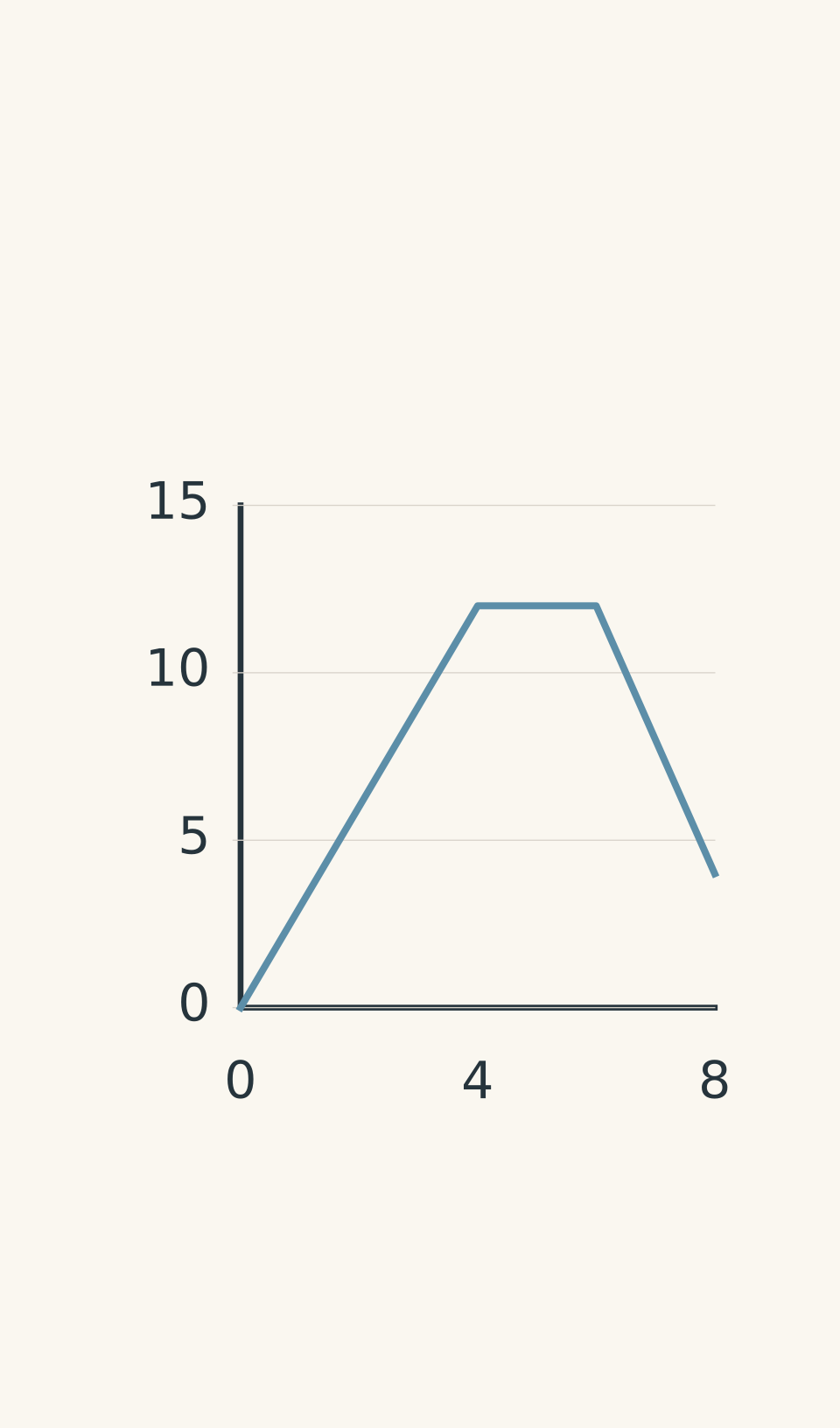
- Robot displacement
(a) Identify the interval during which the robot is at rest. (1 mark)
(b) Calculate its velocity between \(t=0\) s and \(t=4\) s. (1 mark)
(c) Calculate its velocity between \(t=6\) s and \(t=8\) s. (1 mark)
(d) Calculate its average velocity over the full 8.0 s interval. (1 mark)
(e) Estimate its instantaneous velocity at \(t=3.0\) s from the graph. (1 mark)
Question 5 (6 marks)
An object moves along a straight east-west track. East is positive. Its signed velocity is recorded below, with straight segments joining successive data points.
| Time \(t\) (s) | Velocity \(v\) (m/s) |
|---|---|
| 0 | +4 |
| 3 | +4 |
| 5 | 0 |
| 7 | -2 |
| 9 | -2 |
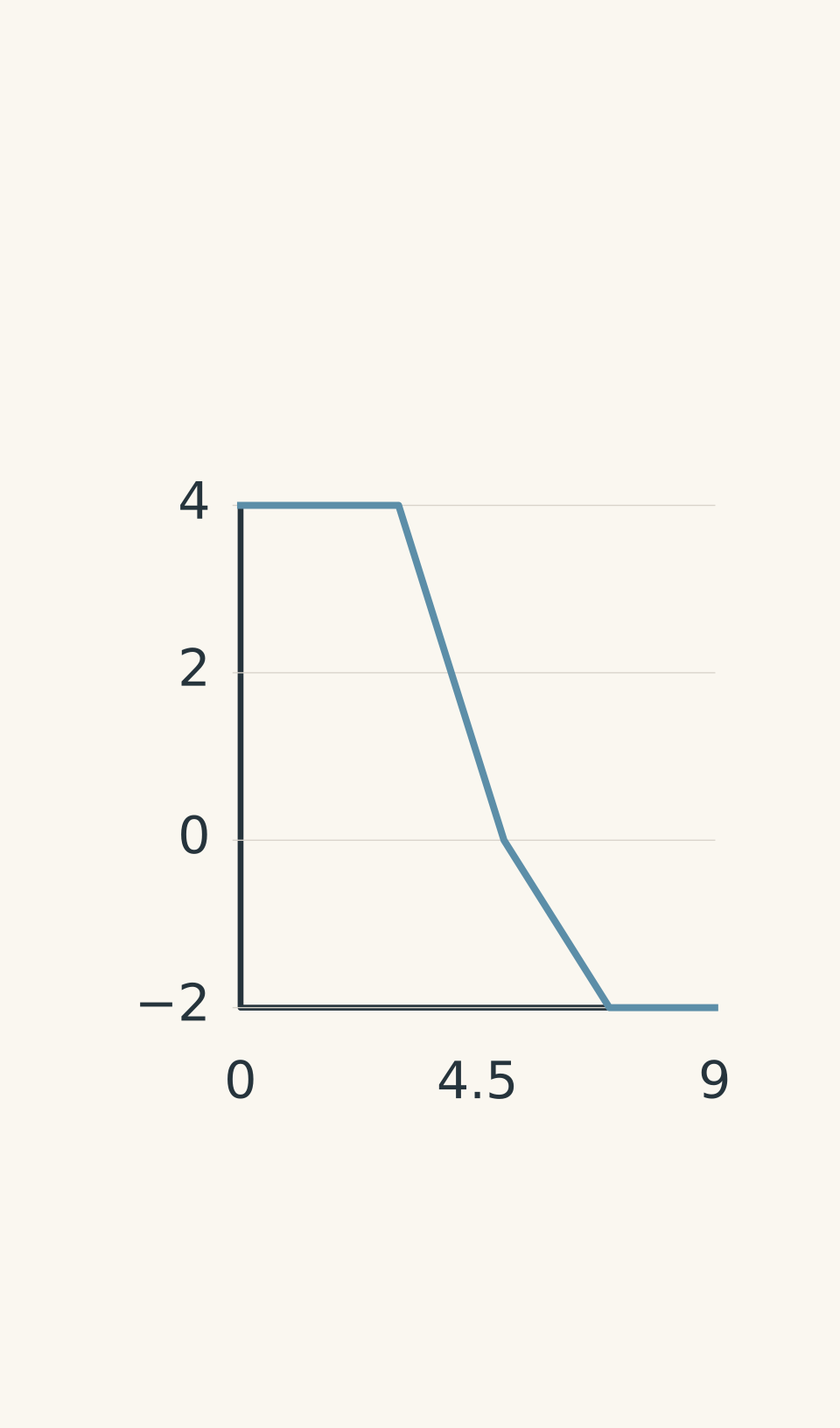
- Velocity
(a) Calculate the acceleration from \(t=0\) s to \(t=3\) s, and from \(t=3\) s to \(t=5\) s. (2 marks)
(b) Calculate the displacement from \(t=0\) s to \(t=5\) s using the area under the velocity-time graph. (2 marks)
(c) Calculate the displacement from \(t=5\) s to \(t=9\) s using signed areas. (2 marks)
Question 6 (5 marks)
An object moves along a straight track. East is positive, and its initial velocity is \(+1.0\ \mathrm{m/s}\). Its acceleration is piecewise constant, as shown below.
| Time interval (s) | Acceleration \(a\) (m/s²) |
|---|---|
| 0 to 2 | +3.0 |
| 2 to 5 | 0 |
| 5 to 7 | -2.0 |
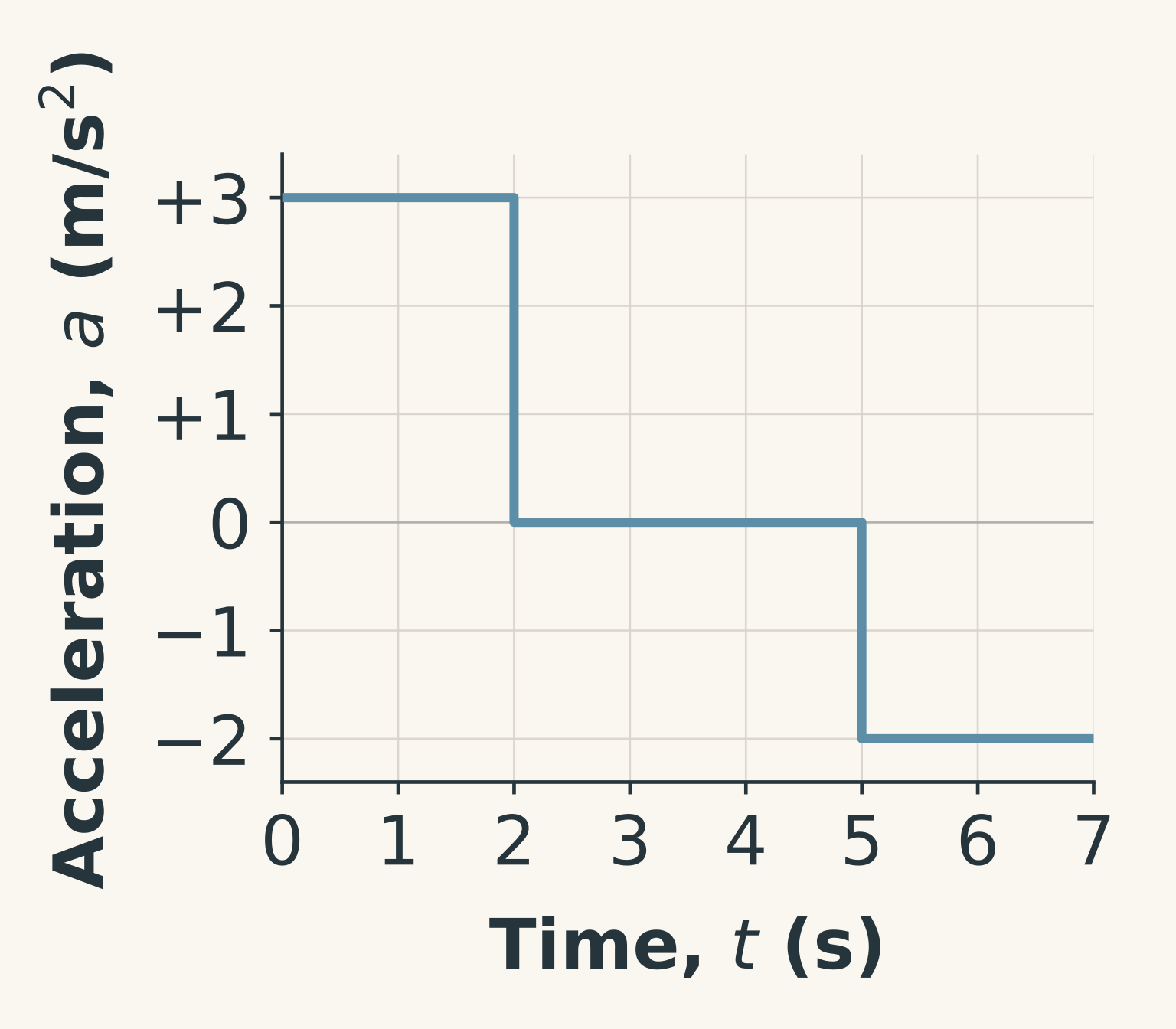
(a) Calculate the change in velocity from \(t=0\) s to \(t=2\) s. (1 mark)
(b) Calculate the total change in velocity over the full 7.0 s interval. (2 marks)
(c) Determine the final velocity at \(t=7.0\) s. (1 mark)
(d) State the physical quantity represented by the signed area under an acceleration-time graph. (1 mark)
Question 7 (4 marks)
A cart moves along a straight track. Its initial velocity is \(2.0\ \mathrm{m/s}\). A constant-acceleration model assigns it an acceleration of \(1.5\ \mathrm{m/s^2}\) for the next \(6.0\) s.
(a) Calculate the cart’s final velocity. (1 mark)
(b) Calculate its displacement over the 6.0 s interval. (2 marks)
(c) State what it means for the cart to be uniformly accelerated in this model. (1 mark)
Question 8 (5 marks)
A cyclist travels along a straight road at \(12\ \mathrm{m/s}\) and brakes uniformly, coming to rest after a displacement of 18 m. Take the initial direction of motion as positive.
(a) Calculate the cyclist’s acceleration. (2 marks)
(b) Calculate the time taken for the cyclist to stop. (2 marks)
(c) Explain the sign of the acceleration obtained in part (a). (1 mark)
Question 9 (5 marks)
A boat is aimed due north. Its velocity relative to the water is \(4.0\ \mathrm{m/s}\) north. The river current flows at \(1.5\ \mathrm{m/s}\) east, and the river is 120 m wide, measured north-south.
Assume both velocities remain constant throughout the crossing.
(a) Calculate the boat’s ground speed and the direction of its ground track. (2 marks)
(b) Calculate the time taken to reach the opposite bank. (1 mark)
(c) Calculate the downstream drift during the crossing. (1 mark)
(d) Explain why the boat’s heading and ground track are different. (1 mark)
Question 10 (6 marks)
An aircraft has an airspeed of \(250\ \mathrm{km/h}\). The wind velocity is \(60\ \mathrm{km/h}\) east. Treat both velocities as constant vectors.
(a) If the aircraft heads due north relative to the air, calculate its ground speed and the angle of its ground track east of north. (3 marks)
(b) The pilot wants to maintain a ground track due north. Calculate the required heading angle west of north and the resulting ground speed. (3 marks)
Question 11 (5 marks)
Two objects, A and B, move at constant velocities on a horizontal plane. Use east as the positive \(x\)-direction and north as the positive \(y\)-direction.
At \(t=0\), their positions and velocities relative to a fixed origin are:
\[ \vec r_A=(20,10)\ \mathrm{m} \]
\[ \vec r_B=(-10,-5)\ \mathrm{m} \]
\[ \vec v_A=(3,-1)\ \mathrm{m/s} \]
\[ \vec v_B=(1,2)\ \mathrm{m/s} \]
(a) Calculate the position of A relative to B at \(t=0\). (1 mark)
(b) Calculate the velocity of A relative to B. (1 mark)
(c) Write an expression for the relative position of A with respect to B as a function of time \(t\), measured in seconds. (1 mark)
(d) Calculate the separation between A and B at \(t=4.0\) s. (2 marks)
Question 12 (6 marks)
A trolley’s position is recorded at equal time intervals using calibrated video analysis. The measurements are shown below.
| Time \(t\) (s) | Position \(x\) (m) |
|---|---|
| 0.0 | 0.00 |
| 0.2 | 0.08 |
| 0.4 | 0.32 |
| 0.6 | 0.72 |
| 0.8 | 1.28 |
(a) Calculate the average velocity between \(t=0.2\) s and \(t=0.4\) s. (1 mark)
(b) Estimate the instantaneous velocity at \(t=0.4\) s using a central difference. Show your calculation. (2 marks)
(c) Estimate the acceleration using the average velocities over the intervals \(0.2\)-\(0.4\) s and \(0.4\)-\(0.6\) s. (2 marks)
(d) State one practical step that would reduce measurement uncertainty or improve the reliability of this experiment. (1 mark)
03Worked solutions and marking guide
Award equivalent mathematically valid methods. Apply follow-through where a later calculation correctly uses an earlier result, even if that result contains a minor arithmetic error. Numerical answers should include appropriate units and directions.
Solution 1
(a) Distance and displacement
Distance is the total length of the path travelled:
\[ d=120+50=170\ \mathrm{m} \]
Taking east as positive, displacement is the directed change in position:
\[ \Delta x=+120-50=+70\ \mathrm{m} \]
The displacement is 70 m east.
Marking:
- 1 mark for the total distance of 170 m.
- 1 mark for the displacement of \(+70\) m, including its direction.
(b) Average speed and average velocity
Average speed is total distance divided by total time:
\[ \begin{aligned} \text{Average speed} &=\frac{170}{34}\\ &=5.0\ \mathrm{m/s} \end{aligned} \]
Average velocity is displacement divided by elapsed time:
\[ \begin{aligned} v_{\mathrm{avg}} &=\frac{+70}{34}\\ &=+2.06\ \mathrm{m/s} \end{aligned} \]
To two significant figures, the average velocity is \(2.1\ \mathrm{m/s}\) east.
The average speed depends on the whole path. Average velocity depends on the net displacement, so the westward part of the journey reduces the average velocity without reducing the distance already travelled.
Marking:
- 1 mark for the average speed of \(5.0\ \mathrm{m/s}\).
- 1 mark for the average velocity of approximately \(2.1\ \mathrm{m/s}\) east.
Solution 2
(a) Displacement components
Taking east as the positive \(x\)-direction and north as the positive \(y\)-direction, the resultant displacement is
\[ \Delta\vec r=(120,50)\ \mathrm{m} \]
Marking:
- 1 mark for both correct components, with directions or a clear sign convention.
(b) Magnitude
The east and north components are perpendicular. Use Pythagoras’ theorem:
\[ \begin{aligned} |\Delta\vec r| &=\sqrt{120^2+50^2}\\ &=\sqrt{16900}\\ &=130\ \mathrm{m} \end{aligned} \]
Marking:
- 1 mark for the correct magnitude and unit.
(c) Direction
Let \(\theta\) be the angle north of east.
\[ \begin{aligned} \tan\theta&=\frac{50}{120}\\ \theta&=\tan^{-1}\left(\frac{50}{120}\right)\\ &=22.6^\circ \end{aligned} \]
The direction is \(22.6^\circ\) north of east.
Marking:
- 1 mark for the correct angle and direction.
(d) Path length
The drone travels two separate legs, so its total path length is
\[ d=120+50=170\ \mathrm{m} \]
Marking:
- 1 mark for 170 m.
Solution 3
(a) Velocity of the car relative to the cyclist
Relative velocity is found by subtracting the observer’s velocity from the object’s velocity.
\[ \begin{aligned} v_{\mathrm{car/cyclist}} &=v_{\mathrm{car}}-v_{\mathrm{cyclist}}\\ &=+24-(+8)\\ &=+16\ \mathrm{m/s} \end{aligned} \]
The car moves at \(16\ \mathrm{m/s}\) east relative to the cyclist.
Marking:
- 1 mark for \(+16\ \mathrm{m/s}\) east.
(b) Velocity of the cyclist relative to the car
Reverse the order of subtraction:
\[ \begin{aligned} v_{\mathrm{cyclist/car}} &=+8-(+24)\\ &=-16\ \mathrm{m/s} \end{aligned} \]
The cyclist moves at \(16\ \mathrm{m/s}\) west relative to the car.
Marking:
- 1 mark for \(-16\ \mathrm{m/s}\), or \(16\ \mathrm{m/s}\) west.
(c) Change in velocity of the trolley
Change in velocity is final velocity minus initial velocity:
\[ \begin{aligned} \Delta v&=v_f-v_i\\ &=-4.0-(+6.0)\\ &=-10.0\ \mathrm{m/s} \end{aligned} \]
The change in velocity is \(-10.0\ \mathrm{m/s}\), or \(10.0\ \mathrm{m/s}\) west.
Notice that the trolley reverses direction. Subtracting the signed velocities accounts for both the reduction in speed and the reversal.
Marking:
- 1 mark for the correct subtraction.
- 1 mark for the signed result and direction.
(d) Change in speed
Speed is the magnitude of velocity, so the initial speed is \(6.0\ \mathrm{m/s}\) and the final speed is \(4.0\ \mathrm{m/s}\).
\[ \begin{aligned} \Delta \text{speed} &=4.0-6.0\\ &=-2.0\ \mathrm{m/s} \end{aligned} \]
The speed decreases by \(2.0\ \mathrm{m/s}\).
Marking:
- 1 mark for \(-2.0\ \mathrm{m/s}\), with the decrease correctly interpreted.
Solution 4
(a) Interval at rest
The robot is at rest from \(t=4\) s to \(t=6\) s. Its displacement remains at 12 m during this interval.
Marking:
- 1 mark for the interval from 4 s to 6 s.
(b) Velocity from 0 s to 4 s
Velocity is the slope of a displacement-time graph:
\[ \begin{aligned} v&=\frac{\Delta x}{\Delta t}\\ &=\frac{12-0}{4-0}\\ &=+3.0\ \mathrm{m/s} \end{aligned} \]
The velocity is \(3.0\ \mathrm{m/s}\) east.
Marking:
- 1 mark for the correct velocity and direction.
(c) Velocity from 6 s to 8 s
\[ \begin{aligned} v&=\frac{4-12}{8-6}\\ &=\frac{-8}{2}\\ &=-4.0\ \mathrm{m/s} \end{aligned} \]
The velocity is \(4.0\ \mathrm{m/s}\) west.
Marking:
- 1 mark for the correct signed velocity and direction.
(d) Average velocity over 8.0 s
The initial displacement is 0 m, and the final displacement is 4 m.
\[ \begin{aligned} v_{\mathrm{avg}} &=\frac{x_f-x_i}{t_f-t_i}\\ &=\frac{4-0}{8-0}\\ &=+0.50\ \mathrm{m/s} \end{aligned} \]
The average velocity is \(0.50\ \mathrm{m/s}\) east.
Marking:
- 1 mark for the correct average velocity and direction.
(e) Instantaneous velocity at 3.0 s
At \(t=3.0\) s, the robot is on the straight segment between \((0,0)\) and \((4,12)\).
The instantaneous velocity is the slope of the displacement-time graph at that instant. Since this segment is straight, its slope is constant:
\[ v=\frac{12-0}{4-0}=+3.0\ \mathrm{m/s} \]
The instantaneous velocity is \(3.0\ \mathrm{m/s}\) east.
Marking:
- 1 mark for the correct instantaneous velocity.
Solution 5
(a) Acceleration in the two intervals
Acceleration is the slope of a velocity-time graph:
\[ a=\frac{\Delta v}{\Delta t} \]
From \(t=0\) s to \(t=3\) s:
\[ a=\frac{4-4}{3-0}=0\ \mathrm{m/s^2} \]
The velocity is constant, so the acceleration is zero.
From \(t=3\) s to \(t=5\) s:
\[ a=\frac{0-4}{5-3}=-2.0\ \mathrm{m/s^2} \]
The acceleration is \(-2.0\ \mathrm{m/s^2}\), meaning it acts in the westward direction under the chosen sign convention.
Marking:
- 1 mark for the acceleration from 0-3 s.
- 1 mark for the acceleration from 3-5 s.
(b) Displacement from 0 s to 5 s
The signed area under a velocity-time graph gives displacement.
From 0 s to 3 s, the area is a rectangle:
\[ A_1=4\times3=12\ \mathrm{m} \]
From 3 s to 5 s, the area is a trapezoid:
\[ A_2=\frac{4+0}{2}\times2=4\ \mathrm{m} \]
Both areas are positive, so the total displacement is
\[ \Delta x=12+4=16\ \mathrm{m} \]
The displacement is 16 m east.
Marking:
- 1 mark for the correct areas.
- 1 mark for the total displacement of 16 m.
(c) Displacement from 5 s to 9 s
From 5 s to 7 s, the graph forms a triangle below the time axis:
\[ A_1=-\frac12\times2\times2=-2\ \mathrm{m} \]
From 7 s to 9 s, the area is a rectangle below the axis:
\[ A_2=(-2)\times2=-4\ \mathrm{m} \]
The total signed area is
\[ \Delta x=-2-4=-6\ \mathrm{m} \]
The displacement is 6 m west.
Marking:
- 1 mark for the correct signed areas.
- 1 mark for the total displacement of \(-6\) m.
Solution 6
(a) Change in velocity from 0 s to 2 s
The area under an acceleration-time graph gives the change in velocity:
\[ \begin{aligned} \Delta v&=a\Delta t\\ &=3.0\times2\\ &=+6.0\ \mathrm{m/s} \end{aligned} \]
Marking:
- 1 mark for \(+6.0\ \mathrm{m/s}\).
(b) Total change in velocity
Calculate the signed area over each interval.
From 0 s to 2 s:
\[ \Delta v_1=3.0\times2=+6.0\ \mathrm{m/s} \]
From 2 s to 5 s, the acceleration is zero:
\[ \Delta v_2=0\times3=0 \]
From 5 s to 7 s:
\[ \Delta v_3=(-2.0)\times2=-4.0\ \mathrm{m/s} \]
Therefore,
\[ \begin{aligned} \Delta v_{\mathrm{total}} &=6.0+0-4.0\\ &=+2.0\ \mathrm{m/s} \end{aligned} \]
Marking:
- 1 mark for the correct signed areas.
- 1 mark for the total change in velocity of \(+2.0\ \mathrm{m/s}\).
(c) Final velocity
Final velocity equals initial velocity plus the change in velocity:
\[ \begin{aligned} v_f&=v_i+\Delta v_{\mathrm{total}}\\ &=+1.0+2.0\\ &=+3.0\ \mathrm{m/s} \end{aligned} \]
The final velocity is \(3.0\ \mathrm{m/s}\) east.
Marking:
- 1 mark for the correct final velocity and direction.
(d) Meaning of signed area
The signed area under an acceleration-time graph represents the change in velocity.
Marking:
- 1 mark for identifying change in velocity.
Solution 7
(a) Final velocity
Use the constant-acceleration equation
\[ v=u+at \]
where \(u\) is initial velocity, \(v\) is final velocity, \(a\) is acceleration, and \(t\) is elapsed time.
Substituting the given values:
\[ \begin{aligned} v&=2.0+(1.5)(6.0)\\ &=11.0\ \mathrm{m/s} \end{aligned} \]
The final velocity is \(11.0\ \mathrm{m/s}\).
Marking:
- 1 mark for the correct final velocity and unit.
(b) Displacement
Use
\[ s=ut+\frac12 at^2 \]
where \(s\) is displacement.
Substituting:
\[ \begin{aligned} s&=(2.0)(6.0)+\frac12(1.5)(6.0)^2\\ &=12+27\\ &=39\ \mathrm{m} \end{aligned} \]
The displacement is 39 m in the positive direction, east.
Marking:
- 1 mark for the correct equation and substitution.
- 1 mark for the correct displacement and unit.
(c) Uniformly accelerated motion
Uniformly accelerated motion has constant acceleration. Velocity changes by equal amounts during equal time intervals.
Marking:
- 1 mark for stating that acceleration remains constant.
Solution 8
(a) Acceleration
The initial velocity is \(u=+12\ \mathrm{m/s}\), the final velocity is \(v=0\), and the displacement is \(s=+18\ \mathrm{m}\).
The time-free constant-acceleration equation is
\[ v^2=u^2+2as \]
Substitute the known values:
\[ \begin{aligned} 0^2&=12^2+2a(18)\\ 0&=144+36a\\ a&=-\frac{144}{36}\\ &=-4.0\ \mathrm{m/s^2} \end{aligned} \]
The acceleration is \(-4.0\ \mathrm{m/s^2}\).
Marking:
- 1 mark for the correct equation and substitution.
- 1 mark for the correct acceleration, including its sign and unit.
(b) Stopping time
Use
\[ v=u+at \]
Rearranging for time:
\[ \begin{aligned} t&=\frac{v-u}{a}\\ &=\frac{0-12}{-4.0}\\ &=3.0\ \mathrm{s} \end{aligned} \]
The cyclist takes 3.0 s to stop.
Marking:
- 1 mark for the correct equation and substitution.
- 1 mark for the correct stopping time and unit.
(c) Sign of acceleration
The cyclist’s initial direction is defined as positive. Braking produces acceleration opposite to that direction, so the acceleration is negative while the cyclist’s positive velocity decreases towards zero.
A negative acceleration does not automatically mean an object is travelling backwards.
Marking:
- 1 mark for explaining that the acceleration opposes the initial direction of motion.
Solution 9
(a) Ground speed and direction
The boat’s velocity relative to the water is \(4.0\ \mathrm{m/s}\) north. The water’s velocity relative to the ground is \(1.5\ \mathrm{m/s}\) east.
Add the perpendicular components to obtain the boat’s ground velocity:
\[ \vec v_{\mathrm{ground}}=(1.5,4.0)\ \mathrm{m/s} \]
The ground speed is
\[ \begin{aligned} v_{\mathrm{ground}} &=\sqrt{1.5^2+4.0^2}\\ &=\sqrt{18.25}\\ &=4.27\ \mathrm{m/s} \end{aligned} \]
Let \(\theta\) be the angle east of north:
\[ \begin{aligned} \tan\theta&=\frac{1.5}{4.0}\\ \theta&=\tan^{-1}\left(\frac{1.5}{4.0}\right)\\ &=20.6^\circ \end{aligned} \]
The ground speed is \(4.27\ \mathrm{m/s}\), at \(20.6^\circ\) east of north.
Marking:
- 1 mark for the ground speed.
- 1 mark for the direction.
(b) Crossing time
The boat’s northward ground-velocity component is \(4.0\ \mathrm{m/s}\). The current adds an eastward component but does not change the northward component.
\[ \begin{aligned} t&=\frac{\text{northward distance}}{\text{northward velocity}}\\ &=\frac{120}{4.0}\\ &=30\ \mathrm{s} \end{aligned} \]
Marking:
- 1 mark for the crossing time of 30 s.
(c) Downstream drift
The eastward velocity is \(1.5\ \mathrm{m/s}\) for 30 s.
\[ \begin{aligned} d_{\mathrm{east}}&=vt\\ &=1.5\times30\\ &=45\ \mathrm{m} \end{aligned} \]
The boat drifts 45 m east.
Marking:
- 1 mark for the correct drift and direction.
(d) Heading and ground track
Heading describes the direction the boat moves relative to the water. The ground track describes its actual direction relative to the riverbank.
The eastward current adds an eastward velocity component to the boat’s northward velocity. The resulting ground track is therefore northeast, even though the boat is aimed due north.
Marking:
- 1 mark for explaining that the ground velocity is the vector sum of the boat’s velocity relative to the water and the current.
Solution 10
(a) Aircraft heading due north
The aircraft’s velocity relative to the air is \(250\ \mathrm{km/h}\) north. The wind adds \(60\ \mathrm{km/h}\) east.
The ground-velocity components are therefore
\[ \vec v_{\mathrm{ground}}=(60,250)\ \mathrm{km/h} \]
Calculate the magnitude:
\[ \begin{aligned} v_{\mathrm{ground}} &=\sqrt{60^2+250^2}\\ &=\sqrt{66100}\\ &=257.1\ \mathrm{km/h} \end{aligned} \]
The ground speed is approximately \(257\ \mathrm{km/h}\).
For the angle east of north:
\[ \begin{aligned} \tan\theta&=\frac{60}{250}\\ \theta&=\tan^{-1}\left(\frac{60}{250}\right)\\ &=13.5^\circ \end{aligned} \]
The ground track is \(13.5^\circ\) east of north.
Marking:
- 1 mark for the correct ground-velocity components.
- 1 mark for the ground speed.
- 1 mark for the angle and direction.
(b) Maintaining a ground track due north
For the ground track to point due north, the net east-west velocity must be zero.
The aircraft must therefore have a westward component of \(60\ \mathrm{km/h}\) relative to the air to cancel the eastward wind.
Let \(\theta\) be the required heading angle west of north. The aircraft’s airspeed remains \(250\ \mathrm{km/h}\), so
\[ \sin\theta=\frac{60}{250} \]
Hence,
\[ \begin{aligned} \theta&=\sin^{-1}\left(\frac{60}{250}\right)\\ &=13.9^\circ \end{aligned} \]
The aircraft must head \(13.9^\circ\) west of north.
Its northward air-velocity component is
\[ \begin{aligned} v_{\mathrm{north}} &=\sqrt{250^2-60^2}\\ &=\sqrt{58900}\\ &=242.7\ \mathrm{km/h} \end{aligned} \]
The wind has no north-south component, so the ground speed is also \(242.7\ \mathrm{km/h}\), or approximately \(243\ \mathrm{km/h}\) north.
Marking:
- 1 mark for identifying the required westward component of \(60\ \mathrm{km/h}\).
- 1 mark for the correct heading angle.
- 1 mark for the correct ground speed and direction.
Solution 11
(a) Relative position at \(t=0\)
The position of A relative to B is the position vector of A minus the position vector of B:
\[ \begin{aligned} \vec r_{A/B}(0) &=\vec r_A-\vec r_B\\ &=(20-(-10),10-(-5))\\ &=(30,15)\ \mathrm{m} \end{aligned} \]
A is initially 30 m east and 15 m north of B.
Marking:
- 1 mark for the correct relative-position vector.
(b) Relative velocity
Subtract B’s velocity from A’s velocity:
\[ \begin{aligned} \vec v_{A/B} &=\vec v_A-\vec v_B\\ &=(3-1,-1-2)\\ &=(2,-3)\ \mathrm{m/s} \end{aligned} \]
The relative velocity has an eastward component of \(2\ \mathrm{m/s}\) and a southward component of \(3\ \mathrm{m/s}\).
Marking:
- 1 mark for the correct relative-velocity vector.
(c) Relative position as a function of time
For constant relative velocity,
\[ \vec r_{A/B}(t)=\vec r_{A/B}(0)+\vec v_{A/B}t \]
Substitute the initial relative position and relative velocity:
\[ \boxed{ \vec r_{A/B}(t)=(30+2t,15-3t)\ \mathrm{m} } \]
Here, \(t\) is measured in seconds.
Marking:
- 1 mark for the correct relative-position equation.
(d) Separation after 4.0 s
Substitute \(t=4.0\) s into the relative-position equation:
\[ \begin{aligned} \vec r_{A/B}(4) &=(30+2(4),15-3(4))\\ &=(38,3)\ \mathrm{m} \end{aligned} \]
The separation is the magnitude of this relative-position vector:
\[ \begin{aligned} r&=\sqrt{38^2+3^2}\\ &=\sqrt{1453}\\ &=38.1\ \mathrm{m} \end{aligned} \]
The objects are approximately 38.1 m apart after 4.0 s.
Marking:
- 1 mark for the correct relative position at \(t=4.0\) s.
- 1 mark for the correct separation.
Solution 12
(a) Average velocity from 0.2 s to 0.4 s
Average velocity is displacement divided by elapsed time:
\[ \begin{aligned} v_{\mathrm{avg}} &=\frac{0.32-0.08}{0.4-0.2}\\ &=\frac{0.24}{0.20}\\ &=1.2\ \mathrm{m/s} \end{aligned} \]
Marking:
- 1 mark for the correct average velocity and unit.
(b) Instantaneous velocity at 0.4 s
A central difference estimates instantaneous velocity by calculating the average velocity over an interval centred on the time of interest.
Here, use the positions at \(t=0.2\) s and \(t=0.6\) s:
\[ \begin{aligned} v(0.4) &\approx\frac{x(0.6)-x(0.2)}{0.6-0.2}\\ &=\frac{0.72-0.08}{0.40}\\ &=\frac{0.64}{0.40}\\ &=1.6\ \mathrm{m/s} \end{aligned} \]
The estimated instantaneous velocity is \(1.6\ \mathrm{m/s}\).
The interval is centred on \(t=0.4\) s, so its average velocity provides an estimate of the velocity at that instant.
Marking:
- 1 mark for the correct central-difference setup.
- 1 mark for the correct value and unit.
(c) Estimate acceleration
First, calculate the average velocity from \(t=0.2\) s to \(t=0.4\) s:
\[ v_1=\frac{0.32-0.08}{0.4-0.2} =1.2\ \mathrm{m/s} \]
Next, calculate the average velocity from \(t=0.4\) s to \(t=0.6\) s:
\[ v_2=\frac{0.72-0.32}{0.6-0.4} =2.0\ \mathrm{m/s} \]
These average velocities correspond to the midpoints of their respective intervals, at \(t=0.3\) s and \(t=0.5\) s.
Estimate the acceleration from the change in velocity divided by the time between these midpoints:
\[ \begin{aligned} a&\approx\frac{v_2-v_1}{0.5-0.3}\\ &=\frac{2.0-1.2}{0.20}\\ &=4.0\ \mathrm{m/s^2} \end{aligned} \]
The estimated acceleration is \(4.0\ \mathrm{m/s^2}\).
Marking:
- 1 mark for the correct interval-average velocities.
- 1 mark for the correct acceleration calculation and result.
(d) Improving measurement reliability
One suitable method is to repeat the motion several times under the same conditions and average the results.
Other valid responses include calibrating the video against a known length in the plane of motion, using a higher frame rate, or ensuring the camera position minimises parallax error.
Marking:
- 1 mark for one valid practical improvement.