
M3 Waves and Thermodynamics: Original HSC Physics Practice Exam
Test your understanding of the legacy 2017 NSW HSC Physics M3 Waves and Thermodynamics unit with this original 100-mark practice exam. Includes a 120-minute assessment, complete worked solutions, and a question-by-question marking guide.
This original tutorgum practice paper tests mixed revision across the legacy 2017 NSW HSC Physics unit M3: Waves and Thermodynamics. It covers wave properties and energy transfer, sound, standing waves and resonance, geometrical optics, and thermal physics. The paper assesses only the supplied syllabus scope; it does not combine content from other modules or syllabus editions. It is an original tutorgum practice resource, not an official, endorsed, past, or predicted NESA examination.
01Exam instructions
- Working time: 120 minutes.
- Reading time: 5 minutes.
- Total marks: 100.
- Equipment: Scientific calculator, ruler, pencil, and eraser.
- Working: Show all relevant calculations, substitutions, units, and reasoning. A numerical answer without supporting working may not receive full marks.
- Significant figures: Give answers to 2-3 significant figures unless otherwise stated.
- Diagrams: Draw ray diagrams on paper where requested. Label principal rays, focal points, and images clearly.
- Assumptions: Use the numerical values and assumptions supplied in each question. Angles of incidence and refraction are measured from the normal. Unless stated otherwise, assume idealised conditions and negligible energy losses.
Attempt every question before consulting the worked solutions. The marks beside each subpart indicate how much detail is expected.
02Questions
Question 1 (8 marks)
A periodic wave passes a fixed observation point. Successive crests pass the point at \(t=0.00\ \text{s}\) and \(t=0.25\ \text{s}\). A snapshot of the wave shows adjacent crests separated by \(1.20\ \text{m}\).
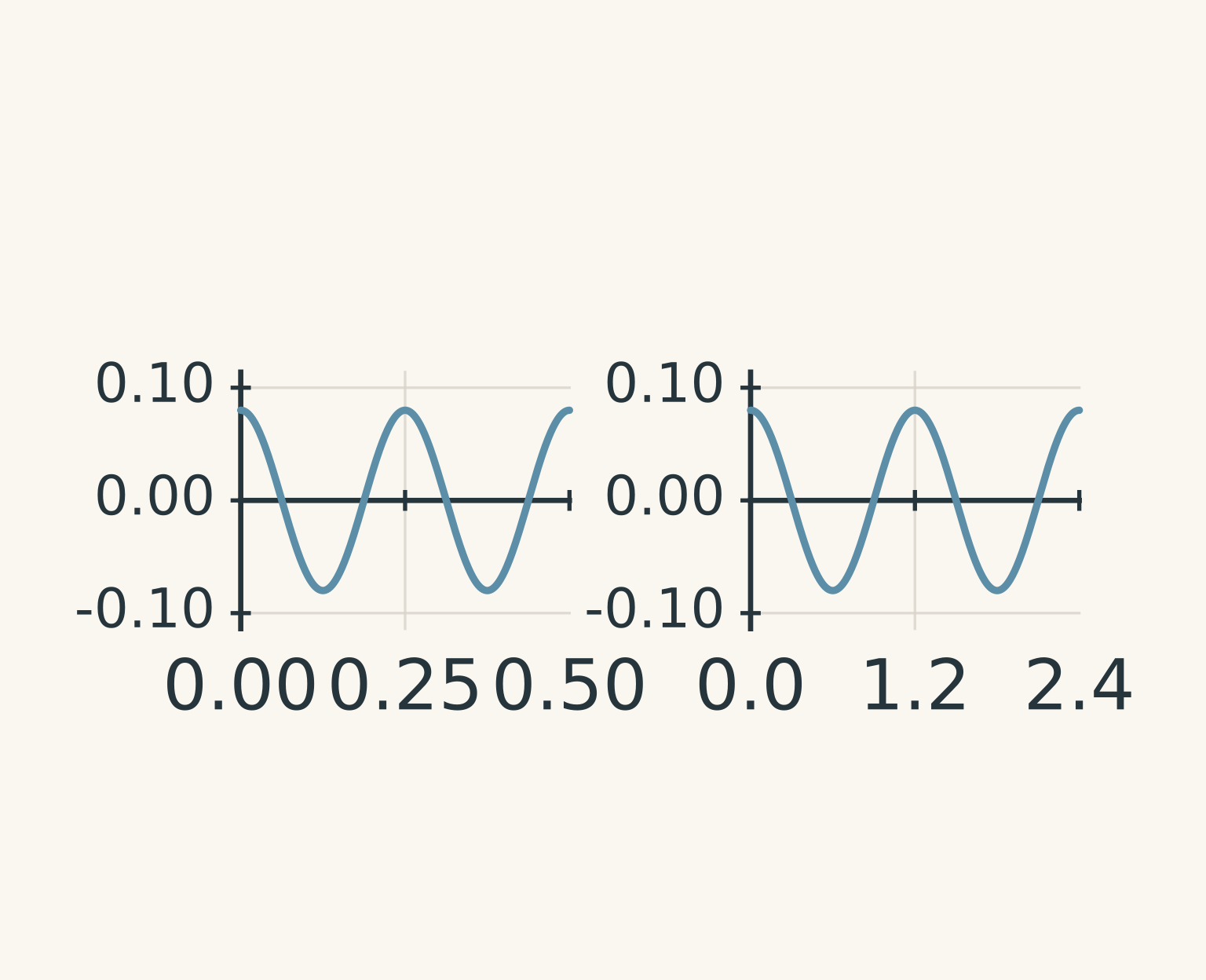
(a) Calculate the period and frequency of the wave. (2 marks)
(b) Calculate the wave speed. (2 marks)
(c) At one instant, a point is \(0.030\ \text{m}\) above equilibrium, while the wave’s maximum displacement is \(0.080\ \text{m}\). Identify the instantaneous displacement and the amplitude. (1 mark)
(d) For a displacement-time graph and a displacement-position graph, state what the horizontal axis represents in each case and identify one quantity that can be determined from each graph. (2 marks)
(e) Which type of wave can propagate through a vacuum: a mechanical wave or an electromagnetic wave? (1 mark)
Question 2 (8 marks)
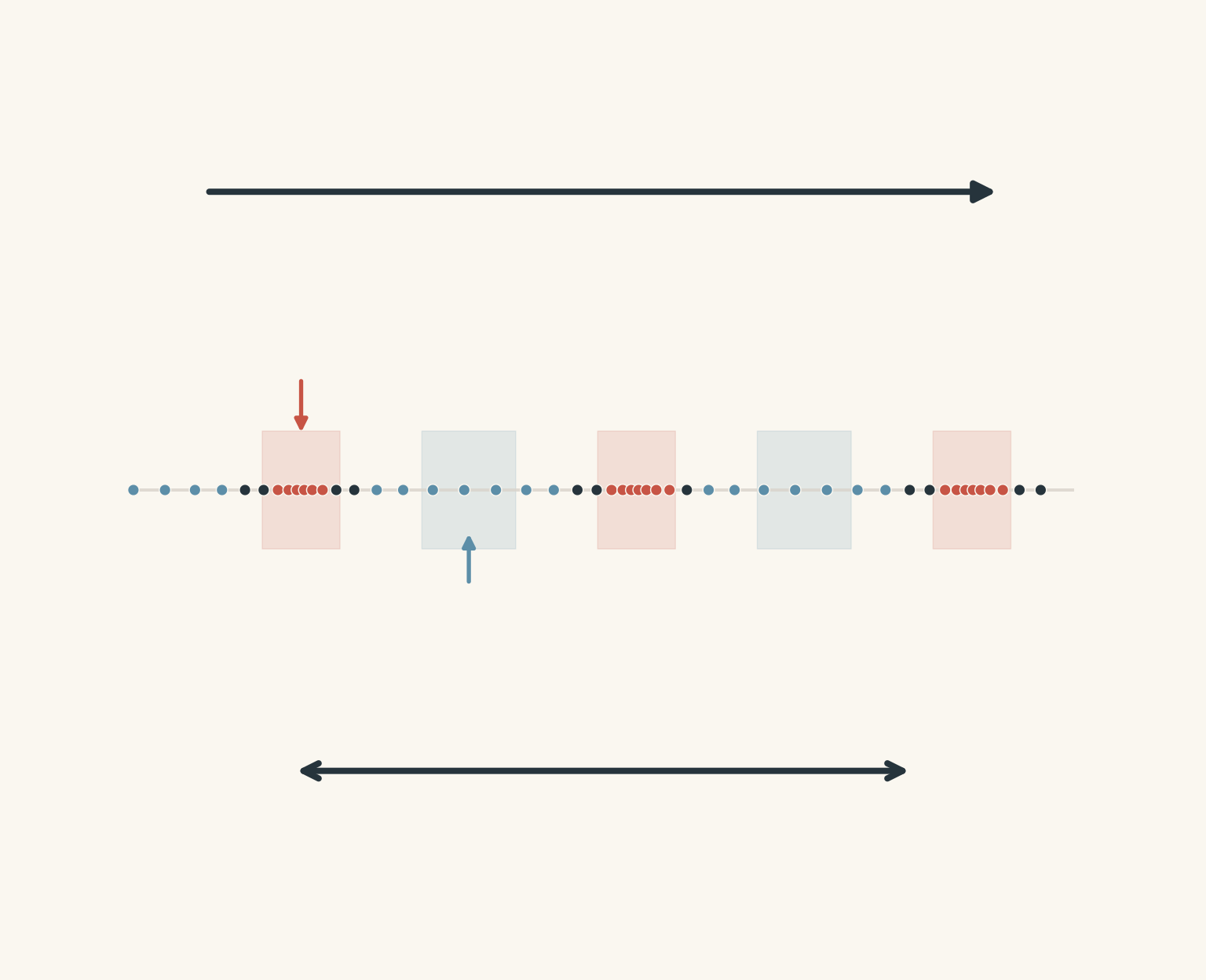
(a) Sound travels through air as a longitudinal pressure wave. Describe the motion of air particles relative to the direction of propagation, and distinguish compressions from rarefactions. (2 marks)
(b) Explain how frequency and amplitude relate to the perceived pitch and loudness of a sound, respectively. (2 marks)
(c) Two tuning forks produce frequencies of \(256\ \text{Hz}\) and \(262\ \text{Hz}\) simultaneously. Calculate the beat frequency. (1 mark)
(d) Two sound waves of equal frequency meet at a point. State the phase relationship required for constructive interference and the phase relationship required for destructive interference. (2 marks)
(e) Explain why low-frequency sound generally diffracts around obstacles more noticeably than high-frequency sound in the same medium. (1 mark)
Question 3 (5 marks)
A stationary listener hears a tone from a source moving directly towards them at \(20\ \text{m s}^{-1}\). The source emits a frequency of \(680\ \text{Hz}\), and the speed of sound in air is \(340\ \text{m s}^{-1}\).
For a source approaching a stationary listener, use
\[ f_o=\frac{f_s v}{v-v_s} \]
where \(f_o\) is the observed frequency, \(f_s\) is the emitted frequency, \(v\) is the speed of sound, and \(v_s\) is the source speed towards the listener.
(a) Calculate the observed frequency. (3 marks)
(b) After the source passes the listener and moves away, will the observed pitch be higher or lower than the emitted pitch? Explain your answer. (2 marks)
Question 4 (7 marks)
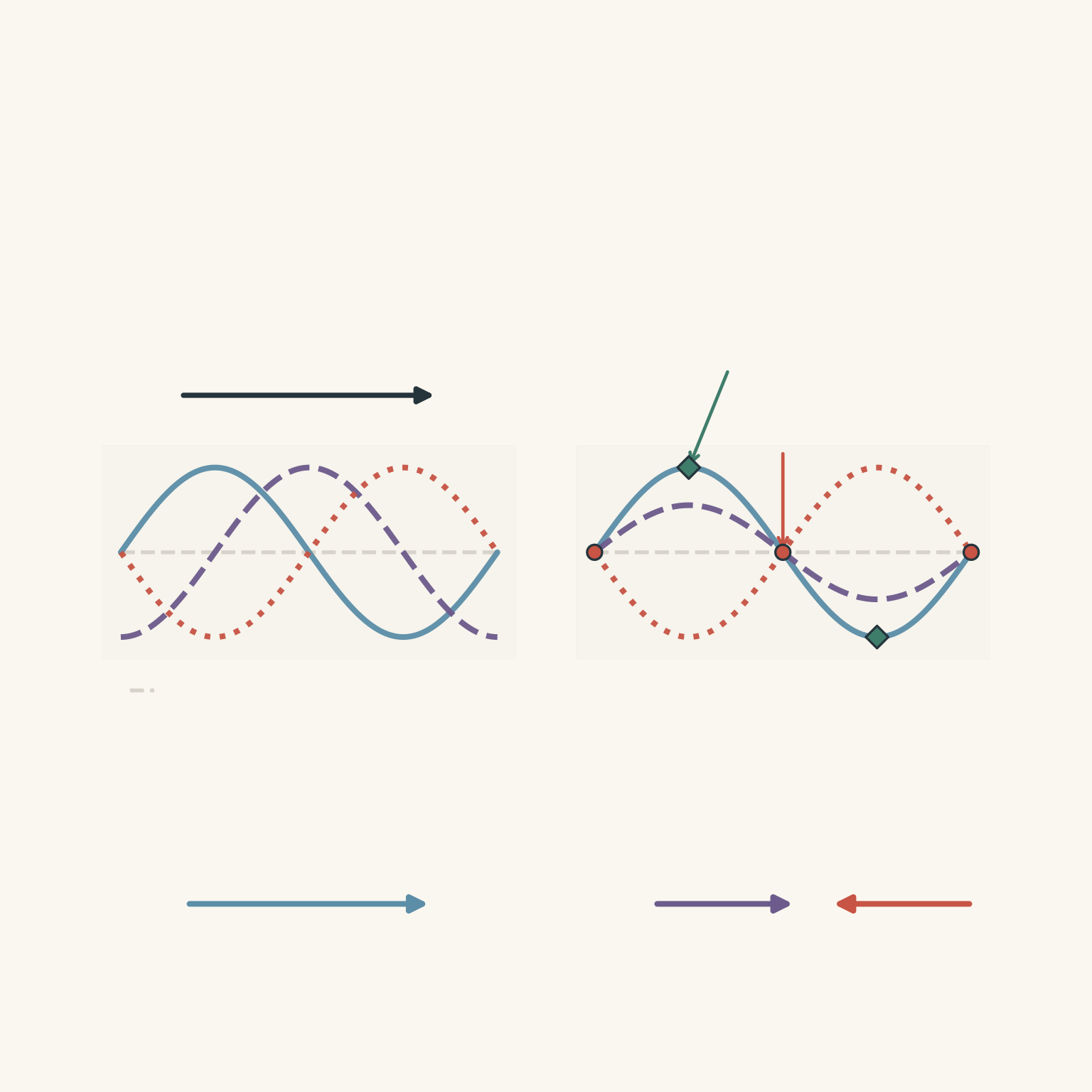
(a) Compare progressive waves and standing waves in terms of energy transfer and their spatial patterns. Include the meaning of nodes and antinodes in a standing wave. (3 marks)
(b) A wave pulse reflects from a fixed end and then from a free end. Describe what happens to the phase of the reflected pulse at each boundary. (2 marks)
(c) Explain how a mechanical wave transfers energy through a medium without transporting the medium as a whole. (2 marks)
Question 5 (6 marks)
A string of length \(0.800\ \text{m}\) is fixed at both ends. Its tension is \(80.0\ \text{N}\), and its linear mass density is \(5.00\times10^{-3}\ \text{kg m}^{-1}\).
For this string, the wave speed is given by
\[ v=\sqrt{\frac{T}{\mu}} \]
where \(T\) is the tension in newtons and \(\mu\) is the linear mass density in kilograms per metre.
(a) Calculate the speed of a transverse wave on the string. (2 marks)
(b) Calculate the fundamental frequency of the string. (2 marks)
(c) Calculate the frequency of the third harmonic. (1 mark)
(d) If the tension is quadrupled while the string’s length and linear mass density remain unchanged, by what factor does the wave speed change? (1 mark)
Question 6 (6 marks)
Two air columns have the same length, \(0.850\ \text{m}\). One pipe is open at both ends, while the other is closed at one end and open at the other. Take the speed of sound in air to be \(340\ \text{m s}^{-1}\).
(a) For the pipe open at both ends, calculate the fundamental frequency and the second-harmonic frequency. (2 marks)
(b) For the pipe closed at one end, calculate the fundamental frequency and the next allowed resonant frequency. Identify the harmonic number of this next frequency. (2 marks)
(c) State the displacement condition at an open end and at a closed end of an ideal air column. (2 marks)
Question 7 (4 marks)
(a) Explain why a string or air column can develop a large-amplitude oscillation when driven near its natural frequency. Refer to energy transfer. (2 marks)
(b) An air column has a natural frequency of \(440\ \text{Hz}\). Compare its expected response when driven by a \(440\ \text{Hz}\) tone and a \(300\ \text{Hz}\) tone, assuming comparable driving conditions. Explain how this effect is used in sound systems or musical instruments. (2 marks)
Question 8 (4 marks)
A student shouts towards a large wall and hears an echo \(0.80\ \text{s}\) later. The speed of sound in air is \(340\ \text{m s}^{-1}\).
(a) Calculate the distance between the student and the wall. (2 marks)
(b) Describe one effect of sound reflection on the acoustics of an enclosed room and one way the room’s surfaces could be modified to change that effect. (2 marks)
Question 9 (5 marks)
Assume a point-like source radiates uniformly in all directions and its power remains constant.
(a) A lamp produces a light intensity of \(72\ \text{W m}^{-2}\) at a distance of \(2.0\ \text{m}\). Calculate the intensity at a distance of \(6.0\ \text{m}\). (2 marks)
(b) Explain why the intensity of light from a point-like source follows an inverse-square relationship with distance. (2 marks)
(c) A sound source produces an intensity of \(12\ \text{mW m}^{-2}\) at a distance of \(3.0\ \text{m}\). Calculate the intensity at \(6.0\ \text{m}\), assuming the same spreading conditions. (1 mark)
Question 10 (8 marks)
Light travels from air into glass. Take the refractive index of air to be \(1.00\), the refractive index of glass to be \(1.50\), and the speed of light in a vacuum to be \(3.00\times10^8\ \text{m s}^{-1}\).
(a) Calculate the speed of light in the glass using \(n=c/v\), where \(n\) is refractive index, \(c\) is the speed of light in a vacuum, and \(v\) is the speed of light in the material. (2 marks)
(b) A light ray enters the glass at an angle of incidence of \(40.0^\circ\). Use Snell’s law to calculate the angle of refraction and state whether the ray bends towards or away from the normal. (2 marks)
(c) Calculate the critical angle for a glass-to-air boundary. (2 marks)
(d) State the two conditions required for total internal reflection. Then explain why white light separates into different colours when it passes through a prism. (2 marks)
Question 11 (8 marks)
For each part, draw a principal-ray diagram on paper. Label the object, focal point or points, image, and relevant distances. Use an ideal concave mirror in part (a) and an ideal thin converging lens in part (b).
(a) A concave mirror has a focal length of \(10\ \text{cm}\). An object is placed \(30\ \text{cm}\) in front of the mirror. Use a principal-ray construction to locate the image and describe its position, orientation, and relative size. (4 marks)
(b) A converging lens has a focal length of \(12\ \text{cm}\). An object is placed \(18\ \text{cm}\) from the lens. Use a principal-ray construction to locate the image and describe its position, orientation, and relative size. (4 marks)
Question 12 (5 marks)
(a) Two objects at \(70^\circ\text{C}\) and \(25^\circ\text{C}\) are placed in thermal contact. State the direction of net thermal energy transfer and the condition under which the net transfer stops. (2 marks)
(b) Two samples are both at \(40^\circ\text{C}\). Sample A has twice the mass of sample B, and the samples are made of different substances. Explain why their temperatures alone do not determine which sample has the greater total thermal energy. (2 marks)
(c) In the particle model, what does temperature indicate about the particles of a substance? (1 mark)
Question 13 (5 marks)
A \(0.400\ \text{kg}\) sample absorbs \(3600\ \text{J}\) of thermal energy, causing its temperature to increase by \(30^\circ\text{C}\). Assume all the supplied energy is absorbed by the sample and no phase change occurs.
(a) Calculate the specific heat capacity of the material. (3 marks)
(b) A second \(0.400\ \text{kg}\) sample has a specific heat capacity of \(600\ \text{J kg}^{-1}\text{K}^{-1}\). If it absorbs the same energy, calculate its temperature increase and compare it with that of the first sample. (2 marks)
Question 14 (4 marks)
A \(0.200\ \text{kg}\) sample of ice at \(0^\circ\text{C}\) melts completely at \(0^\circ\text{C}\). The specific latent heat of fusion of ice is \(3.34\times10^5\ \text{J kg}^{-1}\).
(a) Calculate the energy required to melt the ice. (2 marks)
(b) Explain why the temperature remains constant while the ice melts, even though thermal energy is transferred to it. (2 marks)
Question 15 (6 marks)
A flat wall has a thermal conductivity of \(0.80\ \text{W m}^{-1}\text{K}^{-1}\), an area of \(12\ \text{m}^2\), and a thickness of \(0.20\ \text{m}\). The temperature difference across the wall is \(15\ \text{K}\).
Assume steady, one-dimensional conduction and negligible energy losses through other paths. Use
\[ \frac{Q}{t}=\frac{kA\Delta T}{d} \]
where \(Q/t\) is the rate of thermal energy transfer, \(k\) is thermal conductivity, \(A\) is cross-sectional area, \(\Delta T\) is the temperature difference, and \(d\) is wall thickness.
(a) Calculate the rate of thermal energy transfer through the wall. (3 marks)
(b) Explain how thermal conduction transfers energy through a metal, and why metals generally conduct thermal energy more effectively than many insulating materials. (3 marks)
Question 16 (6 marks)
(a) Explain how convection transfers thermal energy through a fluid heated from below. Include the roles of density and fluid movement. (3 marks)
(b) Explain how thermal radiation transfers energy. Describe how dark, matte surfaces generally behave compared with light-coloured or shiny surfaces when absorbing and emitting thermal radiation. (3 marks)
Question 17 (5 marks)
Water waves travel from a deep region into a shallow region. The wave frequency is \(3.0\ \text{Hz}\). Their speed is \(1.20\ \text{m s}^{-1}\) in the deep region and \(0.75\ \text{m s}^{-1}\) in the shallow region.
(a) Calculate the wavelength in each region and state what happens to the frequency at the boundary. (3 marks)
(b) If the waves cross the boundary obliquely, state the direction in which they bend when entering the slower region. (1 mark)
(c) Two waves pass through the same gap. One has a wavelength of \(0.60\ \text{m}\), while the other has a wavelength of \(0.15\ \text{m}\). Which wave will generally diffract more strongly, and why? (1 mark)
03Worked solutions and marking guide
The solutions below show one valid method for each question. Equivalent methods and correctly justified answers should receive credit. Follow-through marks are appropriate where a student uses a correct method with a numerical value carried forward from an earlier error.
Solution 1
(a) Period and frequency
The period \(T\) is the time for one complete cycle, measured in seconds. The frequency \(f\) is the number of complete cycles per second, measured in hertz.
Successive crests are separated by one period, so
\[ T=0.25\ \text{s} \]
Frequency is the reciprocal of period:
\[ \begin{aligned} f&=\frac{1}{T}\\ &=\frac{1}{0.25}\\ &=4.0\ \text{Hz} \end{aligned} \]
The wave completes four cycles per second.
Marking (2):
- Correct period: 1 mark.
- Correct frequency calculation and answer: 1 mark.
(b) Wave speed
The wavelength \(\lambda\) is the distance between successive points in the same phase, such as adjacent crests. Wave speed \(v\) is related to frequency and wavelength by \(v=f\lambda\).
\[ \begin{aligned} v&=f\lambda\\ &=4.0\times1.20\\ &=4.8\ \text{m s}^{-1} \end{aligned} \]
Marking (2):
- Correct relationship and substitution: 1 mark.
- Correct speed with units: 1 mark.
(c) Displacement and amplitude
The instantaneous displacement is \(+0.030\ \text{m}\), because the point is above equilibrium at that instant. The amplitude is \(0.080\ \text{m}\), because amplitude is the maximum displacement from equilibrium.
Marking (1):
- Correctly identifies both values: 1 mark.
(d) Interpreting wave graphs
A displacement-time graph has time on its horizontal axis. It can be used to measure the period and determine frequency.
A displacement-position graph has position along the medium on its horizontal axis. It can be used to measure the wavelength.
Marking (2):
- Correctly identifies the axes: 1 mark.
- Identifies an appropriate quantity from each graph: 1 mark.
(e) Waves in a vacuum
Electromagnetic waves can propagate through a vacuum. Mechanical waves require a material medium.
Marking (1):
- Identifies electromagnetic waves: 1 mark.
Solution 2
(a) Sound as a longitudinal pressure wave
Air particles oscillate parallel to the direction in which the sound wave propagates. They do not travel all the way from the source to the listener.
Compressions are regions where particles are closer together and pressure is higher. Rarefactions are regions where particles are more spread out and pressure is lower.
Marking (2):
- Correct particle-motion direction: 1 mark.
- Correct distinction between compressions and rarefactions: 1 mark.
(b) Pitch and loudness
Pitch is primarily related to frequency. A higher-frequency sound is generally perceived as having a higher pitch.
For comparable conditions, greater wave amplitude corresponds to greater sound intensity and is generally perceived as greater loudness. Loudness is a perceptual response, so it also depends on factors such as frequency and the listener’s hearing.
Marking (2):
- Correct relationship between frequency and pitch: 1 mark.
- Correct relationship between amplitude or intensity and loudness: 1 mark.
(c) Beat frequency
The beat frequency is the absolute difference between two nearby frequencies:
\[ \begin{aligned} f_{\text{beat}}&=|f_1-f_2|\\ &=|262-256|\\ &=6\ \text{Hz} \end{aligned} \]
The sound’s loudness fluctuates six times per second.
Marking (1):
- Correct difference and answer: 1 mark.
(d) Constructive and destructive interference
Constructive interference occurs when the two waves arrive in phase. Their displacements reinforce each other.
Destructive interference occurs when they arrive in antiphase, meaning a phase difference of \(180^\circ\), or \(\pi\) radians. Their displacements oppose each other. Complete cancellation requires equal amplitudes.
Marking (2):
- Correct phase relationship for constructive interference: 1 mark.
- Correct phase relationship for destructive interference: 1 mark.
(e) Diffraction of sound
In the same medium, lower frequency means longer wavelength because wave speed is approximately constant. A longer wavelength is more comparable to the size of a given obstacle, so the sound generally diffracts more noticeably around it.
Marking (1):
- Links longer wavelength to stronger diffraction around obstacles: 1 mark.
Solution 3
(a) Observed frequency
For a source moving towards a stationary listener, the wavefronts are closer together in front of the source. The listener therefore receives a higher frequency.
Using the supplied Doppler equation:
\[ \begin{aligned} f_o&=\frac{f_s v}{v-v_s}\\ &=\frac{680\times340}{340-20}\\ &=\frac{231200}{320}\\ &=722.5\ \text{Hz} \end{aligned} \]
To three significant figures, the observed frequency is \(723\ \text{Hz}\).
Marking (3):
- Correct substitution into the supplied equation: 1 mark.
- Correct numerical calculation: 1 mark.
- Correct answer with units and appropriate precision: 1 mark.
(b) Receding source
The observed pitch is lower than the emitted pitch. As the source moves away, the wavefronts reaching the listener are more widely spaced, increasing the observed wavelength and decreasing the observed frequency.
Marking (2):
- States that the observed pitch is lower: 1 mark.
- Correctly explains the change using wavefront spacing, wavelength, or frequency: 1 mark.
Solution 4
(a) Progressive and standing waves
A progressive wave travels through a medium and transfers energy from one region to another.
A standing wave has a stationary pattern formed by the superposition of suitable waves travelling in opposite directions. It has no net energy transfer along the medium in the ideal standing-wave model.
Nodes are positions of zero displacement. Antinodes are positions of maximum oscillation amplitude.
Marking (3):
- Identifies energy transfer by a progressive wave: 1 mark.
- Identifies the stationary pattern and absence of net energy transfer in a standing wave: 1 mark.
- Correctly defines nodes and antinodes: 1 mark.
(b) Reflection at boundaries
At a fixed end, the reflected pulse is inverted. Its phase changes by \(180^\circ\), or \(\pi\) radians.
At an ideal free end, the reflected pulse is not inverted. There is no phase reversal.
Marking (2):
- Correct behaviour at a fixed end: 1 mark.
- Correct behaviour at a free end: 1 mark.
(c) Energy transfer without bulk transport
Particles in a mechanical wave oscillate around their equilibrium positions. Their interactions transfer energy to neighbouring particles, allowing the disturbance to propagate through the medium.
The medium does not need to move as a whole in the direction of propagation. Individual particles oscillate while the wave carries energy onwards.
Marking (2):
- Describes local particle oscillation and energy transfer between particles: 1 mark.
- Explains the absence of bulk transport of the medium: 1 mark.
Solution 5
(a) Wave speed on the string
The wave speed depends on the string tension \(T\) and linear mass density \(\mu\).
\[ \begin{aligned} v&=\sqrt{\frac{T}{\mu}}\\ &=\sqrt{\frac{80.0}{5.00\times10^{-3}}}\\ &=\sqrt{16000}\\ &=126.5\ \text{m s}^{-1} \end{aligned} \]
To three significant figures, \(v=126\ \text{m s}^{-1}\).
Marking (2):
- Correct formula and substitution: 1 mark.
- Correct speed and units: 1 mark.
(b) Fundamental frequency
For a string fixed at both ends, the fundamental wavelength is twice the string length:
\[ \lambda_1=2L \]
The fundamental frequency \(f_1\) is therefore
\[ \begin{aligned} f_1&=\frac{v}{2L}\\ &=\frac{126.5}{2\times0.800}\\ &=79.1\ \text{Hz} \end{aligned} \]
Marking (2):
- Correct fundamental-frequency relationship: 1 mark.
- Correct answer with units: 1 mark.
(c) Third harmonic
The third harmonic has three times the fundamental frequency:
\[ f_3=3f_1=3\times79.1=237\ \text{Hz} \]
Marking (1):
- Correct third-harmonic frequency: 1 mark.
(d) Effect of quadrupling tension
Since \(v=\sqrt{T/\mu}\), wave speed is proportional to the square root of tension when \(\mu\) is constant.
If tension becomes four times larger,
\[ \frac{v_{\text{new}}}{v_{\text{old}}}=\sqrt{4}=2 \]
The wave speed doubles.
Marking (1):
- Correct factor of two: 1 mark.
Solution 6
(a) Pipe open at both ends
For a pipe open at both ends, the fundamental standing wave has a wavelength of twice the pipe length.
\[ f_1=\frac{v}{2L} =\frac{340}{2\times0.850} =200\ \text{Hz} \]
The second harmonic has twice the fundamental frequency:
\[ f_2=2f_1=400\ \text{Hz} \]
Marking (2):
- Correct fundamental frequency: 1 mark.
- Correct second-harmonic frequency: 1 mark.
(b) Pipe closed at one end
A pipe closed at one end has a displacement node at the closed end and an antinode at the open end. Its fundamental wavelength is four times the pipe length.
\[ f_1=\frac{v}{4L} =\frac{340}{4\times0.850} =100\ \text{Hz} \]
The next allowed mode is the third harmonic, not the second harmonic:
\[ f_3=3f_1=300\ \text{Hz} \]
Only odd harmonics occur in the ideal closed-open pipe: \(f_1, 3f_1, 5f_1,\ldots\).
Marking (2):
- Correct fundamental frequency: 1 mark.
- Correct next frequency and identification as the third harmonic: 1 mark.
(c) Open and closed ends
At an open end, the air has a displacement antinode. At a closed end, the air has a displacement node.
Marking (2):
- Correct open-end condition: 1 mark.
- Correct closed-end condition: 1 mark.
Solution 7
(a) Resonance and energy transfer
Resonance occurs when the driving frequency matches, or is sufficiently close to, a system’s natural frequency. The driving force then transfers energy efficiently to the oscillating system.
The amplitude can build to a large value because energy is added in step with the motion. Damping limits the maximum amplitude in a real system.
Marking (2):
- Relates resonance to matching the natural and driving frequencies: 1 mark.
- Explains efficient energy transfer and increased amplitude: 1 mark.
(b) Resonance in an air column
At \(440\ \text{Hz}\), the driving frequency matches the air column’s natural frequency, so a strong response is expected under comparable driving conditions.
At \(300\ \text{Hz}\), the driving frequency does not match this natural frequency, so the response associated with this resonance will generally be weaker. Musical instruments use resonant strings or air columns to strengthen particular frequencies and produce characteristic sounds. Sound systems can also excite resonances in enclosed spaces.
Marking (2):
- Correct comparison of the responses at the two frequencies: 1 mark.
- Connects resonance to a musical instrument or sound system: 1 mark.
Solution 8
(a) Distance to the wall
The \(0.80\ \text{s}\) is the time taken for sound to travel to the wall and back. The total distance travelled by the sound is therefore twice the student-to-wall distance.
\[ \begin{aligned} d&=\frac{vt}{2}\\ &=\frac{340\times0.80}{2}\\ &=136\ \text{m} \end{aligned} \]
The wall is \(136\ \text{m}\) away.
Marking (2):
- Recognises that the sound travels a round trip: 1 mark.
- Correct calculation and answer with units: 1 mark.
(b) Acoustic effects of reflection
A hard wall reflects sound, potentially producing echoes or prolonged reverberation. Reverberation occurs when many reflected sounds overlap and persist after the original sound.
Acoustic panels or other sound-absorbing materials can reduce reflections and shorten reverberation. The result is often clearer speech in a room.
Marking (2):
- Correctly describes an acoustic effect of reflection: 1 mark.
- Gives a suitable treatment and explains its effect: 1 mark.
Solution 9
(a) Light intensity at 6.0 m
For a point-like source with constant power, intensity \(I\) is inversely proportional to the square of distance \(r\).
\[ I_2=I_1\left(\frac{r_1}{r_2}\right)^2 \]
Substituting the given values:
\[ \begin{aligned} I_2&=72\left(\frac{2.0}{6.0}\right)^2\\ &=72\times\frac{1}{9}\\ &=8.0\ \text{W m}^{-2} \end{aligned} \]
Marking (2):
- Correct inverse-square relationship and substitution: 1 mark.
- Correct intensity and units: 1 mark.
(b) Why the inverse-square law applies
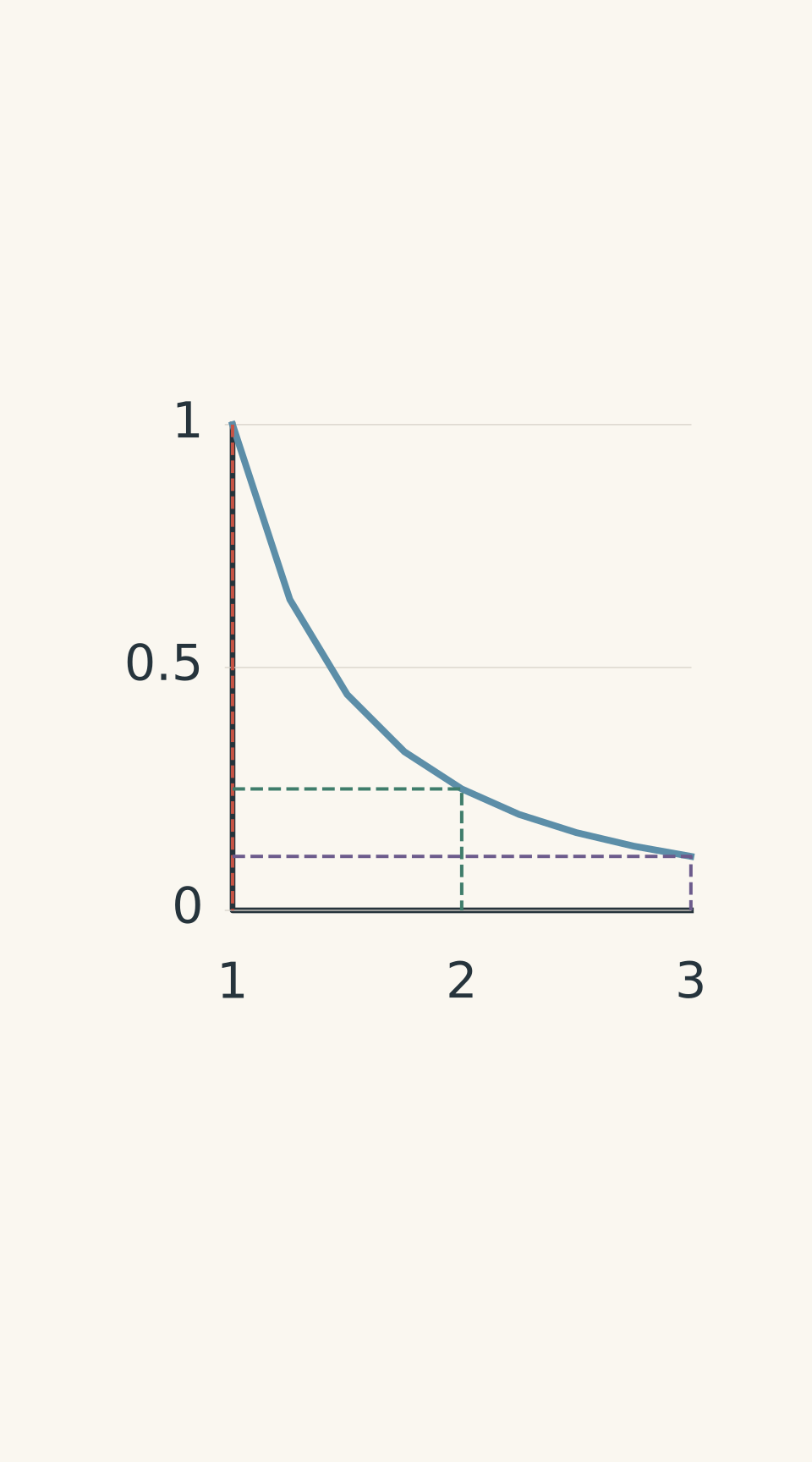
For a source radiating uniformly in all directions, the emitted energy spreads over the surface of an expanding sphere. The sphere’s area is \(4\pi r^2\), so the area increases with the square of the distance.
For constant source power \(P\), intensity is power per unit area:
\[ I=\frac{P}{4\pi r^2} \]
Therefore, \(I\propto 1/r^2\). Doubling the distance reduces the intensity to one-quarter of its original value.
- Inverse-square law
- r
- 2r
- 3r
Marking (2):
- Explains the increasing spherical area: 1 mark.
- Links intensity to power per unit area and derives the inverse-square relationship: 1 mark.
(c) Sound intensity at 6.0 m
The distance doubles from \(3.0\ \text{m}\) to \(6.0\ \text{m}\). The intensity becomes one-quarter of its original value:
\[ I_2=12\left(\frac{3.0}{6.0}\right)^2 =3.0\ \text{mW m}^{-2} \]
Marking (1):
- Correct answer with units: 1 mark.
Solution 10
(a) Speed of light in glass
The refractive index \(n\) is the ratio of the speed of light in a vacuum \(c\) to its speed \(v\) in a material.
\[ \begin{aligned} n&=\frac{c}{v}\\ v&=\frac{c}{n}\\ &=\frac{3.00\times10^8}{1.50}\\ &=2.00\times10^8\ \text{m s}^{-1} \end{aligned} \]
Marking (2):
- Correct rearrangement and substitution: 1 mark.
- Correct speed and units: 1 mark.
(b) Angle of refraction
Snell’s law relates the refractive indices and angles:
\[ n_1\sin i=n_2\sin r \]
Here, \(n_1=1.00\), \(n_2=1.50\), and \(i=40.0^\circ\).
\[ \begin{aligned} \sin r&=\frac{1.00\sin40.0^\circ}{1.50}\\ &=0.4285\\ r&=\sin^{-1}(0.4285)\\ &=25.4^\circ \end{aligned} \]
The ray bends towards the normal because it enters a medium with a higher refractive index and a lower light speed.
Marking (2):
- Correct Snell’s law calculation: 1 mark.
- Correct angle and direction of bending: 1 mark.
(c) Critical angle
The critical angle \(c_{\text{crit}}\) is the angle of incidence in the higher-index material that produces a refracted ray travelling along the boundary at \(90^\circ\) to the normal.
Applying Snell’s law at the critical angle:
\[ \begin{aligned} 1.50\sin c_{\text{crit}}&=1.00\sin90^\circ\\ \sin c_{\text{crit}}&=\frac{1.00}{1.50}\\ c_{\text{crit}}&=\sin^{-1}\left(\frac{1.00}{1.50}\right)\\ &=41.8^\circ \end{aligned} \]
Marking (2):
- Correct critical-angle relationship: 1 mark.
- Correct angle: 1 mark.
(d) Total internal reflection and dispersion
Total internal reflection requires both of the following:
- Light travels from a higher refractive index to a lower refractive index.
- The angle of incidence in the higher-index material is greater than the critical angle.
Dispersion occurs because refractive index depends on wavelength. Different colours of white light therefore refract by different amounts in the prism, separating the light into its component colours. In ordinary glass, violet light generally refracts more strongly than red light.
Marking (2):
- States both conditions for total internal reflection: 1 mark.
- Explains wavelength-dependent refraction and colour separation: 1 mark.
Solution 11
(a) Concave mirror
The mirror has focal length \(f=10\ \text{cm}\), so its centre of curvature is \(2f=20\ \text{cm}\) from the mirror. The object is \(30\ \text{cm}\) away, beyond the centre of curvature.
For the ray diagram:
- Draw a ray parallel to the principal axis. It reflects through the focal point.
- Draw a ray through the centre of curvature. It reflects back along itself.
- The reflected rays intersect between the focal point and the centre of curvature.
The image distance can be checked using the mirror equation:
\[ \begin{aligned} \frac{1}{f}&=\frac{1}{d_o}+\frac{1}{d_i}\\ \frac{1}{d_i}&=\frac{1}{10}-\frac{1}{30}\\ &=\frac{1}{15}\\ d_i&=15\ \text{cm} \end{aligned} \]
The image forms \(15\ \text{cm}\) in front of the mirror. It is real, inverted, and diminished. Its size is half the object’s size because the magnitude of the magnification is \(d_i/d_o=15/30=0.50\).
Marking (4):
- Correct principal rays: 2 marks.
- Correct image location, approximately \(15\ \text{cm}\) in front of the mirror: 1 mark.
- Correct image description: real, inverted, and diminished: 1 mark.
(b) Converging lens
The lens has focal length \(f=12\ \text{cm}\), and the object is \(18\ \text{cm}\) from the lens. Since the object lies between \(F\) and \(2F\), the image forms beyond \(2F\) on the opposite side.
For the ray diagram:
- Draw a ray parallel to the principal axis. After refraction, it passes through the far focal point.
- Draw a ray through the optical centre. It continues approximately straight through the thin lens.
- The refracted rays intersect on the opposite side of the lens.
The image distance can be checked using the thin-lens equation:
\[ \begin{aligned} \frac{1}{f}&=\frac{1}{d_o}+\frac{1}{d_i}\\ \frac{1}{d_i}&=\frac{1}{12}-\frac{1}{18}\\ &=\frac{1}{36}\\ d_i&=36\ \text{cm} \end{aligned} \]
The image forms \(36\ \text{cm}\) from the lens on the opposite side to the object. It is real, inverted, and enlarged. The magnitude of its magnification is \(36/18=2.0\), so the image is twice the object’s height.
Marking (4):
- Correct principal rays: 2 marks.
- Correct image location, approximately \(36\ \text{cm}\) from the lens: 1 mark.
- Correct image description: real, inverted, and enlarged: 1 mark.
Solution 12
(a) Thermal equilibrium
Net thermal energy transfer is from the hotter object at \(70^\circ\text{C}\) to the cooler object at \(25^\circ\text{C}\).
The objects reach thermal equilibrium when they have the same temperature. At that point, there is no net thermal energy transfer between them.
Marking (2):
- Correct direction of net energy transfer: 1 mark.
- Correct condition for thermal equilibrium: 1 mark.
(b) Temperature and total thermal energy
Equal temperatures do not guarantee equal total thermal energy. Temperature is related to the average kinetic energy of particles, whereas total internal energy depends on factors including the number of particles, the substance, and its physical state.
Sample A has twice the mass, but it is made of a different substance. Without more information, such as the materials’ properties and states, the relative total thermal energies cannot be determined from temperature alone.
Marking (2):
- Distinguishes temperature from total thermal energy: 1 mark.
- Explains the relevance of mass and material or state: 1 mark.
(c) Particle model
In the particle model, temperature is related to the average kinetic energy of the particles. For an ideal gas, absolute temperature is proportional to average translational kinetic energy.
Marking (1):
- Correctly relates temperature to average particle kinetic energy: 1 mark.
Solution 13
(a) Specific heat capacity
Specific heat capacity \(c\) is the energy required to raise the temperature of one kilogram of a substance by one kelvin, without a phase change.
The relationship is
\[ Q=mc\Delta T \]
where \(Q\) is transferred energy, \(m\) is mass, and \(\Delta T\) is temperature change.
Rearranging:
\[ \begin{aligned} c&=\frac{Q}{m\Delta T}\\ &=\frac{3600}{0.400\times30}\\ &=\frac{3600}{12}\\ &=300\ \text{J kg}^{-1}\text{K}^{-1} \end{aligned} \]
Marking (3):
- Correct equation and rearrangement: 1 mark.
- Correct substitution and calculation: 1 mark.
- Correct answer with units: 1 mark.
(b) Comparing temperature increases
For the second sample,
\[ \begin{aligned} \Delta T&=\frac{Q}{mc}\\ &=\frac{3600}{0.400\times600}\\ &=15\ \text{K} \end{aligned} \]
A temperature increase of \(15\ \text{K}\) is numerically equal to an increase of \(15^\circ\text{C}\).
The first sample’s temperature increases by \(30^\circ\text{C}\), while the second sample’s temperature increases by \(15^\circ\text{C}\). The second sample has twice the specific heat capacity, so the same energy produces half the temperature increase for the same mass.
Marking (2):
- Correct calculation of the second temperature increase: 1 mark.
- Correct comparison with the first sample: 1 mark.
Solution 14
(a) Energy required to melt the ice
During melting, the energy transferred is calculated using the specific latent heat of fusion \(L_f\).
\[ \begin{aligned} Q&=mL_f\\ &=0.200\times3.34\times10^5\\ &=6.68\times10^4\ \text{J} \end{aligned} \]
The energy required is \(66.8\ \text{kJ}\).
Marking (2):
- Correct latent-heat equation and substitution: 1 mark.
- Correct energy and units: 1 mark.
(b) Constant temperature during melting
During a phase change, the transferred energy changes the arrangement of particles and helps overcome the interactions holding the solid structure together.
The energy does not produce an increase in average kinetic energy during the melting process. Since temperature is linked to average kinetic energy, the temperature remains constant while the ice melts at its melting point.
Marking (2):
- Identifies the energy’s role in changing the phase and particle arrangement: 1 mark.
- Connects constant temperature to unchanged average kinetic energy: 1 mark.
Solution 15
(a) Rate of thermal energy transfer
The rate of conduction through the wall is
\[ \frac{Q}{t}=\frac{kA\Delta T}{d} \]
Substituting the given values:
\[ \begin{aligned} \frac{Q}{t} &=\frac{0.80\times12\times15}{0.20}\\ &=\frac{144}{0.20}\\ &=720\ \text{W} \end{aligned} \]
The rate of thermal energy transfer is \(720\ \text{W}\).
Marking (3):
- Correct equation and substitution: 1 mark.
- Correct numerical calculation: 1 mark.
- Correct rate and units: 1 mark.
(b) Conduction in metals
In conduction, energy moves through interactions between neighbouring particles. More energetic particles transfer energy to neighbouring particles through collisions and vibrations.
Metals also contain mobile electrons. These electrons can move through the material and transfer energy efficiently, which helps explain why metals generally conduct thermal energy better than many insulating materials.
Marking (3):
- Explains energy transfer through particle interactions or vibrations: 1 mark.
- Identifies the role of mobile electrons in metals: 1 mark.
- Connects these mechanisms to more effective conduction in metals: 1 mark.
Solution 16
(a) Convection
When a fluid is heated from below, the warmer fluid expands and generally becomes less dense. The surrounding cooler, denser fluid exerts a buoyant effect that helps the warmer fluid rise.
As the warmer fluid moves upwards, cooler fluid moves downwards to replace it. This circulation transports thermal energy through the bulk movement of the fluid. This process is convection.
Marking (3):
- Explains heating, expansion, and reduced density: 1 mark.
- Explains the rising warmer fluid and sinking cooler fluid: 1 mark.
- Identifies bulk fluid movement as the mechanism of energy transfer: 1 mark.
(b) Thermal radiation
Thermal radiation transfers energy through electromagnetic waves. Unlike conduction and convection, it does not require a material medium and can travel through a vacuum.
Dark, matte surfaces generally absorb and emit thermal radiation effectively. Light-coloured or shiny surfaces generally reflect more incoming radiation and are poorer absorbers and emitters, particularly when they have a highly reflective finish.
Marking (3):
- Identifies electromagnetic radiation as the transfer mechanism: 1 mark.
- States that radiation does not require a material medium: 1 mark.
- Correctly compares the absorption and emission behaviour of the surfaces: 1 mark.
Solution 17
(a) Wavelength in each region
The wave equation is
\[ v=f\lambda \]
where \(v\) is wave speed, \(f\) is frequency, and \(\lambda\) is wavelength.
In the deep region:
\[ \begin{aligned} \lambda_{\text{deep}}&=\frac{v}{f}\\ &=\frac{1.20}{3.0}\\ &=0.40\ \text{m} \end{aligned} \]
In the shallow region:
\[ \begin{aligned} \lambda_{\text{shallow}}&=\frac{v}{f}\\ &=\frac{0.75}{3.0}\\ &=0.25\ \text{m} \end{aligned} \]
The frequency remains \(3.0\ \text{Hz}\) across the boundary because it is set by the source. The wave speed decreases, so the wavelength decreases as well.
Marking (3):
- Correct deep-region wavelength: 1 mark.
- Correct shallow-region wavelength: 1 mark.
- Correctly states that frequency remains constant: 1 mark.
(b) Direction of refraction
When a wave enters a region where its speed is lower, it bends towards the normal if it crosses the boundary obliquely.
Marking (1):
- Correct direction of bending: 1 mark.
(c) Diffraction through a gap
The wave with wavelength \(0.60\ \text{m}\) diffracts more strongly through the same gap. Its wavelength is larger relative to the gap width, making the spreading more pronounced.
Marking (1):
- Selects the longer-wavelength wave and relates stronger diffraction to wavelength relative to gap size: 1 mark.