
Newton’s First Law: Inertia and Zero Net Force Explained
Learn why zero net force means zero acceleration, not zero velocity. This guide explains inertia, balanced forces, constant velocity, and common HSC Physics misconceptions.
Imagine a hockey puck sliding across perfectly smooth ice. You give it one push, then stop touching it. What happens next?
A common prediction is that the puck must eventually stop because there is no longer a force pushing it forward. That prediction feels sensible because almost everything we see in daily life does slow down. But the puck is not slowing because it has “run out of force”. It slows because other forces, mainly friction and air resistance, act against its motion.
Remove those forces, and something stranger happens: the puck keeps moving at the same velocity.
That is the central idea behind Newton’s first law. Zero net force does not mean zero velocity. It means zero acceleration.
01Start with what forces actually change
Suppose a trolley is already rolling to the right.
If you push it harder to the right, it speeds up. If you push against its motion strongly enough, it slows down. You can also push sideways and change its direction.
In each case, the force changes the trolley’s velocity.
Remember that velocity includes both speed and direction. So an object accelerates if it:
- speeds up,
- slows down, or
- changes direction.
Now make a prediction. If there is no net force on the trolley, what should happen to its velocity?
The answer is that its velocity stays constant.
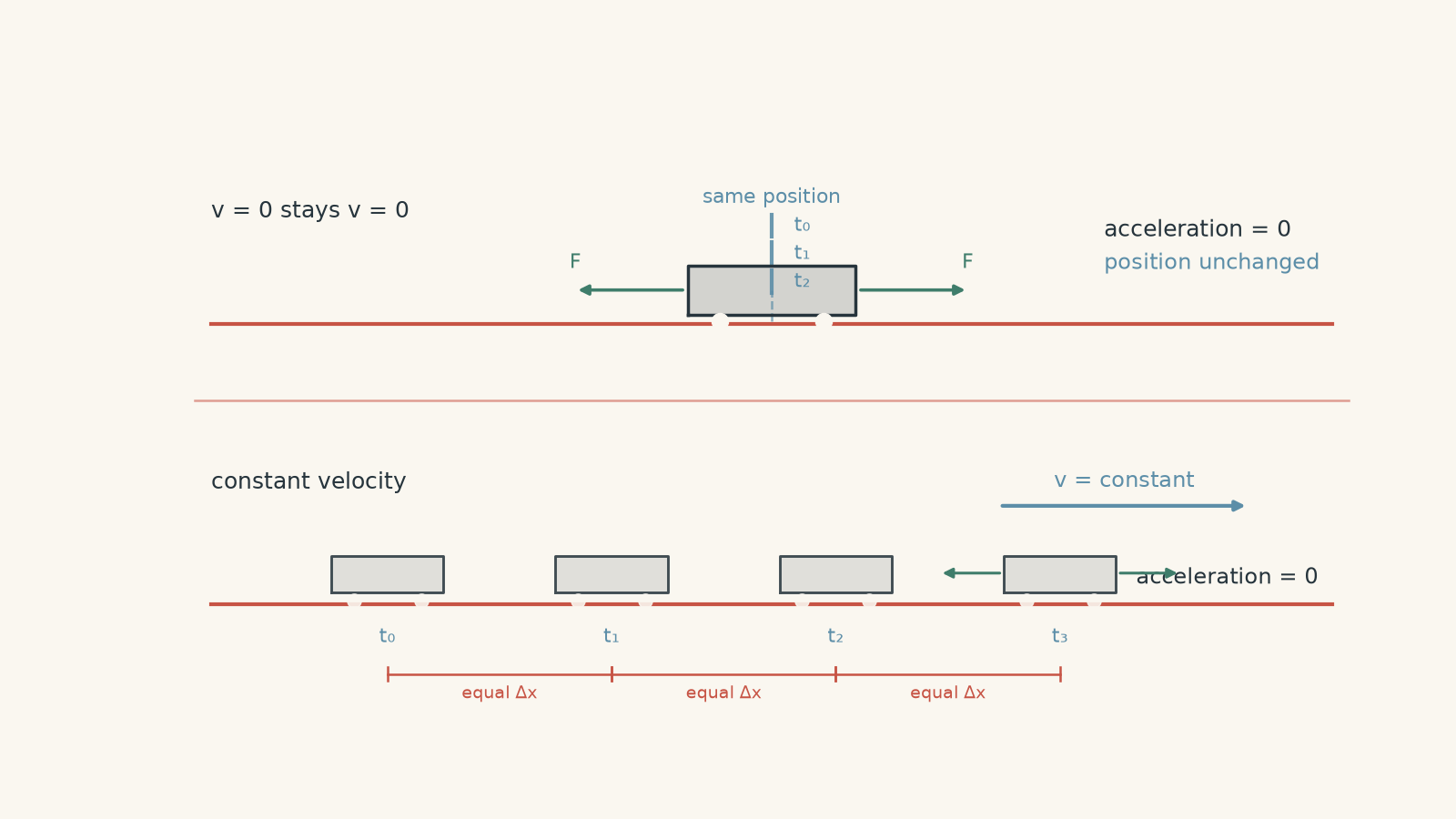
That constant velocity could be \(0\text{ m s}^{-1}\), meaning the trolley remains at rest. But it could just as easily be \(4\text{ m s}^{-1}\) to the right. With zero net force, neither velocity changes.
02Newton’s first law
Newton’s first law states that an object remains at rest, or continues moving with constant velocity, unless acted on by a non-zero net external force.
There are two cases hidden inside that sentence:
| Initial motion | Net force | What happens? |
|---|---|---|
| At rest | Zero | Remains at rest |
| Moving at constant velocity | Zero | Keeps the same velocity |
| Any velocity | Non-zero | Velocity changes |
The important link is:
\[
F_{\text{net}} = 0 \quad \Rightarrow \quad a = 0
\]
Here, \(F_{\text{net}}\) is the vector sum of all external forces on the object, measured in newtons (N), and \(a\) is its acceleration, measured in metres per second squared (\(\text{m s}^{-2}\)).
If \(a=0\), velocity is not changing.
It does not follow that velocity itself must be zero.
03Why everyday experience can mislead you
Kick a soccer ball across grass and it stops. Push a book across a desk and it stops. Stop pedalling a bicycle and, eventually, you slow down.
It is tempting to conclude:
Motion requires a continuing forward force.
But look more carefully. In all three situations, resistive forces are present.
The soccer ball experiences rolling resistance and air resistance. The book experiences friction from the desk. The bicycle experiences rolling resistance and drag.
If the object slows down, then its velocity is changing. That means it is accelerating, even though the acceleration may point opposite the direction of travel.
So the forces cannot be balanced.
For a book sliding to the right, friction acts to the left. Once your hand stops pushing, friction becomes the unbalanced horizontal force, and the book slows down.
The book stops because there is a net force, not because there isn’t one.
04Inertia: the resistance to changing velocity
Newton’s first law leads to the idea of inertia.
Inertia is an object’s tendency to resist a change in its state of motion.
That wording needs care. An object does not “try” to keep moving, and inertia is not another force acting on it. Inertia is a property of matter.
Mass tells us how much inertia an object has.
A loaded shopping trolley is harder to get moving than an empty trolley. Once both are moving, the loaded trolley is also harder to stop or turn. Its larger mass means a given force produces a smaller acceleration.
This connects Newton’s first law to Newton’s second law:
\[
F_{\text{net}} = ma
\]
where:
- \(F_{\text{net}}\) is net force in newtons (N),
- \(m\) is mass in kilograms (kg),
- \(a\) is acceleration in \(\text{m s}^{-2}\).
Rearranging gives
\[
a = \frac{F_{\text{net}}}{m}
\]
For the same net force, a larger mass produces a smaller acceleration.
That is the mathematical side of inertia.
05Balanced forces do not mean “no forces”
Suppose a book is sitting on a table.
Gravity pulls the book downward. The table exerts an upward normal force.
If these forces have equal magnitudes, their vector sum is zero:
\[
F_{\text{net}} = 0
\]
The book has zero acceleration and remains at rest.
Now imagine a car travelling along a straight, level road at constant velocity. The forces can also be balanced there.
The engine ultimately provides a forward driving force through the interaction between the tyres and road. Air resistance and other resistive forces act backwards. If the forward and backward forces are equal, the horizontal net force is zero.
The car is still moving.
This is one of the most important HSC Physics distinctions:
Balanced forces mean no change in velocity. They do not mean no motion.
06Worked example: A spacecraft with its engines switched off
A spacecraft is travelling through deep space at \(3200\text{ m s}^{-1}\) in a straight line. Over a short interval, assume that the net external force acting on it is zero. What is its acceleration, and what happens to its velocity?
Step 1
Newton’s second law gives
\[
F_{\text{net}} = ma
\]
The net force is zero, so
\[
0 = ma
\]
For a spacecraft with non-zero mass,
\[
a = 0\text{ m s}^{-2}
\]
Step 2
Acceleration measures the rate at which velocity changes. If \(a=0\), the velocity does not change.
Therefore, the spacecraft continues travelling in the same direction at
\[
v = 3200\text{ m s}^{-1}
\]
The engines do not need to remain on to “maintain” the spacecraft’s velocity. A force would be needed to change that velocity.
07Constant velocity means constant speed and constant direction
It is not enough for speed alone to stay constant.
Imagine a car moving around a circular track at a steady \(15\text{ m s}^{-1}\). Its speed does not change, but its direction does.
Because velocity includes direction, its velocity is changing. Therefore, the car is accelerating.
A net force must be acting.
This gives us a useful decision rule:
- constant velocity means zero acceleration and zero net force,
- constant speed alone does not necessarily mean zero acceleration.
That distinction becomes especially important when you study circular motion.
08Worked example: Is the force really balanced?
A \(1200\text{ kg}\) car travels east at \(18\text{ m s}^{-1}\). The driving force is \(900\text{ N}\) east and the total resistive force is \(900\text{ N}\) west. Determine the net force and acceleration, and describe the car’s motion over the next few seconds if these forces remain unchanged.
Step 1
Take east as positive.
The driving force is therefore \(+900\text{ N}\), and the resistive force is \(-900\text{ N}\).
Step 2
\[
F_{\text{net}} = 900 + (-900) = 0\text{ N}
\]
Step 3
\[
F_{\text{net}} = ma
\]
Substituting,
\[
0 = (1200)a
\]
so
\[
a = 0\text{ m s}^{-2}
\]
Step 4
The car’s velocity does not change. It continues east at
\[
18\text{ m s}^{-1}
\]
The car does not stop just because the forces cancel. The forces cancel in their effect on acceleration.
09The tempting misconception: force causes velocity
Students often picture force and velocity as if they must point the same way.
That is not how Newton’s laws work.
A net force determines the direction of acceleration, not necessarily the direction of velocity.
Consider a ball thrown vertically upward. After it leaves your hand and while air resistance is neglected, gravity acts downward.
While the ball is rising:
- velocity points upward,
- net force points downward,
- acceleration points downward.
The downward acceleration gradually reduces the upward velocity until the ball reaches its highest point.
At that instant, its velocity is zero. But gravity is still acting, so its acceleration is still downward.
A moment later, the ball moves downward.
This is why it is safer to think:
\[
\text{net force} \rightarrow \text{acceleration} \rightarrow \text{change in velocity}
\]
rather than
\[
\text{net force} \rightarrow \text{velocity}
\]
10Inertial reference frames
There is one extra layer of precision needed for Newton’s first law.
Newton’s laws are stated in an inertial reference frame. This is a reference frame that is not accelerating.
A train travelling in a straight line at constant velocity is approximately an inertial frame. Inside it, a ball placed on a level table can remain where it is relative to the train.
Now suppose the train suddenly accelerates forward. You may see the ball roll towards the back of the carriage even though nobody pushed it backwards.
From the ground, the explanation is straightforward. The train accelerates forward, while the ball initially tends to maintain its previous velocity because of inertia. The floor then has to exert a force on the ball to accelerate it with the train.
From the accelerating train, the motion looks different because the train itself is a non-inertial reference frame.
For most introductory HSC problems, the Earth’s surface is treated as approximately inertial unless the problem gives you a reason to consider otherwise.
11Questions and solutions
Question 1
A probe moves north at a constant velocity of \(250\text{ m s}^{-1}\). The net external force on it is zero. What will its velocity be \(8.0\text{ s}\) later?
Solution 1
The probe will still be travelling north at \(250\text{ m s}^{-1}\).
Zero net force means zero acceleration:
\[
F_{\text{net}} = ma
\]
so
\[
0 = ma \quad \Rightarrow \quad a=0\text{ m s}^{-2}
\]
Using
\[
v = u + at
\]
where \(u\) is initial velocity, \(v\) is final velocity, \(a\) is acceleration, and \(t\) is time,
\[
v = 250 + (0)(8.0) = 250\text{ m s}^{-1}
\]
Its velocity is unchanged. A zero net force does not bring a moving object to rest.
Question 2
A \(6.0\text{ kg}\) crate is pulled horizontally to the right with a force of \(24\text{ N}\). Friction acts to the left with a force of \(24\text{ N}\). At this instant, the crate is already moving right at \(3.0\text{ m s}^{-1}\).
Determine its acceleration and describe its motion if the forces remain constant.
Solution 2
The crate has zero acceleration and continues moving right at \(3.0\text{ m s}^{-1}\).
Taking right as positive,
\[
F_{\text{net}} = 24 + (-24) = 0\text{ N}
\]
Newton’s second law gives
\[
F_{\text{net}} = ma
\]
so
\[
0 = (6.0)a
\]
and therefore
\[
a=0\text{ m s}^{-2}
\]
Because its acceleration is zero, its velocity remains constant.
A common error is to see equal opposing forces and conclude that the crate must be stationary. Balanced forces tell us about acceleration, not about the object’s existing velocity.
Question 3
Two identical pucks move across a nearly frictionless horizontal surface.
Puck A is stationary. Puck B moves east at \(5.0\text{ m s}^{-1}\). Both have zero net force acting on them.
A student says, “Because the same net force acts on both pucks, they must have the same velocity after \(10\text{ s}\).”
Is the student correct? Explain.
Solution 3
No. The pucks will have the same acceleration, but not the same velocity.
For each puck,
\[
F_{\text{net}}=0
\]
so
\[
a=0\text{ m s}^{-2}
\]
Puck A begins at rest, so it remains at
\[
v_A=0\text{ m s}^{-1}
\]
Puck B begins with an eastward velocity of \(5.0\text{ m s}^{-1}\), so it continues at
\[
v_B=5.0\text{ m s}^{-1}\text{ east}
\]
The student’s mistake is assuming that equal force means equal velocity. Force determines acceleration. It does not determine an object’s existing velocity.
Question 4
A car travels around a circular test track at a constant speed of \(20\text{ m s}^{-1}\). A student argues that Newton’s first law proves the net force must be zero because the speed is constant.
Explain why this conclusion is incorrect.
Solution 4
The net force is not zero because the car’s velocity is changing direction.
Velocity is a vector, so it depends on both speed and direction. Although the magnitude of the car’s velocity remains \(20\text{ m s}^{-1}\), its direction changes continuously as it moves around the circle.
A changing velocity means the car has acceleration. Therefore,
\[
a \ne 0
\]
and Newton’s second law requires
\[
F_{\text{net}} = ma \ne 0
\]
The student’s mistake is treating constant speed as though it were constant velocity. Newton’s first law requires constant velocity, including constant direction, when the net force is zero.
Question 5
A \(2.0\text{ kg}\) cart moves east at \(4.0\text{ m s}^{-1}\). For the next \(3.0\text{ s}\), two horizontal forces act on it: \(10\text{ N}\) east and \(10\text{ N}\) west.
At \(t=3.0\text{ s}\), both forces are suddenly removed.
Describe the cart’s motion from \(t=0\) onward, assuming all other horizontal forces are negligible.
Solution 5
The cart moves east at a constant \(4.0\text{ m s}^{-1}\) both while the two forces act and after they are removed.
During the first \(3.0\text{ s}\),
\[
F_{\text{net}} = 10 + (-10) = 0\text{ N}
\]
so
\[
a = \frac{F_{\text{net}}}{m}
= \frac{0}{2.0}
=0\text{ m s}^{-2}
\]
Its velocity therefore stays at
\[
v=4.0\text{ m s}^{-1}\text{ east}
\]
When both forces are removed, the net horizontal force is still zero:
\[
F_{\text{net}}=0\text{ N}
\]
so the acceleration remains zero and the cart continues east at the same velocity.
The important point is that “two balanced forces” and “no forces” can produce the same motion. What matters for translational acceleration is the net force, not the number of forces present.
Question 6
A spacecraft travels to the right. Its engine produces a constant force to the right for several seconds, then switches off. Ignore gravitational and resistive forces after the engine switches off.
A student sketches the spacecraft’s velocity as increasing while the engine fires, then immediately dropping to zero when the engine switches off.
Explain what is wrong with the sketch and describe the correct velocity-time behaviour.
Solution 6
The velocity should increase while the engine provides a net force, then remain constant at its final value after the engine switches off.
While the engine fires,
\[
F_{\text{net}} > 0
\]
so
\[
a = \frac{F_{\text{net}}}{m} > 0
\]
The spacecraft’s rightward velocity therefore increases.
Once the engine switches off, the problem states that gravitational and resistive forces can be ignored. Therefore,
\[
F_{\text{net}}=0
\]
and
\[
a=0
\]
The spacecraft keeps the velocity it had at the instant the engine switched off.
On a velocity-time graph, the line would slope upward while the engine operates, then become horizontal. It would not fall to zero.
The student’s sketch assumes that an object needs a continuing force to maintain motion. Newton’s first law says the opposite: a net force is needed to change velocity.
12Where this idea leads next
Newton’s first law gives you the baseline case for motion: if the vector sum of the forces is zero, velocity stays unchanged.
Newton’s second law then tells you what happens when that balance is broken. A non-zero net force produces acceleration, and the object’s velocity changes according to both the size and direction of that acceleration.
That same distinction becomes essential when you move into projectile motion, circular motion, gravitational fields, and more complicated force diagrams. Before asking “Which way is it moving?”, first ask the more useful Newtonian question: Which way is the net force, and therefore the acceleration?