
Progressive and Standing Waves: HSC Physics Guide
Compare progressive and standing waves through energy transfer, nodes, antinodes, wave appearance, and fixed-string examples. Includes worked calculations and HSC-style practice.
A wave pulse travels along a rope towards a wall, reflects, and comes back. If you watch one crest, it clearly moves. But at certain frequencies, something stranger happens: the rope seems to split into sections that vibrate in place. Some points never move at all, while others swing with the largest amplitude.
Before reading on, predict this: if the rope is visibly vibrating, must energy be travelling along it from one end to the other?
Not necessarily. That is the key difference between a progressive wave and a standing wave.
01Start with the wave you already know
Imagine flicking one end of a long rope once.
The disturbance moves along the rope. Each small section of rope moves up and down, but the shape of the disturbance travels horizontally. Energy travels with that disturbance.
This is a progressive wave, also called a travelling wave.
A useful distinction is:
- the particles of the medium oscillate around their equilibrium positions
- the wave pattern travels through the medium
- energy is transferred in the direction the wave travels
So if a transverse wave travels to the right along a rope, the rope itself is not flowing to the right. Individual pieces of rope mainly move up and down.
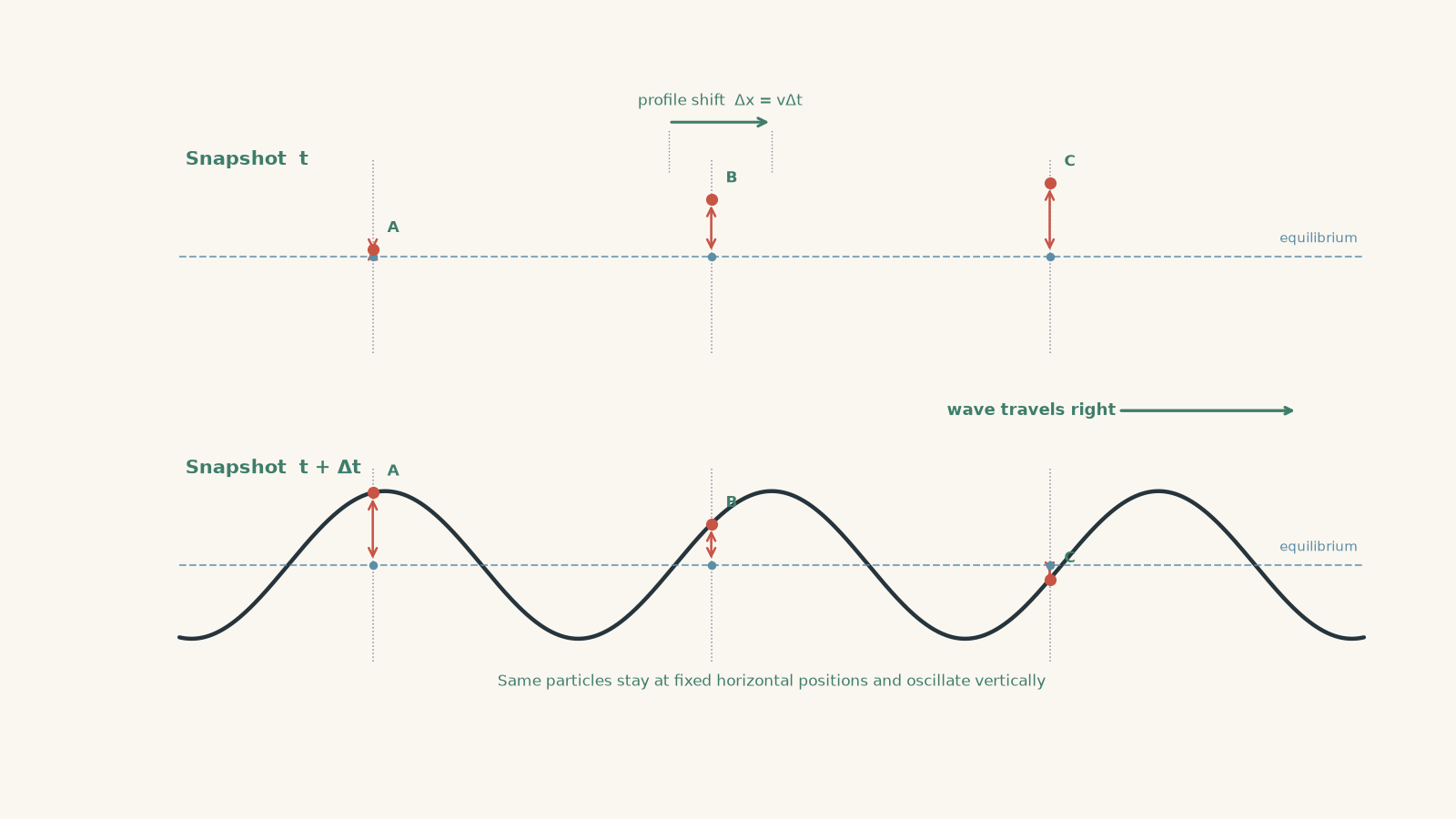
For any periodic wave,
\[
v = f\lambda
\]
where \(v\) is wave speed in metres per second (\(\text{m s}^{-1}\)), \(f\) is frequency in hertz (\(\text{Hz}\)), and \(\lambda\) is wavelength in metres (\(\text{m}\)).
A crest on a progressive wave moves one wavelength during one period.
02What changes when a wave reflects?
Now fix the far end of the rope.
A continuous wave travels towards that end and reflects back. You now have:
- one wave travelling towards the fixed end
- another wave travelling back in the opposite direction
The two waves overlap.
Because waves obey the principle of superposition, their displacements add at every point.
Suppose one wave tries to move a point on the rope \(3\text{ cm}\) upwards while the other tries to move it \(3\text{ cm}\) downwards. The total displacement there is zero.
At another point, both waves might try to move the rope upwards together. Their displacements add, producing a larger oscillation.
If the two waves have the same frequency, wavelength, and amplitude, and travel in opposite directions, this repeated interference can form a standing wave.
The important feature is not simply that waves are interfering. Progressive waves can interfere too. A standing wave requires a stable interference pattern whose nodes and antinodes stay in fixed positions.
03Nodes and antinodes
A node is a point in a standing wave that always has zero displacement from equilibrium.
It does not merely pass through equilibrium occasionally. It stays there.
An antinode is a position where the oscillation has its greatest amplitude.
Picture two people doing exactly opposite moves in a very awkward dance. At one spot, their effects always cancel. That’s a node. Halfway between cancellation points, their effects reinforce most strongly. That’s an antinode.
The analogy has a limit. The two component waves are not little objects meeting and bouncing off each other. Superposition means their displacements simply add while they overlap.
For a standing wave:
- adjacent nodes are separated by \(\frac{\lambda}{2}\)
- adjacent antinodes are separated by \(\frac{\lambda}{2}\)
- a node and its nearest antinode are separated by \(\frac{\lambda}{4}\)
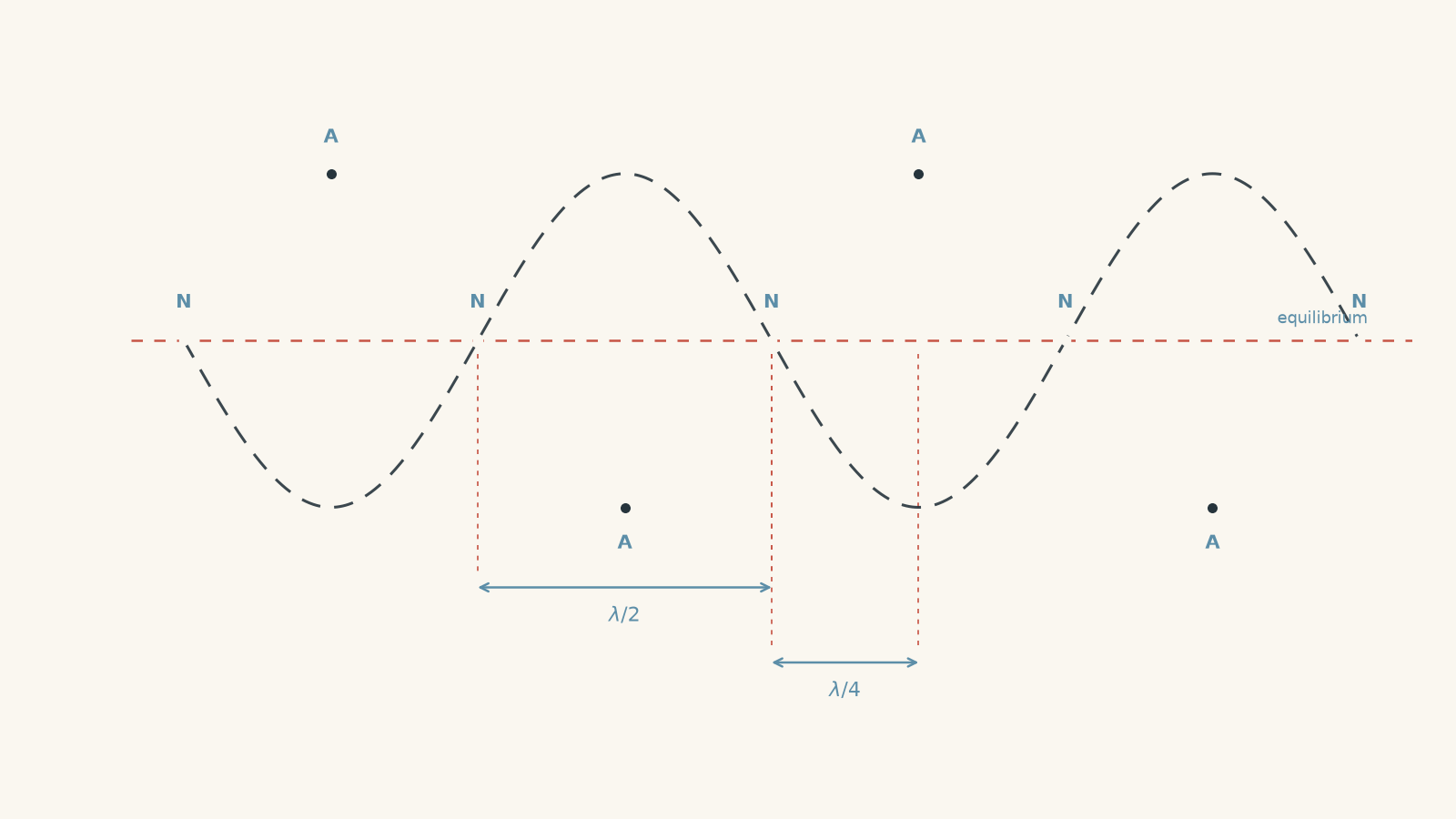
This gives a very useful HSC decision rule:
If you can identify the spacing between neighbouring nodes, double it to find the wavelength.
Worked example: Finding wavelength from nodes
A standing wave forms on a string. Two adjacent nodes are \(0.40\text{ m}\) apart. The wave frequency is \(15\text{ Hz}\). Find the wavelength and wave speed.
Step 1
Adjacent nodes are separated by half a wavelength:
\[
\frac{\lambda}{2} = 0.40\text{ m}
\]
Therefore,
\[
\lambda = 0.80\text{ m}
\]
Step 2
\[
v = f\lambda
\]
Substituting \(f = 15\text{ Hz}\) and \(\lambda = 0.80\text{ m}\),
\[
v = (15)(0.80) = 12\text{ m s}^{-1}
\]
The wavelength is therefore \(0.80\text{ m}\), and the wave speed is \(12\text{ m s}^{-1}\).
The \(0.40\text{ m}\) node spacing is not the wavelength. It is half the wavelength.
04Why does a standing wave look stationary?
Here is the part that often causes trouble.
A standing wave is made from two travelling waves. So how can the result appear not to travel?
At some positions, the two component waves always cancel. Those positions become nodes.
At positions between the nodes, the interference changes with time. The string moves back and forth, but the locations of maximum and minimum oscillation stay fixed.
So the pattern does not travel, even though the two waves producing it do.
A progressive wave might look like this over time:
\[
\text{crest position} \rightarrow \text{moves along the medium}
\]
A standing wave behaves differently:
\[
\text{node positions} \rightarrow \text{stay fixed}
\]
That fixed spatial pattern is why it is called a standing wave.
05The mathematical picture
You do not need to start with the equation to understand the physics, but the equation makes the fixed pattern precise.
Consider two waves with equal amplitude \(A\), angular frequency \(\omega\), and wave number \(k\), travelling in opposite directions:
\[
y_1 = A\sin(kx-\omega t)
\]
and
\[
y_2 = A\sin(kx+\omega t)
\]
Here:
- \(y_1\) and \(y_2\) are the displacements produced by each wave
- \(A\) is the amplitude of each travelling wave
- \(x\) is position
- \(t\) is time
- \(k = \frac{2\pi}{\lambda}\) is the wave number
- \(\omega = 2\pi f\) is the angular frequency
Adding the two waves using superposition gives
\[
y = 2A\sin(kx)\cos(\omega t)
\]
This is the equation of a standing wave in one common choice of origin.
Look at its two parts:
\[
\sin(kx)
\]
depends on position, while
\[
\cos(\omega t)
\]
depends on time.
The factor \(2A\sin(kx)\) tells us the amplitude available at each position.
At some positions,
\[
\sin(kx)=0
\]
so
\[
y=0
\]
for every value of \(t\). These positions are nodes.
At positions where
\[
|\sin(kx)|=1
\]
the oscillation amplitude reaches its maximum value,
\[
2A
\]
so those positions are antinodes.
Notice something subtle: if each component wave has amplitude \(A\), the maximum standing-wave amplitude can be \(2A\). That does not mean energy has somehow appeared from nowhere. It results from constructive interference between the two component waves.
06Do standing waves transfer energy?
Return to the prediction from the start.
The string is moving. Surely energy must be travelling along it?
In a progressive wave, there is a net transfer of energy through the medium in the direction of wave propagation.
In an ideal standing wave, there is no net energy transfer along the medium.
That does not mean there is no energy.
Segments of the string are continually changing between forms such as kinetic energy and elastic potential energy. What disappears is the overall one-way flow of energy down the string.
Why?
The standing wave is produced by two component waves carrying energy in opposite directions. For equal waves, those opposite energy transfers balance.
This distinction is worth remembering:
| Feature | Progressive wave | Standing wave |
|---|---|---|
| Overall pattern | Travels through space | Remains in fixed positions |
| Net energy transfer | Yes, in direction of propagation | No net transfer along the medium |
| Nodes | No permanently fixed nodes in a single travelling wave | Fixed points of zero displacement |
| Antinodes | No permanently fixed antinodes | Fixed positions of maximum amplitude |
| Amplitude at a given point | Same for an ideal uniform travelling wave | Depends on position |
| How it commonly forms | A disturbance propagates through a medium | Two matching waves travel in opposite directions and interfere |
The phrase no net energy transfer matters. Saying “standing waves have no energy” is incorrect.
07Every point between two nodes moves together
Take one section of a standing wave between two adjacent nodes.
All the points in that section move in the same phase. When one is above equilibrium, the others in that same section are also above equilibrium, apart from the nodes themselves.
Cross a node, and the next section moves in the opposite phase.
So if the section on the left of a node is moving upwards, the neighbouring section on the right is moving downwards.
That is another way to recognise a standing wave.
A tempting picture is that the humps themselves slide left and right. They do not. Each loop grows, collapses to the equilibrium line, reverses, grows in the opposite direction, and collapses again.
At the instant the entire string passes through equilibrium, the nodes have not disappeared. They are still the positions whose displacement remains zero at all times.
08A standing wave can momentarily look like no wave at all
Suppose you photograph a standing wave at exactly the moment every moving point passes through equilibrium.
The whole string appears straight.
Would it be correct to say that the wave has disappeared?
No.
At that instant, displacement is zero everywhere, but many parts of the string have maximum speed. The pattern becomes visible again a moment later.
This exposes an important mistake: a wave cannot be completely described by one snapshot.
To distinguish a progressive wave from a standing wave confidently, you often need information about how the pattern changes with time.
09Standing waves on a string fixed at both ends
If both ends of a string are fixed, the displacement at each end must always be zero.
So both ends must be nodes.
That condition means only certain wavelengths fit.
For the simplest standing-wave pattern, half a wavelength fits along the string:
\[
L = \frac{\lambda}{2}
\]
where \(L\) is the string length.
For the next pattern, one full wavelength fits:
\[
L = \lambda
\]
More generally,
\[
L = \frac{n\lambda}{2}
\]
where \(n\) is a positive integer \(1,2,3,\ldots\).
Rearranging,
\[
\lambda_n = \frac{2L}{n}
\]
Using \(v=f\lambda\),
\[
f_n = \frac{nv}{2L}
\]
These allowed frequencies are the natural frequencies of the ideal fixed string.
Worked example: Identifying a standing-wave mode
A \(1.20\text{ m}\) string is fixed at both ends. A standing wave forms with four antinodes. Waves travel along the string at \(96\text{ m s}^{-1}\). Find the wavelength and frequency.
Step 1
For a string fixed at both ends, the \(n\)th mode has \(n\) antinodes.
Four antinodes therefore means
\[
n=4
\]
The string length satisfies
\[
L = \frac{n\lambda}{2}
\]
Step 2
Substitute \(L=1.20\text{ m}\) and \(n=4\):
\[
1.20 = \frac{4\lambda}{2}
\]
so
\[
1.20 = 2\lambda
\]
and therefore
\[
\lambda = 0.600\text{ m}
\]
Step 3
Using
\[
v=f\lambda
\]
gives
\[
f = \frac{v}{\lambda}
= \frac{96}{0.600}
= 160\text{ Hz}
\]
The standing wave has wavelength \(0.600\text{ m}\) and frequency \(160\text{ Hz}\).
The important reasoning came before the arithmetic: four antinodes on a string fixed at both ends means four half-wavelength sections fit into the string.
10The misconception to avoid: “The nodes are where the waves meet”
This sounds reasonable, but it is not precise enough.
The two component waves overlap throughout the region containing the standing wave. They do not meet only at nodes.
Nodes are positions where the two waves produce destructive interference at every instant.
Antinodes are positions where the resulting oscillation has maximum amplitude.
Even there, the interference is not simply “constructive all the time”. An antinode moves from maximum positive displacement to equilibrium, then to maximum negative displacement. The two component waves combine so that the amplitude of that oscillation is as large as possible.
11Progressive or standing? Ask these questions
When an HSC question gives you a diagram, description, or experiment, use the evidence rather than guessing from the shape.
Does the pattern move through the medium?
If yes, that supports a progressive wave.
Are there fixed positions that never move?
If yes, those are nodes, which strongly indicates a standing wave.
Does amplitude depend on position, becoming zero at nodes and greatest at antinodes?
That is a standing-wave pattern.
Is there net energy transfer along the medium?
A progressive wave transfers energy. An ideal standing wave has no net energy transfer along the medium.
Does one snapshot show a wavy shape?
That alone is not enough. Either type of wave can have a similar-looking shape at one instant.
12Questions and solutions
Question 1
A standing wave on a rope has adjacent nodes \(0.35\text{ m}\) apart. The frequency is \(8.0\text{ Hz}\).
Find the wavelength and wave speed.
Solution 1
The wavelength is \(0.70\text{ m}\), and the wave speed is \(5.6\text{ m s}^{-1}\).
Adjacent nodes in a standing wave are separated by half a wavelength:
\[
\frac{\lambda}{2}=0.35\text{ m}
\]
so
\[
\lambda = 0.70\text{ m}
\]
Now use
\[
v=f\lambda
\]
Substituting,
\[
v=(8.0)(0.70)=5.6\text{ m s}^{-1}
\]
The common trap is to use \(0.35\text{ m}\) directly as the wavelength. It represents only half a wavelength.
Question 2
Two identical waves, each with amplitude \(2.5\text{ cm}\), travel in opposite directions along the same string and form a standing wave.
What are the displacement amplitudes at a node and at an antinode?
Solution 2
The amplitude is \(0\text{ cm}\) at a node and \(5.0\text{ cm}\) at an antinode.
At a node, the component waves always cancel, so the resultant displacement is zero:
\[
A_{\text{node}}=0
\]
At an antinode, the largest possible resultant amplitude occurs when the two equal component amplitudes reinforce:
\[
A_{\text{antinode}}=2A
\]
Substituting \(A=2.5\text{ cm}\),
\[
A_{\text{antinode}}=2(2.5)=5.0\text{ cm}
\]
This does not mean every point on the standing wave has amplitude \(5.0\text{ cm}\). The amplitude varies with position from zero at nodes to \(5.0\text{ cm}\) at antinodes.
Question 3
A string \(0.90\text{ m}\) long is fixed at both ends. It vibrates in a standing-wave pattern containing three antinodes. The wave speed is \(72\text{ m s}^{-1}\).
Calculate the wavelength and frequency.
Solution 3
The wavelength is \(0.60\text{ m}\), and the frequency is \(120\text{ Hz}\).
Three antinodes mean three half-wavelength sections fit into the string, so \(n=3\).
For a string fixed at both ends,
\[
L=\frac{n\lambda}{2}
\]
Substituting \(L=0.90\text{ m}\) and \(n=3\),
\[
0.90=\frac{3\lambda}{2}
\]
Therefore,
\[
\lambda = \frac{2(0.90)}{3}=0.60\text{ m}
\]
Now use
\[
v=f\lambda
\]
so
\[
f=\frac{v}{\lambda}
=\frac{72}{0.60}
=120\text{ Hz}
\]
The pattern therefore consists of three half-wavelengths packed into the \(0.90\text{ m}\) string.
Question 4
A student photographs a vibrating string at one instant. The photograph shows a sinusoidal shape. The student concludes that the string must contain a progressive wave because “standing waves stay still”.
Explain why this conclusion is not justified, and state one observation that would distinguish the two types of wave.
Solution 4
The photograph alone cannot determine whether the wave is progressive or standing.
“Standing” does not mean every particle of the medium stays still. In a standing wave, most points oscillate. What remains stationary is the pattern of nodes and antinodes.
A single snapshot of a standing wave can look very similar to a snapshot of a progressive wave.
To distinguish them, the student should observe the string over time. If the wave profile travels along the string, it is progressive. If fixed nodes remain at the same positions while the sections between them oscillate, the pattern is standing.
The trap is confusing a stationary wave pattern with stationary particles.
Question 5
Two equal waves travel in opposite directions along a string and produce a standing wave. At one particular instant, the entire string is exactly on its equilibrium line.
A student argues that all energy in the string must be zero at that instant because every point has zero displacement.
Evaluate the student’s reasoning.
Solution 5
The student’s conclusion is incorrect. Zero displacement everywhere does not mean the string has zero energy.
At the instant a standing wave passes through its equilibrium configuration, the moving sections of the string can have large, and in the ideal model maximum, particle speeds. The string therefore has kinetic energy even though its displacement is zero.
During the oscillation, energy changes between kinetic and elastic potential forms.
The important distinction is that an ideal standing wave has no net transfer of energy along the string. It does not have zero energy.
The tempting error is to treat displacement as if it were a direct measure of total energy. A particle can be at equilibrium while moving rapidly.
Question 6
A string is fixed at both ends and supports a stable standing wave. The tension is then increased while the string’s length and linear mass density remain unchanged. The driving frequency is kept exactly the same.
A student predicts that the original standing-wave pattern will simply remain in place with a faster wave speed.
Explain why that prediction is generally incorrect.
Solution 6
The original standing-wave mode will generally not remain stable because increasing the tension changes the wave speed, which changes the frequencies that satisfy the boundary conditions.
For a stretched string,
\[
v=\sqrt{\frac{T}{\mu}}
\]
where \(v\) is wave speed, \(T\) is tension, and \(\mu\) is linear mass density.
Increasing \(T\) increases \(v\).
For a string fixed at both ends, the allowed wavelengths depend only on the string length and mode number:
\[
\lambda_n=\frac{2L}{n}
\]
The corresponding natural frequencies are
\[
f_n=\frac{v}{\lambda_n}
=\frac{nv}{2L}
\]
So increasing \(v\) increases all of the string’s natural frequencies.
If the driving frequency is held at its old value, it will generally no longer match the same natural frequency. The original stable standing-wave pattern therefore will not simply continue unchanged.
This is the deeper reason standing waves matter: fixed boundaries allow only particular spatial patterns, and those patterns correspond to particular frequencies. That leads directly to resonance, harmonics, and the natural frequencies of strings and air columns.