
Refractive Index: Using n = c/v in HSC Physics
Learn what refractive index means physically, how to use n = c/v, and how changes in refractive index affect the speed of light in a medium.
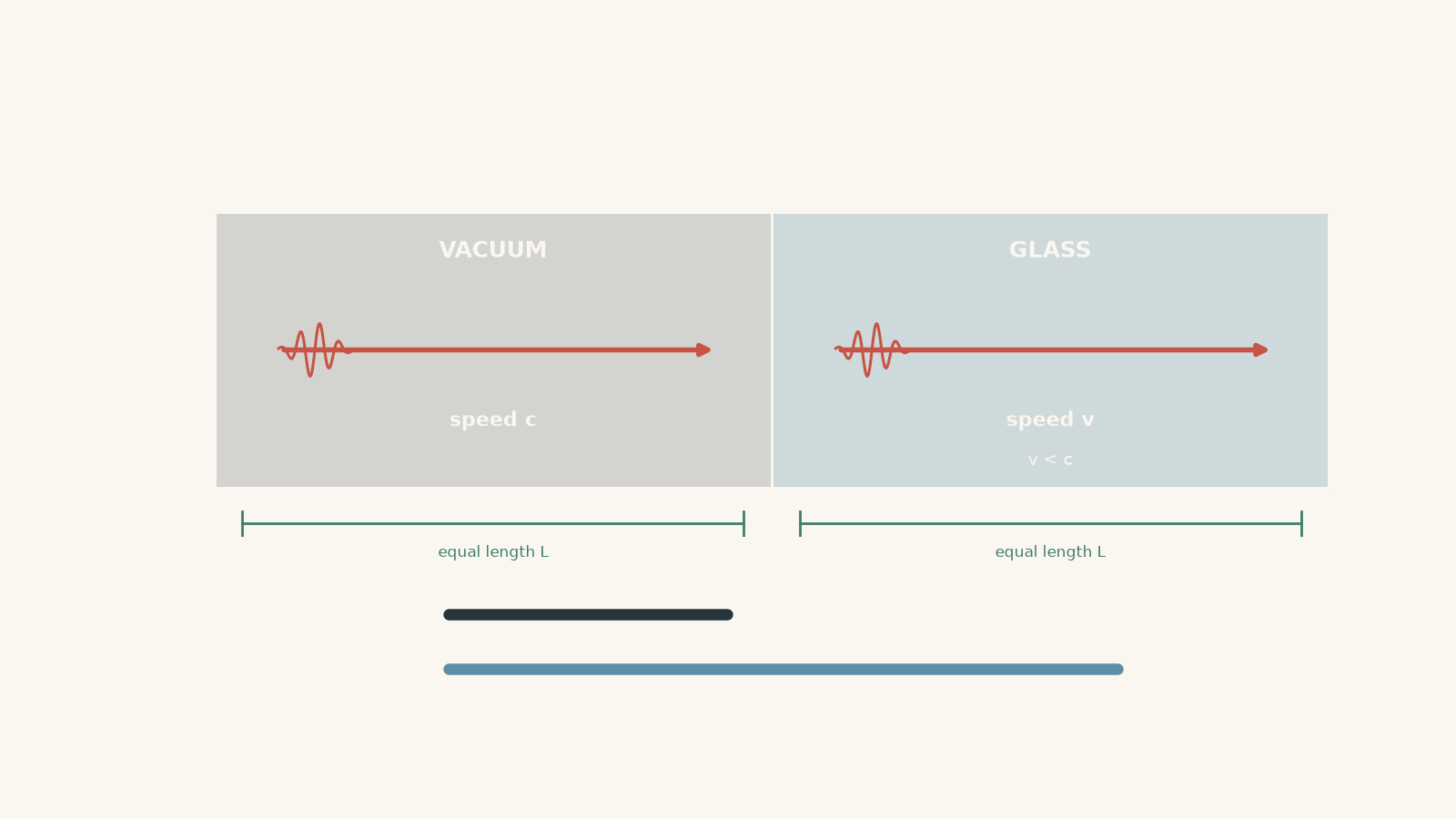
A laser pulse crosses 30 cm of empty space, then 30 cm of glass. Which part takes longer?
The glass section does. Light still moves extremely fast in glass, but not as fast as it does in a vacuum. Refractive index is the number that tells us how much slower light travels in a material compared with its speed in a vacuum.
Before looking at the equation, make a prediction. Suppose material A has refractive index \(1.3\) and material B has refractive index \(1.8\). In which material does light travel faster?
Material A. A larger refractive index means a lower light speed. The equation will show exactly why.
01Start with a speed comparison
In a vacuum, light travels at
\[
c = 3.00 \times 10^8\ \text{m s}^{-1}
\]
where \(c\) is the speed of light in a vacuum.
Now imagine light entering glass. Its speed becomes \(v\), where \(v\) is the speed of light in that particular medium.
Refractive index compares these two speeds:
\[
n = \frac{c}{v}
\]
where:
- \(n\) is the refractive index of the medium
- \(c\) is the speed of light in a vacuum, \(3.00 \times 10^8\ \text{m s}^{-1}\)
- \(v\) is the speed of light in the medium, in \(\text{m s}^{-1}\)
The equation is really asking:
How many times larger is the vacuum speed than the speed in this material?
If light travels at \(2.00 \times 10^8\ \text{m s}^{-1}\) in a particular glass, then
\[
n = \frac{3.00 \times 10^8}{2.00 \times 10^8} = 1.50
\]
So the vacuum speed is 1.50 times the speed of light in that glass.
Notice that \(n\) has no unit. The numerator and denominator are both speeds, so their units cancel.
02Why a larger refractive index means slower light
The equation
\[
n = \frac{c}{v}
\]
contains an inverse relationship between \(n\) and \(v\).
Because \(c\) is constant, increasing \(n\) requires \(v\) to decrease.
You can make this clearer by rearranging the equation:
\[
v = \frac{c}{n}
\]
Suppose one material has \(n=1.2\) and another has \(n=1.5\).
For \(n=1.2\),
\[
v = \frac{3.00 \times 10^8}{1.2} = 2.50 \times 10^8\ \text{m s}^{-1}
\]
For \(n=1.5\),
\[
v = \frac{3.00 \times 10^8}{1.5} = 2.00 \times 10^8\ \text{m s}^{-1}
\]
The material with the higher refractive index has the lower light speed.
A useful mental picture is a runner moving through different surfaces. The vacuum is the fastest possible track. A material with a larger refractive index is like a surface on which the runner makes less progress per second.
That analogy has a limit. Light isn’t literally being slowed by friction, and photons aren’t tiny runners getting tired in glass. Refractive index describes how an electromagnetic wave propagates through a material. For HSC calculations, the important result is that its propagation speed in the medium is lower than \(c\).
03What does \(n=1\) mean?
Put \(n=1\) into
\[
v = \frac{c}{n}
\]
and you get
\[
v=c
\]
A vacuum therefore has refractive index \(1\).
For ordinary transparent materials, the refractive index is greater than \(1\), so the light speed is less than \(c\).
For example, if a material has \(n=1.50\),
\[
v=\frac{c}{1.50}
\]
so light travels at two-thirds of its vacuum speed.
This is worth understanding rather than memorising. A refractive index of \(1.50\) does not mean light travels at 1.50 times the speed of light. It means the vacuum speed is 1.50 times the speed in the material.
04Worked example: Find the refractive index
Light travels through a transparent material at \(2.25 \times 10^8\ \text{m s}^{-1}\). Calculate the refractive index of the material.
Step 1
\[
n=\frac{c}{v}
\]
Here, \(c=3.00\times10^8\ \text{m s}^{-1}\) and \(v=2.25\times10^8\ \text{m s}^{-1}\).
Step 2
\[
n=\frac{3.00\times10^8}{2.25\times10^8}
=1.33
\]
Step 3
The refractive index is
\[
\boxed{n=1.33}
\]
There is no unit. Light travels more slowly in this material than in a vacuum, with the vacuum speed being about \(1.33\) times the speed in the material.
05Be careful with the phrase “light slows down”
At HSC level, saying that light travels more slowly in a medium is useful and correct for the quantities you calculate.
There is, however, a detail worth keeping straight. You shouldn’t picture an individual light ray crossing a boundary and somehow losing energy because it became slower.
For light crossing into a transparent medium:
- its frequency remains unchanged
- its propagation speed changes
- its wavelength therefore changes
The speed relation for any wave is
\[
v=f\lambda
\]
where \(f\) is frequency in hertz and \(\lambda\) is wavelength in metres.
If \(v\) decreases while \(f\) stays constant, \(\lambda\) must also decrease.
This connects refractive index to the broader topic of refraction. The speed change is what ultimately leads to a change in direction when light enters a new medium at an angle.
06The most tempting misconception
A student sees \(n=1.6\) and thinks, “That material must make light go 1.6 times faster.”
It sounds reasonable because bigger numbers often mean “more”. But look at where \(v\) appears:
\[
n=\frac{c}{v}
\]
The medium speed is in the denominator.
A smaller \(v\) makes the fraction larger. So:
| Refractive index | Speed of light in the medium |
|---|---|
| Smaller \(n\) | Faster \(v\) |
| Larger \(n\) | Slower \(v\) |
This gives you a useful comparison rule even when no calculation is required.
If diamond has a higher refractive index than water, you can immediately conclude that light travels more slowly through diamond than through water.
07Worked example: Combine refractive index with travel time
A light pulse travels through \(4.00\ \text{m}\) of a transparent material with refractive index \(1.60\). Calculate the speed of light in the material and the time taken for the pulse to cross it.
Step 1
\[
v=\frac{c}{n}
\]
Step 2
\[
v=\frac{3.00\times10^8\ \text{m s}^{-1}}{1.60}
=1.875\times10^8\ \text{m s}^{-1}
\]
To three significant figures,
\[
v=1.88\times10^8\ \text{m s}^{-1}
\]
Step 3
Recall:
\[
v=\frac{d}{t}
\]
where \(d\) is distance in metres and \(t\) is time in seconds.
Rearranging gives
\[
t=\frac{d}{v}
\]
Step 4
\[
t=\frac{4.00\ \text{m}}{1.875\times10^8\ \text{m s}^{-1}}
=2.13\times10^{-8}\ \text{s}
\]
So,
\[
\boxed{v=1.88\times10^8\ \text{m s}^{-1}}
\]
and
\[
\boxed{t=2.13\times10^{-8}\ \text{s}}
\]
The time is only about \(21.3\) nanoseconds, but it is longer than the time light would take to travel the same distance in a vacuum.
08Comparing two materials without calculating everything
Suppose medium X has \(n=1.40\) and medium Y has \(n=1.70\).
Which medium has the lower light speed?
You could calculate both speeds, but you don’t need to. Since
\[
v=\frac{c}{n},
\]
the larger value of \(n\) gives the smaller value of \(v\).
So light travels more slowly in medium Y.
You can even compare their speeds directly:
\[
v_X=\frac{c}{1.40}
\]
and
\[
v_Y=\frac{c}{1.70}
\]
Therefore,
\[
\frac{v_X}{v_Y}
=
\frac{c/1.40}{c/1.70}
=
\frac{1.70}{1.40}
\approx1.21
\]
Light travels about \(1.21\) times as fast in X as it does in Y.
That inverse relationship is useful in harder questions because it lets you reason from refractive index before reaching for a calculator.
09Refractive index can depend on wavelength
Treating a material as having one fixed refractive index is often a useful first model, but it isn’t the whole story.
For many transparent materials, refractive index changes slightly with wavelength. Different wavelengths of visible light can therefore travel at slightly different speeds in the same material.
This effect is called dispersion. It helps explain why a prism can separate white light into different colours.
For a question that gives you one value of \(n\), however, use that supplied value for the light being considered. Don’t invent an extra correction unless the question gives you information requiring one.
10Questions and solutions
Question 1
Light travels through a transparent polymer at \(2.40\times10^8\ \text{m s}^{-1}\). Calculate its refractive index.
Solution 1
The refractive index is \(\boxed{1.25}\).
Use
\[
n=\frac{c}{v}
\]
with \(c=3.00\times10^8\ \text{m s}^{-1}\) and \(v=2.40\times10^8\ \text{m s}^{-1}\):
\[
n
=
\frac{3.00\times10^8}{2.40\times10^8}
=
1.25
\]
The speed units cancel, so refractive index has no unit. A value greater than \(1\) is consistent with light travelling more slowly in the polymer than in a vacuum.
Question 2
A transparent crystal has refractive index \(1.80\). Calculate the speed of light through the crystal.
Solution 2
The speed of light in the crystal is \(\boxed{1.67\times10^8\ \text{m s}^{-1}}\).
Start with
\[
n=\frac{c}{v}
\]
and rearrange:
\[
v=\frac{c}{n}
\]
Substitute the values:
\[
v
=
\frac{3.00\times10^8\ \text{m s}^{-1}}{1.80}
=
1.67\times10^8\ \text{m s}^{-1}
\]
The result is less than \(c\), as expected for a material with \(n>1\).
Question 3
Two transparent materials, P and Q, have refractive indices \(1.25\) and \(1.50\), respectively.
A student claims, “Light must travel 20% faster in Q because its refractive index is 20% larger.”
Explain the error and calculate the speed of light in each material.
Solution 3
The student’s conclusion is reversed: light travels more slowly in Q because Q has the larger refractive index.
Refractive index and speed are related by
\[
v=\frac{c}{n},
\]
so they vary inversely.
For P:
\[
v_P
=
\frac{3.00\times10^8\ \text{m s}^{-1}}{1.25}
=
2.40\times10^8\ \text{m s}^{-1}
\]
For Q:
\[
v_Q
=
\frac{3.00\times10^8\ \text{m s}^{-1}}{1.50}
=
2.00\times10^8\ \text{m s}^{-1}
\]
Therefore,
\[
\boxed{v_P=2.40\times10^8\ \text{m s}^{-1}}
\]
and
\[
\boxed{v_Q=2.00\times10^8\ \text{m s}^{-1}}
\]
The trap is treating refractive index as directly proportional to speed. It isn’t. A larger denominator \(n\) in \(v=c/n\) gives a smaller speed.
Also, a 20% increase in refractive index does not produce a 20% decrease in speed. The relationship is inverse, not a simple percentage subtraction.
Question 4
A \(6.00\ \text{m}\) optical path consists of \(3.00\ \text{m}\) of material A followed by \(3.00\ \text{m}\) of material B. Their refractive indices are \(1.20\) and \(1.80\), respectively.
Calculate the total time taken for light to travel through the two sections.
Solution 4
The total travel time is \(\boxed{3.00\times10^{-8}\ \text{s}}\).
The important idea is that the light has a different speed in each section, so the entire \(6.00\ \text{m}\) distance cannot be treated as if it had one refractive index.
For material A:
\[
v_A
=
\frac{c}{n_A}
=
\frac{3.00\times10^8}{1.20}
=
2.50\times10^8\ \text{m s}^{-1}
\]
Its travel time is
\[
t_A
=
\frac{d_A}{v_A}
=
\frac{3.00}{2.50\times10^8}
=
1.20\times10^{-8}\ \text{s}
\]
For material B:
\[
v_B
=
\frac{c}{n_B}
=
\frac{3.00\times10^8}{1.80}
=
1.67\times10^8\ \text{m s}^{-1}
\]
Its travel time is
\[
t_B
=
\frac{d_B}{v_B}
=
\frac{3.00}{1.67\times10^8}
=
1.80\times10^{-8}\ \text{s}
\]
Therefore,
\[
t_{\text{total}}
=
t_A+t_B
=
1.20\times10^{-8}+1.80\times10^{-8}
=
3.00\times10^{-8}\ \text{s}
\]
So,
\[
\boxed{t_{\text{total}}=3.00\times10^{-8}\ \text{s}}
\]
The higher-index second section contributes more travel time even though the two sections have equal lengths, because light moves more slowly there.
Question 5
A student measures the speed of light in an unknown transparent material as \(1.50\times10^8\ \text{m s}^{-1}\). They report its refractive index as \(0.50\), arguing that the light travels at half the vacuum speed.
Identify the mistake and determine the correct refractive index.
Solution 5
The correct refractive index is \(\boxed{2.00}\), not \(0.50\).
The student has reversed the ratio.
Refractive index is defined as
\[
n=\frac{c}{v},
\]
not \(v/c\).
Substituting the measured speed gives
\[
n
=
\frac{3.00\times10^8\ \text{m s}^{-1}}
{1.50\times10^8\ \text{m s}^{-1}}
=
2.00
\]
The fact that the medium speed is half the vacuum speed means the vacuum speed is twice the medium speed. That is exactly what \(n=2.00\) tells us.
A useful check is that an ordinary transparent medium in which light travels more slowly than \(c\) should have \(n>1\). The student’s value of \(0.50\) should therefore have triggered suspicion.
Question 6
Two slabs have equal thickness. Slab R has refractive index \(1.40\), while slab S has refractive index \(1.60\).
A light pulse takes \(7.00\ \text{ns}\) to cross slab R. Without first calculating the thickness of either slab, determine how long the pulse takes to cross slab S.
Solution 6
The pulse takes \(\boxed{8.00\ \text{ns}}\) to cross slab S.
For a slab of thickness \(d\),
\[
t=\frac{d}{v}
\]
and because
\[
v=\frac{c}{n},
\]
we can substitute:
\[
t
=
\frac{d}{c/n}
=
\frac{dn}{c}
\]
For equal thicknesses, \(d\) and \(c\) are the same, so travel time is directly proportional to refractive index:
\[
\frac{t_S}{t_R}
=
\frac{n_S}{n_R}
\]
Substitute the values:
\[
t_S
=
t_R\frac{n_S}{n_R}
=
7.00\ \text{ns}\times\frac{1.60}{1.40}
=
8.00\ \text{ns}
\]
So,
\[
\boxed{t_S=8.00\ \text{ns}}
\]
The subtle point is that speed is inversely proportional to refractive index, but the time required to cross a fixed distance is directly proportional to refractive index. A higher \(n\) gives a lower speed and therefore a longer travel time.
11Where this idea leads next
The equation \(n=c/v\) gives refractive index a physical meaning: it is a comparison between the speed of light in a vacuum and its speed in a medium.
That speed change is the starting point for understanding refraction. When light reaches a boundary at an angle, one part of the wavefront enters the new medium before another. Its speed changes first, the wavefront pivots, and the ray changes direction.
So when you later use Snell’s law, don’t treat refractive index as just a mysterious number beside a sine. It tells you something physical about how light propagates through each medium.