
Resolving Forces into Components for HSC Physics
Learn how to split a force into perpendicular components using trigonometry, correct signs, and consistent axes. Includes worked examples and progressively harder HSC Physics questions.
A rope pulls a crate with a force of 100 N at \(30^\circ\) above the horizontal. The crate does not feel 100 N horizontally and another 100 N vertically. That would create more force than you started with. So how much of the 100 N acts in each direction?
Before calculating, predict this: will the horizontal component be larger or smaller than the vertical component?
At \(30^\circ\) above the horizontal, the force points mostly sideways and only partly upwards. So the horizontal component must be larger. Resolving a force into components is the mathematical way to turn that picture into numbers.
01One force can describe motion in two directions
Suppose a force \(F\) acts diagonally.
You can represent that same force using:
- a horizontal component, \(F_x\)
- a vertical component, \(F_y\)
These components are not two new forces that suddenly appear. They are two perpendicular parts of the original force.
Imagine carrying a slightly awkward sofa up a staircase. Your movement can be described as some distance forwards and some distance upwards. You did not secretly travel twice. You just described one displacement using two directions.
Force components work the same way.
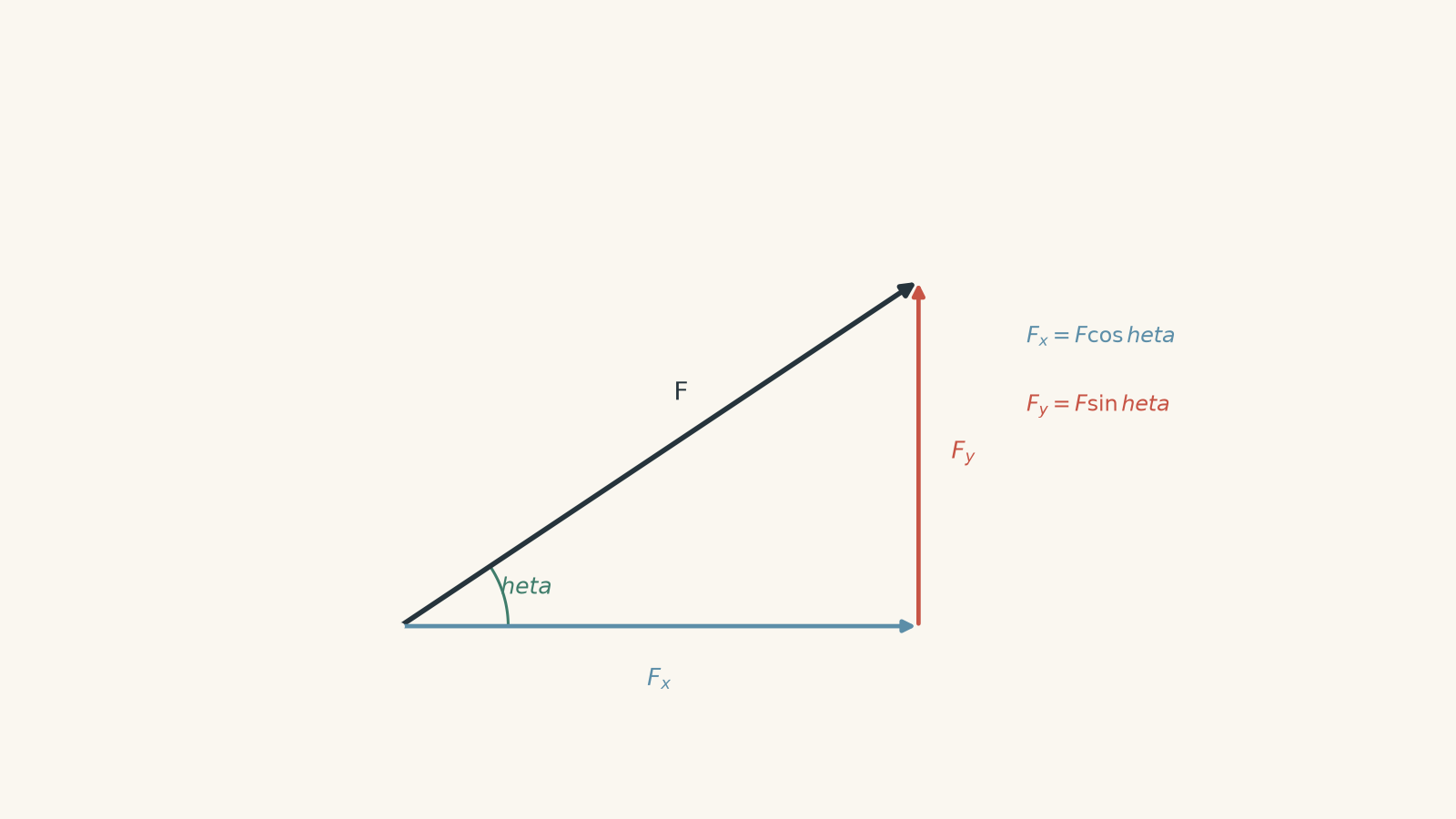
The force vector is the hypotenuse of a right-angled triangle. The components are the two shorter sides.
That triangle is the key to the whole method.
02Why cosine gives the horizontal component
Assume the angle \(\theta\) is measured from the positive horizontal axis.
From right-angle trigonometry,
\[
\cos\theta = \frac{\text{adjacent}}{\text{hypotenuse}}
\]
For our force triangle:
- the adjacent side is \(F_x\)
- the hypotenuse is \(F\)
So
\[
\cos\theta = \frac{F_x}{F}
\]
and therefore
\[
F_x = F\cos\theta
\]
Similarly,
\[
\sin\theta = \frac{\text{opposite}}{\text{hypotenuse}}
\]
so
\[
F_y = F\sin\theta
\]
where:
- \(F\) is the magnitude of the original force, in newtons (N)
- \(F_x\) is the horizontal component, in newtons
- \(F_y\) is the vertical component, in newtons
- \(\theta\) is the angle measured from the positive \(x\)-axis in this particular setup
That final point matters more than memorising which equation contains sine.
03Do not memorise “horizontal means cosine”
A common shortcut is:
Horizontal uses cosine. Vertical uses sine.
That works only when the angle is measured from the horizontal axis.
The real rule is:
- the component adjacent to the angle uses cosine
- the component opposite the angle uses sine
Suppose a 50 N force is \(20^\circ\) from the vertical instead.
Which component is adjacent to the \(20^\circ\) angle?
The vertical component.
So now:
\[
F_y = F\cos20^\circ
\]
and
\[
F_x = F\sin20^\circ
\]
Nothing mysterious happened. The triangle stayed the same. Only the location of the labelled angle changed.
This is why drawing the force triangle is safer than trying to remember a phrase.
04Worked example: Resolve a force above the horizontal
A student pulls a trolley with a force of 80 N directed \(35^\circ\) above the horizontal. Find the horizontal and vertical components of the force.
Step 1
Take positive \(x\) to the right and positive \(y\) upwards.
The force points right and up, so both components will be positive.
Step 2
The \(35^\circ\) angle is measured from the horizontal, so the horizontal component is adjacent to the angle.
Therefore,
\[
F_x = F\cos\theta
\]
and the vertical component is opposite:
\[
F_y = F\sin\theta
\]
Step 3
\[
\begin{aligned}
F_x &= 80\cos35^\circ \\
&= 65.5\text{ N}
\end{aligned}
\]
\[
\begin{aligned}
F_y &= 80\sin35^\circ \\
&= 45.9\text{ N}
\end{aligned}
\]
Step 4
The 80 N force is equivalent to a component of approximately \(65.5\text{ N}\) to the right and \(45.9\text{ N}\) upwards.
The horizontal component is larger, which matches our picture because the force is closer to horizontal than vertical.
05The signs come from your axes
So far, both components have been positive. Real HSC questions will not always be that polite.
Suppose you choose:
- right as positive \(x\)
- up as positive \(y\)
Then:
| Direction of component | Sign |
|---|---|
| Right | Positive \(x\) |
| Left | Negative \(x\) |
| Up | Positive \(y\) |
| Down | Negative \(y\) |
The trigonometry gives you the size of each component. Your chosen coordinate system tells you its sign.
This is where inconsistent axes cause trouble.
For example, you cannot call right positive in one line and then quietly treat left as positive three lines later because the arithmetic looks nicer. Your axis convention must stay fixed for the entire calculation.
06Worked example: A force pointing down and left
A 120 N force acts \(25^\circ\) below the horizontal towards the left. Take positive \(x\) to the right and positive \(y\) upwards. Find \(F_x\) and \(F_y\).
Step 1
The force points left, so \(F_x\) must be negative.
It also points down, so \(F_y\) must be negative.
If either answer comes out positive, something has gone wrong with the direction convention.
Step 2
The horizontal component has magnitude
\[
|F_x| = F\cos25^\circ
\]
and the vertical component has magnitude
\[
|F_y| = F\sin25^\circ
\]
Step 3
\[
\begin{aligned}
|F_x| &= 120\cos25^\circ \\
&= 108.8\text{ N}
\end{aligned}
\]
\[
\begin{aligned}
|F_y| &= 120\sin25^\circ \\
&= 50.7\text{ N}
\end{aligned}
\]
Step 4
\[
F_x = -108.8\text{ N}
\]
\[
F_y = -50.7\text{ N}
\]
The negative signs do not mean the force has a “negative size”. They tell us direction: \(108.8\text{ N}\) left and \(50.7\text{ N}\) down.
07A reliable method for any component question
When resolving a force, use this sequence.
- Draw the force direction.
- Choose positive \(x\) and positive \(y\).
- Mark the angle exactly where it is given.
- Identify which component is adjacent to the angle.
- Use cosine for the adjacent component.
- Use sine for the opposite component.
- Apply signs according to your chosen axes.
- Check whether the sizes make sense from the diagram.
This is more reliable than starting with \(F_x = F\cos\theta\) automatically.
That equation assumes \(\theta\) has been defined in a compatible way.
08A quick consistency check
Because the force and its perpendicular components form a right-angled triangle,
\[
F^2 = F_x^2 + F_y^2
\]
For the previous example,
\[
\begin{aligned}
F &= \sqrt{(-108.8)^2 + (-50.7)^2} \\
&\approx 120\text{ N}
\end{aligned}
\]
The negative signs disappear when squared, which makes sense. This calculation checks the magnitude, not the direction.
This is a useful error check. If your calculated components reconstruct a force much larger or smaller than the original, revisit your trig.
09The most tempting mistake: using the angle without checking its reference axis
Consider a force of 200 N directed \(15^\circ\) to the right of vertical.
A student writes
\[
F_x = 200\cos15^\circ
\]
Is that sensible?
Before touching the calculator, picture the force. It is only \(15^\circ\) away from vertical, so it should have a very large vertical component and a much smaller horizontal component.
But \(200\cos15^\circ\) is about 193 N. That would make the horizontal component almost the entire force.
The calculation itself is valid trigonometry. The component choice is wrong.
Because the angle is measured from vertical:
\[
F_y = 200\cos15^\circ
\]
and
\[
F_x = 200\sin15^\circ
\]
giving
\[
F_y \approx 193\text{ N}
\]
and
\[
F_x \approx 51.8\text{ N}
\]
That matches the physical picture.
Your sketch is not decoration. It is one of your strongest ways to catch a wrong equation.
10Components do not change the original force
Another tempting misconception is to add the component magnitudes directly:
\[
F_x + F_y = F
\]
That is generally false.
For example, a force could have components \(30\text{ N}\) and \(40\text{ N}\). Their ordinary sum is \(70\text{ N}\), but the force magnitude is
\[
F = \sqrt{30^2 + 40^2} = 50\text{ N}
\]
Why?
Because the components act in perpendicular directions. Vector quantities cannot usually be combined by ordinary scalar addition.
A force of \(30\text{ N}\) east and \(40\text{ N}\) north is not the same thing as \(70\text{ N}\) in one direction.
11Questions and solutions
Question 1
A 60 N force acts at \(40^\circ\) above the horizontal towards the right. Take positive \(x\) to the right and positive \(y\) upwards. Find \(F_x\) and \(F_y\).
Solution 1
The components are \(F_x \approx 46.0\text{ N}\) and \(F_y \approx 38.6\text{ N}\).
Because the angle is measured from the horizontal, the horizontal component is adjacent to the angle:
\[
\begin{aligned}
F_x &= F\cos\theta \\
&= 60\cos40^\circ \\
&= 46.0\text{ N}
\end{aligned}
\]
The vertical component is opposite:
\[
\begin{aligned}
F_y &= F\sin\theta \\
&= 60\sin40^\circ \\
&= 38.6\text{ N}
\end{aligned}
\]
Both are positive because the force points right and up.
The horizontal component is slightly larger, which is sensible because \(40^\circ\) is closer to the horizontal than the vertical.
Question 2
A cable exerts a force of 95 N at \(30^\circ\) to the vertical, pulling an object upwards and to the left. Take positive \(x\) to the right and positive \(y\) upwards. Find the horizontal and vertical force components.
Solution 2
The components are \(F_x = -47.5\text{ N}\) and \(F_y \approx 82.3\text{ N}\).
The important detail is that the \(30^\circ\) angle is measured from the vertical, not the horizontal.
The vertical component is therefore adjacent:
\[
\begin{aligned}
F_y &= F\cos30^\circ \\
&= 95\cos30^\circ \\
&= 82.3\text{ N}
\end{aligned}
\]
The horizontal component is opposite:
\[
\begin{aligned}
|F_x| &= F\sin30^\circ \\
&= 95\sin30^\circ \\
&= 47.5\text{ N}
\end{aligned}
\]
Because the force points left while positive \(x\) is defined to the right,
\[
F_x = -47.5\text{ N}
\]
The trap is assuming that \(F_x\) always uses cosine. It does not. Cosine belongs to the component adjacent to the stated angle.
Question 3
A force of 140 N acts \(20^\circ\) below the horizontal towards the right. A student writes
\[
F_x = 140\cos20^\circ
\]
and
\[
F_y = 140\sin20^\circ
\]
and reports both components as positive.
Their numerical magnitudes are correct. Explain what is wrong, then determine the correct components if positive \(x\) is right and positive \(y\) is up.
Solution 3
The correct components are \(F_x \approx 131.6\text{ N}\) and \(F_y \approx -47.9\text{ N}\). The student’s mistake is the sign of the vertical component.
The horizontal component is
\[
\begin{aligned}
F_x &= 140\cos20^\circ \\
&= 131.6\text{ N}
\end{aligned}
\]
and it is positive because the force points to the right.
The vertical component has magnitude
\[
\begin{aligned}
|F_y| &= 140\sin20^\circ \\
&= 47.9\text{ N}
\end{aligned}
\]
but the force points downwards. Since positive \(y\) is upwards,
\[
F_y = -47.9\text{ N}
\]
The trigonometric functions can give the correct component magnitudes while the vector answer is still wrong. Direction must be handled consistently with the chosen axes.
Question 4
A student resolves a force and obtains
\[
F_x = -72\text{ N}, \qquad F_y = 96\text{ N}
\]
where positive \(x\) is right and positive \(y\) is up.
Find the magnitude of the original force. Then determine the acute angle the force makes with the horizontal and state clearly which direction it points.
Solution 4
The original force has magnitude \(120\text{ N}\), and it points up and to the left at approximately \(53.1^\circ\) above the negative horizontal direction.
First find the magnitude using Pythagoras:
\[
\begin{aligned}
F &= \sqrt{F_x^2 + F_y^2} \\
&= \sqrt{(-72)^2 + 96^2} \\
&= \sqrt{5184 + 9216} \\
&= 120\text{ N}
\end{aligned}
\]
To find the acute angle with the horizontal,
\[
\tan\theta = \frac{|F_y|}{|F_x|}
\]
so
\[
\begin{aligned}
\theta &= \tan^{-1}\left(\frac{96}{72}\right) \\
&= 53.1^\circ
\end{aligned}
\]
The signs now provide the direction. \(F_x\) is negative, so the force points left. \(F_y\) is positive, so it points up.
The trap is reporting only \(53.1^\circ\). An angle without its reference direction can describe several different vectors. Here the signs show that the force lies in the upper-left region.
Question 5
Two students analyse the same 100 N force, which points \(60^\circ\) above the horizontal to the right.
Student A chooses horizontal and vertical axes and obtains
\[
F_x = 100\cos60^\circ,\qquad F_y = 100\sin60^\circ
\]
Student B chooses a new \(x\)-axis pointing exactly along the force and a perpendicular \(y\)-axis.
Without doing unnecessary calculations, determine the components Student B should obtain. Explain why Student A and Student B can report different component values without disagreeing about the actual force.
Solution 5
Student B obtains \(F_x = 100\text{ N}\) and \(F_y = 0\text{ N}\).
Student B has deliberately chosen the positive \(x\)-axis to lie along the force. The entire force therefore acts in the \(x\)-direction, with no component perpendicular to it.
Student A instead uses the usual horizontal and vertical axes:
\[
\begin{aligned}
F_x &= 100\cos60^\circ = 50.0\text{ N} \\
F_y &= 100\sin60^\circ = 86.6\text{ N}
\end{aligned}
\]
These descriptions look different, but they represent the same 100 N vector.
Components depend on the coordinate axes you choose. The physical force does not.
That idea becomes especially important when you analyse forces on slopes. Instead of automatically using horizontal and vertical axes, it is often more useful to choose one axis parallel to the slope and one perpendicular to it. Resolving forces correctly is therefore not just a trigonometry skill. It is the step that lets you turn a force diagram into Newton’s second law equations in each direction.