
Resonance in HSC Physics: Frequency, Amplitude and Energy
Learn how driving frequency, natural frequency, damping, and energy transfer combine to produce resonance, with worked examples and HSC-style practice.
Push a child on a swing at random times and your effort mostly goes nowhere. Push at just the right moments and the swing climbs higher, even if each push is small. The difference is not the size of the force. It is the timing.
Now predict this: if a swing naturally completes one cycle every 2.0 s, would pushing it every 0.5 s make it gain energy faster because you are pushing more often?
No. More frequent pushes are not automatically better. The most effective driving occurs when the repeated force is timed to match the swing’s own tendency to oscillate. That is the central idea behind resonance.
01Start with the system’s own rhythm
Imagine pulling a mass on a spring down and releasing it. The mass moves up, overshoots its equilibrium position, moves back down, and repeats.
You do not need to keep pushing it to create this oscillation. The spring-mass system already has a preferred rate of oscillation determined by its physical properties.
That preferred rate is its natural frequency, \(f_0\).
A pendulum has a natural frequency. A guitar string has natural frequencies. A column of air inside a pipe has natural frequencies. Buildings, bridges, car suspension systems, and even electrical circuits can have them too.
Frequency means the number of complete cycles per second. It is measured in hertz (Hz), where \(1\text{ Hz}\) means one cycle per second.
Frequency and period are related by
\[
f=\frac{1}{T}
\]
where:
- \(f\) is frequency in hertz (Hz)
- \(T\) is period in seconds (s)
If an oscillator completes one cycle every \(2.0\text{ s}\), its frequency is \(0.50\text{ Hz}\).
02What changes when an external force keeps acting?
Suppose you now push the oscillator repeatedly. This external repeating force is called a driving force, and its frequency is the driving frequency, \(f_d\).
There are now two frequencies to keep separate:
| Quantity | Meaning |
|---|---|
| Natural frequency, \(f_0\) | The frequency at which the system tends to oscillate when disturbed |
| Driving frequency, \(f_d\) | The frequency of the external repeating force |
This distinction is the key to resonance.
Imagine a swing as a slightly awkward dating situation. The swing has its own rhythm, while you are trying to arrange repeated meetings with it. If you turn up at completely the wrong time, your timing is terrible and very little happens. If you keep meeting it at just the right point in its cycle, each interaction builds on the previous one.
The analogy breaks because an oscillator is governed by forces and energy, not emotional availability. The useful part is simply this: timing determines whether repeated inputs reinforce the motion or interfere with it.
03Resonance is efficient energy transfer
When the driving frequency is equal to, or very close to, the natural frequency,
\[
f_d \approx f_0
\]
the external force can transfer energy to the oscillator particularly efficiently.
The result is a large oscillation amplitude.
This condition is called resonance.
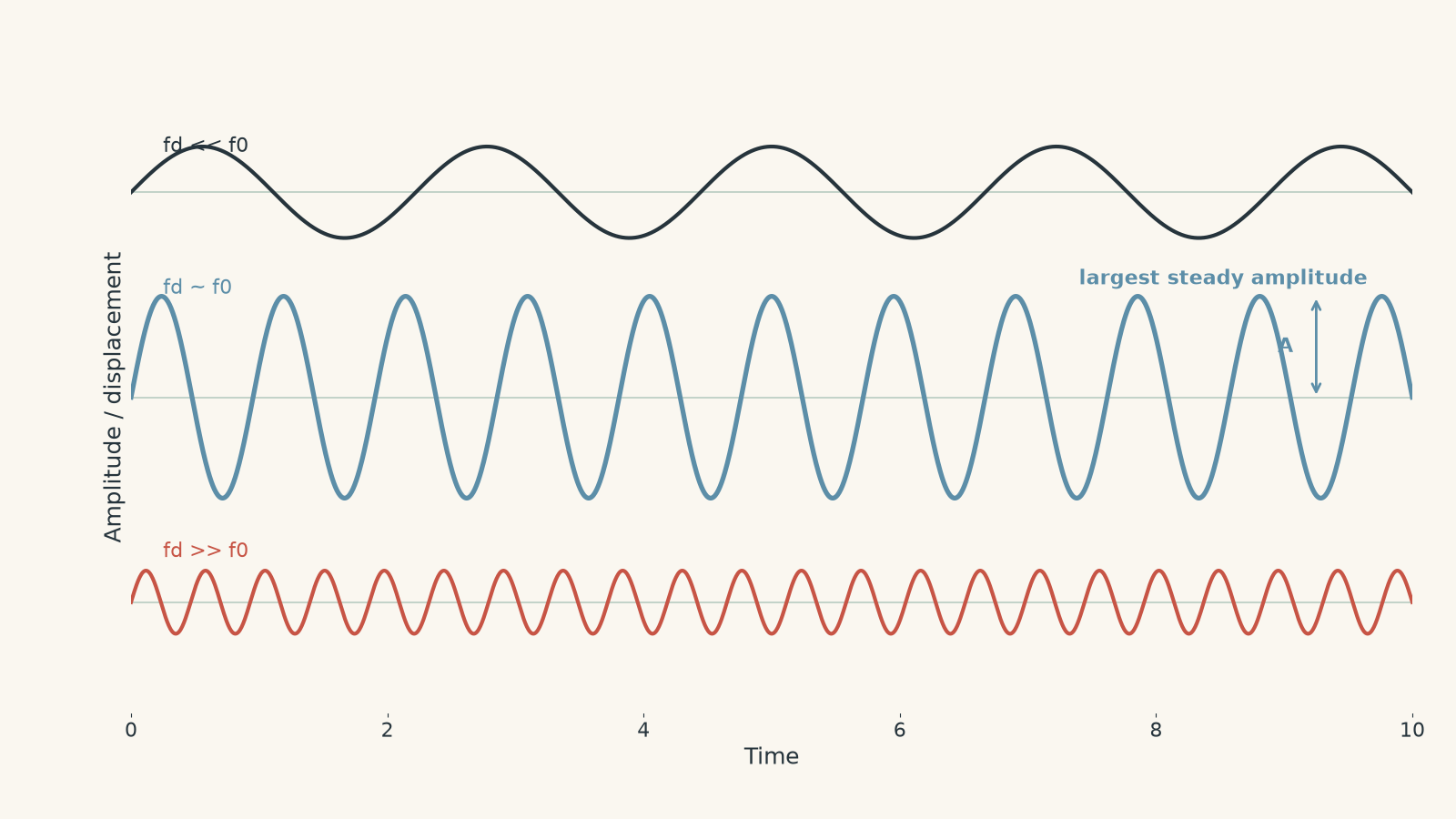
Why does matching the frequencies matter?
Consider pushing a swing. A well-timed push adds energy while the swing is moving in a way that allows your force to reinforce the existing motion. On the next cycle, your next push again arrives at a useful time. The energy additions accumulate.
If your timing is badly mismatched, some pushes may help but others may oppose the motion. Energy is not added as consistently, so the amplitude remains smaller.
This gives us the chain you should be able to explain:
driving frequency close to natural frequency -> repeated force acts with favourable timing -> efficient energy transfer -> large amplitude
The large amplitude is an effect of resonance. It is not the definition by itself.
04Worked example: When should the pushes occur?
A playground swing completes 6 oscillations in 15 s when it is displaced and released. A student then gives the swing repeated pushes. Calculate the natural frequency of the swing and the driving frequency that would produce resonance most effectively.
Step 1
The swing completes 6 oscillations in \(15\text{ s}\), so
\[
T_0=\frac{15}{6}=2.5\text{ s}
\]
Step 2
Using \(f=1/T\),
\[
f_0=\frac{1}{2.5}=0.40\text{ Hz}
\]
Step 3
For resonance,
\[
f_d\approx f_0
\]
so
\[
f_d\approx0.40\text{ Hz}
\]
The student should therefore push with a repeating pattern of about \(0.40\text{ Hz}\), corresponding to one complete driving cycle every \(2.5\text{ s}\).
The important result is not simply the number \(0.40\text{ Hz}\). The pushes are effective because their timing stays matched to the swing’s natural oscillation.
05Why doesn’t resonance produce infinite amplitude?
Our first model sounds dangerous: if every cycle adds energy, shouldn’t the amplitude grow forever?
That would only happen in an unrealistic system with no mechanisms for removing energy and no physical limits.
Real oscillators lose energy. Friction, air resistance, internal deformation, electrical resistance, and other effects convert organised oscillation energy into thermal energy or other forms. Collectively, effects that reduce oscillations are described as damping.
As the amplitude grows, energy losses generally become important. Eventually, a driven oscillator can reach a state where the average energy supplied each cycle equals the average energy lost each cycle.
The amplitude then stops increasing.
So resonance does not mean “infinite amplitude”.
It means that the system responds particularly strongly because energy transfer from the driver is especially efficient.
06Resonance curves
A useful way to see the whole pattern is to vary the driving frequency while measuring the steady amplitude.
The result is a resonance curve.
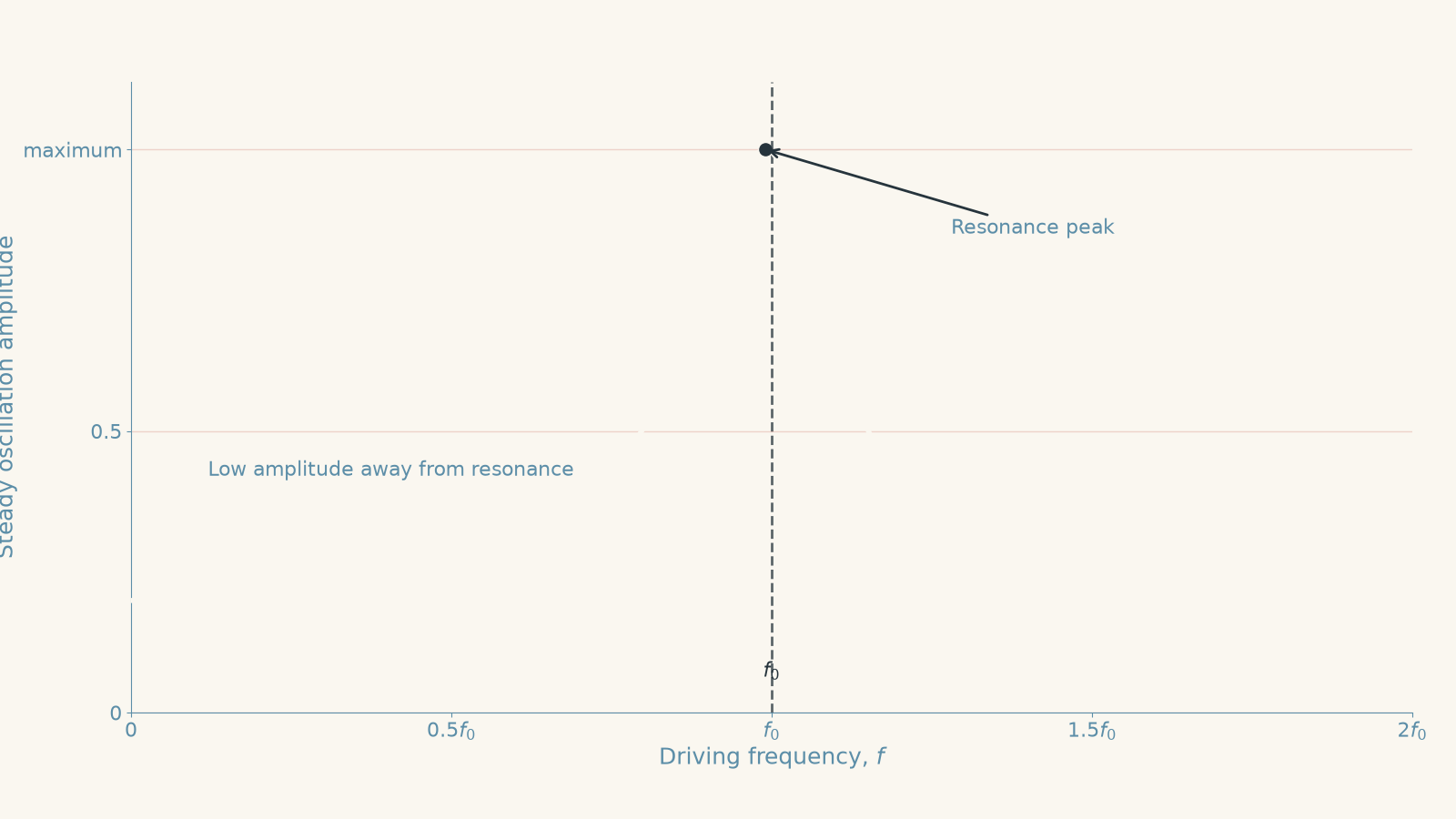
Far below the natural frequency, the amplitude is relatively small.
As the driving frequency approaches the natural frequency, the amplitude increases.
Near resonance, the amplitude reaches a maximum.
As the driving frequency moves well above the natural frequency, the amplitude decreases again.
This is why saying “a larger driving frequency gives a larger amplitude” is wrong. Increasing \(f_d\) can increase the amplitude while you are approaching resonance, but once you pass the resonant region, increasing \(f_d\) further can reduce the amplitude.
The relationship is not simply “more frequency means more response”.
It depends on how close the driving frequency is to the system’s natural frequency.
07Damping changes the resonance response
Now suppose we compare two otherwise similar oscillators. One has weak damping and the other has strong damping.
Which would you expect to show the taller resonance peak?
The weakly damped oscillator.
With weak damping, less energy is lost each cycle. Near resonance, energy supplied by the driver can therefore build up to a larger oscillation amplitude.
Stronger damping removes energy more rapidly. The maximum amplitude is smaller, and the resonance response is less sharply concentrated around one frequency.
A useful summary is:
| Damping | Resonance peak | Frequency range producing a strong response |
|---|---|---|
| Weak | Higher and sharper | Narrower |
| Strong | Lower and broader | Wider |
There is a small piece of precision worth adding. In a damped oscillator, the frequency at which the maximum displacement amplitude occurs can be slightly different from the natural frequency of the corresponding undamped system. For the level of most HSC resonance reasoning, the essential idea remains that resonance occurs when the driving frequency is at or very near the natural frequency.
08Worked example: Choosing between two driving systems
A mechanical oscillator has a natural period of \(0.80\text{ s}\). Two motors are available.
Motor A produces a repeating force 60 times in 50 s. Motor B produces a repeating force 80 times in 50 s.
Assuming the motors apply comparable forces, determine which motor is more likely to produce the larger steady oscillation amplitude.
Step 1
\[
f_0=\frac{1}{T_0}
=\frac{1}{0.80}
=1.25\text{ Hz}
\]
Step 2
\[
f_A=\frac{60}{50}=1.20\text{ Hz}
\]
Step 3
\[
f_B=\frac{80}{50}=1.60\text{ Hz}
\]
Step 4
Motor A differs from the natural frequency by
\[
|1.20-1.25|=0.05\text{ Hz}
\]
Motor B differs by
\[
|1.60-1.25|=0.35\text{ Hz}
\]
Motor A is much closer to the natural frequency.
Therefore, Motor A is more likely to produce the larger amplitude, because its driving frequency is closer to the resonant condition and energy can be transferred more efficiently.
Notice what we did not do. We did not choose Motor B because its frequency was higher. Resonance depends on frequency matching, not simply on frequency being large.
09The most tempting misconception
A student sees a resonating oscillator moving through a large distance and says:
“The driving force must have become much larger.”
That does not follow.
A small repeating force can produce a large response if it transfers energy efficiently over many cycles. The large amplitude can result from repeated energy additions rather than one enormous force.
This distinction matters whenever you interpret resonance:
- force amplitude tells you how strong the driving force is
- driving frequency tells you how often the force repeats
- natural frequency describes the oscillator’s preferred frequency
- oscillation amplitude describes the size of the resulting motion
Changing any one of these does not automatically mean the others have changed.
10Resonance can be useful or unwanted
Resonance itself is neither good nor bad. What matters is whether a large response is useful.
In a musical instrument, resonance can strengthen particular vibrations. A vibrating string can transfer energy to other parts of the instrument, increasing the motion of surfaces that interact more effectively with the surrounding air.
In engineering, resonance may instead need to be controlled. If repeated forces from machinery, traffic, wind, or another source occur near a structure’s natural frequency, the resulting oscillation can become much larger than expected from considering the size of each force alone.
One possible response is to change the system’s natural frequency. Another is to increase damping so that oscillation energy is removed more rapidly.
This gives engineers two quite different strategies:
- Avoid the frequency match.
- Reduce the size of the resonant response through damping.
11Questions and solutions
Question 1
A platform oscillates naturally with a period of \(0.40\text{ s}\). What driving frequency should be used to produce resonance approximately?
Solution 1
A driving frequency of approximately \(2.5\text{ Hz}\) should produce resonance.
The natural frequency is found from
\[
f_0=\frac{1}{T_0}
=\frac{1}{0.40}
=2.5\text{ Hz}
\]
Resonance occurs when the driving frequency is at or near the natural frequency, so
\[
f_d\approx2.5\text{ Hz}
\]
This means the repeating force should complete about 2.5 cycles each second. A common mistake is to use \(0.40\text{ Hz}\), but \(0.40\text{ s}\) is the period, not the frequency.
Question 2
An oscillator has a natural frequency of \(4.0\text{ Hz}\). It is first driven at \(1.0\text{ Hz}\), then at \(3.8\text{ Hz}\), and finally at \(7.0\text{ Hz}\). The driving force has the same amplitude in all three cases.
At which driving frequency would you expect the largest steady oscillation amplitude? Explain why.
Solution 2
The largest amplitude should occur at \(3.8\text{ Hz}\).
The oscillator’s natural frequency is \(4.0\text{ Hz}\). Of the three available driving frequencies, \(3.8\text{ Hz}\) is closest to this value.
Near resonance, the timing of the driving force allows energy to be transferred efficiently to the oscillator over repeated cycles. The response therefore becomes larger than when the driving frequency is well below or above the natural frequency.
The trap is to select \(7.0\text{ Hz}\) simply because it is the largest frequency. A larger driving frequency does not necessarily produce a larger amplitude. The important quantity is the match between \(f_d\) and \(f_0\).
Question 3
Two identical oscillating systems are driven at their respective resonant frequencies using equal driving forces. System X is weakly damped, while System Y is strongly damped.
Compare their steady amplitudes and explain the difference in terms of energy.
Solution 3
System X will have the larger steady amplitude.
Both systems are being driven near the condition for efficient energy transfer, but System X loses less energy through damping during each cycle.
For System X, the energy supplied by the driving force can build the oscillation to a relatively large amplitude before the average energy loss per cycle balances the average energy input.
System Y loses energy more rapidly. Its steady amplitude is reached when energy input balances energy loss, but that balance occurs at a smaller amplitude.
The difference is therefore not that resonance occurs only in System X. Both systems can show resonance. Strong damping simply reduces the size and sharpness of the resonant response.
Question 4
A machine contains a component with a natural frequency of \(12\text{ Hz}\). During operation, an engineer measures the following steady amplitudes.
| Driving frequency | Amplitude |
|---|---|
| \(6\text{ Hz}\) | \(1.1\text{ mm}\) |
| \(10\text{ Hz}\) | \(2.8\text{ mm}\) |
| \(12\text{ Hz}\) | \(7.4\text{ mm}\) |
| \(14\text{ Hz}\) | \(3.0\text{ mm}\) |
| \(20\text{ Hz}\) | \(0.9\text{ mm}\) |
A student claims, “The amplitude at \(12\text{ Hz}\) is large because the machine is being driven faster than at \(6\text{ Hz}\).”
Evaluate this explanation using the data.
Solution 4
The student’s explanation is not supported by the data. The large amplitude at \(12\text{ Hz}\) is best explained by resonance, not simply by the driving frequency being higher.
The component’s natural frequency is \(12\text{ Hz}\), and the largest measured amplitude also occurs when
\[
f_d=12\text{ Hz}
\]
This is the expected resonant condition.
The data also directly contradict the idea that increasing frequency automatically increases amplitude. When the driving frequency rises from \(12\text{ Hz}\) to \(14\text{ Hz}\), the amplitude falls from \(7.4\text{ mm}\) to \(3.0\text{ mm}\). At \(20\text{ Hz}\), it falls further to \(0.9\text{ mm}\).
The pattern is therefore a peak near the natural frequency, which is characteristic of resonance. The relevant relationship is frequency matching, not “higher frequency gives higher amplitude”.
Question 5
A lightly damped oscillator initially has a natural frequency of \(5.0\text{ Hz}\) and is driven continuously at \(5.0\text{ Hz}\). Its amplitude becomes large.
A modification changes the oscillator’s natural frequency to \(6.5\text{ Hz}\), but the driving system remains unchanged at \(5.0\text{ Hz}\).
Predict what happens to the steady amplitude. Then explain why this change could reduce vibration even though neither the driving force nor its frequency has been reduced.
Solution 5
The steady amplitude should decrease because the system has been moved away from resonance.
Initially,
\[
f_d=f_0=5.0\text{ Hz}
\]
so the system is driven at its natural frequency. Energy transfer is efficient, producing a large response.
After the modification,
\[
f_0=6.5\text{ Hz}, \qquad f_d=5.0\text{ Hz}
\]
The driver is now \(1.5\text{ Hz}\) away from the new natural frequency. Its timing no longer reinforces the oscillation as effectively over repeated cycles, so less energy is transferred into the oscillation and the steady amplitude falls.
The important insight is that unwanted vibration can be reduced without weakening the driving force. Changing the physical system can shift its natural frequency so that the existing driving frequency no longer produces resonance.
Question 6
A student investigates resonance by changing the driving frequency of an oscillator. They observe that the maximum amplitude occurs at \(3.9\text{ Hz}\). They conclude:
“The oscillator’s natural frequency must be exactly \(3.9\text{ Hz}\), and any driving frequency other than exactly \(3.9\text{ Hz}\) cannot produce resonance.”
Identify two problems with this conclusion.
Solution 6
The conclusion is too precise in two ways: a measured amplitude peak does not necessarily give the undamped natural frequency exactly, and a strong resonant response is not restricted to one mathematically exact driving frequency.
First, real systems are damped. The frequency at which the maximum displacement amplitude occurs can differ slightly from the undamped natural frequency. Experimental uncertainty also limits how precisely the natural frequency can be inferred from measured data.
Second, resonance is observed over a range of frequencies around the resonant peak. Driving close to the natural frequency can still produce a strong response. The width of this frequency range depends partly on damping.
A weakly damped system tends to have a tall, narrow resonance peak, while stronger damping produces a lower, broader peak.
The tempting mistake is to treat resonance like an on-off switch that exists at one perfect frequency and disappears everywhere else. A better model is a response curve with a peak.
12What resonance lets you understand next
Resonance connects three ideas that are easy to study separately but much more useful together: an oscillator’s natural frequency, an external driving frequency, and the movement of energy into and out of the system.
Once that connection is clear, resonance curves make physical sense rather than becoming another graph to memorise. You can also start analysing how damping changes the height and width of the resonance peak, and why engineers sometimes change a system’s natural frequency instead of trying to remove the driving force altogether.