
Applications of Circular Motion: HSC Physics Practice Exam
Test your understanding of circular motion with an original 40-mark Physics practice paper covering string tension, banked tracks, and friction on flat bends. Includes complete worked solutions and a marking guide.
This original tutorgum practice paper assesses the supplied Physics 2017 scope for applications of circular motion. You will resolve forces for a mass moving in a horizontal circle on a string, analyse normal-force components on banked tracks, and calculate the friction required for cars travelling around flat bends. The paper focuses on identifying the real forces acting on a system and determining their inward resultant.
This is a focused revision paper, not a full-course examination. It is an original tutorgum practice paper, not an official, endorsed, past, or predicted NESA paper.
01Exam instructions
- Suggested working time: 50 minutes.
- Suggested reading time: 5 minutes.
- Total marks: 40.
- Permitted equipment: Scientific calculator, ruler, and writing materials. No notes.
- Gravitational field strength: Use \(g=9.80\,\text{m s}^{-2}\) throughout.
- Working and precision: Show your working, include units, and give numerical answers to an appropriate number of significant figures.
Assessed content
This paper covers:
- Resolving tension and weight for a mass moving in a horizontal circle on a string.
- Resolving normal force on a banked track and calculating design speed.
- Analysing static friction as the source of centripetal force on a flat circular bend.
- Interpreting the relationship between inward resultant force and speed.
Vertical circular motion, friction-assisted banked-track calculations, and other circular-motion topics are excluded.
For banked tracks, measure the bank angle from the horizontal. For a mass attached to a string, measure the string angle from the vertical. Assume air resistance is negligible. Where a track is described as frictionless, neglect friction entirely.
02Questions
Question 1 (7 marks)
A \(0.500\,\text{kg}\) mass is attached to a light string and moves at a constant speed of \(4.00\,\text{m s}^{-1}\) in a horizontal circle of radius \(0.600\,\text{m}\). The string makes an angle \(\theta\) with the vertical.
(a) Identify the forces acting on the mass and state the direction of its acceleration. (2 marks)
(b) Calculate the inward resultant force acting on the mass. (2 marks)
(c) Resolve the tension into vertical and horizontal components. Calculate the tension in the string and the angle \(\theta\). (3 marks)
Question 2 (7 marks)
A car travels around a frictionless banked circular track of radius \(85.0\,\text{m}\). The track is banked at an angle of \(12.0^\circ\) to the horizontal.
For this question, the design speed is the speed at which the car can follow the circular path without relying on friction.
(a) Identify the forces acting on the car and describe how the components of the normal force relate to the car’s vertical and inward motion. (2 marks)
(b) By resolving the forces, derive an expression for the design speed \(v\) in terms of the radius \(r\), bank angle \(\theta\), and gravitational field strength \(g\). (3 marks)
(c) Calculate the design speed for this track. (2 marks)
Question 3 (8 marks)
A car of mass \(1.20\times10^3\,\text{kg}\) travels at \(14.0\,\text{m s}^{-1}\) around a flat, horizontal bend of radius \(55.0\,\text{m}\). Static friction is the only horizontal force acting on the car.
(a) Calculate the inward resultant force required for the car to follow the bend. (2 marks)
(b) Identify the direction of the frictional force and calculate the minimum coefficient of static friction required to prevent the car from skidding at this speed. (3 marks)
(c) The car then takes the same bend at \(16.8\,\text{m s}^{-1}\). The available coefficient of static friction is \(0.450\). Determine whether the car can maintain the circular path. Support your answer with a calculation. (3 marks)
Question 4 (5 marks)
A \(0.750\,\text{kg}\) mass is attached to a string. At a particular instant, the tension in the string is \(12.0\,\text{N}\), and the string makes an angle of \(25.0^\circ\) with the vertical. Tension and weight are the only forces acting on the mass.
(a) Calculate the vertical component of the tension. (2 marks)
(b) A student claims that the mass is moving in a horizontal circle at constant height with these force values. Assess this claim. If the stated values hold, calculate the mass’s initial vertical acceleration, including its direction. (3 marks)
Question 5 (6 marks)
An object moves in a horizontal circle of fixed radius. Its speed is varied, and the inward resultant force \(F_{\text{in}}\) is measured. The results are recorded below.
| Speed \(v\) (\(\text{m s}^{-1}\)) | Speed squared \(v^2\) (\(\text{m}^2\text{s}^{-2}\)) | Inward resultant force \(F_{\text{in}}\) (N) |
|---|---|---|
| 1.00 | 1.00 | 0.400 |
| 2.00 | 4.00 | 1.60 |
| 3.00 | 9.00 | 3.60 |
| 4.00 | 16.0 | 6.40 |
The following graph represents the supplied measurements.
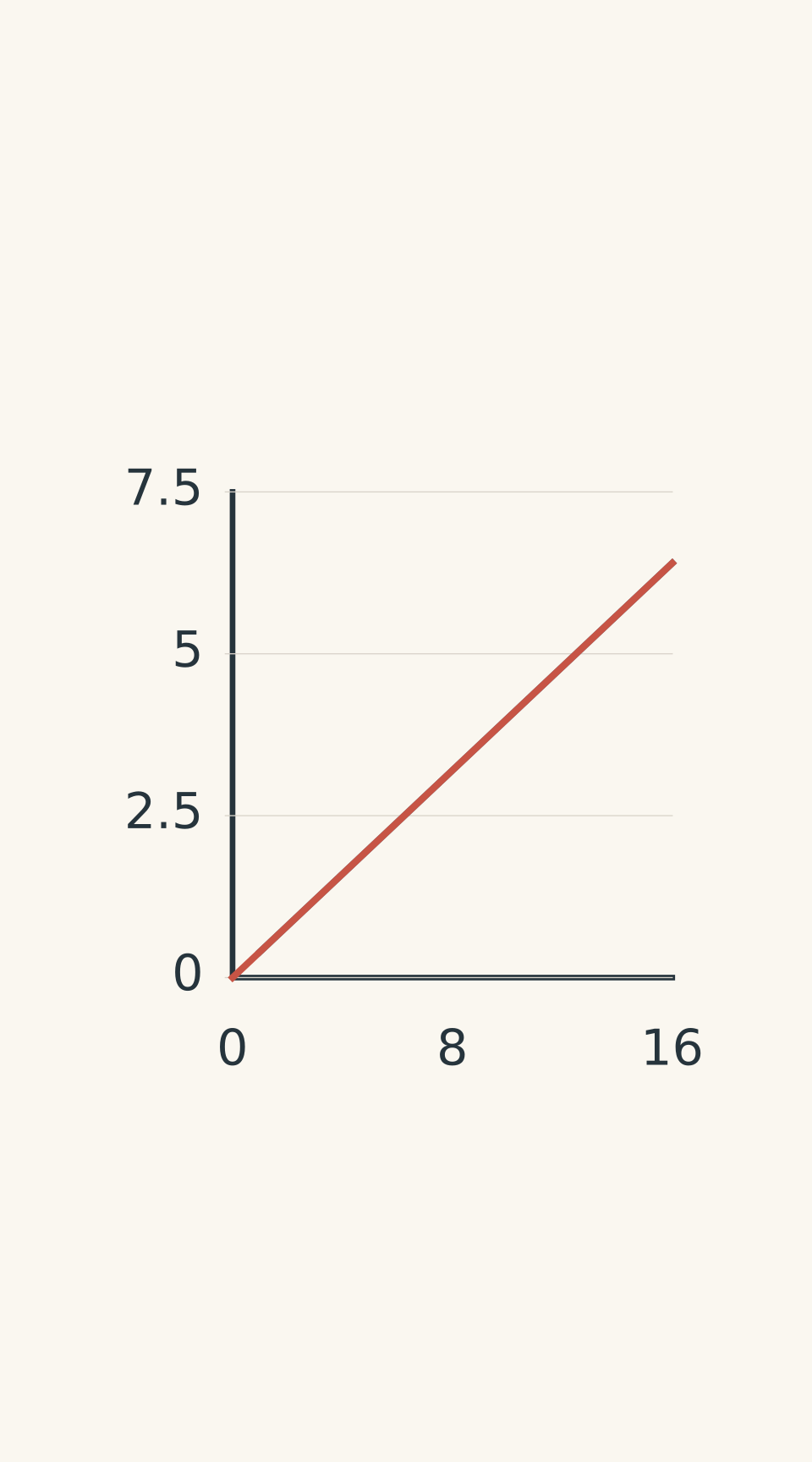
- Measured data
- Best-fit line
(a) Describe the relationship between the inward resultant force and the speed squared. (2 marks)
(b) Calculate the gradient of the graph and state what this gradient represents in terms of the mass \(m\) and radius \(r\) of the circular path. (2 marks)
(c) If the radius of the circular path is \(1.50\,\text{m}\), calculate the mass of the object. (2 marks)
Question 6 (7 marks)
A frictionless banked test track is designed for a speed of \(20.0\,\text{m s}^{-1}\) on a circular section of radius \(120.0\,\text{m}\). A car of mass \(900.0\,\text{kg}\) travels at this design speed.
(a) Calculate the required bank angle. (3 marks)
(b) Calculate the magnitude of the normal force acting on the car. (2 marks)
(c) Calculate the inward component of the normal force. Verify your result by comparing it with the inward resultant force required for the car’s circular motion. (2 marks)
03Worked solutions and marking guide
Solution 1
(a) Identify the forces and acceleration. (2 marks)
The two forces acting on the mass are:
- Tension, \(T\), directed along the string towards the point of support.
- Weight, \(mg\), directed vertically downwards.
The mass accelerates horizontally towards the centre of the circle. Since it remains at a constant height, its vertical acceleration is zero, so the vertical components of the forces balance.
Marking guide:
- 1 mark for identifying both tension and weight.
- 1 mark for identifying the inward direction of acceleration.
(b) Calculate the inward resultant force. (2 marks)
For uniform circular motion, the inward resultant force is
\[ F_{\text{in}}=\frac{mv^2}{r} \]
where \(m\) is mass in kilograms, \(v\) is speed in metres per second, and \(r\) is the radius in metres.
Substituting the values:
\[ \begin{aligned} F_{\text{in}} &=\frac{(0.500)(4.00)^2}{0.600}\\ &=13.3\,\text{N} \end{aligned} \]
The inward resultant force is \(13.3\,\text{N}\).
Marking guide:
- 1 mark for the correct equation and substitution.
- 1 mark for the correct answer with units.
(c) Calculate the tension and angle. (3 marks)
Let \(\theta\) be the angle between the string and the vertical.
The vertical component of tension balances the weight:
\[ T\cos\theta=mg \]
The horizontal component supplies the inward resultant force:
\[ T\sin\theta=F_{\text{in}} \]
First, calculate the tension using the two perpendicular components:
\[ \begin{aligned} T&=\sqrt{(mg)^2+F_{\text{in}}^2}\\ &=\sqrt{(4.90)^2+(13.3)^2}\\ &=14.2\,\text{N} \end{aligned} \]
Next, divide the horizontal component equation by the vertical component equation:
\[ \tan\theta=\frac{F_{\text{in}}}{mg} \]
Therefore,
\[ \begin{aligned} \theta&=\tan^{-1}\left(\frac{13.3}{4.90}\right)\\ &=69.8^\circ \end{aligned} \]
The tension is \(14.2\,\text{N}\), and the string is inclined at \(69.8^\circ\) to the vertical.
Marking guide:
- 1 mark for correctly resolving tension into vertical and horizontal components.
- 1 mark for calculating the tension.
- 1 mark for calculating the angle.
Award follow-through marks for the tension and angle if an earlier numerical error is carried through consistently.
Solution 2
(a) Identify the forces and their components. (2 marks)
The forces acting on the car are its weight, \(mg\), vertically downwards, and the normal force, \(F_N\), exerted by the track perpendicular to its surface.
The normal force has two relevant components:
- A vertical component, \(F_N\cos\theta\), which balances the weight.
- A horizontal component, \(F_N\sin\theta\), which acts towards the centre of the circular path.
There is no frictional force because the track is specified as frictionless.
Marking guide:
- 1 mark for identifying weight and the normal force.
- 1 mark for correctly describing the vertical and inward components.
(b) Derive the design-speed equation. (3 marks)
Because the car maintains a constant height, the vertical forces balance:
\[ F_N\cos\theta=mg \]
The inward component of the normal force provides the centripetal force:
\[ F_N\sin\theta=\frac{mv^2}{r} \]
Divide the inward equation by the vertical equation:
\[ \frac{F_N\sin\theta}{F_N\cos\theta} =\frac{mv^2/r}{mg} \]
Cancel the common factors and use \(\sin\theta/\cos\theta=\tan\theta\):
\[ \tan\theta=\frac{v^2}{rg} \]
Rearranging for speed gives
\[ \boxed{v=\sqrt{rg\tan\theta}} \]
The equation shows that the design speed depends on the track radius, bank angle, and gravitational field strength.
Marking guide:
- 1 mark for the correct vertical force equation.
- 1 mark for the correct inward force equation.
- 1 mark for dividing the equations and deriving the design-speed expression.
(c) Calculate the design speed. (2 marks)
Using \(r=85.0\,\text{m}\), \(g=9.80\,\text{m s}^{-2}\), and \(\theta=12.0^\circ\):
\[ \begin{aligned} v&=\sqrt{rg\tan\theta}\\ &=\sqrt{(85.0)(9.80)\tan12.0^\circ}\\ &=13.3\,\text{m s}^{-1} \end{aligned} \]
The design speed is \(13.3\,\text{m s}^{-1}\).
Marking guide:
- 1 mark for correct substitution into the design-speed equation.
- 1 mark for the correct numerical answer with units.
Solution 3
(a) Calculate the inward resultant force. (2 marks)
The required inward resultant force is
\[ F_{\text{in}}=\frac{mv^2}{r} \]
Substitute the car’s mass, speed, and bend radius:
\[ \begin{aligned} F_{\text{in}} &=\frac{(1.20\times10^3)(14.0)^2}{55.0}\\ &=4.28\times10^3\,\text{N} \end{aligned} \]
The car requires an inward resultant force of \(4.28\times10^3\,\text{N}\).
Marking guide:
- 1 mark for the correct equation and substitution.
- 1 mark for the correct answer with units.
(b) Calculate the minimum coefficient of static friction. (3 marks)
On a flat, horizontal road, static friction acts towards the centre of the bend. It provides the inward resultant force.
The vertical forces balance, so
\[ F_N=mg \]
The maximum available static friction is
\[ f_{s,\max}=\mu_s F_N \]
where \(f_{s,\max}\) is the maximum static friction in newtons and \(\mu_s\) is the coefficient of static friction.
At the minimum coefficient needed to avoid skidding, the maximum friction equals the required inward force:
\[ \mu_s mg=\frac{mv^2}{r} \]
Cancel the mass and rearrange:
\[ \mu_{s,\min}=\frac{v^2}{rg} \]
Substitute the values:
\[ \begin{aligned} \mu_{s,\min} &=\frac{(14.0)^2}{(55.0)(9.80)}\\ &=0.364 \end{aligned} \]
The minimum coefficient of static friction is \(0.364\).
Marking guide:
- 1 mark for identifying static friction as the inward force.
- 1 mark for relating maximum friction to the normal force and weight.
- 1 mark for calculating the minimum coefficient correctly.
(c) Determine whether the car can maintain the bend at the higher speed. (3 marks)
At \(16.8\,\text{m s}^{-1}\), the required coefficient is
\[ \mu_{s,\text{required}}=\frac{v^2}{rg} \]
Substituting:
\[ \begin{aligned} \mu_{s,\text{required}} &=\frac{(16.8)^2}{(55.0)(9.80)}\\ &=0.524 \end{aligned} \]
The required coefficient, \(0.524\), is greater than the available coefficient, \(0.450\).
Therefore, the available static friction is insufficient to provide the required inward force. The car cannot maintain the circular path and will skid towards the outside of the bend.
Marking guide:
- 1 mark for the correct equation and substitution.
- 1 mark for the required coefficient of approximately \(0.524\).
- 1 mark for comparing the required and available coefficients and reaching the correct conclusion.
Solution 4
(a) Calculate the vertical component of tension. (2 marks)
The string makes an angle of \(25.0^\circ\) with the vertical. Therefore, the vertical component of tension is
\[ T_y=T\cos\theta \]
Substituting:
\[ \begin{aligned} T_y&=(12.0)\cos25.0^\circ\\ &=10.9\,\text{N} \end{aligned} \]
The vertical component of tension is \(10.9\,\text{N}\), directed upwards.
Marking guide:
- 1 mark for using the correct component equation.
- 1 mark for the correct numerical answer with units.
(b) Assess the claim and calculate vertical acceleration. (3 marks)
The weight of the mass is
\[ \begin{aligned} mg&=(0.750)(9.80)\\ &=7.35\,\text{N} \end{aligned} \]
For the mass to move in a horizontal circle at constant height, the vertical component of tension must equal the weight.
However,
\[ T_y=10.9\,\text{N}>mg=7.35\,\text{N} \]
The forces do not balance vertically. The student’s claim is inconsistent with the stated force values.
The net vertical force is upwards:
\[ \begin{aligned} F_{\text{net},y}&=T_y-mg\\ &=10.9-7.35\\ &=3.53\,\text{N} \end{aligned} \]
Using Newton’s second law,
\[ \begin{aligned} a_y&=\frac{F_{\text{net},y}}{m}\\ &=\frac{3.53}{0.750}\\ &=4.70\,\text{m s}^{-2} \end{aligned} \]
The initial vertical acceleration is \(4.70\,\text{m s}^{-2}\) upwards. The mass cannot maintain constant height under these conditions.
Marking guide:
- 1 mark for comparing the vertical tension component with the weight and identifying the imbalance.
- 1 mark for calculating the net vertical force.
- 1 mark for calculating the acceleration and stating its direction.
Solution 5
(a) Describe the relationship. (2 marks)
The graph shows that the inward resultant force increases linearly with the speed squared. The data are consistent with a straight line passing through the origin, so
\[ F_{\text{in}}\propto v^2 \]
In other words, if the speed doubles, the required inward resultant force becomes four times as large, provided the mass and radius remain constant.
Marking guide:
- 1 mark for identifying the linear relationship with speed squared.
- 1 mark for stating that the force is directly proportional to \(v^2\).
(b) Calculate and interpret the gradient. (2 marks)
The gradient is the change in inward resultant force divided by the change in speed squared:
\[ \begin{aligned} \text{gradient} &=\frac{\Delta F_{\text{in}}}{\Delta(v^2)}\\ &=\frac{6.40-0.400}{16.0-1.00}\\ &=0.400\,\frac{\text{N}}{\text{m}^2\text{s}^{-2}}\\ &=0.400\,\text{kg m}^{-1} \end{aligned} \]
The units simplify to kilograms per metre.
The circular-motion equation is
\[ F_{\text{in}}=\frac{mv^2}{r} \]
Rearrange it into the form of a straight-line equation:
\[ F_{\text{in}}=\frac{m}{r}v^2 \]
Comparing this with \(y=mx\), the gradient of the graph represents the ratio of mass to radius:
\[ \boxed{\text{gradient}=\frac{m}{r}} \]
Marking guide:
- 1 mark for the correct gradient with units.
- 1 mark for identifying the gradient as \(m/r\).
(c) Calculate the mass. (2 marks)
From part (b),
\[ \text{gradient}=\frac{m}{r} \]
Rearrange to make mass the subject:
\[ m=(\text{gradient})r \]
Substitute the gradient and radius:
\[ \begin{aligned} m&=(0.400)(1.50)\\ &=0.600\,\text{kg} \end{aligned} \]
The mass of the object is \(0.600\,\text{kg}\).
Marking guide:
- 1 mark for correctly rearranging the gradient relationship and substituting the radius.
- 1 mark for the correct mass with units.
Award follow-through for a consistent gradient from part (b).
Solution 6
(a) Calculate the bank angle. (3 marks)
For a frictionless banked track, the design-speed relationship is
\[ \tan\theta=\frac{v^2}{rg} \]
Substitute the given speed, radius, and gravitational field strength:
\[ \begin{aligned} \tan\theta &=\frac{(20.0)^2}{(120.0)(9.80)}\\ &=\frac{400}{1176}\\ &=0.340 \end{aligned} \]
Taking the inverse tangent gives
\[ \begin{aligned} \theta&=\tan^{-1}(0.340)\\ &=18.8^\circ \end{aligned} \]
The required bank angle is \(18.8^\circ\) to the horizontal.
Marking guide:
- 1 mark for using the correct design-speed relationship.
- 1 mark for correct substitution.
- 1 mark for the correct angle.
(b) Calculate the normal force. (2 marks)
The car has no vertical acceleration, so the vertical component of the normal force balances its weight:
\[ F_N\cos\theta=mg \]
Rearrange:
\[ F_N=\frac{mg}{\cos\theta} \]
Substitute the values:
\[ \begin{aligned} F_N&=\frac{(900.0)(9.80)}{\cos18.8^\circ}\\ &=9.31\times10^3\,\text{N} \end{aligned} \]
The normal force has a magnitude of \(9.31\times10^3\,\text{N}\).
Marking guide:
- 1 mark for resolving the normal force vertically and using the correct equation.
- 1 mark for the correct normal force with units.
(c) Calculate and verify the inward component. (2 marks)
The inward component of the normal force is
\[ F_{N,\text{in}}=F_N\sin\theta \]
Using \(F_N\cos\theta=mg\), this can also be written as
\[ F_{N,\text{in}}=mg\tan\theta \]
Substitute the values:
\[ \begin{aligned} F_{N,\text{in}} &=(900.0)(9.80)\tan18.8^\circ\\ &\approx3.00\times10^3\,\text{N} \end{aligned} \]
Now calculate the inward resultant force required for circular motion:
\[ \begin{aligned} F_{\text{in}}&=\frac{mv^2}{r}\\ &=\frac{(900.0)(20.0)^2}{120.0}\\ &=3.00\times10^3\,\text{N} \end{aligned} \]
The inward component of the normal force matches the required inward resultant force, within rounding. This confirms that the normal force can provide the required centripetal force at the design speed.
Marking guide:
- 1 mark for calculating the inward component of the normal force.
- 1 mark for calculating the required inward resultant and confirming that the two values agree.
Award follow-through in parts (b) and (c) for a consistently used angle from part (a), provided the method is correct.