
Atomic Spectra and Energy Levels: HSC Physics Practice Exam
Test your understanding of atomic spectra and energy levels with this original 40-mark tutorgum Physics practice paper. Includes a 60-minute assessment, exam-style calculations, and fully worked solutions with a detailed marking guide.
This original tutorgum practice paper assesses atomic spectra and energy levels for Year 11-12 Physics. It is a focused topic assessment, not a full-course mock exam, and it is not an official, NESA-endorsed, past, or predicted paper. Complete all six questions before checking the worked solutions and marking guide.
01Exam instructions
- Suggested working time: 60 minutes.
- Reading time: 5 minutes.
- Total marks: 40.
- Equipment: Scientific calculator and writing materials. No notes or internet access.
- Answer all questions. Show your working, include units, and give numerical answers to three significant figures unless a whole-number quantum level is required.
Assessed scope
This paper covers the supplied atomic spectra and energy-level content, compatible with the Physics 2017 and Physics 2025 syllabus editions.
The assessed topics are:
- The instability predicted by Rutherford’s atomic model when classical physics is applied to orbiting electrons.
- Photon energy, frequency, and wavelength.
- The Balmer series and visible hydrogen emission lines.
- Quantised energy levels in the Bohr model, including its scope and limitations.
- Hydrogen spectral wavelengths calculated using the Rydberg equation.
- The relationship between absorption, emission, and electron energy-level differences.
Other Physics modules are excluded, including nuclear physics, circuits, electric and magnetic fields, and quantum models beyond the Bohr model. These are the conditions for this practice paper, not claims about official examination rules.
Data sheet
Use the following constants and equations throughout the paper.
| Quantity | Value |
|---|---|
| Planck’s constant, \(h\) | \(6.626\times10^{-34}\ \mathrm{J\,s}\) |
| Speed of light, \(c\) | \(3.00\times10^8\ \mathrm{m\,s^{-1}}\) |
| Rydberg constant, \(R\) | \(1.097\times10^7\ \mathrm{m^{-1}}\) |
| Electronvolt conversion | \(1\ \mathrm{eV}=1.602\times10^{-19}\ \mathrm{J}\) |
Photon energy:
\[ E=hf \]
Photon energy using wavelength:
\[ E=\frac{hc}{\lambda} \]
Wave relationship:
\[ c=f\lambda \]
Rydberg equation for hydrogen emission:
\[ \frac{1}{\lambda} =R\left(\frac{1}{n_f^2}-\frac{1}{n_i^2}\right) \]
Here, \(E\) is photon energy, \(f\) is frequency, and \(\lambda\) is wavelength. The symbols \(n_i\) and \(n_f\) represent the initial and final principal quantum numbers, respectively. For emission, \(n_i>n_f\).
For this paper, take the visible region of the electromagnetic spectrum to be approximately \(400\)-\(700\ \mathrm{nm}\).
02Questions
Question 1 (5 marks)
The Rutherford model describes an atom with a small, positively charged nucleus and electrons orbiting around it.
(a) Using classical electromagnetism, explain why an electron moving in a circular orbit around the nucleus is expected to emit electromagnetic radiation. (2 marks)
(b) Explain what this prediction implies for the electron’s orbit and the stability of the atom. (2 marks)
(c) State one feature of observed atomic spectra that the Rutherford model cannot explain. (1 mark)
Question 2 (6 marks)
A photon in a monochromatic beam has a wavelength of \(532.0\ \mathrm{nm}\).
(a) Calculate the photon’s frequency in hertz. (2 marks)
(b) Calculate the photon’s energy in joules using \(E=hf\). (2 marks)
(c) Express the photon’s energy in electronvolts. (2 marks)
Question 3 (6 marks)
During an emission transition, a hydrogen electron moves from the initial level \(n_i=4\) to the final level \(n_f=2\).
(a) Use the Rydberg equation to calculate the wavelength of the emitted photon in nanometres. Show your working. (4 marks)
(b) Identify the spectral series to which this line belongs and state whether the line lies in the visible region. (2 marks)
Question 4 (7 marks)
The following table gives approximate energy values for several allowed energy levels in a hydrogen atom.
| Principal quantum number, \(n\) | Energy, \(E_n\) (eV) |
|---|---|
| 1 | \(-13.60\) |
| 2 | \(-3.40\) |
| 3 | \(-1.51\) |
| 4 | \(-0.85\) |
A hydrogen atom is initially in the \(n=2\) state and absorbs a photon with an energy of \(1.89\ \mathrm{eV}\).
(a) Determine whether this photon can excite the electron from \(n=2\) to \(n=3\). Justify your answer using the energy values. (2 marks)
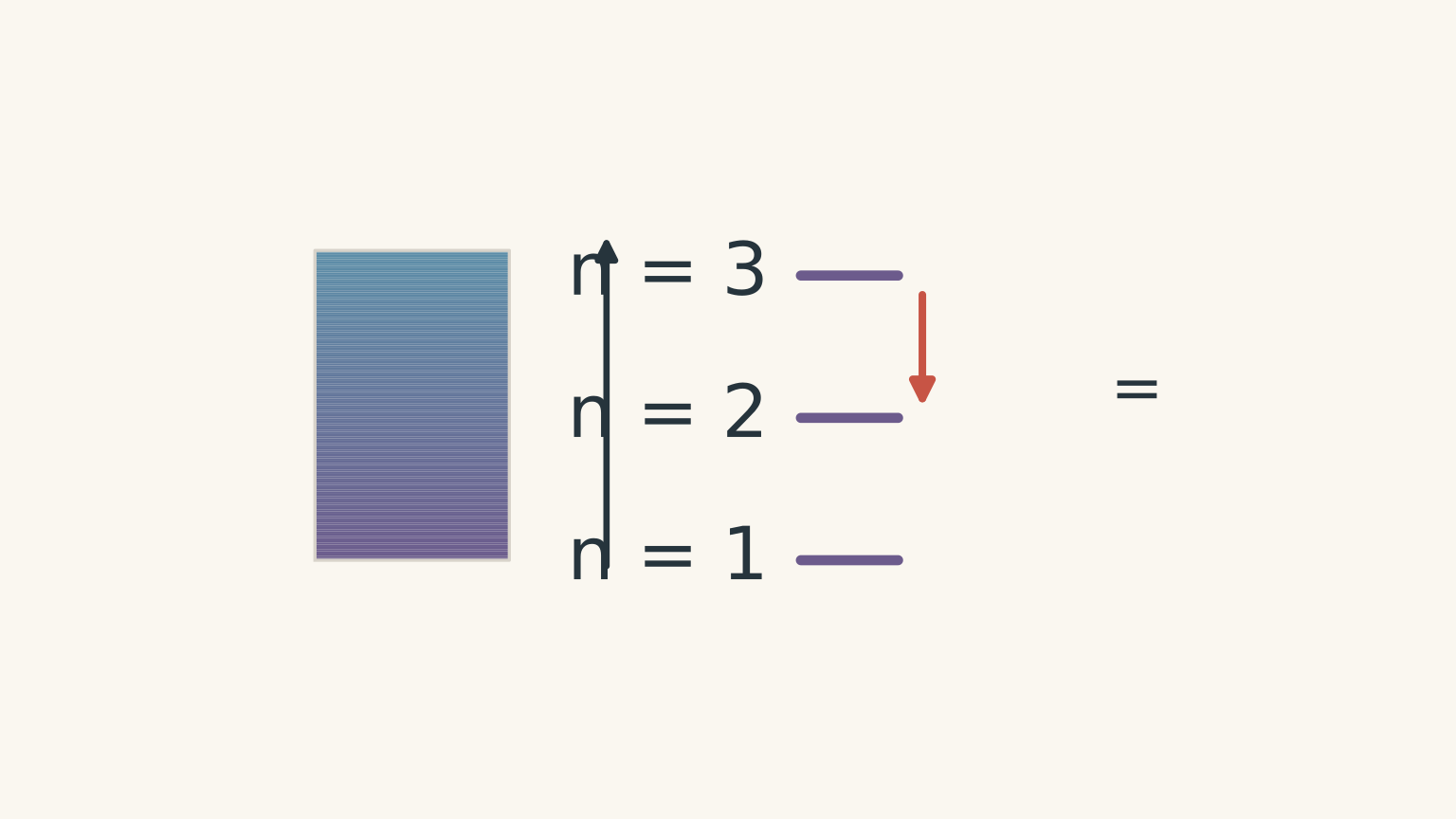
(b) The electron is now in the \(n=3\) state and transitions down to \(n=2\). Calculate the energy of the emitted photon in joules. (2 marks)
(c) Calculate the wavelength of this emitted photon in nanometres using \(E=hc/\lambda\). (3 marks)
Question 5 (7 marks)
The Bohr model was developed to address problems with the classical picture of electrons orbiting a nucleus.
(a) Explain what it means to say that electron orbits and energies are quantised in the Bohr model. (2 marks)
(b) Explain how transitions between allowed energy levels produce a discrete atomic emission spectrum rather than a continuous range of wavelengths. (2 marks)
(c) State the type of atomic system that the Bohr model describes most successfully. Identify one limitation of the model and explain why this limitation occurs. (3 marks)
Question 6 (9 marks)
A hydrogen emission line has a wavelength of \(434.0\ \mathrm{nm}\). The electron finishes its transition at the energy level \(n_f=2\).
(a) Use the Rydberg equation to determine the initial principal quantum number, \(n_i\). Show your working. (5 marks)
(b) Calculate the energy of the emitted photon in electronvolts using \(E=hc/\lambda\). (2 marks)
(c) A hydrogen atom initially in the \(n=2\) state absorbs a photon of the same wavelength. State the final principal quantum number and explain your answer. (2 marks)
03Worked solutions and marking guide
Marking note: Follow-through marks should be awarded when a student makes an earlier numerical error but then applies a correct method consistently to the value they obtained. Equivalent mathematical methods are acceptable where they produce the correct result.
Solution 1
(a) Why does the electron radiate?
An electron moving in a circular orbit continually changes the direction of its velocity. A change in velocity means the electron is accelerating, even if its speed stays constant.
Classical electromagnetism predicts that an accelerating electric charge emits electromagnetic radiation.
Marking (2 marks):
- Identifies that circular motion involves acceleration because the velocity direction changes. (1)
- States that an accelerating charge emits electromagnetic radiation according to classical electromagnetism. (1)
(b) Why does this make the atom unstable?
If the electron radiates energy, it loses orbital energy. Its orbit would contract, bringing it closer to the nucleus, and it would continue losing energy until it spiralled into the nucleus.
This predicts that the atom is unstable, contrary to the observed stability of atoms.
Marking (2 marks):
- Explains that radiation causes the electron to lose energy and its orbit to shrink. (1)
- Explains that the electron would spiral into the nucleus, making the atom unstable. (1)
(c) What does the model fail to explain?
The Rutherford model cannot explain why atoms produce discrete spectral lines at specific wavelengths rather than a continuous range of wavelengths.
Marking (1 mark):
- Identifies the discrete nature of atomic line spectra. (1)
Question total: 5 marks.
Solution 2
(a) Calculate the frequency.
First, convert the wavelength into metres:
\[ \lambda=532.0\ \mathrm{nm} \]
\[ \lambda=5.320\times10^{-7}\ \mathrm{m} \]
Rearrange \(c=f\lambda\):
\[ f=\frac{c}{\lambda} \]
Substitute the values:
\[ f=\frac{3.00\times10^8}{5.320\times10^{-7}} \]
\[ \boxed{f=5.64\times10^{14}\ \mathrm{Hz}} \]
Marking (2 marks):
- Correctly converts the wavelength to metres. (1)
- Calculates the frequency with the correct unit. (1)
(b) Calculate the photon energy in joules.
Use \(E=hf\):
\[ E=hf \]
\[ E=(6.626\times10^{-34}) (5.639\times10^{14}) \]
\[ \boxed{E=3.74\times10^{-19}\ \mathrm{J}} \]
Marking (2 marks):
- Correct substitution into \(E=hf\). (1)
- Correct energy with the unit joules. (1)
(c) Convert the energy to electronvolts.
One electronvolt is \(1.602\times10^{-19}\ \mathrm{J}\). Divide the energy in joules by this conversion factor:
\[ E=\frac{3.736\times10^{-19}} {1.602\times10^{-19}}\ \mathrm{eV} \]
\[ \boxed{E=2.33\ \mathrm{eV}} \]
Marking (2 marks):
- Correctly applies the joule-to-electronvolt conversion. (1)
- Gives the correct energy in electronvolts. (1)
Question total: 6 marks.
Solution 3
(a) Calculate the wavelength.
The Rydberg equation for an emission transition is
\[ \frac{1}{\lambda} =R\left(\frac{1}{n_f^2}-\frac{1}{n_i^2}\right) \]
Here, \(n_f=2\), \(n_i=4\), and \(R=1.097\times10^7\ \mathrm{m^{-1}}\).
Substitute:
\[ \frac{1}{\lambda} =1.097\times10^7 \left(\frac{1}{2^2}-\frac{1}{4^2}\right) \]
Simplify the bracket:
\[ \frac{1}{\lambda} =1.097\times10^7 \left(\frac{1}{4}-\frac{1}{16}\right) \]
\[ \frac{1}{\lambda} =2.056875\times10^6\ \mathrm{m^{-1}} \]
Take the reciprocal:
\[ \lambda=\frac{1}{2.056875\times10^6} \]
\[ \lambda=4.86\times10^{-7}\ \mathrm{m} \]
Convert to nanometres:
\[ \boxed{\lambda=486\ \mathrm{nm}} \]
Marking (4 marks):
- Correctly substitutes the initial and final levels into the Rydberg equation. (1)
- Correctly evaluates the difference between the inverse squares. (1)
- Calculates the wavelength in metres. (1)
- Converts the result to nanometres with appropriate precision. (1)
(b) Identify the spectral series and region.
The Balmer series consists of hydrogen electron transitions that finish at \(n_f=2\). Since this transition ends at \(n=2\), it belongs to the Balmer series.
The wavelength is approximately \(486\ \mathrm{nm}\), which lies within the visible region of \(400\)-\(700\ \mathrm{nm}\).
Marking (2 marks):
- Identifies the Balmer series because the final level is \(n_f=2\). (1)
- Identifies the line as visible light. (1)

Question total: 6 marks.
Solution 4
(a) Determine whether the transition can occur.
The energy required to move the electron from \(n=2\) to \(n=3\) is the difference between the two energy levels:
\[ \Delta E=E_3-E_2 \]
\[ \Delta E=(-1.51)-(-3.40) \]
\[ \Delta E=1.89\ \mathrm{eV} \]
The incident photon has an energy of \(1.89\ \mathrm{eV}\), which matches the energy difference exactly. Therefore, the photon can be absorbed to excite the electron from \(n=2\) to \(n=3\).
Marking (2 marks):
- Correctly calculates the energy-level difference. (1)
- Compares it with the photon energy and reaches the correct conclusion. (1)
(b) Calculate the emitted photon energy in joules.
The electron drops from \(n=3\) to \(n=2\), so the energy released is the positive magnitude of the level difference:
\[ E_{\text{photon}}=1.89\ \mathrm{eV} \]
Convert to joules:
\[ E_{\text{photon}} =1.89(1.602\times10^{-19}) \]
\[ \boxed{E_{\text{photon}}=3.03\times10^{-19}\ \mathrm{J}} \]
Marking (2 marks):
- Identifies the correct energy difference for the emitted photon. (1)
- Converts the energy to joules correctly. (1)
(c) Calculate the wavelength.
Use the photon energy equation:
\[ E=\frac{hc}{\lambda} \]
Rearrange to make wavelength the subject:
\[ \lambda=\frac{hc}{E} \]
Substitute the values:
\[ \lambda= \frac{(6.626\times10^{-34})(3.00\times10^8)} {3.03\times10^{-19}} \]
\[ \lambda=6.56\times10^{-7}\ \mathrm{m} \]
Convert to nanometres:
\[ \boxed{\lambda=656\ \mathrm{nm}} \]
Marking (3 marks):
- Correctly rearranges the photon energy equation. (1)
- Substitutes the values and calculates the wavelength in metres. (1)
- Converts to nanometres and gives the correct result. (1)
Question total: 7 marks.
Solution 5
(a) Explain quantisation.
In the Bohr model, an electron can occupy only certain allowed orbits, each associated with a specific energy. The electron cannot occupy an intermediate orbit with an arbitrary energy between these allowed states.
The allowed energies are therefore discrete rather than continuous.
Marking (2 marks):
- States that only certain electron orbits or energy levels are allowed. (1)
- Explains that intermediate energy values are not allowed. (1)
(b) Explain the origin of discrete spectral lines.
When an electron moves between two allowed energy levels, it must gain or lose a specific amount of energy.
For emission, the photon carries away the energy difference:
\[ E_{\text{photon}}=|\Delta E|=hf \]
Because only certain energy differences are possible, only certain photon frequencies and wavelengths are produced. Each allowed transition can therefore produce a specific spectral line.
Marking (2 marks):
- Explains that a transition produces a photon with energy equal to the energy-level difference. (1)
- Connects the restricted energy differences to the discrete wavelengths of an emission spectrum. (1)
(c) State the scope and one limitation of the Bohr model.
The Bohr model describes hydrogen and hydrogen-like ions, such as \(\mathrm{He^+}\), particularly well because these systems contain only one electron.
One limitation is that it does not adequately describe multi-electron atoms. Its simple treatment does not fully account for interactions between multiple electrons and the resulting complexity of their energy levels.
Marking (3 marks):
- Identifies hydrogen or hydrogen-like, one-electron systems as the model’s main successful scope. (1)
- Identifies a valid limitation, such as its inability to accurately describe multi-electron atoms. (1)
- Explains the limitation, for example by referring to electron-electron interactions or the model’s simplified assumptions. (1)
Question total: 7 marks.
Solution 6
(a) Determine the initial principal quantum number.
Convert the wavelength into metres:
\[ \lambda=434.0\ \mathrm{nm} =4.340\times10^{-7}\ \mathrm{m} \]
Calculate the inverse wavelength:
\[ \frac{1}{\lambda} =2.304\times10^6\ \mathrm{m^{-1}} \]
The transition finishes at \(n_f=2\). Apply the Rydberg equation:
\[ \frac{1}{\lambda} =R\left(\frac14-\frac{1}{n_i^2}\right) \]
Divide by the Rydberg constant:
\[ \frac{2.304\times10^6}{1.097\times10^7} =0.2500-\frac{1}{n_i^2} \]
Simplify:
\[ 0.2100=0.2500-\frac{1}{n_i^2} \]
Rearrange:
\[ \frac{1}{n_i^2}=0.0400 \]
Therefore,
\[ n_i=\sqrt{\frac{1}{0.0400}} \]
\[ \boxed{n_i=5} \]
The initial level is \(n=5\), and the electron transitions from \(n=5\) to \(n=2\).
Marking (5 marks):
- Converts the wavelength and calculates its inverse correctly. (1)
- Correctly substitutes the final level into the Rydberg equation. (1)
- Divides by the Rydberg constant correctly. (1)
- Rearranges to obtain the inverse square of the initial quantum number. (1)
- Obtains the correct integer initial level, \(n_i=5\). (1)
(b) Calculate the photon energy in electronvolts.
Use the wavelength form of the photon energy equation:
\[ E=\frac{hc}{\lambda} \]
Substitute the given wavelength:
\[ E= \frac{(6.626\times10^{-34})(3.00\times10^8)} {4.340\times10^{-7}} \]
This gives
\[ E=4.58\times10^{-19}\ \mathrm{J} \]
Convert to electronvolts:
\[ E=\frac{4.58\times10^{-19}} {1.602\times10^{-19}}\ \mathrm{eV} \]
\[ \boxed{E=2.86\ \mathrm{eV}} \]
Marking (2 marks):
- Calculates the photon energy in joules using \(E=hc/\lambda\). (1)
- Converts to electronvolts correctly. (1)
(c) Determine the final level after absorption.
The emitted photon corresponds to the transition from \(n=5\) down to \(n=2\). Absorbing a photon of the same energy can produce the reverse transition.
Therefore, an atom initially at \(n=2\) can absorb this photon and move to
\[ \boxed{n=5} \]
The photon supplies exactly the energy difference between the two levels.
Marking (2 marks):
- Identifies the final level as \(n=5\). (1)
- Explains that absorption reverses the corresponding emission transition because the energy difference is the same. (1)
Question total: 9 marks.
Total paper: 40 marks.
For revision, pay particular attention to the difference between calculating a photon wavelength and identifying the energy levels responsible for it. The Rydberg equation connects the levels to the wavelength, while \(E=hf\) and \(E=hc/\lambda\) connect that wavelength to the photon’s energy.