
Cathode Rays and Charge-to-Mass Experiments: Practice Exam
Test your understanding of cathode-ray evidence for electrons and Thomson’s charge-to-mass experiment with this original 40-mark Physics practice paper. Includes timed exam conditions, calculation questions, and fully worked solutions with a detailed marking guide.
This original tutorgum practice paper focuses on cathode-ray evidence for negatively charged particles and Thomson’s charge-to-mass experiment. It assesses deflection observations, crossed-field speed selection, magnetic curvature, and the interpretation of experimental results. It is a focused topic paper, not a full-course exam, and is not an official, past, predicted, or NESA-endorsed paper.
01Exam instructions
- Suggested reading time: 5 minutes.
- Working time: 50 minutes.
- Total marks: 40.
- Permitted equipment: Calculator. No notes.
- Show your working, including equations, substitutions, units, and final answers.
- Use SI units in calculations and give numerical answers to an appropriate number of significant figures.
- If a question requires a result from an earlier question, use your earlier result. Follow-through marks are available where appropriate.
Assumptions and notation
Unless stated otherwise, assume that the electric and magnetic fields are uniform, edge effects are negligible, and the beam speed is much less than the speed of light. The beam velocity is perpendicular to the magnetic field. When the electric field is switched off, the beam speed remains unchanged.
The symbols used are:
- \(E\): electric field strength, measured in volts per metre (\(\mathrm{V\,m^{-1}}\)).
- \(B\): magnetic flux density, measured in tesla (\(\mathrm{T}\)).
- \(v\): particle speed, measured in metres per second (\(\mathrm{m\,s^{-1}}\)).
- \(r\): radius of the curved path, measured in metres (\(\mathrm{m}\)).
- \(q\): particle charge, measured in coulombs (\(\mathrm{C}\)).
- \(m\): particle mass, measured in kilograms (\(\mathrm{kg}\)).
- \(|q|\): magnitude of the particle’s charge.
- \(|q|/m\): magnitude of the charge-to-mass ratio, measured in \(\mathrm{C\,kg^{-1}}\).
Assessed scope: Evidence for negatively charged particles in cathode rays; Thomson’s crossed-field method; calculating particle speed and charge-to-mass ratio; interpreting deflection, curvature, and experimental consistency.
Exclusions: Other atomic models, methods for measuring electron charge independently, and unrelated electricity and magnetism topics.
02Questions
Question 1 (6 marks)
In a discharge tube, a narrow beam travels from the cathode towards the anode. When an electric field is applied between two plates, the beam deflects towards the plate connected to the positive terminal. A magnetic field can also bend the beam.
Experiments using different cathode materials and different residual gases produce the same qualitative behaviour.
(a) Determine the sign of the charge carried by the particles in the beam. Justify your answer using the direction of the electric force. (2 marks)
(b) Explain why the beam’s response to electric and magnetic fields supports the interpretation that cathode rays are a stream of charged particles rather than neutral radiation. (2 marks)
(c) What does the consistent behaviour across different cathode materials and residual gases suggest about the nature of the particles? (2 marks)
Question 2 (6 marks)
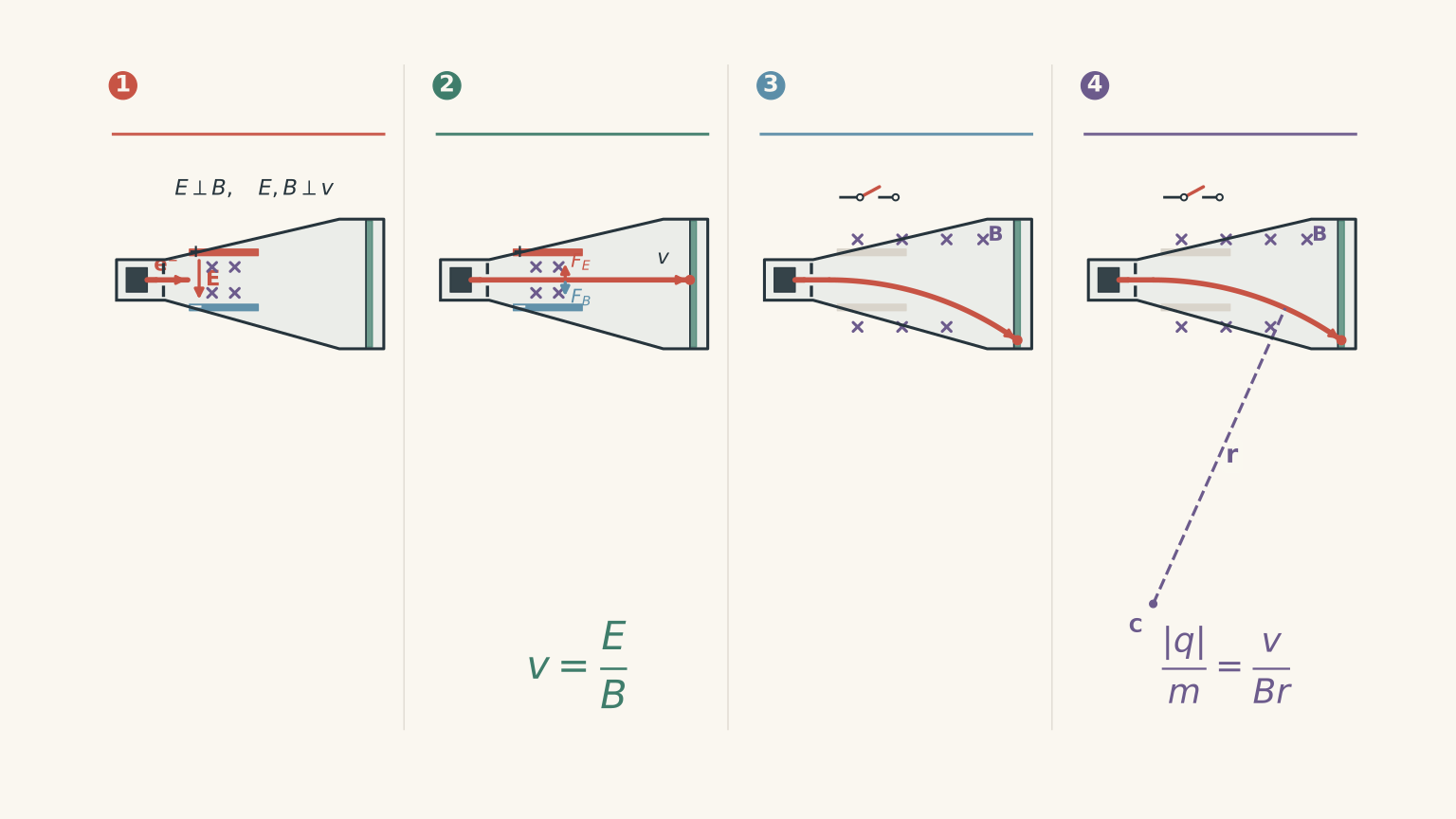
Thomson’s charge-to-mass experiment uses an electric field and a magnetic field arranged perpendicular to each other and to the beam’s initial velocity. The field orientations are chosen so that the electric and magnetic forces on the beam particles act in opposite directions.
(a) Describe how the experimenter uses the two fields to select a particular beam speed. (2 marks)
(b) When the beam passes straight through the crossed fields, what does this tell you about the transverse forces? Express the condition in terms of \(q\), \(E\), \(v\), and \(B\). (2 marks)
(c) Once this condition is achieved, describe what the experimenter changes and what measurement is required to determine the charge-to-mass ratio. (2 marks)
Question 3 (6 marks)
In a crossed-field experiment, a potential difference of \(480\ \mathrm{V}\) is applied across two parallel plates separated by \(2.0\ \mathrm{cm}\). The magnetic field strength is \(3.0\times10^{-3}\ \mathrm{T}\).
The beam passes straight through the region while both fields are operating.
(a) Calculate the magnitude of the electric field between the plates. (3 marks)
(b) Calculate the speed of the particles passing through the crossed fields. (3 marks)
Question 4 (8 marks)
After the beam speed has been selected in Question 3, the electric field is switched off. The magnetic field remains at \(3.0\times10^{-3}\ \mathrm{T}\), and the beam follows a circular path with radius \(1.50\ \mathrm{cm}\).
Assume that the beam speed is unchanged and that the magnetic force provides the centripetal force.
(a) Starting from expressions for the magnetic force and the centripetal force, derive an expression for the magnitude of the charge-to-mass ratio, \(|q|/m\), in terms of \(v\), \(B\), and \(r\). (4 marks)
(b) Use your expression and the data from Questions 3 and 4 to calculate \(|q|/m\). Give your answer in SI units and to an appropriate number of significant figures. (4 marks)
Question 5 (6 marks)
An experimenter repeats the charge-to-mass measurement using different cathode materials and residual gases. The results are shown below.
| Run | Cathode material | Residual gas | Measured \(|q|/m\) \((10^{11}\ \mathrm{C\,kg^{-1}})\) |
|---|---|---|---|
| A | Material A | Gas P | \(1.74 \pm 0.04\) |
| B | Material B | Gas Q | \(1.77 \pm 0.04\) |
| C | Material C | Gas R | \(1.79 \pm 0.04\) |
The quoted uncertainty for each run is \(\pm0.04\times10^{11}\ \mathrm{C\,kg^{-1}}\).
(a) Determine whether the three measurements are consistent within their stated uncertainties. Justify your answer. (2 marks)
(b) State the conclusion these results support about the particles in cathode rays. (2 marks)
(c) Identify one limitation of changing both the cathode material and the residual gas in every run when investigating whether the result depends on either factor separately. (2 marks)
Question 6 (8 marks)
During a velocity-selection experiment, the electric and magnetic forces initially balance. The field orientations remain fixed.
(a) The magnetic field strength is increased while the electric field strength and particle speed remain constant. Identify which force becomes larger and state the direction of the beam’s net force relative to the magnetic force. (2 marks)
(b) Later, only the magnetic field acts on the same particles. Their speed is unchanged, but the magnetic field strength is doubled. Predict how the radius of the circular path changes. Justify your answer using the relationship derived in Question 4. (3 marks)
(c) A student claims that measuring \(|q|/m\) gives the particle’s mass directly. Explain why this claim is incorrect and identify the additional information needed to determine the mass. (3 marks)
03Worked solutions and marking guide
Solution 1
(a) The particles carry a negative charge.
The electric field points from the positively charged plate towards the negatively charged plate. The electric force on a negative charge acts in the opposite direction to the electric field, so the particles are pushed towards the positive plate.
The observed deflection is therefore consistent with negatively charged particles.
Marking (2 marks):
- 1 mark for identifying the charge as negative.
- 1 mark for explaining that the force on a negative charge is opposite to the electric field direction.
(b) The beam behaves like a stream of moving charged particles.
An electric field exerts a force on a particle with non-zero charge. A magnetic field can also deflect a moving charged particle. Under the stated experimental conditions, neutral radiation would not experience these electric and magnetic forces.
The deflection in both types of field therefore supports the conclusion that cathode rays consist of moving charged particles.
Marking (2 marks):
- 1 mark for linking electric and magnetic deflection to the behaviour of charged particles.
- 1 mark for explaining why neutral radiation would not undergo the observed field-driven deflection.
(c) The particles appear to be common constituents of matter.
The same qualitative behaviour occurs even when the cathode material and residual gas change. This suggests that cathode rays are not simply a property of one particular electrode or gas. Instead, they contain a type of particle common to different forms of matter.
Marking (2 marks):
- 1 mark for recognising that the behaviour persists across different materials and gases.
- 1 mark for linking this consistency to the idea of a common constituent of matter.
Solution 2
(a) Adjust the fields until the beam passes straight through.
The experimenter adjusts the electric and magnetic field strengths while keeping their orientations fixed. The fields can then select particles with a particular speed: particles for which the two transverse forces balance pass through without deflection.
Marking (2 marks):
- 1 mark for describing the adjustment of the fields until the beam is undeflected.
- 1 mark for identifying that the condition selects a particular particle speed.
(b) The transverse forces are equal in magnitude and opposite in direction.
For a charged particle, the magnitude of the electric force is
\[ F_E=|q|E \]
The magnitude of the magnetic force, when the velocity is perpendicular to the magnetic field, is
\[ F_B=|q|vB \]
For the beam to pass straight through, the net transverse force must be zero. Therefore,
\[ |q|E=|q|vB \]
Cancelling the non-zero charge magnitude gives
\[ v=\frac{E}{B} \]
This relationship allows the particle speed to be calculated from the two field strengths.
Marking (2 marks):
- 1 mark for stating that the forces are equal in magnitude and opposite in direction.
- 1 mark for expressing the balance condition correctly and obtaining \(v=E/B\).
(c) Switch off the electric field and measure the radius of the curved path.
The experimenter removes the electric field but leaves the magnetic field operating. The magnetic force then bends the moving particles into a circular path.
The experimenter measures the radius \(r\) and uses it, together with the known speed and magnetic field strength, to calculate the charge-to-mass ratio.
Marking (2 marks):
- 1 mark for identifying that the electric field is switched off while the magnetic field remains.
- 1 mark for identifying the radius measurement and its use in determining \(|q|/m\).
Solution 3
(a) Electric field strength
For a uniform electric field between parallel plates, the field strength is the potential difference divided by the plate separation:
\[ E=\frac{V}{d} \]
The potential difference is \(V=480\ \mathrm{V}\). The separation must be converted to metres:
\[ d=2.0\ \mathrm{cm}=0.020\ \mathrm{m} \]
Substituting,
\[ \begin{aligned} E&=\frac{480}{0.020}\\ &=2.4\times10^4\ \mathrm{V\,m^{-1}} \end{aligned} \]
The electric field strength is therefore \(2.4\times10^4\ \mathrm{V\,m^{-1}}\).
Marking (3 marks):
- 1 mark for converting the plate separation to metres.
- 1 mark for selecting and applying \(E=V/d\).
- 1 mark for the correct field strength with units.
(b) Particle speed
Since the beam passes straight through, the electric and magnetic force magnitudes are equal:
\[ |q|E=|q|vB \]
Cancelling the charge magnitude gives
\[ v=\frac{E}{B} \]
Substitute the electric field strength from part (a) and the magnetic field strength:
\[ \begin{aligned} v&=\frac{2.4\times10^4}{3.0\times10^{-3}}\\ &=8.0\times10^6\ \mathrm{m\,s^{-1}} \end{aligned} \]
The selected particle speed is \(8.0\times10^6\ \mathrm{m\,s^{-1}}\).
Marking (3 marks):
- 1 mark for using the balanced-force condition to obtain \(v=E/B\).
- 1 mark for correct substitution of the field strengths.
- 1 mark for the correct speed with units and appropriate significant figures.
Solution 4
(a) Deriving the charge-to-mass relationship
When only the magnetic field acts, the magnetic force supplies the centripetal force needed to maintain circular motion.
The magnitude of the magnetic force is
\[ F_B=|q|vB \]
The centripetal force required for circular motion is
\[ F_c=\frac{mv^2}{r} \]
Equating the two expressions gives
\[ |q|vB=\frac{mv^2}{r} \]
Divide both sides by \(mvB\):
\[ \frac{|q|}{m}=\frac{v}{Br} \]
Therefore, the required expression is
\[ \boxed{\frac{|q|}{m}=\frac{v}{Br}} \]
This equation shows how the charge-to-mass ratio can be determined from the selected speed, magnetic field strength, and radius of curvature.
Marking (4 marks):
- 1 mark for the magnetic force expression, \(F_B=|q|vB\).
- 1 mark for the centripetal force expression, \(F_c=mv^2/r\).
- 1 mark for correctly equating the two forces.
- 1 mark for rearranging to obtain \(|q|/m=v/(Br)\).
(b) Calculating the charge-to-mass ratio
From Question 3,
\[ v=8.0\times10^6\ \mathrm{m\,s^{-1}} \]
The magnetic field strength is
\[ B=3.0\times10^{-3}\ \mathrm{T} \]
Convert the radius into metres:
\[ r=1.50\ \mathrm{cm}=1.50\times10^{-2}\ \mathrm{m} \]
Substitute into the derived relationship:
\[ \begin{aligned} \frac{|q|}{m} &=\frac{v}{Br}\\[4pt] &=\frac{8.0\times10^6} {(3.0\times10^{-3})(1.50\times10^{-2})}\\[4pt] &=\frac{8.0\times10^6}{4.50\times10^{-5}}\\[4pt] &=1.78\times10^{11}\ \mathrm{C\,kg^{-1}} \end{aligned} \]
To two significant figures, the result is
\[ \boxed{\frac{|q|}{m}=1.8\times10^{11}\ \mathrm{C\,kg^{-1}}} \]
The units are coulombs per kilogram because charge is measured in coulombs and mass in kilograms.
Marking (4 marks):
- 1 mark for converting the radius to metres.
- 1 mark for correct substitution into \(|q|/m=v/(Br)\).
- 1 mark for the numerical calculation.
- 1 mark for the correct SI units and appropriate significant figures.
Follow-through marks should be awarded if a student’s speed from Question 3 is incorrect but is used consistently in the correct method.
Solution 5
(a) The measurements are consistent within their stated uncertainties.
Calculate the range allowed by the uncertainty for each run. All values below are expressed in units of \(10^{11}\ \mathrm{C\,kg^{-1}}\).
- Run A: \(1.74\pm0.04\), giving a range from \(1.70\) to \(1.78\).
- Run B: \(1.77\pm0.04\), giving a range from \(1.73\) to \(1.81\).
- Run C: \(1.79\pm0.04\), giving a range from \(1.75\) to \(1.83\).
The three ranges overlap between \(1.75\) and \(1.78\). Therefore, the results are consistent with a common charge-to-mass ratio within the stated uncertainties.
Marking (2 marks):
- 1 mark for correctly determining or interpreting the uncertainty ranges.
- 1 mark for identifying the common overlap and concluding that the results are consistent.
(b) The results support the existence of a common particle in cathode rays.
The measured charge-to-mass ratios agree within uncertainty despite changes in cathode material and residual gas. This supports the conclusion that cathode rays contain the same type of negatively charged particle across these different experimental conditions, rather than particles unique to one particular material or gas.
Marking (2 marks):
- 1 mark for recognising that the measured ratios are consistent.
- 1 mark for linking the consistent ratios across different materials and gases to a common particle.
(c) Changing both factors at once prevents their individual effects from being isolated.
Because the cathode material and residual gas both change between runs, the experimenter cannot determine from these results alone whether either factor has an individual effect on the measurement.
To investigate that question, the experimenter could vary one factor at a time while keeping the other conditions controlled.
Marking (2 marks):
- 1 mark for identifying that the two variables change together.
- 1 mark for suggesting that one variable should be changed at a time to isolate its effect.
Solution 6
(a) The magnetic force becomes larger, so the net force acts in the magnetic force’s direction.
The magnetic force magnitude is
\[ F_B=|q|vB \]
With the particle speed and charge unchanged, increasing \(B\) increases the magnetic force. The electric force remains constant because \(E\) is unchanged.
The magnetic force therefore becomes larger than the electric force, and the net force acts in the direction of the magnetic force. The beam deflects in that direction.
Marking (2 marks):
- 1 mark for identifying that the magnetic force increases and becomes larger than the electric force.
- 1 mark for stating that the net force and resulting deflection are in the magnetic force’s direction.
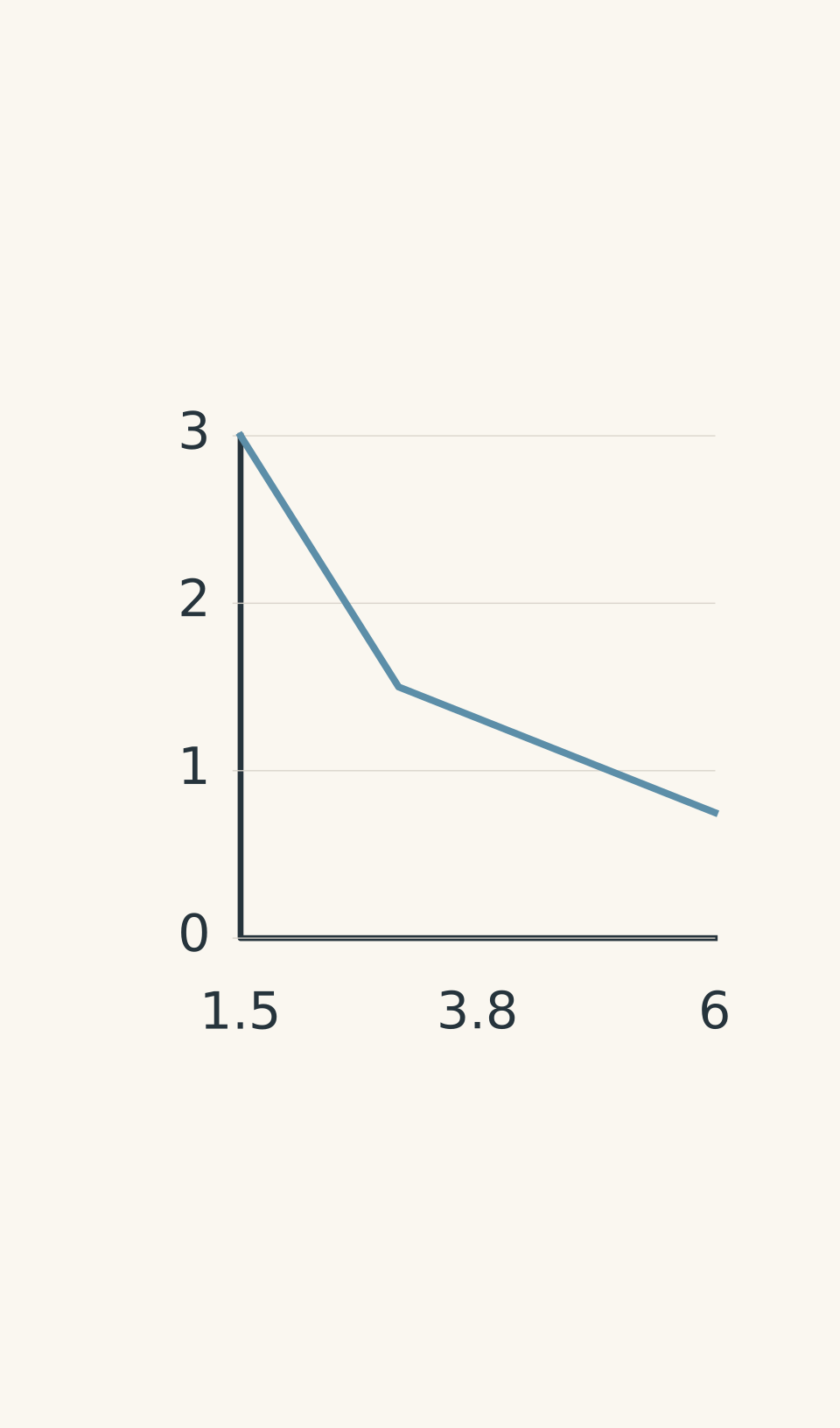
(b) The radius halves when the magnetic field strength doubles.
From Question 4,
\[ \frac{|q|}{m}=\frac{v}{Br} \]
Rearranging gives
\[ r=\frac{mv}{|q|B} \]
For the same particle at the same speed, \(m\), \(v\), and \(|q|\) are constant. Therefore,
\[ r\propto\frac{1}{B} \]
The radius is inversely proportional to the magnetic field strength. If the field strength doubles, the radius becomes half its original value.
Marking (3 marks):
- 1 mark for correctly using or rearranging the charge-to-mass relationship.
- 1 mark for identifying the inverse relationship between \(r\) and \(B\).
- 1 mark for predicting that the radius halves.
- Inverse relationship: r ∝ 1/B
(c) The measured ratio does not give the mass directly.
The charge-to-mass ratio gives the charge magnitude divided by the mass. If the ratio is known but both the charge magnitude and mass are unknown, the ratio alone cannot determine either quantity separately.
An independent measurement of the particle’s charge magnitude is needed to calculate its mass. If the charge magnitude is known, then
\[ m=\frac{|q|}{|q|/m} \]
This is why Thomson’s experiment established the charge-to-mass ratio, rather than determining the particle’s charge and mass independently.
Marking (3 marks):
- 1 mark for stating that the ratio alone does not determine the mass.
- 1 mark for explaining that the charge magnitude and mass cannot be separated using only their ratio.
- 1 mark for identifying the need for an independent charge-magnitude measurement.