
NSW HSC Physics: Charged Particles Practice Exam
Test your understanding of charged particles in magnetic fields with this original 40-mark tutorgum practice exam. Includes a suggested 60-minute working time, six exam-style questions, fully worked solutions, and a detailed marking guide.
This original tutorgum practice paper assesses the magnetic force on moving charges and the circular motion of charged particles in uniform magnetic fields. It covers the supplied topic scope compatible with the 2017 and 2025 NSW Physics syllabus editions. It is a focused topic assessment, not a full-course exam or an official, endorsed, past, or predicted NESA paper.
01Exam instructions
- Suggested reading time: 5 minutes.
- Suggested working time: 60 minutes.
- Total marks: 40.
- Permitted equipment: scientific calculator and writing materials.
These are the conditions for this practice paper only, not a statement of official NESA examination rules.
The assessed scope includes calculating magnetic force, determining force direction for positive and negative charges, deriving orbital radius and period, and comparing the motion of particles with different properties.
The paper excludes magnetic fields produced by currents, forces on current-carrying wires, electromagnetic induction, electric fields, and relativistic motion.
Assume that magnetic fields are uniform and static, and that all particles move at non-relativistic speeds. Ignore gravity, electric fields, and field-edge effects. Unless an angle is specified, the velocity is perpendicular to the magnetic field for orbital calculations.
Throughout the paper, \(F\) denotes magnetic-force magnitude in newtons (N), \(q\) is charge in coulombs (C), and \(|q|\) is the magnitude of charge. The speed \(v\) is measured in metres per second (\(\mathrm{m\,s^{-1}}\)), \(B\) is magnetic flux density in tesla (T), and \(\theta\) is the angle between the velocity and the magnetic field. The particle’s mass \(m\) is in kilograms (kg), its orbital radius \(r\) is in metres (m), and its orbital period \(T\) is in seconds (s).
Use the elementary charge magnitude
\[ e=1.60\times10^{-19}\ \mathrm C. \]
Show your working, use SI units, and give numerical answers to an appropriate number of significant figures. Include units in calculated answers and explain your reasoning in questions that ask for comparisons or explanations.
02Questions
Question 1 (6 marks)
A proton moves at \(3.0\times10^6\ \mathrm{m\,s^{-1}}\) through a uniform magnetic field of \(0.40\ \mathrm T\). The angle between its velocity and the magnetic field is \(30^\circ\).
Take the proton’s charge to be \(+e\).
(a) Calculate the magnitude of the magnetic force acting on the proton. (2 marks)
(b) Describe the orientation of the magnetic force relative to the proton’s velocity and the magnetic field. (1 mark)
(c) An electron moves with the same velocity vector through the same magnetic field. Compare the magnitude and direction of the magnetic force on the electron with those on the proton. Explain your answer. (3 marks)
Question 2 (6 marks)
Two charged particles enter a region containing a uniform magnetic field. The field points into the page. At the instant considered, both particles move horizontally to the right, perpendicular to the field.
Particle P has a positive charge, while particle N has a negative charge.
(a) State the initial direction of the magnetic force on each particle. (2 marks)
(b) State the direction in which each particle’s path initially curves. (2 marks)
(c) The speed of particle P is doubled while its mass, charge magnitude, and the magnetic field remain unchanged. State how its orbital radius changes and justify your answer. (2 marks)
Question 3 (8 marks)
A particle of mass \(m\), charge \(q\), and speed \(v\) enters a uniform magnetic field with its velocity perpendicular to the field. The particle follows a circular orbit at constant speed.
(a) Starting from the magnetic-force magnitude and the centripetal-force requirement, derive an expression for the orbital radius \(r\) in terms of \(m\), \(v\), \(|q|\), and \(B\). (4 marks)
(b) Derive an expression for the orbital period \(T\) in terms of \(m\), \(|q|\), and \(B\). (3 marks)
(c) Identify one quantity that the orbital period is independent of in this model. (1 mark)
Question 4 (8 marks)
A singly charged positive ion has a mass of \(3.32\times10^{-27}\ \mathrm{kg}\). It enters a uniform magnetic field of \(0.25\ \mathrm T\) with a speed of \(4.0\times10^5\ \mathrm{m\,s^{-1}}\). Its velocity is perpendicular to the field.
(a) Calculate the radius of its circular orbit. (3 marks)
(b) Calculate the time taken for one complete revolution. (3 marks)
(c) The ion enters an identical magnetic field with its speed increased to \(8.0\times10^5\ \mathrm{m\,s^{-1}}\). State its new orbital radius and period, using your results from parts (a) and (b). (2 marks)
Question 5 (6 marks)
Two particles enter the same uniform magnetic field with the same velocity direction and speed. Both velocities are perpendicular to the field.
Particle A has mass \(m\) and charge \(+q\). Particle B has mass \(2m\) and charge \(-q/2\), where \(q>0\).
(a) Determine the ratio of their orbital radii, \(r_B/r_A\). (2 marks)
(b) Determine the ratio of their orbital periods, \(T_B/T_A\). (2 marks)
(c) State whether the particles initially curve in the same direction or in opposite directions. Explain your answer. (2 marks)
Question 6 (6 marks)
A particle has a charge magnitude of \(3.0\times10^{-6}\ \mathrm C\) and moves at \(2.0\times10^4\ \mathrm{m\,s^{-1}}\) through a uniform magnetic field of \(0.50\ \mathrm T\).
The angle \(\theta\) between its velocity and the magnetic field can vary between \(0^\circ\) and \(180^\circ\).
(a) Calculate the maximum possible magnitude of the magnetic force on the particle. (2 marks)
(b) The magnetic-force magnitude is measured to be \(1.8\times10^{-2}\ \mathrm N\). Determine all possible values of \(\theta\) between \(0^\circ\) and \(180^\circ\). (3 marks)
(c) Calculate the magnetic-force magnitude when the velocity is parallel to the magnetic field. (1 mark)
03Worked solutions and marking guide
Equivalent correct methods should receive the same credit. Follow-through marks are appropriate when a later calculation uses an earlier numerical result consistently and the method remains valid.
Solution 1
(a) Calculate the magnetic-force magnitude. (2 marks)
The magnetic force on a moving charge depends on the charge magnitude, speed, magnetic flux density, and angle between the velocity and the field.
\[ F=|q|vB\sin\theta \]
Substitute the given values:
\[ \begin{aligned} F&=(1.60\times10^{-19})(3.0\times10^6)\\ &\quad\times0.40\times\sin30^\circ\\ &=9.6\times10^{-14}\ \mathrm N \end{aligned} \]
Therefore,
\[ \boxed{F=9.6\times10^{-14}\ \mathrm N} \]
Marking guide:
- 1 mark for the correct magnetic-force relationship.
- 1 mark for correct substitution and the final magnitude with units.
(b) Describe the force orientation. (1 mark)
The magnetic force is perpendicular to both the proton’s velocity and the magnetic field. Its specific direction is determined by the right-hand rule for a positive charge.
Marking guide:
- 1 mark for stating that the force is perpendicular to both the velocity and the magnetic field.
(c) Compare the electron and proton. (3 marks)
The electron experiences a magnetic force of the same magnitude as the proton:
\[ F_e=9.6\times10^{-14}\ \mathrm N \]
The electron and proton have equal charge magnitudes, and their speeds, magnetic-field strengths, and angles are identical. The magnetic-force magnitude therefore remains the same.
Their force directions are opposite. The proton is positively charged, whereas the electron is negatively charged, so reversing the charge sign reverses the magnetic-force direction for the same velocity and field.
Marking guide:
- 1 mark for stating that the force magnitudes are equal.
- 1 mark for stating that the force directions are opposite.
- 1 mark for explaining the role of equal charge magnitudes and opposite charge signs.
Solution 2
(a) State the initial force directions. (2 marks)
The particles move to the right, and the magnetic field points into the page.
For a positive charge, the right-hand rule gives an initial magnetic force upwards. For a negative charge, the force direction is reversed.
Therefore:
- Particle P: upwards.
- Particle N: downwards.
Marking guide:
- 1 mark for the upward force on P.
- 1 mark for the downward force on N.
(b) State the initial curvature directions. (2 marks)
The magnetic force changes the direction of each particle’s velocity. The initial curvature is towards the direction of the magnetic force.
Therefore:
- Particle P curves upwards.
- Particle N curves downwards.
Marking guide:
- 1 mark for each correct curvature direction.
(c) Determine the change in orbital radius. (2 marks)
For a particle moving perpendicular to a uniform magnetic field, the orbital radius is
\[ r=\frac{mv}{|q|B}. \]
With mass, charge magnitude, and magnetic-field strength unchanged, the radius is directly proportional to speed:
\[ r\propto v. \]
Doubling the speed therefore doubles the orbital radius.
Marking guide:
- 1 mark for identifying the direct proportionality between radius and speed.
- 1 mark for stating that the radius doubles.
Solution 3
(a) Derive the orbital radius. (4 marks)
The particle’s velocity is perpendicular to the magnetic field, so the magnetic-force magnitude is
\[ F_B=|q|vB. \]
Here, \(F_B\) is the magnetic-force magnitude. For circular motion, the required net inward force has magnitude
\[ F_c=\frac{mv^2}{r}, \]
where \(F_c\) is the centripetal-force requirement.
The magnetic force provides this inward force, so their magnitudes are equal:
\[ |q|vB=\frac{mv^2}{r}. \]
Rearrange to make \(r\) the subject:
\[ \begin{aligned} r|q|vB&=mv^2\\ r&=\frac{mv^2}{|q|vB}\\ r&=\frac{mv}{|q|B}. \end{aligned} \]
Therefore,
\[ \boxed{r=\frac{mv}{|q|B}} \]
Marking guide:
- 1 mark for \(F_B=|q|vB\).
- 1 mark for the centripetal-force requirement \(F_c=mv^2/r\).
- 1 mark for equating the two force magnitudes.
- 1 mark for correctly rearranging to obtain the radius expression.
(b) Derive the orbital period. (3 marks)
The orbital period \(T\) is the time required for one complete revolution. The particle travels one circumference, \(2\pi r\), at constant speed \(v\).
Therefore,
\[ T=\frac{2\pi r}{v}. \]
Substitute the expression for the radius:
\[ T=\frac{2\pi}{v}\left(\frac{mv}{|q|B}\right). \]
Cancel \(v\):
\[ \boxed{T=\frac{2\pi m}{|q|B}} \]
Marking guide:
- 1 mark for \(T=2\pi r/v\).
- 1 mark for substituting the derived radius.
- 1 mark for correctly simplifying to the final period expression.
Deriving orbital radius and period
- Equate the forces
|q|vB = mv²/r
For v ⟂ B, magnetic force supplies centripetal force.
- Rearrange for radius
r = mv/(|q|B)
The radius increases with speed and mass.
- Use one revolution
T = 2πr/v
Period = circumference ÷ speed.
- Substitute and simplify
T = 2πm/(|q|B)
Speed cancels; period is independent of speed.
(c) Identify a quantity the period is independent of. (1 mark)
The orbital period is independent of the particle’s speed \(v\). Speed does not appear in the final expression:
\[ T=\frac{2\pi m}{|q|B}. \]
Marking guide:
- 1 mark for identifying speed as a quantity that does not affect the period in this model.
Solution 4
(a) Calculate the orbital radius. (3 marks)
The ion has charge \(+e\), so its charge magnitude is \(e=1.60\times10^{-19}\ \mathrm C\).
Use the radius expression:
\[ r=\frac{mv}{|q|B}. \]
First, calculate the numerator and denominator:
\[ mv=(3.32\times10^{-27})(4.0\times10^5) =1.328\times10^{-21} \]
\[ eB=(1.60\times10^{-19})(0.25) =4.00\times10^{-20} \]
Therefore,
\[ \begin{aligned} r&=\frac{1.328\times10^{-21}}{4.00\times10^{-20}}\\ &=3.32\times10^{-2}\ \mathrm m. \end{aligned} \]
To two significant figures,
\[ \boxed{r=3.3\times10^{-2}\ \mathrm m} \]
Marking guide:
- 1 mark for the correct radius expression.
- 1 mark for correct substitution and calculation.
- 1 mark for the final radius with units and appropriate precision.
(b) Calculate the orbital period. (3 marks)
Use the period expression derived in Question 3:
\[ T=\frac{2\pi m}{|q|B}. \]
Substitute the values:
\[ \begin{aligned} T&=\frac{2\pi(3.32\times10^{-27})} {4.00\times10^{-20}}\\ &=5.22\times10^{-7}\ \mathrm s. \end{aligned} \]
To two significant figures,
\[ \boxed{T=5.2\times10^{-7}\ \mathrm s} \]
Marking guide:
- 1 mark for the correct period expression.
- 1 mark for correct substitution and calculation.
- 1 mark for the final period with units and appropriate precision.
(c) Determine the new radius and period. (2 marks)
The speed has doubled, while the mass, charge magnitude, and magnetic field are unchanged.
Since
\[ r=\frac{mv}{|q|B}, \]
the radius doubles:
\[ r_{\text{new}}=2(3.3\times10^{-2}) \]
\[ \boxed{r_{\text{new}}=6.6\times10^{-2}\ \mathrm m} \]
The period is independent of speed, so it remains
\[ \boxed{T_{\text{new}}=5.2\times10^{-7}\ \mathrm s} \]
Marking guide:
- 1 mark for the doubled radius.
- 1 mark for the unchanged period, with reasoning that it is independent of speed.
Solution 5
(a) Determine the radius ratio. (2 marks)
For particles moving at the same speed in the same magnetic field,
\[ r\propto\frac{m}{|q|}. \]
Particle A has mass \(m\) and charge magnitude \(q\). Particle B has mass \(2m\) and charge magnitude \(q/2\).
Therefore,
\[ \begin{aligned} \frac{r_B}{r_A} &=\frac{2m/(q/2)}{m/q}\\ &=4. \end{aligned} \]
Thus,
\[ \boxed{\frac{r_B}{r_A}=4} \]
Particle B has four times the orbital radius of particle A.
Marking guide:
- 1 mark for using the correct dependence on mass and charge magnitude.
- 1 mark for obtaining the ratio of 4.
(b) Determine the period ratio. (2 marks)
The period is
\[ T=\frac{2\pi m}{|q|B}. \]
Since both particles are in the same magnetic field,
\[ T\propto\frac{m}{|q|}. \]
Hence,
\[ \begin{aligned} \frac{T_B}{T_A} &=\frac{2m/(q/2)}{m/q}\\ &=4. \end{aligned} \]
Therefore,
\[ \boxed{\frac{T_B}{T_A}=4} \]
Particle B takes four times as long to complete one revolution.
Marking guide:
- 1 mark for using the correct dependence of period on mass and charge magnitude.
- 1 mark for obtaining the ratio of 4.
(c) Compare the curvature directions. (2 marks)
The particles initially curve in opposite directions.
They have the same velocity direction and move through the same magnetic field, but their charge signs are opposite. Reversing the charge sign reverses the magnetic-force direction, so their initial curvature directions are opposite.
Marking guide:
- 1 mark for stating that the curvature directions are opposite.
- 1 mark for explaining that opposite charge signs reverse the magnetic-force direction.
Solution 6
(a) Calculate the maximum magnetic force. (2 marks)
The magnetic-force magnitude is
\[ F=|q|vB\sin\theta. \]
Its maximum occurs when \(\sin\theta=1\), so
\[ F_{\max}=|q|vB. \]
Substitute the values:
\[ \begin{aligned} F_{\max} &=(3.0\times10^{-6})(2.0\times10^4)(0.50)\\ &=3.0\times10^{-2}\ \mathrm N. \end{aligned} \]
Therefore,
\[ \boxed{F_{\max}=3.0\times10^{-2}\ \mathrm N} \]
Marking guide:
- 1 mark for the correct maximum-force expression.
- 1 mark for the correct numerical answer with units.
(b) Determine all possible angles. (3 marks)
Start with
\[ F=|q|vB\sin\theta. \]
Rearrange to find the sine of the angle:
\[ \sin\theta=\frac{F}{|q|vB}. \]
Using the maximum force calculated in part (a),
\[ \begin{aligned} \sin\theta &=\frac{1.8\times10^{-2}}{3.0\times10^{-2}}\\ &=0.60. \end{aligned} \]
Taking the inverse sine gives the first possible angle:
\[ \theta_1=\sin^{-1}(0.60)\approx36.9^\circ. \]
However, the sine function has the same positive value at supplementary angles between \(0^\circ\) and \(180^\circ\). The second angle is
\[ \theta_2=180^\circ-36.9^\circ \]
\[ \theta_2\approx143.1^\circ. \]
Therefore, to the nearest degree,
\[ \boxed{\theta=37^\circ\ \text{or}\ 143^\circ} \]
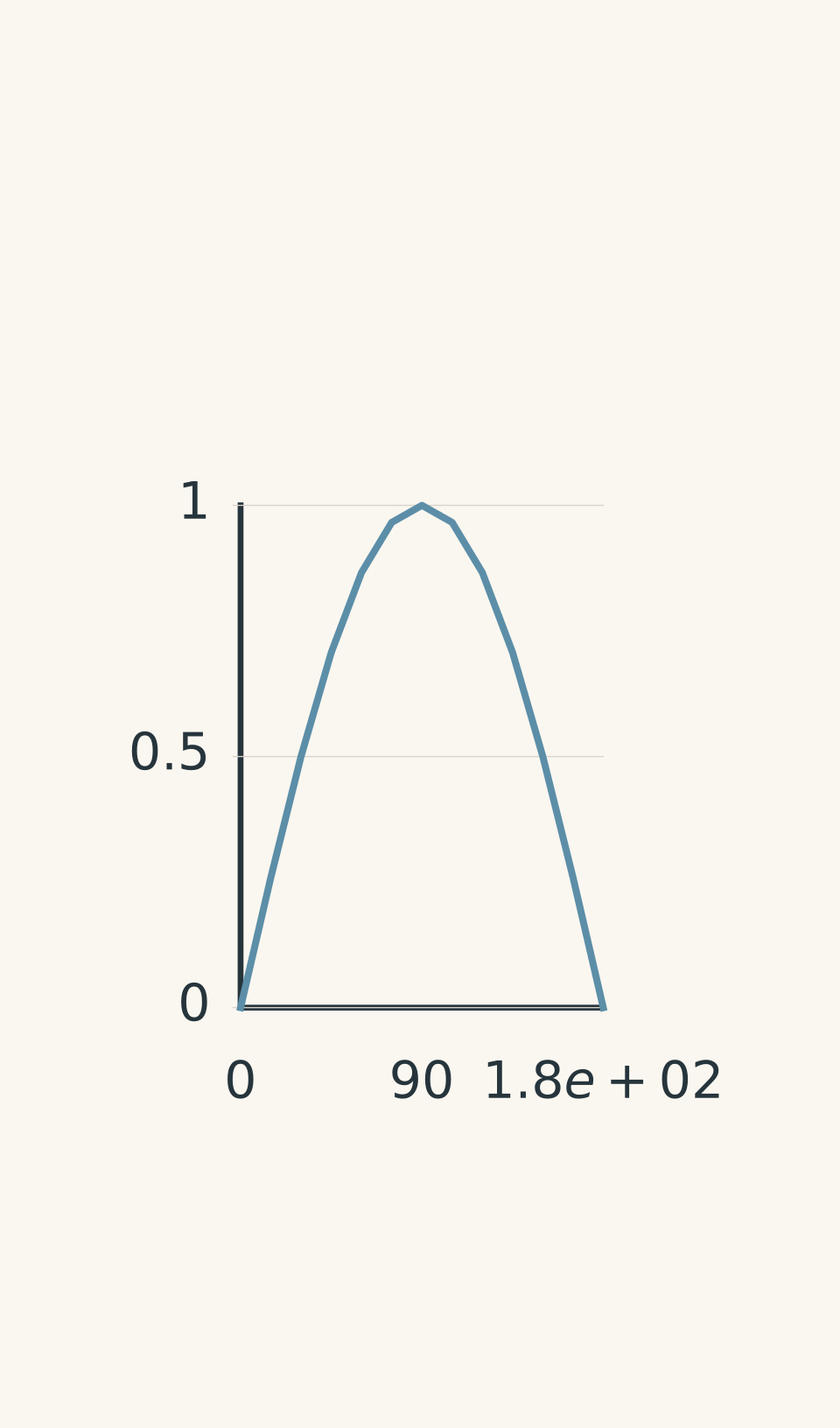
- F/(|q|vB) = sin θ
Marking guide:
- 1 mark for setting up the correct sine relationship and obtaining \(\sin\theta=0.60\).
- 1 mark for the first angle, approximately \(37^\circ\).
- 1 mark for the second angle, approximately \(143^\circ\).
(c) Calculate the force when the velocity is parallel to the field. (1 mark)
When the velocity is parallel to the magnetic field, \(\theta=0^\circ\). Therefore,
\[ F=|q|vB\sin0^\circ=0. \]
The magnetic-force magnitude is
\[ \boxed{F=0\ \mathrm N} \]
Marking guide:
- 1 mark for the zero-force result.