
Circular Motion Foundations: HSC Physics Practice Exam
Test your understanding of circular motion with an original 40-mark Physics practice paper. Includes a suggested 50-minute working time, six questions, fully worked solutions, and a detailed marking guide.
This original tutorgum practice paper tests the foundations of uniform circular motion within the supplied Physics 2017 syllabus scope. It assesses angular velocity, the relationship between angular and linear motion, centripetal acceleration, and centripetal force. It is a focused topic paper, not a full-course mock exam, and it is not an official or NESA-endorsed paper.
01Exam instructions
- Suggested reading time: 5 minutes.
- Working time: 50 minutes.
- Total marks: 40.
- Permitted equipment: scientific calculator, ruler, pencil, and graph paper.
- Show your working for calculations. Include appropriate units and give numerical answers to an appropriate number of significant figures.
- Assume uniform circular motion unless a question states otherwise.
- Use the direction of rotation specified in a question when interpreting angular displacement and angular velocity.
- No formula sheet is assumed.
Assessed scope
This paper assesses:
- Angular displacement and angular velocity, including \(\omega = \Delta\theta/\Delta t\).
- Connections between angular velocity, linear speed, radius, and period.
- Centripetal acceleration, using \(a_c = v^2/r\), and its inward direction.
- Centripetal force, using \(F_c = mv^2/r\), and identifying the real force that supplies it.
- Interpretation of relationships and changes in circular-motion quantities.
Multi-force systems, force resolution, non-uniform circular motion, vertical circles, banked turns, torque, rotational energy, and orbital dynamics are excluded.
The conditions and mark allocations above are specific to this tutorgum practice paper. They are not statements about current official HSC examination conditions.
02Questions
Question 1 (6 marks)
A point on a rigid platform rotating uniformly moves through 2.5 revolutions in 4.0 s. Its distance from the centre of the platform is 0.40 m. Take the direction of rotation as positive.
(a) Calculate the angular displacement of the point in radians. (2 marks)
(b) Calculate the angular velocity of the point. (2 marks)
(c) Calculate the linear speed of the point. (2 marks)
Question 2 (6 marks)
Two markers, A and B, move uniformly in circular paths. They rotate in the same direction.
| Marker | Radius \(r\) | Period \(T\) |
|---|---|---|
| A | 0.50 m | 2.0 s |
| B | 1.50 m | 6.0 s |
The period is the time taken to complete one revolution.
(a) Calculate the magnitude of the angular velocity of each marker. (2 marks)
(b) Calculate the linear speed of each marker. (2 marks)
(c) Explain why the markers have equal linear speeds even though their angular velocities are different. (2 marks)
Question 3 (7 marks)
A model car moves at a constant speed of 6.0 m s\(^{-1}\) around a circular track of radius 2.0 m.
(a) Calculate the magnitude of its centripetal acceleration. (2 marks)
(b) The car then follows a circular path of radius 4.0 m at the same speed. Calculate its new centripetal acceleration and state how it compares with the value in part (a). (2 marks)
(c) Explain why the car is accelerating even though its speed remains constant. State the direction of its centripetal acceleration at any instant. (3 marks)
Question 4 (7 marks)
A puck of mass 0.25 kg moves in a circle of radius 0.80 m on a smooth horizontal surface. A horizontal string pulls the puck towards the centre. Assume the string tension is the only horizontal force acting on the puck.
The puck moves at a speed of 4.0 m s\(^{-1}\).
(a) Calculate the magnitude of the centripetal force required to maintain this motion. (3 marks)
(b) Identify the real force supplying the centripetal force. (1 mark)
(c) The puck’s speed increases to 8.0 m s\(^{-1}\), while its mass and radius remain unchanged. Calculate the new centripetal force and state how it compares with the original force. (3 marks)
Question 5 (7 marks)
An object moves uniformly in a circle of fixed radius 2.0 m. Measurements of its speed and centripetal acceleration are shown below.
| Speed, \(v\) (m s\(^{-1}\)) | Centripetal acceleration, \(a_c\) (m s\(^{-2}\)) |
|---|---|
| 2.0 | 2.0 |
| 4.0 | 8.0 |
| 6.0 | 18 |
| 8.0 | 32 |
(a) Plot a graph of centripetal acceleration against linear speed. Label both axes, use suitable scales, and draw an appropriate curve through the data. (3 marks)
(b) Does the data support a direct proportionality between centripetal acceleration and linear speed? Justify your answer using the data. (2 marks)
(c) Estimate the centripetal acceleration when the speed is 5.0 m s\(^{-1}\). (1 mark)
(d) At a fixed radius, by what factor does the centripetal acceleration change if the speed triples? (1 mark)
Question 6 (7 marks)
A sensor of mass 0.40 kg moves in uniform circular motion at a radius of 0.60 m. It completes one revolution every 1.2 s.
(a) Calculate its linear speed. (2 marks)
(b) Calculate its centripetal acceleration. (2 marks)
(c) Calculate the magnitude of the centripetal force required to maintain its motion. (2 marks)
(d) If the period is halved while the radius and mass remain unchanged, by what factor does the required centripetal force change? (1 mark)
03Worked solutions and marking guide
For multi-step calculations, award follow-through marks where a student applies a correct method consistently to an earlier numerical result, even if that result contains an error. Do not award the same mark twice for the same demonstrated step.
Solution 1
(a) Angular displacement (2 marks)
One complete revolution corresponds to an angular displacement of \(2\pi\) radians.
For 2.5 revolutions,
\[ \begin{aligned} \Delta\theta &= 2.5 \times 2\pi\\ &= 5\pi\\ &= 15.7\ \mathrm{rad} \end{aligned} \]
The angular displacement is \(15.7\) rad.
Marking guide:
- 1 mark for converting revolutions to radians using \(2\pi\) rad per revolution.
- 1 mark for the correct angular displacement, including the unit.
(b) Angular velocity (2 marks)
Angular velocity is angular displacement divided by the time taken.
\[ \begin{aligned} \omega &= \frac{\Delta\theta}{\Delta t}\\ &= \frac{5\pi}{4.0}\\ &= 3.93\ \mathrm{rad\,s^{-1}} \end{aligned} \]
The angular velocity is \(3.93\ \mathrm{rad\,s^{-1}}\).
Marking guide:
- 1 mark for the correct relationship and substitution.
- 1 mark for the correct numerical answer and unit.
(c) Linear speed (2 marks)
The linear speed of a point on a rotating platform is related to its angular velocity by \(v=r\omega\).
\[ \begin{aligned} v &= r\omega\\ &= 0.40 \times 3.93\\ &= 1.57\ \mathrm{m\,s^{-1}} \end{aligned} \]
The linear speed is \(1.57\ \mathrm{m\,s^{-1}}\).
Marking guide:
- 1 mark for using \(v=r\omega\).
- 1 mark for the correct calculation and unit.
A solution using the period and \(v=2\pi r/T\) is also acceptable if the period is calculated correctly.
Solution 2
(a) Angular velocity (2 marks)
A complete revolution is \(2\pi\) radians. Since each marker completes one revolution in a period \(T\),
\[ \omega=\frac{2\pi}{T} \]
For marker A,
\[ \omega_A=\frac{2\pi}{2.0} =3.14\ \mathrm{rad\,s^{-1}} \]
For marker B,
\[ \omega_B=\frac{2\pi}{6.0} =1.05\ \mathrm{rad\,s^{-1}} \]
Marker A has an angular velocity of \(3.14\ \mathrm{rad\,s^{-1}}\), while marker B has an angular velocity of \(1.05\ \mathrm{rad\,s^{-1}}\).
Marking guide:
- 1 mark for the correct calculation for marker A.
- 1 mark for the correct calculation for marker B.
(b) Linear speed (2 marks)
For uniform circular motion,
\[ v=\frac{2\pi r}{T} \]
For marker A,
\[ \begin{aligned} v_A &= \frac{2\pi(0.50)}{2.0}\\ &= 1.57\ \mathrm{m\,s^{-1}} \end{aligned} \]
For marker B,
\[ \begin{aligned} v_B &= \frac{2\pi(1.50)}{6.0}\\ &= 1.57\ \mathrm{m\,s^{-1}} \end{aligned} \]
Both markers have a linear speed of \(1.57\ \mathrm{m\,s^{-1}}\).
Marking guide:
- 1 mark for the correct calculation for marker A.
- 1 mark for the correct calculation for marker B.
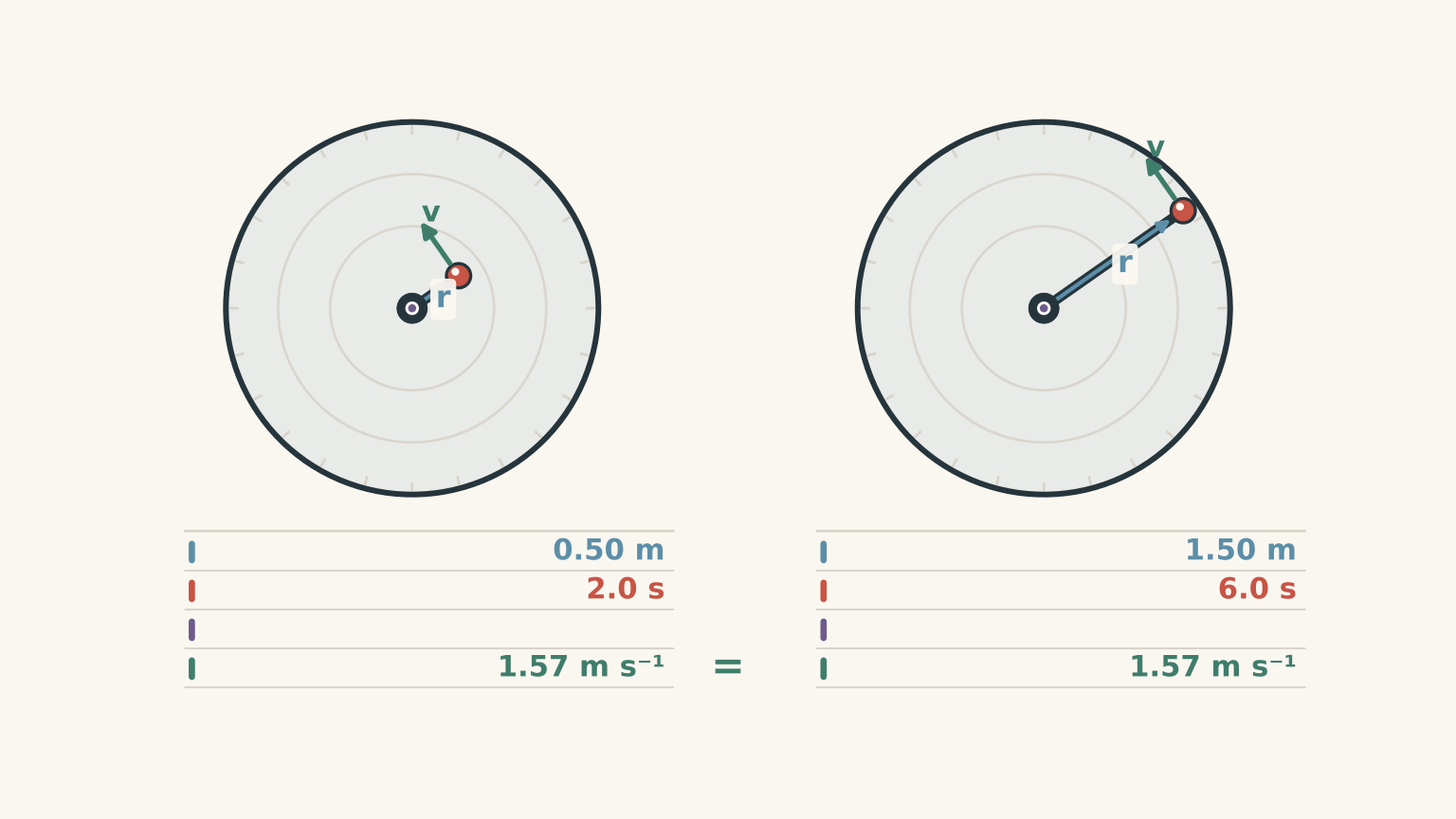
(c) Comparing angular velocity and linear speed (2 marks)
Linear speed depends on both radius and period:
\[ v=\frac{2\pi r}{T} \]
For marker A,
\[ \frac{r}{T}=\frac{0.50}{2.0}=0.25 \]
For marker B,
\[ \frac{r}{T}=\frac{1.50}{6.0}=0.25 \]
The ratio \(r/T\) is the same for both markers, so their linear speeds are equal.
Their angular velocities are different because angular velocity depends on period alone. Marker B takes three times as long to complete a revolution, so its angular velocity is one-third that of marker A. Its radius is three times larger, which compensates for its lower angular velocity when calculating linear speed.
Marking guide:
- 1 mark for explaining that both markers have the same ratio \(r/T\), giving equal linear speeds.
- 1 mark for explaining that the different periods produce different angular velocities.
Solution 3
(a) Centripetal acceleration at a radius of 2.0 m (2 marks)
Centripetal acceleration is calculated using
\[ a_c=\frac{v^2}{r} \]
Substituting the given values,
\[ \begin{aligned} a_c &= \frac{6.0^2}{2.0}\\ &= \frac{36}{2.0}\\ &= 18\ \mathrm{m\,s^{-2}} \end{aligned} \]
The centripetal acceleration is \(18\ \mathrm{m\,s^{-2}}\).
Marking guide:
- 1 mark for the correct relationship and substitution.
- 1 mark for the correct answer and unit.
(b) Centripetal acceleration at a radius of 4.0 m (2 marks)
The speed stays at \(6.0\ \mathrm{m\,s^{-1}}\), but the radius increases to \(4.0\) m.
\[ \begin{aligned} a_c &= \frac{6.0^2}{4.0}\\ &= 9.0\ \mathrm{m\,s^{-2}} \end{aligned} \]
The new centripetal acceleration is \(9.0\ \mathrm{m\,s^{-2}}\), which is half the original value.
This happens because \(a_c\) is inversely proportional to radius when speed is constant.
Marking guide:
- 1 mark for the correct substitution and calculation.
- 1 mark for stating that the acceleration is half the original value.
(c) Why acceleration exists at constant speed (3 marks)
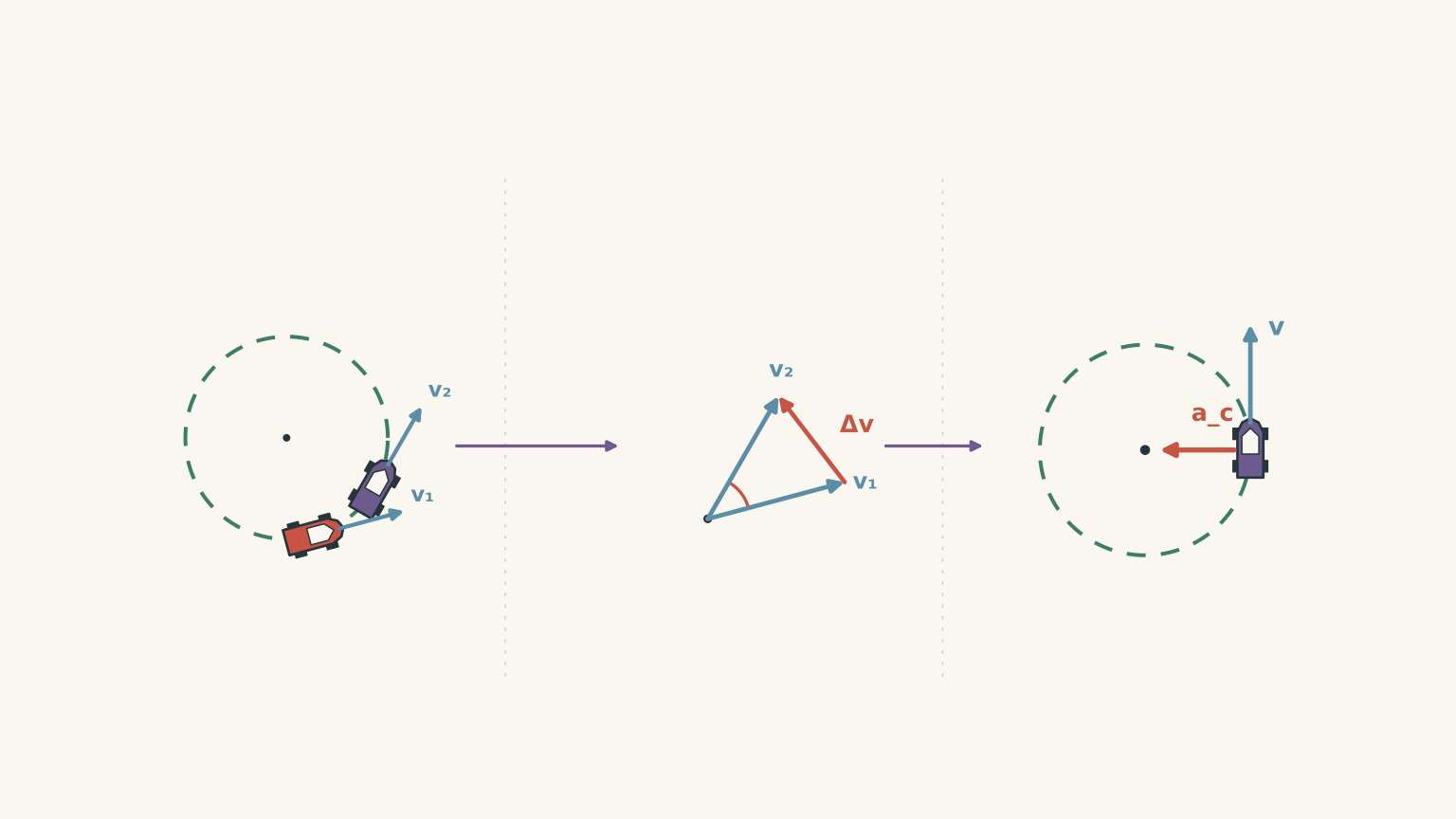
Speed describes how fast an object moves. Velocity describes both its speed and its direction.
As the car travels around a circle, its direction of motion continually changes. Its velocity therefore changes, even though its speed remains constant. Since acceleration is the rate of change of velocity, the car is accelerating.
For uniform circular motion, centripetal acceleration always points towards the centre of the circle.
Marking guide:
- 1 mark for explaining that the direction of velocity changes.
- 1 mark for linking the change in velocity to the presence of acceleration.
- 1 mark for identifying the direction as towards the centre.
Solution 4
(a) Centripetal force (3 marks)
The magnitude of the required centripetal force is
\[ F_c=\frac{mv^2}{r} \]
Substitute the mass, speed, and radius:
\[ \begin{aligned} F_c &= \frac{0.25(4.0)^2}{0.80}\\ &= \frac{0.25 \times 16}{0.80}\\ &= 5.0\ \mathrm{N} \end{aligned} \]
The required centripetal force is \(5.0\ \mathrm{N}\).
Marking guide:
- 1 mark for the correct relationship.
- 1 mark for correct substitution and calculation.
- 1 mark for the correct force and unit.
(b) Real force supplying centripetal force (1 mark)
The tension in the string supplies the inward force required for the puck’s circular motion.
Marking guide:
- 1 mark for identifying string tension.
(c) Doubling the speed (3 marks)
The mass and radius remain constant. From
\[ F_c=\frac{mv^2}{r} \]
the centripetal force is proportional to the square of the speed:
\[ F_c\propto v^2 \]
Doubling the speed therefore increases the force by a factor of \(2^2=4\).
The new force is
\[ \begin{aligned} F_{\text{new}} &= 4F_{\text{original}}\\ &=4 \times 5.0\\ &=20\ \mathrm{N} \end{aligned} \]
The new centripetal force is \(20\ \mathrm{N}\), four times the original force.
Marking guide:
- 1 mark for recognising the square dependence on speed and the factor of four.
- 1 mark for a correct calculation or application of the factor to the original force.
- 1 mark for the correct new force, including the unit.
A correct calculation using the new speed directly is equally acceptable.
Solution 5
(a) Graph of centripetal acceleration against speed (3 marks)
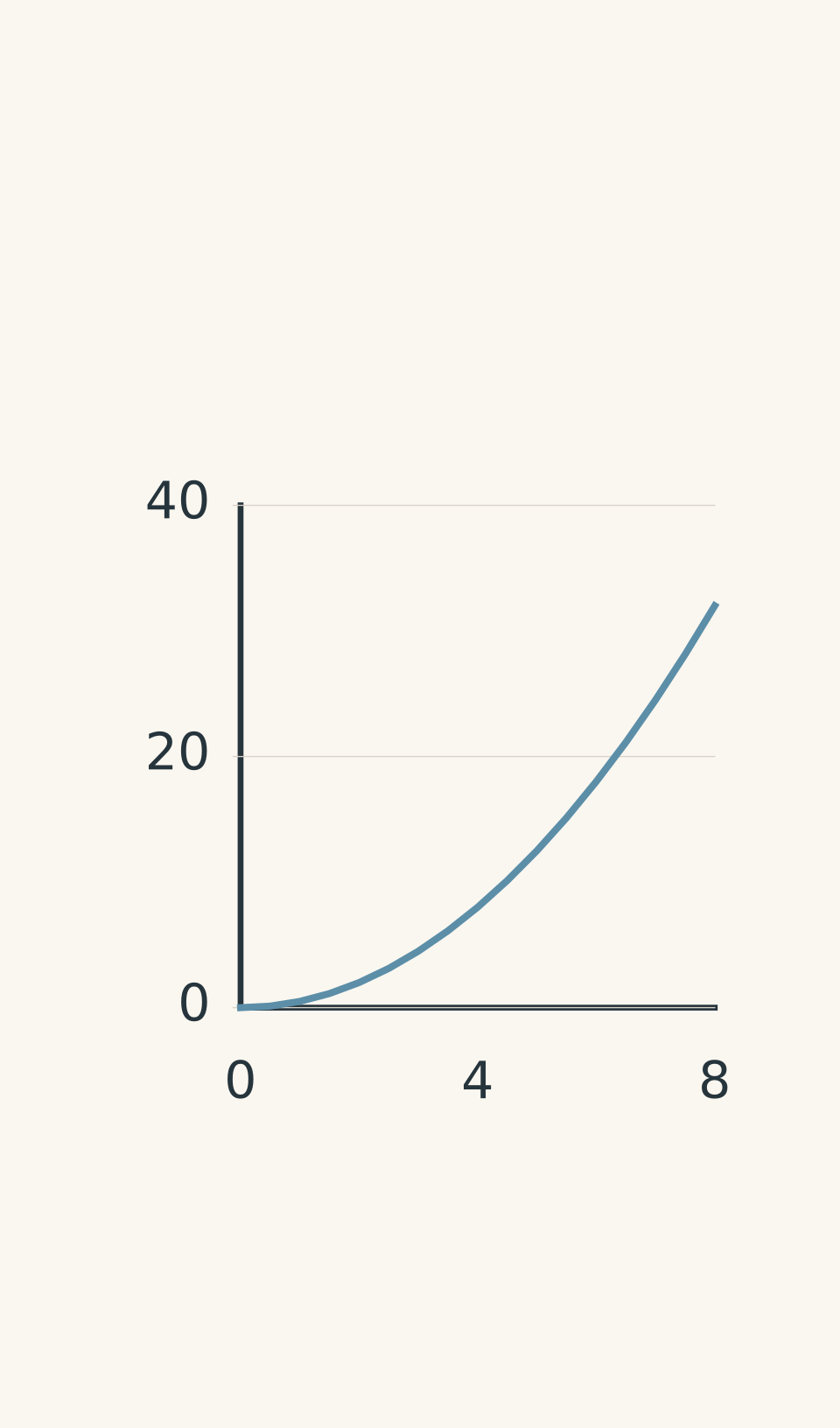
The horizontal axis should represent linear speed, \(v\), in \(\mathrm{m\,s^{-1}}\). The vertical axis should represent centripetal acceleration, \(a_c\), in \(\mathrm{m\,s^{-2}}\).
Plot the points:
- \((2.0, 2.0)\)
- \((4.0, 8.0)\)
- \((6.0, 18)\)
- \((8.0, 32)\)
Use suitable, evenly spaced scales and draw a smooth upward-curving line through the points. The graph should not be a straight line.
- a_c = v²/2
Marking guide:
- 1 mark for correctly labelled axes and sensible scales.
- 1 mark for accurately plotting the data points.
- 1 mark for an appropriate smooth, upward-curving graph.
(b) Direct proportionality (2 marks)
No. Centripetal acceleration is not directly proportional to linear speed.
For a direct proportion, doubling the speed would double the acceleration. However, the data shows that increasing the speed from \(2.0\) to \(4.0\ \mathrm{m\,s^{-1}}\) increases the acceleration from \(2.0\) to \(8.0\ \mathrm{m\,s^{-2}}\). The speed doubles, but the acceleration increases by a factor of four.
Marking guide:
- 1 mark for stating that the relationship is not directly proportional.
- 1 mark for using the data correctly to justify the conclusion.
(c) Acceleration at 5.0 m s\(^{-1}\) (1 mark)
The radius remains \(2.0\) m, so
\[ \begin{aligned} a_c &= \frac{v^2}{r}\\ &= \frac{5.0^2}{2.0}\\ &= 12.5\ \mathrm{m\,s^{-2}} \end{aligned} \]
The estimated centripetal acceleration is \(12.5\ \mathrm{m\,s^{-2}}\).
Marking guide:
- 1 mark for the correct estimate. A reasonable graph-based estimate is also acceptable.
(d) Tripling the speed (1 mark)
Since
\[ a_c=\frac{v^2}{r} \]
and the radius remains constant, tripling the speed multiplies the centripetal acceleration by
\[ 3^2=9 \]
The centripetal acceleration increases by a factor of nine.
Marking guide:
- 1 mark for the correct factor of nine.
Solution 6
(a) Linear speed (2 marks)
The sensor completes one revolution in \(1.2\) s. The distance travelled in one revolution is the circumference, \(2\pi r\).
Therefore,
\[ v=\frac{2\pi r}{T} \]
Substituting the given values,
\[ \begin{aligned} v &= \frac{2\pi(0.60)}{1.2}\\ &= 3.14\ \mathrm{m\,s^{-1}} \end{aligned} \]
The linear speed is \(3.14\ \mathrm{m\,s^{-1}}\), or approximately \(3.1\ \mathrm{m\,s^{-1}}\) to two significant figures.
Marking guide:
- 1 mark for the correct relationship and substitution.
- 1 mark for the correct speed and unit.
(b) Centripetal acceleration (2 marks)
Use the relationship
\[ a_c=\frac{v^2}{r} \]
Using the unrounded linear speed,
\[ \begin{aligned} a_c &= \frac{(3.14159\ldots)^2}{0.60}\\ &= 16.4\ \mathrm{m\,s^{-2}} \end{aligned} \]
The centripetal acceleration is approximately \(16.4\ \mathrm{m\,s^{-2}}\), or \(16\ \mathrm{m\,s^{-2}}\) to two significant figures.
Marking guide:
- 1 mark for the correct relationship and substitution.
- 1 mark for the correct acceleration and unit.
Follow-through marks apply if the speed in part (a) is incorrect but used consistently in a correct calculation.
(c) Centripetal force (2 marks)
The required centripetal force is the mass multiplied by the centripetal acceleration:
\[ F_c=ma_c \]
Using the unrounded acceleration,
\[ \begin{aligned} F_c &= 0.40 \times 16.449\ldots\\ &= 6.58\ \mathrm{N} \end{aligned} \]
The required centripetal force is approximately \(6.58\ \mathrm{N}\), or \(6.6\ \mathrm{N}\) to two significant figures.
Marking guide:
- 1 mark for using \(F_c=ma_c\) with the given mass and the calculated acceleration.
- 1 mark for the correct force and unit.
Follow-through marks apply for a correct calculation using the student’s answer to part (b).
(d) Halving the period (1 mark)
The linear speed is
\[ v=\frac{2\pi r}{T} \]
With radius unchanged, halving the period doubles the linear speed.
Since centripetal force is proportional to the square of speed,
\[ F_c=\frac{mv^2}{r} \]
doubling the speed multiplies the required force by \(2^2=4\).
The centripetal force increases by a factor of four.
Marking guide:
- 1 mark for stating that the required centripetal force becomes four times its original value.