
Circular Motion Investigations: Physics Practice Exam
Test your understanding of circular motion with this original 40-mark timed physics practice paper. Analyse experimental data, interpret graphs, calculate uncertainty, and check your work with complete worked solutions and a marking guide.
This original tutorgum practice paper tests circular-motion investigations within the supplied physics-2025 revision scope. You will calculate centripetal acceleration and force, connect speed with radius and period, analyse experimental data, choose graphs that linearise relationships, evaluate uncertainty, and predict motion when the inward force is removed.
This is a focused topic paper, not a full-course exam. It excludes banked roads, vertical circular motion, gravitational orbits, and unrelated mechanics topics. It is an original tutorgum practice paper, not an official, endorsed, past, or predicted NESA paper.
01Exam instructions
- Suggested reading time: 5 minutes.
- Suggested working time: 55 minutes.
- Total marks: 40.
- Permitted equipment: Scientific calculator, ruler, and pen or pencil. No internet access or external notes are assumed.
- Working: Show your calculations, include units, and give numerical answers to an appropriate number of significant figures.
- Constants: Use \(\pi=3.142\) where needed.
- Assumptions: Assume uniform circular motion unless stated otherwise. Measure the radius from the centre of rotation to the centre of the moving object. Ignore friction and air resistance only where explicitly stated.
- Terminology: Centripetal force, \(F_c\), means the resultant force directed towards the centre of a circular path. It is supplied by real forces, such as tension or friction; it is not an additional type of force.
- Uncertainty: For maximum uncertainty estimates involving products and quotients, add the relevant fractional uncertainties.
The suggested times and equipment are conditions for this practice paper, not claims about official examination requirements.
02Questions
Question 1 (6 marks)
A puck of mass \(0.50\,\text{kg}\) moves at a constant speed of \(3.0\,\text{m s}^{-1}\) in a horizontal circle of radius \(0.75\,\text{m}\) on a smooth table. A light string connects the puck to a fixed point at the centre of the circle. Friction is negligible.
(a) Calculate the centripetal acceleration of the puck, including its direction. (2 marks)
(b) Calculate the resultant inward force required to maintain the circular motion. (2 marks)
(c) Identify the real force that supplies this inward force. (1 mark)
(d) Explain why the puck accelerates even though its speed remains constant. (1 mark)
Question 2 (7 marks)
A student investigates uniform circular motion by tracking a marker moving in a horizontal circle.
The measured radius is \(r=(0.600\pm0.005)\,\text{m}\). The elapsed time for 10 complete revolutions is \(t=(12.6\pm0.2)\,\text{s}\).
(a) Calculate the period of the motion and its absolute uncertainty. (2 marks)
(b) Calculate the speed of the marker using the measured radius and period. (2 marks)
(c) Estimate the maximum percentage uncertainty in the calculated speed. Then report the speed with its absolute uncertainty. (3 marks)
Question 3 (7 marks)
A student investigates how the centripetal force required for circular motion depends on speed. The mass of the moving object is kept constant at \(0.20\,\text{kg}\), and the radius is kept constant at \(0.50\,\text{m}\).
The student records the following measurements.
| Trial | Speed, \(v\) (\(\text{m s}^{-1}\)) | \(v^2\) (\(\text{m}^2\text{s}^{-2}\)) | Measured \(F_c\) (N) |
|---|---|---|---|
| 1 | 1.0 | 0.40 | |
| 2 | 1.5 | 0.90 | |
| 3 | 2.0 | 1.60 | |
| 4 | 2.5 | 2.50 |
(a) Select the horizontal-axis quantity that would produce a straight-line graph if the circular-motion model is consistent with the measurements. Choose from \(v\), \(v^2\), \(1/v^2\), or \(r\). (1 mark)
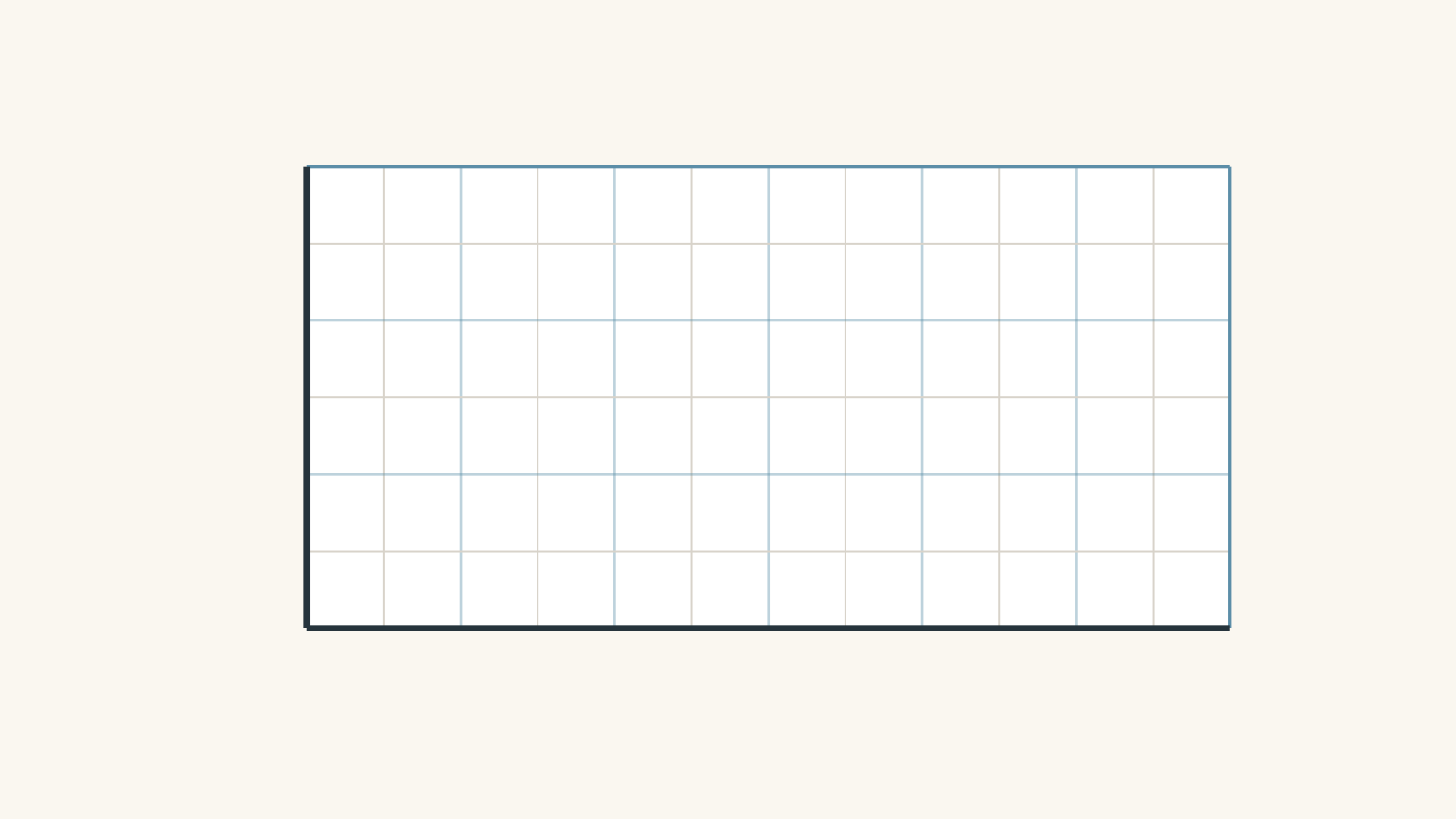
(b) Complete the \(v^2\) column and plot the measured centripetal force against your selected quantity. Label both axes with appropriate units and use a suitable scale. (3 marks)
(c) Calculate the gradient of your graph using two well-separated data points. Include the appropriate units. (2 marks)
(d) Compare your gradient with the ratio of the object’s mass to its radius. State what this comparison suggests about the experimental data. (1 mark)
Question 4 (8 marks)
A student investigates how the required centripetal force depends on radius. The mass is maintained at \(0.12\,\text{kg}\), and the speed is maintained at \(2.00\,\text{m s}^{-1}\).
The student obtains the following measurements.
| Radius, \(r\) (m) | Measured \(F_c\) (N) |
|---|---|
| 0.20 | 2.40 |
| 0.30 | 1.62 |
| 0.40 | 1.20 |
| 0.50 | 0.96 |
(a) Calculate \(1/r\) for each measurement. State which quantity should be plotted on the horizontal axis to test a straight-line relationship when \(F_c\) is on the vertical axis. (3 marks)
(b) Calculate the product \(F_c r\) for each measurement. Use the results to evaluate whether the data support an inverse relationship between centripetal force and radius. (2 marks)
(c) If you repeated this investigation, identify the two quantities that must be controlled and explain how the radius should be measured consistently. (3 marks)
Question 5 (7 marks)
A second student investigates the relationship between mass and centripetal force. The student aims to maintain a constant speed of \(2.40\,\text{m s}^{-1}\) and a constant radius of \(0.800\,\text{m}\) while changing the mass.
Each measured force has an absolute uncertainty of \(\pm0.05\,\text{N}\). Treat the stated speed and radius as fixed values for the calculations in this question.
| Mass, \(m\) (kg) | Measured \(F_c\) (N) |
|---|---|
| 0.10 | 0.72 |
| 0.15 | 1.11 |
| 0.20 | 1.46 |
| 0.25 | 1.78 |
(a) Use the circular-motion model to calculate the predicted centripetal force when the mass is \(0.20\,\text{kg}\). (2 marks)
(b) Calculate \(F_c/m\) for the measurements at \(0.10\,\text{kg}\) and \(0.25\,\text{kg}\). Use these results to assess whether the data support direct proportionality between centripetal force and mass. (2 marks)
(c) Compare the measured force at \(0.20\,\text{kg}\) with the predicted force, taking the stated force uncertainty into account. (1 mark)
(d) State an overall conclusion about the experiment and recommend one specific improvement to its reliability or control of variables. (2 marks)
Question 6 (5 marks)
A puck moves in a horizontal circle at a constant speed of \(2.0\,\text{m s}^{-1}\) and a radius of \(0.40\,\text{m}\). A string supplies the inward force that maintains the circular motion.
At point P, the string suddenly snaps. The table is smooth, and horizontal friction after the string snaps is negligible.
(a) Describe the direction of the puck’s velocity immediately after the string snaps, relative to the radius from the centre of the circle to point P. (2 marks)
(b) Calculate the puck’s centripetal acceleration immediately before the string snaps. (1 mark)
(c) Describe the puck’s subsequent motion under the stated assumptions and explain why it follows this motion. (2 marks)
03Worked solutions and marking guide
Solution 1
(a) Centripetal acceleration (2 marks)
The magnitude of centripetal acceleration is
\[ a_c=\frac{v^2}{r} \]
Substitute the speed and radius:
\[ \begin{aligned} a_c&=\frac{(3.0)^2}{0.75}\\ &=\frac{9.0}{0.75}\\ &=12\,\text{m s}^{-2} \end{aligned} \]
The acceleration is \(12\,\text{m s}^{-2}\), directed towards the centre of the circle.
Marking:
- 1 mark for the correct relationship and substitution.
- 1 mark for the correct magnitude, unit, and inward direction.
(b) Resultant inward force (2 marks)
The resultant centripetal force is
\[ F_c=ma_c \]
Therefore,
\[ \begin{aligned} F_c&=0.50\times12\\ &=6.0\,\text{N} \end{aligned} \]
The required inward force is \(6.0\,\text{N}\).
Marking:
- 1 mark for using \(F_c=ma_c\).
- 1 mark for the correct answer with unit.
(c) Real force supplying the inward force (1 mark)
The string’s tension supplies the inward force.
Marking:
- 1 mark for identifying tension in the string.
(d) Constant speed and acceleration (1 mark)
Acceleration occurs because the puck’s velocity changes direction continuously. Velocity includes direction as well as speed, so a constant speed does not mean constant velocity.
Marking:
- 1 mark for explaining that the changing direction of velocity means the puck is accelerating.
Solution 2
(a) Period and uncertainty (2 marks)
The period \(T\) is the time taken for one complete revolution.
\[ T=\frac{t}{N} \]
where \(t\) is the total elapsed time and \(N\) is the number of revolutions.
\[ T=\frac{12.6}{10}=1.26\,\text{s} \]
The absolute uncertainty in the period is the total timing uncertainty divided by the number of revolutions:
\[ \Delta T=\frac{0.2}{10}=0.02\,\text{s} \]
Therefore,
\[ \boxed{T=(1.26\pm0.02)\,\text{s}} \]
Marking:
- 1 mark for the correct period.
- 1 mark for the correct absolute uncertainty.
(b) Speed (2 marks)
For uniform circular motion, the object travels one circumference in one period. The circumference is \(2\pi r\), so
\[ v=\frac{2\pi r}{T} \]
Substituting the measurements:
\[ \begin{aligned} v&=\frac{2(3.142)(0.600)}{1.26}\\ &=2.99\,\text{m s}^{-1} \end{aligned} \]
The calculated speed is \(2.99\,\text{m s}^{-1}\).
Marking:
- 1 mark for the correct equation and substitution.
- 1 mark for the correct speed with unit.
(c) Percentage and absolute uncertainty in speed (3 marks)
Because \(v=2\pi r/T\), the maximum fractional uncertainty in speed is the sum of the fractional uncertainties in radius and period.
The percentage uncertainty in radius is
\[ \frac{0.005}{0.600}\times100 =0.83\% \]
The percentage uncertainty in period is
\[ \frac{0.02}{1.26}\times100 =1.59\% \]
Adding these gives
\[ \begin{aligned} \%\Delta v&=0.83\%+1.59\%\\ &=2.42\% \end{aligned} \]
The absolute uncertainty in speed is approximately
\[ \begin{aligned} \Delta v&=2.99\times\frac{2.42}{100}\\ &=0.072\,\text{m s}^{-1}\\ &\approx0.07\,\text{m s}^{-1} \end{aligned} \]
Therefore, the result is
\[ \boxed{v=(2.99\pm0.07)\,\text{m s}^{-1}} \]
Marking:
- 1 mark for calculating the fractional or percentage uncertainties correctly.
- 1 mark for adding the percentage uncertainties to obtain approximately \(2.42\%\).
- 1 mark for calculating the absolute uncertainty and reporting the speed appropriately.
Solution 3
(a) Selecting the horizontal-axis quantity (1 mark)
The correct choice is \(v^2\).
For fixed mass and radius, the circular-motion model predicts that centripetal force is proportional to the square of speed:
\[ F_c=\frac{mv^2}{r} \]
Rearranging gives
\[ F_c=\left(\frac{m}{r}\right)v^2 \]
This has the form \(y=kx\), where the gradient \(k\) is constant. Plotting \(F_c\) against \(v^2\) should therefore produce a straight line if the model is consistent with the data.
Marking:
- 1 mark for selecting \(v^2\).
(b) Completing the table and plotting the data (3 marks)
Square each measured speed.
| Trial | \(v\) (\(\text{m s}^{-1}\)) | \(v^2\) (\(\text{m}^2\text{s}^{-2}\)) | \(F_c\) (N) |
|---|---|---|---|
| 1 | 1.0 | 1.00 | 0.40 |
| 2 | 1.5 | 2.25 | 0.90 |
| 3 | 2.0 | 4.00 | 1.60 |
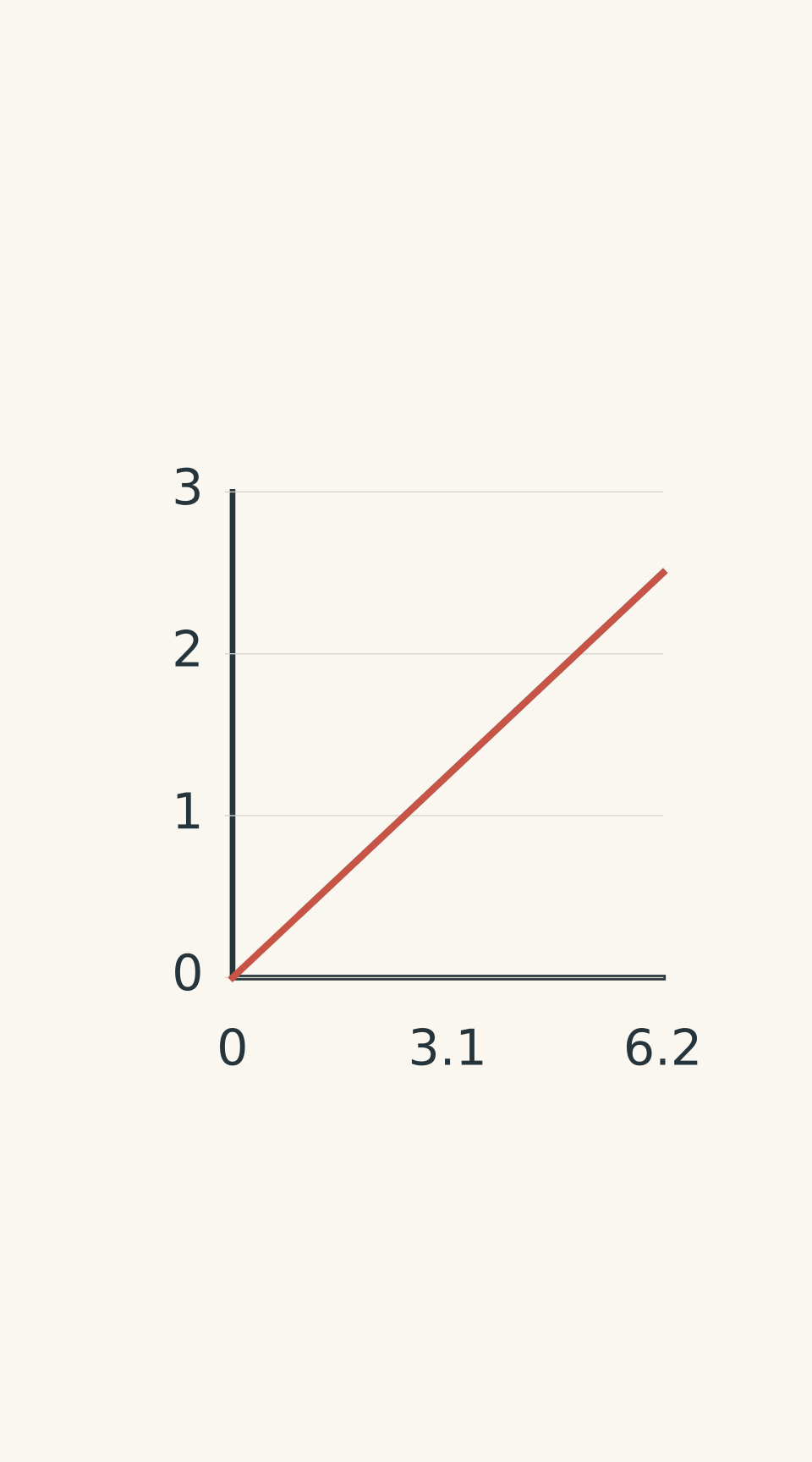
| 4 | 2.5 | 6.25 | 2.50 |
The horizontal axis should be \(v^2\), measured in \(\text{m}^2\text{s}^{-2}\). The vertical axis should be \(F_c\), measured in newtons.
- Measured data
- Best-fit line
The points lie on a straight line through the origin.
Marking:
- 1 mark for correctly calculating the squared speeds.
- 1 mark for appropriate scales, labelled axes, and units.
- 1 mark for accurately plotting the four points.
Follow-through: award plotting marks for a consistent graph if a minor arithmetic error occurs in the squared-speed column.
(c) Gradient of the graph (2 marks)
Using the first and last data points,
\[ \begin{aligned} \text{gradient} &=\frac{\Delta F_c}{\Delta(v^2)}\\ &=\frac{2.50-0.40}{6.25-1.00}\\ &=\frac{2.10}{5.25}\\ &=0.400\,\text{kg m}^{-1} \end{aligned} \]
The gradient is \(0.400\,\text{kg m}^{-1}\).
The units follow from dividing force in newtons by speed squared in \(\text{m}^2\text{s}^{-2}\).
Marking:
- 1 mark for a correct gradient calculation using two data points.
- 1 mark for the correct unit.
Accept a mathematically equivalent gradient calculation using other well-separated points on the student’s graph.
(d) Comparing the gradient with \(m/r\) (1 mark)
The expected gradient is
\[ \frac{m}{r}=\frac{0.20}{0.50} =0.400\,\text{kg m}^{-1} \]
This agrees with the experimental gradient. The data are therefore consistent with the model \(F_c\propto v^2\) for fixed mass and radius.
Marking:
- 1 mark for comparing the gradient with \(m/r\) and drawing the correct conclusion.
Solution 4
(a) Reciprocal radius and graph selection (3 marks)
Calculate the reciprocal of each radius.
| Radius, \(r\) (m) | \(1/r\) (\(\text{m}^{-1}\)) | \(F_c\) (N) |
|---|---|---|
| 0.20 | 5.00 | 2.40 |
| 0.30 | 3.33 | 1.62 |
| 0.40 | 2.50 | 1.20 |
| 0.50 | 2.00 | 0.96 |
The most direct graph is \(F_c\) on the vertical axis against \(1/r\) on the horizontal axis.
For constant mass and speed, the circular-motion model can be written as
\[ F_c=(mv^2)\left(\frac{1}{r}\right) \]
The factor \(mv^2\) remains constant, so the model predicts a straight-line relationship between force and reciprocal radius.
Marking:
- 1 mark for correctly calculating at least two reciprocal radii.
- 1 mark for all four values to appropriate precision.
- 1 mark for selecting \(F_c\) against \(1/r\), with the correct axis quantity.
(b) Testing the inverse relationship (2 marks)
Calculate \(F_c r\) for each row.
| \(r\) (m) | \(F_c\) (N) | \(F_c r\) (N m) |
|---|---|---|
| 0.20 | 2.40 | 0.480 |
| 0.30 | 1.62 | 0.486 |
| 0.40 | 1.20 | 0.480 |
| 0.50 | 0.96 | 0.480 |
The products are approximately constant at \(0.48\,\text{N m}\). The small variation in the second result may reflect measurement variation or rounding.
These results support an inverse relationship between centripetal force and radius when mass and speed are held constant.
Marking:
- 1 mark for correctly calculating the products.
- 1 mark for interpreting their approximate constancy as evidence supporting inverse proportionality.
(c) Controls and consistent radius measurement (3 marks)
The two variables that must remain constant are:
- Mass of the moving object.
- Speed of the moving object.
The radius should always be measured from the centre of rotation to the centre of the moving object, rather than to its edge.
To check that speed remains constant as radius changes, the student could measure the period for each radius and calculate \(v=2\pi r/T\). The motion can then be adjusted as needed to maintain the target speed.
Marking:
- 1 mark for identifying mass as a controlled variable.
- 1 mark for identifying speed as a controlled variable, with a suitable way to monitor it.
- 1 mark for describing a consistent measurement of radius.
Solution 5
(a) Predicted force at \(m=0.20\,\text{kg}\) (2 marks)
The circular-motion model is
\[ F_c=\frac{mv^2}{r} \]
Substituting the given values,
\[ \begin{aligned} F_c&=\frac{0.20(2.40)^2}{0.800}\\ &=\frac{0.20(5.76)}{0.800}\\ &=1.44\,\text{N} \end{aligned} \]
The predicted centripetal force is \(1.44\,\text{N}\).
Marking:
- 1 mark for the correct equation and substitution.
- 1 mark for the correct predicted force with unit.
(b) Testing direct proportionality (2 marks)
For the \(0.10\,\text{kg}\) measurement,
\[ \frac{F_c}{m}=\frac{0.72}{0.10} =7.20\,\text{N kg}^{-1} \]
For the \(0.25\,\text{kg}\) measurement,
\[ \frac{F_c}{m}=\frac{1.78}{0.25} =7.12\,\text{N kg}^{-1} \]
The ratios are similar. This supports direct proportionality between centripetal force and mass when speed and radius remain constant.
Marking:
- 1 mark for calculating both ratios correctly.
- 1 mark for using their similarity to assess direct proportionality.
(c) Comparing measured and predicted force (1 mark)
The measured force is \(1.46\,\text{N}\), while the predicted force is \(1.44\,\text{N}\).
The difference is
\[ |1.46-1.44|=0.02\,\text{N} \]
This is smaller than the stated force uncertainty of \(0.05\,\text{N}\). The measured result is consistent with the prediction within the stated uncertainty.
Marking:
- 1 mark for comparing the difference with the uncertainty and reaching the correct conclusion.
(d) Conclusion and improvement (2 marks)
The results support the model’s prediction that \(F_c\propto m\) when speed and radius are constant. The ratios \(F_c/m\) are similar, and the measured force at \(0.20\,\text{kg}\) agrees with the predicted value within the stated force uncertainty.
One improvement would be to repeat the measurements several times at each mass and calculate the mean force. The student should also check that speed and radius remain constant between trials.
Marking:
- 1 mark for a conclusion supported by the data.
- 1 mark for a specific, relevant improvement to reliability or control of variables.
Solution 6
(a) Direction immediately after the string snaps (2 marks)
Immediately after the string snaps, the puck’s velocity is directed along the tangent to the circular path at point P.
The tangent is perpendicular to the radius from the centre of the circle to P.
Marking:
- 1 mark for identifying the tangential direction.
- 1 mark for stating that this direction is perpendicular to the radius.
(b) Centripetal acceleration before the string snaps (1 mark)
Before the string snaps,
\[ \begin{aligned} a_c&=\frac{v^2}{r}\\ &=\frac{(2.0)^2}{0.40}\\ &=10\,\text{m s}^{-2} \end{aligned} \]
The centripetal acceleration is \(10\,\text{m s}^{-2}\), directed towards the centre.
Marking:
- 1 mark for the correct calculation and inward direction.
(c) Motion after the string snaps (2 marks)
Once the string snaps, the tension that supplied the inward force disappears. With horizontal friction negligible, there is no resultant horizontal force acting on the puck. The vertical forces balance.
The puck therefore continues in a straight line along the tangent at point P, at constant speed. This follows from Newton’s first law: an object maintains constant velocity when the resultant force on it is zero.
Marking:
- 1 mark for describing straight-line motion along the tangent.
- 1 mark for explaining that the puck maintains constant velocity because there is no resultant horizontal force.
Mark total check: Question 1: 6 marks; Question 2: 7 marks; Question 3: 7 marks; Question 4: 8 marks; Question 5: 7 marks; Question 6: 5 marks.
\[ 6+7+7+8+7+5=\boxed{40\text{ marks}} \]