Collision and Momentum Problems: HSC Physics Practice Exam
Test your understanding of collision and momentum problems with this original 50-mark, 60-minute tutorgum HSC Physics practice paper. Includes one- and two-dimensional collisions, elastic and inelastic collisions, complete worked solutions, and a detailed marking guide.
This original tutorgum practice paper targets the collision-and-momentum content specified in the 2017 and 2025 NSW HSC Physics syllabus scopes. It covers system boundaries and external impulse, conservation of momentum in one and two dimensions, and elastic and inelastic collisions. This is a focused topic paper, not a full-course exam, and is not an official, endorsed, past, or predicted NESA paper.
01Exam instructions
| Assessment condition | Details |
|---|---|
| Suggested reading time | 5 minutes |
| Suggested working time | 60 minutes |
| Total marks | 50 |
| Equipment | Scientific calculator, ruler, pen and pencil |
| Notes | No notes or external references |
Assessed content
This paper assesses:
- Defining system boundaries and identifying internal and external interactions.
- Deciding whether momentum conservation is valid by considering external impulse.
- Applying conservation of momentum in one dimension.
- Applying conservation of momentum in two perpendicular dimensions.
- Applying both momentum and kinetic-energy conservation to elastic collisions.
- Comparing momentum and kinetic energy before and after inelastic collisions.
Other syllabus modules are excluded. Detailed force-time graph analysis and energy problems unrelated to collisions are also outside the scope of this paper.
Working conventions
- Show all working. Answers without supporting calculations may not receive full marks.
- Include appropriate units and give numerical answers to a sensible precision, usually two or three significant figures.
- Take right/east as the positive \(x\)-direction and north as the positive \(y\)-direction unless stated otherwise.
- Treat velocity as a signed quantity. A negative velocity indicates motion in the opposite direction to the chosen positive direction.
- All motion occurs in the horizontal plane. Ignore vertical momentum.
- Assume negligible external impulse only when the question explicitly states this.
- In two-dimensional questions, consider momentum separately in the perpendicular directions.
The symbols used are \(m\) for mass (kg), \(v\) for velocity (m s\(^{-1}\)), \(p\) for momentum (kg m s\(^{-1}\)), \(K\) for kinetic energy (J), and \(J_{\text{ext}}\) for net external impulse (N s). Subscripts \(i\) and \(f\) refer to the initial and final states.
02Questions
Question 1 (8 marks)
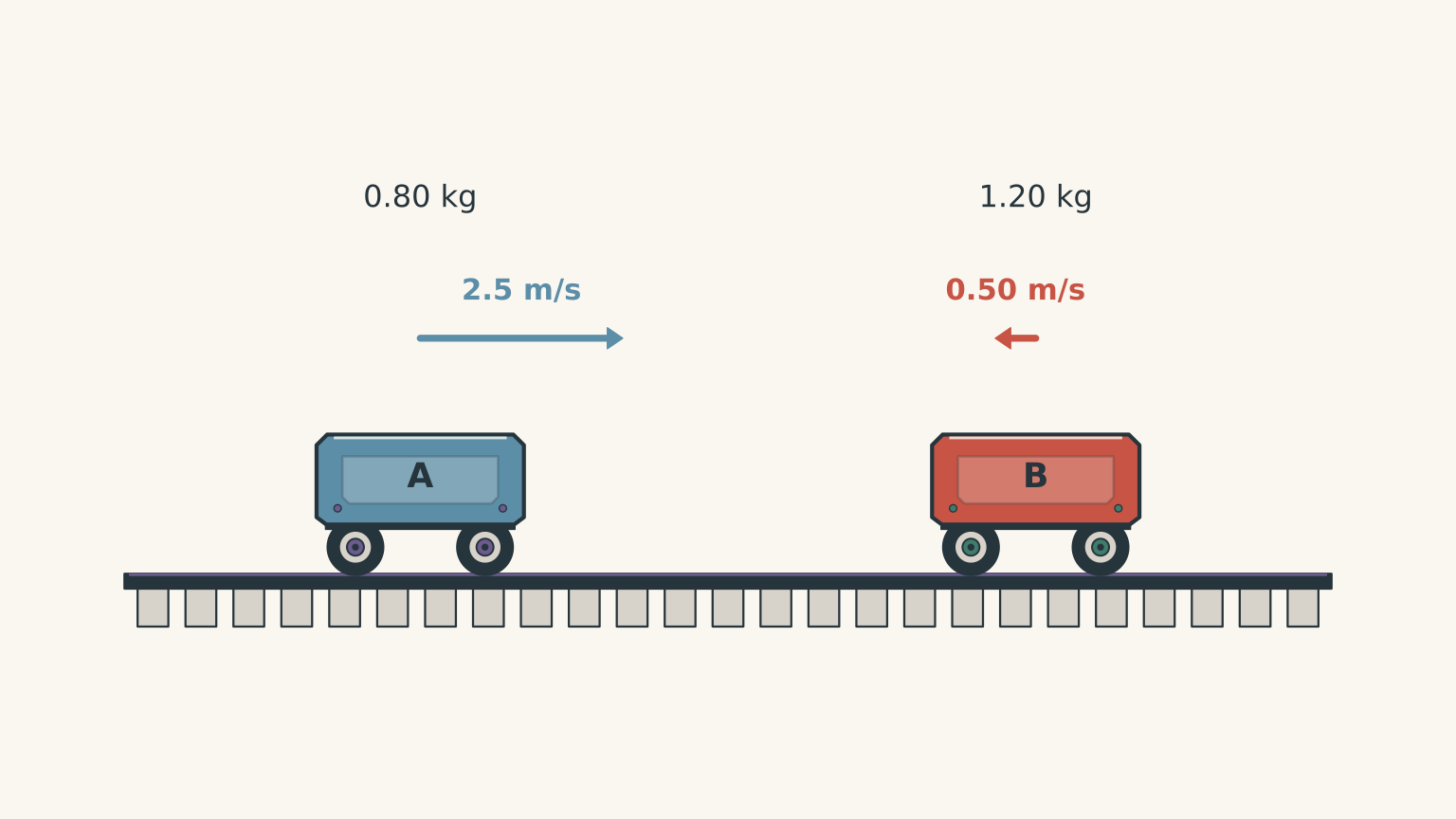
Two carts approach each other on a horizontal track.
Cart A has a mass of \(0.80\ \mathrm{kg}\) and moves to the right at \(2.5\ \mathrm{m\,s^{-1}}\).
Cart B has a mass of \(1.20\ \mathrm{kg}\) and moves to the left at \(0.50\ \mathrm{m\,s^{-1}}\).
During the collision, the track supplies a net external horizontal impulse of \(+0.10\ \mathrm{N\,s}\) to the two-cart system. Assume all other horizontal external impulses are zero.
Take right as the positive direction.
(a) Choose a system boundary suitable for analysing the combined momentum of both carts. Identify whether the interaction between the carts and the horizontal interaction between the track and carts are internal or external to this system. (2 marks)
(b) Calculate the total initial horizontal momentum of the two-cart system. (2 marks)
(c) Calculate the total final horizontal momentum of the system immediately after the collision. (2 marks)
(d) Is the total horizontal momentum conserved exactly during this collision? Justify your answer using the external impulse. (2 marks)
Question 2 (10 marks)
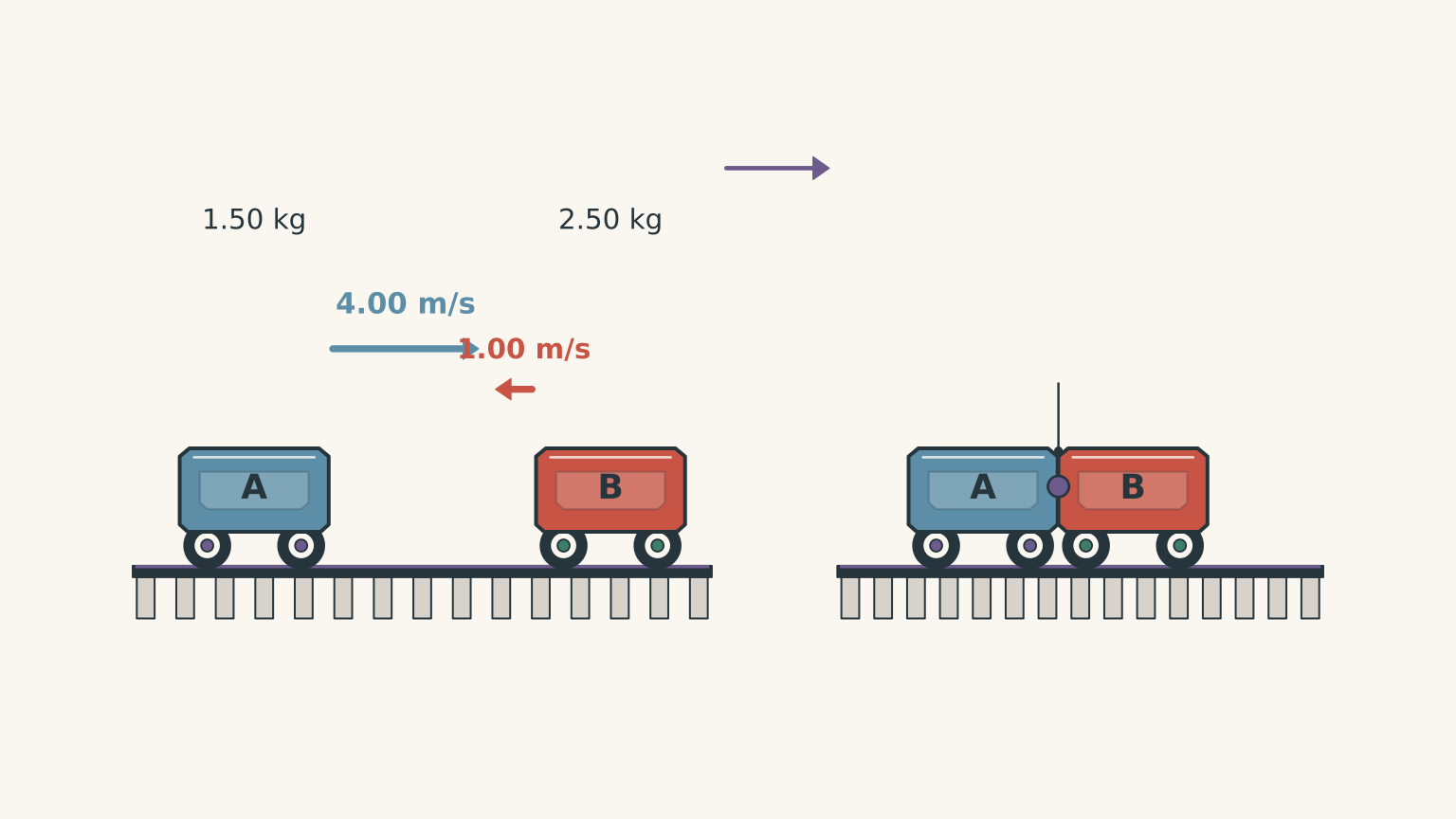
Two carts collide on a straight horizontal track and latch together.
Cart A has a mass of \(1.50\ \mathrm{kg}\) and initially moves to the right at \(4.00\ \mathrm{m\,s^{-1}}\).
Cart B has a mass of \(2.50\ \mathrm{kg}\) and initially moves to the left at \(1.00\ \mathrm{m\,s^{-1}}\).
The carts move together immediately after the collision. The horizontal external impulse on the two-cart system is negligible.
(a) Taking right as positive, calculate the total initial momentum of the two-cart system. (2 marks)
(b) Calculate the common velocity of the carts immediately after the collision. Include the direction of motion. (3 marks)
(c) Calculate the total kinetic energy of the system:
- immediately before the collision;
- immediately after the collision. (3 marks)
(d) Calculate the decrease in kinetic energy during the collision. Explain what happens to this energy. (2 marks)
Question 3 (11 marks)
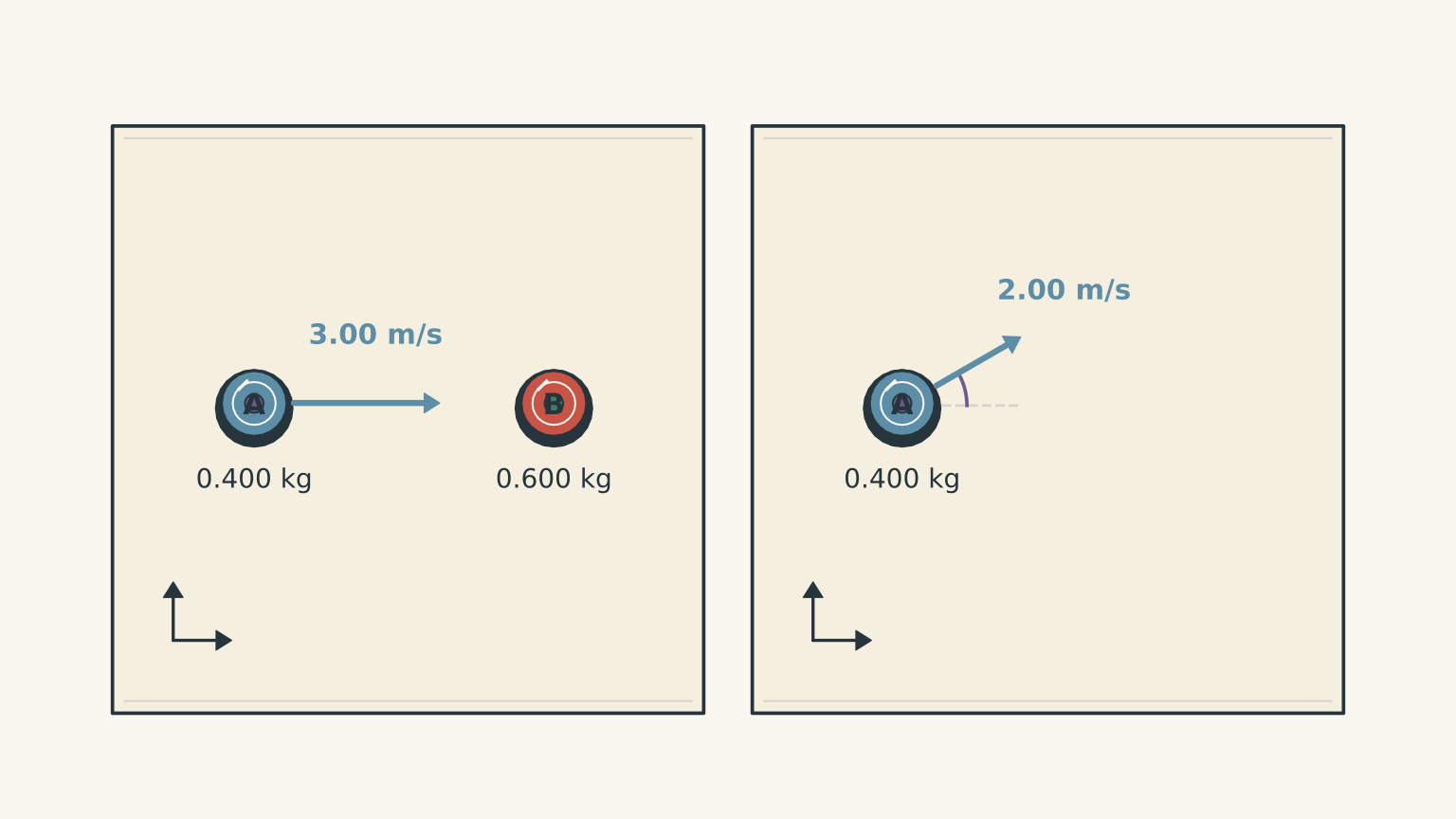
Two pucks collide on a low-friction horizontal air table.
Puck A has a mass of \(0.400\ \mathrm{kg}\) and initially travels east at \(3.00\ \mathrm{m\,s^{-1}}\).
Puck B has a mass of \(0.600\ \mathrm{kg}\) and is initially stationary.
After the collision, puck A travels at \(2.00\ \mathrm{m\,s^{-1}}\), at an angle of \(30.0^\circ\) north of east.
The net external impulse on the two-puck system is negligible.
(a) Write separate momentum conservation equations for the \(x\)- and \(y\)-directions. (2 marks)
(b) Calculate the \(x\)- and \(y\)-components of puck A’s momentum immediately after the collision. (2 marks)
(c) Determine the \(x\)- and \(y\)-components of puck B’s velocity immediately after the collision. (3 marks)
(d) Calculate the speed of puck B immediately after the collision. (2 marks)
(e) Determine the direction of puck B’s velocity, expressed as an angle relative to east. (2 marks)
Question 4 (10 marks)
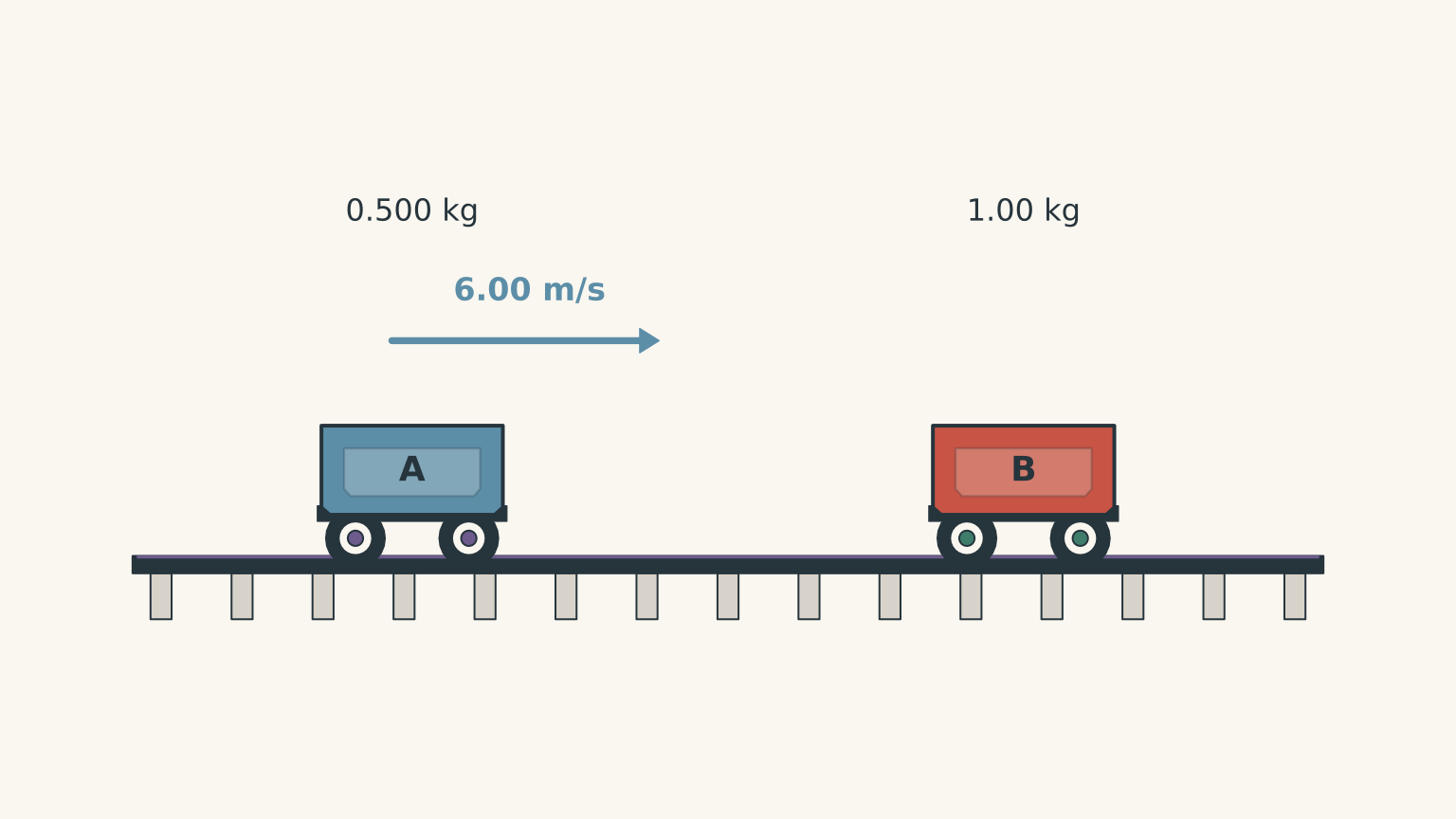
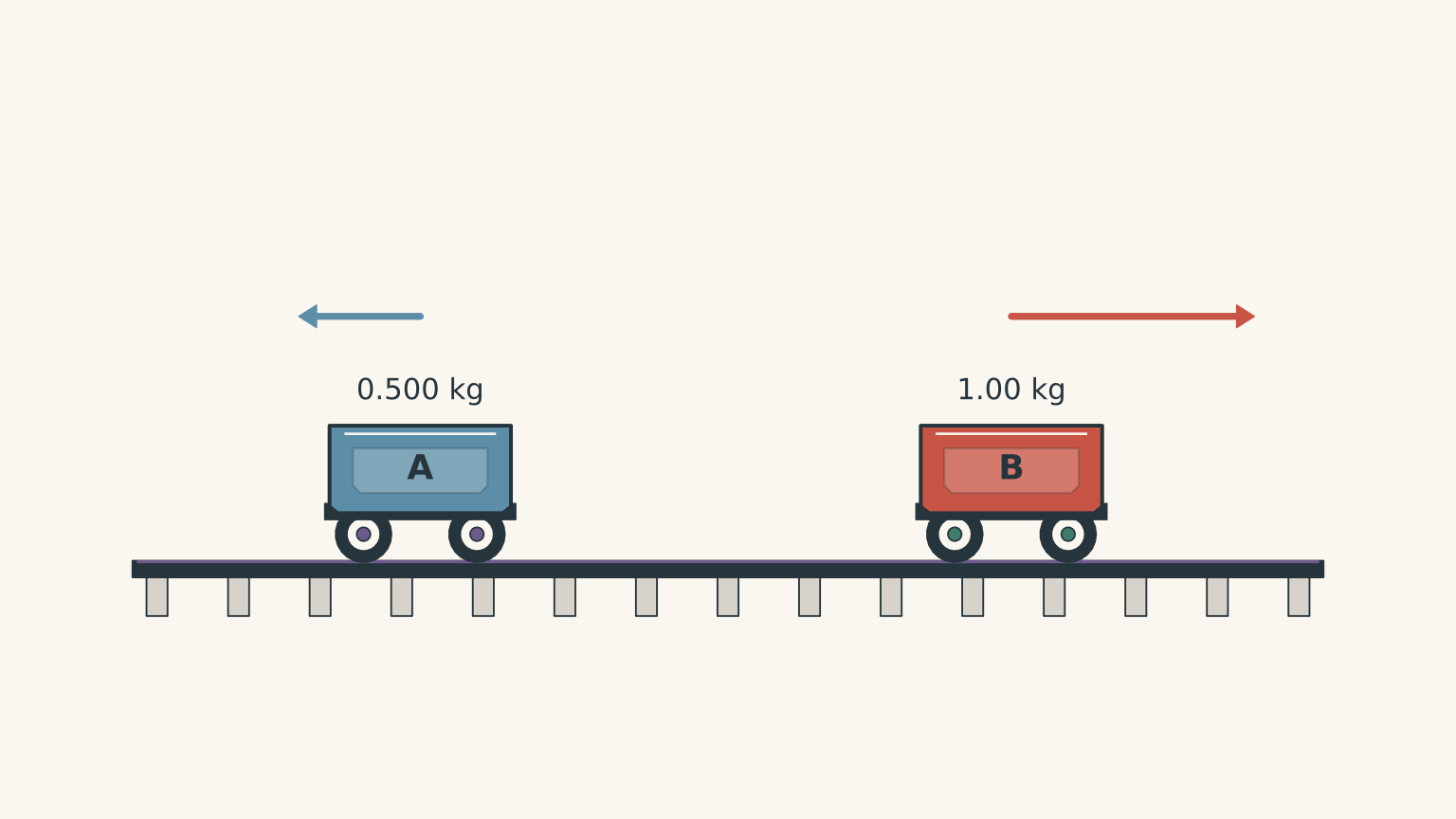
Cart A has a mass of \(0.500\ \mathrm{kg}\) and moves to the right at \(6.00\ \mathrm{m\,s^{-1}}\).
It collides with stationary cart B, which has a mass of \(1.00\ \mathrm{kg}\).
The carts undergo a one-dimensional elastic collision on a low-friction horizontal track. The horizontal external impulse on the system is negligible.
Let \(v_A\) and \(v_B\) represent the signed velocities of carts A and B immediately after the collision.
(a) Calculate the total initial momentum and total initial kinetic energy of the two-cart system. (2 marks)
(b) Write two equations representing conservation of:
- total momentum;
- total kinetic energy. (2 marks)
(c) Solve the equations to determine the physically relevant post-collision velocities \(v_A\) and \(v_B\).
Explain why the other algebraic solution does not represent the post-collision state. (4 marks)
(d) Verify that the final total momentum and final total kinetic energy agree with their initial values. (2 marks)
Question 5 (11 marks)
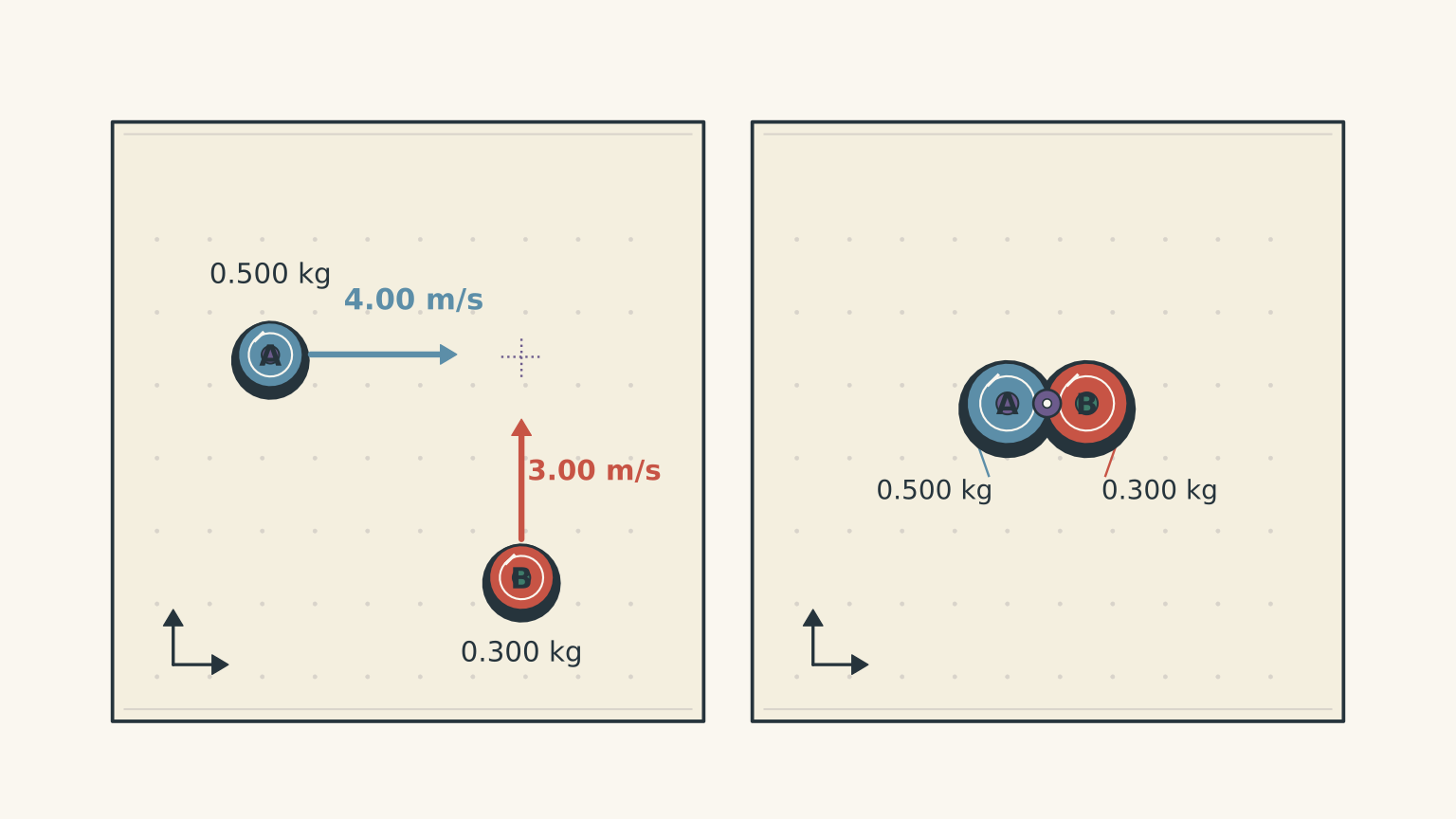
Two pucks travel along perpendicular paths on a low-friction horizontal table.
Puck A has a mass of \(0.500\ \mathrm{kg}\) and moves east at \(4.00\ \mathrm{m\,s^{-1}}\).
Puck B has a mass of \(0.300\ \mathrm{kg}\) and moves north at \(3.00\ \mathrm{m\,s^{-1}}\).
The pucks collide and stick together. The net external horizontal impulse on the two-puck system is negligible.
(a) Calculate the initial total momentum of the system in the \(x\)- and \(y\)-directions. (2 marks)
(b) Determine the \(x\)- and \(y\)-components of the common velocity of the joined pucks immediately after the collision. (2 marks)
(c) Calculate the speed and direction of the joined pucks immediately after the collision. (2 marks)
(d) Calculate the total kinetic energy:
- immediately before the collision;
- immediately after the collision.
Hence, determine the decrease in kinetic energy. (3 marks)
(e) Explain why the total momentum of the system is conserved even though its kinetic energy decreases. (2 marks)
03Worked solutions and marking guide
Solution 1
(a) System boundary (2 marks)
Choose a system boundary that surrounds both carts but excludes the track.
The interaction between the two carts is internal because both carts are inside the boundary. The horizontal interaction between the track and the carts is external because the track is outside the boundary.
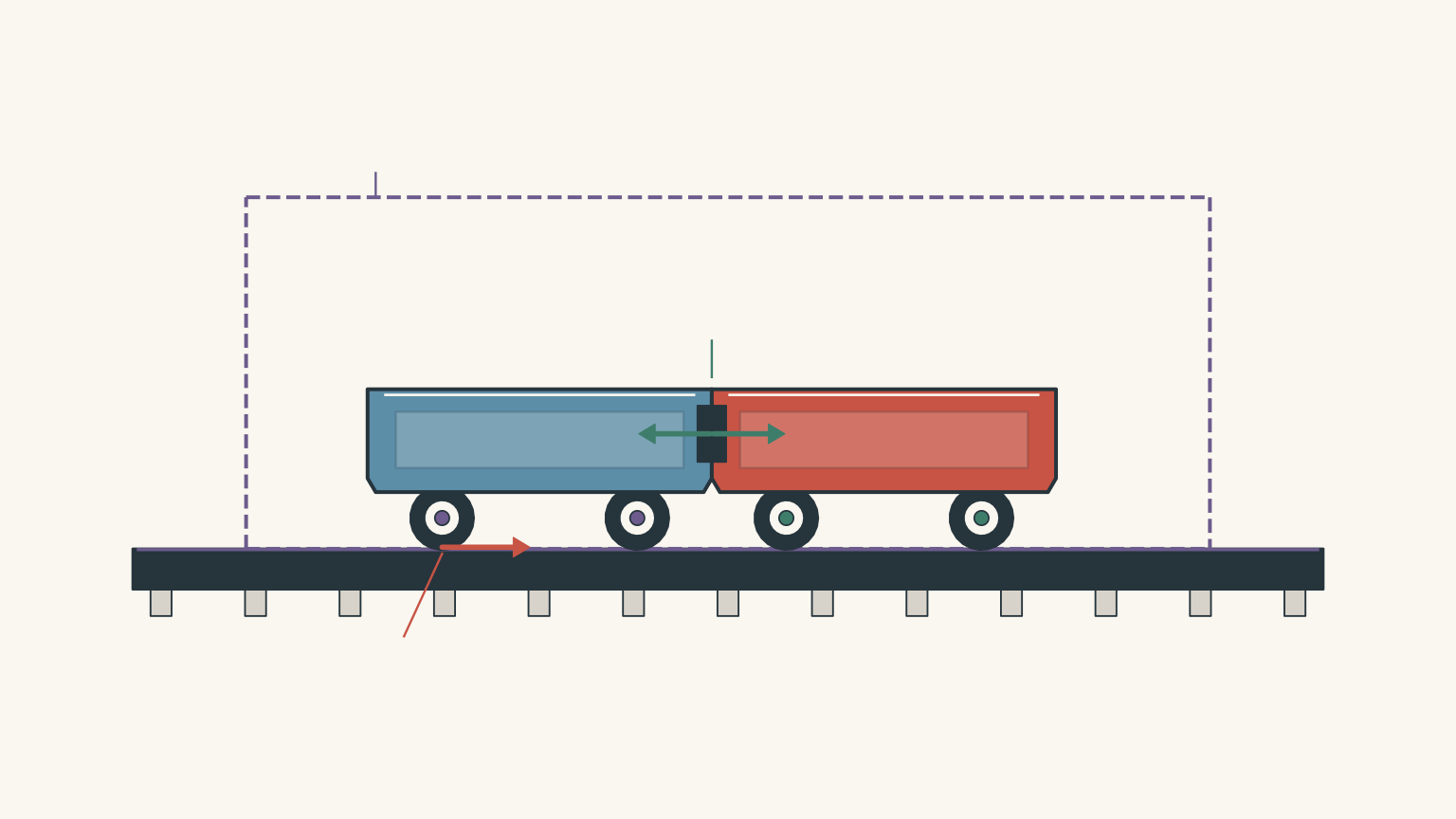
There is an important distinction here. A closed system has no matter entering or leaving its boundary. However, momentum conservation also requires the net external impulse to be zero (or negligible).
The two carts form a closed system, but the non-zero external impulse means the system is not isolated in the horizontal direction.
Marking:
- 1 mark for a boundary enclosing both carts but excluding the track.
- 1 mark for correctly identifying the cart interaction as internal and the track interaction as external.
(b) Initial total momentum (2 marks)
Momentum is calculated using:
\[ p=mv \]
The initial total momentum is:
\[ \begin{aligned} p_i &=m_Av_A+m_Bv_B\\ &=(0.80)(+2.5)+(1.20)(-0.50)\\ &=2.0-0.60\\ &=+1.4\ \mathrm{kg\,m\,s^{-1}} \end{aligned} \]
The positive result means the initial total momentum is to the right.
Answer:
\[ \boxed{p_i=1.4\ \mathrm{kg\,m\,s^{-1}}\text{ right}} \]
Marking:
- 1 mark for correctly substituting signed velocities.
- 1 mark for the correct momentum and direction.
(c) Final total momentum (2 marks)
The impulse-momentum relationship is:
\[ J_{\text{ext}}=p_f-p_i \]
Rearranging:
\[ p_f=p_i+J_{\text{ext}} \]
Substitute the known values:
\[ \begin{aligned} p_f&=1.4+0.10\\ &=+1.5\ \mathrm{kg\,m\,s^{-1}} \end{aligned} \]
Answer:
\[ \boxed{p_f=1.5\ \mathrm{kg\,m\,s^{-1}}\text{ right}} \]
Marking:
- 1 mark for applying the impulse-momentum relationship correctly.
- 1 mark for the correct final momentum, including direction.
(d) Is momentum conserved? (2 marks)
No. The total horizontal momentum is not conserved exactly.
Momentum conservation requires the net external impulse on the system to be zero.
Here, the track supplies an external impulse of \(+0.10\ \mathrm{N\,s}\). This changes the total momentum by \(+0.10\ \mathrm{kg\,m\,s^{-1}}\).
Marking:
- 1 mark for stating that momentum is not conserved exactly.
- 1 mark for explaining that the non-zero external impulse changes the system’s momentum.
Solution 2
(a) Initial total momentum (2 marks)
Take right as positive.
Cart A moves right, so its velocity is positive. Cart B moves left, so its velocity is negative.
\[ \begin{aligned} p_i&=m_Av_A+m_Bv_B\\ &=(1.50)(+4.00)+(2.50)(-1.00)\\ &=6.00-2.50\\ &=+3.50\ \mathrm{kg\,m\,s^{-1}} \end{aligned} \]
Answer:
\[ \boxed{p_i=3.50\ \mathrm{kg\,m\,s^{-1}}\text{ right}} \]
Marking:
- 1 mark for the correct signed momentum calculation.
- 1 mark for the correct result and direction.
(b) Common final velocity (3 marks)
The horizontal external impulse is negligible, so the total momentum is conserved.
After the collision, the carts move together. Their combined mass is:
\[ m_{\text{total}}=1.50+2.50=4.00\ \mathrm{kg} \]
Apply conservation of momentum:
\[ p_i=p_f \]
\[ 3.50=4.00v_f \]
Rearranging:
\[ \begin{aligned} v_f&=\frac{3.50}{4.00}\\ &=+0.875\ \mathrm{m\,s^{-1}} \end{aligned} \]
Answer:
\[ \boxed{v_f=0.875\ \mathrm{m\,s^{-1}}\text{ right}} \]
The positive sign confirms that the joined carts move to the right.
Marking:
- 1 mark for determining the combined mass.
- 1 mark for correctly applying conservation of momentum.
- 1 mark for the final velocity and direction.
(c) Initial and final kinetic energy (3 marks)
Kinetic energy is calculated using:
\[ K=\frac{1}{2}mv^2 \]
First, calculate the initial kinetic energy.
Both carts have kinetic energy because both are moving.
\[ \begin{aligned} K_i&=\frac12 m_Av_A^2+\frac12 m_Bv_B^2\\ &=\frac12(1.50)(4.00)^2\\ &\quad+\frac12(2.50)(1.00)^2\\ &=12.0+1.25\\ &=13.25\ \mathrm{J} \end{aligned} \]
Now calculate the final kinetic energy.
After the collision, the carts move together as one object.
\[ \begin{aligned} K_f&=\frac12 m_{\text{total}}v_f^2\\ &=\frac12(4.00)(0.875)^2\\ &=1.53125\ \mathrm{J} \end{aligned} \]
Answers:
\[ \boxed{K_i=13.25\ \mathrm{J}} \]
\[ \boxed{K_f=1.53\ \mathrm{J}} \]
Marking:
- 1 mark for the correct initial kinetic energy.
- 1 mark for the correct final kinetic energy.
- 1 mark for appropriate working and units.
(d) Decrease in kinetic energy (2 marks)
The decrease in kinetic energy is:
\[ \Delta K=K_i-K_f \]
\[ \begin{aligned} \Delta K&=13.25-1.53125\\ &=11.71875\ \mathrm{J} \end{aligned} \]
Answer:
\[ \boxed{\Delta K=11.7\ \mathrm{J}} \]
The carts latch together, so this is an inelastic collision.
Some of the initial kinetic energy is transformed into other forms of energy, including internal energy, sound, and deformation of the carts.
Energy has not disappeared. Total energy is still conserved, but kinetic energy is not.
Marking:
- 1 mark for calculating the decrease in kinetic energy.
- 1 mark for explaining that kinetic energy is transformed into other forms of energy.
Solution 3
(a) Momentum conservation equations (2 marks)
Momentum is a vector, so it must be conserved separately in the \(x\)- and \(y\)-directions.
The initial total momentum in the east-west direction is:
\[ p_{ix}=(0.400)(3.00)=1.20 \]
The initial total momentum in the north-south direction is zero because puck B is stationary and puck A initially moves east.
Therefore, the conservation equations are:
\[ 1.20=p_{Ax,f}+p_{Bx,f} \]
\[ 0=p_{Ay,f}+p_{By,f} \]
All momentum values are in \(\mathrm{kg\,m\,s^{-1}}\).
Marking:
- 1 mark for the correct \(x\)-direction equation.
- 1 mark for the correct \(y\)-direction equation.
(b) Final momentum components of puck A (2 marks)
Puck A moves at \(2.00\ \mathrm{m\,s^{-1}}\), at \(30.0^\circ\) north of east.
Resolve its velocity into perpendicular components.
The eastward component is:
\[ v_{Ax}=2.00\cos30.0^\circ \]
The northward component is:
\[ v_{Ay}=2.00\sin30.0^\circ \]
Momentum in each direction is mass multiplied by the corresponding velocity component.
For the \(x\)-direction:
\[ \begin{aligned} p_{Ax,f} &=0.400(2.00\cos30.0^\circ)\\ &=0.693\ \mathrm{kg\,m\,s^{-1}} \end{aligned} \]
For the \(y\)-direction:
\[ \begin{aligned} p_{Ay,f} &=0.400(2.00\sin30.0^\circ)\\ &=0.400\ \mathrm{kg\,m\,s^{-1}} \end{aligned} \]
Answers:
\[ \boxed{p_{Ax,f}=+0.693\ \mathrm{kg\,m\,s^{-1}}} \]
\[ \boxed{p_{Ay,f}=+0.400\ \mathrm{kg\,m\,s^{-1}}} \]
Marking:
- 1 mark for the correct eastward momentum component.
- 1 mark for the correct northward momentum component.
(c) Final velocity components of puck B (3 marks)
Use conservation of momentum in each direction.
In the \(x\)-direction:
\[ p_{ix}=p_{Ax,f}+p_{Bx,f} \]
Rearranging:
\[ p_{Bx,f}=1.20-0.693 \]
\[ p_{Bx,f}=+0.507\ \mathrm{kg\,m\,s^{-1}} \]
In the \(y\)-direction:
\[ p_{iy}=p_{Ay,f}+p_{By,f} \]
Rearranging:
\[ p_{By,f}=0-0.400 \]
\[ p_{By,f}=-0.400\ \mathrm{kg\,m\,s^{-1}} \]
Now use \(p=mv\) to calculate puck B’s velocity components.
\[ v_{Bx}=\frac{0.507}{0.600} =+0.845\ \mathrm{m\,s^{-1}} \]
\[ v_{By}=\frac{-0.400}{0.600} =-0.667\ \mathrm{m\,s^{-1}} \]
Answers:
\[ \boxed{v_{Bx}=+0.845\ \mathrm{m\,s^{-1}}} \]
\[ \boxed{v_{By}=-0.667\ \mathrm{m\,s^{-1}}} \]
The positive \(x\)-component means puck B moves east. The negative \(y\)-component means it moves south.
Marking:
- 1 mark for the correct residual \(x\)-momentum.
- 1 mark for the correct residual \(y\)-momentum.
- 1 mark for correctly converting both momentum components into velocity components.
(d) Speed of puck B (2 marks)
The speed is the magnitude of the velocity vector.
Use Pythagoras:
\[ v_B=\sqrt{v_{Bx}^2+v_{By}^2} \]
Substitute:
\[ \begin{aligned} v_B&=\sqrt{(0.845)^2+(-0.667)^2}\\ &=1.08\ \mathrm{m\,s^{-1}} \end{aligned} \]
Answer:
\[ \boxed{v_B=1.08\ \mathrm{m\,s^{-1}}} \]
Marking:
- 1 mark for using the correct vector magnitude relationship.
- 1 mark for the correct speed.
(e) Direction of puck B (2 marks)
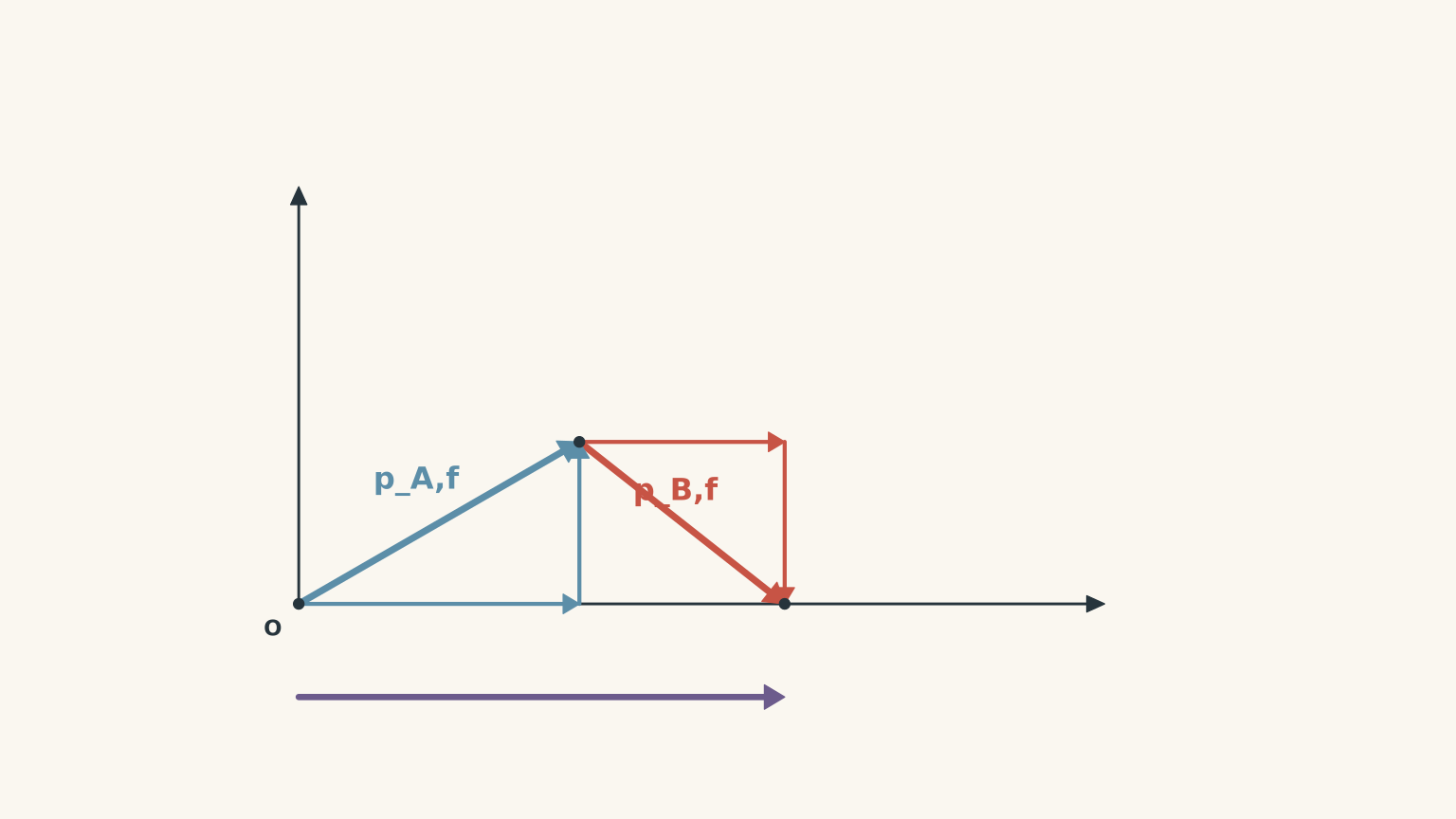
The velocity components show that puck B moves east and south.
Therefore, its direction is south of east.
Let \(\theta_B\) be the angle measured clockwise from east.
\[ \tan\theta_B= \frac{|v_{By}|}{v_{Bx}} \]
\[ \begin{aligned} \theta_B&=\tan^{-1}\left(\frac{0.667}{0.845}\right)\\ &=38.3^\circ \end{aligned} \]
Answer:
\[ \boxed{38.3^\circ\text{ south of east}} \]
Marking:
- 1 mark for the correct trigonometric calculation.
- 1 mark for identifying the correct direction as south of east.
Solution 4
(a) Initial momentum and kinetic energy (2 marks)
Cart A initially moves right at \(6.00\ \mathrm{m\,s^{-1}}\). Cart B is stationary.
The initial momentum is:
\[ \begin{aligned} p_i&=m_Au_A+m_Bu_B\\ &=(0.500)(6.00)+(1.00)(0)\\ &=3.00\ \mathrm{kg\,m\,s^{-1}} \end{aligned} \]
The initial kinetic energy is:
\[ \begin{aligned} K_i&=\frac12m_Au_A^2+\frac12m_Bu_B^2\\ &=\frac12(0.500)(6.00)^2\\ &=9.00\ \mathrm{J} \end{aligned} \]
Answers:
\[ \boxed{p_i=3.00\ \mathrm{kg\,m\,s^{-1}}} \]
\[ \boxed{K_i=9.00\ \mathrm{J}} \]
Marking:
- 1 mark for the correct initial momentum.
- 1 mark for the correct initial kinetic energy.
(b) Conservation equations (2 marks)
There are two conservation laws to apply.
Because the external impulse is negligible, total momentum is conserved:
\[ p_i=p_f \]
Substituting the cart masses and initial velocities:
\[ 3.00=0.500v_A+1.00v_B \]
Because the collision is elastic, total kinetic energy is also conserved:
\[ K_i=K_f \]
Therefore:
\[ 9.00=0.250v_A^2+0.500v_B^2 \]
These are the two simultaneous equations needed to determine the final velocities.
Marking:
- 1 mark for the correct momentum conservation equation.
- 1 mark for the correct kinetic-energy conservation equation.
(c) Final velocities (4 marks)
Start with the momentum equation:
\[ 3.00=0.500v_A+v_B \]
Rearrange to make \(v_B\) the subject:
\[ v_B=3.00-0.500v_A \]
Substitute this expression into the kinetic-energy equation:
\[ 9.00=0.250v_A^2 +0.500(3.00-0.500v_A)^2 \]
Expand the squared bracket:
\[ 9.00=0.375v_A^2-1.50v_A+4.50 \]
Rearrange:
\[ 0.375v_A^2-1.50v_A-4.50=0 \]
Divide by \(0.375\):
\[ v_A^2-4.00v_A-12.0=0 \]
Factorise:
\[ (v_A-6.00)(v_A+2.00)=0 \]
Therefore, there are two possible mathematical solutions:
\[ v_A=6.00\ \mathrm{m\,s^{-1}} \]
or
\[ v_A=-2.00\ \mathrm{m\,s^{-1}} \]
Substitute each value into the momentum equation.
For \(v_A=6.00\):
\[ v_B=3.00-0.500(6.00)=0 \]
This gives the original state: cart A moving at \(6.00\ \mathrm{m\,s^{-1}}\) and cart B stationary.
It does not represent the changed state after the collision.
For \(v_A=-2.00\):
\[ v_B=3.00-0.500(-2.00) \]
\[ v_B=+4.00\ \mathrm{m\,s^{-1}} \]
This is the physically relevant post-collision solution.
Answers:
\[ \boxed{v_A=-2.00\ \mathrm{m\,s^{-1}}} \]
\[ \boxed{v_B=+4.00\ \mathrm{m\,s^{-1}}} \]
Cart A rebounds to the left, while cart B moves to the right.
Marking:
- 1 mark for correctly rearranging the momentum equation.
- 1 mark for substituting into the kinetic-energy equation and obtaining the quadratic.
- 1 mark for solving the quadratic and identifying both mathematical roots.
- 1 mark for selecting the physically relevant solution and explaining why the other root reproduces the initial state.
(d) Verification (2 marks)
Check the final total momentum:
\[ \begin{aligned} p_f&=0.500(-2.00)+1.00(4.00)\\ &=-1.00+4.00\\ &=3.00\ \mathrm{kg\,m\,s^{-1}} \end{aligned} \]
This agrees with the initial momentum.
Now check the final kinetic energy:
\[ \begin{aligned} K_f&=\frac12(0.500)(-2.00)^2\\ &\quad+\frac12(1.00)(4.00)^2\\ &=1.00+8.00\\ &=9.00\ \mathrm{J} \end{aligned} \]
This agrees with the initial kinetic energy.
Therefore:
\[ \boxed{p_f=p_i=3.00\ \mathrm{kg\,m\,s^{-1}}} \]
\[ \boxed{K_f=K_i=9.00\ \mathrm{J}} \]
Both conservation laws are satisfied.
Marking:
- 1 mark for correctly verifying final momentum.
- 1 mark for correctly verifying final kinetic energy.
Solution 5
(a) Initial momentum components (2 marks)
Take east as positive \(x\) and north as positive \(y\).
Puck A moves entirely in the \(x\)-direction.
Its momentum is:
\[ p_{Ax}=m_Av_A \]
\[ p_{Ax}=(0.500)(4.00) =+2.00\ \mathrm{kg\,m\,s^{-1}} \]
Puck B moves entirely in the \(y\)-direction.
Its momentum is:
\[ p_{By}=m_Bv_B \]
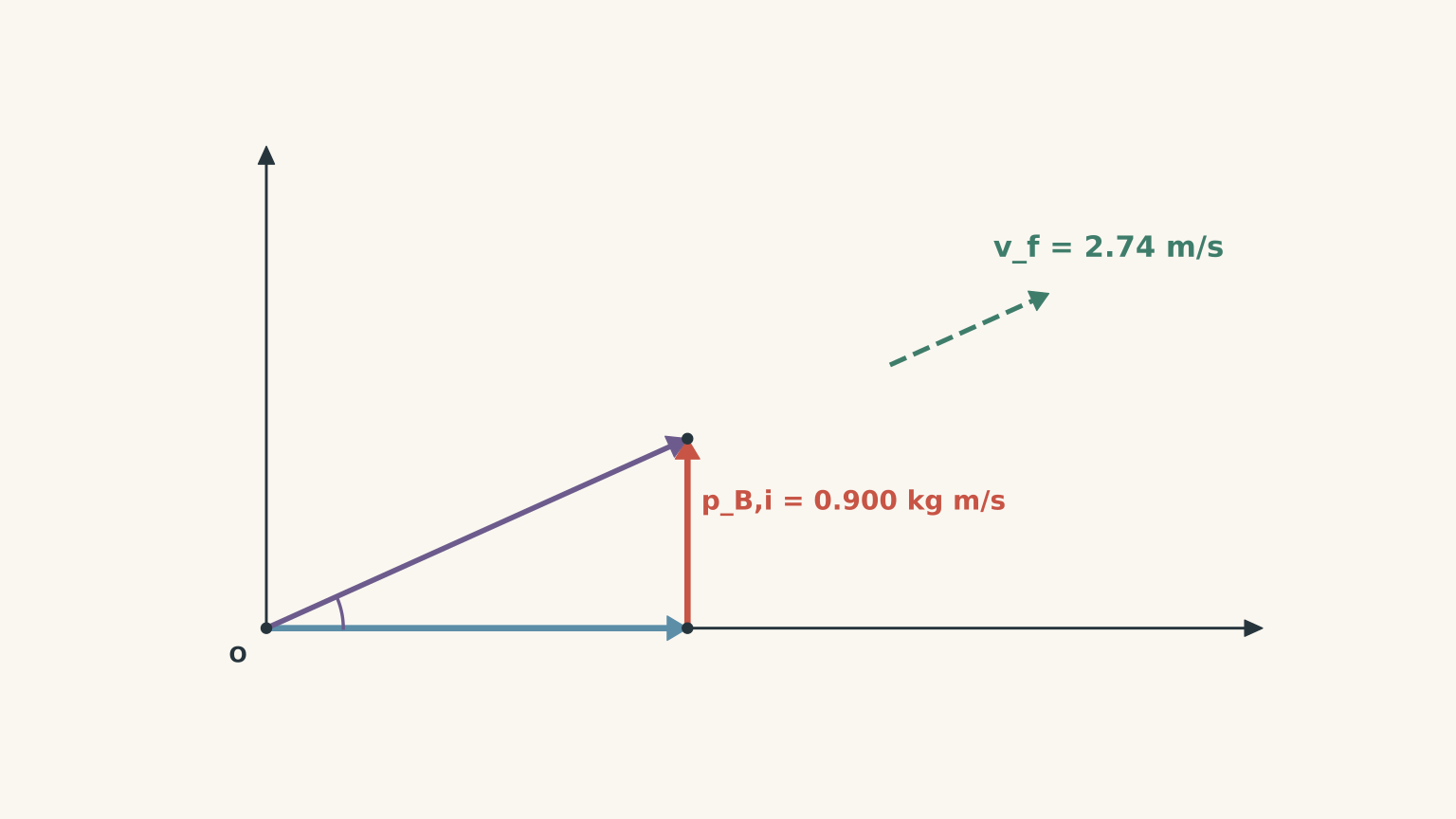
\[ p_{By}=(0.300)(3.00) =+0.900\ \mathrm{kg\,m\,s^{-1}} \]
The total initial momentum components are therefore:
\[ \boxed{p_{ix}=+2.00\ \mathrm{kg\,m\,s^{-1}}} \]
\[ \boxed{p_{iy}=+0.900\ \mathrm{kg\,m\,s^{-1}}} \]
Marking:
- 1 mark for the correct initial \(x\)-momentum.
- 1 mark for the correct initial \(y\)-momentum.
(b) Final velocity components (2 marks)
The pucks stick together, so their combined mass is:
\[ m_{\text{total}}=0.500+0.300 \]
\[ m_{\text{total}}=0.800\ \mathrm{kg} \]
The external impulse is negligible, so momentum is conserved in both directions.
In the \(x\)-direction:
\[ p_{ix}=p_{fx} \]
\[ 2.00=0.800v_{fx} \]
Therefore:
\[ v_{fx}=2.50\ \mathrm{m\,s^{-1}} \]
In the \(y\)-direction:
\[ p_{iy}=p_{fy} \]
\[ 0.900=0.800v_{fy} \]
Therefore:
\[ v_{fy}=1.125\ \mathrm{m\,s^{-1}} \]
Answers:
\[ \boxed{v_{fx}=+2.50\ \mathrm{m\,s^{-1}}} \]
\[ \boxed{v_{fy}=+1.125\ \mathrm{m\,s^{-1}}} \]
Marking:
- 1 mark for correctly determining the combined mass and applying conservation of momentum.
- 1 mark for both correct final velocity components.
(c) Final speed and direction (2 marks)
The final speed is the magnitude of the velocity vector.
Using Pythagoras:
\[ v_f=\sqrt{v_{fx}^2+v_{fy}^2} \]
Substitute:
\[ \begin{aligned} v_f&=\sqrt{(2.50)^2+(1.125)^2}\\ &=\sqrt{7.515625}\\ &=2.74\ \mathrm{m\,s^{-1}} \end{aligned} \]
Now calculate the direction.
Let \(\theta\) be the angle measured north of east.
\[ \tan\theta=\frac{v_{fy}}{v_{fx}} \]
\[ \begin{aligned} \theta&=\tan^{-1}\left(\frac{1.125}{2.50}\right)\\ &=24.2^\circ \end{aligned} \]
Both components are positive, so the joined pucks move north-east.
Answers:
\[ \boxed{v_f=2.74\ \mathrm{m\,s^{-1}}} \]
\[ \boxed{\theta=24.2^\circ\text{ north of east}} \]
Marking:
- 1 mark for the correct final speed.
- 1 mark for the correct angle and direction.
(d) Initial and final kinetic energy (3 marks)
First, calculate the total initial kinetic energy.
Both pucks are moving before the collision.
\[ K_i=\frac12m_Av_A^2+\frac12m_Bv_B^2 \]
Substitute:
\[ \begin{aligned} K_i&=\frac12(0.500)(4.00)^2\\ &\quad+\frac12(0.300)(3.00)^2\\ &=4.00+1.35\\ &=5.35\ \mathrm{J} \end{aligned} \]
Now calculate the final kinetic energy.
After the collision, the joined pucks have a combined mass of \(0.800\ \mathrm{kg}\) and a speed of \(2.74\ \mathrm{m\,s^{-1}}\).
Using the unrounded velocity components:
\[ K_f=\frac12m_{\text{total}} (v_{fx}^2+v_{fy}^2) \]
\[ \begin{aligned} K_f&=\frac12(0.800)\\ &\quad\times[(2.50)^2+(1.125)^2]\\ &=3.00625\ \mathrm{J} \end{aligned} \]
Therefore:
\[ K_f=3.01\ \mathrm{J} \]
The decrease in kinetic energy is:
\[ \begin{aligned} \Delta K&=K_i-K_f\\ &=5.35-3.00625\\ &=2.34375\ \mathrm{J} \end{aligned} \]
Answers:
\[ \boxed{K_i=5.35\ \mathrm{J}} \]
\[ \boxed{K_f=3.01\ \mathrm{J}} \]
\[ \boxed{\Delta K=2.34\ \mathrm{J}} \]
Marking:
- 1 mark for the correct initial kinetic energy.
- 1 mark for the correct final kinetic energy.
- 1 mark for the correct decrease in kinetic energy.
(e) Why is momentum conserved but kinetic energy decreases? (2 marks)
The net external impulse on the two-puck system is negligible. Therefore, the total momentum of the system is conserved.
However, the pucks stick together after colliding. This is an inelastic collision, so kinetic energy is not conserved.
Some of the initial kinetic energy is transformed into internal energy, sound, and deformation during the collision.
The important distinction is that momentum is conserved, but kinetic energy is not. Total energy remains conserved.
Marking:
- 1 mark for explaining momentum conservation using negligible external impulse.
- 1 mark for explaining the decrease in kinetic energy through energy transfer into other forms.