
Conical Pendulums: A 40-Mark HSC Physics Practice Exam
Prepare for HSC Physics with this original 40-mark conical pendulums practice exam from tutorgum. Includes timed exam conditions, five original questions, complete worked solutions, and a detailed marking guide.
This is an original tutorgum practice paper for NSW HSC Physics revision. It focuses exclusively on conical pendulums: resolving tension and weight, distinguishing string length from circular-path radius, and calculating angle, tension, speed, and period. It also tests how changing the string length affects the motion.
This is a focused topic assessment, not a full-course examination or an official or NESA-endorsed paper.
01Exam instructions
Suggested examination conditions
| Condition | Details |
|---|---|
| Reading time | 5 minutes |
| Working time | 60 minutes |
| Total marks | 40 |
| Equipment | Scientific calculator, ruler, pens, and pencils |
| Working | Show all calculations and reasoning |
| Accuracy | Give numerical answers to 3 significant figures unless otherwise specified |
Assumptions and supplied information
For all questions, assume:
- The string is massless and inextensible.
- Air resistance is negligible.
- The pivot is stationary.
- The mass moves at constant speed in a horizontal circular path.
- The gravitational field strength is \(g=9.81\,\mathrm{m\,s^{-2}}\).
- All angles are measured from the vertical unless stated otherwise.
Use the following symbols where appropriate:
- \(m\): mass, in kilograms (kg).
- \(L\): string length, in metres (m).
- \(r\): radius of the horizontal circular path, in metres (m).
- \(\theta\): angle between the string and the vertical.
- \(T\): tension in the string, in newtons (N).
- \(v\): linear speed, in metres per second (\(\mathrm{m\,s^{-1}}\)).
- \(P\): period, in seconds (s).
- \(\omega\): angular speed, in radians per second (\(\mathrm{rad\,s^{-1}}\)).
Assessed scope
This paper assesses:
- Resolving tension into vertical and horizontal components.
- Using vertical force balance and horizontal centripetal force.
- Distinguishing string length from circular-path radius.
- Calculating angle, tension, speed, and period.
- Comparing the effects of changing string length.
Other circular-motion situations, such as vertical circles, banked roads, and satellite motion, are excluded.
02Questions
Question 1 (8 marks)
A small object of mass \(0.30\,\mathrm{kg}\) is attached to a light string of length \(1.25\,\mathrm{m}\). The object moves at constant speed in a horizontal circle. The string makes an angle of \(30.0^\circ\) with the vertical.
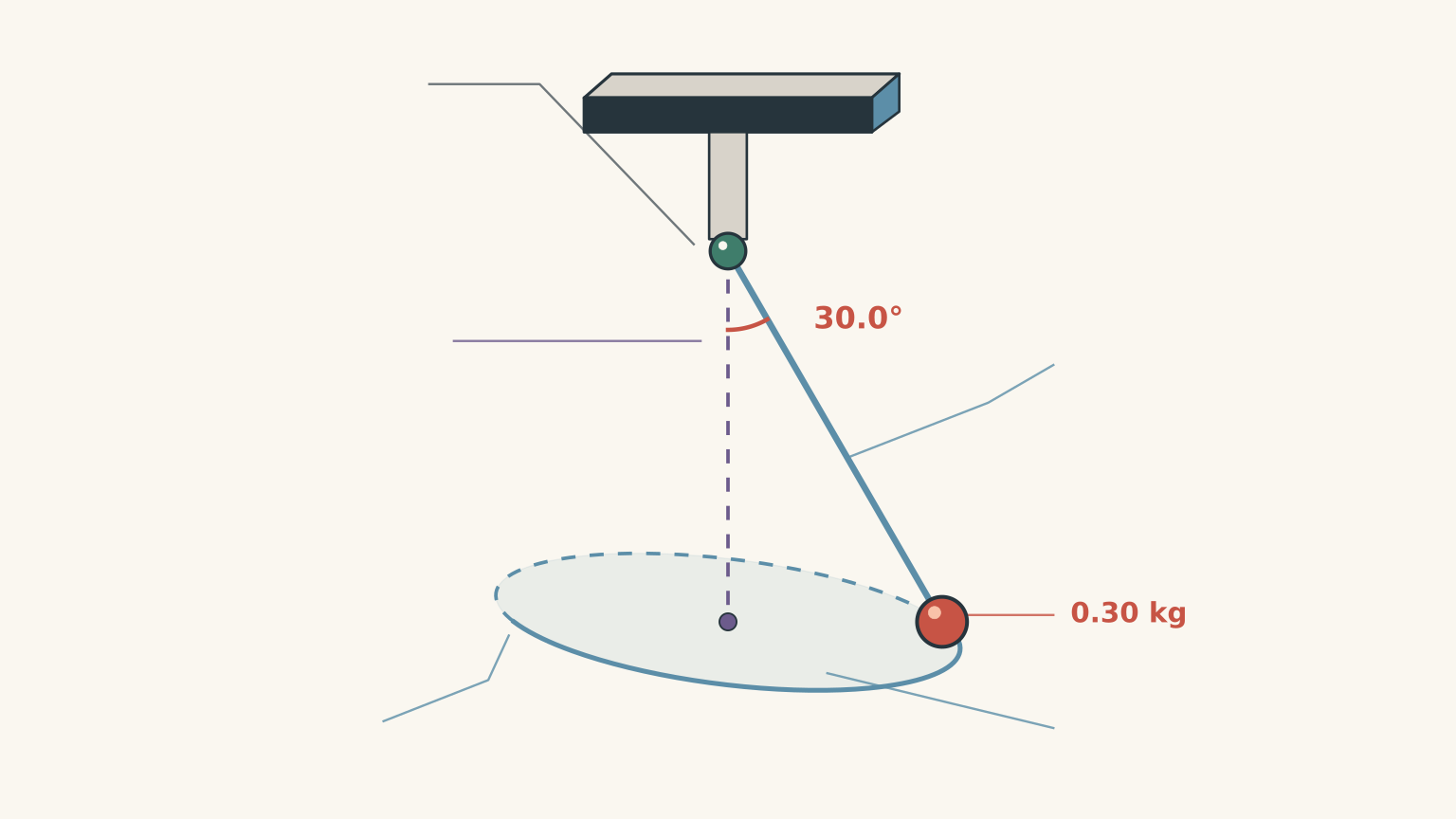
(a) Calculate the radius of the horizontal circular path. (2 marks)
(b) Determine the tension in the string. (2 marks)
(c) Calculate the speed of the object. (2 marks)
(d) Determine the period of the circular motion. (2 marks)
Question 2 (8 marks)
A mass of \(0.20\,\mathrm{kg}\) is attached to a string of length \(0.90\,\mathrm{m}\). It moves in a horizontal circle, completing one revolution every \(1.60\,\mathrm{s}\).
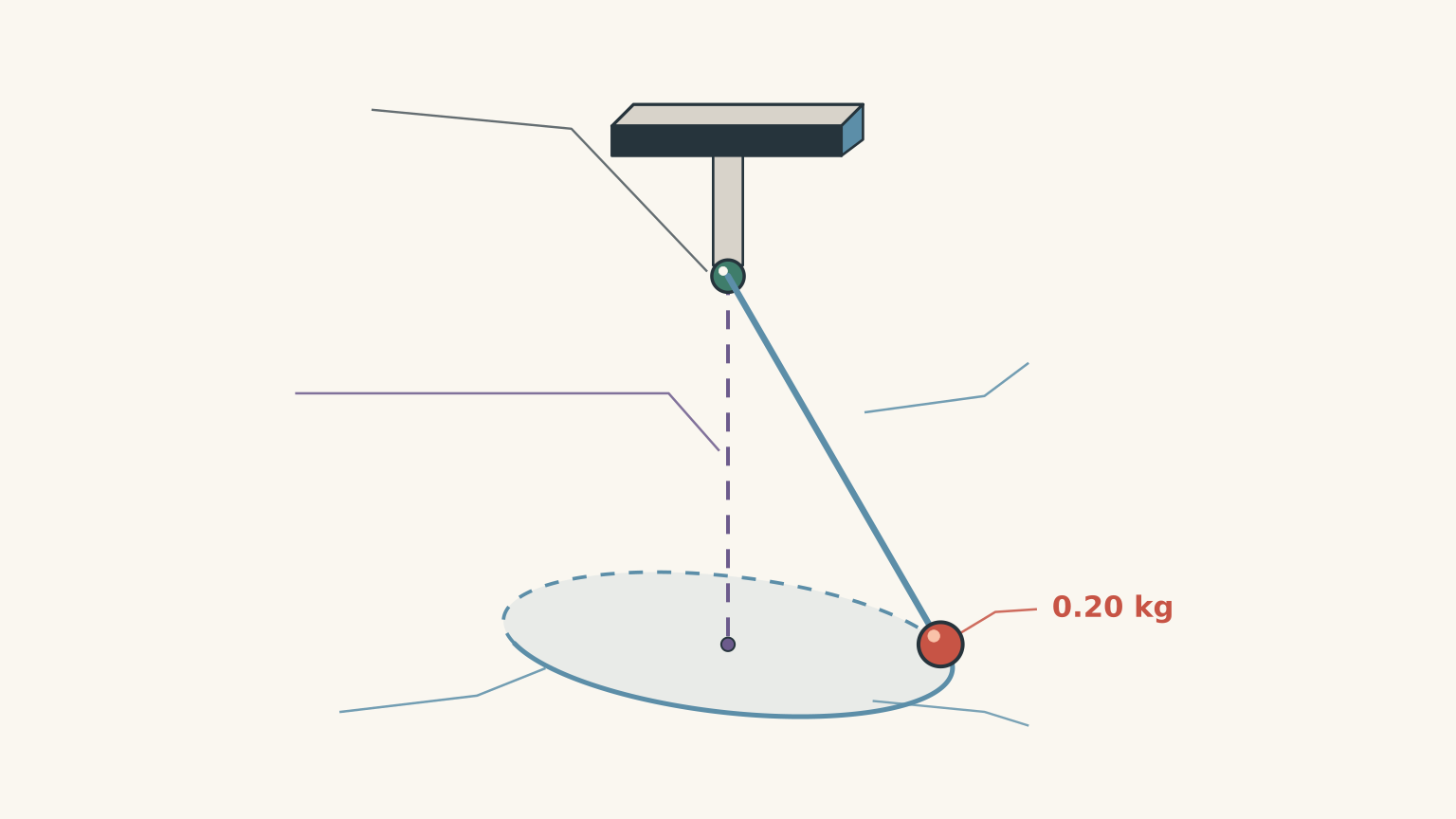
(a) Calculate the angular speed of the mass. (1 mark)
(b) Determine the angle between the string and the vertical. (3 marks)
(c) Calculate the radius of the horizontal circular path. (2 marks)
(d) Determine the tension in the string. (2 marks)
Question 3 (7 marks)
Two conical pendulums, A and B, are set up using identical masses of \(0.25\,\mathrm{kg}\).
The string lengths are:
- Pendulum A: \(0.60\,\mathrm{m}\)
- Pendulum B: \(1.20\,\mathrm{m}\)
Both strings make an angle of \(35.0^\circ\) with the vertical. Each mass moves at constant speed in a horizontal circle.
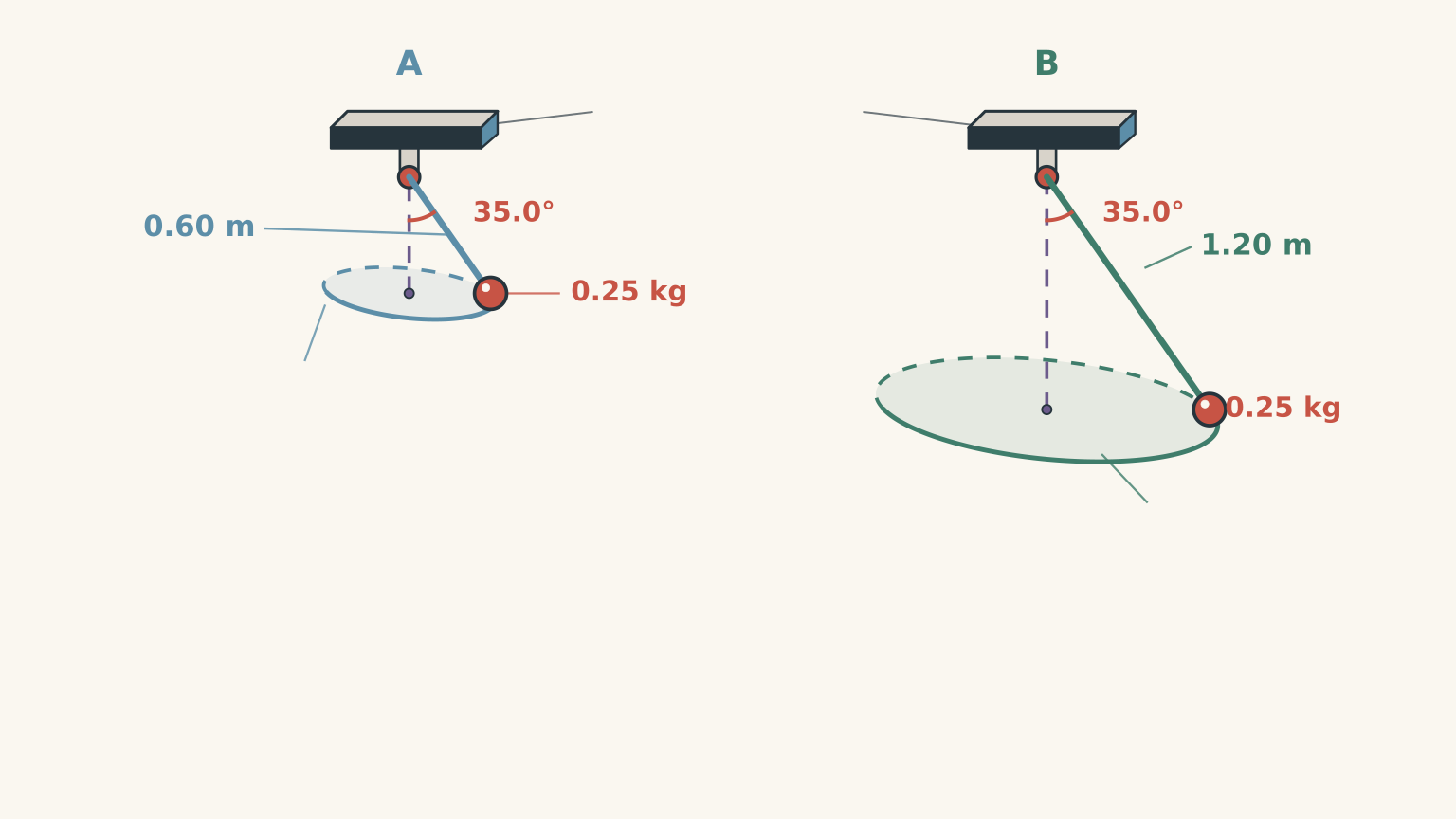
(a) Determine the ratio of the circular-path radii, \(r_B/r_A\). (2 marks)
(b) Determine the ratio of the linear speeds, \(v_B/v_A\). Explain your reasoning. (2 marks)
(c) Determine the ratio of the periods, \(P_B/P_A\). Explain your reasoning. (2 marks)
(d) Compare the tensions in the two strings. Justify your answer. (1 mark)
Question 4 (8 marks)
A mass of \(0.40\,\mathrm{kg}\) is attached to a string of length \(0.85\,\mathrm{m}\). The mass moves at constant speed in a horizontal circle with a radius of \(0.51\,\mathrm{m}\).
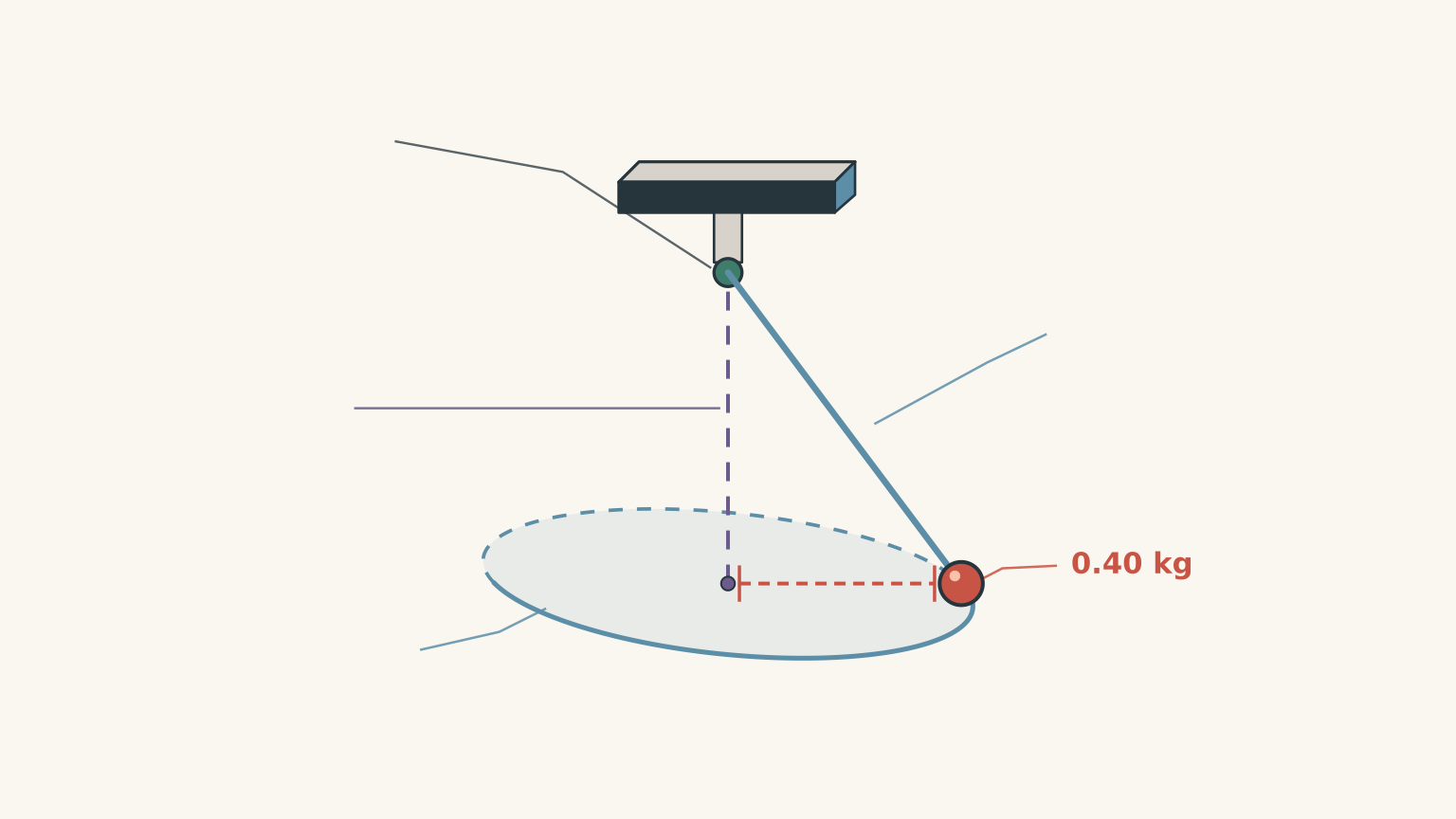
(a) Calculate the angle between the string and the vertical. (2 marks)
(b) Determine the tension in the string. (2 marks)
(c) Calculate the speed of the mass. (2 marks)
(d) Calculate the period of the circular motion. (2 marks)
Question 5 (9 marks)
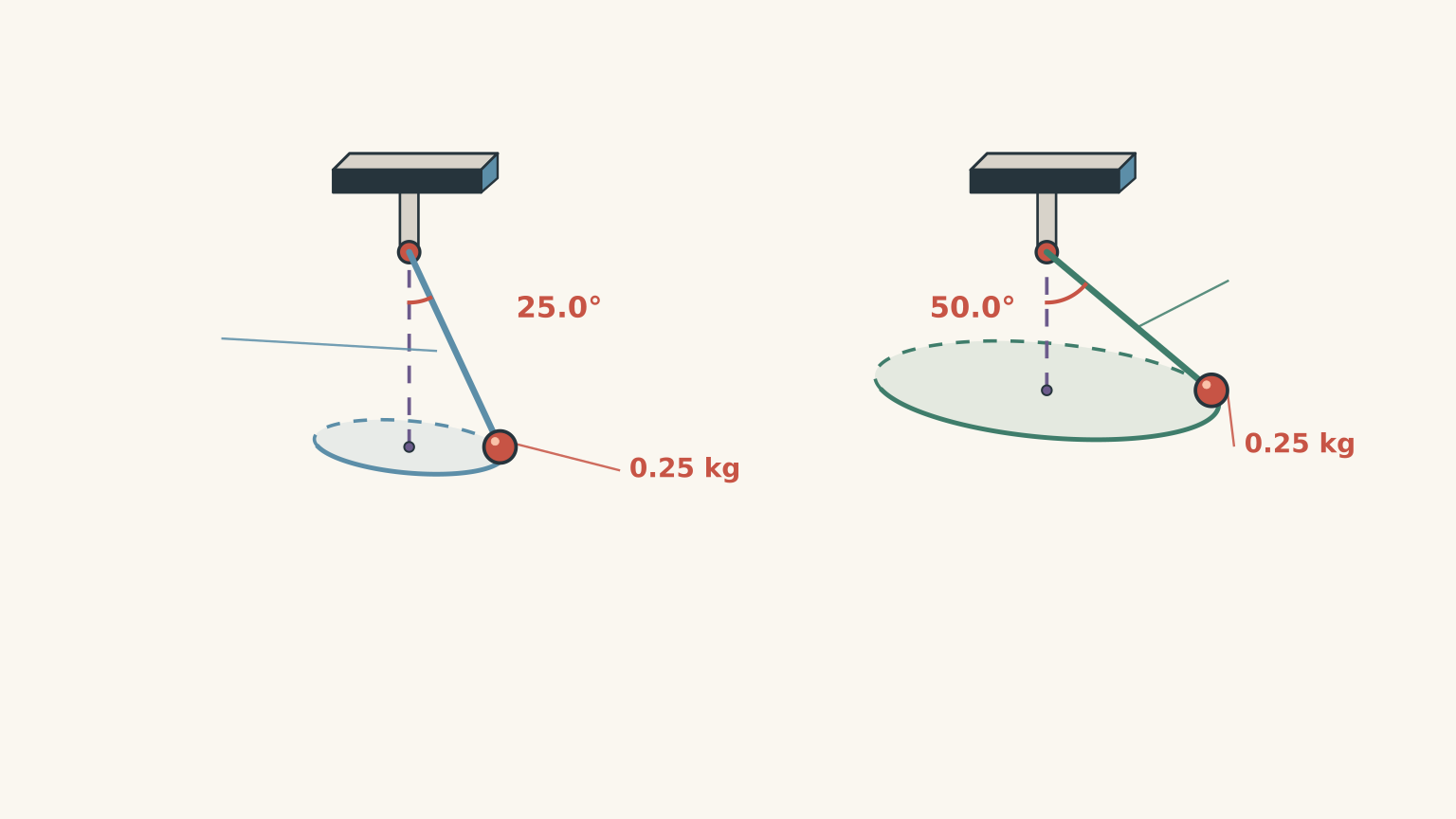
A mass of \(0.25\,\mathrm{kg}\) moves as a conical pendulum on a string of length \(1.10\,\mathrm{m}\).
Consider two separate cases:
- Case A: the string makes an angle of \(25.0^\circ\) with the vertical.
- Case B: the string makes an angle of \(50.0^\circ\) with the vertical.
In both cases, the mass moves at constant speed in a horizontal circle.
(a) Starting with the vertical force balance and horizontal centripetal force equations, derive an expression for the period \(P\) in terms of string length \(L\), angle \(\theta\), and gravitational field strength \(g\). (4 marks)
(b) Calculate the period for Case A and Case B. Give both answers to 3 significant figures. (3 marks)
(c) Explain why the period changes when the angle increases, even though the string length and mass remain unchanged. (2 marks)
03Worked solutions and marking guide
Solution 1
(a) Calculate the radius of the circular path. (2 marks)
The string length is not the same as the radius of the circular path.
The radius is the horizontal component of the string length.
Using trigonometry:
\[ r=L\sin\theta \]
Substitute the given values:
\[ r=1.25\sin30.0^\circ \]
\[ \boxed{r=0.625\,\mathrm{m}} \]
Marking guide:
- 1 mark for identifying \(r=L\sin\theta\).
- 1 mark for the correct answer, including units.
(b) Determine the tension in the string. (2 marks)
There are two forces acting on the mass:
- Tension, \(T\), acting along the string towards the pivot.
- Weight, \(mg\), acting vertically downwards.
The mass does not accelerate vertically. Therefore, the vertical component of tension balances its weight.
\[ T\cos\theta=mg \]
Rearrange to make tension the subject:
\[ T=\frac{mg}{\cos\theta} \]
Substitute:
\[ T=\frac{0.30\times9.81}{\cos30.0^\circ} \]
\[ \boxed{T=3.40\,\mathrm{N}} \]
Marking guide:
- 1 mark for applying vertical force balance.
- 1 mark for the correct substitution and tension.
(c) Calculate the speed of the object. (2 marks)
The horizontal component of tension provides the centripetal force.
\[ T\sin\theta=\frac{mv^2}{r} \]
From part (b):
\[ T=\frac{mg}{\cos\theta} \]
Substitute this into the horizontal force equation:
\[ \frac{mg}{\cos\theta}\sin\theta =\frac{mv^2}{r} \]
Cancel the mass and rearrange:
\[ v^2=gr\tan\theta \]
Therefore:
\[ v=\sqrt{gr\tan\theta} \]
Substitute the known values:
\[ v=\sqrt{9.81\times0.625\times\tan30.0^\circ} \]
\[ \boxed{v=1.88\,\mathrm{m\,s^{-1}}} \]
Marking guide:
- 1 mark for applying the horizontal centripetal force equation and obtaining the correct relationship.
- 1 mark for correct substitution and final speed.
(d) Determine the period. (2 marks)
The period is the time taken to complete one full revolution.
The distance travelled in one revolution is the circumference of the horizontal circle:
\[ \text{Distance}=2\pi r \]
Using speed = distance / time:
\[ P=\frac{2\pi r}{v} \]
Substitute:
\[ P=\frac{2\pi\times0.625}{1.88146} \]
\[ \boxed{P=2.09\,\mathrm{s}} \]
Marking guide:
- 1 mark for identifying \(P=2\pi r/v\).
- 1 mark for the correct calculation and answer.
Solution 2
(a) Calculate the angular speed. (1 mark)
Angular speed describes how quickly the mass rotates through an angle.
It is related to period by:
\[ \omega=\frac{2\pi}{P} \]
The period is \(1.60\,\mathrm{s}\).
\[ \omega=\frac{2\pi}{1.60} \]
\[ \boxed{\omega=3.93\,\mathrm{rad\,s^{-1}}} \]
Marking guide:
- 1 mark for the correct relationship, substitution, and answer.
(b) Determine the angle between the string and the vertical. (3 marks)
Start with the two force equations.
Vertical force balance:
\[ T\cos\theta=mg \]
Horizontal centripetal force:
\[ T\sin\theta=\frac{mv^2}{r} \]
Since \(v=\omega r\), the horizontal equation can also be written as:
\[ T\sin\theta=m\omega^2r \]
Divide the horizontal equation by the vertical equation:
\[ \tan\theta=\frac{\omega^2r}{g} \]
We know that the circular-path radius is related to string length by:
\[ r=L\sin\theta \]
Substitute:
\[ \tan\theta=\frac{\omega^2L\sin\theta}{g} \]
Since \(\tan\theta=\sin\theta/\cos\theta\), cancel \(\sin\theta\):
\[ \frac{1}{\cos\theta}=\frac{\omega^2L}{g} \]
Rearrange:
\[ \cos\theta=\frac{g}{\omega^2L} \]
Now substitute:
\[ \cos\theta= \frac{9.81}{(3.92699)^2\times0.90} \]
\[ \cos\theta=0.7068 \]
Therefore:
\[ \theta=\cos^{-1}(0.7068) \]
\[ \boxed{\theta=45.0^\circ} \]
Marking guide:
- 1 mark for combining the vertical and horizontal force equations correctly.
- 1 mark for substituting \(r=L\sin\theta\) and obtaining the relationship for \(\cos\theta\).
- 1 mark for the correct numerical angle.
(c) Calculate the radius of the horizontal circular path. (2 marks)
The radius is the horizontal component of the string length:
\[ r=L\sin\theta \]
Using the unrounded angle from part (b):
\[ r=0.90\sin45.0235^\circ \]
\[ \boxed{r=0.637\,\mathrm{m}} \]
Marking guide:
- 1 mark for using \(r=L\sin\theta\).
- 1 mark for the correct numerical answer and units.
(d) Determine the tension. (2 marks)
Use the vertical force balance:
\[ T\cos\theta=mg \]
Rearrange:
\[ T=\frac{mg}{\cos\theta} \]
Substitute:
\[ T=\frac{0.20\times9.81}{0.7068} \]
\[ \boxed{T=2.78\,\mathrm{N}} \]
Marking guide:
- 1 mark for applying vertical force balance.
- 1 mark for the correct substitution and answer.
Solution 3
(a) Determine the ratio of the circular-path radii. (2 marks)
The radius of a conical pendulum is:
\[ r=L\sin\theta \]
For pendulum A:
\[ r_A=L_A\sin35.0^\circ \]
For pendulum B:
\[ r_B=L_B\sin35.0^\circ \]
Form the required ratio:
\[ \frac{r_B}{r_A} = \frac{L_B\sin35.0^\circ} {L_A\sin35.0^\circ} \]
The sine terms cancel:
\[ \frac{r_B}{r_A} = \frac{1.20}{0.60} \]
\[ \boxed{\frac{r_B}{r_A}=2.00} \]
Pendulum B has twice the circular-path radius of pendulum A.
Marking guide:
- 1 mark for correctly relating radius to string length and angle.
- 1 mark for the correct ratio.
(b) Determine the ratio of the linear speeds. (2 marks)
From the conical pendulum force equations:
\[ v^2=gr\tan\theta \]
Substitute \(r=L\sin\theta\):
\[ v^2=gL\sin\theta\tan\theta \]
Both pendulums have the same angle and experience the same gravitational field strength.
Therefore:
\[ v^2\propto L \]
Taking the square root:
\[ v\propto\sqrt{L} \]
The speed ratio is:
\[ \frac{v_B}{v_A} = \sqrt{\frac{L_B}{L_A}} \]
\[ =\sqrt{\frac{1.20}{0.60}} \]
\[ \boxed{\frac{v_B}{v_A}=\sqrt{2}=1.41} \]
Pendulum B moves approximately 1.41 times as fast as pendulum A.
Marking guide:
- 1 mark for establishing that speed is proportional to the square root of string length when the angle is fixed.
- 1 mark for the correct speed ratio.
(c) Determine the ratio of the periods. (2 marks)
The period is:
\[ P=\frac{2\pi r}{v} \]
Substituting the conical pendulum relationships gives:
\[ P=2\pi\sqrt{\frac{L\cos\theta}{g}} \]
For a fixed angle and gravitational field strength:
\[ P\propto\sqrt{L} \]
Therefore:
\[ \frac{P_B}{P_A} = \sqrt{\frac{L_B}{L_A}} \]
\[ =\sqrt{\frac{1.20}{0.60}} \]
\[ \boxed{\frac{P_B}{P_A}=1.41} \]
Pendulum B takes approximately 1.41 times as long to complete one revolution.
Marking guide:
- 1 mark for identifying the correct relationship between period and string length.
- 1 mark for the correct period ratio.
(d) Compare the tensions. (1 mark)
The tension is given by:
\[ T=\frac{mg}{\cos\theta} \]
Both pendulums have the same mass, angle, and gravitational field strength.
Therefore, their tensions are equal.
\[ \boxed{T_A=T_B} \]
Marking guide:
- 1 mark for identifying equal tensions and justifying the comparison using \(T=mg/\cos\theta\).
Solution 4
(a) Calculate the angle between the string and the vertical. (2 marks)
The string length is the hypotenuse of the right-angled triangle formed by the string and its horizontal projection.
The horizontal projection is the circular-path radius.
Therefore:
\[ \sin\theta=\frac{r}{L} \]
Substitute:
\[ \sin\theta=\frac{0.51}{0.85} \]
\[ \sin\theta=0.600 \]
Taking the inverse sine:
\[ \theta=\sin^{-1}(0.600) \]
\[ \boxed{\theta=36.9^\circ} \]
Marking guide:
- 1 mark for identifying the correct trigonometric relationship.
- 1 mark for the correct angle.
(b) Determine the tension. (2 marks)
The mass has no vertical acceleration, so the vertical component of tension balances its weight.
\[ T\cos\theta=mg \]
Rearrange:
\[ T=\frac{mg}{\cos\theta} \]
Substitute:
\[ T=\frac{0.40\times9.81}{\cos36.9^\circ} \]
Using \(\cos36.9^\circ\approx0.800\):
\[ T=\frac{3.924}{0.800} \]
\[ \boxed{T=4.91\,\mathrm{N}} \]
Marking guide:
- 1 mark for applying vertical force balance.
- 1 mark for the correct tension.
(c) Calculate the speed of the mass. (2 marks)
The horizontal component of tension provides the centripetal force.
Combining the vertical and horizontal force equations gives:
\[ v^2=gr\tan\theta \]
Substitute:
\[ v^2=9.81\times0.51\times\tan36.9^\circ \]
\[ v^2=3.752 \]
Taking the square root:
\[ \boxed{v=1.94\,\mathrm{m\,s^{-1}}} \]
Marking guide:
- 1 mark for applying \(v^2=gr\tan\theta\).
- 1 mark for the correct calculation and speed.
(d) Calculate the period. (2 marks)
The period is the circumference of the circular path divided by the linear speed.
\[ P=\frac{2\pi r}{v} \]
Substitute:
\[ P=\frac{2\pi\times0.51}{1.93709} \]
\[ \boxed{P=1.65\,\mathrm{s}} \]
Marking guide:
- 1 mark for identifying the correct period relationship.
- 1 mark for the correct answer and units.
Solution 5
(a) Derive an expression for the period. (4 marks)
Start by resolving the tension into its vertical and horizontal components.
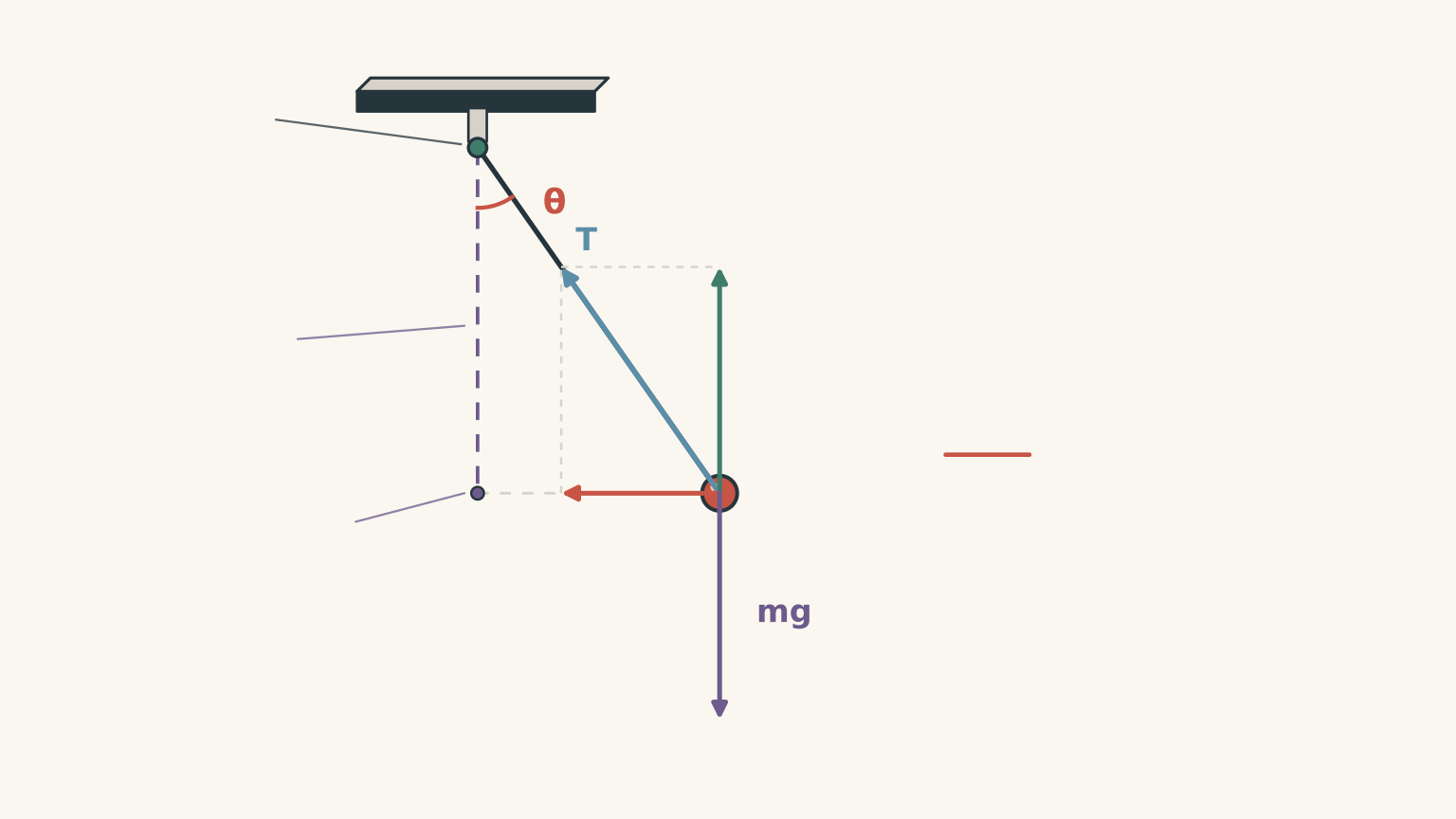
The vertical forces balance because the mass does not accelerate vertically.
Therefore:
\[ T\cos\theta=mg \tag{1} \]
The horizontal component of tension provides the centripetal force:
\[ T\sin\theta=\frac{mv^2}{r} \tag{2} \]
Divide equation (2) by equation (1):
\[ \frac{T\sin\theta}{T\cos\theta} = \frac{mv^2/r}{mg} \]
Cancel the common terms:
\[ \tan\theta=\frac{v^2}{rg} \]
Now use the relationship between linear speed and period:
\[ v=\frac{2\pi r}{P} \]
Substitute this into the force relationship:
\[ \tan\theta= \frac{(2\pi r/P)^2}{rg} \]
Simplify:
\[ \tan\theta=\frac{4\pi^2r}{gP^2} \]
Recall that the circular-path radius is:
\[ r=L\sin\theta \]
Substitute:
\[ \tan\theta= \frac{4\pi^2L\sin\theta}{gP^2} \]
Rearrange:
\[ P^2= \frac{4\pi^2L\sin\theta}{g\tan\theta} \]
Since:
\[ \tan\theta=\frac{\sin\theta}{\cos\theta} \]
We obtain:
\[ P^2=\frac{4\pi^2L\cos\theta}{g} \]
Taking the square root gives the required expression:
\[ \boxed{ P=2\pi\sqrt{\frac{L\cos\theta}{g}} } \]
This equation describes the period of a conical pendulum using its string length, angle from the vertical, and gravitational field strength.
Notice that mass does not appear in the final equation. This means the period does not depend on the mass of the suspended object.
Marking guide:
- 1 mark for correctly writing the vertical force balance and horizontal centripetal force equations.
- 1 mark for dividing the equations to obtain \(\tan\theta=v^2/(rg)\).
- 1 mark for substituting \(r=L\sin\theta\) and \(v=2\pi r/P\).
- 1 mark for correctly rearranging to obtain the final period equation.
(b) Calculate the period for both cases. (3 marks)
We use the derived expression:
\[ P=2\pi\sqrt{\frac{L\cos\theta}{g}} \]
The string length is \(1.10\,\mathrm{m}\), and gravitational field strength is \(9.81\,\mathrm{m\,s^{-2}}\).
Case A: \(\theta=25.0^\circ\)
Substitute:
\[ P_A=2\pi\sqrt{ \frac{1.10\cos25.0^\circ}{9.81} } \]
\[ P_A=2\pi\sqrt{0.101625} \]
\[ \boxed{P_A=2.00\,\mathrm{s}} \]
Case B: \(\theta=50.0^\circ\)
Substitute:
\[ P_B=2\pi\sqrt{ \frac{1.10\cos50.0^\circ}{9.81} } \]
\[ P_B=2\pi\sqrt{0.0720761} \]
\[ \boxed{P_B=1.69\,\mathrm{s}} \]
The period decreases from \(2.00\,\mathrm{s}\) to \(1.69\,\mathrm{s}\) as the angle increases.
Marking guide:
- 1 mark for the correct period calculation for Case A.
- 1 mark for the correct period calculation for Case B.
- 1 mark for correctly identifying that the period decreases as the angle increases.
(c) Explain why the period changes. (2 marks)
The derived equation is:
\[ P=2\pi\sqrt{\frac{L\cos\theta}{g}} \]
The string length and gravitational field strength remain constant.
Therefore, the period depends on the cosine of the angle:
\[ P\propto\sqrt{\cos\theta} \]
As the angle increases from \(25.0^\circ\) to \(50.0^\circ\), the value of \(\cos\theta\) decreases.
Consequently, the period decreases.
The mass does not affect this result because it cancels when the vertical force balance and horizontal centripetal force equations are divided.
Marking guide:
- 1 mark for explaining that increasing the angle decreases \(\cos\theta\), reducing the period.
- 1 mark for recognising that mass cancels from the governing equation and therefore does not affect the period.
Total: 40 marks
Marking notes
- Accept mathematically equivalent methods that use correct physics.
- Allow follow-through marks where a student uses an earlier incorrect numerical result consistently in a subsequent calculation.
- Accept minor differences caused by rounding, provided the method is correct.
- Numerical answers should include appropriate units.
- Ratios should be expressed consistently, with the requested order of quantities maintained.