
Constant-Acceleration Problems: HSC Physics Practice Exam
Test your understanding of constant-acceleration problems with this original 40-mark NSW HSC Physics practice exam. Includes timed exam conditions, six questions, complete worked solutions, and a detailed marking guide.
This original tutorgum practice paper tests constant-acceleration problems in NSW HSC Physics. It covers uniform motion, uniformly accelerated motion, choosing and applying the three constant-acceleration equations, stopping and reversal, and vertical free fall using consistent sign conventions.
This is a focused topic paper, not a full-course mock exam. It assesses the supplied constant-acceleration scope, compatible with the 2017 and 2025 Physics syllabus editions. No other syllabus areas are assessed. It is an original tutorgum practice paper, not an official or NESA-endorsed examination, and it does not predict exam questions.
01Exam instructions
| Paper condition | Details |
|---|---|
| Subject | NSW HSC Physics |
| Topic | Constant-acceleration problems |
| Reading time | 5 minutes |
| Working time | 45 minutes |
| Total time | 50 minutes |
| Total marks | 40 |
| Questions | 6 |
| Permitted equipment | Scientific calculator, pen, pencil, eraser, and ruler |
| Formula sheet | Not provided |
Assessed content
This paper assesses:
- Recognising uniform motion and uniformly accelerated motion.
- Applying \(s=ut+\frac{1}{2}at^2\).
- Applying \(v^2=u^2+2as\) without needing to calculate time first.
- Applying \(v=u+at\) to determine changes in velocity.
- Selecting an appropriate equation from the quantities known.
- Choosing consistent positive directions and signs.
- Solving stopping and reversal problems.
- Applying constant-acceleration equations to vertical free fall.
Exclusions
This paper does not assess variable acceleration, force analysis, energy, momentum, circular motion, or multi-dimensional projectile motion.
Working conventions
Use the following symbols throughout the paper:
| Symbol | Meaning | SI unit |
|---|---|---|
| \(u\) | Initial velocity | m/s |
| \(v\) | Final velocity | m/s |
| \(a\) | Acceleration | m/s² |
| \(t\) | Time | s |
| \(s\) | Displacement | m |
- Assume one-dimensional motion throughout.
- Assume acceleration is constant over each stated interval.
- Use the positive direction specified in each question.
- Treat velocity, acceleration, and displacement as signed quantities.
- Remember that speed and distance are magnitudes.
- Show your equation selection, substitutions, and working.
- Include appropriate units and directions in your answers.
- Give numerical answers to an appropriate number of significant figures.
These are conditions for this practice paper, not claims about official NESA examination requirements.
02Questions
Question 1 (5 marks)
Two carts move along a straight track. Their velocities are recorded at equal 2.0 s intervals.
| Time (s) | Cart A velocity (m/s) | Cart B velocity (m/s) |
|---|---|---|
| 0.0 | +3.0 | -4.0 |
| 2.0 | +3.0 | -1.0 |
| 4.0 | +3.0 | +2.0 |
| 6.0 | +3.0 | +5.0 |
(a) Define uniform motion and uniformly accelerated motion. (2 marks)
(b) Identify which cart undergoes uniform motion and which undergoes uniformly accelerated motion. (1 mark)
(c) Calculate the acceleration of Cart B over the 6.0 s interval. (2 marks)
Question 2 (5 marks)
A skateboarder travels along a straight, horizontal path. At \(t=0\), the skateboarder has an initial velocity of \(+2.50\text{ m/s}\).
The skateboarder then experiences a constant acceleration of \(+0.800\text{ m/s}^2\) for 5.00 s.
Take the positive direction as the direction of the skateboarder’s initial motion.
(a) Calculate the skateboarder’s final velocity after 5.00 s. (2 marks)
(b) Calculate the skateboarder’s displacement during the 5.00 s interval. (3 marks)
Question 3 (7 marks)
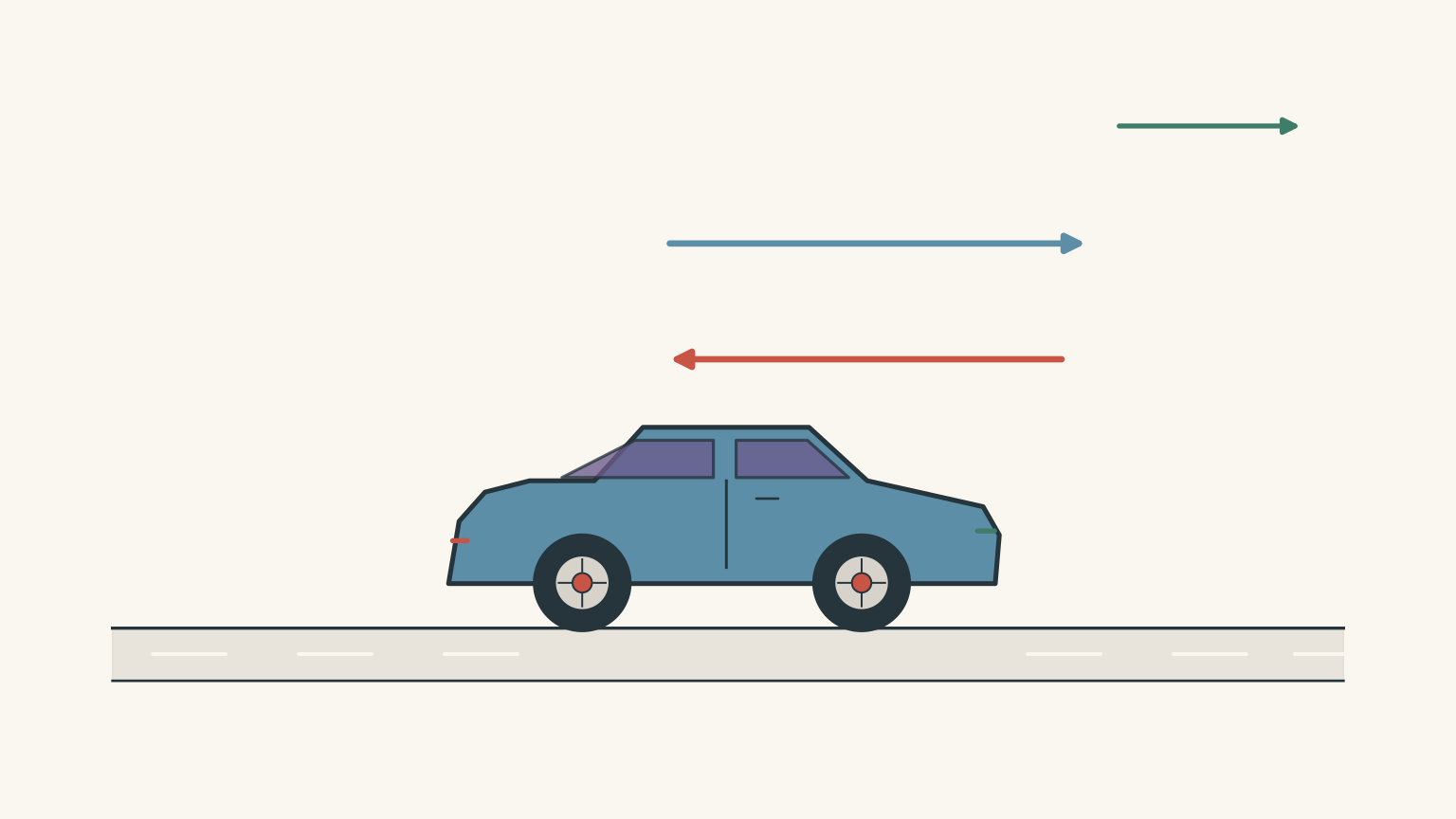
A car travels east along a straight road at 24.0 m/s. The driver applies the brakes, producing a constant acceleration of 3.00 m/s² towards the west, until the car stops.
Take east as the positive direction.
(a) Write the signed values of the initial velocity \(u\) and acceleration \(a\). (1 mark)
(b) Calculate the car’s displacement from the instant braking begins until it stops. Select an equation that does not require time, and explain why it is suitable. (4 marks)
(c) Calculate the time taken for the car to stop. (2 marks)
Question 4 (8 marks)
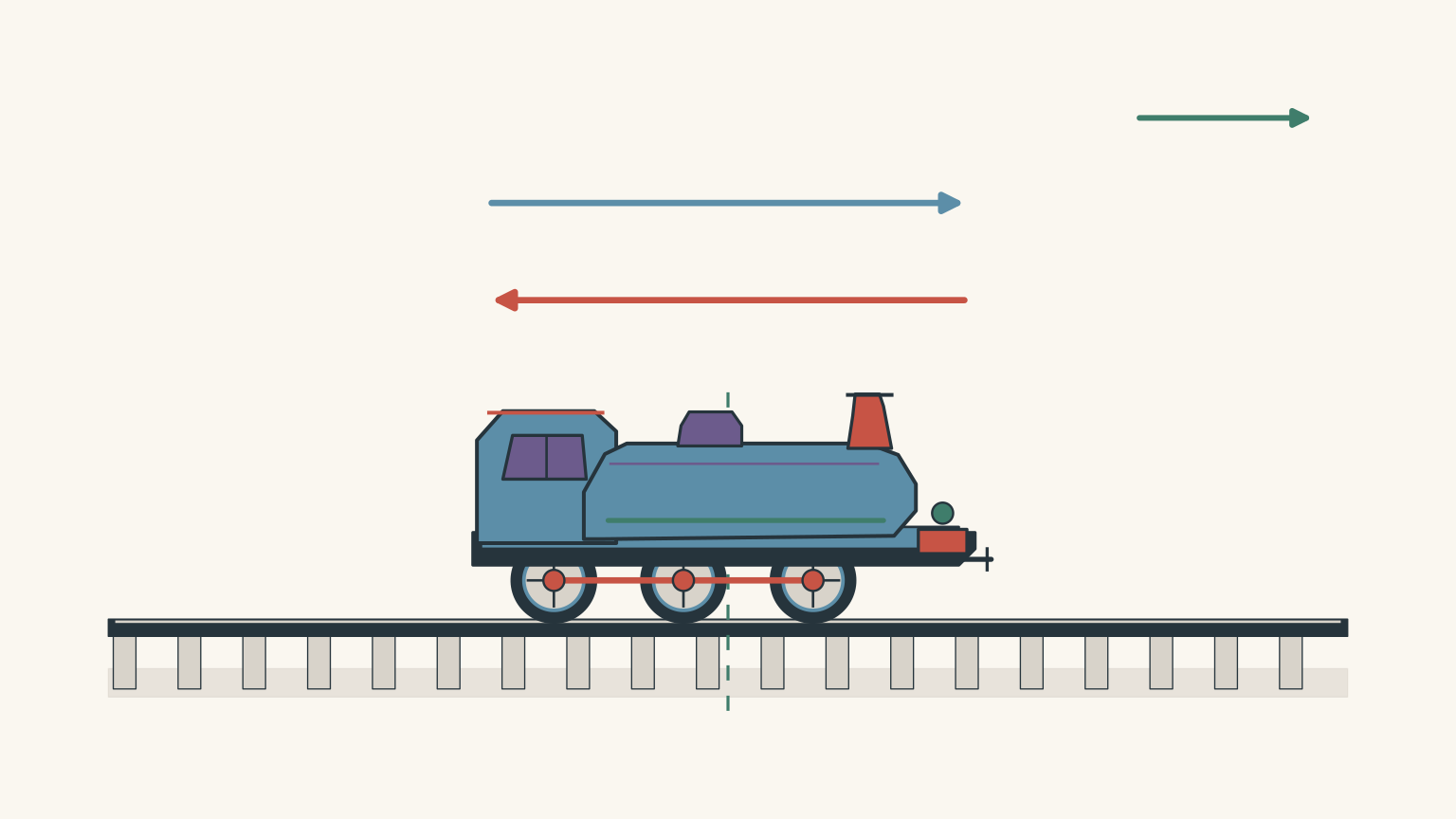
A model train passes a fixed reference marker at \(t=0\), travelling east at 12.0 m/s.
At this instant, the train is at \(x=0\). It then experiences a constant acceleration of 2.00 m/s² towards the west.
Take east as the positive direction.
(a) Write the signed value of the train’s acceleration. (1 mark)
(b) Calculate the train’s velocity after 8.00 s. (2 marks)
(c) Determine the time at which the train first becomes momentarily stationary. (2 marks)
(d) Calculate the train’s displacement from the reference marker after 8.00 s. (2 marks)
(e) Explain how the train can have a positive displacement but a negative velocity at \(t=8.00\text{ s}\). (1 mark)
Question 5 (8 marks)
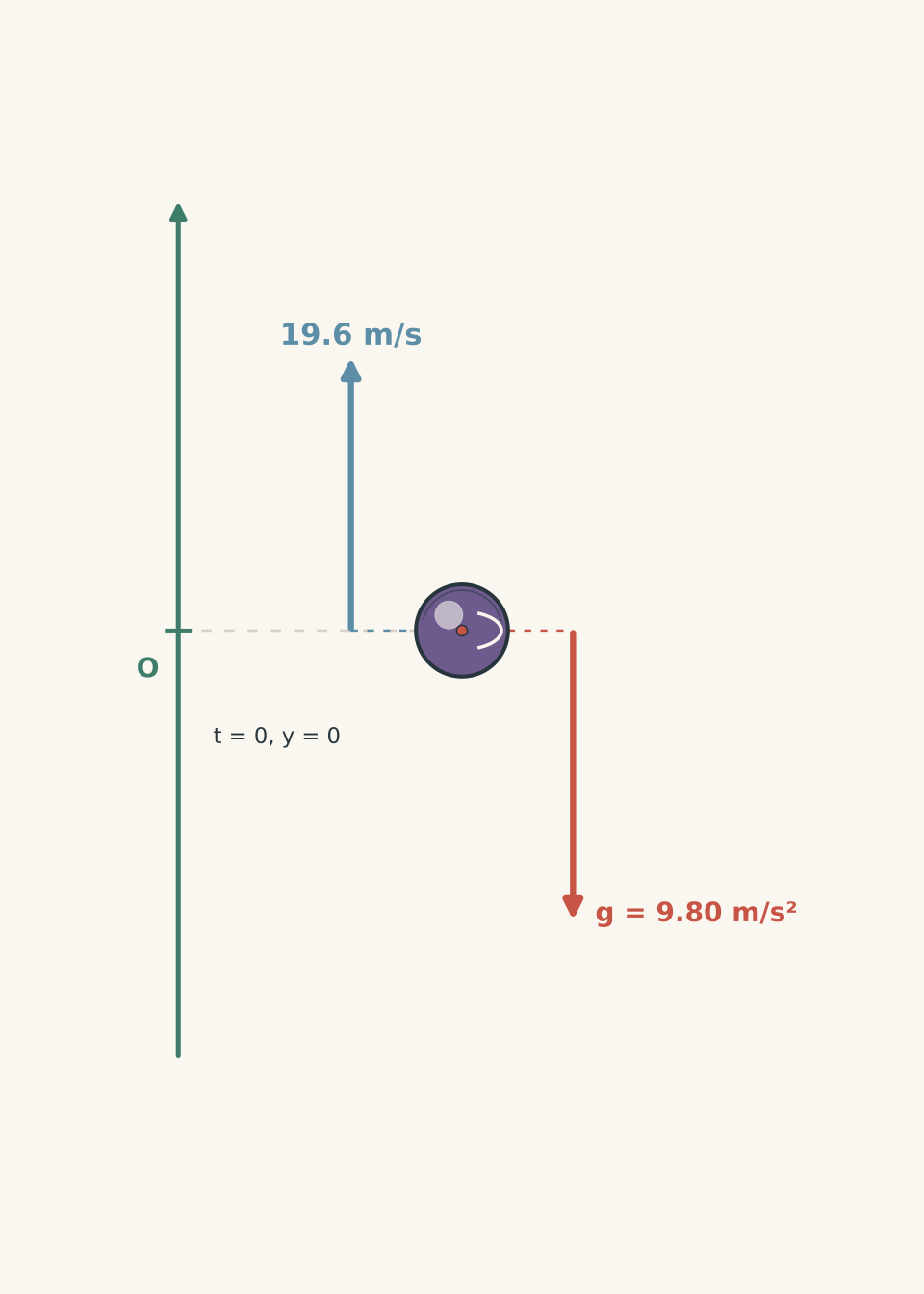
A ball is launched vertically upwards from a release point at \(t=0\), with an initial velocity of 19.6 m/s.
After release, air resistance is negligible, and the ball moves under the influence of gravity alone.
Take upward as the positive direction and the release point as the origin.
Use \(g=9.80\text{ m/s}^2\).
(a) Write the signed values of the ball’s initial velocity \(u\) and acceleration \(a\). (1 mark)
(b) Calculate the ball’s velocity after 3.00 s. (2 marks)
(c) Calculate the ball’s displacement from its release point after 3.00 s. (3 marks)
(d) Determine whether the ball is rising or falling at \(t=3.00\text{ s}\). Justify your answer using the sign of its velocity. (1 mark)
(e) While the ball is travelling upwards, explain why its acceleration still has a negative value. (1 mark)
Question 6 (7 marks)
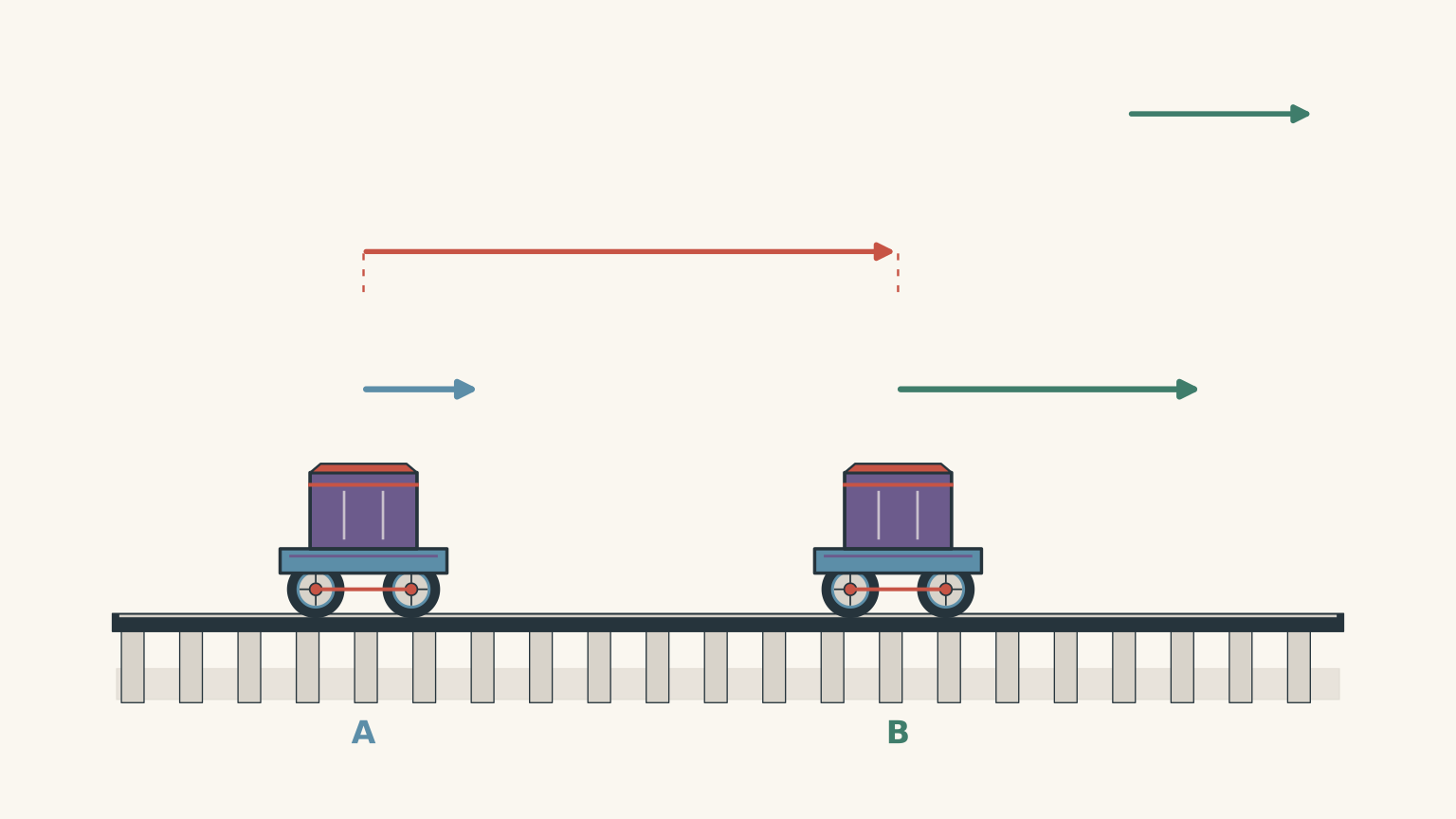
A trolley travels along a straight, horizontal track from point A to point B.
The displacement from A to B is 45.0 m east. The trolley’s velocity at A is \(+5.00\text{ m/s}\), and its velocity at B is \(+13.0\text{ m/s}\).
The trolley experiences constant acceleration throughout this interval.
Take east as the positive direction.
(a) Calculate the trolley’s acceleration. Select a constant-acceleration equation that does not involve time. (3 marks)
(b) Calculate the time taken for the trolley to travel from A to B. (2 marks)
(c) Use the displacement equation involving initial velocity, acceleration, and time to verify that your answers are consistent with the given displacement of 45.0 m. (2 marks)
03Worked solutions and marking guide
The following solutions show the expected reasoning, not just the final numerical answers.
Equivalent mathematical methods are acceptable where they are correctly applied. Follow-through marks should be awarded when a student makes an earlier numerical error but uses their resulting value consistently in a later part.
Solution 1
(a) Define uniform motion and uniformly accelerated motion. (2 marks)
Uniform motion occurs when an object travels with constant velocity. Its speed and direction remain unchanged.
Uniformly accelerated motion occurs when an object experiences constant acceleration. Its velocity changes by equal amounts during equal time intervals.
Marking guide:
- 1 mark: Identifies uniform motion as motion with constant velocity.
- 1 mark: Identifies uniformly accelerated motion as motion with constant acceleration.
(b) Identify the type of motion for each cart. (1 mark)
Cart A undergoes uniform motion because its velocity remains constant at \(+3.0\text{ m/s}\).
Cart B undergoes uniformly accelerated motion because its velocity increases by \(3.0\text{ m/s}\) during every 2.0 s interval.
Marking guide:
- 1 mark: Correctly identifies both carts.
(c) Calculate the acceleration of Cart B. (2 marks)
Acceleration is the change in velocity divided by the time taken.
\[ a=\frac{v-u}{t} \]
Using the initial and final velocities:
\[ \begin{aligned} a&=\frac{5.0-(-4.0)}{6.0}\\ &=\frac{9.0}{6.0}\\ &=+1.5\text{ m/s}^2 \end{aligned} \]
The acceleration is \(1.5\text{ m/s}^2\) in the positive direction.
Marking guide:
- 1 mark: Correctly calculates the change in velocity per unit time.
- 1 mark: Obtains \(+1.5\text{ m/s}^2\), including the correct unit and sign.
Solution 2
(a) Calculate the final velocity after 5.00 s. (2 marks)
We know:
- Initial velocity: \(u=+2.50\text{ m/s}\)
- Acceleration: \(a=+0.800\text{ m/s}^2\)
- Time: \(t=5.00\text{ s}\)
We need the final velocity, so use:
\[ v=u+at \]
Substitute:
\[ \begin{aligned} v&=2.50+(0.800)(5.00)\\ &=2.50+4.00\\ &=+6.50\text{ m/s} \end{aligned} \]
The final velocity is \(+6.50\text{ m/s}\).
Marking guide:
- 1 mark: Selects and correctly applies \(v=u+at\).
- 1 mark: Obtains \(+6.50\text{ m/s}\).
(b) Calculate the displacement during the 5.00 s interval. (3 marks)
We know the initial velocity, acceleration, and time.
We want displacement, so use:
\[ s=ut+\frac{1}{2}at^2 \]
Substitute:
\[ \begin{aligned} s&=(2.50)(5.00)\\ &\quad+\frac{1}{2}(0.800)(5.00)^2\\ &=12.5+10.0\\ &=22.5\text{ m} \end{aligned} \]
The skateboarder’s displacement is \(+22.5\text{ m}\).
The positive sign indicates that the skateboarder moves 22.5 m in the chosen positive direction.
Marking guide:
- 1 mark: Selects the correct displacement equation.
- 1 mark: Correctly substitutes the given quantities.
- 1 mark: Obtains \(+22.5\text{ m}\), including the correct unit and sign.
Solution 3
(a) Write the signed initial velocity and acceleration. (1 mark)
East is positive.
The car initially travels east, so its initial velocity is positive.
The acceleration acts west, so its acceleration is negative.
Therefore:
\[ u=+24.0\text{ m/s} \]
\[ a=-3.00\text{ m/s}^2 \]
Marking guide:
- 1 mark: Correctly identifies both signed quantities.
(b) Calculate the stopping displacement using an equation that does not require time. (4 marks)
We know:
- Initial velocity: \(u=+24.0\text{ m/s}\)
- Final velocity: \(v=0\text{ m/s}\), because the car stops.
- Acceleration: \(a=-3.00\text{ m/s}^2\)
We need displacement, but time is not given.
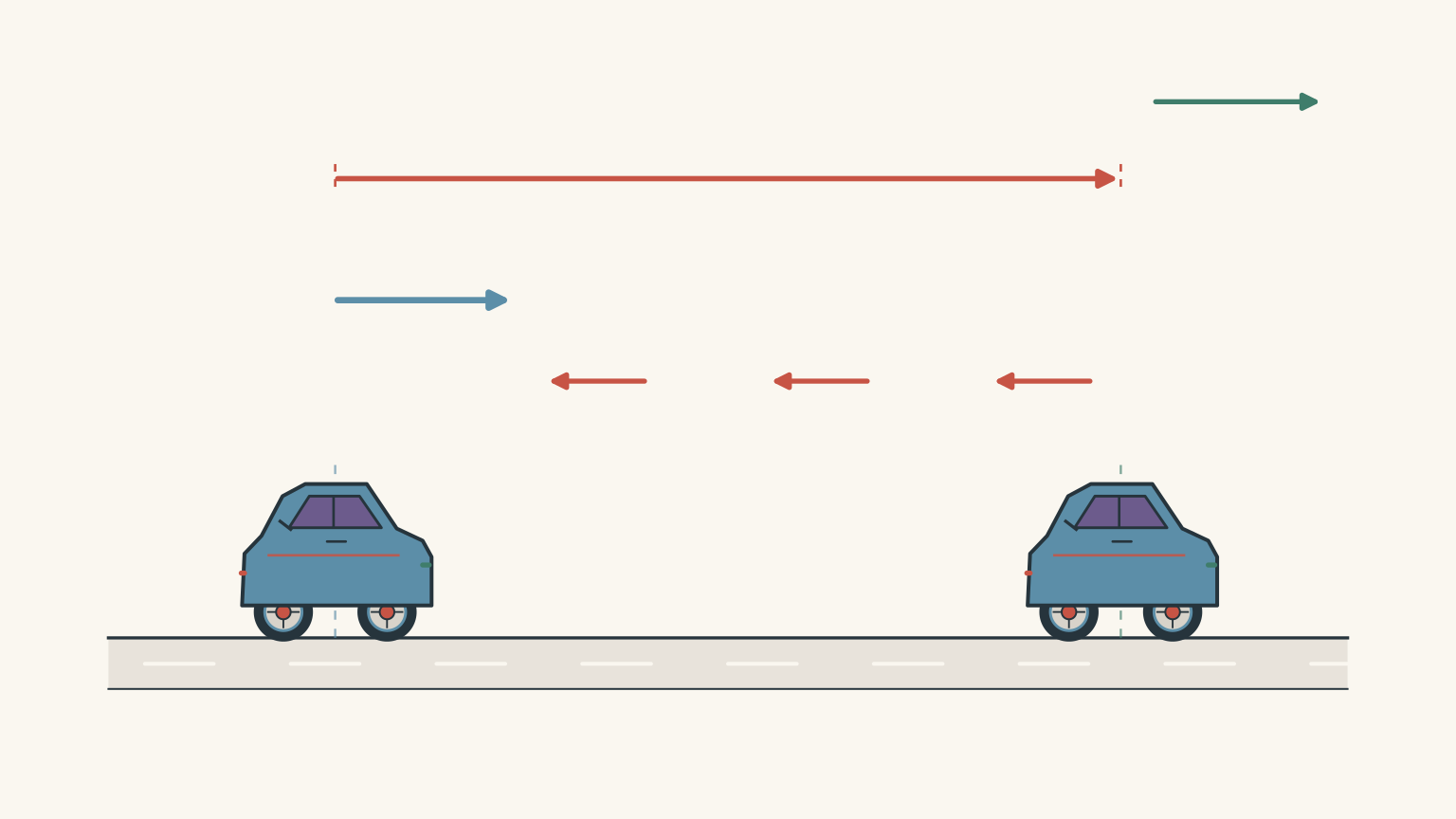
The most suitable equation is:
\[ v^2=u^2+2as \]
This equation is useful because it connects initial velocity, final velocity, acceleration, and displacement without requiring time.
Substitute:
\[ \begin{aligned} 0^2&=(24.0)^2+2(-3.00)s\\ 0&=576-6.00s\\ 6.00s&=576\\ s&=\frac{576}{6.00}\\ &=+96.0\text{ m} \end{aligned} \]
The stopping displacement is 96.0 m east.
Notice that the acceleration is negative, but the displacement is positive. This makes physical sense: the car continues travelling east while slowing down.
Marking guide:
- 1 mark: Selects \(v^2=u^2+2as\).
- 1 mark: Explains that the equation is suitable because it does not require time.
- 1 mark: Correctly substitutes the signed quantities.
- 1 mark: Obtains \(+96.0\text{ m}\), with the correct direction.
(c) Calculate the time taken for the car to stop. (2 marks)
Now we know the initial velocity, final velocity, and acceleration.
Use:
\[ v=u+at \]
At the stopping point, \(v=0\).
\[ \begin{aligned} 0&=24.0-3.00t\\ 3.00t&=24.0\\ t&=\frac{24.0}{3.00}\\ &=8.00\text{ s} \end{aligned} \]
The car takes 8.00 s to stop.
Marking guide:
- 1 mark: Correctly applies \(v=u+at\) and substitutes the known values.
- 1 mark: Obtains \(8.00\text{ s}\).
Solution 4
(a) Write the signed acceleration. (1 mark)
East is positive, so west is negative.
Therefore:
\[ a=-2.00\text{ m/s}^2 \]
Marking guide:
- 1 mark: Correctly identifies the signed acceleration.
(b) Calculate the velocity after 8.00 s. (2 marks)
We know:
\[ u=+12.0\text{ m/s} \]
\[ a=-2.00\text{ m/s}^2 \]
\[ t=8.00\text{ s} \]
Use:
\[ v=u+at \]
Substitute:
\[ \begin{aligned} v&=12.0+(-2.00)(8.00)\\ &=12.0-16.0\\ &=-4.00\text{ m/s} \end{aligned} \]
The train’s velocity is \(-4.00\text{ m/s}\), meaning it is travelling west.
Marking guide:
- 1 mark: Correctly applies \(v=u+at\).
- 1 mark: Obtains \(-4.00\text{ m/s}\) and interprets the direction correctly.
(c) Determine when the train first becomes momentarily stationary. (2 marks)
An object is momentarily stationary when its velocity is zero.
Set:
\[ v=0 \]
Using:
\[ v=u+at \]
Substitute:
\[ \begin{aligned} 0&=12.0-2.00t\\ 2.00t&=12.0\\ t&=\frac{12.0}{2.00}\\ &=6.00\text{ s} \end{aligned} \]
The train first becomes stationary after 6.00 s.
Marking guide:
- 1 mark: Sets \(v=0\) and correctly applies the velocity equation.
- 1 mark: Obtains \(6.00\text{ s}\).
(d) Calculate the displacement after 8.00 s. (2 marks)
We know:
- \(u=+12.0\text{ m/s}\)
- \(a=-2.00\text{ m/s}^2\)
- \(t=8.00\text{ s}\)
Use:
\[ s=ut+\frac{1}{2}at^2 \]
Substitute:
\[ \begin{aligned} s&=(12.0)(8.00)\\ &\quad+\frac{1}{2}(-2.00)(8.00)^2\\ &=96.0-64.0\\ &=+32.0\text{ m} \end{aligned} \]
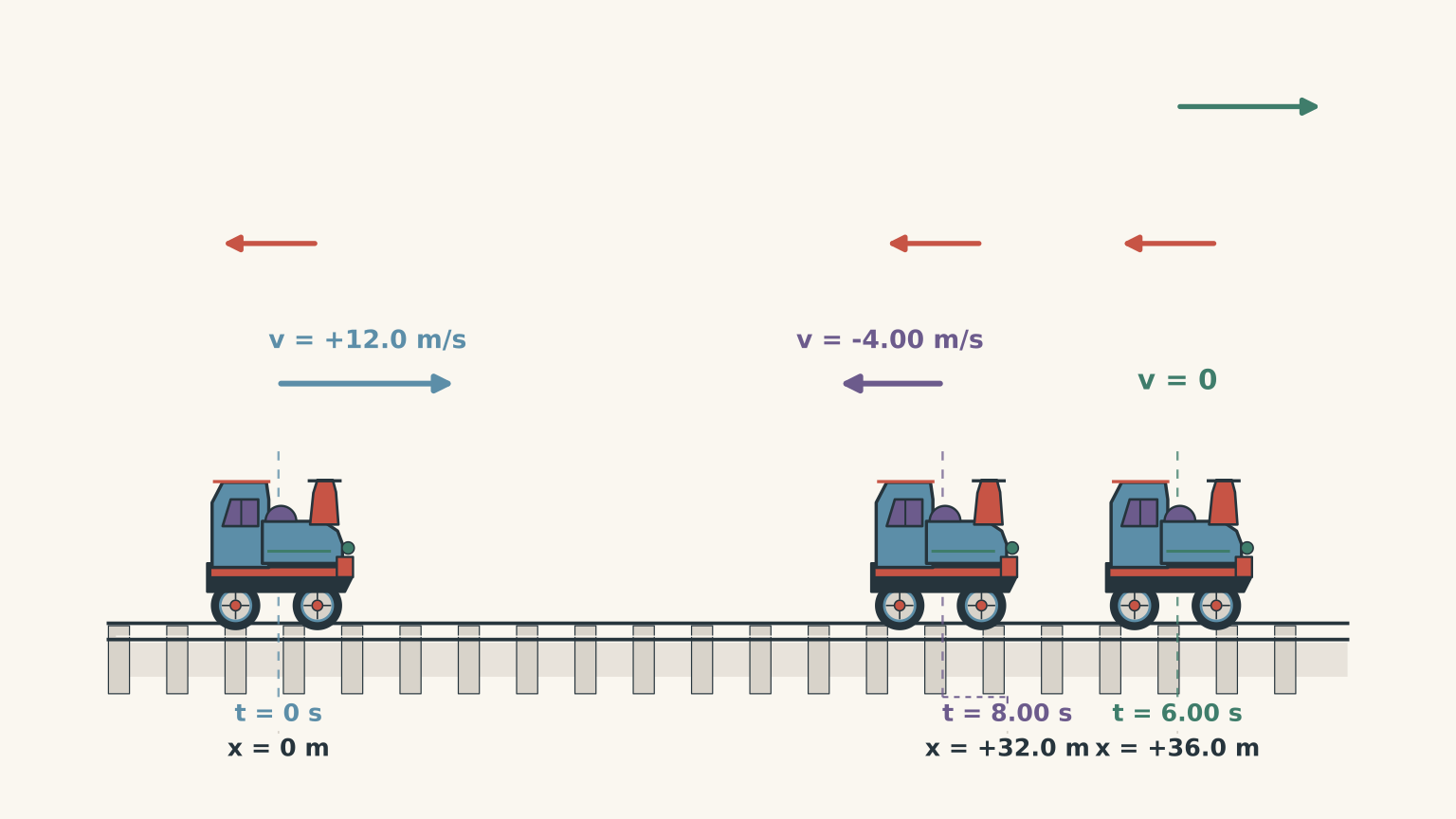
The train’s displacement is \(+32.0\text{ m}\), meaning it is 32.0 m east of the reference marker.
Marking guide:
- 1 mark: Correctly applies the displacement equation and substitutes the values.
- 1 mark: Obtains \(+32.0\text{ m}\).
(e) Explain why the displacement is positive but the velocity is negative. (1 mark)
Displacement and velocity describe different things.
Displacement tells us the train’s position relative to the reference marker. Its positive displacement means it is still east of the marker.
Velocity tells us the direction in which the train is currently moving. Its negative velocity means it is travelling west.
The train initially travels east, slows down, stops after 6.00 s, and then reverses direction. By 8.00 s, it has started travelling west but has not yet returned to the reference marker.
Marking guide:
- 1 mark: Correctly distinguishes positive position/displacement from negative instantaneous velocity and explains that the train has reversed direction.
Solution 5
(a) Write the signed initial velocity and acceleration. (1 mark)
Upward is positive.
The ball is initially moving upwards, so:
\[ u=+19.6\text{ m/s} \]
Gravity acts downwards, so:
\[ a=-9.80\text{ m/s}^2 \]
Marking guide:
- 1 mark: Correctly identifies both signed quantities.
(b) Calculate the velocity after 3.00 s. (2 marks)
We know:
\[ u=+19.6\text{ m/s} \]
\[ a=-9.80\text{ m/s}^2 \]
\[ t=3.00\text{ s} \]
Use:
\[ v=u+at \]
Substitute:
\[ \begin{aligned} v&=19.6+(-9.80)(3.00)\\ &=19.6-29.4\\ &=-9.80\text{ m/s} \end{aligned} \]
The ball’s velocity is \(-9.80\text{ m/s}\), meaning it is moving downwards.
Marking guide:
- 1 mark: Correctly applies \(v=u+at\).
- 1 mark: Obtains \(-9.80\text{ m/s}\), with the correct sign.
(c) Calculate the displacement after 3.00 s. (3 marks)
We know the initial velocity, acceleration, and time.
Use:
\[ s=ut+\frac{1}{2}at^2 \]
Substitute:
\[ \begin{aligned} s&=(19.6)(3.00)\\ &\quad+\frac{1}{2}(-9.80)(3.00)^2\\ &=58.8-44.1\\ &=+14.7\text{ m} \end{aligned} \]
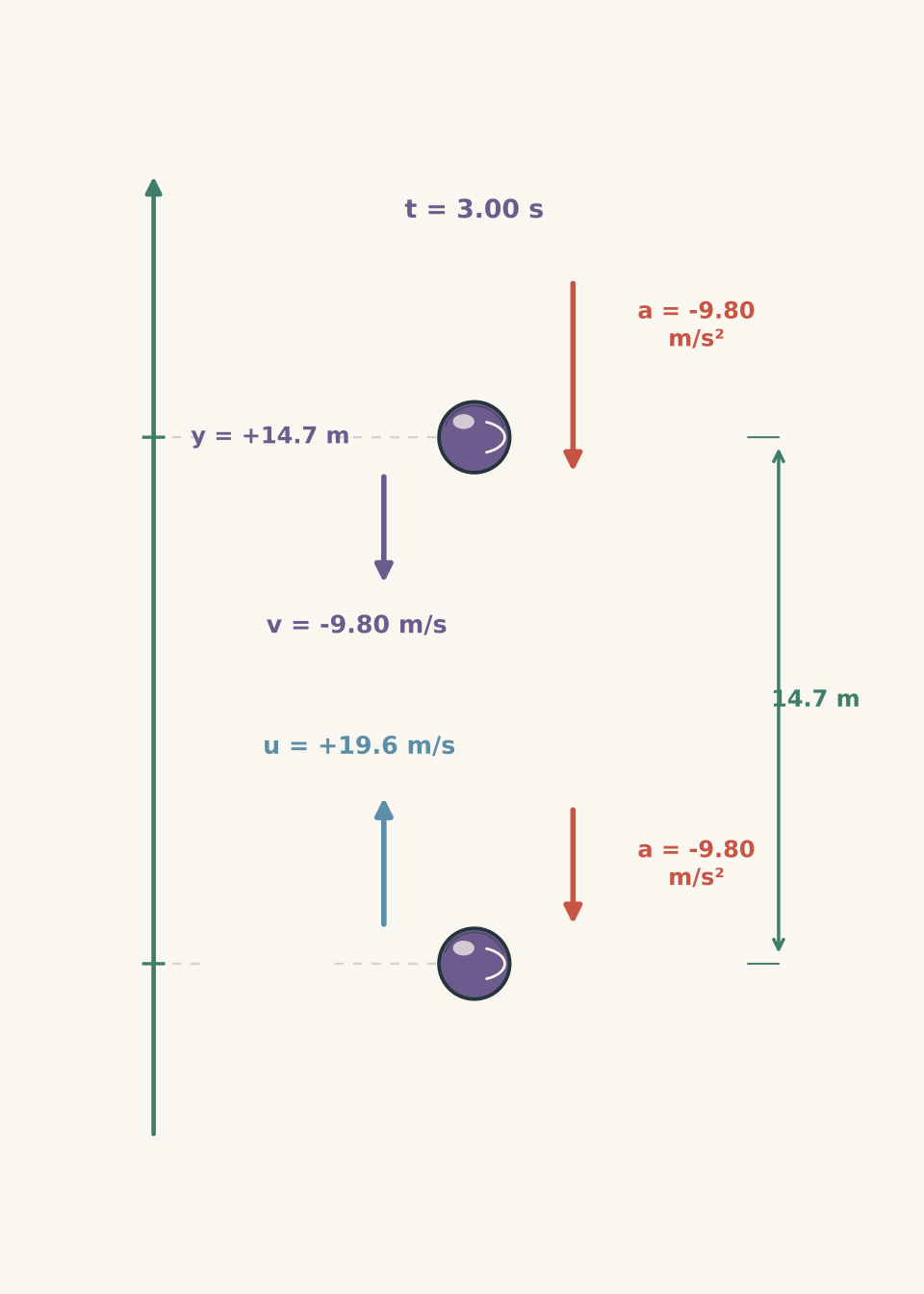
The ball’s displacement is \(+14.7\text{ m}\).
This means the ball is still 14.7 m above its release point, even though it is travelling downwards.
Marking guide:
- 1 mark: Selects the correct displacement equation.
- 1 mark: Correctly substitutes the signed quantities.
- 1 mark: Obtains \(+14.7\text{ m}\), including the correct direction.
(d) Determine whether the ball is rising or falling at 3.00 s. (1 mark)
The ball is falling.
Its velocity is negative, and upward was defined as positive. Therefore, its instantaneous direction of motion is downwards.
Marking guide:
- 1 mark: Identifies that the ball is falling, supported by the negative velocity.
(e) Explain why the acceleration is still negative while the ball is travelling upwards. (1 mark)
Acceleration describes how velocity changes, not which direction an object is currently travelling.
Gravity always acts downwards during the ball’s flight. Therefore, its acceleration remains negative throughout the flight, including while the ball is travelling upwards.
The ball initially moves upwards while its downward acceleration reduces its upward velocity. Eventually, the velocity reaches zero at the highest point, before becoming negative as the ball falls.
Marking guide:
- 1 mark: Explains that gravity acts downwards throughout the flight, so acceleration remains negative regardless of the direction of velocity.
Solution 6
(a) Calculate the trolley’s acceleration without using time. (3 marks)
We know:
- Initial velocity: \(u=+5.00\text{ m/s}\)
- Final velocity: \(v=+13.0\text{ m/s}\)
- Displacement: \(s=+45.0\text{ m}\)
We need acceleration, but time is not provided.
The appropriate equation is:
\[ v^2=u^2+2as \]
Rearrange to make acceleration the subject:
\[ a=\frac{v^2-u^2}{2s} \]
Substitute:
\[ \begin{aligned} a&=\frac{(13.0)^2-(5.00)^2}{2(45.0)}\\ &=\frac{169-25.0}{90.0}\\ &=\frac{144}{90.0}\\ &=+1.60\text{ m/s}^2 \end{aligned} \]
The trolley’s acceleration is \(+1.60\text{ m/s}^2\), or 1.60 m/s² east.
Marking guide:
- 1 mark: Selects \(v^2=u^2+2as\) and correctly substitutes the known quantities.
- 1 mark: Correctly rearranges and calculates the acceleration.
- 1 mark: Obtains \(+1.60\text{ m/s}^2\), including the correct unit and direction.
(b) Calculate the time taken to travel from A to B. (2 marks)
We now know the acceleration, initial velocity, and final velocity.
Use:
\[ v=u+at \]
Rearrange:
\[ t=\frac{v-u}{a} \]
Substitute:
\[ \begin{aligned} t&=\frac{13.0-5.00}{1.60}\\ &=\frac{8.00}{1.60}\\ &=5.00\text{ s} \end{aligned} \]
The trolley takes 5.00 s to travel from A to B.
Marking guide:
- 1 mark: Correctly applies \(v=u+at\) and substitutes the values.
- 1 mark: Obtains \(5.00\text{ s}\).
(c) Verify the displacement using the displacement equation. (2 marks)
We can check our answers using:
\[ s=ut+\frac{1}{2}at^2 \]
Substitute:
\[ \begin{aligned} s&=(5.00)(5.00)\\ &\quad+\frac{1}{2}(1.60)(5.00)^2\\ &=25.0+20.0\\ &=45.0\text{ m} \end{aligned} \]
The calculated displacement is 45.0 m east.
This matches the displacement given in the question, so our answers are consistent.
Marking guide:
- 1 mark: Correctly applies the displacement equation using the calculated acceleration and time.
- 1 mark: Obtains 45.0 m and confirms that it matches the given displacement. Follow-through is appropriate if earlier values contain an error but are used consistently.
End of paper
Total: 40 marks
| Question | Topic assessed | Marks |
|---|---|---|
| 1 | Uniform and uniformly accelerated motion | 5 |
| 2 | Velocity and displacement under constant acceleration | 5 |
| 3 | Braking and the time-free kinematics equation | 7 |
| 4 | Stopping, reversal, and sign conventions | 8 |
| 5 | Vertical free fall and velocity versus acceleration | 8 |
| 6 | Equation selection and combined kinematics | 7 |
| Total | 40 |