
Electric Forces and Fields: NSW HSC Physics Practice Exam
Test your understanding of electric forces and fields with this original 50-mark NSW HSC Physics practice exam. Includes timed assessment conditions, five exam-style questions, fully worked solutions, and a detailed marking guide covering the Physics 2017 syllabus scope.
This original tutorgum practice paper tests electric forces and fields in the supplied NSW HSC Physics 2017 syllabus scope. It is a focused topic assessment, not a full-course examination. The paper is written specifically for revision and is not an official NESA paper, an endorsed examination, or a prediction of future exam questions.
01Exam instructions
Assessment details
| Condition | Details |
|---|---|
| Subject | NSW HSC Physics |
| Syllabus edition | Physics 2017 |
| Topic | Electric forces and fields |
| Reading time | 5 minutes |
| Working time | 65 minutes |
| Total marks | 50 |
| Permitted equipment | Scientific calculator, ruler, pens, pencils, and eraser |
Assessed topics
This paper assesses the following content:
- Coulomb’s law and the electrostatic force between point charges.
- The effect of charge magnitude, separation, and the surrounding medium on electrostatic force.
- Electric field direction and relative strength around a point charge.
- Electric fields produced by pairs of charges, including electric dipoles.
- Superposition of electric fields.
- The force on positive and negative charges in an electric field.
Excluded topics
This paper does not assess electric potential, electric potential energy, capacitance, electrical circuits, magnetic fields, or the motion of charged particles.
Only the supplied Physics 2017 scope is assessed.
General instructions
- Attempt every question.
- Show all working for numerical calculations.
- Include appropriate units in your answers.
- Give answers to 2-3 significant figures unless otherwise specified.
- Include vector directions wherever a question asks for a force or electric field.
- For field-line diagrams, use clear arrows and ensure that field lines do not cross.
- All charges can be treated as point charges.
Unless otherwise stated, assume charges are in air, with the relative permittivity approximated as 1.00.
Supplied equations and constants
The following relationships may be used throughout the paper.
Coulomb’s law
For two point charges in a medium:
\[ F=\frac{k|q_1q_2|}{\epsilon_r r^2} \]
Electric field due to a point charge
\[ E=\frac{k|Q|}{\epsilon_r r^2} \]
Force on a charge in an electric field
\[ \vec F=q\vec E \]
Where:
- \(F\) = electrostatic force, measured in newtons (N).
- \(E\) = electric field strength, measured in newtons per coulomb (N C\(^{-1}\)).
- \(q_1\), \(q_2\), and \(Q\) = electric charges, measured in coulombs (C).
- \(r\) = separation or distance from the source charge, measured in metres (m).
- \(k\) = Coulomb’s constant.
- \(\epsilon_r\) = relative permittivity of the surrounding medium.
Use:
\[ k=8.99\times10^9 \ \mathrm{N\,m^2\,C^{-2}} \]
\[ 1\ \mu\mathrm{C}=1.0\times10^{-6}\ \mathrm C \]
For air or a vacuum, \(\epsilon_r=1\).
Remember that electric field direction is defined as the direction of the force on a positive test charge. A negative charge experiences a force in the opposite direction.
02Questions
Question 1 (8 marks)
Two stationary point charges are placed in air.
- Charge \(q_1=+3.0\ \mu\mathrm C\)
- Charge \(q_2=-2.0\ \mu\mathrm C\)
- Separation \(r=0.30\ \mathrm m\)
(a) Calculate the magnitude of the electrostatic force between the two charges. (3 marks)
(b) State whether the force is attractive or repulsive. Describe the direction of the force acting on each charge. (2 marks)
(c) Both charge magnitudes are doubled, and the separation between them is also doubled.
Determine the new force magnitude relative to the original force. Explain your reasoning using Coulomb’s law. (3 marks)
Question 2 (8 marks)
The diagram below shows the electric field surrounding an isolated negative point charge, \(-Q\).
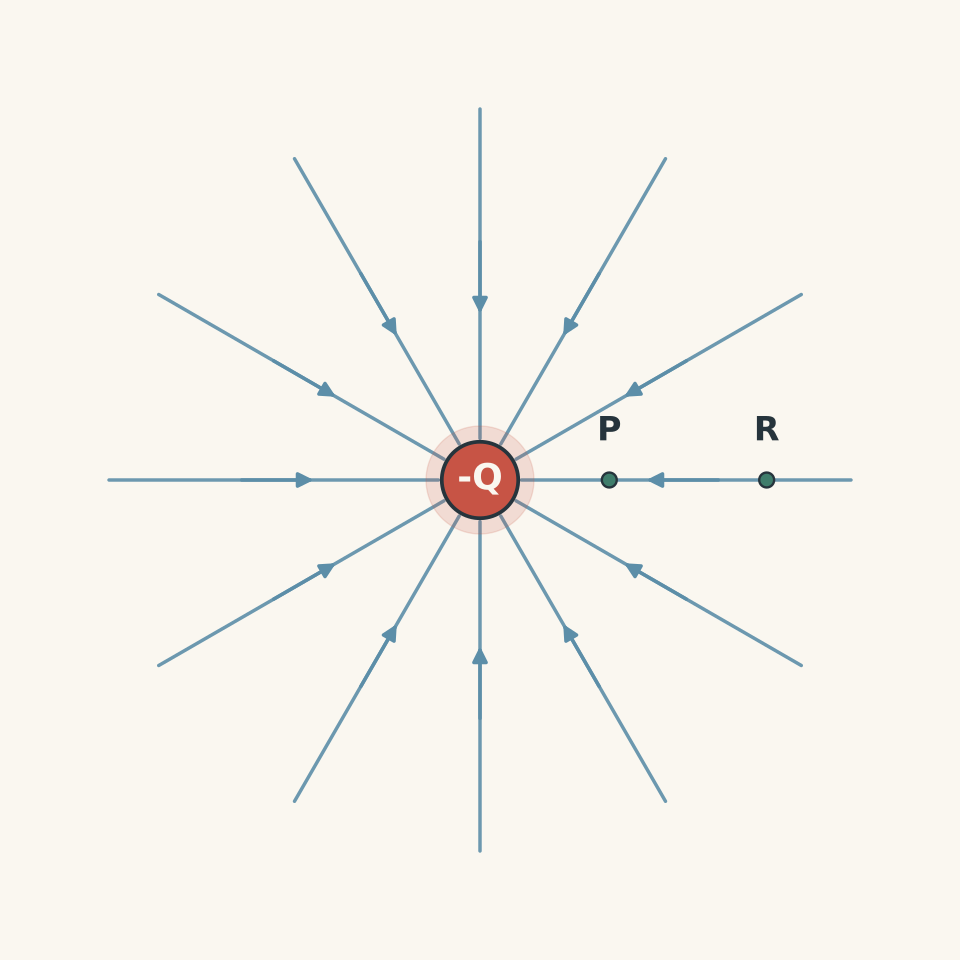
(a) State the direction of the electric field at points P and R. (2 marks)
(b) Compare the magnitude of the electric field strength at P and R. Justify your answer using the field-line diagram. (2 marks)
(c) A small negative test charge is placed at point R.
State the direction of the force acting on this test charge. (2 marks)
(d) The original source charge is replaced with a positive charge of equal magnitude.
Describe what happens to:
- The direction of the electric field lines.
- The relative spacing of the field lines at P and R.
(2 marks)
Question 3 (12 marks)
Two different arrangements of stationary point charges are shown below. The charges in each arrangement have equal magnitudes, and the separation between the charges is the same.
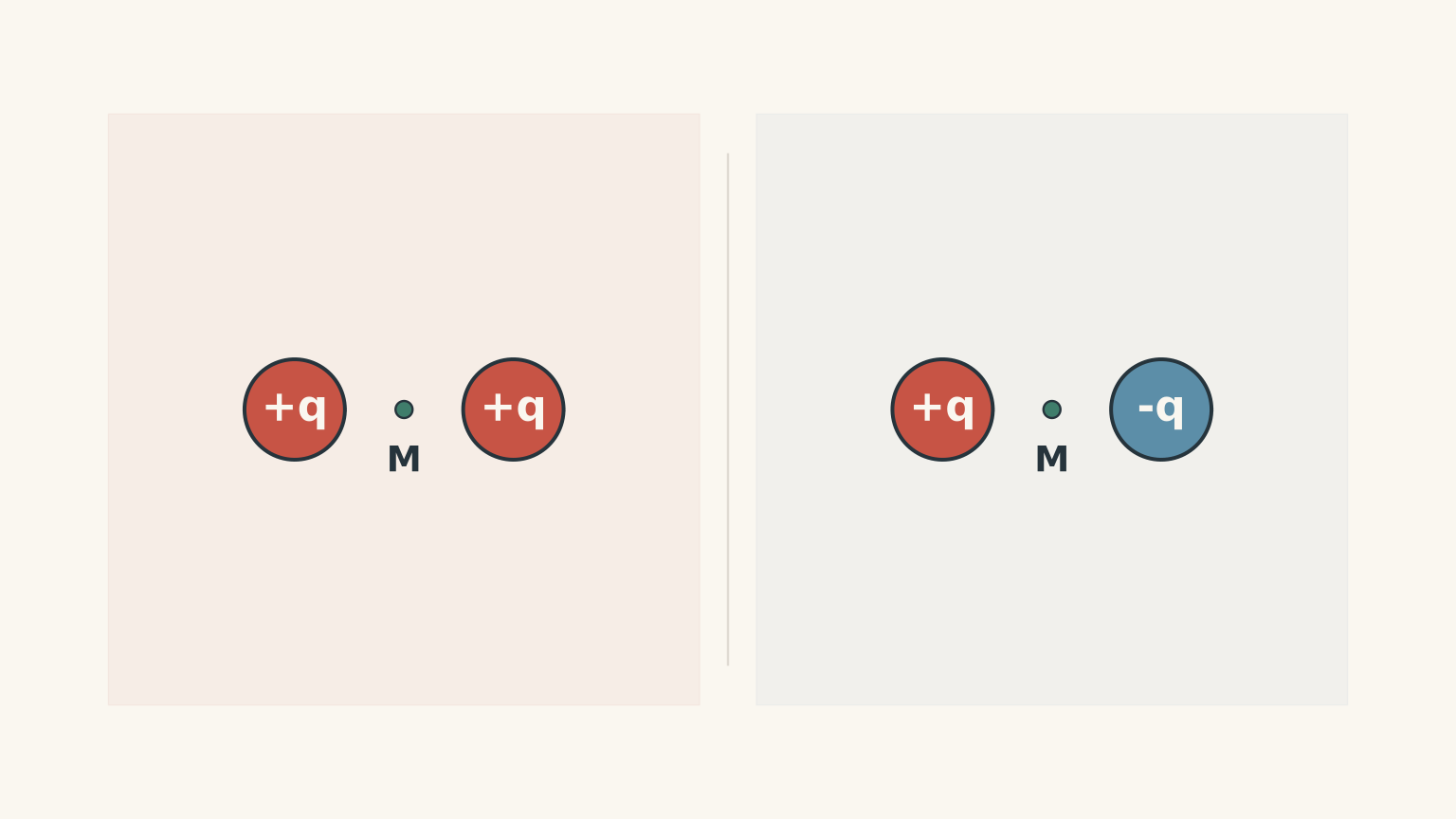
(a) Draw a qualitative electric field-line diagram for the two positive charges.
Your diagram should show the general shape and direction of the electric field lines. (4 marks)
(b) Draw a qualitative electric field-line diagram for the electric dipole.
Your diagram should show the general shape and direction of the electric field lines. (4 marks)
(c) Consider the electric field at midpoint M in each arrangement.
For each arrangement:
- Determine the net electric field at M.
- Explain your answer using the principle of superposition.
(4 marks)
Question 4 (12 marks)
Two fixed point charges, A and B, are positioned along a straight horizontal line.
- Charge A is \(+2.0\ \mu\mathrm C\).
- Charge B is \(-2.0\ \mu\mathrm C\).
- The separation between A and B is \(0.30\ \mathrm m\).
- Point P is located \(0.20\ \mathrm m\) to the right of B.
All charges are in air.
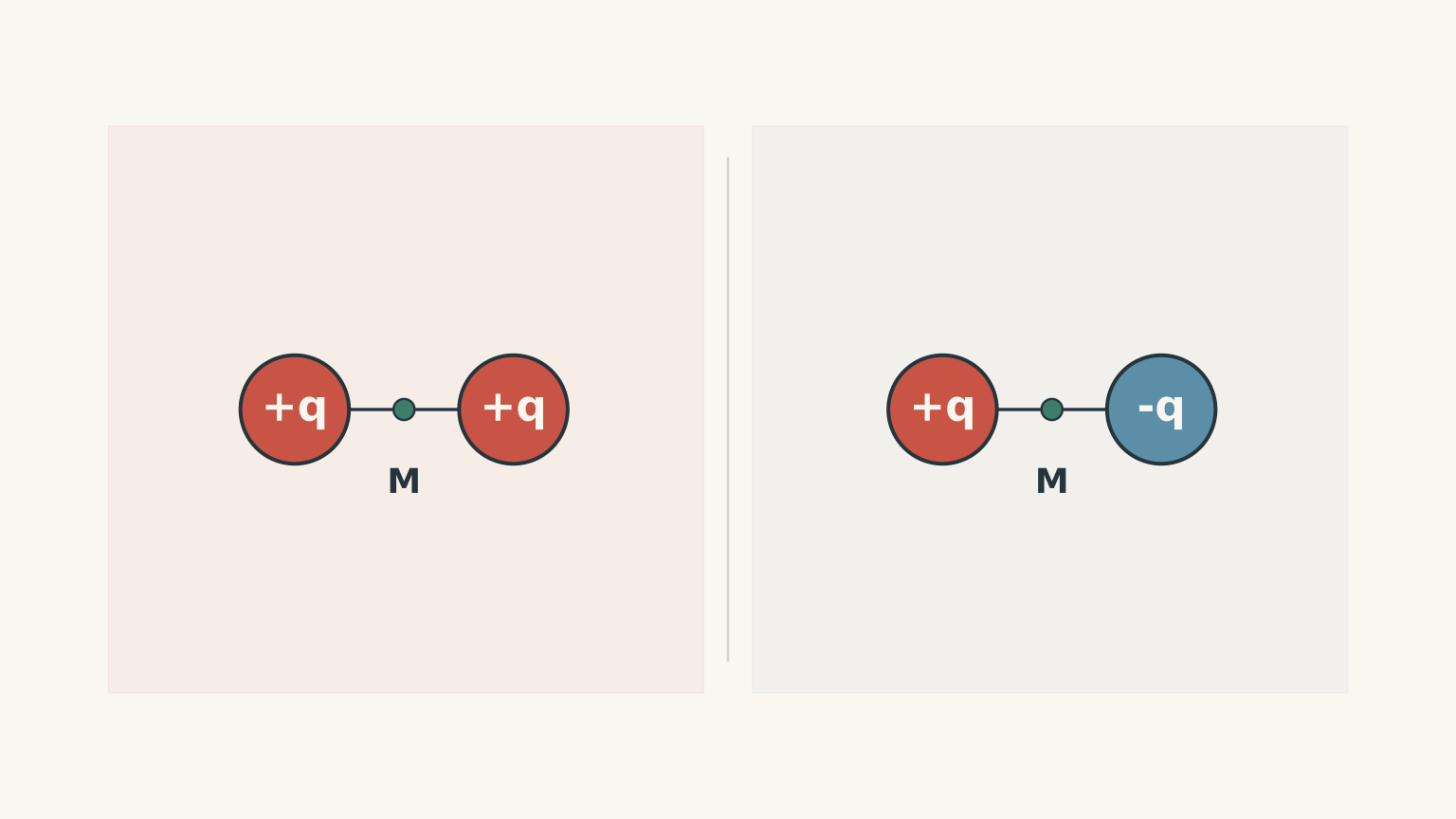
Initially, point P is empty. The source charges remain fixed throughout the question.
(a) On a copy of the diagram, draw an arrow at P showing the direction of the electric field produced by charge A alone. Draw a second arrow showing the direction of the electric field produced by charge B alone. (2 marks)
(b) Calculate the magnitude of the electric field at P due to charge A alone. (2 marks)
(c) Calculate the magnitude of the electric field at P due to charge B alone. (2 marks)
(d) Determine the magnitude and direction of the net electric field at P.
Show how you combine the two electric field contributions. (3 marks)
(e) A small test charge of \(-3.0\ \mu\mathrm C\) is now placed at P.
Calculate the magnitude of the electrostatic force acting on this test charge and state its direction. (3 marks)
Assume that introducing the test charge does not change the positions of the source charges.
Question 5 (10 marks)
Two stationary point charges are separated by \(0.25\ \mathrm m\) inside a uniform insulating medium.
The charges are:
- \(q_A=+4.0\ \mu\mathrm C\)
- \(q_B=-2.0\ \mu\mathrm C\)
The relative permittivity of the medium is \(\epsilon_r=2.0\).
(a) Calculate the magnitude of the electrostatic force between the charges.
State whether the force is attractive or repulsive. (4 marks)
(b) The same charges are placed at the same separation in a different insulating material with relative permittivity \(\epsilon_r=5.0\).
Calculate the new force magnitude and compare it with your answer to part (a). (3 marks)
(c) Return to the original arrangement, where \(\epsilon_r=2.0\).
Both charge magnitudes are increased by 50%, while the separation between the charges is doubled.
A student claims that the electrostatic force must increase because both charges have increased.
Determine the new force as a fraction of the original force and evaluate the student’s claim. (3 marks)
03Worked solutions and marking guide
Solution 1
(a) Calculate the magnitude of the electrostatic force. (3 marks)
We are given:
\[ q_1=3.0\times10^{-6}\ \mathrm C \]
\[ q_2=2.0\times10^{-6}\ \mathrm C \]
\[ r=0.30\ \mathrm m \]
Since the charges are in air, we use \(\epsilon_r=1\).
Apply Coulomb’s law:
\[ F=\frac{k|q_1q_2|}{r^2} \]
Substitute:
\[ F=\frac{ (8.99\times10^9) (3.0\times10^{-6})(2.0\times10^{-6}) }{(0.30)^2} \]
\[ F=\frac{0.05394}{0.09} \]
\[ F=0.5993\ \mathrm N \]
Therefore:
\[ \boxed{F=0.60\ \mathrm N} \]
The magnitude of the electrostatic force is 0.60 N.
Marking guide:
| Demonstrated working | Marks |
|---|---|
| Correct application of Coulomb’s law | 1 |
| Correct substitution using SI units | 1 |
| Correct numerical answer with units | 1 |
| Total | 3 |
(b) State whether the force is attractive or repulsive. (2 marks)
The two charges have opposite signs:
- \(q_1\) is positive.
- \(q_2\) is negative.
Opposite charges attract.
Therefore, the force is attractive.
The force on the positive charge acts towards the negative charge. The force on the negative charge acts towards the positive charge.
The two forces have equal magnitudes and opposite directions.
Marking guide:
| Demonstrated understanding | Marks |
|---|---|
| Identifies the force as attractive | 1 |
| Correctly describes the force direction on both charges | 1 |
| Total | 2 |
(c) Determine the new force magnitude. (3 marks)
Coulomb’s law tells us:
\[ F\propto\frac{|q_1q_2|}{r^2} \]
Both charge magnitudes are doubled.
Therefore, the product of the charges increases by:
\[ 2\times2=4 \]
The separation is also doubled, so the squared separation increases by:
\[ 2^2=4 \]
The new force relative to the original force is:
\[ \frac{F_{\mathrm{new}}}{F_{\mathrm{original}}} =\frac{4}{4} \]
\[ =1 \]
Therefore, the force magnitude remains unchanged.
\[ \boxed{F_{\mathrm{new}}=0.60\ \mathrm N} \]
The force also remains attractive because the charges still have opposite signs.
Marking guide:
| Demonstrated working | Marks |
|---|---|
| Recognises that the charge product increases by a factor of 4 | 1 |
| Recognises that the squared separation increases by a factor of 4 | 1 |
| Correctly concludes that the force is unchanged and remains attractive | 1 |
| Total | 3 |
Solution 2
(a) State the direction of the electric field at P and R. (2 marks)
Electric field direction is defined as the direction of the force on a positive test charge.
The source charge is negative.
A positive test charge would be attracted towards it.
Therefore, the electric field at both P and R points towards the negative source charge.
\[ \boxed{\text{Both electric fields point towards }-Q} \]
Marking guide:
| Demonstrated understanding | Marks |
|---|---|
| Correct direction at P | 1 |
| Correct direction at R | 1 |
| Total | 2 |
(b) Compare the electric field strengths at P and R. (2 marks)
The electric field is stronger at P than at R.
\[ \boxed{E_P>E_R} \]
Look at the spacing between the field lines.
The lines are closer together near P and more spread out near R.
Electric field-line density represents the relative strength of the electric field. Greater density indicates a stronger field.
This also agrees with the point-charge relationship:
\[ E=\frac{k|Q|}{r^2} \]
As the distance from a point charge increases, the electric field strength decreases.
Marking guide:
| Demonstrated understanding | Marks |
|---|---|
| Correctly identifies P as having the stronger field | 1 |
| Justifies the comparison using field-line spacing | 1 |
| Total | 2 |
(c) Determine the direction of the force on a negative test charge at R. (2 marks)
At R, the electric field points towards the negative source charge.
However, the test charge is also negative.
From:
\[ \vec F=q\vec E \]
a negative value of \(q\) means the force acts opposite to the electric field direction.
Therefore, the negative test charge experiences a force away from the negative source charge.
\[ \boxed{\text{The force points away from }-Q} \]
Marking guide:
| Demonstrated understanding | Marks |
|---|---|
| Recognises that a negative charge experiences a force opposite to the field | 1 |
| Correctly identifies the direction as away from the source charge | 1 |
| Total | 2 |
(d) Replace the negative source charge with a positive charge of equal magnitude. (2 marks)
Changing the source charge from negative to positive reverses the electric field direction.
The field lines would now point away from the positive source charge.
However, the relative spacing of the field lines would remain unchanged because the magnitude of the source charge and the positions of P and R have not changed.
Therefore:
- The arrows reverse direction.
- The relative field-line density remains the same.
Marking guide:
| Demonstrated understanding | Marks |
|---|---|
| Identifies that the field arrows reverse and point outwards | 1 |
| Recognises that relative line spacing remains unchanged | 1 |
| Total | 2 |
Solution 3
(a) Electric field pattern for two positive charges. (4 marks)
The correct diagram should show:
- Electric field lines pointing away from both positive charges.
- Field lines curving away from the region between the two charges.
- A symmetrical pattern because the charges have equal magnitudes.
- No field lines crossing or connecting the two positive charges.
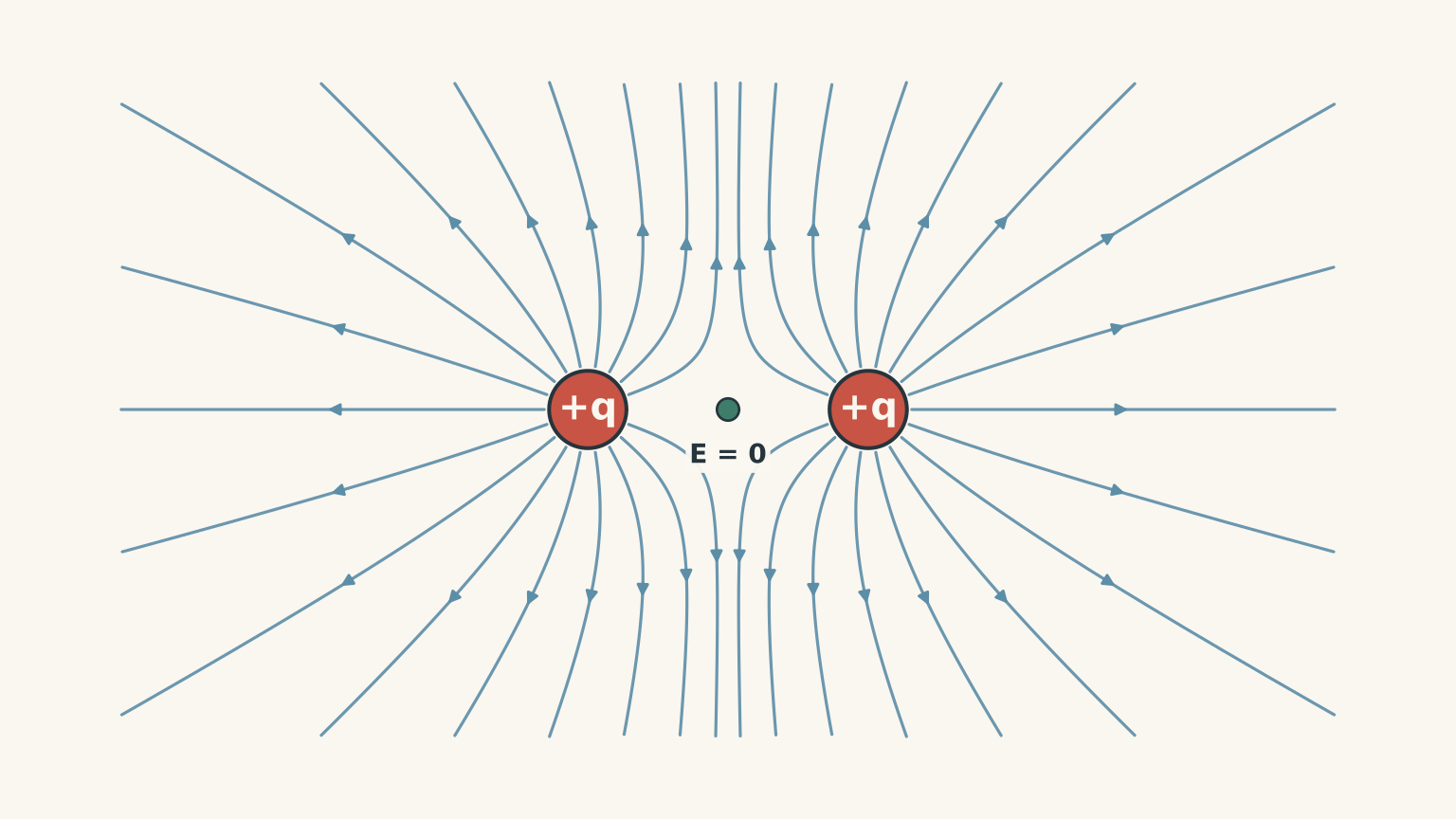
The important feature is that both positive charges act as sources of electric field lines.
Because the charges repel a positive test charge, their field patterns push away from the region between them.
Field lines do not cross because the electric field at any point has one unique direction.
Marking guide:
| Demonstrated understanding | Marks |
|---|---|
| Field lines point away from both positive charges | 1 |
| Lines curve away from the central region and do not join | 1 |
| Pattern is symmetrical | 1 |
| Field lines do not cross and extend outwards | 1 |
| Total | 4 |
Equivalent physically correct qualitative diagrams receive full marks.
(b) Electric field pattern for an electric dipole. (4 marks)
An electric dipole consists of two charges with equal magnitudes and opposite signs.
The correct diagram should show:
- Field lines originating from the positive charge.
- Field lines terminating on the negative charge.
- Arrows pointing from positive to negative.
- A symmetrical pattern with no crossing field lines.
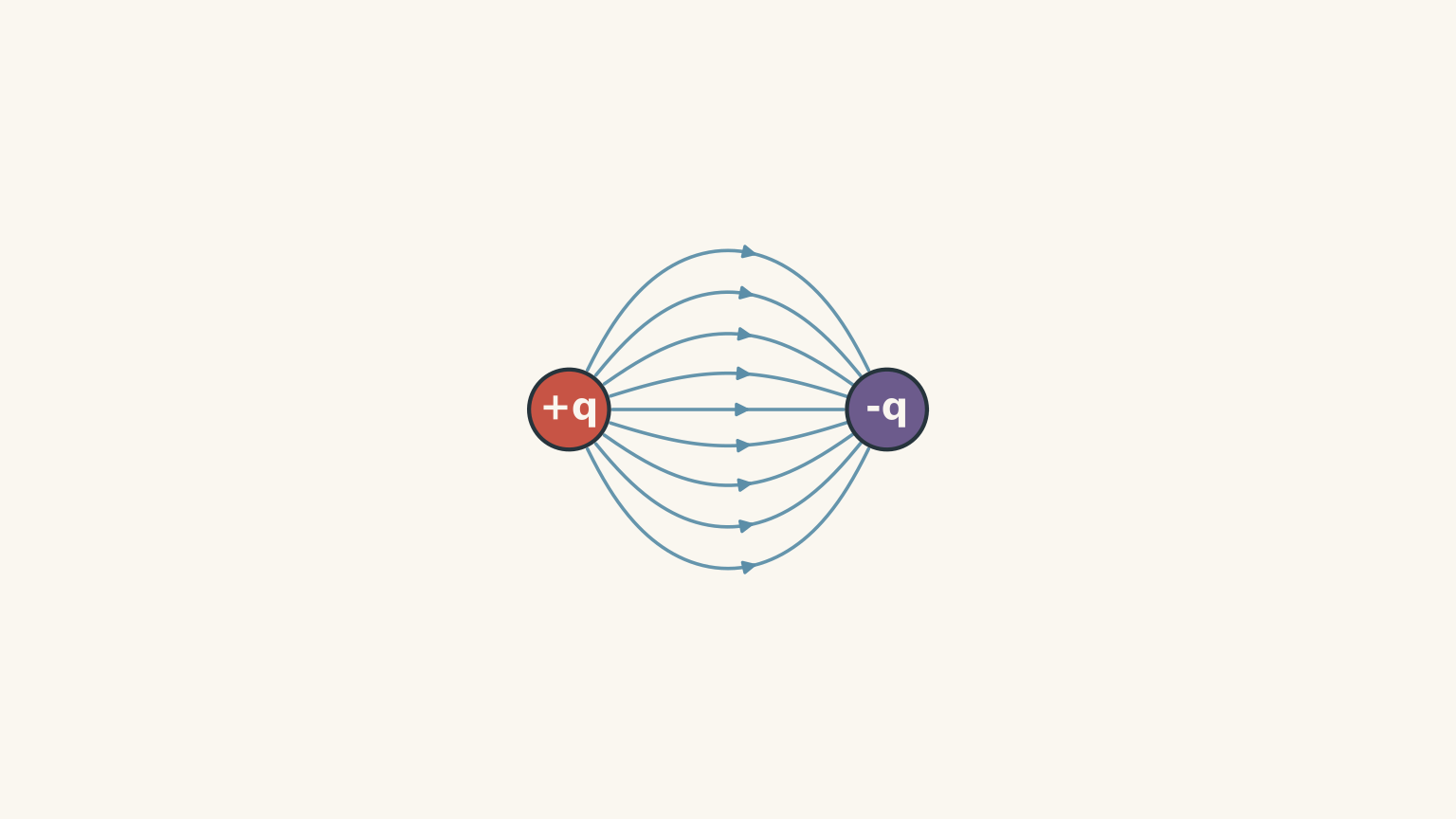
Notice that the field lines connect the two charges in the dipole.
This is different from the two-positive-charge arrangement in part (a), where the field lines extend outwards rather than terminating on another positive charge.
Marking guide:
| Demonstrated understanding | Marks |
|---|---|
| Correctly shows field lines originating at the positive charge and terminating at the negative charge | 1 |
| Correct arrow direction, positive to negative | 1 |
| Correct symmetrical dipole pattern | 1 |
| Field lines do not cross | 1 |
| Total | 4 |
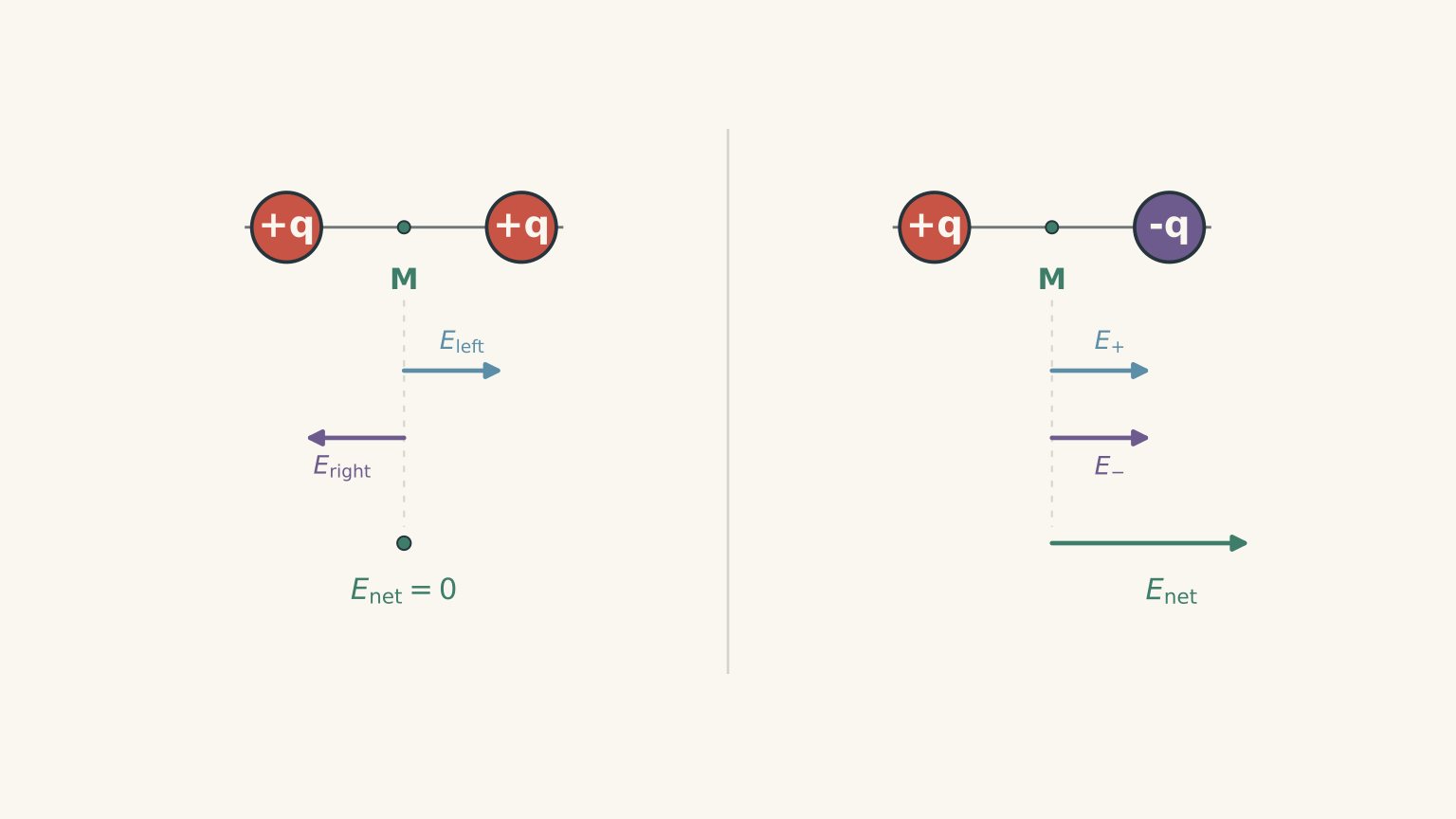
(c) Electric field at midpoint M. (4 marks)
We need to consider the electric field contributions from both charges separately, then combine them using superposition.
Superposition means that the net electric field is the vector sum of the individual electric fields.
Arrangement 1: Two positive charges
At midpoint M, each positive charge produces an electric field pointing away from itself.
Since M is exactly halfway between two equal positive charges:
- The field produced by the left charge points to the right.
- The field produced by the right charge points to the left.
- Both fields have equal magnitudes because the charges and distances are equal.
The two electric fields cancel.
Therefore:
\[ \boxed{E_{\mathrm{net}}=0\ \mathrm{N\,C^{-1}}} \]
Arrangement 2: Electric dipole
At midpoint M:
- The positive charge produces an electric field pointing away from itself.
- The negative charge produces an electric field pointing towards itself.
Both electric field contributions point from left to right, towards the negative charge.
They therefore reinforce each other rather than cancel.
The net electric field is non-zero and points towards the negative charge.
\[ \boxed{\text{Net field points from }+q\text{ to }-q} \]
Marking guide:
| Demonstrated understanding | Marks |
|---|---|
| Identifies equal magnitudes and opposite directions for the like-charge arrangement | 1 |
| Correctly concludes that the net field is zero | 1 |
| Identifies that both dipole contributions point from positive to negative | 1 |
| Correctly concludes that the net field points towards the negative charge | 1 |
| Total | 4 |
Solution 4
(a) Directions of the individual electric fields. (2 marks)
We consider each source charge separately.
Charge A is positive.
The electric field produced by a positive charge points away from the charge. Since P is to the right of A, the field produced by A at P points right.
Charge B is negative.
The electric field produced by a negative charge points towards the charge. Since B is to the left of P, the field produced by B at P points left.
Therefore:
- \(E_A\) points right.
- \(E_B\) points left.
Marking guide:
| Demonstrated understanding | Marks |
|---|---|
| Correct direction for the field produced by A | 1 |
| Correct direction for the field produced by B | 1 |
| Total | 2 |
(b) Calculate the electric field due to charge A. (2 marks)
We are given:
\[ Q_A=2.0\times10^{-6}\ \mathrm C \]
The distance from A to P is:
\[ r_A=0.30+0.20 \]
\[ r_A=0.50\ \mathrm m \]
Using the electric field equation:
\[ E_A=\frac{k|Q_A|}{r_A^2} \]
Substitute:
\[ E_A= \frac{(8.99\times10^9)(2.0\times10^{-6})} {(0.50)^2} \]
\[ E_A=\frac{17980}{0.25} \]
\[ E_A=71920\ \mathrm{N\,C^{-1}} \]
Therefore:
\[ \boxed{E_A=7.19\times10^4\ \mathrm{N\,C^{-1}}} \]
The direction is to the right.
Marking guide:
| Demonstrated working | Marks |
|---|---|
| Correct equation and distance from A to P | 1 |
| Correct numerical answer with units | 1 |
| Total | 2 |
(c) Calculate the electric field due to charge B. (2 marks)
For charge B:
\[ Q_B=2.0\times10^{-6}\ \mathrm C \]
\[ r_B=0.20\ \mathrm m \]
Using:
\[ E_B=\frac{k|Q_B|}{r_B^2} \]
Substitute:
\[ E_B= \frac{(8.99\times10^9)(2.0\times10^{-6})} {(0.20)^2} \]
\[ E_B=\frac{17980}{0.04} \]
\[ E_B=449500\ \mathrm{N\,C^{-1}} \]
Therefore:
\[ \boxed{E_B=4.50\times10^5\ \mathrm{N\,C^{-1}}} \]
The direction is to the left.
Marking guide:
| Demonstrated working | Marks |
|---|---|
| Correct equation and distance from B to P | 1 |
| Correct numerical answer with units | 1 |
| Total | 2 |
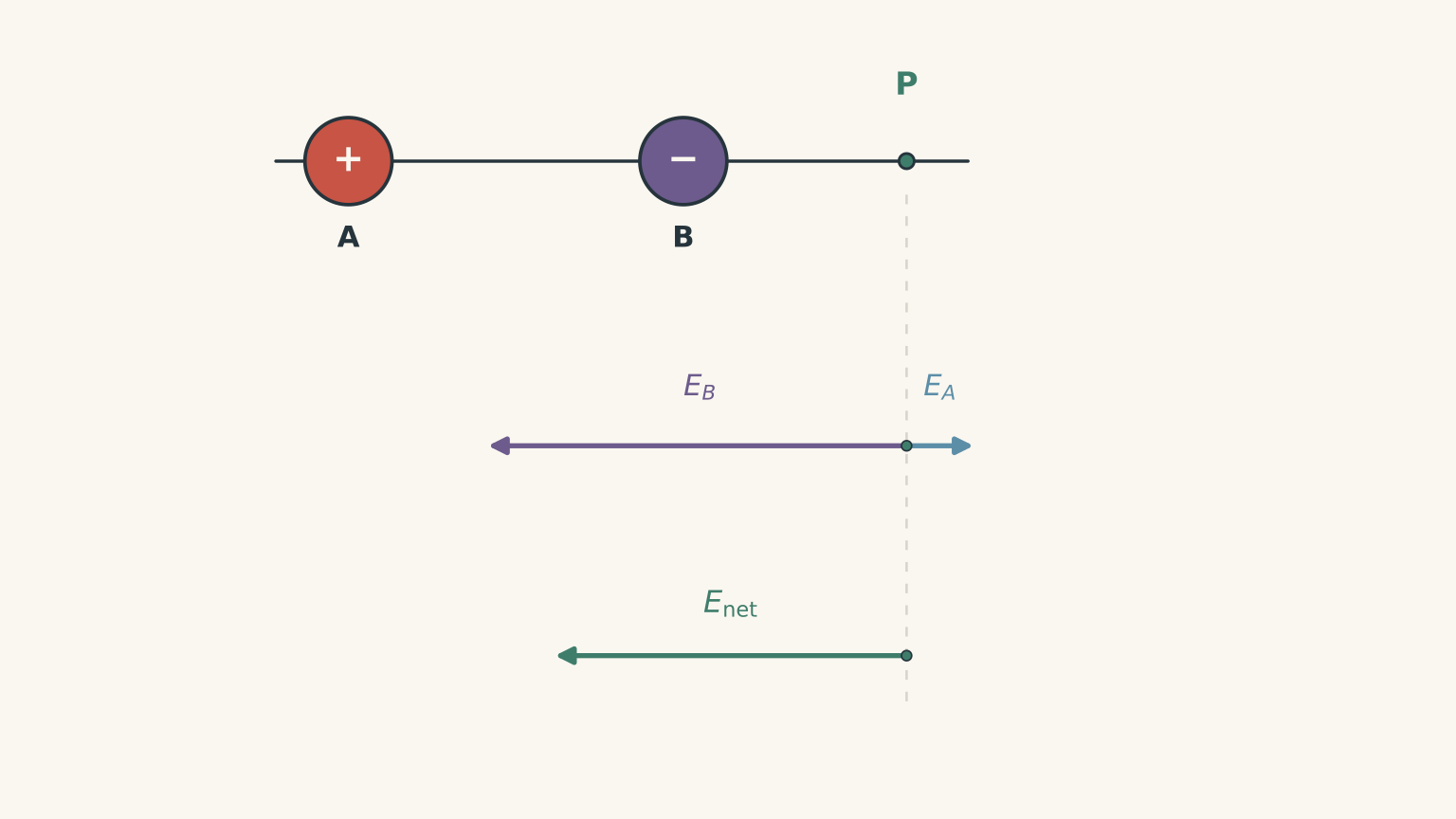
(d) Determine the net electric field at P. (3 marks)
The two electric fields point in opposite directions.
This means we must subtract their magnitudes rather than simply add them.
Take right as the positive direction.
\[ E_{\mathrm{net}}=E_A-E_B \]
Substitute:
\[ E_{\mathrm{net}} =7.192\times10^4 -4.495\times10^5 \]
\[ E_{\mathrm{net}} =-3.7758\times10^5 \ \mathrm{N\,C^{-1}} \]
The negative sign indicates that the net electric field points left.
Therefore:
\[ \boxed{ E_{\mathrm{net}}= 3.78\times10^5\ \mathrm{N\,C^{-1}} } \]
Direction: left.
Marking guide:
| Demonstrated working | Marks |
|---|---|
| Correctly combines the fields as opposing vectors | 1 |
| Correct net field magnitude | 1 |
| Correct direction, left | 1 |
| Total | 3 |
(e) Calculate the force on the negative test charge. (3 marks)
We are now introducing a test charge:
\[ q=-3.0\times10^{-6}\ \mathrm C \]
The net electric field is:
\[ E=3.7758\times10^5\ \mathrm{N\,C^{-1}} \]
From the previous part, the net electric field points left.
Use:
\[ F=|q|E \]
Substitute:
\[ F=(3.0\times10^{-6}) (3.7758\times10^5) \]
\[ F=1.13274\ \mathrm N \]
Therefore, the force magnitude is:
\[ \boxed{F=1.13\ \mathrm N} \]
Now consider the direction.
The test charge is negative, so its force acts opposite to the electric field.
Since the electric field points left, the force points right.
\[ \boxed{\text{Force}=1.13\ \mathrm N \text{ to the right}} \]
This is an important distinction: the electric field at P is produced by the source charges A and B. The force depends on the additional charge placed in that field.
Marking guide:
| Demonstrated working | Marks |
|---|---|
| Correct application of \(F=|q|E\) | 1 |
| Correct force magnitude with units | 1 |
| Correct direction, right | 1 |
| Total | 3 |
Follow-through marks should be awarded if a student’s net field calculation in part (d) contains an arithmetic error but is used correctly in part (e).
Solution 5
(a) Calculate the electrostatic force in the original medium. (4 marks)
We are given:
\[ q_A=4.0\times10^{-6}\ \mathrm C \]
\[ q_B=2.0\times10^{-6}\ \mathrm C \]
\[ r=0.25\ \mathrm m \]
\[ \epsilon_r=2.0 \]
Because the charges are in an insulating medium, we must include relative permittivity in Coulomb’s law.
\[ F=\frac{k|q_Aq_B|}{\epsilon_r r^2} \]
Substitute:
\[ F= \frac{ (8.99\times10^9) (4.0\times10^{-6})(2.0\times10^{-6}) }{ 2.0(0.25)^2 } \]
Simplify:
\[ F=\frac{0.07192}{0.125} \]
\[ F=0.57536\ \mathrm N \]
Therefore:
\[ \boxed{F=0.575\ \mathrm N} \]
The charges have opposite signs, so the force is attractive.
Marking guide:
| Demonstrated working | Marks |
|---|---|
| Correct Coulomb’s law equation, including relative permittivity | 1 |
| Correct substitution of values | 1 |
| Correct force magnitude with units | 1 |
| Correctly identifies the force as attractive | 1 |
| Total | 4 |
(b) Calculate the force in a medium with relative permittivity 5.0. (3 marks)
The charges and separation remain unchanged.
Only the relative permittivity changes from 2.0 to 5.0.
From Coulomb’s law:
\[ F\propto\frac{1}{\epsilon_r} \]
Therefore, the ratio of the new force to the original force is:
\[ \frac{F_{\mathrm{new}}}{F_{\mathrm{original}}} =\frac{2.0}{5.0} \]
\[ =0.40 \]
The new force is 40% of the original force.
Using the original force:
\[ F_{\mathrm{new}}=0.40(0.57536) \]
\[ F_{\mathrm{new}}=0.230144\ \mathrm N \]
Therefore:
\[ \boxed{F_{\mathrm{new}}=0.230\ \mathrm N} \]
The force decreases because the relative permittivity has increased.
The force remains attractive because the charges still have opposite signs.
Marking guide:
| Demonstrated working | Marks |
|---|---|
| Correctly establishes the force ratio of \(2/5\) | 1 |
| Correct new force magnitude with units | 1 |
| Explains why the greater relative permittivity reduces the force | 1 |
| Total | 3 |
(c) Determine the new force as a fraction of the original force. (3 marks)
The student claims that increasing both charge magnitudes must increase the electrostatic force.
However, we also need to consider the increased separation.
Start with Coulomb’s law:
\[ F\propto\frac{|q_Aq_B|}{r^2} \]
Both charge magnitudes increase by 50%.
A 50% increase means multiplying each charge by 1.5.
Therefore, the product of the charge magnitudes increases by:
\[ 1.5\times1.5=2.25 \]
The separation is doubled.
Therefore, the squared separation increases by:
\[ 2^2=4 \]
Combining these changes:
\[ \frac{F_{\mathrm{new}}}{F_{\mathrm{original}}} =\frac{2.25}{4} \]
\[ =0.5625 \]
Therefore:
\[ \boxed{ F_{\mathrm{new}}=0.5625F_{\mathrm{original}} } \]
The new force is 56.25% of the original force.
We can also calculate its numerical value:
\[ F_{\mathrm{new}}=0.5625(0.57536) \]
\[ \boxed{F_{\mathrm{new}}=0.324\ \mathrm N} \]
The student’s claim is incorrect.
Although increasing both charge magnitudes increases the force, doubling the separation has a stronger overall effect. The net result is a decrease in electrostatic force.
Marking guide:
| Demonstrated working | Marks |
|---|---|
| Correctly identifies the charge-product increase of 2.25 | 1 |
| Correctly identifies the squared-separation increase of 4 | 1 |
| Obtains the force ratio of 0.5625 and rejects the student’s claim | 1 |
| Total | 3 |
End of practice paper
Total: 50 marks