
Escape Velocity and Launch Energy: HSC Physics Practice Exam
Test your understanding of escape velocity and gravitational launch energy with this original 40-mark NSW HSC Physics practice exam. Includes timed assessment conditions, six original questions, complete worked solutions, and a detailed marking guide.
This original tutorgum practice paper tests gravitational launch energy and escape velocity in NSW HSC Physics. It focuses on applying conservation of mechanical energy between a launch point and a specified final state, including escape to infinity.
The assessed scope is compatible with the 2017 and 2025 Physics syllabus editions. This is a focused topic assessment, not a full-course HSC mock exam, and it is an original tutorgum practice paper, not an official, endorsed, past, or predicted NESA paper.
The paper covers deriving and using escape velocity, comparing escape conditions across planets and launch altitudes, calculating non-zero speeds at infinity, and distinguishing escape speed from circular orbital speed.
01Exam instructions
| Assessment condition | Details |
|---|---|
| Suggested working time | 60 minutes |
| Reading time | 5 minutes |
| Total marks | 40 |
| Equipment | Scientific calculator, ruler, pens and pencils |
| Working | Show all calculations and reasoning |
| Numerical precision | Give final numerical answers to 3 significant figures unless otherwise stated |
Assumptions and supplied information
Unless a question states otherwise, assume:
- Each planet is spherical, stationary, and non-rotating.
- There is no atmosphere or air resistance.
- Gravity is the only force acting on the object.
- No mechanical energy is lost.
- All launch motion is radially outward.
- The gravitational potential energy of an object is zero at infinity.
Use the following expressions:
Kinetic energy:
\[ K=\frac{1}{2}mv^2 \]
Gravitational potential energy:
\[ U=-\frac{GMm}{r} \]
Total mechanical energy:
\[ E=K+U \]
The symbols represent:
- \(G=6.67\times10^{-11}\ \mathrm{N\,m^2\,kg^{-2}}\): universal gravitational constant.
- \(M\): mass of the planet, in kilograms.
- \(m\): mass of the object, in kilograms.
- \(r\): distance from the planet’s centre, in metres.
- \(R\): radius of the planet, in metres.
- \(h\): altitude above the planet’s surface, in metres.
- \(v\): speed of the object, in metres per second.
For all calculations, use the planet’s mass as though it were concentrated at its centre.
For Question 5, the circular orbital speed at radius \(r\) is given by:
\[ v_c=\sqrt{\frac{GM}{r}} \]
You are not required to derive this expression.
02Questions
Question 1 (7 marks)
An object of mass \(m\) is launched from a distance \(r\) from the centre of a spherical planet of mass \(M\).
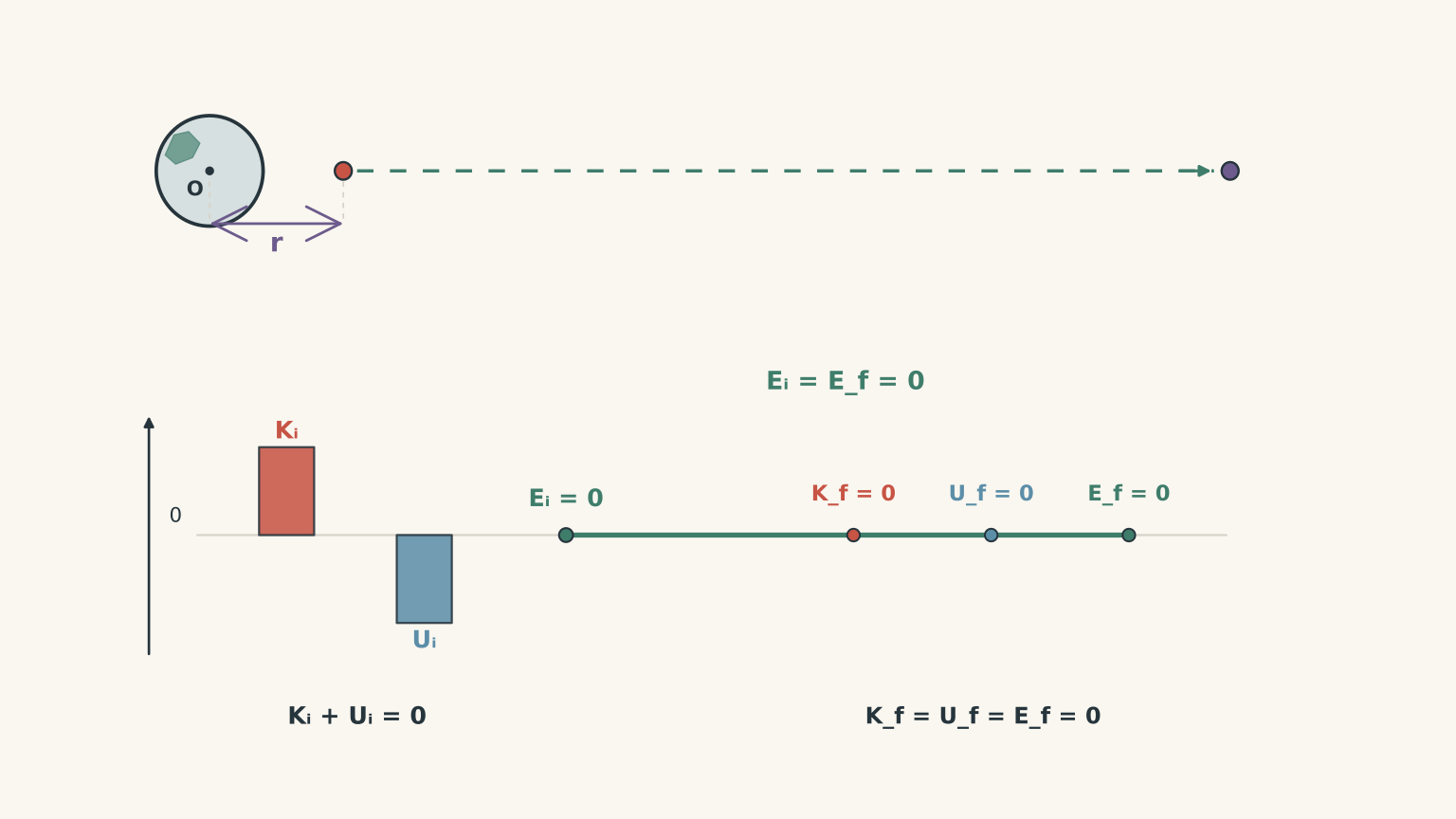
The object is launched with the minimum speed required to escape the planet’s gravitational influence. For this minimum-speed case, the object reaches infinity with zero speed.
(a) Starting from the conservation of mechanical energy, derive an expression for the minimum escape speed, \(v_{\mathrm{esc}}\), in terms of \(G\), \(M\), and \(r\).
(5 marks)
(b) Explain why the mass of the launched object does not affect its minimum escape speed. State what happens to its speed at infinity if it is launched faster than the minimum escape speed.
(2 marks)
Question 2 (8 marks)
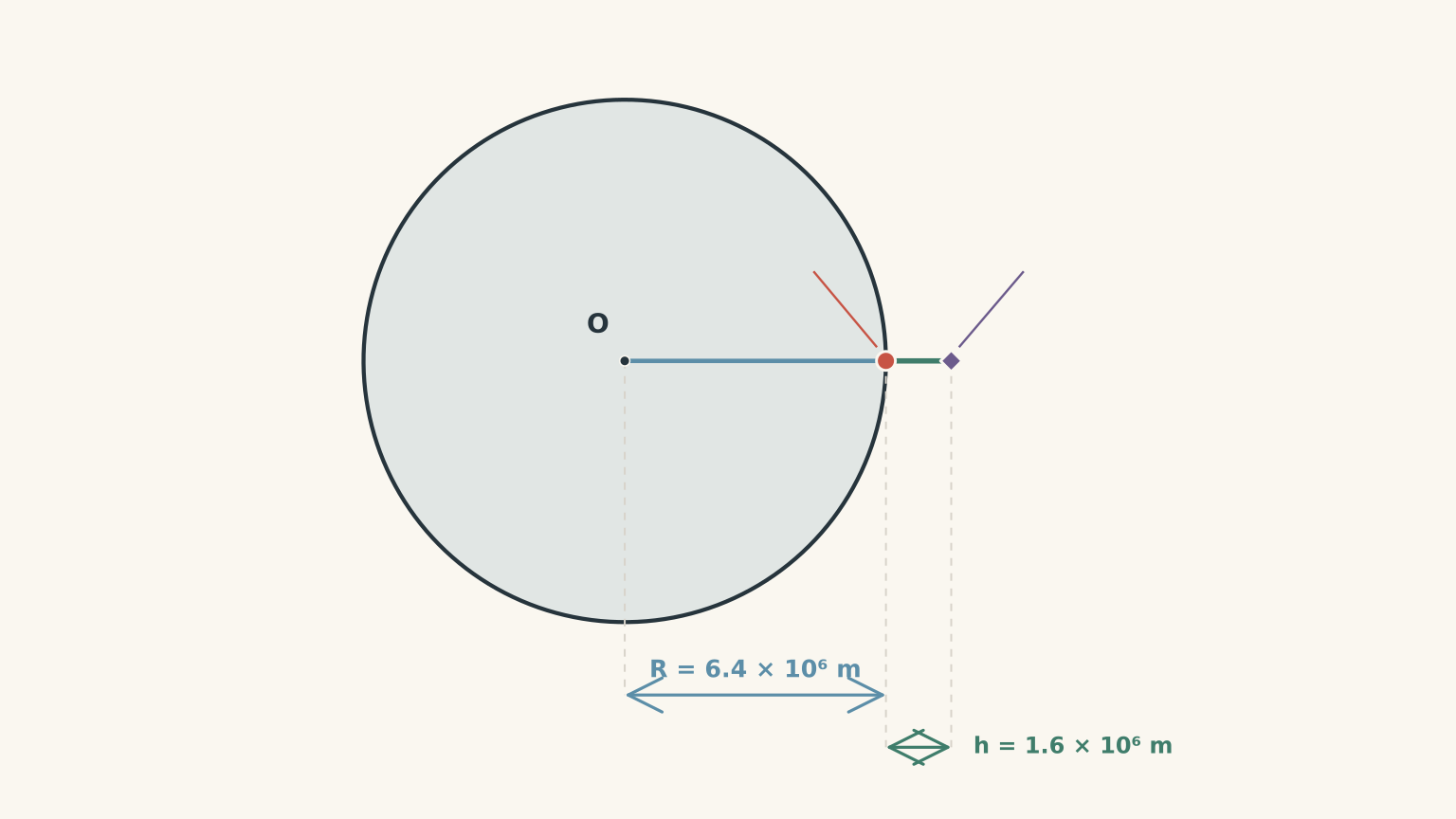
Planet A has a mass of \(6.0\times10^{24}\ \mathrm{kg}\) and a radius of \(6.4\times10^6\ \mathrm{m}\).
An object can be launched from either the planet’s surface or a point at an altitude of \(1.6\times10^6\ \mathrm{m}\) above the surface.
(a) Calculate the minimum escape speed for an object launched from the planet’s surface.
(3 marks)
(b) Calculate the minimum escape speed for an object launched from the specified altitude.
(3 marks)
(c) Calculate the percentage decrease in escape speed when the launch position changes from the surface to the higher altitude.
(2 marks)
Question 3 (6 marks)
Two spherical planets have the following properties.
| Property | Planet B | Planet C |
|---|---|---|
| Mass | \(4.8\times10^{24}\ \mathrm{kg}\) | \(1.2\times10^{25}\ \mathrm{kg}\) |
| Radius | \(6.0\times10^6\ \mathrm{m}\) | \(9.0\times10^6\ \mathrm{m}\) |
An object is launched from the surface of each planet.
(a) Calculate the minimum escape speed from Planet B.
(2 marks)
(b) Calculate the minimum escape speed from Planet C.
(2 marks)
(c) Calculate the ratio of the escape speed from Planet C to the escape speed from Planet B. Use your results to explain why comparing the planets’ masses alone would be misleading.
(2 marks)
Question 4 (7 marks)
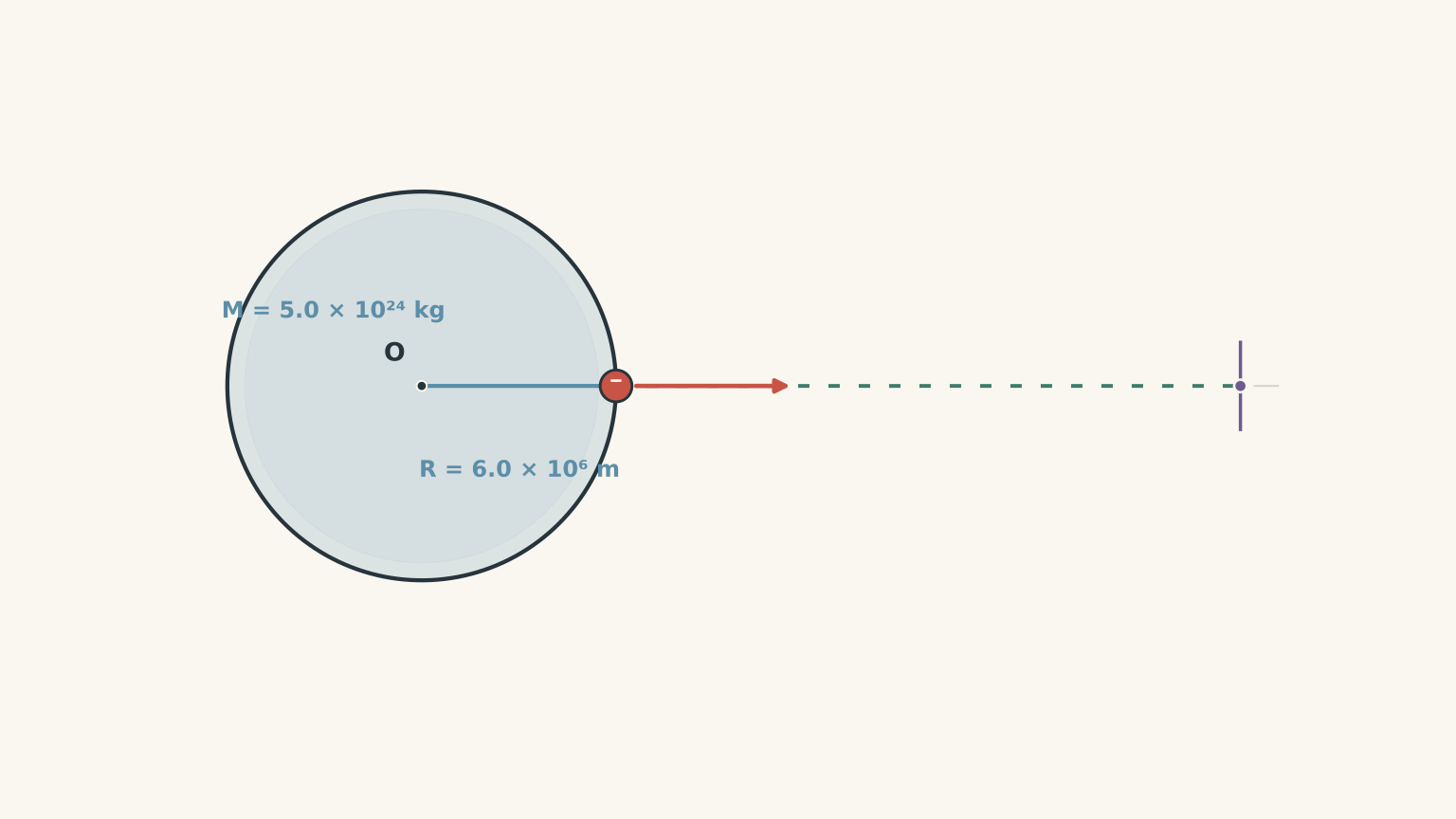
Planet D has a mass of \(5.0\times10^{24}\ \mathrm{kg}\) and a radius of \(6.0\times10^6\ \mathrm{m}\).
An object is launched radially outward from the planet’s surface with an initial speed of \(12.0\ \mathrm{km\,s^{-1}}\).
(a) Calculate the minimum escape speed from the planet’s surface.
(2 marks)
(b) Using conservation of mechanical energy, calculate the object’s speed when it reaches infinity.
(4 marks)
(c) State whether the object’s total mechanical energy at launch is positive, negative, or zero.
(1 mark)
Question 5 (6 marks)
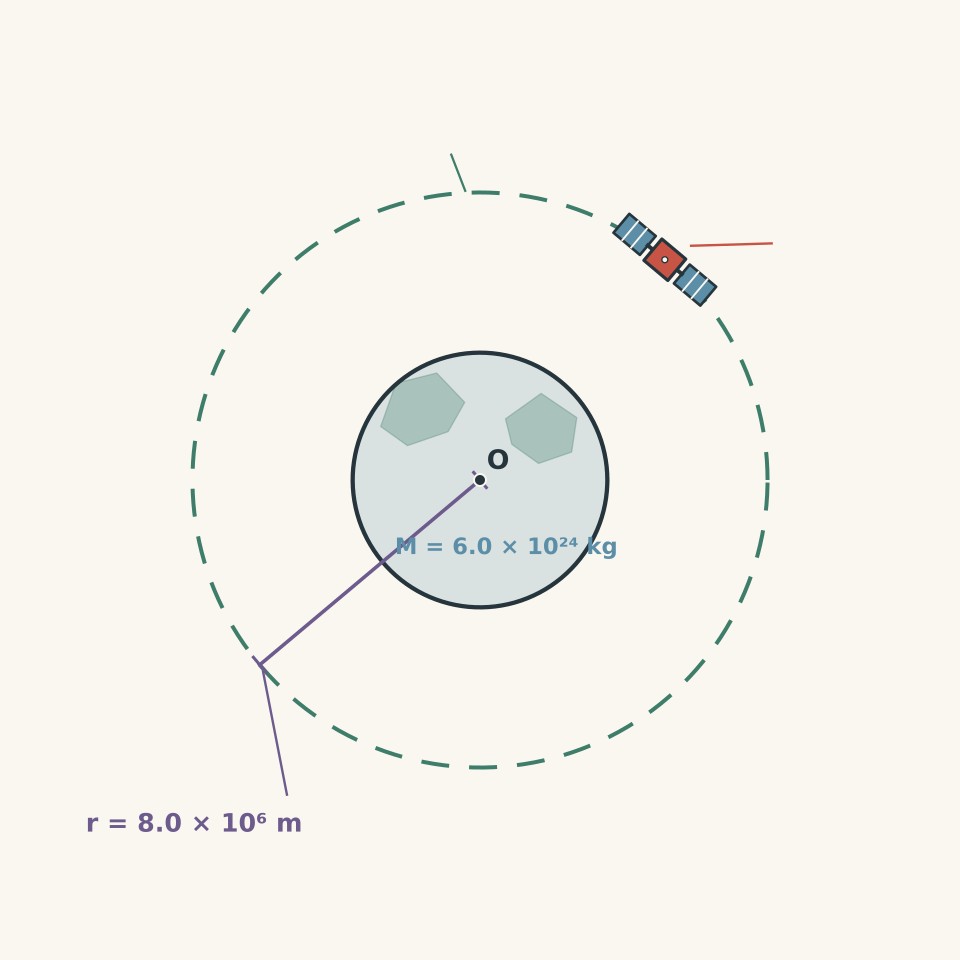
A spacecraft is travelling in a circular orbit around Planet E.
The planet has a mass of \(6.0\times10^{24}\ \mathrm{kg}\), and the spacecraft’s orbital radius is \(8.0\times10^6\ \mathrm{m}\).
Use the supplied expression:
\[ v_c=\sqrt{\frac{GM}{r}} \]
(a) Calculate the spacecraft’s circular orbital speed.
(2 marks)
(b) Calculate the minimum escape speed at the same orbital radius.
(2 marks)
(c) Calculate the ratio of escape speed to circular orbital speed at this radius.
(1 mark)
(d) Explain why a spacecraft travelling at circular orbital speed does not have enough mechanical energy to escape the planet in the ideal model.
(1 mark)
Question 6 (6 marks)
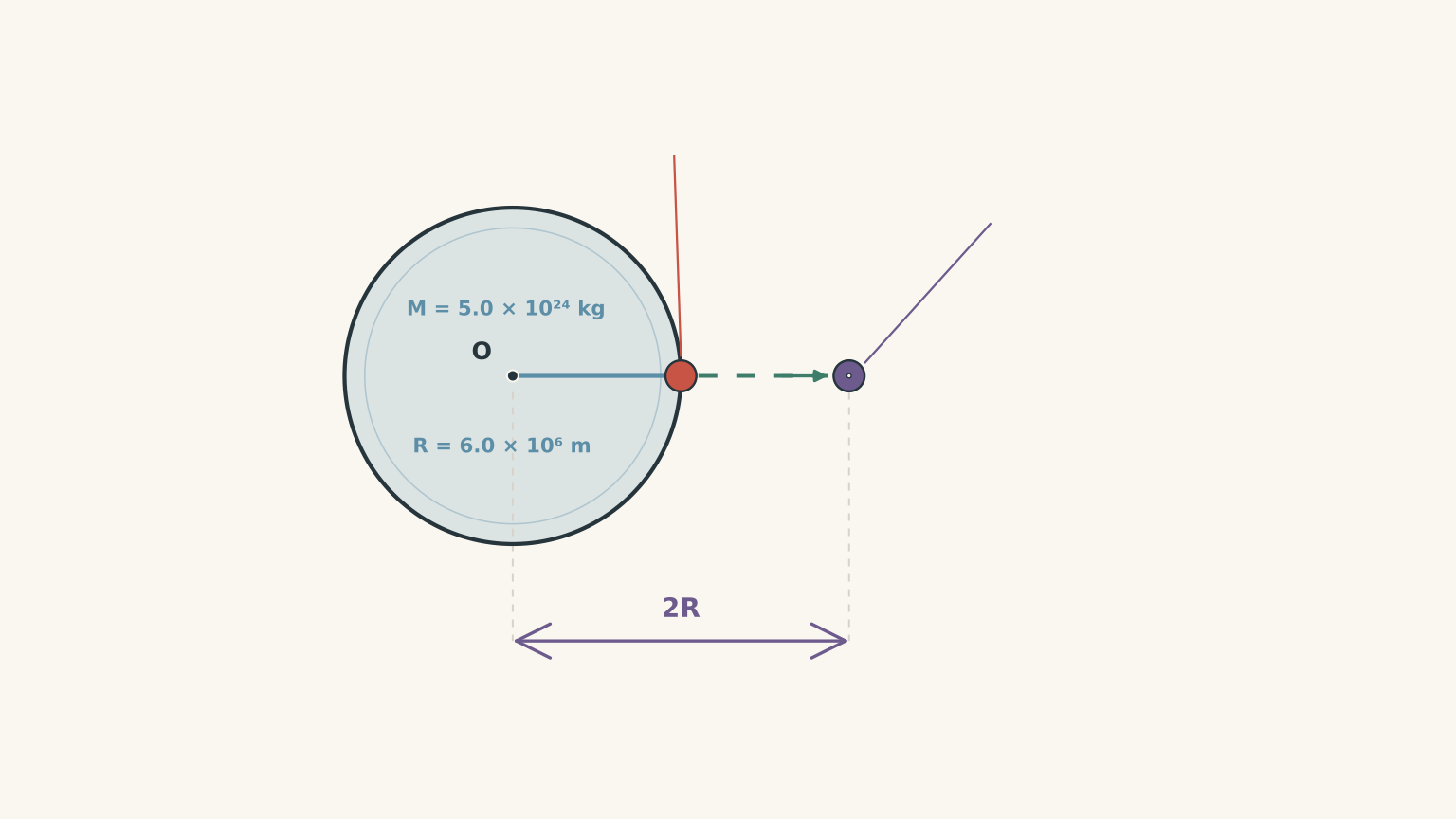
Planet F has a mass of \(5.0\times10^{24}\ \mathrm{kg}\) and a radius of \(6.0\times10^6\ \mathrm{m}\).
An object is launched radially outward from the planet’s surface. When the object reaches a distance of \(2R\) from the planet’s centre, its speed is \(6.0\ \mathrm{km\,s^{-1}}\).
(a) Using conservation of mechanical energy, calculate the object’s initial launch speed at the planet’s surface.
(4 marks)
(b) Determine whether the object has sufficient initial speed to escape the planet. Justify your answer using an appropriate calculation.
(2 marks)
03Worked solutions and marking guide
Solution 1
(a) Derive the minimum escape speed. (5 marks)
The key is to compare the object’s total mechanical energy at launch with its total mechanical energy at infinity.
At the launch position, the object has kinetic energy and negative gravitational potential energy.
Its initial mechanical energy is:
\[ E_i=\frac{1}{2}mv_{\mathrm{esc}}^2 -\frac{GMm}{r} \]
For the minimum escape speed, the object just reaches infinity with zero speed.
At infinity:
- Its kinetic energy is zero.
- Its gravitational potential energy is zero.
Therefore:
\[ E_f=0 \]
Applying conservation of mechanical energy:
\[ E_i=E_f \]
\[ \frac{1}{2}mv_{\mathrm{esc}}^2 -\frac{GMm}{r}=0 \]
Rearranging:
\[ \frac{1}{2}mv_{\mathrm{esc}}^2 =\frac{GMm}{r} \]
Cancel the object mass \(m\):
\[ \frac{1}{2}v_{\mathrm{esc}}^2 =\frac{GM}{r} \]
Multiply both sides by 2:
\[ v_{\mathrm{esc}}^2=\frac{2GM}{r} \]
Taking the positive square root gives:
\[ \boxed{v_{\mathrm{esc}}=\sqrt{\frac{2GM}{r}}} \]
This is the minimum escape speed at a distance \(r\) from the planet’s centre.
Marking guide:
| Demonstrated step | Marks |
|---|---|
| Writes the correct initial mechanical energy expression | 1 |
| Identifies zero final mechanical energy at infinity for the minimum escape case | 1 |
| Applies conservation of energy and rearranges correctly | 1 |
| Cancels the object mass correctly | 1 |
| Obtains the correct escape-speed expression | 1 |
| Total | 5 |
(b) Explain the role of object mass and a greater launch speed. (2 marks)
The object’s mass cancels during the derivation because both kinetic energy and gravitational potential energy are proportional to \(m\).
Therefore, the minimum escape speed depends on the planet’s mass and the launch radius, not the mass of the object being launched.
If the object is launched faster than the minimum escape speed, it has positive total mechanical energy. It therefore reaches infinity with a non-zero speed.
Marking guide:
- Explains that object mass cancels from the energy equation: 1 mark.
- Identifies that a greater launch speed produces a non-zero speed at infinity: 1 mark.
Solution 2
(a) Escape speed from the surface. (3 marks)
We know:
\[ M=6.0\times10^{24}\ \mathrm{kg} \]
\[ R=6.4\times10^6\ \mathrm{m} \]
The launch radius is equal to the planet’s radius.
Using:
\[ v_{\mathrm{esc}}=\sqrt{\frac{2GM}{r}} \]
Substitute the values:
\[ v_{\mathrm{esc}}= \sqrt{ \frac{ 2(6.67\times10^{-11})(6.0\times10^{24}) }{ 6.4\times10^6 } } \]
\[ v_{\mathrm{esc}}= \sqrt{1.250625\times10^8} \]
\[ v_{\mathrm{esc}}=1.1183\times10^4\ \mathrm{m\,s^{-1}} \]
Therefore:
\[ \boxed{v_{\mathrm{esc}}=11.2\ \mathrm{km\,s^{-1}}} \]
Marking guide:
- Correctly identifies the launch radius as \(R\): 1 mark.
- Substitutes the values into the escape-speed expression: 1 mark.
- Obtains the correct answer with units: 1 mark.
(b) Escape speed at the higher altitude. (3 marks)
The important detail is that escape speed depends on distance from the planet’s centre, not distance above its surface.
The launch radius is:
\[ r=R+h \]
\[ r=6.4\times10^6+1.6\times10^6 \]
\[ r=8.0\times10^6\ \mathrm{m} \]
Substitute into the escape-speed equation:
\[ v_{\mathrm{esc}}= \sqrt{ \frac{ 2(6.67\times10^{-11})(6.0\times10^{24}) }{ 8.0\times10^6 } } \]
\[ v_{\mathrm{esc}}= \sqrt{1.0005\times10^8} \]
\[ v_{\mathrm{esc}}=1.00025\times10^4\ \mathrm{m\,s^{-1}} \]
Therefore:
\[ \boxed{v_{\mathrm{esc}}=10.0\ \mathrm{km\,s^{-1}}} \]
Marking guide:
- Correctly calculates the launch radius as \(R+h\): 1 mark.
- Substitutes correctly into the escape-speed equation: 1 mark.
- Obtains the correct answer with units: 1 mark.
(c) Percentage decrease in escape speed. (2 marks)
The percentage decrease is calculated relative to the original surface escape speed.
\[ \%\text{ decrease}= \frac{ v_{\mathrm{surface}}-v_{\mathrm{altitude}} }{ v_{\mathrm{surface}} }\times100 \]
Substitute the unrounded values:
\[ \%\text{ decrease}= \frac{11183.1-10002.5}{11183.1} \times100 \]
\[ \boxed{\%\text{ decrease}=10.6\%} \]
The escape speed decreases as the launch position moves further from the planet’s centre.
Marking guide:
- Correctly calculates the percentage decrease using the surface value as the reference: 1 mark.
- Obtains the correct percentage: 1 mark.
Solution 3
(a) Escape speed from Planet B. (2 marks)
Planet B has:
\[ M_B=4.8\times10^{24}\ \mathrm{kg} \]
\[ R_B=6.0\times10^6\ \mathrm{m} \]
Using the escape-speed equation:
\[ v_{\mathrm{esc,B}}= \sqrt{\frac{2GM_B}{R_B}} \]
Substitute:
\[ v_{\mathrm{esc,B}}= \sqrt{ \frac{ 2(6.67\times10^{-11})(4.8\times10^{24}) }{ 6.0\times10^6 } } \]
\[ v_{\mathrm{esc,B}}=1.0331\times10^4\ \mathrm{m\,s^{-1}} \]
Therefore:
\[ \boxed{v_{\mathrm{esc,B}}=10.3\ \mathrm{km\,s^{-1}}} \]
Marking guide:
- Correct substitution into the escape-speed equation: 1 mark.
- Correct numerical answer with units: 1 mark.
(b) Escape speed from Planet C. (2 marks)
Planet C has:
\[ M_C=1.2\times10^{25}\ \mathrm{kg} \]
\[ R_C=9.0\times10^6\ \mathrm{m} \]
Substitute:
\[ v_{\mathrm{esc,C}}= \sqrt{ \frac{ 2(6.67\times10^{-11})(1.2\times10^{25}) }{ 9.0\times10^6 } } \]
\[ v_{\mathrm{esc,C}}=1.3337\times10^4\ \mathrm{m\,s^{-1}} \]
Therefore:
\[ \boxed{v_{\mathrm{esc,C}}=13.3\ \mathrm{km\,s^{-1}}} \]
Marking guide:
- Correct substitution into the escape-speed equation: 1 mark.
- Correct numerical answer with units: 1 mark.
(c) Compare the two escape speeds. (2 marks)
The required ratio is:
\[ \frac{v_{\mathrm{esc,C}}}{v_{\mathrm{esc,B}}} = \frac{13.3}{10.3} \]
Using unrounded values:
\[ \boxed{\frac{v_{\mathrm{esc,C}}}{v_{\mathrm{esc,B}}}=1.29} \]
Planet C has an escape speed approximately 1.29 times that of Planet B.
Why?
The escape-speed equation is:
\[ v_{\mathrm{esc}}=\sqrt{\frac{2GM}{R}} \]
Since \(2G\) is constant, escape speed depends on the square root of the ratio \(M/R\).
Compare the two planets:
\[ \frac{M_B}{R_B} = 8.0\times10^{17}\ \mathrm{kg\,m^{-1}} \]
\[ \frac{M_C}{R_C} = 1.33\times10^{18}\ \mathrm{kg\,m^{-1}} \]
Planet C has the greater mass-to-radius ratio, so it has the greater escape speed.
A larger mass does not automatically mean a proportionally larger escape speed. The planet’s radius matters too.
Marking guide:
- Correctly calculates the escape-speed ratio: 1 mark.
- Identifies the greater \(M/R\) ratio for Planet C and links it to the greater escape speed: 1 mark.
Solution 4
(a) Minimum escape speed from Planet D. (2 marks)
Given:
\[ M=5.0\times10^{24}\ \mathrm{kg} \]
\[ R=6.0\times10^6\ \mathrm{m} \]
The minimum escape speed is:
\[ v_{\mathrm{esc}}=\sqrt{\frac{2GM}{R}} \]
Substitute:
\[ v_{\mathrm{esc}}= \sqrt{ \frac{ 2(6.67\times10^{-11})(5.0\times10^{24}) }{ 6.0\times10^6 } } \]
\[ v_{\mathrm{esc}}= \sqrt{1.1117\times10^8} \]
\[ \boxed{v_{\mathrm{esc}}=10.5\ \mathrm{km\,s^{-1}}} \]
Marking guide:
- Correct substitution into the escape-speed equation: 1 mark.
- Correct numerical answer with units: 1 mark.
(b) Speed at infinity. (4 marks)
This question is slightly different from a standard escape-speed calculation.
The object is launched faster than the minimum escape speed, so it reaches infinity with some kinetic energy remaining.
We must calculate that final speed using conservation of mechanical energy.
At the planet’s surface:
\[ E_i=\frac{1}{2}mv_0^2-\frac{GMm}{R} \]
At infinity:
\[ E_f=\frac{1}{2}mv_\infty^2 \]
Notice that the gravitational potential energy at infinity is zero.
Apply conservation of mechanical energy:
\[ E_i=E_f \]
\[ \frac{1}{2}mv_0^2-\frac{GMm}{R} = \frac{1}{2}mv_\infty^2 \]
Multiply through by 2 and cancel \(m\):
\[ v_0^2-\frac{2GM}{R}=v_\infty^2 \]
Rearrange:
\[ v_\infty= \sqrt{v_0^2-\frac{2GM}{R}} \]
Convert the initial speed into SI units:
\[ v_0=12.0\ \mathrm{km\,s^{-1}} =1.20\times10^4\ \mathrm{m\,s^{-1}} \]
Substitute:
\[ v_\infty= \sqrt{ (1.20\times10^4)^2 - 1.1117\times10^8 } \]
\[ v_\infty= \sqrt{3.2833\times10^7} \]
\[ v_\infty=5.73\times10^3\ \mathrm{m\,s^{-1}} \]
Therefore:
\[ \boxed{v_\infty=5.73\ \mathrm{km\,s^{-1}}} \]
The object still has a substantial speed when it reaches infinity.
Marking guide:
- Correctly writes the initial and final mechanical energy expressions: 1 mark.
- Applies conservation of mechanical energy and rearranges for \(v_\infty\): 1 mark.
- Correctly substitutes the initial speed and planetary values: 1 mark.
- Obtains the correct final speed with units: 1 mark.
(c) Sign of total mechanical energy. (1 mark)
The object’s initial speed is greater than the minimum escape speed:
\[ 12.0\ \mathrm{km\,s^{-1}} > 10.5\ \mathrm{km\,s^{-1}} \]
Therefore, its total mechanical energy is positive.
\[ \boxed{E>0} \]
Marking guide:
- Correctly identifies the total mechanical energy as positive: 1 mark.
Solution 5
(a) Circular orbital speed. (2 marks)
The spacecraft is travelling in a circular orbit at a radius of:
\[ r=8.0\times10^6\ \mathrm{m} \]
The planet’s mass is:
\[ M=6.0\times10^{24}\ \mathrm{kg} \]
Using the supplied circular orbital speed equation:
\[ v_c=\sqrt{\frac{GM}{r}} \]
Substitute:
\[ v_c= \sqrt{ \frac{ (6.67\times10^{-11})(6.0\times10^{24}) }{ 8.0\times10^6 } } \]
\[ v_c=\sqrt{5.0025\times10^7} \]
\[ \boxed{v_c=7.07\ \mathrm{km\,s^{-1}}} \]
Marking guide:
- Correctly substitutes into the circular orbital speed equation: 1 mark.
- Obtains the correct answer with units: 1 mark.
(b) Escape speed at the same radius. (2 marks)
Use the escape-speed equation:
\[ v_{\mathrm{esc}}=\sqrt{\frac{2GM}{r}} \]
Substitute the same planetary mass and orbital radius:
\[ v_{\mathrm{esc}}= \sqrt{ \frac{ 2(6.67\times10^{-11})(6.0\times10^{24}) }{ 8.0\times10^6 } } \]
\[ v_{\mathrm{esc}}=\sqrt{1.0005\times10^8} \]
\[ \boxed{v_{\mathrm{esc}}=10.0\ \mathrm{km\,s^{-1}}} \]
Marking guide:
- Correct substitution into the escape-speed equation: 1 mark.
- Obtains the correct answer with units: 1 mark.
(c) Ratio of escape speed to circular orbital speed. (1 mark)
The ratio is:
\[ \frac{v_{\mathrm{esc}}}{v_c} = \frac{10.0}{7.07} \]
Using unrounded values:
\[ \boxed{\frac{v_{\mathrm{esc}}}{v_c}=\sqrt{2}=1.41} \]
The escape speed is approximately 1.41 times the circular orbital speed at the same radius.
Marking guide:
- Correct ratio: 1 mark.
(d) Explain why circular orbital speed is insufficient for escape. (1 mark)
An object travelling at circular orbital speed has negative total mechanical energy.
Its kinetic energy is:
\[ K=\frac{1}{2}mv_c^2 \]
Since:
\[ v_c^2=\frac{GM}{r} \]
we can write:
\[ K=\frac{GMm}{2r} \]
The gravitational potential energy is:
\[ U=-\frac{GMm}{r} \]
Therefore, total mechanical energy is:
\[ E=K+U \]
\[ E=\frac{GMm}{2r}-\frac{GMm}{r} \]
\[ \boxed{E=-\frac{GMm}{2r}<0} \]
The negative total energy means the spacecraft is gravitationally bound to the planet.
It needs additional energy to escape.
Marking guide:
- Correctly identifies that circular orbital speed corresponds to negative total mechanical energy and therefore a bound orbit: 1 mark.
Solution 6
(a) Calculate the initial launch speed. (4 marks)
We are given:
\[ M=5.0\times10^{24}\ \mathrm{kg} \]
\[ R=6.0\times10^6\ \mathrm{m} \]
The initial position is at the planet’s surface:
\[ r_i=R \]
The final position is twice the planet’s radius:
\[ r_f=2R \]
The final speed is:
\[ v_f=6.0\times10^3\ \mathrm{m\,s^{-1}} \]
We need to find the initial speed \(v_0\).
At the surface, the initial mechanical energy is:
\[ E_i=\frac{1}{2}mv_0^2-\frac{GMm}{R} \]
At the final position:
\[ E_f= \frac{1}{2}m(6.0\times10^3)^2 -\frac{GMm}{2R} \]
Apply conservation of mechanical energy:
\[ E_i=E_f \]
Therefore:
\[ \frac{1}{2}mv_0^2-\frac{GMm}{R} = \frac{1}{2}m(6.0\times10^3)^2 -\frac{GMm}{2R} \]
Cancel the object mass and rearrange:
\[ v_0^2= (6.0\times10^3)^2 +\frac{GM}{R} \]
Substitute the planetary values:
\[ v_0^2= 3.60\times10^7 + \frac{ (6.67\times10^{-11})(5.0\times10^{24}) }{ 6.0\times10^6 } \]
\[ v_0^2= 3.60\times10^7+5.5583\times10^7 \]
\[ v_0=\sqrt{9.1583\times10^7} \]
\[ \boxed{v_0=9.57\ \mathrm{km\,s^{-1}}} \]
The object must initially be launched at approximately \(9.57\ \mathrm{km\,s^{-1}}\) to have a speed of \(6.0\ \mathrm{km\,s^{-1}}\) at a distance of \(2R\).
Marking guide:
- Correctly identifies the initial and final radii and corresponding energy expressions: 1 mark.
- Applies conservation of mechanical energy correctly: 1 mark.
- Correctly rearranges the equation for the initial speed: 1 mark.
- Obtains the correct initial speed with units: 1 mark.
(b) Determine whether the object can escape. (2 marks)
To escape, the object’s initial speed must be at least equal to the minimum escape speed from the planet’s surface.
Calculate the escape speed:
\[ v_{\mathrm{esc}}=\sqrt{\frac{2GM}{R}} \]
Substitute:
\[ v_{\mathrm{esc}}= \sqrt{ \frac{ 2(6.67\times10^{-11})(5.0\times10^{24}) }{ 6.0\times10^6 } } \]
\[ \boxed{v_{\mathrm{esc}}=10.5\ \mathrm{km\,s^{-1}}} \]
Compare the two speeds:
\[ v_0=9.57\ \mathrm{km\,s^{-1}} \]
\[ v_{\mathrm{esc}}=10.5\ \mathrm{km\,s^{-1}} \]
Since:
\[ 9.57<10.5 \]
the object does not have sufficient energy to escape the planet.
\[ \boxed{\text{The object cannot escape to infinity.}} \]
It can reach the specified position at \(2R\), but it does not have enough mechanical energy to continue to infinity. Under the ideal assumptions, it will eventually stop moving outwards and return towards the planet.
Marking guide:
- Correctly calculates the minimum escape speed from the surface: 1 mark.
- Compares the launch speed with escape speed and reaches the correct conclusion: 1 mark.
End of practice paper
Total: 40 marks.