
Force Diagrams and Newton’s Laws: 50-Mark Physics Practice Exam
Test your understanding of force diagrams and Newton’s laws with this original 50-mark tutorgum Physics 2025 practice paper. Includes six timed questions, fully worked solutions, and a detailed marking guide.
This original tutorgum practice paper assesses free-body diagrams, force interactions, net force, equilibrium, force components, and Newton’s three laws. It is a focused Physics 2025 revision paper based only on the supplied force-diagrams-and-Newton’s-laws scope. It is not a full-course HSC examination, and it is not an official or NESA-endorsed paper.
01Exam instructions
| Exam condition | Details |
|---|---|
| Suggested reading time | 5 minutes |
| Suggested working time | 60 minutes |
| Total marks | 50 |
| Questions | 6 |
| Permitted equipment | Scientific calculator, ruler, pencil, and eraser |
Answer all six questions. Show your working for every calculation, include units, and clearly label all force diagrams and vector diagrams.
For this paper, use the following assumptions and conventions:
- Gravitational acceleration: \(g=9.8\ \mathrm{m/s^2}\).
- Treat forces described as constant as remaining constant throughout the stated time interval.
- Assume air resistance is negligible unless stated otherwise.
- Assume there is no acceleration perpendicular to a horizontal surface unless the question states otherwise.
- Take right and east as positive horizontal directions, and up and north as positive vertical directions where appropriate.
- Give numerical answers to a sensible precision. Two or three significant figures are generally sufficient.
- A free-body diagram must show only forces acting on the isolated object being considered.
Assessed scope
This paper covers:
- Contact forces and field forces, including identifying which object exerts each force.
- Free-body diagrams and correct force directions.
- Resultant force, equilibrium, and Newton’s first law.
- Newton’s second law, \(F_{\text{net}}=ma\).
- Newton’s third law and action-reaction pairs.
- Resolving angled forces into horizontal and vertical components.
- Constant net force, constant acceleration, and kinematics equations.
- Representing motion using velocity-time graphs.
This is a focused topic assessment. Circular motion, momentum, collisions, energy, projectile motion, and other unrelated course content are excluded.
These are suggested practice-paper conditions, not claims about current official NESA examination conditions.
02Questions
Question 1 (8 marks)
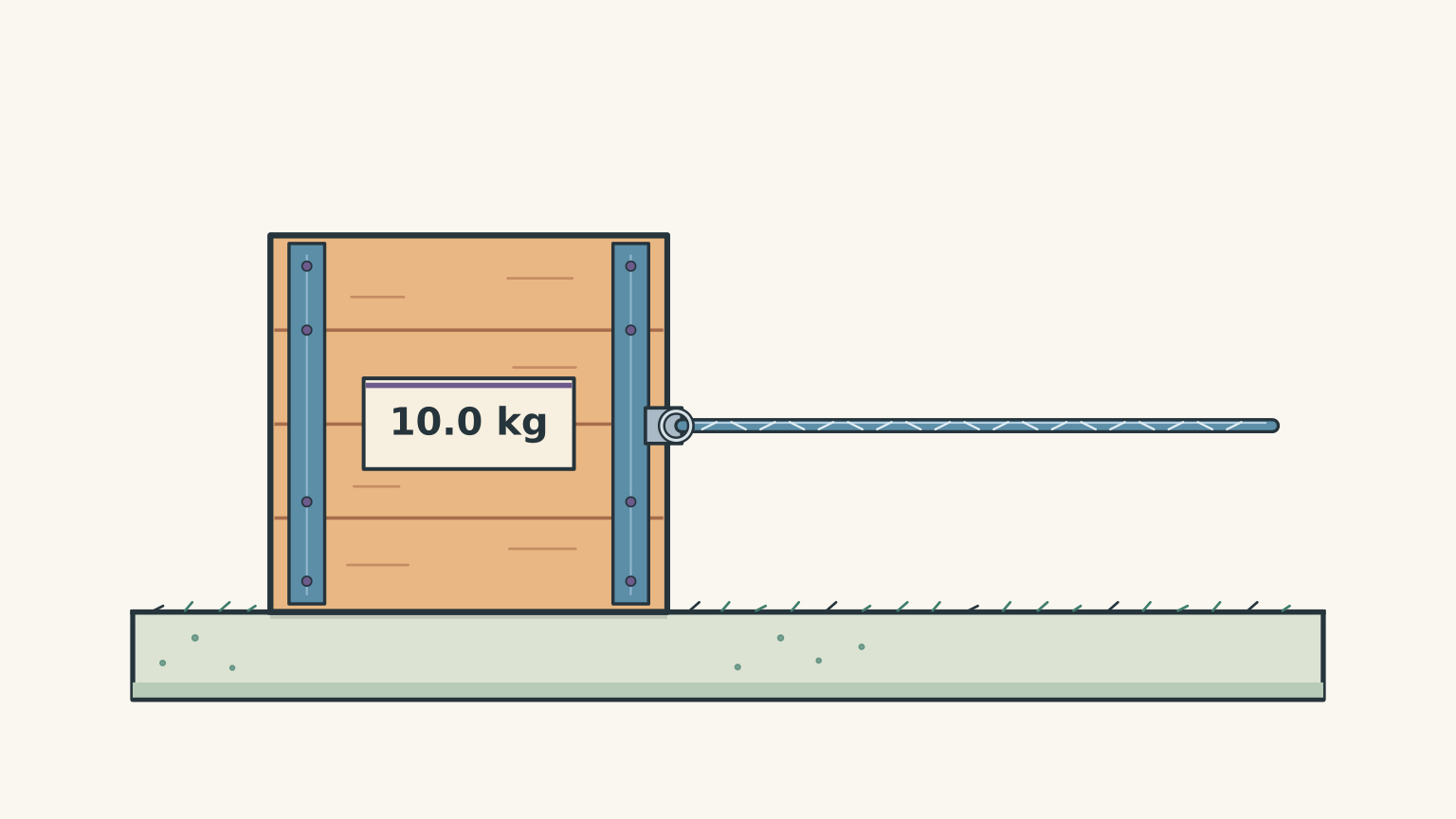
A 10.0 kg crate sits on a rough, horizontal floor. A rope pulls the crate horizontally to the right with a force of 42 N.
The floor exerts a frictional force of 17 N to the left and an upward normal force of 98 N. The Earth’s gravitational force on the crate is 98 N downwards.
Due to technical limitations, this figure may display incorrectly or contain inaccuracies. Please check key details against your course materials.
(a) For each of the four forces acting on the crate, identify the object exerting the force and classify the interaction as either a contact force or a field force. (2 marks)
(b) Draw a labelled free-body diagram for the crate, showing all four forces acting on it. (3 marks)
(c) Calculate the resultant force acting on the crate and determine its acceleration. Include the magnitude and direction of both quantities. (3 marks)
Question 2 (8 marks)
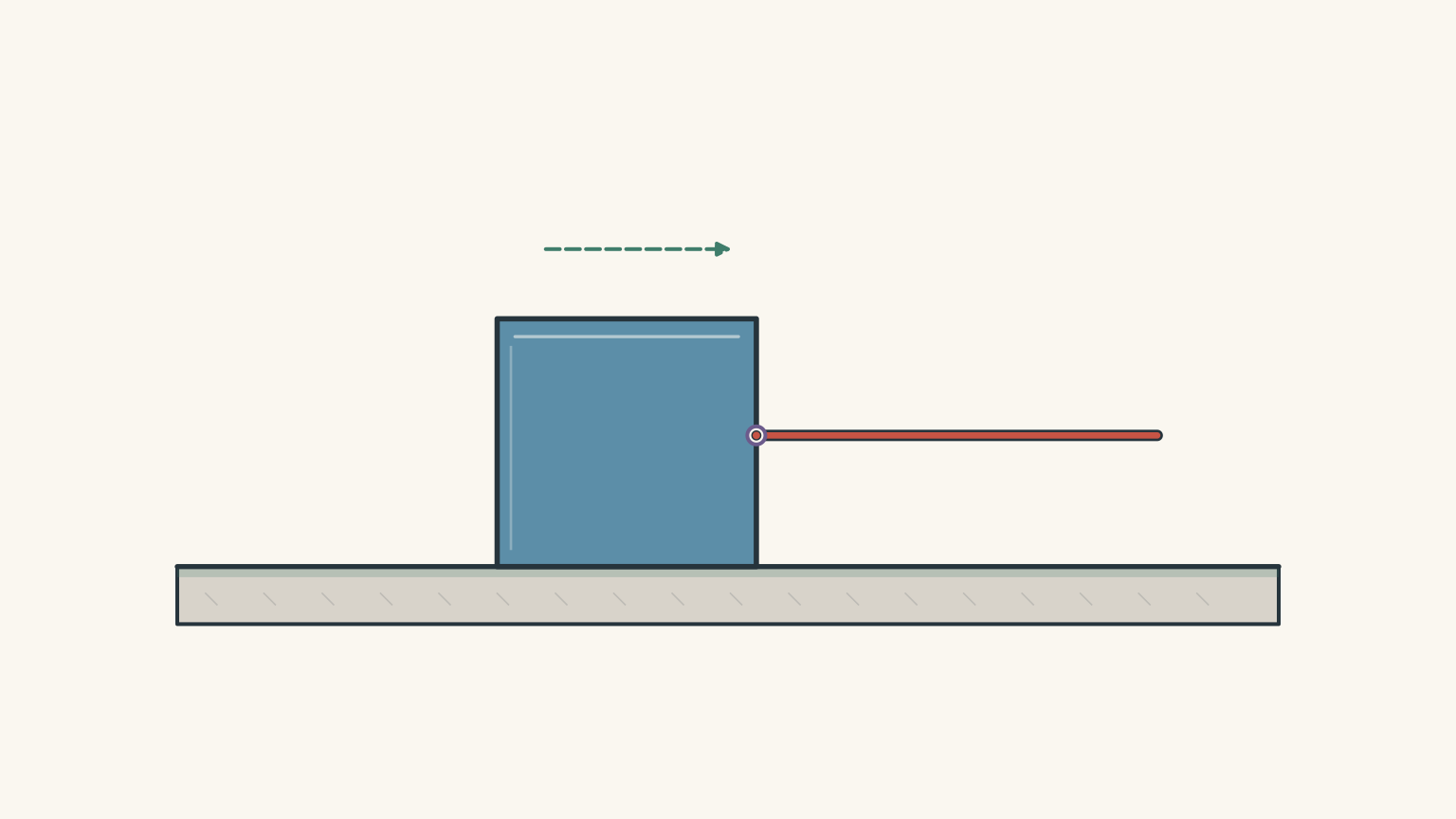
A 5.0 kg block slides to the right along a horizontal surface at constant velocity.
A horizontal rope pulls the block to the right with a force of 12 N. Friction from the surface acts to the left with a force of 12 N.
The surface also exerts an upward normal force of 49 N, while the Earth’s gravitational force on the block is 49 N downwards.
Due to technical limitations, this figure may display incorrectly or contain inaccuracies. Please check key details against your course materials.
(a) Calculate the net force acting on the block, considering both horizontal and vertical directions. (2 marks)
(b) Using Newton’s first law, explain why the block can move to the right at constant velocity even though its net force is zero. (2 marks)
(c) Identify the Newton’s third law partner of the normal force exerted by the surface on the block. State the object on which this partner force acts and its direction. (2 marks)
(d) Explain why the normal force and the weight acting on the block do not form a Newton’s third law pair. Identify the actual third-law partner of the block’s weight. (2 marks)
Question 3 (10 marks)
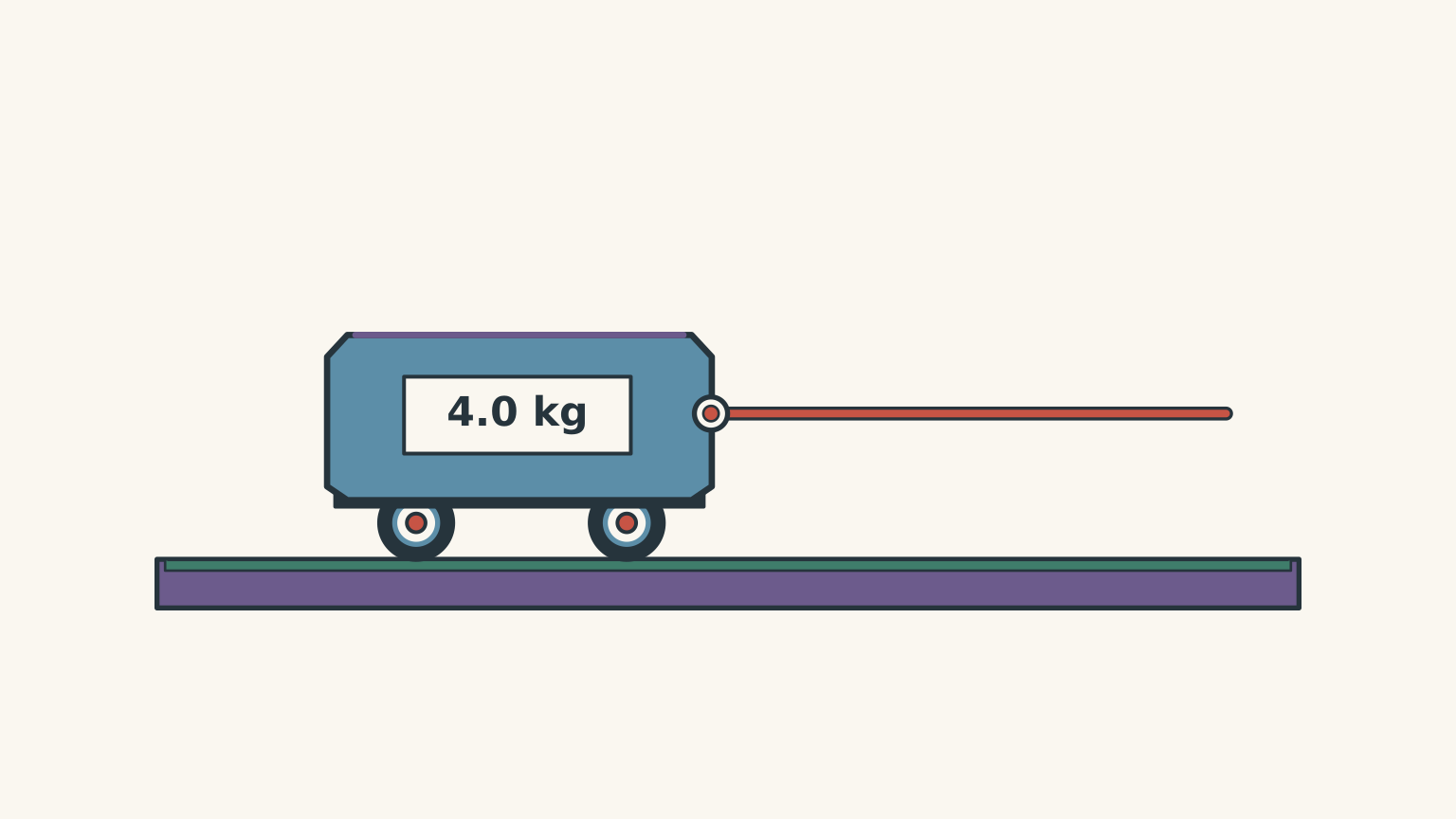
A 4.0 kg cart moves along a horizontal track.
A rope pulls the cart horizontally to the right with a constant force of 18 N. Friction from the track acts to the left with a constant force of 6 N.
The track exerts an upward normal force that balances the cart’s weight. The cart starts from rest, and the horizontal forces remain constant for the first 4.0 seconds.
Due to technical limitations, this figure may display incorrectly or contain inaccuracies. Please check key details against your course materials.
(a) Draw a labelled free-body diagram showing all forces acting on the cart. (3 marks)
(b) Calculate the net horizontal force and the cart’s acceleration. (2 marks)
(c) Calculate the cart’s velocity and displacement after 4.0 seconds. (3 marks)
(d) Sketch a velocity-time graph for the cart over the first 4.0 seconds.
Label both axes, show the initial and final velocities, and indicate the gradient of the graph. (2 marks)
Question 4 (8 marks)
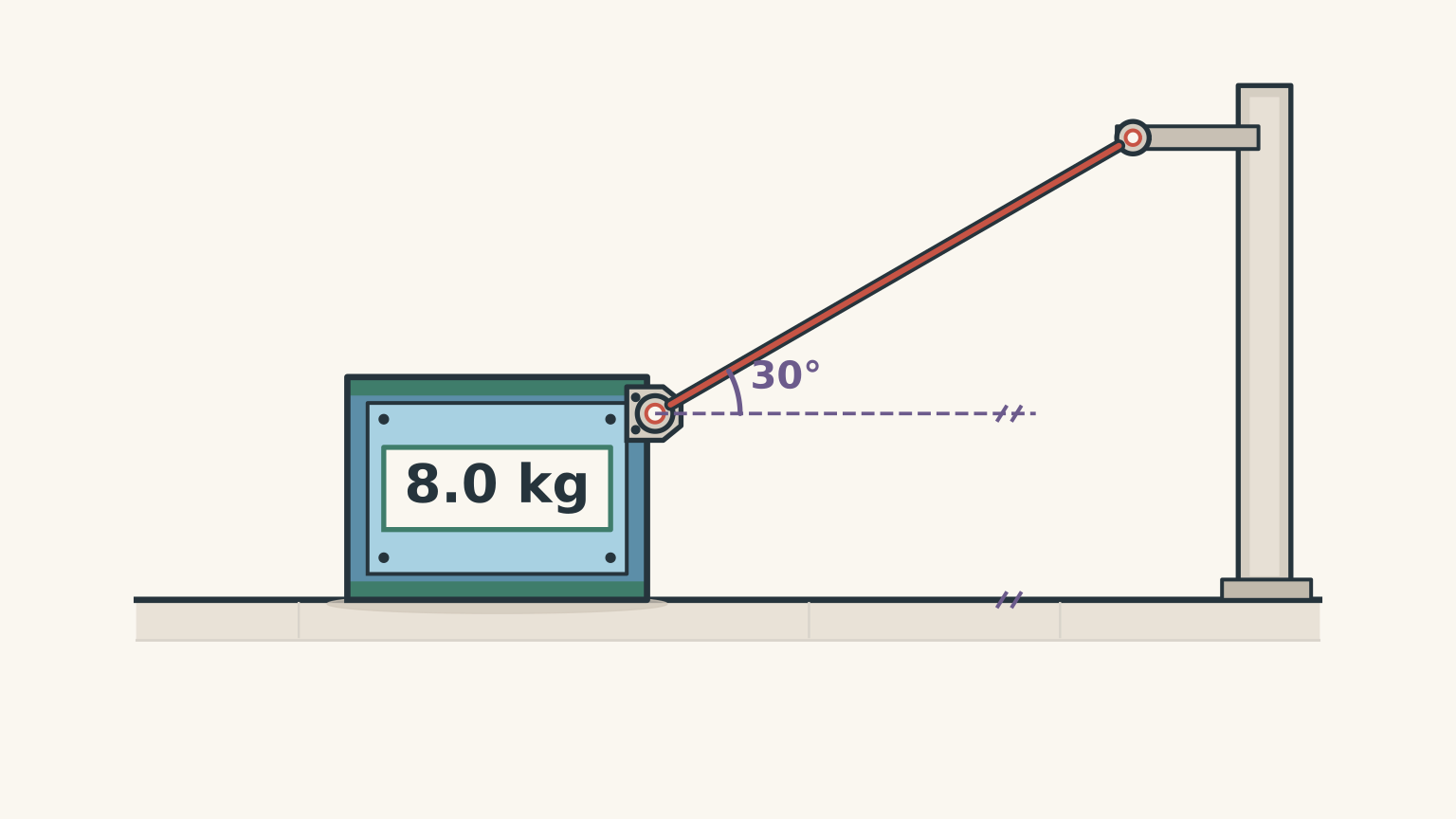
An 8.0 kg crate is pulled along a horizontal floor using a cable.
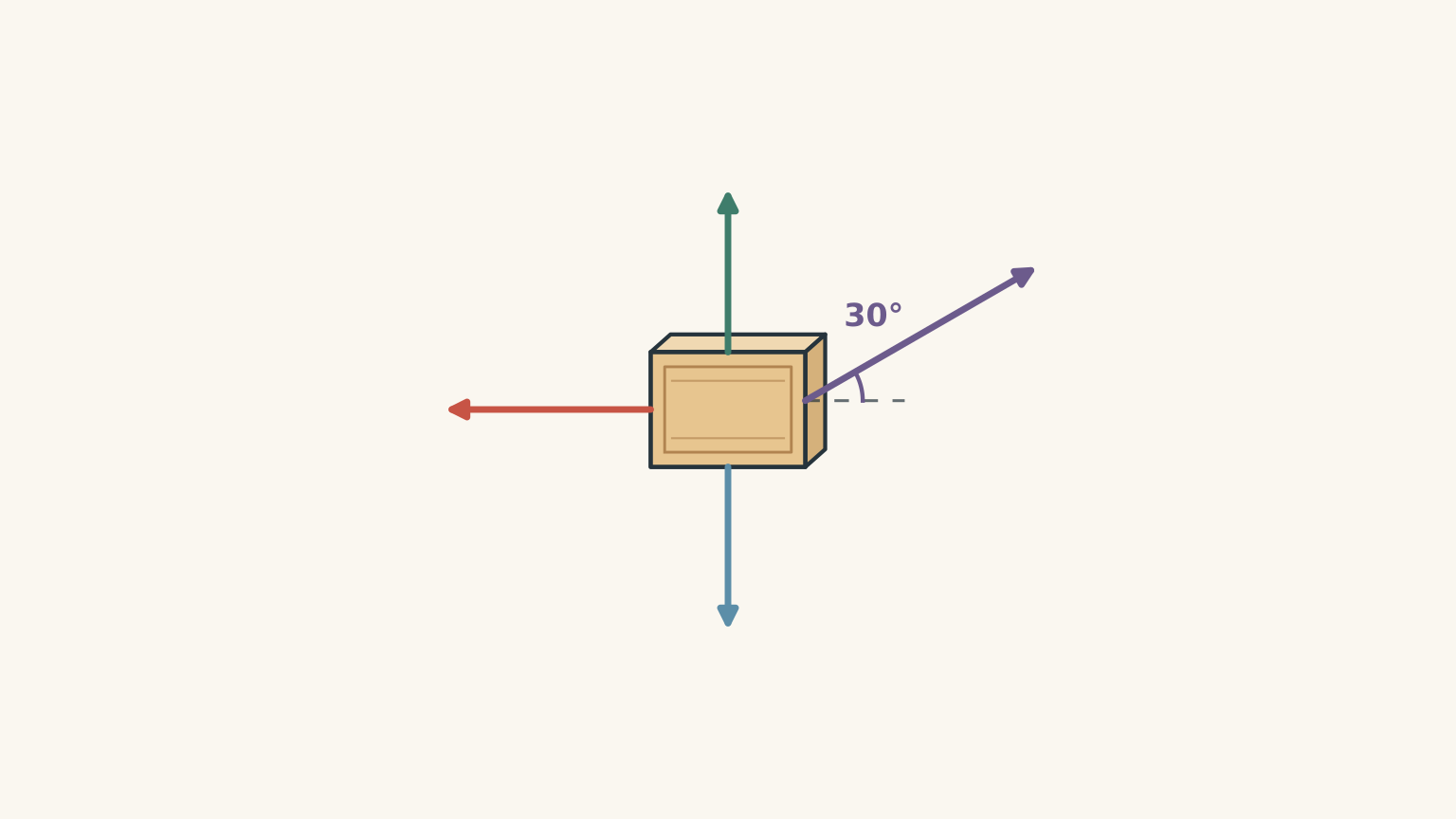
The cable exerts a tension of 50 N at an angle of \(30^\circ\) above the horizontal, directed towards the right.
A frictional force of 12 N acts horizontally to the left. The crate has no vertical acceleration.
Due to technical limitations, this figure may display incorrectly or contain inaccuracies. Please check key details against your course materials.
(a) Draw a labelled free-body diagram showing all forces acting on the crate. (2 marks)
(b) Resolve the cable tension into horizontal and vertical components. (2 marks)
(c) Calculate the magnitude of the normal force exerted by the floor on the crate. (2 marks)
(d) Calculate the net horizontal force and the crate’s horizontal acceleration. (2 marks)
Question 5 (8 marks)
A 2.0 kg glider moves on a frictionless horizontal air table.
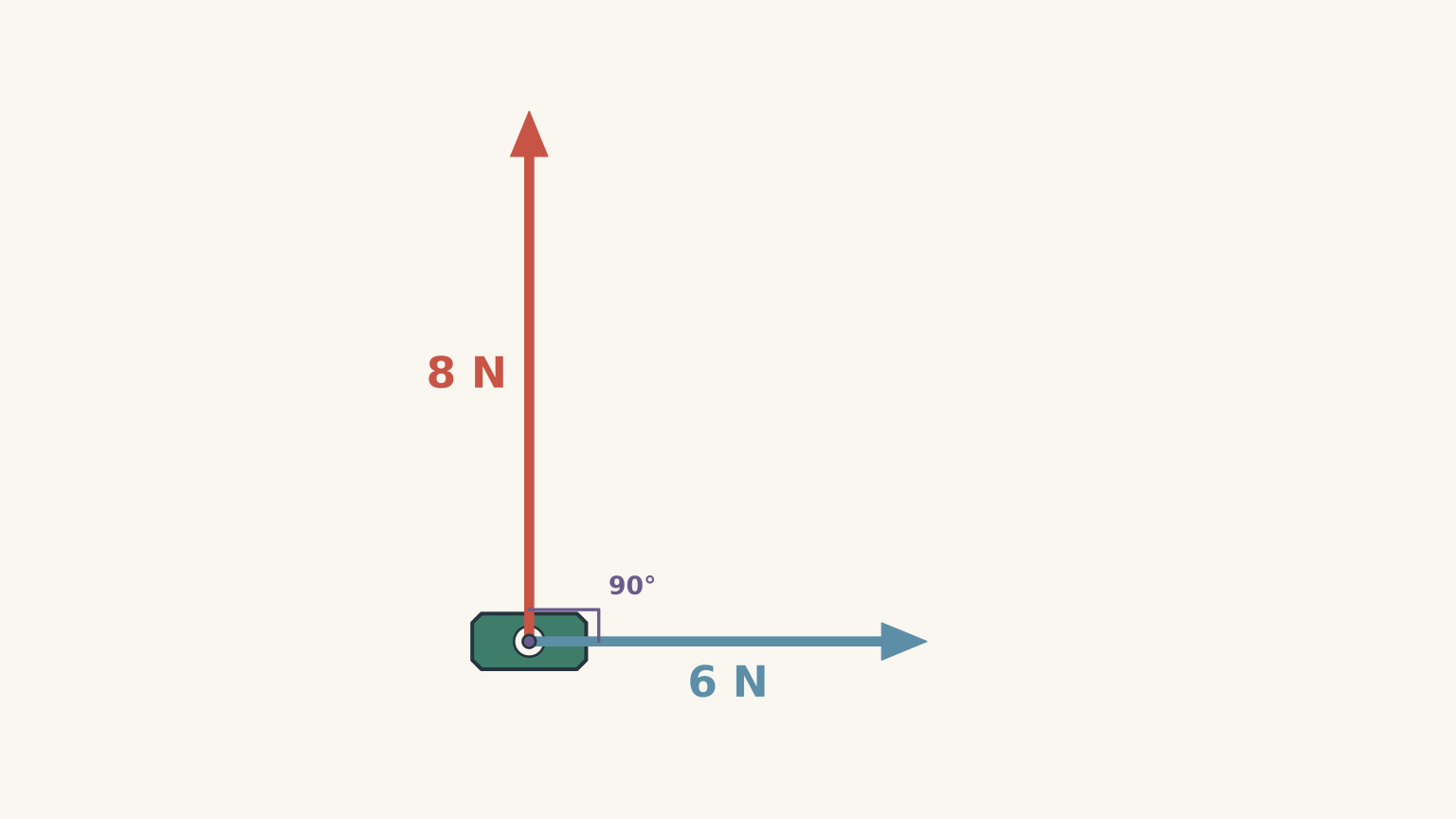
Two horizontal forces act on the glider:
- A force of 6 N towards the east.
- A force of 8 N towards the north.
The vertical forces acting on the glider balance.
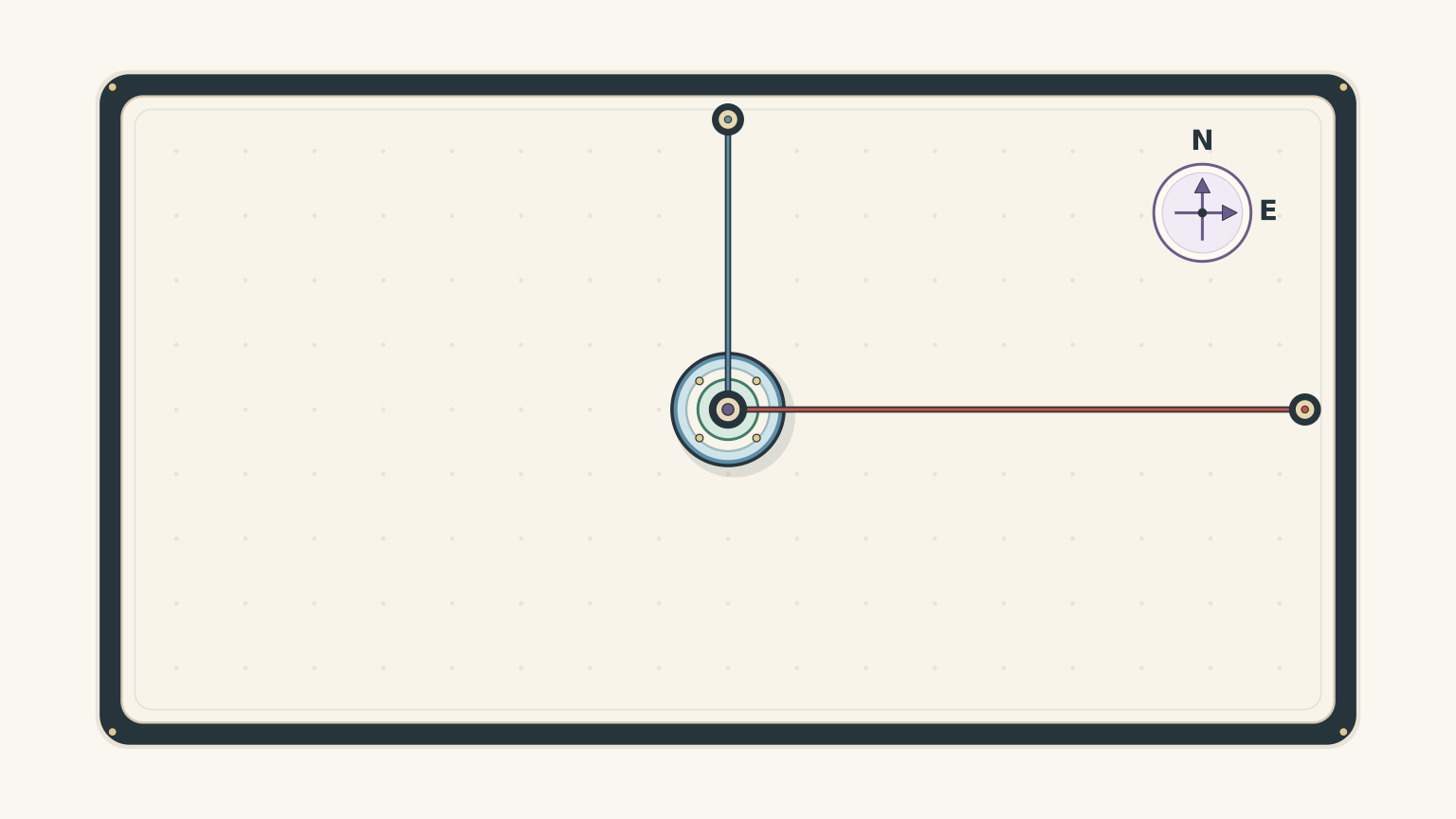
Due to technical limitations, this figure may display incorrectly or contain inaccuracies. Please check key details against your course materials.
(a) Draw a plan-view vector diagram showing the two horizontal forces acting on the glider. Use a common starting point for both vectors. (2 marks)
(b) Calculate the magnitude of the resultant horizontal force and its direction, measured north of east. (3 marks)
(c) Calculate the magnitude and direction of the glider’s acceleration. (2 marks)
(d) State whether the glider is in horizontal equilibrium. Justify your answer. (1 mark)
Question 6 (8 marks)
A person standing on a low-friction wheeled platform is modelled as a single object with a total mass of 50 kg.
The person-platform combination and a 20 kg trolley are both initially at rest on a horizontal floor.
The person pushes the trolley to the right with a horizontal contact force of 60 N. Assume that horizontal resistance from the floor is negligible and that no other horizontal forces act on either object.

Due to technical limitations, this figure may display incorrectly or contain inaccuracies. Please check key details against your course materials.
(a) Draw separate horizontal free-body diagrams for the person-platform combination and the trolley. (2 marks)
(b) Calculate the acceleration of each object, including its direction. (2 marks)
(c) Identify the Newton’s third law force pair involved in the interaction. Explain why these forces do not cancel on either individual object’s free-body diagram. (2 marks)
(d) Now consider the person-platform combination and trolley together as one system.
Classify the pushing forces as internal or external forces. Identify the external vertical interactions and state the net external horizontal force acting on the combined system. (2 marks)
03Worked solutions and marking guide
The solutions below show the expected reasoning, not just the final numerical answers.
In the calculations, \(F_{\text{net}}\) represents net force in newtons (N), \(m\) represents mass in kilograms (kg), and \(a\) represents acceleration in metres per second squared (\(\mathrm{m/s^2}\)).
Award follow-through marks where a student makes an earlier numerical error but then applies a correct method consistently. Equivalent mathematical methods and correctly rounded answers should be accepted.
Solution 1
(a) Identify the force sources and classify the interactions.
There are four forces acting on the crate.
| Force acting on crate | Object exerting the force | Classification |
|---|---|---|
| Pulling force | Rope | Contact |
| Frictional force | Floor | Contact |
| Normal force | Floor | Contact |
| Weight | Earth | Field |
The important distinction is how the interaction occurs.
A contact force requires physical contact between objects. Friction, tension, and normal forces are examples.
A field force acts without physical contact. Gravity is a field force because the Earth attracts the crate through its gravitational field.
Marking:
- 0.25 marks for each correctly identified force source.
- 0.25 marks for each correct classification.
Total: 2 marks.
(b) Draw the free-body diagram.
A free-body diagram isolates the crate and represents every force acting on it as an arrow.
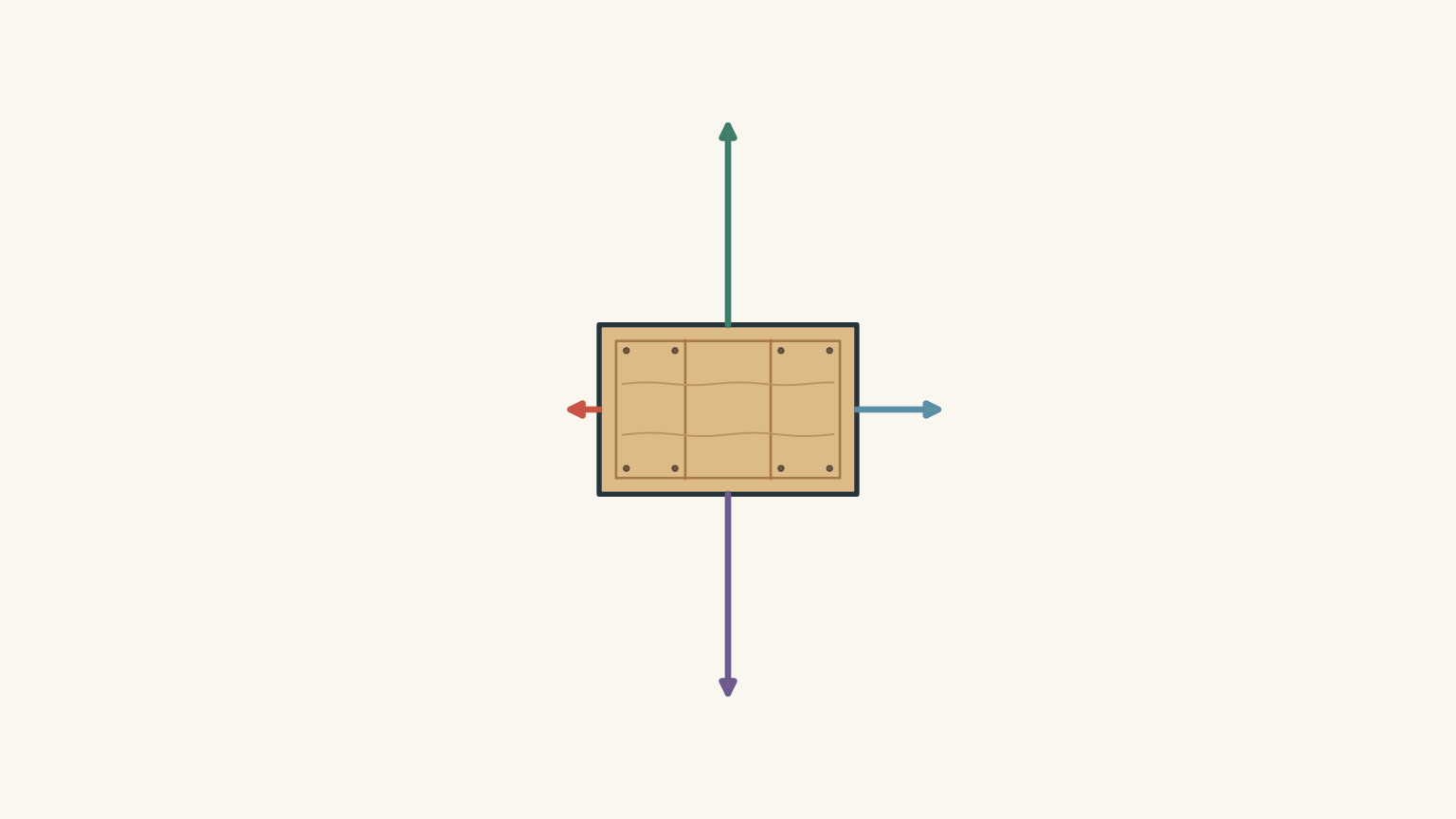
Due to technical limitations, this figure may display incorrectly or contain inaccuracies. Please check key details against your course materials.
There should be exactly four force arrows.
Notice that the normal force and weight are equal in magnitude and opposite in direction. The horizontal forces are not equal.
Marking:
- 0.5 marks for each of the four correctly directed force arrows (2 marks).
- 0.25 marks for each correctly labelled force (1 mark).
Total: 3 marks.
(c) Calculate the resultant force and acceleration.
First, consider the horizontal direction.
Taking right as positive:
\[ \begin{aligned} F_{\text{net},x} &=42-17\\ &=25\ \mathrm{N} \end{aligned} \]
Now consider the vertical direction.
Taking upwards as positive:
\[ \begin{aligned} F_{\text{net},y} &=98-98\\ &=0\ \mathrm{N} \end{aligned} \]
There is no vertical resultant force, so the total resultant force is 25 N to the right.
Apply Newton’s second law:
\[ F_{\text{net}}=ma \]
Rearrange to find acceleration:
\[ a=\frac{F_{\text{net}}}{m} \]
Substitute the values:
\[ \begin{aligned} a&=\frac{25}{10.0}\\ &=2.5\ \mathrm{m/s^2} \end{aligned} \]
Final answer
- Resultant force: 25 N to the right.
- Acceleration: \(2.5\ \mathrm{m/s^2}\) to the right.
Marking:
- 1 mark for the correct horizontal resultant.
- 1 mark for the vertical resultant and correct overall resultant vector.
- 1 mark for correctly applying \(F_{\text{net}}=ma\) and calculating acceleration.
Total: 3 marks.
Solution 2
(a) Calculate the net force.
A useful way to approach this question is to separate the horizontal and vertical directions.
Horizontally:
\[ \begin{aligned} F_{\text{net},x} &=12-12\\ &=0\ \mathrm{N} \end{aligned} \]
Vertically:
\[ \begin{aligned} F_{\text{net},y} &=49-49\\ &=0\ \mathrm{N} \end{aligned} \]
Both components of the net force are zero.
Therefore:
\[ \boxed{F_{\text{net}}=0\ \mathrm{N}} \]
Marking:
- 1 mark for the horizontal resultant.
- 1 mark for the vertical resultant and total net force.
Total: 2 marks.
(b) Explain the motion using Newton’s first law.
Newton’s first law states that an object remains at rest or continues moving at constant velocity unless acted upon by a non-zero net external force.
The key idea is inertia.
Inertia is an object’s tendency to resist changes in its velocity.
The block already has a velocity towards the right. Since the net force is zero, its velocity does not change. It therefore continues moving towards the right at constant velocity.
Zero net force does not mean zero velocity.
It means zero acceleration.
Marking:
- 1 mark for correctly stating Newton’s first law.
- 1 mark for explaining that zero net force means constant velocity, not necessarily zero velocity.
Total: 2 marks.
(c) Identify the third-law partner of the normal force.
The normal force described in the question is the upward force exerted by the surface on the block.
Its Newton’s third law partner is:
The downward force exerted by the block on the surface.
These two forces:
- Have equal magnitudes.
- Act in opposite directions.
- Act on different objects.
The two objects are the block and the surface.
Marking:
- 1 mark for identifying the block and surface interactions.
- 1 mark for identifying the opposite direction and the force acting on the surface.
Total: 2 marks.
(d) Explain why the normal force and weight are not a third-law pair.
Both the normal force and the weight act on the same object: the block.
This immediately tells us they cannot form a Newton’s third law pair.
Newton’s third law requires the two forces to act on different objects.
The actual third-law partner of the block’s weight is the gravitational force exerted by the block on the Earth.
The interaction pair is:
- Earth pulls the block downwards.
- Block gravitationally pulls the Earth upwards.
These forces are equal in magnitude and opposite in direction.
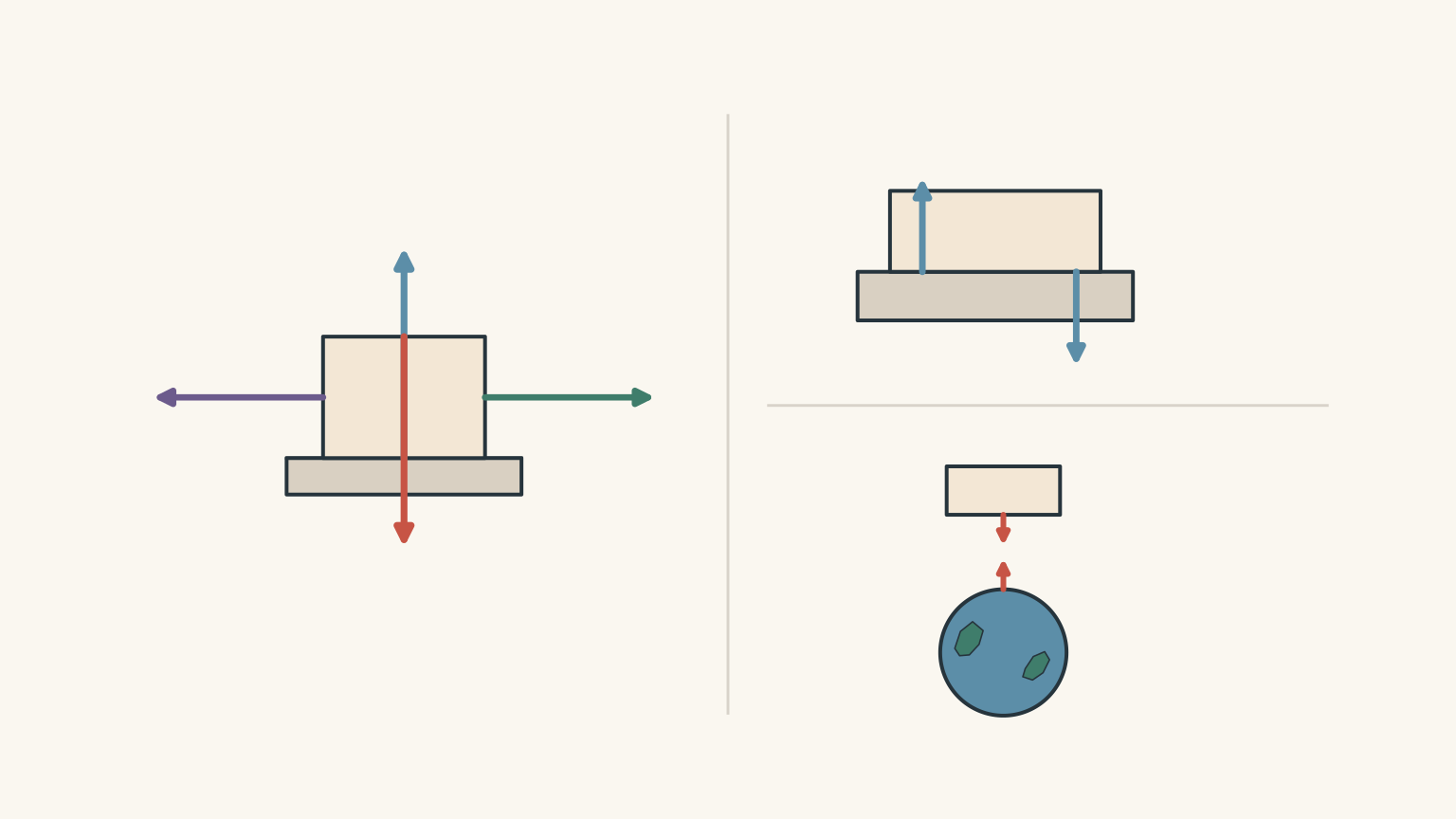
Due to technical limitations, this figure may display incorrectly or contain inaccuracies. Please check key details against your course materials.
Marking:
- 1 mark for explaining that the normal force and weight act on the same object.
- 1 mark for identifying the block’s gravitational attraction on the Earth as the partner of its weight.
Total: 2 marks.
Solution 3
(a) Draw the free-body diagram.
The cart experiences four forces.
- The track pushes upwards on the cart through the normal force.
- The Earth pulls downwards on the cart through gravity.
- The rope pulls horizontally to the right.
- Friction acts horizontally to the left.
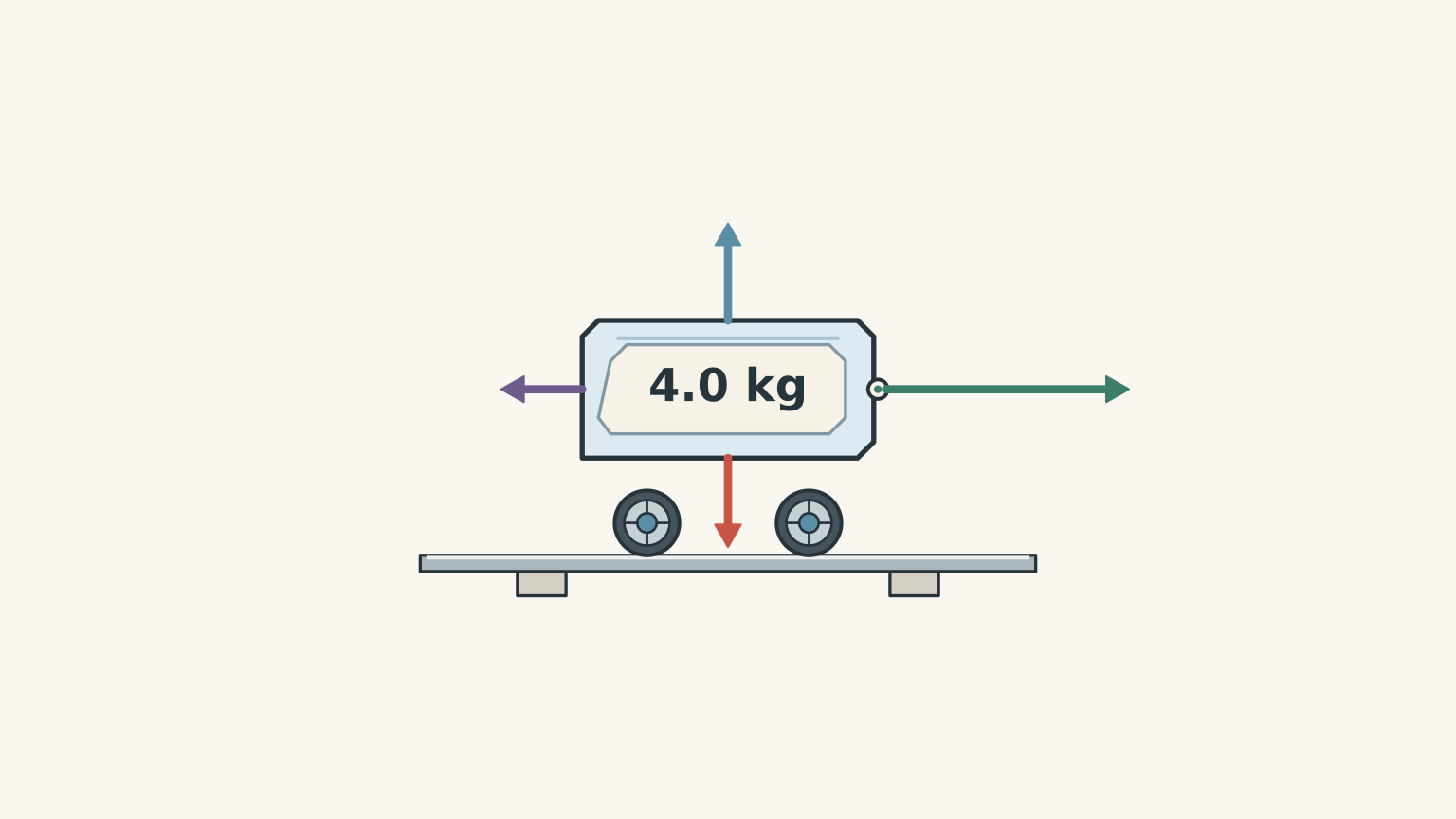
Due to technical limitations, this figure may display incorrectly or contain inaccuracies. Please check key details against your course materials.
The normal force and weight balance because there is no vertical acceleration.
Marking:
- 0.5 marks for each correctly directed force arrow (2 marks).
- 1 mark for correctly labelling all four forces.
Total: 3 marks.
(b) Calculate the net horizontal force and acceleration.
Take right as positive.
The net horizontal force is:
\[ \begin{aligned} F_{\text{net}} &=18-6\\ &=12\ \mathrm{N} \end{aligned} \]
Apply Newton’s second law:
\[ a=\frac{F_{\text{net}}}{m} \]
Substitute:
\[ \begin{aligned} a&=\frac{12}{4.0}\\ &=3.0\ \mathrm{m/s^2} \end{aligned} \]
The acceleration is to the right.
Marking:
- 1 mark for the correct net force.
- 1 mark for the correct acceleration and direction.
Total: 2 marks.
(c) Calculate the velocity and displacement after 4.0 seconds.
We know:
- Initial velocity, \(u=0\ \mathrm{m/s}\).
- Acceleration, \(a=3.0\ \mathrm{m/s^2}\).
- Time, \(t=4.0\ \mathrm{s}\).
Use the constant-acceleration equation:
\[ v=u+at \]
Here, \(v\) is final velocity, \(u\) is initial velocity, and \(t\) is elapsed time.
Substitute:
\[ \begin{aligned} v&=0+3.0(4.0)\\ &=12\ \mathrm{m/s} \end{aligned} \]
The cart’s velocity after 4.0 seconds is 12 m/s to the right.
Now calculate displacement using:
\[ s=ut+\frac{1}{2}at^2 \]
Here, \(s\) is displacement.
Substitute:
\[ \begin{aligned} s&=0(4.0)+\frac{1}{2}(3.0)(4.0)^2\\ &=24\ \mathrm{m} \end{aligned} \]
The displacement is 24 m to the right.
Final answer
- Velocity: 12 m/s to the right.
- Displacement: 24 m to the right.
Marking:
- 1 mark for the correct velocity equation and substitution.
- 1 mark for the final velocity.
- 1 mark for the correct displacement equation, working, and result.
Total: 3 marks.
(d) Sketch the velocity-time graph.
The cart starts from rest and accelerates at a constant rate of \(3.0\ \mathrm{m/s^2}\).
This means its velocity increases at a constant rate.
The graph must therefore be a straight line.
It starts at:
\[ (t,v)=(0,0) \]
It finishes at:
\[ (t,v)=(4.0,12) \]
The gradient of a velocity-time graph represents acceleration.
Therefore:
\[ \text{Gradient}=\frac{12-0}{4.0-0} =3.0\ \mathrm{m/s^2} \]
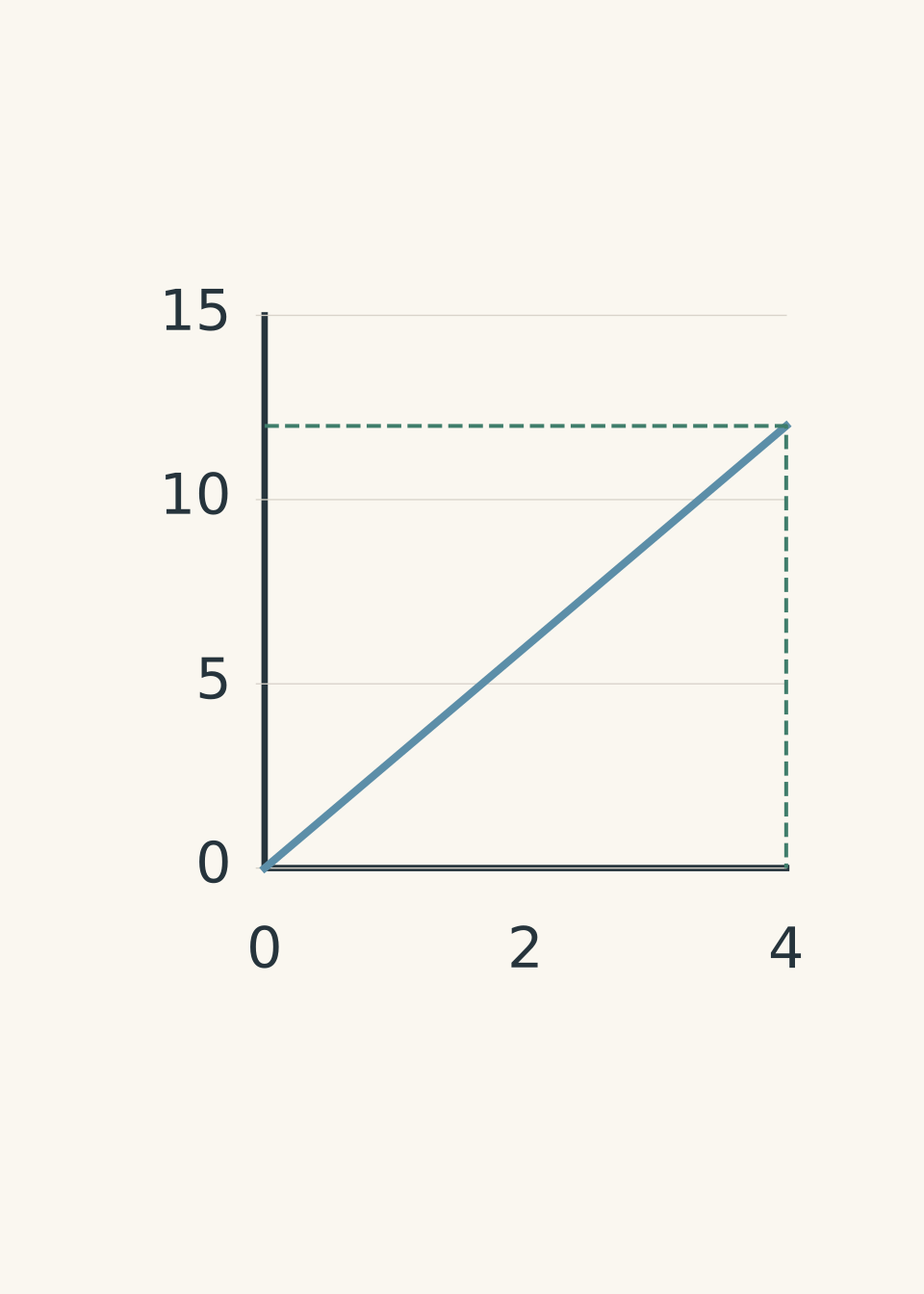
- Cart velocity — gradient = 3.0 m/s²
- (0, 0)
- (4.0, 12)
Due to technical limitations, this figure may display incorrectly or contain inaccuracies. Please check key details against your course materials.
Marking:
- 1 mark for a straight-line graph with the correct starting and finishing points.
- 1 mark for correctly labelled axes and gradient.
Total: 2 marks.
Solution 4
(a) Draw the free-body diagram.
The crate experiences four forces:
- Weight acting vertically downwards.
- Normal force acting vertically upwards.
- Tension acting along the cable, upwards and to the right.
- Friction acting horizontally to the left.
The tension must be drawn at \(30^\circ\) above the horizontal, not vertically upwards.
Due to technical limitations, this figure may display incorrectly or contain inaccuracies. Please check key details against your course materials.
Marking:
- 0.5 marks for each correctly directed and labelled force.
Total: 2 marks.
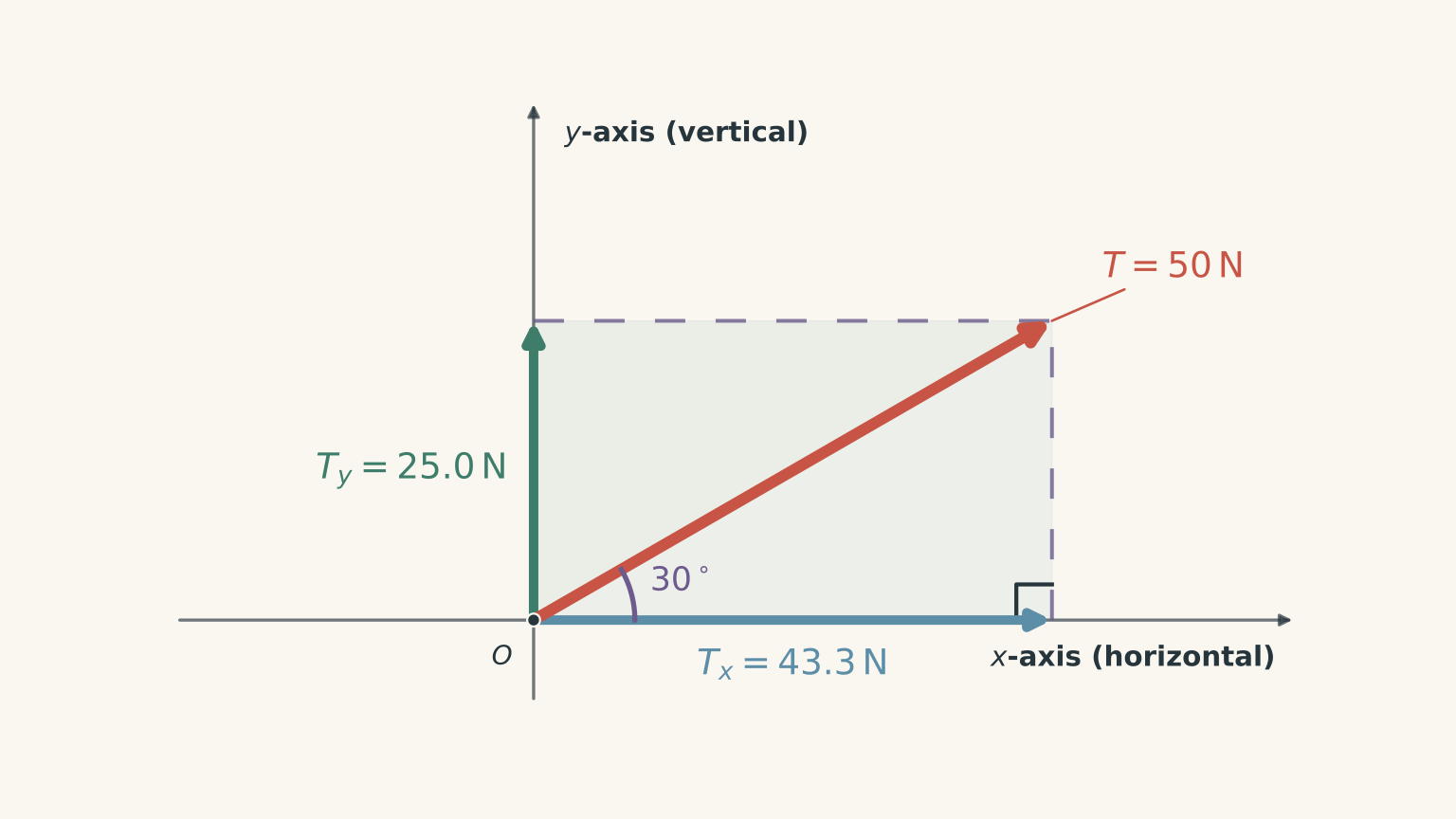
(b) Resolve the tension into components.
The tension is an angled force, so we split it into horizontal and vertical components.
Let:
- \(T_x\) represent the horizontal component.
- \(T_y\) represent the vertical component.
- \(T=50\ \mathrm{N}\) represent the tension.
- \(\theta=30^\circ\) represent the angle above the horizontal.
The horizontal component is:
\[ T_x=T\cos\theta \]
Substitute:
\[ \begin{aligned} T_x&=50\cos30^\circ\\ &=43.3\ \mathrm{N} \end{aligned} \]
The vertical component is:
\[ T_y=T\sin\theta \]
Substitute:
\[ \begin{aligned} T_y&=50\sin30^\circ\\ &=25.0\ \mathrm{N} \end{aligned} \]
Final answer
- Horizontal component: 43.3 N to the right.
- Vertical component: 25.0 N upwards.
Due to technical limitations, this figure may display incorrectly or contain inaccuracies. Please check key details against your course materials.
Marking:
- 1 mark for the correct horizontal component.
- 1 mark for the correct vertical component.
Total: 2 marks.
(c) Calculate the normal force.
The question tells us that the crate has no vertical acceleration.
Therefore, the vertical forces must balance.
First calculate the crate’s weight:
\[ W=mg \]
\[ \begin{aligned} W&=8.0(9.8)\\ &=78.4\ \mathrm{N} \end{aligned} \]
Let \(N\) represent the upward normal force.
The upward forces are the normal force and the vertical tension component.
Taking upwards as positive:
\[ \sum F_y=0 \]
Therefore:
\[ N+25.0-78.4=0 \]
Rearrange:
\[ \begin{aligned} N&=78.4-25.0\\ &=53.4\ \mathrm{N} \end{aligned} \]
The normal force is 53.4 N upwards.
Notice that the normal force is smaller than the crate’s weight. This happens because the cable provides some additional upward support.
Marking:
- 1 mark for correctly applying vertical equilibrium.
- 1 mark for calculating the normal force.
Total: 2 marks.
(d) Calculate the net horizontal force and acceleration.
The horizontal forces are:
- 43.3 N to the right from the cable.
- 12 N to the left from friction.
Taking right as positive:
\[ \begin{aligned} F_{\text{net},x} &=43.3-12\\ &=31.3\ \mathrm{N} \end{aligned} \]
Apply Newton’s second law:
\[ a=\frac{F_{\text{net}}}{m} \]
Substitute:
\[ \begin{aligned} a&=\frac{31.3}{8.0}\\ &=3.91\ \mathrm{m/s^2} \end{aligned} \]
Final answer
- Net horizontal force: 31.3 N to the right.
- Horizontal acceleration: \(3.91\ \mathrm{m/s^2}\) to the right.
Marking:
- 1 mark for the correct net horizontal force.
- 1 mark for the correct acceleration and direction.
Total: 2 marks.
Solution 5
(a) Draw the horizontal force diagram.
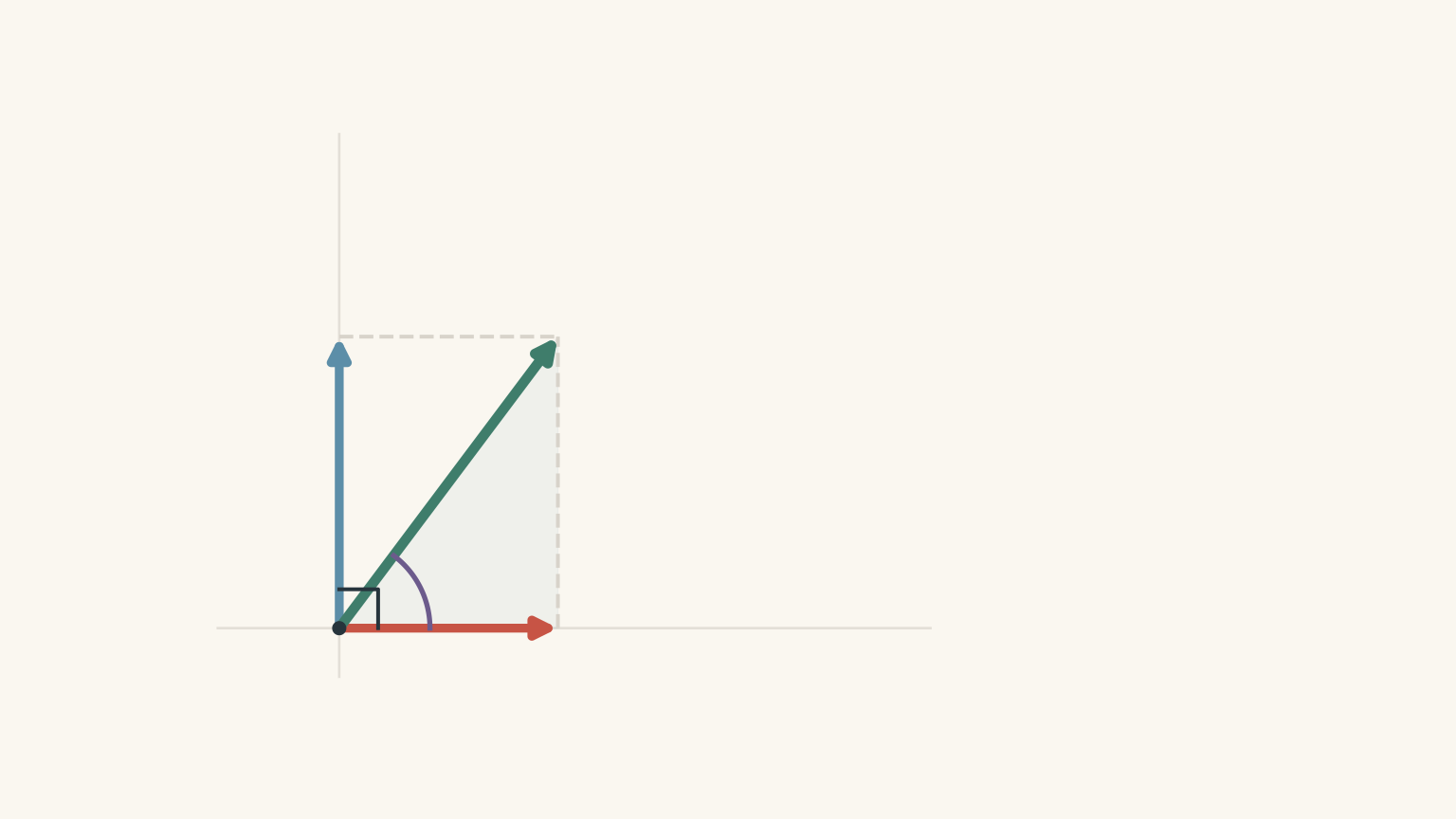
There are two perpendicular horizontal forces acting on the glider.
- 6 N towards the east.
- 8 N towards the north.
Both vectors should start at the same point.
Due to technical limitations, this figure may display incorrectly or contain inaccuracies. Please check key details against your course materials.
Marking:
- 1 mark for the correctly directed and labelled 6 N vector.
- 1 mark for the correctly directed and labelled 8 N vector from the same origin.
Total: 2 marks.
(b) Calculate the resultant force and its direction.
The two forces act at right angles to each other.
We can therefore use Pythagoras’ theorem to calculate the magnitude of the resultant.
Let \(F_R\) represent the magnitude of the resultant force.
\[ F_R=\sqrt{6^2+8^2} \]
\[ \begin{aligned} F_R&=\sqrt{36+64}\\ &=\sqrt{100}\\ &=10\ \mathrm{N} \end{aligned} \]
Now calculate the direction.
Let \(\theta\) represent the angle measured north of east.
Using trigonometry:
\[ \tan\theta=\frac{\text{opposite}}{\text{adjacent}} \]
Therefore:
\[ \begin{aligned} \tan\theta&=\frac{8}{6}\\ \theta&=\tan^{-1}\left(\frac{8}{6}\right)\\ &=53.1^\circ \end{aligned} \]
Due to technical limitations, this figure may display incorrectly or contain inaccuracies. Please check key details against your course materials.
Final answer
The resultant force is 10 N at \(53.1^\circ\) north of east.
Marking:
- 1 mark for correctly applying Pythagoras’ theorem.
- 1 mark for the magnitude of 10 N.
- 1 mark for the correct direction of \(53.1^\circ\) north of east.
Total: 3 marks.
(c) Calculate the glider’s acceleration.
Apply Newton’s second law:
\[ F_{\text{net}}=ma \]
Rearrange:
\[ a=\frac{F_{\text{net}}}{m} \]
Substitute:
\[ \begin{aligned} a&=\frac{10}{2.0}\\ &=5.0\ \mathrm{m/s^2} \end{aligned} \]
Acceleration acts in the same direction as the resultant force.
Therefore, the acceleration is \(5.0\ \mathrm{m/s^2}\) at \(53.1^\circ\) north of east.
Marking:
- 1 mark for the correct acceleration magnitude.
- 1 mark for the correct acceleration direction.
Total: 2 marks.
(d) Determine whether the glider is in equilibrium.
The glider is not in horizontal equilibrium.
For an object to be in equilibrium, its resultant force must be zero.
Here, the resultant horizontal force is 10 N.
Therefore, the horizontal forces are unbalanced.
Marking:
- 1 mark for stating that the glider is not in equilibrium and supporting the answer with the non-zero resultant force.
Total: 1 mark.
Solution 6
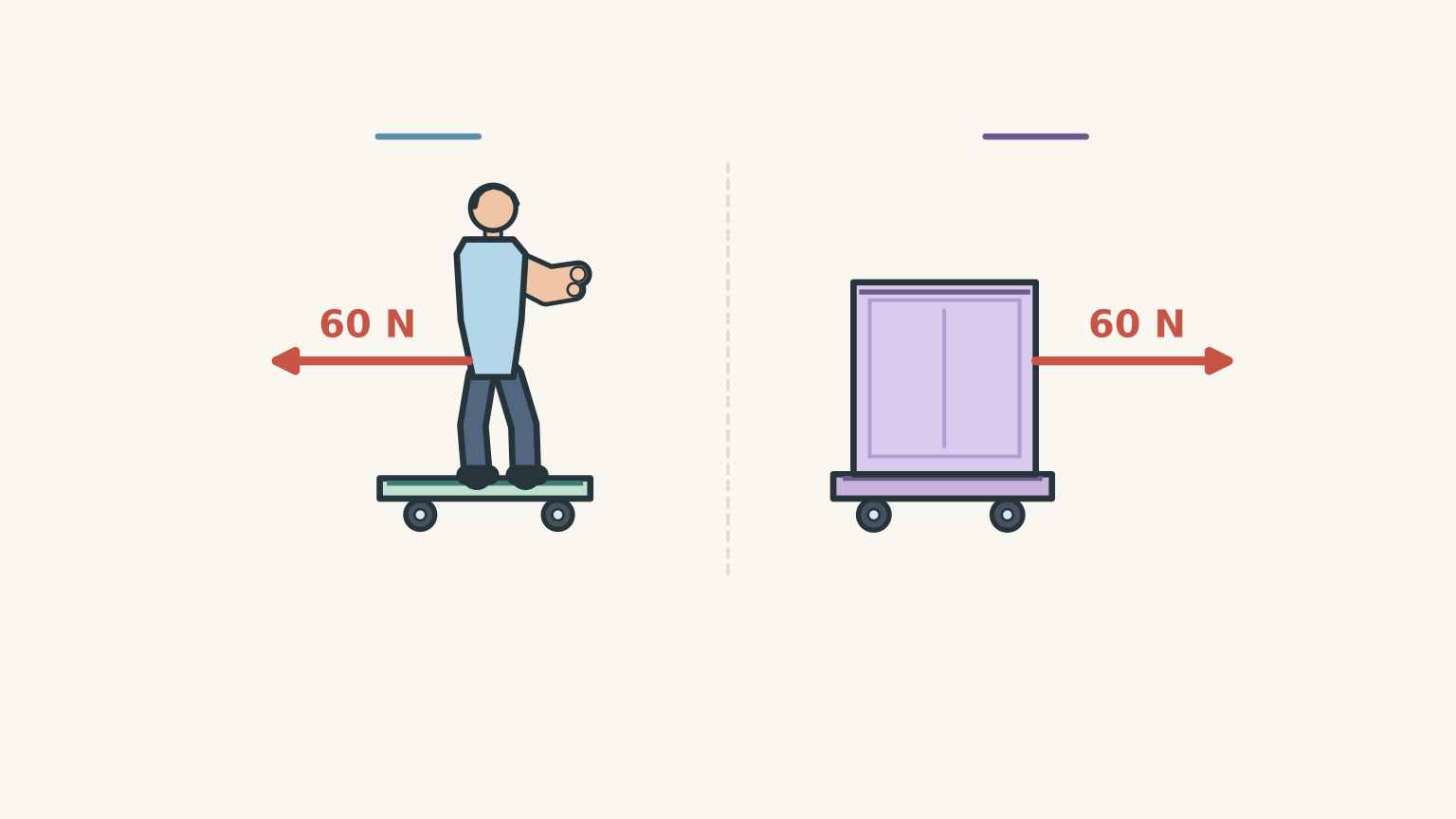
(a) Draw separate horizontal free-body diagrams.
This question is a useful test of Newton’s third law.
The person-platform combination exerts a 60 N force on the trolley towards the right.
Newton’s third law tells us that the trolley must exert an equal and opposite force on the person-platform combination.
Therefore:
- Person-platform combination: 60 N to the left.
- Trolley: 60 N to the right.
Due to technical limitations, this figure may display incorrectly or contain inaccuracies. Please check key details against your course materials.
Marking:
- 1 mark for the correct horizontal force on the person-platform combination.
- 1 mark for the correct horizontal force on the trolley.
Total: 2 marks.
(b) Calculate the acceleration of each object.
Start with the person-platform combination.
Its mass is 50 kg, and the horizontal force acting on it is 60 N to the left.
Using Newton’s second law:
\[ a=\frac{F_{\text{net}}}{m} \]
\[ \begin{aligned} a_{\text{person}} &=\frac{60}{50}\\ &=1.2\ \mathrm{m/s^2} \end{aligned} \]
The person-platform combination accelerates at \(1.2\ \mathrm{m/s^2}\) to the left.
Now consider the trolley.
Its mass is 20 kg, and the horizontal force acting on it is 60 N to the right.
\[ \begin{aligned} a_{\text{trolley}} &=\frac{60}{20}\\ &=3.0\ \mathrm{m/s^2} \end{aligned} \]
The trolley accelerates at \(3.0\ \mathrm{m/s^2}\) to the right.
Final answer
| Object | Acceleration |
|---|---|
| Person-platform combination | \(1.2\ \mathrm{m/s^2}\) left |
| Trolley | \(3.0\ \mathrm{m/s^2}\) right |
Marking:
- 1 mark for the person-platform acceleration and direction.
- 1 mark for the trolley acceleration and direction.
Total: 2 marks.
(c) Identify and explain the Newton’s third law pair.
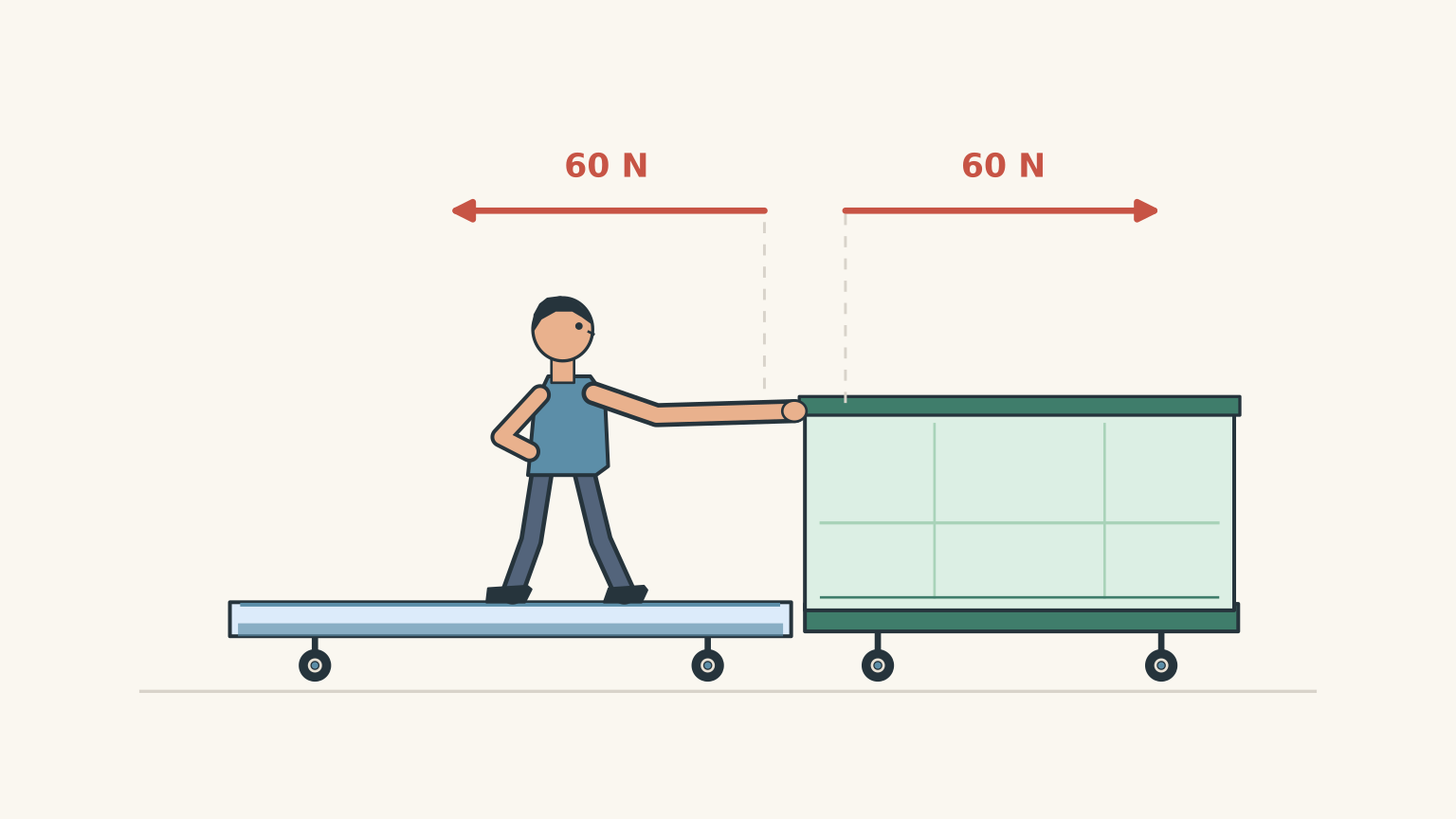
The two forces form a Newton’s third law pair:
- The person-platform combination exerts a 60 N force on the trolley towards the right.
- The trolley exerts a 60 N force on the person-platform combination towards the left.
These forces have equal magnitudes and opposite directions.
However, they act on different objects.
This is the important distinction.
They do not cancel on either individual object’s free-body diagram because each force acts on a different object.
The trolley experiences a rightward force. The person-platform combination experiences a leftward force.
Both objects therefore accelerate.
Due to technical limitations, this figure may display incorrectly or contain inaccuracies. Please check key details against your course materials.
Marking:
- 1 mark for correctly identifying both forces as a Newton’s third law pair.
- 1 mark for explaining that they act on different objects and therefore do not cancel on either individual object’s free-body diagram.
Total: 2 marks.
(d) Consider the combined system.
Now we change the system being analysed.
Instead of looking at the person-platform combination and trolley separately, we treat them as one combined system.
The pushing forces are internal forces because both objects belong to the system.
The external vertical interactions are:
- Gravitational forces exerted by the Earth on the person-platform combination and trolley.
- Normal forces exerted by the floor on the person-platform combination and trolley.
These vertical forces balance.
There are no external horizontal forces under the assumptions in the question because horizontal resistance is negligible.
Therefore:
\[ \boxed{F_{\text{net, horizontal}}=0\ \mathrm{N}} \]
This is an important result.
The person-platform combination and trolley can both accelerate, even though the net external horizontal force on the combined system is zero.
The reason is that the pushing forces are internal to the combined system. They act on different parts of the system, but cancel when considering the system as a whole.
Marking:
- 1 mark for identifying the pushing interaction as internal and the gravitational and normal interactions as external.
- 1 mark for identifying the net external horizontal force as zero.
Total: 2 marks.
04End of practice paper
Total: 50 marks
| Question | Main skills assessed | Marks |
|---|---|---|
| 1 | Force sources, contact and field forces, free-body diagrams, net force | 8 |
| 2 | Equilibrium, Newton’s first law, Newton’s third law | 8 |
| 3 | Newton’s second law, constant acceleration, kinematics, velocity-time graphs | 10 |
| 4 | Free-body diagrams, resolving forces, normal force, acceleration | 8 |
| 5 | Two-dimensional vectors, resultant force, acceleration, equilibrium | 8 |
| 6 | Newton’s third law, individual systems, internal and external forces | 8 |
| Total | 50 |
Final revision checklist
After completing the paper, check that you can confidently:
- [ ] Identify which object exerts each force.
- [ ] Distinguish contact forces from field forces.
- [ ] Draw a free-body diagram with only forces acting on the isolated object.
- [ ] Calculate net force in one and two dimensions.
- [ ] Explain why zero net force does not necessarily mean zero velocity.
- [ ] Apply \(F_{\text{net}}=ma\) to calculate acceleration.
- [ ] Identify Newton’s third law pairs without confusing them with balanced forces.
- [ ] Resolve an angled force using sine and cosine.
- [ ] Connect constant acceleration to velocity, displacement, and velocity-time graphs.
- [ ] Identify internal and external forces when choosing a system.
The biggest skill to take away from this paper is the ability to move between three representations of the same physical situation: a force description, a free-body diagram, and the resulting motion.
If you can do that accurately, Newton’s laws become much easier to apply in unfamiliar HSC Physics questions.