
Standing Waves in Open Pipes: Fundamental and Harmonics
Learn how standing waves form in pipes open at both ends, why the fundamental contains half a wavelength, and how the harmonic frequencies are determined.
A pipe is open at both ends. You blow across one end, and the air inside settles into a strong, steady note. Here is the puzzle: why does the fundamental mode fit only half a wavelength inside the pipe? If a wave has to “fit” between two ends, a full wavelength might seem more natural.
Before reading on, make a prediction. At an open end of the pipe, can the air move freely, or must it stay still?
It can move freely. That single fact controls the entire harmonic pattern of an open pipe.
01What the air is actually doing
Sound in air is a longitudinal wave. Air particles oscillate backwards and forwards along the pipe, while the sound disturbance travels along it.
When waves travelling in opposite directions overlap, they can form a standing wave. Some positions barely move, while others oscillate strongly.
We describe these positions using two terms:
- A displacement node is a position where the air particles have zero displacement in the ideal standing-wave model.
- A displacement antinode is a position where the air particles oscillate with maximum displacement.
At an open end, the air isn’t trapped by a wall. It can move backwards and forwards relatively freely. So an open end behaves approximately as a displacement antinode.
That gives us the boundary condition we need:
A pipe open at both ends has a displacement antinode at each end.
There’s another way to describe the same sound wave using pressure rather than air-particle displacement. The two descriptions swap nodes and antinodes:
| Position | Air displacement | Pressure variation |
|---|---|---|
| Open end | Antinode | Node |
| Displacement node | Node | Antinode |
At an open end, the pressure must stay close to atmospheric pressure, so the pressure variation is very small. That is why the open end is a pressure node but a displacement antinode.
For HSC problems, make sure you know which diagram you are looking at. A displacement diagram and a pressure diagram for the same standing wave do not have their nodes in the same places.
02Building the fundamental mode
Now return to our pipe.
We need the simplest possible standing-wave pattern that has a displacement antinode at both ends.
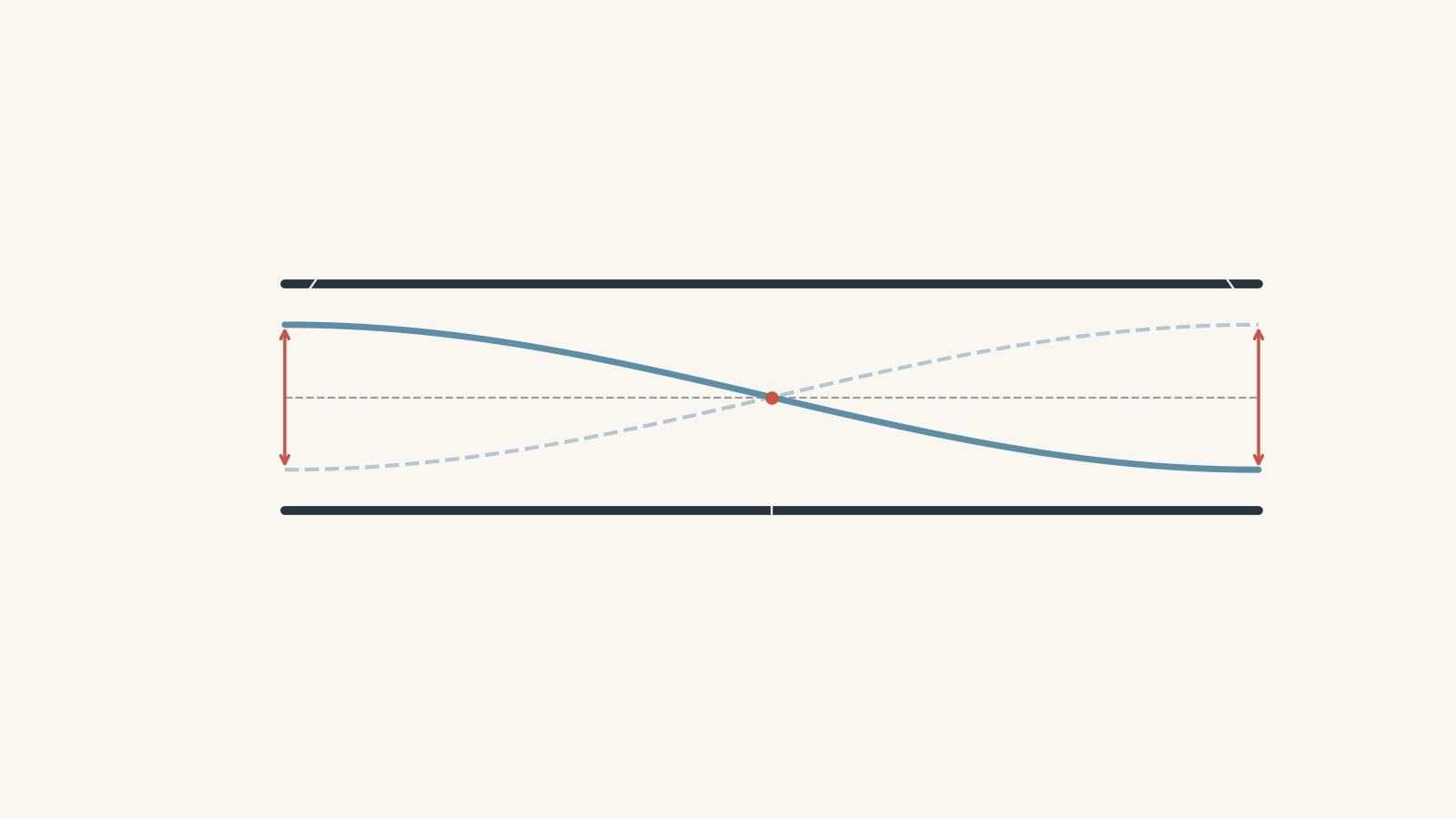
Imagine stretching the displacement pattern between the ends. Starting at one antinode, the wave passes through a node in the middle and reaches another antinode at the other end.
How much of a wavelength is that?
It is half a wavelength.
So, for the fundamental mode,
\[
L = \frac{\lambda_1}{2}
\]
where:
- \(L\) is the length of the pipe in metres,
- \(\lambda_1\) is the wavelength of the fundamental in metres.
Rearranging,
\[
\lambda_1 = 2L
\]
The speed equation for any wave is
\[
v = f\lambda
\]
where \(v\) is the speed of sound in \(\text{m s}^{-1}\), \(f\) is frequency in hertz, and \(\lambda\) is wavelength in metres.
For the fundamental,
\[
f_1 = \frac{v}{\lambda_1} = \frac{v}{2L}
\]
So the fundamental frequency of an ideal pipe open at both ends is
\[
\boxed{f_1 = \frac{v}{2L}}
\]
A longer pipe has a lower fundamental frequency because it requires a longer wavelength. A higher speed of sound gives a higher frequency for the same pipe length.
Worked example: Finding the fundamental frequency
A pipe is open at both ends and has a length of \(0.85\ \text{m}\). The speed of sound is \(340\ \text{m s}^{-1}\). Find its fundamental frequency.
Step 1
For an open pipe,
\[
\lambda_1 = 2L
\]
Substitute \(L = 0.85\ \text{m}\):
\[
\lambda_1 = 2(0.85) = 1.70\ \text{m}
\]
Step 2
\[
v = f\lambda
\]
so
\[
f_1 = \frac{v}{\lambda_1}
\]
Substitute the values:
\[
f_1 = \frac{340\ \text{m s}^{-1}}{1.70\ \text{m}}
= 200\ \text{Hz}
\]
Step 3
The lowest resonant frequency of the pipe is
\[
\boxed{200\ \text{Hz}}
\]
At this frequency, half a wavelength fits along the air column.
03Why there are higher harmonics
The fundamental isn’t the only pattern that satisfies the boundary condition.
Suppose we increase the frequency. Can we fit another standing wave into the pipe while keeping a displacement antinode at both open ends?
Yes. Instead of fitting one half-wavelength into the pipe, we can fit two half-wavelengths.
Then three.
Then four.
In general,
\[
L = n\frac{\lambda_n}{2}
\]
where \(n\) is a positive integer:
\[
n = 1,2,3,4,\ldots
\]
Rearranging,
\[
\lambda_n = \frac{2L}{n}
\]
Using \(v=f\lambda\),
\[
f_n = \frac{nv}{2L}
\]
Since
\[
f_1 = \frac{v}{2L}
\]
we can also write
\[
\boxed{f_n = nf_1}
\]
This is the key harmonic pattern for a pipe open at both ends.
| Harmonic | Wavelength | Frequency |
|---|---|---|
| First, \(n=1\) | \(2L\) | \(f_1\) |
| Second, \(n=2\) | \(L\) | \(2f_1\) |
| Third, \(n=3\) | \(\frac{2L}{3}\) | \(3f_1\) |
| Fourth, \(n=4\) | \(\frac{L}{2}\) | \(4f_1\) |
An ideal open pipe therefore supports all integer harmonics.
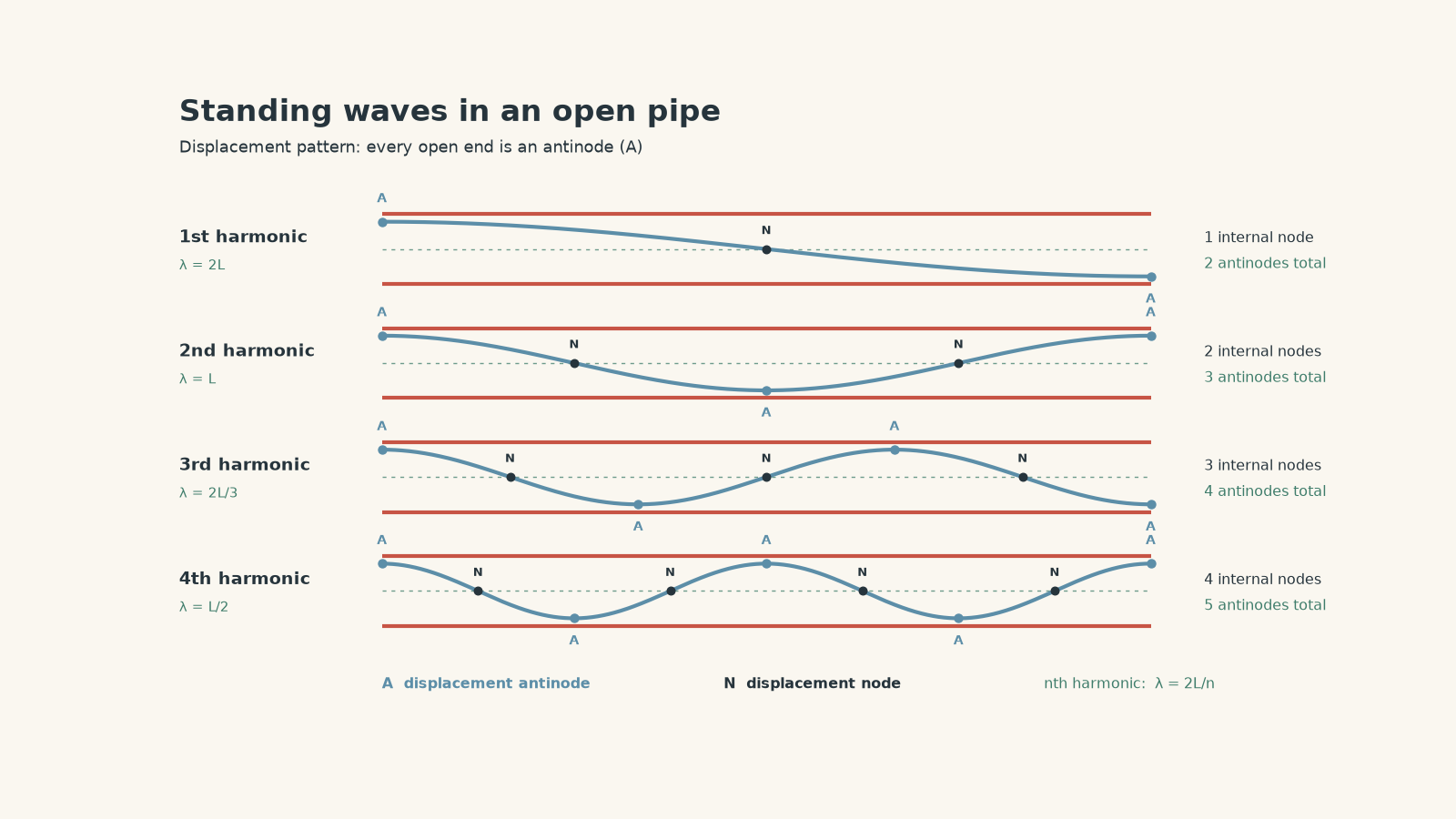
There is a useful counting rule here. For the \(n\)th harmonic of an open pipe:
- \(n\) half-wavelengths fit into the pipe,
- there are \(n\) displacement nodes inside the pipe,
- there are \(n+1\) displacement antinodes if the two open ends are included.
04The tempting mistake: “Both ends are antinodes, so that must be one wavelength”
This prediction is understandable.
You might picture a sine wave and think that if the two ends are both antinodes, the wave must leave one antinode, complete a whole cycle, and return to the same kind of antinode.
But adjacent displacement antinodes are only half a wavelength apart.
They don’t need to oscillate in the same direction at the same instant. In the fundamental mode, when air near one open end is displaced one way, air near the other open end can be displaced the opposite way.
The boundary condition only says both ends must be antinodes. It doesn’t say those antinodes must have the same phase.
That is why the shortest allowed pattern has
\[
L=\frac{\lambda}{2}
\]
rather than \(L=\lambda\).
05Harmonics and overtones are not quite the same words
This terminology causes unnecessary mistakes.
The first harmonic is the fundamental frequency.
The next frequency is therefore:
- the second harmonic, but
- the first overtone.
For an ideal open pipe:
| Frequency | Harmonic name | Overtone name |
|---|---|---|
| \(f_1\) | First harmonic | Fundamental |
| \(2f_1\) | Second harmonic | First overtone |
| \(3f_1\) | Third harmonic | Second overtone |
So if a question asks for the “first overtone” of an open pipe, don’t use \(f_1\). It means \(2f_1\).
Worked example: Identifying a harmonic from its frequency
A \(0.60\ \text{m}\) pipe is open at both ends. The speed of sound is \(340\ \text{m s}^{-1}\). The pipe resonates strongly when driven at \(850\ \text{Hz}\). Determine which harmonic is being produced and find its wavelength.
Step 1
For an open pipe,
\[
f_1 = \frac{v}{2L}
\]
Substitute:
\[
f_1
= \frac{340\ \text{m s}^{-1}}{2(0.60\ \text{m})}
= 283.3\ \text{Hz}
\]
Step 2
The harmonics obey
\[
f_n = nf_1
\]
so
\[
n = \frac{f_n}{f_1}
= \frac{850}{283.3}
\approx 3.00
\]
Therefore the resonance is the third harmonic.
Step 3
We could use \(v=f\lambda\):
\[
\lambda_3
= \frac{v}{f_3}
= \frac{340\ \text{m s}^{-1}}{850\ \text{Hz}}
= 0.400\ \text{m}
\]
The same result follows from
\[
\lambda_3 = \frac{2L}{3}
= \frac{2(0.60)}{3}
= 0.400\ \text{m}
\]
So,
\[
\boxed{n=3,\qquad \lambda_3=0.400\ \text{m}}
\]
Three half-wavelengths fit into the \(0.60\ \text{m}\) air column.
06A useful way to recognise an open-pipe problem
Don’t begin by hunting through a formula sheet. First ask what the air is allowed to do at each boundary.
For a pipe open at both ends:
- Both ends are displacement antinodes.
- An integer number of half-wavelengths must fit into the pipe.
- Therefore \(L=n\lambda/2\).
- Therefore the allowed frequencies are \(f_n=nv/(2L)\).
- The frequencies are \(f_1, 2f_1, 3f_1,\ldots\).
This reasoning is more reliable than memorising a formula because it tells you why the formula applies.
07The ideal model has a small limitation
In the simple HSC model, the displacement antinode is treated as being exactly at the open end of the pipe.
A real sound wave is slightly less tidy. Air just outside the opening also moves, so the air column behaves as though it is a little longer than the physical pipe. This effect is called end correction.
Unless a question gives you information about end correction, the usual ideal model is
\[
L = n\frac{\lambda}{2}
\]
for a pipe open at both ends.
That is a good example of the difference between a useful model and the full physical situation. The model isn’t claiming the real world has magically sharp boundaries. It keeps the important physics while making the resonant pattern calculable.
08Questions and solutions
Question 1
A pipe open at both ends is \(0.50\ \text{m}\) long. Take the speed of sound as \(340\ \text{m s}^{-1}\).
Find the frequencies of its first three harmonics.
Solution 1
The first three harmonic frequencies are \(\boxed{340\ \text{Hz},\ 680\ \text{Hz},\ 1020\ \text{Hz}}\).
For an open pipe,
\[
f_1=\frac{v}{2L}
\]
Substituting,
\[
f_1
=\frac{340\ \text{m s}^{-1}}{2(0.50\ \text{m})}
=340\ \text{Hz}
\]
All integer harmonics are allowed, so
\[
f_n=nf_1
\]
Therefore,
\[
\begin{aligned}
f_1 &= 340\ \text{Hz}\\
f_2 &= 2(340)=680\ \text{Hz}\\
f_3 &= 3(340)=1020\ \text{Hz}
\end{aligned}
\]
The important pattern is that the resonant frequencies are equally spaced by the fundamental frequency, \(340\ \text{Hz}\).
Question 2
An unknown pipe is open at both ends. Two consecutive resonant frequencies are measured as \(510\ \text{Hz}\) and \(680\ \text{Hz}\). The speed of sound is \(340\ \text{m s}^{-1}\).
Determine the fundamental frequency, the length of the pipe, and the harmonic numbers of the two measured resonances.
Solution 2
The fundamental frequency is \(\boxed{170\ \text{Hz}}\), the pipe length is \(\boxed{1.00\ \text{m}}\), and the measured resonances are the third and fourth harmonics.
For an open pipe,
\[
f_n=nf_1
\]
so consecutive harmonics differ by exactly \(f_1\).
Therefore,
\[
f_1=680-510=170\ \text{Hz}
\]
Now use
\[
f_1=\frac{v}{2L}
\]
and rearrange:
\[
L=\frac{v}{2f_1}
\]
Substitute:
\[
L
=\frac{340\ \text{m s}^{-1}}{2(170\ \text{Hz})}
=1.00\ \text{m}
\]
Finally,
\[
\frac{510}{170}=3
\]
and
\[
\frac{680}{170}=4
\]
so \(510\ \text{Hz}\) is the third harmonic and \(680\ \text{Hz}\) is the fourth.
The trap is assuming that the two measured frequencies must be the first and second harmonics. The word consecutive only tells us their harmonic numbers differ by one.
Question 3
A student draws a displacement standing-wave pattern for a pipe open at both ends. The diagram has displacement antinodes at the two ends and at the centre of the pipe, with displacement nodes halfway between the centre and each end.
The student says, “There are three antinodes, so this must be the third harmonic.”
Is the student correct? Identify the harmonic and justify your answer using wavelength.
Solution 3
The student is incorrect. The pattern is the \(\boxed{\text{second harmonic}}\).
Count half-wavelengths, not antinodes.
From the left-end antinode to the centre antinode is half a wavelength:
\[
\frac{\lambda}{2}
\]
From the centre antinode to the right-end antinode is another half-wavelength.
So the whole pipe contains
\[
2\left(\frac{\lambda}{2}\right)=\lambda
\]
Therefore,
\[
L=\lambda
\]
For an open pipe,
\[
L=n\frac{\lambda}{2}
\]
Substituting \(L=\lambda\),
\[
\lambda=n\frac{\lambda}{2}
\]
which gives
\[
n=2
\]
The misconception comes from counting visible features rather than asking how much wavelength fits into the pipe. Three displacement antinodes occur in the second harmonic because the two ends are included.
Question 4
A \(0.75\ \text{m}\) pipe open at both ends is driven by a loudspeaker at a fixed frequency of \(680\ \text{Hz}\). Initially, the speed of sound in the air is \(340\ \text{m s}^{-1}\).
The air is then heated so that the speed of sound becomes \(350\ \text{m s}^{-1}\), while the pipe length and loudspeaker frequency remain unchanged.
Determine whether \(680\ \text{Hz}\) is an exact resonance before heating and after heating. Explain why the pipe cannot simply switch to a nearby harmonic after heating.
Solution 4
The \(680\ \text{Hz}\) sound is initially an exact third-harmonic resonance, but after heating it is \(\boxed{\text{not an exact resonance}}\).
Before heating, the harmonic number required is
\[
n=\frac{2Lf}{v}
\]
Substituting \(L=0.75\ \text{m}\), \(f=680\ \text{Hz}\), and \(v=340\ \text{m s}^{-1}\):
\[
n
=\frac{2(0.75\ \text{m})(680\ \text{Hz})}{340\ \text{m s}^{-1}}
=3
\]
Since \(n\) is an integer, the boundary conditions are satisfied. The sound is the third harmonic.
After heating,
\[
n
=\frac{2(0.75\ \text{m})(680\ \text{Hz})}{350\ \text{m s}^{-1}}
\approx 2.91
\]
An open pipe requires
\[
n=1,2,3,\ldots
\]
because an integer number of half-wavelengths must fit between the two open ends. A value of \(2.91\) does not satisfy that condition, so \(680\ \text{Hz}\) is no longer an exact resonant frequency.
The pipe cannot simply “choose” harmonic \(n=2.91\). Harmonic number is not a continuously adjustable quantity. Each allowed mode must satisfy both boundary conditions simultaneously.
Heating the air has increased \(v\), so every resonant frequency of the pipe increases according to
\[
f_n=\frac{nv}{2L}
\]
For example, the new third-harmonic frequency is
\[
f_3
=\frac{3(350\ \text{m s}^{-1})}{2(0.75\ \text{m})}
=700\ \text{Hz}
\]
So the third-harmonic resonance has shifted from \(680\ \text{Hz}\) to \(700\ \text{Hz}\).
The next useful step is to compare this open-open pattern with a pipe that is closed at one end. Changing just one boundary condition changes which wavelengths can fit, and that is why a closed pipe has a very different harmonic sequence.