
Static and Kinetic Friction Explained for HSC Physics
Learn how static and kinetic friction behave, when to use f = μF_N, and why the normal force matters. Includes worked examples and HSC-style practice.
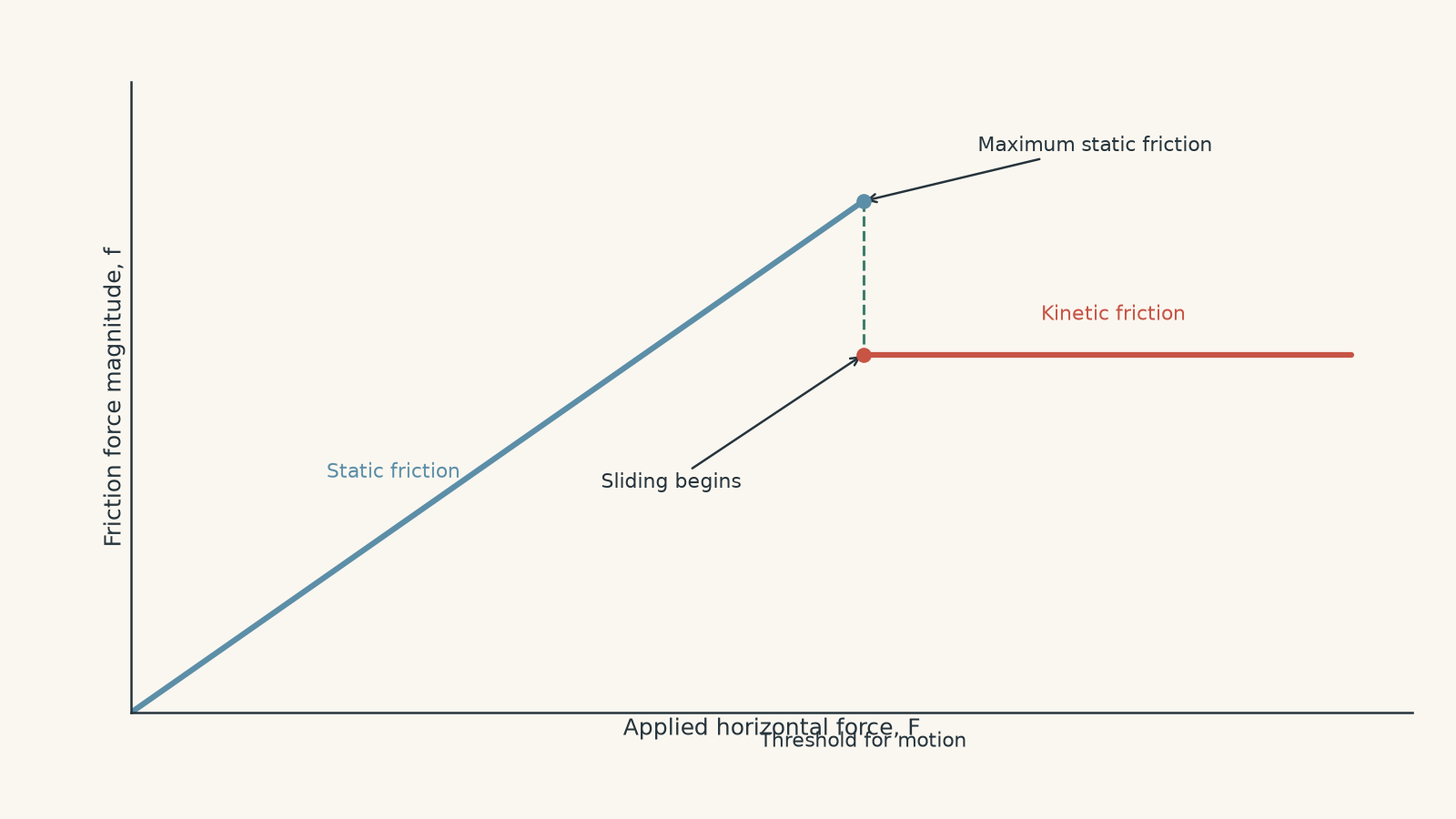
Push a heavy box gently across the floor. It stays still. Push harder. Still nothing. Then, at one particular force, it starts sliding, and suddenly it may feel easier to keep moving.
That is already enough to tell us something important: friction is not simply a fixed force given by \(f = \mu F_N\).
Before reading on, predict this: if you push sideways on a stationary 20 kg box with a force of only 5 N, is the friction force 5 N, \(\mu F_N\), or zero?
If the box remains at rest, the friction force is 5 N in the opposite direction. Static friction adjusts to whatever value is needed to prevent sliding, up to a maximum. The familiar equation \(f = \mu F_N\) only tells the full story in particular situations.
01Start with what friction is trying to do
Imagine two rough surfaces pressed together. At a microscopic scale, neither surface is perfectly flat. Their tiny bumps and irregularities interact.
If you try to slide one surface across the other, those interactions resist the relative sliding.
For HSC Physics, the most useful model is simpler than the microscopic story:
Friction is a contact force that acts parallel to the surfaces and opposes their relative motion, or their tendency to slide relative to each other.
That last part matters. Friction does not always oppose the overall motion of an object.
For example, when you walk forward, your foot pushes backwards on the ground. The ground exerts static friction forwards on your foot. Friction helps accelerate you forwards.
A better rule than “friction opposes motion” is:
Friction opposes sliding, or impending sliding, between surfaces in contact.
There are two cases we need to separate.
- Static friction acts while the surfaces are not sliding relative to each other.
- Kinetic friction acts while the surfaces are sliding relative to each other.
The distinction changes how we calculate the force.
02Static friction adjusts itself
Put a box on a horizontal floor and push it sideways with 2 N. Suppose it stays still.
Because its acceleration is zero, the net horizontal force must also be zero. The floor therefore exerts 2 N of static friction in the opposite direction.
Increase your push to 8 N and suppose the box still doesn’t move. Static friction is now 8 N.
It is not locked at one value.
Think of static friction as a friend stopping you from sending an embarrassing message. If you make a small attempt, they need only a small intervention. If you become more determined, they have to work harder. But there is a limit. Eventually, you’re getting that message out.
The analogy breaks because friction is not making decisions. The useful part is simply that static friction responds to the applied forces until it reaches a maximum possible value.
We write:
\[
f_s \leq \mu_s F_N
\]
where:
- \(f_s\) is the magnitude of the static friction force, measured in newtons (N)
- \(\mu_s\) is the coefficient of static friction
- \(F_N\) is the normal force between the surfaces, measured in newtons (N)
The coefficient \(\mu_s\) has no unit.
The maximum possible static friction is:
\[
f_{s,\text{max}} = \mu_s F_N
\]
This equality applies when the object is just about to slip.
That distinction is one of the most important friction ideas in HSC Physics.
A common mistake
Suppose \(\mu_s F_N = 30\text{ N}\), but you push sideways with only 10 N.
A student might calculate:
\[
f_s = \mu_s F_N = 30\text{ N}
\]
and conclude that friction is 30 N.
But then the forces would not balance. The box would accelerate backwards even though nobody pushed it backwards. That makes no physical sense.
Instead:
\[
f_s = 10\text{ N}
\]
because 10 N is all that is needed to prevent sliding.
The value \(30\text{ N}\) is the maximum available static friction, not the friction force that must always act.
Worked example: Will the box start moving?
A 12.0 kg box rests on a horizontal floor. The coefficient of static friction between the box and floor is 0.35. A student pushes horizontally on the box with a force of 30 N. Determine whether the box moves and find the friction force.
Step 1
There is no vertical acceleration. The only vertical forces are the weight \(mg\) downwards and the normal force \(F_N\) upwards.
Using \(g = 9.8\text{ m s}^{-2}\):
\[
F_N = mg = 12.0 \times 9.8 = 117.6\text{ N}
\]
Step 2
\[
f_{s,\text{max}} = \mu_s F_N
\]
Substituting:
\[
f_{s,\text{max}} = 0.35 \times 117.6 = 41.16\text{ N}
\]
Step 3
The applied force is only 30 N, while static friction can reach up to about 41 N.
The box therefore remains stationary.
Step 4
Because the box is stationary, its horizontal acceleration is zero. The net horizontal force must therefore be zero.
So static friction exactly balances the 30 N push:
\[
f_s = 30\text{ N}
\]
The friction force is 30 N opposite the push. The value 41 N is only the maximum friction that could act before slipping begins.
03What changes once the surfaces slide?
Keep increasing the push. Eventually the required static friction reaches its maximum:
\[
f_s = f_{s,\text{max}} = \mu_s F_N
\]
Any larger unbalanced force can start the box sliding.
Once sliding begins, we switch to a kinetic friction model:
\[
f_k = \mu_k F_N
\]
where:
- \(f_k\) is the magnitude of kinetic friction
- \(\mu_k\) is the coefficient of kinetic friction
- \(F_N\) is the normal force
For many ordinary pairs of surfaces, \(\mu_k\) is smaller than \(\mu_s\). This explains why getting a heavy object moving can require more force than keeping it sliding.
Be careful with the wording, though. In the HSC model, we often treat \(f_k\) as approximately constant for a given normal force. Real friction can depend on surface condition, temperature, speed, deformation, contamination, and other factors.
The equation is a model, not a universal microscopic law.
04The normal force is not automatically \(mg\)
The equation \(f = \mu F_N\) contains the normal force, not the object’s weight.
On a horizontal surface with no other vertical forces and no vertical acceleration:
\[
F_N = mg
\]
That is why students often become used to replacing \(F_N\) with \(mg\).
But \(F_N = mg\) is not a definition.
The normal force is the contact force acting perpendicular to the surface. Its value must come from Newton’s laws.
Suppose you push a box downwards as well as forwards. The floor has to support both the object’s weight and your downward push, so \(F_N\) becomes larger.
If you pull upwards at an angle, \(F_N\) becomes smaller.
And on an incline, the normal force is only the component of the weight perpendicular to the slope.
This matters because changing \(F_N\) changes the friction that the model predicts.
Worked example: Pulling at an angle
A 20.0 kg crate is sliding across a horizontal floor. It is pulled by a 90 N force at \(30^\circ\) above the horizontal. The coefficient of kinetic friction is 0.25. Find the crate’s horizontal acceleration.
Step 1
The horizontal component is:
\[
F_x = 90\cos 30^\circ = 77.9\text{ N}
\]
The upward component is:
\[
F_y = 90\sin 30^\circ = 45.0\text{ N}
\]
The upward component reduces the force with which the crate presses on the floor.
Step 2
The crate has no vertical acceleration, so the vertical forces balance:
\[
F_N + F_y – mg = 0
\]
Therefore:
\[
F_N = mg – F_y
\]
Substituting:
\[
F_N = (20.0)(9.8) – 45.0
= 196 – 45.0
= 151\text{ N}
\]
Notice that \(F_N\) is not 196 N.
Step 3
\[
f_k = \mu_k F_N
\]
So:
\[
f_k = 0.25(151) = 37.75\text{ N}
\]
The friction force acts horizontally opposite the sliding.
Step 4
\[
F_{\text{net},x} = F_x – f_k
\]
\[
F_{\text{net},x} = 77.9 – 37.75
= 40.15\text{ N}
\]
Step 5
Using \(F_{\text{net}} = ma\):
\[
a = \frac{F_{\text{net},x}}{m}
= \frac{40.15}{20.0}
= 2.01\text{ m s}^{-2}
\]
The crate accelerates horizontally at approximately \(2.0\text{ m s}^{-2}\).
The important physics is not the arithmetic. Pulling upwards reduces \(F_N\), which reduces the kinetic friction. Using \(F_N = mg\) without checking the vertical forces would overestimate the friction.
05Friction on an inclined plane
An incline makes the role of the normal force easier to see.
Take an object of mass \(m\) on a slope at angle \(\theta\) above the horizontal. Its weight \(mg\) acts vertically downwards.
We can resolve the weight into two components:
- \(mg\sin\theta\) parallel to the slope
- \(mg\cos\theta\) perpendicular to the slope
If there are no other forces perpendicular to the slope:
\[
F_N = mg\cos\theta
\]
The maximum static friction is therefore:
\[
f_{s,\text{max}} = \mu_s mg\cos\theta
\]
Meanwhile, the component of weight trying to pull the object down the slope is:
\[
F_{\parallel} = mg\sin\theta
\]
So will it slip?
Compare the force trying to produce sliding with the maximum static friction available.
If:
\[
mg\sin\theta \leq \mu_s mg\cos\theta
\]
static friction can prevent sliding.
At the exact point where slipping is about to begin:
\[
mg\sin\theta = \mu_s mg\cos\theta
\]
Cancelling \(mg\):
\[
\tan\theta = \mu_s
\]
This result also reveals something useful: in this simplified model, the angle at which slipping begins does not depend on the mass of the object.
A heavier object has a larger downslope component of weight, but it also has a proportionally larger normal force and therefore proportionally more maximum static friction.
06A decision rule for friction problems
When you see a friction problem, do not immediately write \(f = \mu F_N\). First decide what kind of friction is physically possible.
| Situation | Friction model |
|---|---|
| No tendency to slide | Static friction may be zero |
| Surfaces are stationary relative to each other | \(f_s\) takes the value required, provided \(f_s \leq \mu_s F_N\) |
| Object is just about to slip | \(f_s = \mu_s F_N\) |
| Surfaces are sliding relative to each other | \(f_k = \mu_k F_N\) in the standard model |
A reliable process is:
- Draw the forces.
- Find \(F_N\) from forces perpendicular to the contact surface.
- Decide whether the surfaces are sliding.
- If they are not sliding, calculate the friction required for equilibrium or the stated acceleration.
- Check whether that required value is no greater than \(\mu_s F_N\).
- If sliding occurs, use the kinetic friction model \(f_k = \mu_k F_N\).
- Apply Newton’s second law to the remaining forces.
This avoids the most common mistake: treating \(\mu F_N\) as the automatic value of every friction force.
07Where \(f = \mu F_N\) stops being exact
For HSC calculations, the coefficient model is extremely useful. But it has limits.
The coefficient is not a universal property of one material
It does not make sense to say that “wood has a coefficient of friction of 0.4” without specifying what the wood is touching and the condition of both surfaces.
A friction coefficient describes the behaviour of a pair of contacting surfaces under particular conditions.
Wood on steel can behave differently from wood on rubber. Wet surfaces can behave differently from dry ones.
Contact area is more complicated than the simple model suggests
In the standard dry-friction model, friction is taken to depend mainly on \(F_N\) and \(\mu\), not on the apparent contact area.
So turning the same rectangular block onto a different face does not automatically change the calculated friction.
Real surfaces are more complicated because the true microscopic area of contact is not simply the visible area touching the floor.
For HSC modelling, use the stated coefficient and normal force unless the question gives evidence that another model is required.
Kinetic friction is not perfectly constant in every real situation
The simple model treats:
\[
f_k = \mu_k F_N
\]
as though \(\mu_k\) were fixed.
In real systems, friction can change with speed, temperature, surface wear, lubrication, and deformation. Tyres, soft rubber, fluids, and very high speeds can behave particularly differently from the simple dry-friction model.
So if experimental data do not fit \(f = \mu F_N\) perfectly, that does not automatically mean Newton’s laws have failed. It may mean the friction model is too simple for the system.
08The misconception to remove completely
A tempting rule is:
Friction equals \(\mu F_N\).
Replace it with this:
\(\mu F_N\) gives the maximum static friction before slipping, or the modelled kinetic friction while sliding.
For static friction:
\[
0 \leq f_s \leq \mu_s F_N
\]
For an object just about to slip:
\[
f_s = \mu_s F_N
\]
For sliding surfaces in the standard model:
\[
f_k = \mu_k F_N
\]
That is the distinction most friction questions are really testing.
09Questions and solutions
Question 1
A 6.0 kg textbook box rests on a horizontal table. The coefficient of static friction is 0.40. A horizontal force of 12 N is applied to the box.
Determine whether the box moves and find the magnitude of the friction force. Use \(g = 9.8\text{ m s}^{-2}\).
Solution 1
The box does not move, and the static friction force is 12 N.
First find the normal force. There are no other vertical forces and no vertical acceleration, so:
\[
F_N = mg = 6.0(9.8) = 58.8\text{ N}
\]
The maximum static friction is:
\[
f_{s,\text{max}} = \mu_s F_N
= 0.40(58.8)
= 23.5\text{ N}
\]
The applied force is only 12 N, which is below the maximum available static friction.
Static friction therefore adjusts to exactly balance the applied force:
\[
f_s = 12\text{ N}
\]
The trap is using \(23.5\text{ N}\) as the actual friction. That value is only the maximum that static friction could reach before slipping.
Question 2
A 10.0 kg storage box is sliding to the right across a horizontal floor. The coefficient of kinetic friction is 0.30. A horizontal force of 45 N is applied to the right.
Calculate the acceleration of the box. Use \(g = 9.8\text{ m s}^{-2}\).
Solution 2
The box accelerates to the right at approximately \(1.56\text{ m s}^{-2}\).
Because the applied force is horizontal, the vertical forces balance:
\[
F_N = mg = 10.0(9.8) = 98.0\text{ N}
\]
The box is already sliding, so use kinetic friction:
\[
f_k = \mu_k F_N
= 0.30(98.0)
= 29.4\text{ N}
\]
The friction force acts to the left because the surfaces are sliding relative to each other.
The net horizontal force is:
\[
F_{\text{net}} = 45 – 29.4 = 15.6\text{ N}
\]
Using \(F_{\text{net}} = ma\):
\[
a = \frac{15.6}{10.0}
= 1.56\text{ m s}^{-2}
\]
So the acceleration is:
\[
\boxed{a = 1.56\text{ m s}^{-2}\text{ to the right}}
\]
The important distinction from Question 1 is that the surfaces are sliding. Kinetic friction is therefore modelled using \(f_k = \mu_k F_N\), rather than adjusting to balance the applied force.
Question 3
A 15.0 kg equipment case rests on a horizontal floor. The coefficient of static friction is 0.45. A rope pulls on the case with a force of 80 N at \(25^\circ\) above the horizontal.
Determine whether the case begins to slide. Use \(g = 9.8\text{ m s}^{-2}\).
Solution 3
The case begins to slide because the horizontal pull is greater than the maximum available static friction.
The tempting mistake is to use \(F_N = mg\). The rope has an upward component, so it reduces the normal force.
The vertical component of the rope tension is:
\[
F_y = 80\sin25^\circ = 33.8\text{ N}
\]
The weight is:
\[
mg = 15.0(9.8) = 147\text{ N}
\]
Because there is no vertical acceleration while the case remains in contact with the floor:
\[
F_N = 147 – 33.8 = 113.2\text{ N}
\]
The maximum static friction is:
\[
f_{s,\text{max}} = \mu_s F_N
= 0.45(113.2)
= 50.9\text{ N}
\]
Now calculate the horizontal component of the pull:
\[
F_x = 80\cos25^\circ
= 72.5\text{ N}
\]
To remain stationary, the case would need 72.5 N of static friction. But the largest available static friction is only 50.9 N.
Therefore:
\[
72.5\text{ N} > 50.9\text{ N}
\]
so the case must begin to slide.
This question shows why the normal force has to be calculated rather than assumed. Pulling upwards reduces \(F_N\), which also reduces the maximum available static friction.
Question 4
Two blocks, A and B, are made from the same material and sit on the same horizontal surface. Block B has twice the mass of block A.
A student says:
“Block B must start sliding under the same horizontal force as block A because the coefficient of static friction is the same.”
Using the friction model, determine whether the student’s claim is correct. Assume the only vertical forces are weight and the normal force.
Solution 4
The student’s claim is incorrect. In this model, block B requires twice the horizontal force to reach the point of slipping.
The coefficient of static friction is the same for both blocks, but maximum static friction depends on both \(\mu_s\) and the normal force:
\[
f_{s,\text{max}} = \mu_s F_N
\]
On a horizontal surface:
\[
F_N = mg
\]
So:
\[
f_{s,\text{max}} = \mu_s mg
\]
Let block A have mass \(m\). Then:
\[
f_{s,\text{max,A}} = \mu_s mg
\]
Block B has mass \(2m\), so:
\[
f_{s,\text{max,B}}
= \mu_s(2m)g
= 2\mu_s mg
\]
Therefore:
\[
f_{s,\text{max,B}} = 2f_{s,\text{max,A}}
\]
Block B requires twice the horizontal force to reach the maximum static friction and begin sliding.
The misconception is treating \(\mu_s\) as though it were itself a friction force. It is only a dimensionless coefficient. The actual limiting force also depends on \(F_N\).
Question 5
A block rests on a rough adjustable slope. The coefficient of static friction between the block and slope is 0.50.
The slope is gradually made steeper. A student calculates the friction force at every angle using:
\[
f_s = \mu_s mg\cos\theta
\]
Explain why this method is wrong before the block begins to slide. Then determine the angle at which sliding first becomes possible according to the model.
Solution 5
The method is wrong because \(\mu_s mg\cos\theta\) is the maximum available static friction, not the actual static friction at every angle. Sliding first becomes possible at approximately \(26.6^\circ\).
Before the block slips, the force tending to move it down the slope is the parallel component of its weight:
\[
F_{\parallel} = mg\sin\theta
\]
Static friction acts up the slope and, while equilibrium is possible, adjusts to match this force:
\[
f_s = mg\sin\theta
\]
The maximum static friction available is:
\[
f_{s,\text{max}} = \mu_s F_N
\]
For this slope:
\[
F_N = mg\cos\theta
\]
so:
\[
f_{s,\text{max}} = \mu_s mg\cos\theta
\]
The block reaches the point of slipping when the required static friction equals the maximum available static friction:
\[
mg\sin\theta = \mu_s mg\cos\theta
\]
Cancel \(mg\):
\[
\sin\theta = \mu_s\cos\theta
\]
Therefore:
\[
\tan\theta = \mu_s
\]
Substituting \(\mu_s = 0.50\):
\[
\tan\theta = 0.50
\]
\[
\theta = \tan^{-1}(0.50)
= 26.6^\circ
\]
So sliding first becomes possible at approximately:
\[
\boxed{26.6^\circ}
\]
The deeper point is that before this angle, the actual friction is less than its maximum value. For example, on a very shallow slope only a small friction force is required. The friction force reaches \(\mu_s F_N\) only at the threshold of slipping.
Question 6
A researcher tests a sliding block and obtains the following observations:
- doubling the normal force approximately doubles the measured friction force
- at low sliding speeds, \(f_k/F_N\) is approximately 0.32
- at much higher sliding speeds, \(f_k/F_N\) falls to approximately 0.25
Another student argues that the results contradict the equation \(f_k = \mu_k F_N\), so Newton’s laws must be wrong.
Assess this conclusion.
Solution 6
The conclusion is not justified. The evidence suggests that the simple constant-\(\mu_k\) friction model is becoming inadequate, not that Newton’s laws have failed.
At low speeds, the data are reasonably consistent with:
\[
f_k = \mu_k F_N
\]
with approximately:
\[
\mu_k = 0.32
\]
The fact that doubling \(F_N\) approximately doubles \(f_k\) also supports the proportional relationship between friction and normal force under those conditions.
However, at higher speeds:
\[
\frac{f_k}{F_N} \approx 0.25
\]
rather than 0.32. This means a single constant value of \(\mu_k\) no longer describes all of the measurements.
The correct interpretation is that the assumed friction model has limits. The effective coefficient may depend on factors such as speed, heating, deformation, or changes at the surfaces.
Newton’s second law still relates the actual net force to acceleration:
\[
F_{\text{net}} = ma
\]
Nothing in the observations shows that relationship has failed.
The trap is confusing a model for one particular force with a fundamental law of motion. If \(f_k = \mu_k F_N\) is inaccurate under some conditions, we revise the friction model used to calculate \(f_k\). We do not immediately discard Newton’s laws.
That distinction becomes important whenever HSC Physics moves from idealised force models to experimental evidence. Once you can decide what friction force is actually allowed to do, the next step is combining friction confidently with Newton’s laws on inclines, connected bodies, and other multi-force systems.