
The Doppler Effect: Frequency Changes in HSC Physics
Learn how relative motion changes observed sound frequency, how to choose Doppler equation signs, and why moving sources and observers behave differently.
An ambulance passes you with its siren sounding. Just before it reaches you, the pitch is high. Just after it passes, the pitch suddenly drops. The siren hasn’t changed its setting, so what changed?
Before reading on, make a prediction: does the sound itself travel faster while the ambulance is approaching you?
It doesn’t. In still air, the speed of sound is set mainly by the properties of the air, not by how fast the source is moving. The ambulance changes something else: the spacing and arrival rate of the sound waves. That change in observed frequency is the Doppler effect.
01Start with wavefronts, not the formula
Imagine a stationary speaker producing a steady tone. Each cycle creates another compression in the air. Those compressions travel outwards at the speed of sound.
If the speaker emits \(500\) cycles every second, its frequency is \(500\ \text{Hz}\). The time between successive cycles is the period:
\[
T = \frac{1}{f}
\]
where:
- \(T\) is the period in seconds,
- \(f\) is the frequency in hertz (\(\text{Hz}\)).
While one cycle is being produced, the previous wavefront moves some distance through the air. That gives the wavelength:
\[
v = f\lambda
\]
where:
- \(v\) is the wave speed in \(\text{m s}^{-1}\),
- \(f\) is the frequency in \(\text{Hz}\),
- \(\lambda\) is the wavelength in metres.
For a stationary source and stationary observer, nothing strange happens. The observer receives wavefronts at the same rate that the source produces them.
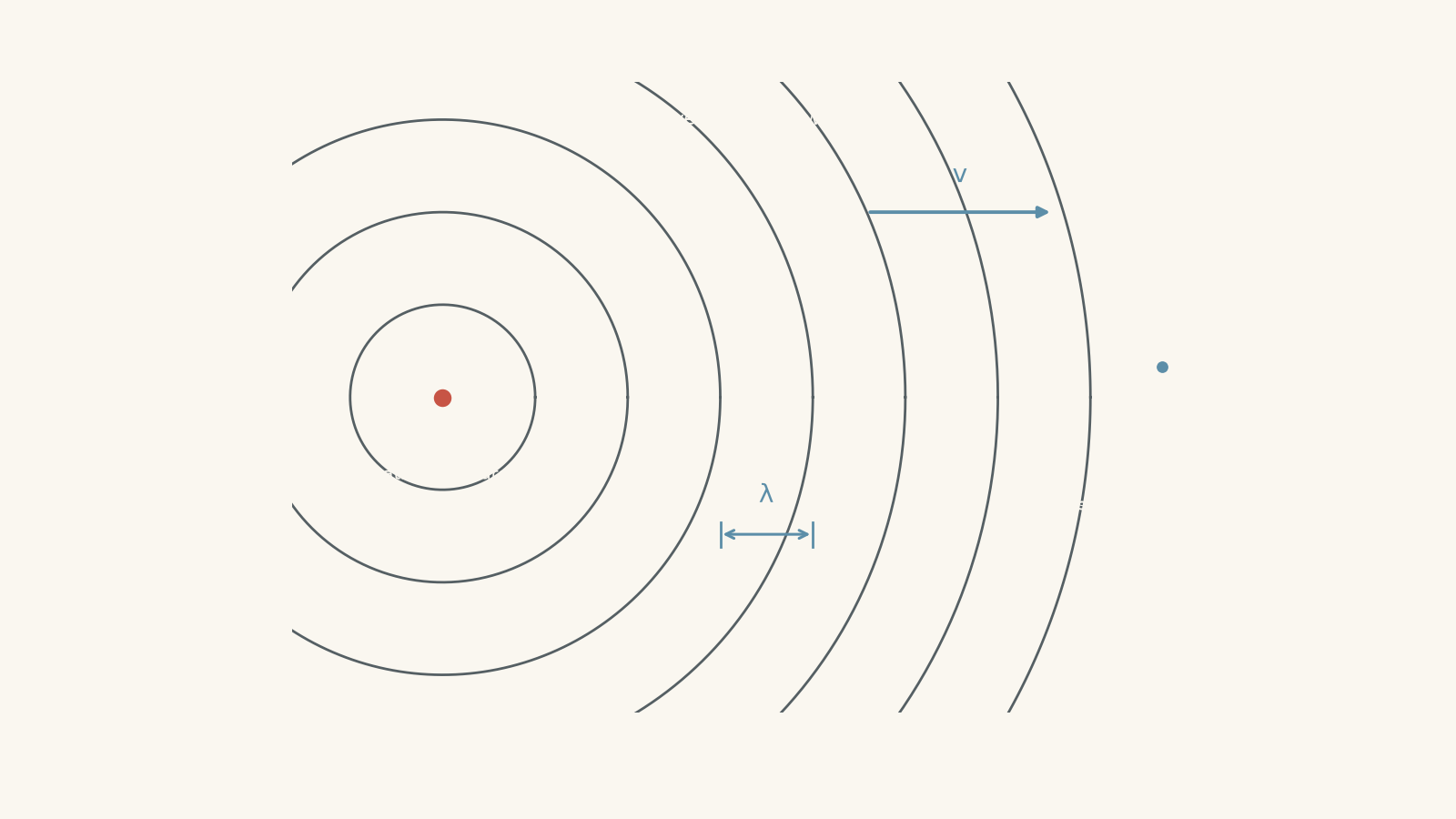
Now move either the source or the observer. Those two cases look similar, but physically they are not quite the same.
02When the observer moves
Suppose the speaker stays still, but you run towards it.
The wavelength in the air doesn’t change. The source is still producing the same pattern of wavefronts at the same locations. Instead, you move into the approaching wavefronts, so you meet them more frequently.
Think of walking towards a line of people who are each standing one metre apart. The spacing between the people doesn’t change just because you’re walking. You simply pass more of them each second.
Sound wavefronts aren’t stationary people, of course. They are moving disturbances in a medium. The analogy is useful only for seeing why the observer can change the encounter rate without changing the wavelength already present in the air.
If the observer moves towards the source at speed \(v_o\), the wavefronts approach the observer at an effective rate based on \(v + v_o\).
Since
\[
f_{\text{obs}} = \frac{\text{speed at which wavefronts are encountered}}{\text{wavelength}},
\]
we get
\[
f_{\text{obs}}
= \frac{v+v_o}{\lambda}
= f_s\frac{v+v_o}{v}
\]
where:
- \(f_{\text{obs}}\) is the observed frequency,
- \(f_s\) is the frequency emitted by the source,
- \(v\) is the speed of sound through the medium,
- \(v_o\) is the observer’s velocity towards the source.
If the observer moves away from the source, \(v_o\) is negative. The observer meets fewer wavefronts each second, so the observed frequency falls.
Worked example: Walking towards a speaker
A stationary speaker emits a tone of \(512\ \text{Hz}\). A student walks directly towards it at \(8.0\ \text{m s}^{-1}\). Take the speed of sound to be \(340\ \text{m s}^{-1}\). What frequency does the student observe?
Step 1
The source is stationary, while the observer moves towards it. Therefore,
\[
v_o = +8.0\ \text{m s}^{-1}
\]
The positive sign makes sense because moving towards the source should increase the observed frequency.
Step 2
\[
f_{\text{obs}} = f_s\frac{v+v_o}{v}
\]
Step 3
\[
f_{\text{obs}}
= 512\left(\frac{340+8.0}{340}\right)
= 524.05\ \text{Hz}
\]
Step 4
\[
\boxed{f_{\text{obs}} \approx 524\ \text{Hz}}
\]
The student hears a slightly higher frequency than the \(512\ \text{Hz}\) emitted by the speaker because they are moving into the wavefronts.
03When the source moves
Now keep the observer still and move the source towards them.
This time something different happens. The source produces one wavefront, then moves forward before producing the next one. That makes successive wavefronts closer together in front of the source.
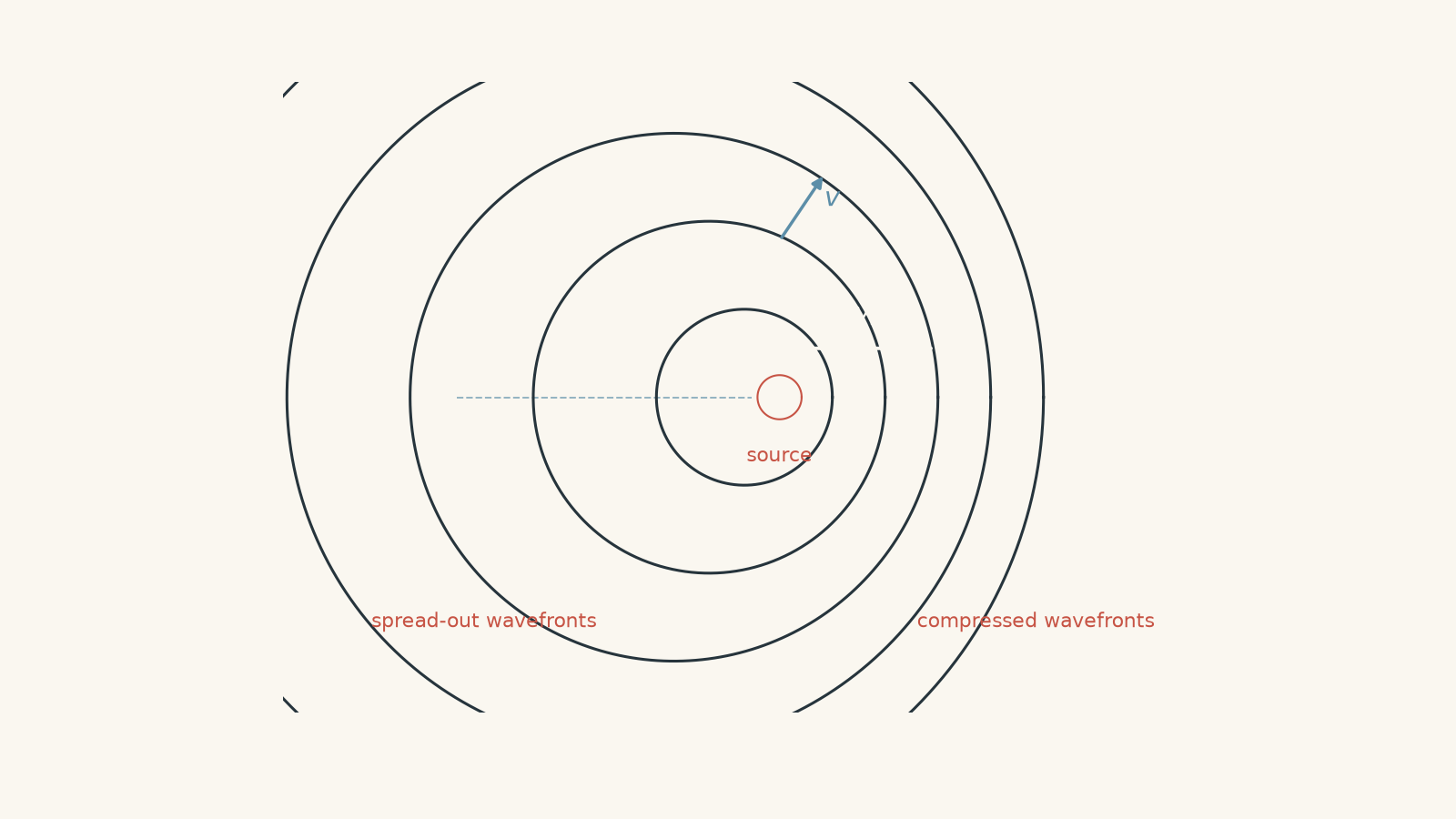
Suppose the source has period \(T\). During one period:
- the first wavefront travels a distance \(vT\),
- the source moves forward a distance \(v_sT\).
So the gap between successive wavefronts in front of the source is
\[
\lambda’ = vT-v_sT
\]
Factorising gives
\[
\lambda’ = (v-v_s)T
\]
and because \(T=1/f_s\),
\[
\lambda’ = \frac{v-v_s}{f_s}
\]
The observer is stationary, so the wavefronts pass them at speed \(v\). Therefore,
\[
f_{\text{obs}}
= \frac{v}{\lambda’}
= f_s\frac{v}{v-v_s}
\]
An approaching source makes \(v-v_s\) smaller. That makes the observed frequency larger.
If the source moves away, we treat \(v_s\) as negative. The denominator becomes larger, and the observed frequency decreases.
04Putting source and observer motion together
If both source and observer move along the line joining them, we combine the two effects:
\[
\boxed{
f_{\text{obs}}
=
f_s
\frac{v+v_o}{v-v_s}
}
\]
Use this sign convention:
| Motion | Sign to use | Effect on observed frequency |
|---|---|---|
| Observer moves towards source | \(v_o>0\) | Increases |
| Observer moves away from source | \(v_o<0\) | Decreases |
| Source moves towards observer | \(v_s>0\) | Increases |
| Source moves away from observer | \(v_s<0\) | Decreases |
Don’t decide signs using “left” and “right”. Decide them using towards and away.
That is much safer when a diagram is reversed.
Worked example: A siren catches a cyclist
A vehicle emits a \(720\ \text{Hz}\) siren while travelling towards a cyclist at \(24\ \text{m s}^{-1}\). The cyclist is travelling in the same direction as the vehicle at \(6.0\ \text{m s}^{-1}\), so the cyclist is moving away from the approaching source. The speed of sound is \(340\ \text{m s}^{-1}\). Find the frequency heard by the cyclist.
Step 1
The source is moving towards the observer, so
\[
v_s = +24\ \text{m s}^{-1}
\]
Step 2
The cyclist is moving away from the source, so
\[
v_o = -6.0\ \text{m s}^{-1}
\]
Notice that the cyclist and vehicle are travelling in the same compass direction. That doesn’t determine the Doppler signs. Their motion towards or away from each other does.
Step 3
\[
\begin{aligned}
f_{\text{obs}}
&=f_s\frac{v+v_o}{v-v_s}\\
&=720\left(\frac{340-6.0}{340-24}\right)\\
&=720\left(\frac{334}{316}\right)\\
&=761.01\ \text{Hz}
\end{aligned}
\]
Step 4
\[
\boxed{f_{\text{obs}} \approx 761\ \text{Hz}}
\]
The cyclist is moving away, which tends to reduce the frequency. However, the approaching source compresses the wavefronts enough to produce a larger overall effect. The observed frequency is therefore higher than \(720\ \text{Hz}\).
05Why “relative speed” isn’t enough
A very tempting idea is:
If the source and observer are approaching each other at \(20\ \text{m s}^{-1}\), it shouldn’t matter which one is moving.
That sounds reasonable. It is also not quite correct for sound.
Suppose \(v=340\ \text{m s}^{-1}\).
If the observer approaches a stationary source at \(20\ \text{m s}^{-1}\), the frequency multiplier is
\[
\frac{340+20}{340} = 1.0588
\]
If the source approaches a stationary observer at \(20\ \text{m s}^{-1}\), the multiplier is
\[
\frac{340}{340-20} = 1.0625
\]
They are close, but not identical.
Why?
Because sound travels through a medium.
Moving the observer changes how quickly the observer encounters an existing pattern of wavefronts.
Moving the source changes the spacing of the wavefronts themselves.
That distinction is one of the most important ideas in Doppler-effect questions.
06What actually changes when a source passes you?
Return to the ambulance.
As it approaches:
- the source moves forward between emissions,
- wavefronts are compressed in front of it,
- their wavelength is shorter,
- you receive them more frequently,
- the observed frequency is higher.
After it passes:
- the source is moving away,
- successive wavefronts reaching you are more widely spaced,
- their wavelength is longer,
- you receive them less frequently,
- the observed frequency is lower.
The speed of each sound wave through still air has not suddenly dropped.
That is why saying “the approaching sound travels faster” gives the wrong mental model.
07A quick sign-check before calculating
Before touching the equation, predict whether the answer should be above or below the emitted frequency.
If the source and observer are getting closer, you would usually expect a higher observed frequency.
If they are separating, you would usually expect a lower observed frequency.
Then inspect the equation:
\[
f_{\text{obs}}
=
f_s
\frac{v+v_o}{v-v_s}
\]
For approaching motion:
- \(v_o>0\) makes the numerator larger,
- \(v_s>0\) makes the denominator smaller.
Both raise \(f_{\text{obs}}\).
For separating motion:
- \(v_o<0\) makes the numerator smaller,
- \(v_s<0\) makes the denominator larger.
Both lower \(f_{\text{obs}}\).
If your calculated answer disagrees with your physical prediction, check the signs before doing anything else.
08The formula has limits
Look at the source term:
\[
f_{\text{obs}}=f_s\frac{v}{v-v_s}
\]
As an approaching source gets closer to the speed of sound, \(v-v_s\) becomes very small. The formula predicts extremely short wavelengths in front of the source and extremely high observed frequencies.
What if \(v_s=v\)?
The denominator becomes zero.
That does not mean an observer literally hears an infinite-frequency sound. It means our simple picture of separated, steadily arriving wavefronts has reached its limit.
At the speed of sound, successive disturbances pile up. For supersonic motion, the source outruns some of its own earlier wavefronts, producing a shock-wave pattern rather than the ordinary subsonic pattern assumed in the simple Doppler equation.
A denominator approaching zero is therefore a warning to think about the physics, not an invitation to write “infinity Hz”.
09Questions and solutions
Question 1
A stationary alarm emits a frequency of \(520\ \text{Hz}\). An observer runs directly towards it at \(12\ \text{m s}^{-1}\). The speed of sound is \(340\ \text{m s}^{-1}\).
Calculate the observed frequency.
Solution 1
The observed frequency is approximately \(\boxed{538\ \text{Hz}}\).
The source is stationary, while the observer moves towards it, so \(v_o=+12\ \text{m s}^{-1}\) and \(v_s=0\).
Using
\[
f_{\text{obs}}
=
f_s\frac{v+v_o}{v-v_s},
\]
we obtain
\[
\begin{aligned}
f_{\text{obs}}
&=520\left(\frac{340+12}{340}\right)\\
&=520\left(\frac{352}{340}\right)\\
&=538.35\ \text{Hz}
\end{aligned}
\]
Therefore,
\[
\boxed{f_{\text{obs}}\approx538\ \text{Hz}}
\]
The result is higher than \(520\ \text{Hz}\), as expected, because the observer is moving into the approaching wavefronts.
Question 2
A cart carries a buzzer emitting \(900\ \text{Hz}\). The cart moves towards a student at \(18\ \text{m s}^{-1}\). The student walks away from the cart at \(4.0\ \text{m s}^{-1}\).
Take the speed of sound to be \(340\ \text{m s}^{-1}\).
Calculate the frequency heard by the student.
Solution 2
The student hears approximately \(\boxed{939\ \text{Hz}}\).
The source moves towards the observer, so
\[
v_s=+18\ \text{m s}^{-1}
\]
The observer moves away from the source, so
\[
v_o=-4.0\ \text{m s}^{-1}
\]
Using the Doppler equation,
\[
\begin{aligned}
f_{\text{obs}}
&=f_s\frac{v+v_o}{v-v_s}\\
&=900\left(\frac{340-4.0}{340-18}\right)\\
&=900\left(\frac{336}{322}\right)\\
&=939.13\ \text{Hz}
\end{aligned}
\]
Hence,
\[
\boxed{f_{\text{obs}}\approx939\ \text{Hz}}
\]
The observer moving away tends to lower the frequency, while the source approaching tends to raise it. Here the source effect is stronger, so the net observed frequency is above \(900\ \text{Hz}\).
Question 3
A \(700\ \text{Hz}\) sound is involved in two experiments. Take the speed of sound as \(340\ \text{m s}^{-1}\).
In experiment A, the source is stationary and the observer moves towards it at \(30\ \text{m s}^{-1}\).
In experiment B, the observer is stationary and the source moves towards them at \(30\ \text{m s}^{-1}\).
Calculate the observed frequency in each experiment and determine whether the frequencies are equal.
Solution 3
The frequencies are not equal. Experiment A gives approximately \(\boxed{762\ \text{Hz}}\), while experiment B gives approximately \(\boxed{768\ \text{Hz}}\).
For experiment A, only the observer moves:
\[
\begin{aligned}
f_A
&=700\left(\frac{340+30}{340}\right)\\
&=761.76\ \text{Hz}
\end{aligned}
\]
so
\[
\boxed{f_A\approx762\ \text{Hz}}
\]
For experiment B, only the source moves:
\[
\begin{aligned}
f_B
&=700\left(\frac{340}{340-30}\right)\\
&=767.74\ \text{Hz}
\end{aligned}
\]
so
\[
\boxed{f_B\approx768\ \text{Hz}}
\]
The tempting mistake is to say that both experiments have the same \(30\ \text{m s}^{-1}\) closing speed, so they must give the same Doppler shift.
They don’t. Moving the observer changes the rate at which existing wavefronts are encountered. Moving the source changes the wavelength produced in the medium. Those are physically different changes, which is why \(v_o\) and \(v_s\) appear in different parts of the equation.
Question 4
A source moves directly towards an observer at \(20\ \text{m s}^{-1}\). The observer is also allowed to move.
At what velocity must the observer move so that the observed frequency is exactly equal to the frequency emitted by the source? Assume both move through still air along the same straight line.
Solution 4
The observer must move away from the source at \(\boxed{20\ \text{m s}^{-1}}\).
For the observed and emitted frequencies to be equal,
\[
f_{\text{obs}}=f_s
\]
so the multiplier in the Doppler equation must equal \(1\):
\[
\frac{v+v_o}{v-v_s}=1
\]
Therefore,
\[
v+v_o=v-v_s
\]
Cancelling \(v\) gives
\[
v_o=-v_s
\]
The source velocity is
\[
v_s=+20\ \text{m s}^{-1}
\]
so
\[
v_o=-20\ \text{m s}^{-1}
\]
Therefore the observer must move away from the source at
\[
\boxed{20\ \text{m s}^{-1}}
\]
This also makes physical sense. If the source and observer travel in the same direction at the same speed, their separation remains constant. The source compresses the wavefronts ahead of itself, but the observer moves away through that pattern at exactly the rate required to cancel the frequency increase.
Question 5
A source emits a \(500\ \text{Hz}\) tone while approaching a stationary observer.
The speed of sound is \(340\ \text{m s}^{-1}\).
First calculate the frequency predicted by the ordinary Doppler equation when the source travels at \(330\ \text{m s}^{-1}\). Then explain what happens to the equation as the source speed approaches \(340\ \text{m s}^{-1}\), and whether this means the physical frequency becomes infinite.
Solution 5
At \(330\ \text{m s}^{-1}\), the equation predicts \(\boxed{17\,000\ \text{Hz}}\). As the source speed approaches the speed of sound, the ordinary formula breaks down. It does not mean a real observer receives an infinite-frequency sound.
With a stationary observer,
\[
f_{\text{obs}}
=
f_s\frac{v}{v-v_s}
\]
Substituting \(f_s=500\ \text{Hz}\), \(v=340\ \text{m s}^{-1}\), and \(v_s=330\ \text{m s}^{-1}\),
\[
\begin{aligned}
f_{\text{obs}}
&=500\left(\frac{340}{340-330}\right)\\
&=500\left(\frac{340}{10}\right)\\
&=17\,000\ \text{Hz}
\end{aligned}
\]
The very large result occurs because the predicted wavelength ahead of the source is extremely small.
If \(v_s\) were increased to exactly \(340\ \text{m s}^{-1}\), the denominator would become
\[
340-340=0
\]
so the equation would be undefined.
The trap is to treat that undefined result as a literal infinite frequency. The equation assumes an ordinary train of separate wavefronts from a subsonic source. At the speed of sound, the wavefronts pile up. Once the source becomes supersonic, shock-wave behaviour must be considered instead. The mathematical failure is telling us that the assumptions behind the simple model no longer hold.
10What this idea unlocks next
The useful habit from Doppler-effect problems is not memorising where the plus and minus signs go. It is asking what the motion physically changes.
Observer motion changes how quickly wavefronts are encountered. Source motion changes the spacing of the wavefronts.
Once that distinction is solid, Doppler calculations become much easier to check, and the same basic idea of frequency shift can be extended to situations where scientists use waves to infer motion. The details change for electromagnetic waves, because light does not behave like sound travelling through air, but the central measurement remains powerful: a change in observed frequency can reveal motion that you cannot measure directly.