
The Wave Equation v = fλ: Speed, Frequency and Wavelength
Learn how wave speed, frequency, and wavelength are related, and how to tell which quantity changes when a wave enters a new medium.
A wave travels from one medium into another and suddenly slows down. What changes with it?
A common first prediction is: “If the wave is moving more slowly, maybe its frequency must decrease too.” That sounds reasonable because speed and frequency appear together in the equation \(v = f\lambda\).
But it misses one crucial question: what controls each quantity?
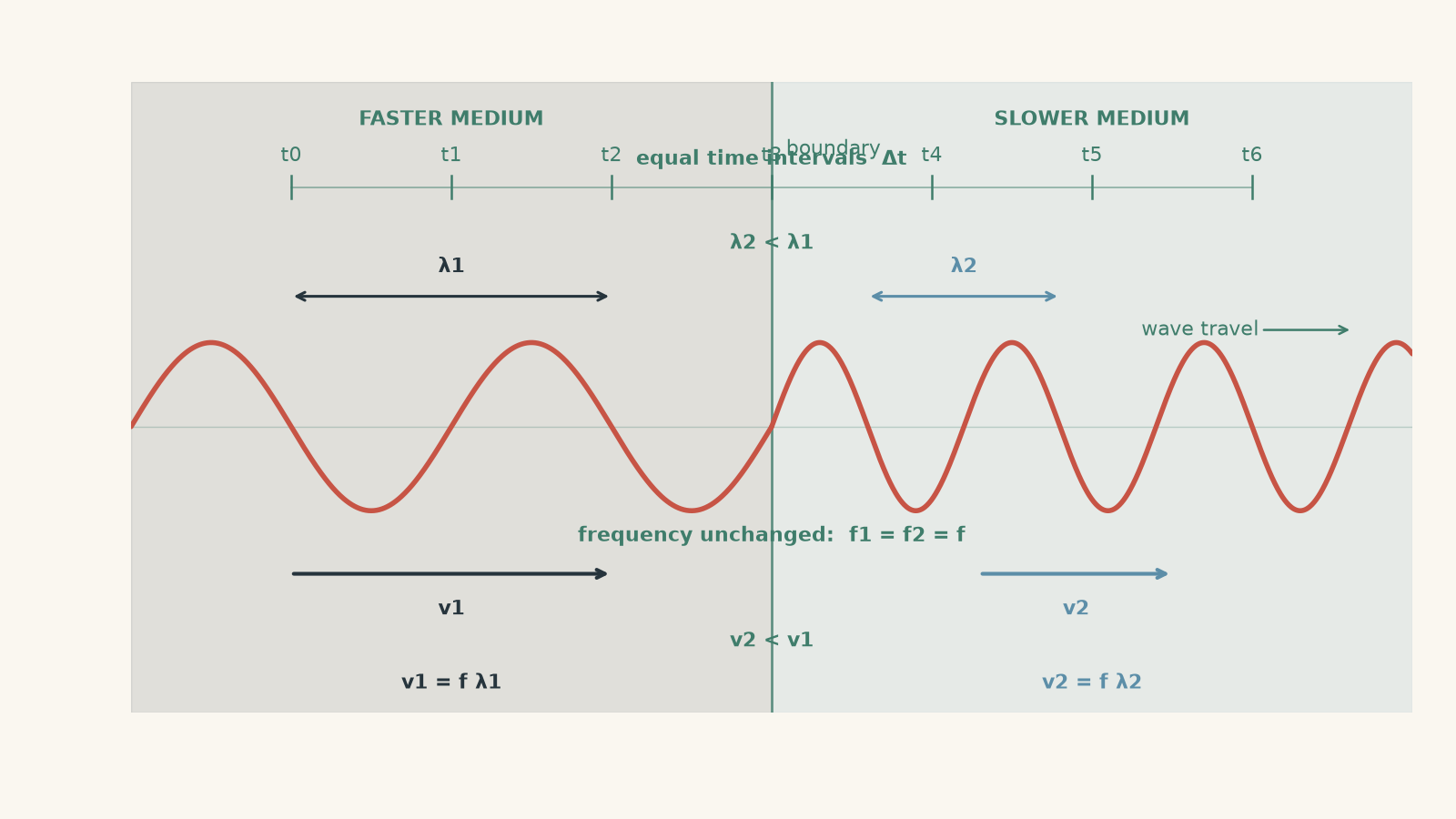
If the source keeps vibrating at the same rate, the frequency stays the same. The new medium changes the wave speed. The wavelength then adjusts to make the three quantities fit together.
That source-versus-medium distinction is the key to using the wave equation without getting tangled up.
01Start with a picture you can actually imagine
Picture yourself shaking one end of a long rope up and down.
Suppose your hand completes 3 full oscillations every second. You are the source of the wave, so you are producing a frequency of 3 hertz.
Now imagine part of the rope is replaced by a different section that causes waves to travel more slowly.
Before doing any maths, predict what will happen when the wave enters that section:
- Will your hand suddenly start oscillating at a different rate?
- Will the wave crests arrive closer together or further apart?
Your hand does not know that the rope changed further along. It keeps moving 3 times per second, so the frequency remains 3 Hz.
But the wave now travels a smaller distance during each cycle. The crests therefore become closer together. The wavelength decreases.
That is the basic physical meaning behind the wave equation.
02What \(v = f\lambda\) is really saying
The wave equation is
\[
v = f\lambda
\]
where:
- \(v\) is the wave speed in metres per second, \(\text{m s}^{-1}\)
- \(f\) is the frequency in hertz, \(\text{Hz}\)
- \(\lambda\) is the wavelength in metres, \(\text{m}\)
The equation is easier to remember if you understand it as a distance-per-time idea.
Frequency tells you how many complete waves are produced each second.
Wavelength tells you how much distance one complete wave occupies.
So if 5 waves pass each second and each wave is 2 m long, the wave pattern advances
\[
5 \times 2 = 10\text{ m}
\]
each second.
Therefore,
\[
v = 10\text{ m s}^{-1}
\]
The equation is not an arbitrary formula linking three letters. It is counting how much wave pattern passes in a certain time.
03Frequency belongs to the oscillation
Suppose your hand shakes a rope 6 times every second.
That gives
\[
f = 6\text{ Hz}
\]
The frequency describes how rapidly the source oscillates.
For a sound wave, the source might be a vibrating speaker cone.
For a water wave, the source might be a paddle moving up and down.
For an electromagnetic wave, frequency is associated with the oscillating electric and magnetic fields produced by the source.
In ordinary HSC wave-boundary problems, when a wave enters a new medium, the source does not suddenly change its oscillation rate. Therefore, the frequency remains unchanged across the boundary.
This gives a very useful rule:
A change of medium can change wave speed and wavelength, but it does not by itself change the frequency.
There are situations, such as the Doppler effect, where an observer measures a different frequency because the source or observer is moving. That is a different mechanism. Do not mix it up with a stationary wave crossing from one medium into another.
04Wave speed depends on the medium
The medium determines how quickly a disturbance can be passed from one location to the next.
Imagine a stadium wave. One person stands up, then the next responds, then the next. If everyone reacts quickly, the wave moves around the stadium quickly. If everyone has the reaction time of someone checking five group chats at once, it moves more slowly.
The people represent parts of the medium. Their response to neighbouring motion helps determine the speed at which the disturbance travels.
The analogy is useful because the individual people do not travel around the stadium. The pattern does.
But the analogy has limits. Real mechanical waves depend on physical properties such as tension, elasticity, density, and inertia, not on people deliberately watching their neighbours.
The important point is that changing the medium can change \(v\), even though the source frequency remains fixed.
05Wavelength is the quantity that adjusts
Wavelength is the distance between equivalent points on consecutive waves, such as crest to crest.
From
\[
v = f\lambda
\]
we can rearrange to
\[
\lambda = \frac{v}{f}
\]
If \(f\) stays constant, wavelength is directly proportional to wave speed.
So:
- larger \(v\) means larger \(\lambda\)
- smaller \(v\) means smaller \(\lambda\)
This is one of the most useful quick predictions you can make before calculating anything.
Suppose a wave enters a medium where its speed halves. If the source has not changed, what happens to the wavelength?
The frequency stays constant, so the wavelength also halves.
You should be able to predict that without reaching for a calculator.
06Worked example: Finding wavelength from speed and frequency
A wave travels along a rope at \(18\text{ m s}^{-1}\). The source oscillates at \(6.0\text{ Hz}\). Calculate the wavelength.
Step 1
The medium gives the wave speed:
\[
v = 18\text{ m s}^{-1}
\]
The source gives the frequency:
\[
f = 6.0\text{ Hz}
\]
We want the wavelength, \(\lambda\).
Step 2
Starting with
\[
v = f\lambda
\]
divide by \(f\):
\[
\lambda = \frac{v}{f}
\]
Step 3
\[
\lambda = \frac{18\text{ m s}^{-1}}{6.0\text{ s}^{-1}} = 3.0\text{ m}
\]
Step 4
The wavelength is
\[
\boxed{3.0\text{ m}}
\]
Consecutive crests are 3.0 m apart.
Notice that \(1\text{ Hz} = 1\text{ s}^{-1}\), so the seconds cancel correctly and leave metres.
07Crossing a boundary
Now consider a wave travelling from medium 1 into medium 2.
Its speed changes from \(v_1\) to \(v_2\).
The frequency remains \(f\) on both sides because the source is still producing oscillations at the same rate.
Therefore,
\[
v_1 = f\lambda_1
\]
and
\[
v_2 = f\lambda_2
\]
Because the same \(f\) appears in both equations,
\[
\frac{v_1}{\lambda_1} = \frac{v_2}{\lambda_2}
\]
or, more usefully,
\[
\frac{v_2}{v_1} = \frac{\lambda_2}{\lambda_1}
\]
This tells you that when frequency is unchanged, the speed ratio equals the wavelength ratio.
Be careful with that statement. It is not a universal rule for every imaginable situation. It works here because the same wave source supplies the same frequency across the boundary.
Worked example: A wave enters a slower medium
A wave with frequency \(12\text{ Hz}\) travels through medium A at \(30\text{ m s}^{-1}\). It then enters medium B, where its speed is \(18\text{ m s}^{-1}\).
Calculate the wavelength in each medium and explain what changes at the boundary.
Step 1
Using
\[
\lambda_A = \frac{v_A}{f}
\]
we get
\[
\lambda_A = \frac{30\text{ m s}^{-1}}{12\text{ s}^{-1}} = 2.5\text{ m}
\]
Step 2
The wave has entered a different medium, but its source has not changed.
Therefore,
\[
f_B = 12\text{ Hz}
\]
Step 3
\[
\lambda_B = \frac{v_B}{f}
\]
so
\[
\lambda_B = \frac{18\text{ m s}^{-1}}{12\text{ s}^{-1}} = 1.5\text{ m}
\]
Step 4
In medium A,
\[
\boxed{\lambda_A = 2.5\text{ m}}
\]
and in medium B,
\[
\boxed{\lambda_B = 1.5\text{ m}}
\]
The wave slows from \(30\text{ m s}^{-1}\) to \(18\text{ m s}^{-1}\), while its frequency remains \(12\text{ Hz}\). Because it covers less distance during each cycle, the wavelength decreases.
08The misconception: “If \(v\) changes, \(f\) must change”
This mistake usually comes from treating
\[
v = f\lambda
\]
as though any change in one quantity must force both of the others to change.
An equation tells you how quantities are related. It does not, by itself, tell you which physical cause changed.
Suppose
\[
v = 20\text{ m s}^{-1}, \qquad f = 5\text{ Hz}
\]
Then
\[
\lambda = 4\text{ m}
\]
Now the wave enters another medium and slows to \(10\text{ m s}^{-1}\).
You cannot simply decide that frequency halves because speed halved. The frequency is fixed by the source.
Instead,
\[
\lambda = \frac{10}{5} = 2\text{ m}
\]
The speed halves, the wavelength halves, and the frequency stays at \(5\text{ Hz}\).
The useful habit is to ask this before doing any algebra:
Did the source change, or did the medium change?
That question often tells you which quantity should remain constant.
09A decision rule for HSC problems
When you see \(v = f\lambda\), separate the physics from the arithmetic.
| What changes? | Quantity usually affected directly | What often stays fixed? |
|---|---|---|
| Source oscillation rate changes | Frequency \(f\) | Medium properties |
| Wave enters a different medium | Speed \(v\) | Frequency \(f\) |
| Speed changes while frequency is fixed | Wavelength \(\lambda\) must change | Frequency \(f\) |
| Frequency changes in the same medium, assuming wave speed is constant | Wavelength \(\lambda\) must change | Speed \(v\) |
The last row deserves attention.
If two waves travel through the same medium under the same conditions, it is often reasonable at HSC level to treat their wave speed as the same. If one has a higher frequency, it must therefore have a shorter wavelength.
From
\[
\lambda = \frac{v}{f}
\]
increasing \(f\) while keeping \(v\) fixed makes \(\lambda\) decrease.
10Worked example: Comparing two frequencies in the same medium
Two waves travel through the same medium at \(24\text{ m s}^{-1}\).
Wave P has a frequency of \(4.0\text{ Hz}\), while wave Q has a frequency of \(10.0\text{ Hz}\).
Calculate each wavelength and compare the two waves.
Step 1
Both waves travel through the same medium under the stated conditions, so
\[
v = 24\text{ m s}^{-1}
\]
for each.
Step 2
\[
\lambda_P = \frac{v}{f_P}
= \frac{24\text{ m s}^{-1}}{4.0\text{ s}^{-1}}
= 6.0\text{ m}
\]
Step 3
\[
\lambda_Q = \frac{v}{f_Q}
= \frac{24\text{ m s}^{-1}}{10.0\text{ s}^{-1}}
= 2.4\text{ m}
\]
Step 4
\[
\boxed{\lambda_P = 6.0\text{ m}}
\]
and
\[
\boxed{\lambda_Q = 2.4\text{ m}}
\]
Wave Q has the higher frequency, so more complete waves must fit into each metre travelled. Its wavelength is therefore shorter.
11Frequency and period are connected too
You may also be given the period, \(T\), instead of frequency.
Period is the time taken for one complete oscillation, measured in seconds.
Frequency and period are reciprocals:
\[
f = \frac{1}{T}
\]
where:
- \(f\) is frequency in \(\text{Hz}\)
- \(T\) is period in seconds, \(\text{s}\)
You can combine this with the wave equation:
\[
v = f\lambda = \frac{\lambda}{T}
\]
This has a simple interpretation. If one full wavelength moves past a point during one period, then speed is distance divided by time:
\[
v = \frac{\lambda}{T}
\]
Worked example: Starting with period
A wave has a period of \(0.040\text{ s}\) and a wavelength of \(0.80\text{ m}\). Calculate its frequency and speed.
Step 1
\[
f = \frac{1}{T}
= \frac{1}{0.040\text{ s}}
= 25\text{ Hz}
\]
Step 2
\[
v = f\lambda
\]
Substituting,
\[
v = (25\text{ s}^{-1})(0.80\text{ m})
= 20\text{ m s}^{-1}
\]
Step 3
The frequency is
\[
\boxed{25\text{ Hz}}
\]
and the wave speed is
\[
\boxed{20\text{ m s}^{-1}}
\]
The source completes 25 oscillations each second, and each oscillation produces one wavelength of 0.80 m. The pattern therefore travels 20 m each second.
12What the equation does not tell you
The equation
\[
v = f\lambda
\]
does not explain why a particular medium has a particular wave speed.
It only relates the speed to the wave’s frequency and wavelength.
For example, changing the tension in a string can change the speed of waves on that string. The wave equation can then tell you the corresponding wavelength for a known frequency, but you need another model to calculate how the tension itself determines the speed.
Similarly, electromagnetic waves travel at different speeds in different materials. The wave equation relates that speed to frequency and wavelength, but it is not the complete explanation of the material’s electromagnetic behaviour.
This matters because formulas have jobs. \(v = f\lambda\) is a relationship between wave quantities, not a full theory of every factor that sets \(v\).
13Questions and solutions
Question 1
A water wave travels at \(2.4\text{ m s}^{-1}\) and has a frequency of \(3.0\text{ Hz}\). Calculate its wavelength.
Solution 1
The wavelength is \(\boxed{0.80\text{ m}}\).
The wave equation is
\[
v = f\lambda
\]
so
\[
\lambda = \frac{v}{f}
\]
Substituting the values,
\[
\lambda
= \frac{2.4\text{ m s}^{-1}}{3.0\text{ s}^{-1}}
= 0.80\text{ m}
\]
This means consecutive crests are 0.80 m apart.
Question 2
A source produces waves at \(8.0\text{ Hz}\). In medium X, the waves travel at \(12\text{ m s}^{-1}\).
The waves then enter medium Y, where their speed becomes \(7.2\text{ m s}^{-1}\).
Calculate the wavelength in each medium.
Solution 2
The wavelength decreases from \(\boxed{1.5\text{ m}}\) in medium X to \(\boxed{0.90\text{ m}}\) in medium Y.
The frequency stays at \(8.0\text{ Hz}\) because changing the medium does not change the source oscillation rate.
For medium X,
\[
\lambda_X = \frac{v_X}{f}
= \frac{12\text{ m s}^{-1}}{8.0\text{ s}^{-1}}
= 1.5\text{ m}
\]
For medium Y,
\[
\lambda_Y = \frac{v_Y}{f}
= \frac{7.2\text{ m s}^{-1}}{8.0\text{ s}^{-1}}
= 0.90\text{ m}
\]
The wave travels more slowly in medium Y, so it moves a shorter distance during each cycle. Its wavelength therefore decreases.
Question 3
Two wave generators send waves through the same uniform medium.
Generator A operates at \(15\text{ Hz}\) and produces a wavelength of \(0.40\text{ m}\).
Generator B operates at \(24\text{ Hz}\).
Assuming the wave speed is the same for both, calculate the wavelength produced by generator B.
Solution 3
Generator B produces a wavelength of \(\boxed{0.25\text{ m}}\).
First find the wave speed using generator A:
\[
v = f_A\lambda_A
\]
so
\[
v = (15\text{ s}^{-1})(0.40\text{ m})
= 6.0\text{ m s}^{-1}
\]
The same medium is stated to give the same wave speed for generator B, so
\[
\lambda_B = \frac{v}{f_B}
= \frac{6.0\text{ m s}^{-1}}{24\text{ s}^{-1}}
= 0.25\text{ m}
\]
The higher-frequency wave has the shorter wavelength because both waves travel at the same speed.
The important assumption is stated in the question: the wave speed is the same for both frequencies. You should not assume that for every physical system without justification.
Question 4
A student observes a wave crossing from region P into region Q. The measured wavelength decreases from \(1.2\text{ m}\) to \(0.80\text{ m}\).
The student says:
“The frequency must have increased because the crests are now closer together.”
The source remains unchanged.
Evaluate the student’s statement, and determine the ratio \(v_Q/v_P\).
Solution 4
The student’s statement is incorrect. The frequency stays constant, and the wave speed decreases to \(\boxed{\frac{2}{3}}\) of its original value.
The tempting mistake is to associate closely spaced crests directly with higher frequency. That only works when the wave speed is fixed.
Here, the wave crosses into a different region, so the speed can change.
Because the source remains unchanged,
\[
f_P = f_Q
\]
Using
\[
v = f\lambda
\]
for each region,
\[
v_P = f\lambda_P
\]
and
\[
v_Q = f\lambda_Q
\]
Dividing,
\[
\frac{v_Q}{v_P}
=
\frac{f\lambda_Q}{f\lambda_P}
=
\frac{\lambda_Q}{\lambda_P}
\]
Therefore,
\[
\frac{v_Q}{v_P}
=
\frac{0.80}{1.2}
=
\frac{2}{3}
\]
So
\[
\boxed{\frac{v_Q}{v_P} = \frac{2}{3}}
\]
The crests are closer together because the wave travels less distance during each source cycle, not because the source cycles more quickly.
Question 5
A vibrating source produces waves in medium A. Measurements give a wave speed of \(16\text{ m s}^{-1}\) and a wavelength of \(0.80\text{ m}\).
Without changing the source, the wave enters medium B. Its wavelength is measured as \(1.1\text{ m}\).
A second student argues that there is not enough information to calculate the speed in medium B because the frequency in medium B has not been measured.
Is the student correct? Calculate the speed in medium B and justify any assumption you use.
Solution 5
The student is not correct. The speed in medium B is \(\boxed{22\text{ m s}^{-1}}\) because the unchanged source fixes the frequency.
First calculate the frequency in medium A:
\[
f = \frac{v_A}{\lambda_A}
\]
Substituting,
\[
f
=
\frac{16\text{ m s}^{-1}}{0.80\text{ m}}
=
20\text{ Hz}
\]
The wave then enters medium B without any change to the source. Therefore, its frequency in medium B is still
\[
f_B = 20\text{ Hz}
\]
Now use
\[
v_B = f_B\lambda_B
\]
so
\[
v_B
=
(20\text{ s}^{-1})(1.1\text{ m})
=
22\text{ m s}^{-1}
\]
Therefore,
\[
\boxed{v_B = 22\text{ m s}^{-1}}
\]
The hidden idea is that frequency does not need to be measured independently in medium B. The unchanged source already tells us that it remains \(20\text{ Hz}\).
Question 6
A source produces waves with a period of \(0.050\text{ s}\). The waves travel through medium R with wavelength \(1.5\text{ m}\).
They then enter medium S.
In medium S, an experiment records a wave speed of \(18\text{ m s}^{-1}\) and a wavelength of \(0.60\text{ m}\).
Assume the source and media are stationary relative to each other.
Are all of these measurements consistent with one wave travelling from R into S? Support your conclusion quantitatively.
Solution 6
No. The measurements are inconsistent with one unchanged source crossing from medium R into medium S.
First calculate the source frequency from its period:
\[
f = \frac{1}{T}
\]
so
\[
f
=
\frac{1}{0.050\text{ s}}
=
20\text{ Hz}
\]
Because the source remains unchanged, the frequency should remain \(20\text{ Hz}\) when the wave enters medium S.
The speed predicted from the measured wavelength in medium S would therefore be
\[
v_S = f\lambda_S
\]
so
\[
v_S
=
(20\text{ s}^{-1})(0.60\text{ m})
=
12\text{ m s}^{-1}
\]
But the experiment reports
\[
18\text{ m s}^{-1}
\]
Alternatively, the reported speed and wavelength in medium S imply
\[
f
=
\frac{v_S}{\lambda_S}
=
\frac{18\text{ m s}^{-1}}{0.60\text{ m}}
=
30\text{ Hz}
\]
That conflicts with the source frequency of \(20\text{ Hz}\).
So at least one assumption or measurement is wrong. Possible explanations include measurement error, an incorrectly identified wavelength, or an unstated change to the source.
The key idea is more important than the arithmetic: you should not force measured numbers into \(v = f\lambda\) independently and ignore the physics. If one unchanged source sends a wave across a stationary boundary, its frequency must be consistent on both sides.
14Where this idea leads next
Once you can separate source effects from medium effects, several later wave ideas become much easier.
When a wave changes speed at a boundary, its wavelength changes while its frequency stays fixed. That becomes important when explaining refraction, because a change in wave speed can also change the direction of travel.
The same reasoning also helps with electromagnetic waves moving between materials, standing waves with particular allowed wavelengths, and the Doppler effect, where you must carefully distinguish the source frequency from the frequency measured by an observer.
The equation \(v = f\lambda\) is simple. The real HSC skill is knowing what the symbols are allowed to do in the physical situation.