
The Work-Energy Theorem: Why Net Work Changes Kinetic Energy
Learn why net work equals the change in kinetic energy, how the theorem follows from Newton's laws, and how to apply it in HSC Physics problems.
A car’s engine does 500 J of work while air resistance and friction do \(-200\) J of work. How much extra kinetic energy does the car gain?
It is tempting to say 500 J because that is what the engine supplied. But the car gains only 300 J of kinetic energy. Some of the engine’s work is opposed by resistive forces.
That is the problem the work-energy theorem solves. Instead of tracking acceleration second by second, it lets us connect the total work done by all forces to the change in an object’s speed.
01Start with the idea of net work
Imagine pushing a trolley forwards while someone else pulls it backwards.
Your force transfers energy to the trolley. The opposing force transfers energy away from its motion. What matters for the trolley’s kinetic energy is not either force by itself, but their combined effect.
This is net work:
\[
W_{\text{net}} = W_1 + W_2 + W_3 + \cdots
\]
where \(W_{\text{net}}\) is the net work done on the object, measured in joules (J).
You can picture kinetic energy as the object’s “motion account”. Positive work makes a deposit. Negative work makes a withdrawal. Zero work leaves the account unchanged.
That analogy is useful, but it has a limit. Kinetic energy is not a physical substance stored inside an object. It is a quantity determined by the object’s mass and speed.
The kinetic energy of an object is
\[
K = \frac{1}{2}mv^2
\]
where:
- \(K\) is kinetic energy in joules (J)
- \(m\) is mass in kilograms (kg)
- \(v\) is speed in metres per second (\(\text{m s}^{-1}\))
The work-energy theorem states
\[
W_{\text{net}} = \Delta K
\]
or, written more fully,
\[
W_{\text{net}} = K_f-K_i
\]
where \(K_i\) is the initial kinetic energy and \(K_f\) is the final kinetic energy.
So:
- positive net work means kinetic energy increases
- negative net work means kinetic energy decreases
- zero net work means kinetic energy stays constant
Notice that the theorem refers to net work, not the work done by one chosen force.
02Why does net work equal the change in kinetic energy?
The result can look suspiciously convenient until you connect it to Newton’s second law.
Consider an object of mass \(m\) moving in a straight line. Suppose the net force is constant and acts in the direction of the displacement.
For a constant force,
\[
W_{\text{net}} = F_{\text{net}}s
\]
where \(s\) is the displacement.
Newton’s second law gives
\[
F_{\text{net}} = ma
\]
so
\[
W_{\text{net}} = mas
\]
Now recall the kinematics equation
\[
v^2=u^2+2as
\]
where \(u\) is initial speed and \(v\) is final speed.
Rearranging,
\[
as=\frac{v^2-u^2}{2}
\]
Substitute this into \(W_{\text{net}}=mas\):
\[
\begin{aligned}
W_{\text{net}}
&=m\left(\frac{v^2-u^2}{2}\right)\\
&=\frac{1}{2}mv^2-\frac{1}{2}mu^2
\end{aligned}
\]
But \(\frac{1}{2}mv^2\) is final kinetic energy, and \(\frac{1}{2}mu^2\) is initial kinetic energy. Therefore,
\[
\boxed{W_{\text{net}}=\Delta K}
\]
So the theorem is not a separate rule that happens to work. It follows from the same physics as Newton’s second law and the equations of motion.
This derivation assumed a constant net force in one dimension. The work-energy theorem itself is more general. It also works when forces change during the motion, provided the net work is calculated correctly.
03Work can be positive, negative, or zero
For a constant force, the work done by that force is
\[
W=Fs\cos\theta
\]
where:
- \(F\) is the force magnitude in newtons (N)
- \(s\) is the displacement magnitude in metres (m)
- \(\theta\) is the angle between the force and displacement
The sign of the work matters.
| Force relative to motion | Work | Effect on kinetic energy |
|---|---|---|
| Force has a component along the displacement | Positive | Tends to increase \(K\) |
| Force has a component opposite the displacement | Negative | Tends to decrease \(K\) |
| Force is perpendicular to the displacement | Zero | Does not directly change \(K\) |
That last row causes a common mistake.
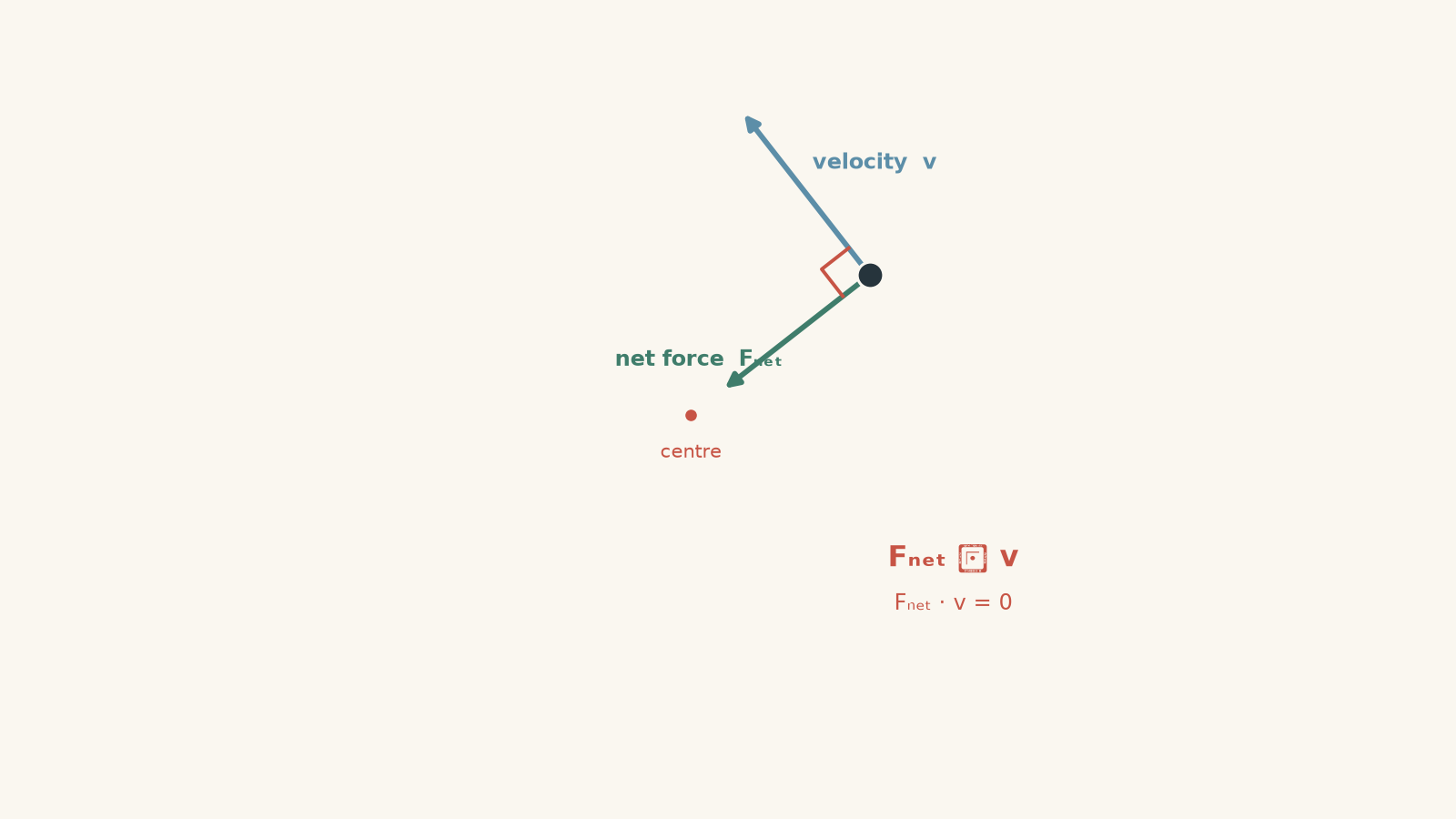
Suppose a satellite travels in a circular orbit. Gravity acts continuously towards Earth, so there is definitely a net force. Does that automatically mean gravity is doing work?
No. In a circular orbit, the instantaneous displacement is tangential while gravity is radial. The two directions are perpendicular, so gravity does zero work at that instant.
The satellite can therefore have a non-zero net force while its kinetic energy remains constant.
Zero net work does not mean zero net force.
04Individual forces versus net work
Suppose a 20 N applied force pushes a box 5 m forwards while friction exerts 8 N backwards.
The applied force does
\[
W_{\text{push}}=(20)(5)=100\text{ J}
\]
Friction does
\[
W_{\text{friction}}=(-8)(5)=-40\text{ J}
\]
so the net work is
\[
W_{\text{net}}=100-40=60\text{ J}
\]
Therefore,
\[
\Delta K=60\text{ J}
\]
The box gains 60 J of kinetic energy, not 100 J.
This distinction becomes especially important in problems involving engines, friction, air resistance, gravity, or several forces acting at once.
Worked example: Find the final speed of a pushed box
A \(5.0\text{ kg}\) box starts from rest on a horizontal floor. It is pushed with a constant horizontal force of \(30\text{ N}\) through \(4.0\text{ m}\). Friction exerts a constant force of \(10\text{ N}\) in the opposite direction. Find the final speed of the box.
Step 1
The applied force acts in the direction of displacement:
\[
W_{\text{push}}=(30)(4.0)=120\text{ J}
\]
Friction acts opposite the displacement:
\[
W_{\text{friction}}=(-10)(4.0)=-40\text{ J}
\]
The weight and normal force are perpendicular to the horizontal displacement, so each does zero work.
Step 2
\[
W_{\text{net}}=120-40=80\text{ J}
\]
Step 3
The box starts from rest, so \(K_i=0\).
\[
\begin{aligned}
W_{\text{net}}&=K_f-K_i\\
80&=\frac{1}{2}(5.0)v^2-0
\end{aligned}
\]
Step 4
\[
\begin{aligned}
80&=2.5v^2\\
v^2&=32\\
v&=5.7\text{ m s}^{-1}
\end{aligned}
\]
The box reaches a speed of approximately
\[
\boxed{5.7\text{ m s}^{-1}}
\]
The important point is that only 80 J of the push’s 120 J becomes extra kinetic energy. Friction removes 40 J from the box’s kinetic energy change.
05Gravity fits into the theorem as another force
Gravity does not need special treatment when you use the work-energy theorem. If gravity does work, include its work in the net work.
For an object moving down an incline, the component of its weight along the slope is
\[
F_{\parallel}=mg\sin\theta
\]
where \(g\) is gravitational field strength and \(\theta\) is the angle of the slope above the horizontal.
If the object moves down the slope, this component of gravity points in the same direction as the displacement, so gravity does positive work.
If the object moves up the slope, gravity does negative work.
Worked example: A box sliding down a rough incline
A \(2.0\text{ kg}\) box is already moving at \(1.5\text{ m s}^{-1}\) when it begins travelling \(3.0\text{ m}\) down a \(25^\circ\) incline. A constant friction force of \(4.0\text{ N}\) acts up the incline. Take \(g=9.8\text{ m s}^{-2}\). Find the speed after the box has moved \(3.0\text{ m}\).
Step 1
The component of weight down the slope is
\[
F_{\parallel}=mg\sin25^\circ
\]
so the work done by gravity is
\[
\begin{aligned}
W_g
&=(mg\sin25^\circ)s\\
&=(2.0)(9.8)(\sin25^\circ)(3.0)\\
&\approx24.8\text{ J}
\end{aligned}
\]
Step 2
Friction points opposite the displacement:
\[
W_f=(-4.0)(3.0)=-12.0\text{ J}
\]
The normal force is perpendicular to the displacement, so it does zero work.
Step 3
\[
W_{\text{net}}=24.8-12.0=12.8\text{ J}
\]
Therefore, the kinetic energy increases by \(12.8\text{ J}\).
Step 4
\[
K_i=\frac{1}{2}(2.0)(1.5)^2=2.25\text{ J}
\]
So
\[
K_f=2.25+12.8=15.05\text{ J}
\]
Step 5
\[
\begin{aligned}
15.05&=\frac{1}{2}(2.0)v^2\\
v^2&=15.05\\
v&\approx3.9\text{ m s}^{-1}
\end{aligned}
\]
Therefore,
\[
\boxed{v\approx3.9\text{ m s}^{-1}}
\]
Gravity adds more kinetic energy than friction removes, so the box speeds up.
06The most tempting misconception: mixing two energy methods
There are two closely related ways to solve many mechanics problems.
One is the work-energy theorem:
\[
W_{\text{net}}=\Delta K
\]
Here, you include the work done by every force, including gravity.
Another approach uses gravitational potential energy:
\[
U_g=mgh
\]
In that approach, you often account for gravity through the change in gravitational potential energy rather than through \(W_g\).
Both methods are valid. The problem comes when you count gravity twice.
For example, suppose an object falls while air resistance acts. You could write the net-work equation
\[
W_g+W_{\text{air}}=\Delta K
\]
Alternatively, you could use mechanical energy and write
\[
W_{\text{air}}=\Delta K+\Delta U_g
\]
These describe the same energy changes.
But writing gravitational work and a gravitational potential energy change in the same accounting equation without adjusting the method would count gravity twice.
A useful decision rule is:
- using \(W_{\text{net}}=\Delta K\): include gravitational work
- using changes in \(K+U_g\): represent gravity through \(U_g\), rather than adding \(W_g\) again
07Why displacement matters, not time
Suppose the same constant net force acts on two identical objects.
Object A experiences the force for a long time but barely moves. Object B experiences it for a shorter time but moves much further.
Which necessarily receives more work?
You cannot decide from time alone. Work depends on force and displacement:
\[
W=Fs\cos\theta
\]
The work-energy theorem therefore links force acting through displacement to a change in kinetic energy.
This is different from impulse, which links force acting over time to a change in momentum:
\[
J=\Delta p
\]
That distinction becomes useful later. Work-energy and impulse-momentum can describe the same motion, but they answer different types of question.
08A reliable method for HSC problems
When a work-energy problem contains several forces, use this sequence:
- Identify the initial and final states.
- Identify the displacement between those states.
- List the forces acting during that displacement.
- Decide whether each force does positive, negative, or zero work.
- Calculate the work done by each relevant force.
- Add them to obtain \(W_{\text{net}}\).
- Use \(W_{\text{net}}=K_f-K_i\).
- Check whether the sign of \(\Delta K\) agrees with the physical motion.
That final check catches a surprising number of errors. If your calculation gives positive net work but you claim the object slows down, something is inconsistent.
09Questions and solutions
Question 1
A \(3.0\text{ kg}\) trolley is moving at \(2.0\text{ m s}^{-1}\). The net work done on it over the next section of track is \(24\text{ J}\). Find its final speed.
Solution 1
The final speed is approximately \(\boxed{4.5\text{ m s}^{-1}}\).
Net work equals the change in kinetic energy:
\[
W_{\text{net}}=K_f-K_i
\]
First calculate the initial kinetic energy:
\[
K_i=\frac{1}{2}(3.0)(2.0)^2=6.0\text{ J}
\]
The net work is positive, so \(24\text{ J}\) is added to the kinetic energy:
\[
K_f=6.0+24=30\text{ J}
\]
Now use \(K_f=\frac{1}{2}mv^2\):
\[
\begin{aligned}
30&=\frac{1}{2}(3.0)v^2\\
30&=1.5v^2\\
v^2&=20\\
v&\approx4.47\text{ m s}^{-1}
\end{aligned}
\]
So
\[
\boxed{v\approx4.5\text{ m s}^{-1}}
\]
The positive net work increases the trolley’s kinetic energy from 6 J to 30 J.
Question 2
A \(1200\text{ kg}\) car speeds up from \(10\text{ m s}^{-1}\) to \(15\text{ m s}^{-1}\). During this change, air resistance and rolling resistance together do \(-45\text{ kJ}\) of work on the car. How much work does the driving force from the road do on the car?
Solution 2
The driving force does \(\boxed{120\text{ kJ}}\) of work.
First find the change in kinetic energy:
\[
\begin{aligned}
\Delta K
&=\frac{1}{2}m(v^2-u^2)\\
&=\frac{1}{2}(1200)(15^2-10^2)\\
&=600(225-100)\\
&=75\,000\text{ J}\\
&=75\text{ kJ}
\end{aligned}
\]
The work-energy theorem says the net work must be \(75\text{ kJ}\):
\[
W_{\text{net}}=75\text{ kJ}
\]
Let \(W_D\) be the work done by the driving force. Then
\[
\begin{aligned}
W_D+W_{\text{resistance}}&=W_{\text{net}}\\
W_D-45&=75\\
W_D&=120\text{ kJ}
\end{aligned}
\]
The tempting mistake is to say the driving force does \(75\text{ kJ}\) because the kinetic energy rises by that amount. That ignores the \(45\text{ kJ}\) of negative work done by resistive forces.
Question 3
A spacecraft moves at constant speed in a circular path around a planet. The gravitational force is the only significant force acting on it.
A student argues: “Its kinetic energy is constant, so the net force on the spacecraft must be zero.”
Explain what is wrong with this argument using the work-energy theorem.
Solution 3
The net force is not zero, even though the net work and change in kinetic energy are zero.
Gravity provides the centripetal force directed towards the centre of the circular path. The spacecraft’s instantaneous displacement is tangential to that path.
Therefore, the force and displacement are perpendicular:
\[
W=Fs\cos90^\circ=0
\]
So
\[
W_{\text{net}}=0
\]
and the work-energy theorem gives
\[
\Delta K=0
\]
The spacecraft’s speed therefore remains constant.
The student’s mistake is assuming that a non-zero net force must always change kinetic energy. A force can change the direction of velocity without changing its magnitude. When the net force is perpendicular to the motion, it can produce acceleration while doing zero work.
Question 4
A \(10\text{ kg}\) crate moves along a straight floor at an initial speed of \(3.0\text{ m s}^{-1}\). A constant \(50\text{ N}\) forward force acts over \(4.0\text{ m}\).
For the first \(2.0\text{ m}\), friction is \(20\text{ N}\). For the next \(2.0\text{ m}\), friction is \(60\text{ N}\).
Find:
a) the speed after the first \(2.0\text{ m}\)
b) the speed after the full \(4.0\text{ m}\)
c) whether the crate’s greatest speed occurs at the end of the \(4.0\text{ m}\)
Solution 4
The crate travels at approximately \(\boxed{4.6\text{ m s}^{-1}}\) after the first \(2.0\text{ m}\), finishes at approximately \(\boxed{4.1\text{ m s}^{-1}}\), and reaches its greatest speed at the \(2.0\text{ m}\) point rather than at the end.
The initial kinetic energy is
\[
K_i=\frac{1}{2}(10)(3.0)^2=45\text{ J}
\]
For the first \(2.0\text{ m}\), the work done by the forward force is
\[
W_F=(50)(2.0)=100\text{ J}
\]
Friction does
\[
W_f=(-20)(2.0)=-40\text{ J}
\]
so the net work over this section is
\[
W_{\text{net,1}}=100-40=60\text{ J}
\]
Therefore,
\[
K_1=45+60=105\text{ J}
\]
and
\[
\begin{aligned}
105&=\frac{1}{2}(10)v_1^2\\
v_1^2&=21\\
v_1&\approx4.58\text{ m s}^{-1}
\end{aligned}
\]
So
\[
\boxed{v_1\approx4.6\text{ m s}^{-1}}
\]
For the second \(2.0\text{ m}\), the applied force again does \(100\text{ J}\) of work, but friction now does
\[
W_f=(-60)(2.0)=-120\text{ J}
\]
The net work in the second section is therefore
\[
W_{\text{net,2}}=100-120=-20\text{ J}
\]
The kinetic energy falls from \(105\text{ J}\) to
\[
K_f=105-20=85\text{ J}
\]
Hence,
\[
\begin{aligned}
85&=\frac{1}{2}(10)v_f^2\\
v_f^2&=17\\
v_f&\approx4.12\text{ m s}^{-1}
\end{aligned}
\]
So the final speed is
\[
\boxed{v_f\approx4.1\text{ m s}^{-1}}
\]
The key reasoning is that the sign of the net work changes halfway through the motion. During the first section, net work is positive and the crate speeds up. During the second section, net work is negative and the crate slows down.
Looking only at the total displacement would hide that change. The final speed is still greater than the initial speed because the total net work over all \(4.0\text{ m}\) is positive, but the greatest speed occurs earlier.
Question 5
A \(2.0\text{ kg}\) block is launched up a rough incline at \(10\text{ m s}^{-1}\). It travels \(6.0\text{ m}\) up the incline, momentarily stops, and then slides back to its starting point. The friction force has constant magnitude \(3.0\text{ N}\) throughout the motion.
When the block returns to its starting height:
a) what is the total work done by gravity over the complete trip?
b) what is the total work done by friction?
c) what is the block’s speed when it returns?
A student claims that because the block returns to its original height, it must return with its original speed. Explain the flaw in that reasoning.
Solution 5
Gravity does \(\boxed{0\text{ J}}\) of net work over the round trip, friction does \(\boxed{-36\text{ J}}\), and the block returns at \(\boxed{8.0\text{ m s}^{-1}}\).
For part a, gravity does negative work while the block moves upwards and positive work while it moves back down. Because the block finishes at the same height at which it started, these gravitational contributions cancel:
\[
\boxed{W_g=0\text{ J}}
\]
For part b, friction always acts opposite the direction of motion.
The block travels \(6.0\text{ m}\) upwards and \(6.0\text{ m}\) downwards, giving a total path length of \(12.0\text{ m}\).
Therefore,
\[
\begin{aligned}
W_f&=-fs\\
&=-(3.0)(12.0)\\
&=-36\text{ J}
\end{aligned}
\]
So
\[
\boxed{W_f=-36\text{ J}}
\]
The normal force does zero work because it is perpendicular to the motion. The total net work is therefore
\[
W_{\text{net}}=-36\text{ J}
\]
The initial kinetic energy is
\[
K_i=\frac{1}{2}(2.0)(10)^2=100\text{ J}
\]
Using the work-energy theorem,
\[
\begin{aligned}
W_{\text{net}}&=K_f-K_i\\
-36&=K_f-100\\
K_f&=64\text{ J}
\end{aligned}
\]
Now solve for the return speed:
\[
\begin{aligned}
64&=\frac{1}{2}(2.0)v^2\\
v^2&=64\\
v&=8.0\text{ m s}^{-1}
\end{aligned}
\]
Therefore,
\[
\boxed{v=8.0\text{ m s}^{-1}}
\]
The student’s reasoning would be correct only if no process removed mechanical energy. Returning to the same height means the gravitational potential energy is the same, but friction has done negative work throughout the entire journey. The block therefore returns with less kinetic energy than it had initially.
This question also shows an important distinction between displacement and distance travelled. Gravity’s total work depends only on the change in height, so it is zero over this closed trip. Friction acts against the motion on both legs, so its negative work depends on the full \(12.0\text{ m}\) path.
10What the theorem lets you understand next
The work-energy theorem gives you a bridge between forces and energy:
\[
\boxed{\text{net work by forces}=\text{change in kinetic energy}}
\]
That bridge becomes especially useful when the acceleration is awkward to track directly, but the work done over a displacement is easy to calculate.
The next step is to connect this theorem to mechanical energy. Once gravitational and elastic potential energies are introduced, many problems can be reorganised around
\[
K+U
\]
rather than calculating conservative forces one at a time. The physics has not changed. You are choosing a different, often faster, way of keeping the same energy account.