
Thermal Conduction in HSC Physics: Particles and Electrons
Learn how thermal energy moves through solids by particle interactions and mobile electrons, then apply the conduction equation to HSC-style problems.
Put a metal spoon and a wooden spoon in the same room overnight. By morning, both are at essentially the same temperature. Touch them, though, and the metal feels colder.
So predict this before reading on: is the metal actually colder, or is something else happening?
Something else is happening. The metal removes thermal energy from your warmer hand much faster than the wood does. Your skin senses that rapid energy loss as “cold”.
That observation gets us to the real job of thermal conduction: explaining how energy moves through matter when there is a temperature difference.
01How can energy move if the solid stays still?
Imagine a row of people sitting on fixed chairs. Nobody is allowed to swap seats, but the person at one end starts shaking around and bumping their neighbours. Those neighbours begin moving more, then disturb the people beside them.
The people haven’t travelled along the row. The disturbance has.
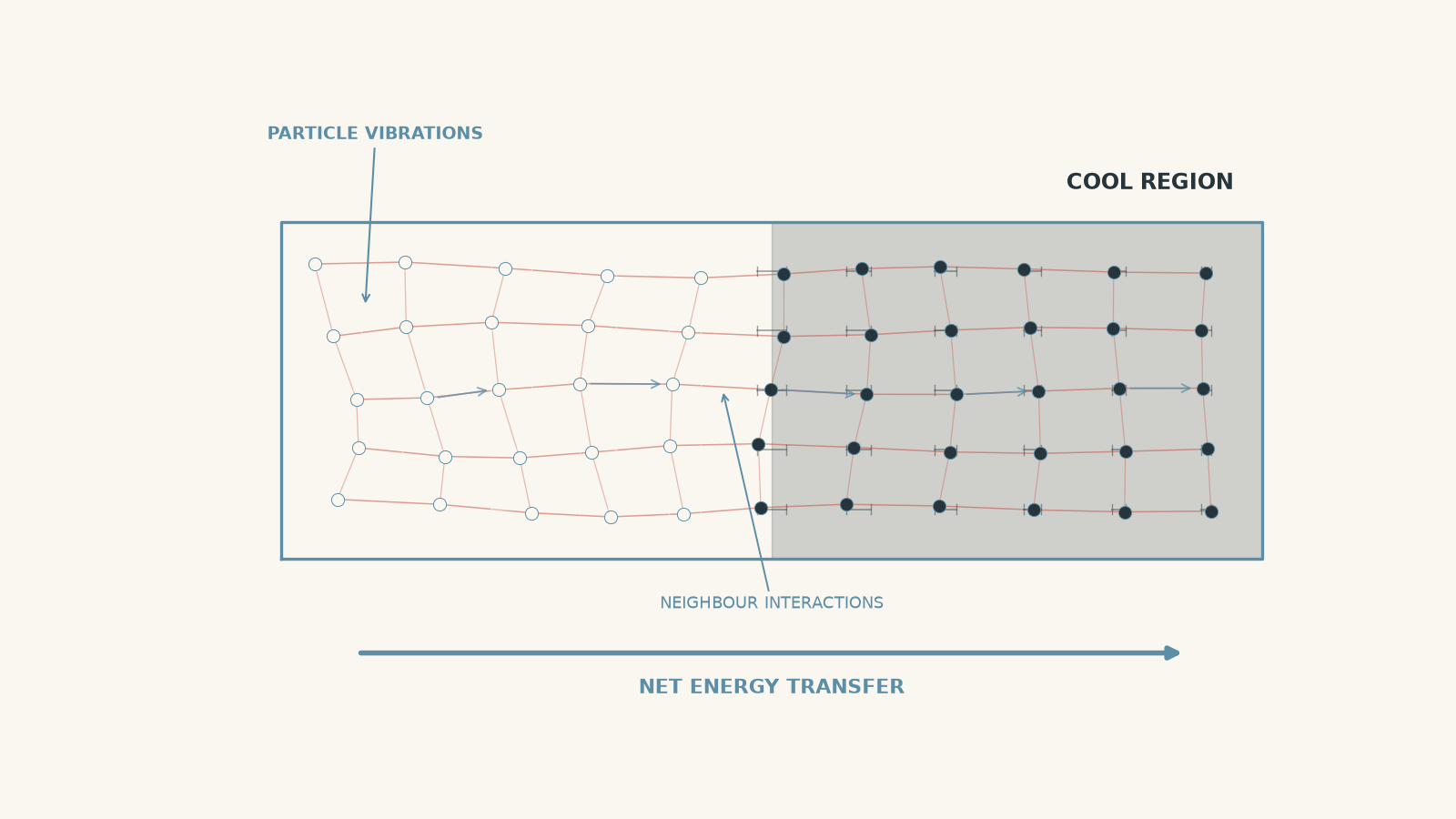
A solid behaves somewhat like this. Its particles are held around fixed equilibrium positions, but they vibrate. In a hotter region, those particles have greater average kinetic energy, so their vibrations are more energetic.
Because neighbouring particles interact, energy can be passed from one part of the solid to the next.
This is thermal conduction: the transfer of energy through interactions within a material, without bulk movement of the material itself.
The chair analogy is useful, but incomplete. Atoms aren’t literally colliding like people knocking shoulders. They interact through electromagnetic forces, and vibrations in a solid can behave collectively. For HSC Physics, though, the particle-interaction model gives us the essential mechanism.
02Temperature tells us why there is a net direction
Suppose the left end of a rod is at \(80^\circ\text{C}\) and the right end is at \(20^\circ\text{C}\).
Which way will thermal energy be transferred?
From the hotter end towards the cooler end.
At the hot end, particles have greater average kinetic energy. Their interactions with neighbouring particles transfer some of this energy into regions where the particles have lower average energy.
Importantly, microscopic energy exchanges aren’t occurring in only one direction. Neighbouring particles interact constantly. The key idea is that there is a net transfer of energy from the higher-temperature region to the lower-temperature region.
This continues until there is no temperature difference capable of driving further net transfer.
03What changes inside a metal?
The particle-vibration explanation works well as a starting model, but metals have another important way to transfer energy.
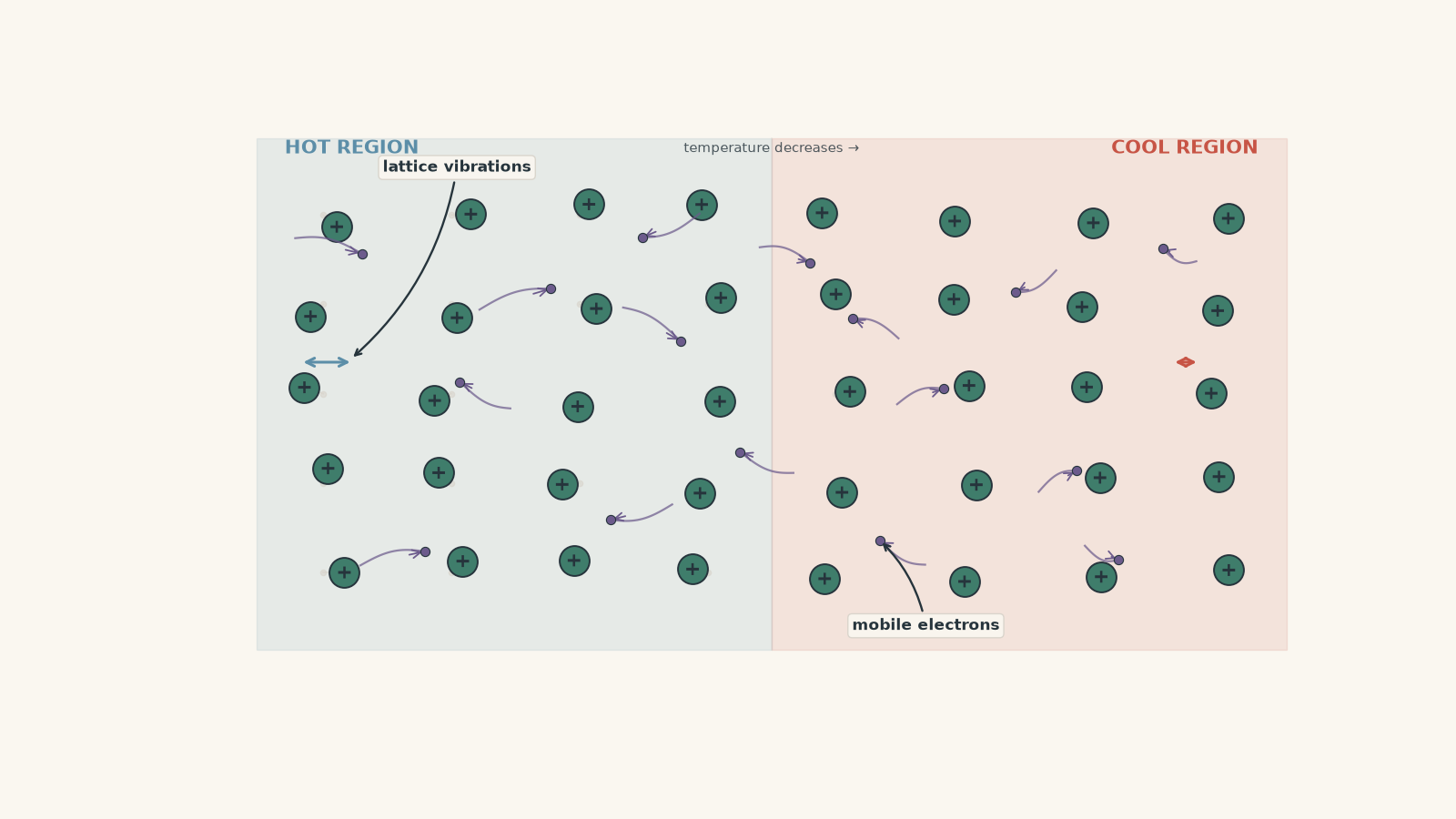
Metals contain delocalised electrons. These electrons are not permanently attached to one particular atom. They can move through the metal’s lattice of positive ions.
Picture our row of people on fixed chairs again. Now add people who are allowed to move along the row. They can pick up energy in the energetic end, move through the crowd, interact elsewhere, and transfer energy there.
The fixed people represent the vibrating metal ions. The mobile people represent the delocalised electrons.
Again, the analogy eventually breaks. Electrons follow quantum physics, not the social rules of an awkward school formal. The useful point is that metals have mobile charge carriers that can transport energy through the material.
How the electrons transfer energy
At the hotter end of a metal:
- The lattice is vibrating more strongly.
- Mobile electrons interact with this energetic region.
- The electrons move through the metal and undergo many interactions and scattering events.
- Energy is transferred into cooler regions of the lattice.
The metal therefore conducts thermal energy through both lattice vibrations and mobile electrons. In many metals, the electrons make a major contribution to the high thermal conductivity.
This also explains a useful pattern: metals that conduct electricity well often conduct thermal energy well too. The same mobile electrons are involved in both processes, although electrical conductivity and thermal conductivity are not identical properties.
04A common trap: the electrons aren’t simply streaming from hot to cold
It is tempting to picture thermal conduction in a metal as an electric current, with electrons all travelling from the hot end to the cold end.
That isn’t the right model.
Electrons already have motion throughout the material. During thermal conduction, their microscopic movements and interactions allow them to transport energy. You can have a net transfer of thermal energy without having a net electric current through the rod.
So keep these two statements separate:
- Net energy transfer: from hot to cold.
- Net charge flow: not required.
That distinction becomes particularly useful when you later study electric current.
05Why metal feels colder than wood
Return to the metal and wooden spoons.
Suppose both are at \(20^\circ\text{C}\), while your hand is around \(33^\circ\text{C}\). When you touch either spoon, your hand is the hotter object.
Energy therefore transfers from your hand into the spoon.
The metal has a much higher thermal conductivity than the wood, so it transfers energy away from your skin more rapidly. Your skin temperature near the contact point drops more quickly, so the metal feels colder.
The important correction is:
Feeling colder does not necessarily mean being at a lower temperature.
Your sense of temperature is strongly affected by the rate of energy transfer between your skin and the object.
06Thermal conductivity turns the idea into a calculation
Different materials conduct thermal energy at different rates. We describe this using thermal conductivity, \(k\).
For a flat, uniform material under steady conditions, the rate of thermal energy transfer can be modelled as
\[
\frac{Q}{t}=\frac{kA\Delta T}{d}
\]
where:
- \(Q\) is the thermal energy transferred, measured in joules (J)
- \(t\) is time, measured in seconds (s)
- \(Q/t\) is the rate of energy transfer, measured in watts (W)
- \(k\) is the thermal conductivity, measured in \(\text{W m}^{-1}\text{K}^{-1}\)
- \(A\) is the area through which conduction occurs, measured in square metres (\(\text{m}^2\))
- \(\Delta T\) is the temperature difference across the material, measured in kelvin (K) or degrees Celsius (\(^\circ\text{C}\)) when used as a temperature difference
- \(d\) is the thickness of the material in the direction of energy transfer, measured in metres (m)
Because power is energy transferred per unit time,
\[
P=\frac{Q}{t}
\]
so the same relationship can be written as
\[
P=\frac{kA\Delta T}{d}
\]
The equation should agree with the physical picture before you start substituting numbers.
| Change | Effect on conduction rate | Why? |
|---|---|---|
| Increase \(k\) | Increases | The material transfers energy more readily |
| Increase \(A\) | Increases | There is more area available for transfer |
| Increase \(\Delta T\) | Increases | The temperature difference driving net transfer is larger |
| Increase \(d\) | Decreases | Energy must be transferred across a greater distance |
A useful habit is to predict these effects first. If your calculation says a thicker layer of the same insulation transfers energy faster, something has probably gone wrong.
What this equation assumes
The equation is a model, not a universal description of every thermal situation.
It works most directly when:
- conduction is approximately one-dimensional
- the material is uniform
- \(k\) can be treated as constant
- the temperatures at the two faces are maintained
- the system has reached approximately steady conditions.
Real objects can also lose or gain energy through convection and radiation. Contact between different materials can add extra thermal resistance too.
Worked example: Heat transfer through an insulated lid
An insulated container has a flat lid with area \(0.50\,\text{m}^2\) and thickness \(0.040\,\text{m}\). The lid material has thermal conductivity \(0.030\,\text{W m}^{-1}\text{K}^{-1}\). The outer surface is at \(25^\circ\text{C}\), while the inner surface is at \(5^\circ\text{C}\). Assuming steady conduction, calculate the rate of thermal energy transfer through the lid.
Step 1
\[
\Delta T=25-5=20\,\text{K}
\]
A temperature difference of \(20^\circ\text{C}\) is also \(20\,\text{K}\).
Step 2
\[
P=\frac{kA\Delta T}{d}
\]
Step 3
\[
P=
\frac{(0.030)(0.50)(20)}
{0.040}
=7.5\,\text{W}
\]
Step 4
The lid conducts thermal energy at a rate of
\[
\boxed{7.5\,\text{W}}
\]
under the stated conditions. This means \(7.5\,\text{J}\) of energy is transferred through the lid each second.
Because the outside is warmer, the net energy transfer is towards the inside.
07Why thermal conductivity varies so much between materials
The value of \(k\) tells us how easily energy can be transported through a particular material.
In many non-metallic solids, conduction occurs mainly through interactions associated with vibrations of the structure. There is no large population of mobile electrons available to transport energy rapidly through the material.
In metals, mobile electrons provide an additional, highly effective energy-transfer mechanism.
That is why a copper rod and a glass rod with identical dimensions can transfer energy at dramatically different rates.
Worked example: Copper rod versus glass rod
A copper rod and a glass rod each have cross-sectional area \(1.5\times10^{-4}\,\text{m}^2\) and length \(0.20\,\text{m}\). One end of each rod is maintained at \(80^\circ\text{C}\), and the other at \(20^\circ\text{C}\).
Use:
\[
k_{\text{copper}}=390\,\text{W m}^{-1}\text{K}^{-1}
\]
and
\[
k_{\text{glass}}=0.80\,\text{W m}^{-1}\text{K}^{-1}.
\]
Calculate the thermal energy transferred through each rod in \(5.0\) minutes, assuming steady conduction. Then compare the results.
Step 1
\[
\Delta T=80-20=60\,\text{K}
\]
\[
t=5.0\times60=300\,\text{s}
\]
Step 2
\[
P_{\text{copper}}
=
\frac{kA\Delta T}{d}
=
\frac{(390)(1.5\times10^{-4})(60)}
{0.20}
=17.55\,\text{W}
\]
Step 3
\[
Q_{\text{copper}}
=
Pt
=
(17.55)(300)
=
5265\,\text{J}
\]
\[
Q_{\text{copper}}\approx5.27\,\text{kJ}
\]
Step 4
\[
P_{\text{glass}}
=
\frac{(0.80)(1.5\times10^{-4})(60)}
{0.20}
=
0.036\,\text{W}
\]
\[
Q_{\text{glass}}
=
(0.036)(300)
=
10.8\,\text{J}
\]
Step 5
Because the rods have the same \(A\), \(d\), and \(\Delta T\),
\[
\frac{P_{\text{copper}}}{P_{\text{glass}}}
=
\frac{k_{\text{copper}}}{k_{\text{glass}}}
=
\frac{390}{0.80}
\approx488
\]
Under this model, the copper transfers thermal energy about \(488\) times as rapidly as the glass.
The huge difference is not because the copper is “hotter”. Both rods have the same temperatures at their ends. Copper simply provides much more effective microscopic mechanisms for transporting energy, especially through its mobile electrons.
08Conduction also happens in liquids and gases
Conduction is not restricted to solids.
In liquids and gases, particles can transfer energy through collisions and intermolecular interactions. The difference is that the particles are free to move around rather than vibrating about fixed lattice positions.
Gases generally conduct thermal energy poorly because their particles are relatively far apart. They interact less frequently than particles in a dense solid.
This is one reason trapped air can be useful in insulation. Materials such as foams contain many small pockets of gas. The gas has low thermal conductivity, and trapping it also reduces large-scale fluid motion.
That last point matters because fluids can transfer energy through another mechanism: convection.
Conduction involves microscopic interactions. Convection involves bulk movement of a fluid carrying energy with it.
09Thermal equilibrium does not mean particles stop moving
Suppose a hot metal block touches a cool metal block. Energy is transferred from the hot block to the cool block.
Eventually, both reach the same temperature.
What happens then? Do the particles and electrons stop moving?
No.
At thermal equilibrium, microscopic motion continues. The particles still vibrate, electrons in a metal still have microscopic motion, and energy exchanges can still occur between neighbouring regions.
What disappears is the net energy transfer caused by a temperature difference.
There is no longer a hotter region systematically transferring more energy into a cooler region.
This is thermal equilibrium.
So:
thermal equilibrium means equal temperature and no net thermal energy transfer, not zero microscopic motion.
10Five conduction misconceptions worth removing
| Tempting idea | What actually happens |
|---|---|
| “Cold flows into an object.” | Thermal energy is transferred from higher temperature to lower temperature. “Cold” is not a substance that flows. |
| “Particles travel from the hot end of a solid to the cold end.” | In a solid, particles mainly vibrate around equilibrium positions. Energy moves through interactions even though the material does not flow through the object. |
| “Metal feels colder, so its temperature must be lower.” | Two materials can be at the same temperature but feel different because they transfer energy from your skin at different rates. |
| “Electrons all flow from the hot end to the cold end.” | Mobile electrons transport energy through their motion and interactions, but net thermal energy transfer does not require a net electric current. |
| “At thermal equilibrium, particle motion stops.” | Microscopic motion continues. There is simply no net conduction caused by a temperature difference. |
There is one more useful distinction. Thermal conductivity \(k\) is a material property, while the actual conduction rate depends on \(k\), area, thickness, and temperature difference.
A thick copper object and a thin copper object are made from material with the same \(k\), but they do not necessarily transfer energy at the same rate.
11Questions and solutions
Question 1
A steel tile and a plastic tile have been sitting in the same room for several hours and are both at \(21^\circ\text{C}\). A student touches each tile with the same hand and says the steel must be at a lower temperature because it feels colder.
Explain what the student has misunderstood.
Solution 1
The two tiles can be at the same temperature even though the steel feels colder.
The student’s mistake is treating the sensation of coldness as a direct measurement of temperature.
The hand is warmer than both tiles, so thermal energy is transferred from the hand into each tile. Steel has a much greater thermal conductivity than typical plastics, so it removes energy from the skin more rapidly.
The skin cools more quickly when it touches the steel, producing a stronger sensation of cold.
The important principle is that your skin responds partly to the rate of thermal energy transfer, not just to the object’s temperature.
Question 2
A layer of insulating material has thermal conductivity \(0.050\,\text{W m}^{-1}\text{K}^{-1}\), area \(0.24\,\text{m}^2\), and thickness \(0.030\,\text{m}\). The temperature difference across it is maintained at \(15\,\text{K}\).
Calculate:
a. the rate of thermal energy transfer through the layer
b. the thermal energy transferred in \(8.0\) minutes.
Solution 2
The conduction rate is \(6.0\,\text{W}\), and \(2.88\,\text{kJ}\) is transferred in \(8.0\) minutes.
For part a, use
\[
P=\frac{kA\Delta T}{d}
\]
and substitute:
\[
P=
\frac{(0.050)(0.24)(15)}
{0.030}
=
6.0\,\text{W}
\]
So the material transfers \(6.0\,\text{J}\) of thermal energy each second.
For part b, convert the time to seconds:
\[
t=8.0\times60=480\,\text{s}
\]
Then use
\[
Q=Pt
\]
so
\[
Q=(6.0)(480)=2880\,\text{J}
\]
\[
\boxed{Q=2.88\,\text{kJ}}
\]
The calculation assumes that the temperature difference and other conditions remain approximately constant throughout those \(8.0\) minutes.
Question 3
Two flat slabs have the same area and experience the same temperature difference.
Slab A has thermal conductivity \(0.24\,\text{W m}^{-1}\text{K}^{-1}\) and thickness \(0.030\,\text{m}\).
Slab B has thermal conductivity \(0.060\,\text{W m}^{-1}\text{K}^{-1}\) and thickness \(0.015\,\text{m}\).
A student argues that Slab A must transfer thermal energy more slowly because it is twice as thick.
Determine which slab has the greater conduction rate and by what factor.
Solution 3
Slab A transfers thermal energy twice as rapidly as Slab B.
Thickness matters, but it cannot be considered separately from thermal conductivity.
Because the slabs have the same area and temperature difference,
\[
P\propto\frac{k}{d}
\]
For Slab A:
\[
\frac{k_A}{d_A}
=
\frac{0.24}{0.030}
=
8.0
\]
For Slab B:
\[
\frac{k_B}{d_B}
=
\frac{0.060}{0.015}
=
4.0
\]
Therefore,
\[
\frac{P_A}{P_B}
=
\frac{8.0}{4.0}
=
2.0
\]
so
\[
\boxed{P_A=2P_B}
\]
The student’s reasoning contains a common trap. Increasing thickness does reduce conduction if everything else stays the same, but everything else is not the same here. Slab A also has four times the thermal conductivity.
Its larger \(k\) more than compensates for its greater thickness.
Question 4
A copper bar is placed inside an insulated container. Initially, its left end is hotter than its right end. After a long time, the entire bar reaches a uniform temperature.
A student writes:
Once the temperature becomes uniform, conduction stops because the electrons and atoms have stopped moving.
Evaluate this statement.
Solution 4
The conclusion about net conduction is reasonable, but the explanation is incorrect.
Once the entire bar reaches the same temperature, there is no temperature gradient, so there is no net thermal energy transfer by conduction from one part of the bar to another.
However, the atoms have not stopped vibrating. Their microscopic thermal motion continues.
The mobile electrons in the copper also continue to have microscopic motion and interactions.
What has disappeared is the imbalance that produced net energy transfer from the hotter region towards the cooler region.
The trap is confusing no net energy transfer with no microscopic activity. Thermal equilibrium requires equal temperature, not motionless particles.
Question 5
A wall contains two uniform layers in series. Thermal energy must pass through both layers.
The first layer is timber with:
\[
d_1=0.020\,\text{m}, \qquad
k_1=0.10\,\text{W m}^{-1}\text{K}^{-1}
\]
The second layer is foam insulation with:
\[
d_2=0.040\,\text{m}, \qquad
k_2=0.025\,\text{W m}^{-1}\text{K}^{-1}
\]
Both layers have area \(0.50\,\text{m}^2\). The total temperature difference across the wall is \(18\,\text{K}\).
Assume steady one-dimensional conduction and ignore contact resistance.
Calculate:
a. the rate of thermal energy transfer through the wall
b. the temperature difference across each layer.
Solution 5
The wall transfers energy at \(5.0\,\text{W}\). The temperature difference is \(2.0\,\text{K}\) across the timber and \(16\,\text{K}\) across the foam.
The important idea is that, at steady state, the same rate of energy transfer must pass through both layers. Energy cannot continuously pile up at their boundary.
For one layer,
\[
P=\frac{kA\Delta T}{d}
\]
Rearranging gives
\[
\Delta T=P\frac{d}{kA}
\]
The quantity
\[
R=\frac{d}{kA}
\]
acts as a thermal resistance, measured in \(\text{K W}^{-1}\).
For the timber:
\[
R_1=
\frac{0.020}
{(0.10)(0.50)}
=
0.40\,\text{K W}^{-1}
\]
For the foam:
\[
R_2=
\frac{0.040}
{(0.025)(0.50)}
=
3.2\,\text{K W}^{-1}
\]
Because the layers are in series, the temperature differences add:
\[
\Delta T_{\text{total}}
=
P(R_1+R_2)
\]
Therefore,
\[
18=P(0.40+3.2)
\]
\[
P=\frac{18}{3.6}=5.0\,\text{W}
\]
For the timber:
\[
\Delta T_1=PR_1=(5.0)(0.40)=2.0\,\text{K}
\]
For the foam:
\[
\Delta T_2=PR_2=(5.0)(3.2)=16\,\text{K}
\]
and
\[
2.0+16=18\,\text{K}
\]
as required.
The main trap is applying the full \(18\,\text{K}\) temperature difference separately to both layers. That would treat each layer as though it independently connected the hot side directly to the cold side.
Instead, the total temperature difference is shared between them. The poorer conductor, the foam, accounts for most of the temperature drop.
Question 6
Consider the same timber and foam layers from Question 5. A builder reverses their order, placing the foam on the hot side and the timber on the cool side.
Another student claims that the steady rate of thermal energy transfer must change because the better conductor is now closer to the cool side.
Under the assumptions used in Question 5, is the student correct? Explain without repeating the full calculation.
Solution 6
No. Under the ideal steady-state model used here, reversing the order of the layers does not change the overall conduction rate.
Each layer still has the same thermal resistance:
\[
R=\frac{d}{kA}
\]
The total resistance is
\[
R_{\text{total}}=R_1+R_2
\]
Addition gives the same result regardless of order:
\[
R_1+R_2=R_2+R_1
\]
Therefore,
\[
P=
\frac{\Delta T_{\text{total}}}
{R_{\text{total}}}
\]
is unchanged.
The tempting misconception is that energy somehow gets an advantage from meeting the better conductor first. At steady state, that is not how the model works. The same energy-transfer rate must pass through each layer, and the total resistance depends on the properties and thicknesses of the layers, not their order.
There is an important limit to this conclusion. In a real system, reversing layers can matter during heating and cooling before steady state is reached, and surface conditions, contact resistance, convection, radiation, and the materials’ heat capacities can also matter. The result above applies specifically to the simplified steady-state conduction model.
12What conduction prepares you to understand next
Conduction explains how thermal energy can move through matter even when the matter as a whole is not travelling from one place to another. In non-metallic solids, particle interactions and structural vibrations dominate the picture. In metals, mobile electrons provide an additional and often very effective route for transporting energy.
The next useful question is what changes when the material itself starts moving.
That leads to convection, where warmer and cooler regions of a fluid move and carry energy with them. After that comes radiation, which can transfer energy even when there is no material between the source and receiver.
Keeping those mechanisms separate is the key. Conduction transfers energy through microscopic interactions, convection transports energy with moving fluid, and radiation transfers energy using electromagnetic waves.