
Total Internal Reflection: Conditions and Critical Angle
Learn the two conditions required for total internal reflection, how to calculate the critical angle, and how to apply both ideas in HSC Physics questions.
A ray of light inside glass hits the glass-air boundary. Sometimes it escapes into the air. Sometimes it runs exactly along the boundary. Increase the angle a little more, and suddenly no light escapes at all.
What changed? The glass did not change. The air did not change. The only thing that changed was the direction of the ray.
Before reading on, make a prediction: could the same effect happen for light travelling the other way, from air into glass?
No. That direction is impossible for total internal reflection. Understanding why gives you the cleanest way to handle almost every HSC question on total internal reflection.
01What total internal reflection is trying to explain
When light reaches a boundary between two transparent materials, it will usually split. Some light reflects, and some refracts into the second material.
Suppose light is travelling from glass into air.
Glass has a higher refractive index than air. As the ray enters the lower refractive index material, it bends away from the normal.
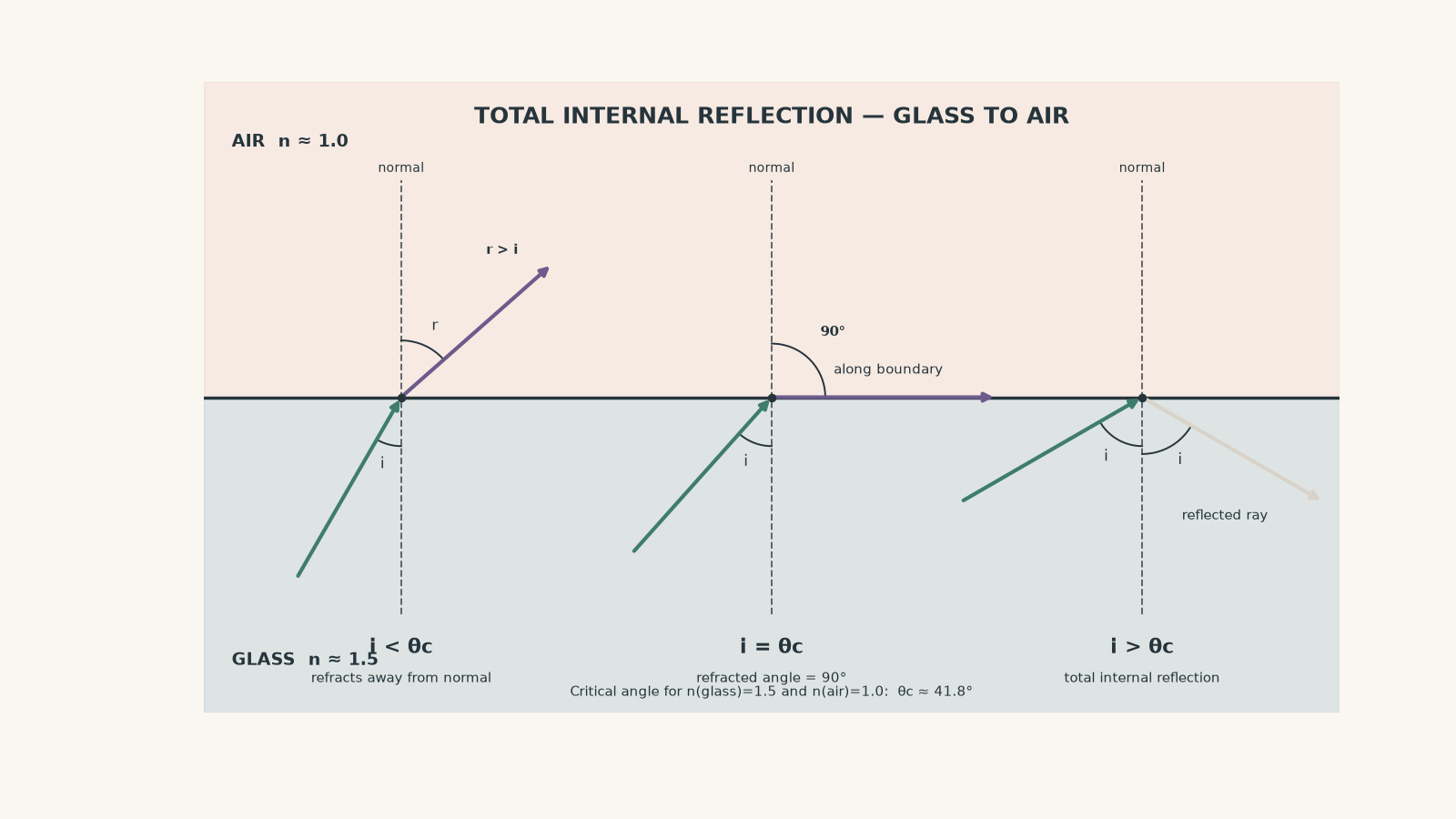
Now imagine gradually increasing the angle of incidence.
The refracted ray bends further and further away from the normal. Eventually, it reaches a limiting case where the refracted ray travels exactly along the boundary.
After that, there is nowhere further for the refracted ray to bend. The light remains in the original material and reflects back inside.
That is total internal reflection, or TIR.
02The two conditions for total internal reflection
There are two conditions. You need both.
| Condition | What it means |
|---|---|
| Direction condition | Light must travel from a higher refractive index material into a lower refractive index material. |
| Angle condition | The angle of incidence must be greater than the critical angle. |
In symbols, if light travels from material 1 to material 2:
\[
n_1 > n_2
\]
and
\[
\theta_i > \theta_c
\]
where \(n_1\) is the refractive index of the material containing the incident ray, \(n_2\) is the refractive index of the second material, \(\theta_i\) is the angle of incidence, and \(\theta_c\) is the critical angle.
A useful decision rule is:
- Check the direction first.
- Then check the angle.
That order matters. If the light is travelling from a lower refractive index into a higher one, TIR cannot happen at any incidence angle. There is no point calculating a critical angle.
03Why the direction matters
Think about a ray travelling from air into glass.
Air has \(n \approx 1.00\), while ordinary glass might have \(n \approx 1.50\). The ray bends towards the normal as it enters the glass.
Increasing the incidence angle does not make the refracted ray approach the surface. It still remains on the glass side of the normal.
Now reverse the journey.
When light travels from glass into air, it bends away from the normal. As the incidence angle increases, the refracted angle increases even faster. Eventually, the refracted angle reaches \(90^\circ\).
That limiting case produces the critical angle.
A common shortcut is to say that light must travel from an “optically dense” material into an “optically less dense” material. That is acceptable if optical density means refractive index. It does not mean the material must have a greater mass density.
04The critical angle
The critical angle is the angle of incidence that produces an angle of refraction of exactly \(90^\circ\).
Notice the wording carefully. The critical angle is an incidence angle, so it is measured from the normal.
At the critical angle:
\[
\theta_i = \theta_c
\]
and
\[
\theta_r = 90^\circ
\]
The refracted ray therefore travels along the boundary.
This is not yet total internal reflection.
TIR occurs only when:
\[
\theta_i > \theta_c
\]
That strict inequality is an easy source of lost marks.
Deriving the critical angle
Snell’s law is
\[
n_1\sin\theta_1 = n_2\sin\theta_2
\]
where \(n_1\) and \(n_2\) are the two refractive indices, and \(\theta_1\) and \(\theta_2\) are the corresponding angles measured from the normal.
At the critical angle, the refracted angle is \(90^\circ\). Therefore:
\[
n_1\sin\theta_c = n_2\sin90^\circ
\]
Since \(\sin90^\circ = 1\):
\[
n_1\sin\theta_c = n_2
\]
so
\[
\sin\theta_c = \frac{n_2}{n_1}
\]
and therefore:
\[
\theta_c = \sin^{-1}\left(\frac{n_2}{n_1}\right)
\]
This formula only describes a real critical angle when \(n_1 > n_2\).
Why? If \(n_2 > n_1\), then \(n_2/n_1\) is greater than 1. But the sine of a real angle cannot be greater than 1.
The mathematics is telling you the same thing as the physics: there is no critical angle when light travels from lower refractive index to higher refractive index.
Worked example: Will light escape from glass?
Light travels through glass with refractive index \(1.50\) towards air with refractive index \(1.00\). It strikes the glass-air boundary at an incidence angle of \(50.0^\circ\). Determine whether total internal reflection occurs.
Step 1
The ray travels from glass, \(n_1 = 1.50\), into air, \(n_2 = 1.00\).
Since
\[
1.50 > 1.00
\]
the direction condition is satisfied.
Step 2
\[
\theta_c = \sin^{-1}\left(\frac{n_2}{n_1}\right)
= \sin^{-1}\left(\frac{1.00}{1.50}\right)
= 41.8^\circ
\]
Step 3
\[
50.0^\circ > 41.8^\circ
\]
Therefore, total internal reflection occurs.
The light does not produce a transmitted refracted ray in the air. Instead, it reflects back into the glass.
05The angle is measured from the normal, not the surface
Imagine a ray that appears to skim almost along a boundary. A student might call this a “small angle” because there is only a small angle between the ray and the surface.
For refraction questions, that is the wrong angle.
Angles of incidence, reflection, and refraction are measured from the normal, which is perpendicular to the surface.
So a ray that makes \(20^\circ\) with the surface makes:
\[
90^\circ – 20^\circ = 70^\circ
\]
with the normal.
That \(70^\circ\) is the angle of incidence.
This matters because TIR is favoured by a large angle from the normal.
A slightly silly way to picture it is to imagine the ray trying to leave a party. Heading almost straight at the door is like a small incidence angle. Skimming almost sideways past the door is like a large incidence angle. At a sufficiently large angle, our ray gets rejected and stays inside.
The analogy breaks because light is not making a decision at the boundary. Its behaviour follows the wave conditions described by refraction and reflection.
Worked example: An angle given from the surface
A ray travels inside a material of refractive index \(1.60\) towards air. The ray makes an angle of \(35.0^\circ\) with the surface. Determine whether total internal reflection occurs.
Step 1
The normal is \(90^\circ\) to the surface, so:
\[
\theta_i = 90.0^\circ – 35.0^\circ = 55.0^\circ
\]
Step 2
The ray travels from \(n_1 = 1.60\) to \(n_2 = 1.00\).
Since \(1.60 > 1.00\), TIR is possible.
Step 3
\[
\theta_c
= \sin^{-1}\left(\frac{1.00}{1.60}\right)
= 38.7^\circ
\]
Step 4
\[
55.0^\circ > 38.7^\circ
\]
Therefore, total internal reflection occurs.
The important move was not the calculator work. It was noticing that \(35.0^\circ\) was measured from the surface rather than the normal.
06What happens below, at, and above the critical angle?
For light travelling in the correct direction, from higher \(n\) to lower \(n\), there are three useful cases.
| Incidence angle | Behaviour |
|---|---|
| \(\theta_i < \theta_c\) | A refracted ray enters the second material. |
| \(\theta_i = \theta_c\) | The refracted ray travels along the boundary at \(90^\circ\) to the normal. |
| \(\theta_i > \theta_c\) | Total internal reflection occurs. |
Suppose the critical angle is \(42^\circ\).
At \(40^\circ\), there is no TIR.
At exactly \(42^\circ\), there is still no TIR. The refracted ray travels along the boundary.
At \(43^\circ\), TIR occurs.
The word greater is doing real work here.
07A more subtle comparison: glass into water
Students sometimes memorise “glass to air can totally internally reflect” and accidentally turn that example into the rule.
Air is not required.
Consider light travelling from glass with \(n = 1.52\) into water with \(n = 1.33\).
The direction condition is satisfied because:
\[
1.52 > 1.33
\]
So TIR is possible.
The critical angle is:
\[
\theta_c
= \sin^{-1}\left(\frac{1.33}{1.52}\right)
= 61.0^\circ
\]
Now compare two rays.
A ray incident at \(58^\circ\) does not totally internally reflect because:
\[
58^\circ < 61.0^\circ
\]
A ray incident at \(65^\circ\) does totally internally reflect because:
\[
65^\circ > 61.0^\circ
\]
The key idea is the relationship between the two refractive indices, not whether one material happens to be air.
08The most tempting misconception
A student sees a very large incidence angle and immediately writes “TIR”.
That feels reasonable. Large angles do help produce TIR.
But angle alone is not enough.
Suppose light travels from water, \(n = 1.33\), into glass, \(n = 1.50\), at an incidence angle of \(85^\circ\).
That is an enormous incidence angle, but:
\[
1.33 < 1.50
\]
The light is travelling from lower refractive index to higher refractive index.
Therefore, total internal reflection cannot occur.
This is why checking the direction before touching the calculator is such a useful habit.
09Why total internal reflection is useful
TIR lets light remain trapped inside a transparent material even when the path bends.
That is the basic idea behind optical fibres. A fibre has a core with a slightly higher refractive index than the surrounding cladding. Rays that meet the core-cladding boundary at sufficiently large incidence angles undergo repeated total internal reflection and remain guided through the fibre.
The refractive indices may be quite close together. TIR does not require a dramatic difference. It requires the correct direction and an incidence angle greater than the corresponding critical angle.
This also explains why changing the material outside a transparent block can change whether TIR occurs. The critical angle depends on both refractive indices:
\[
\theta_c = \sin^{-1}\left(\frac{n_2}{n_1}\right)
\]
Replace air with water, for example, and \(n_2\) increases. The critical angle also increases, so TIR becomes harder to achieve at the same incidence angle.
10Questions and solutions
Question 1
A light ray travels from water with refractive index \(1.33\) into air with refractive index \(1.00\). The critical angle is \(48.8^\circ\). The ray strikes the boundary at \(53.0^\circ\) to the normal.
Does total internal reflection occur?
Solution 1
Yes, total internal reflection occurs.
The direction condition is satisfied because the light travels from the higher refractive index material, water, into the lower refractive index material, air:
\[
1.33 > 1.00
\]
The incidence angle is also greater than the critical angle:
\[
53.0^\circ > 48.8^\circ
\]
Both conditions are therefore satisfied, so the ray undergoes total internal reflection.
The trap is checking only the angle. A large enough angle matters only after the direction condition has been satisfied.
Question 2
A transparent block has refractive index \(1.70\). Light inside the block reaches a boundary with air.
Calculate the critical angle. Then state what happens when the incidence angle is:
a. \(30.0^\circ\)
b. equal to the critical angle
c. \(40.0^\circ\)
Solution 2
The critical angle is \(36.0^\circ\). At \(30.0^\circ\) the light refracts into the air, at \(36.0^\circ\) the refracted ray travels along the boundary, and at \(40.0^\circ\) total internal reflection occurs.
The direction condition is satisfied because light travels from \(n_1 = 1.70\) to \(n_2 = 1.00\).
Calculate the critical angle:
\[
\theta_c
= \sin^{-1}\left(\frac{n_2}{n_1}\right)
= \sin^{-1}\left(\frac{1.00}{1.70}\right)
= 36.0^\circ
\]
For part a:
\[
30.0^\circ < 36.0^\circ
\]
so the ray can refract into the air.
For part b:
\[
\theta_i = \theta_c = 36.0^\circ
\]
so the refracted angle is \(90^\circ\). The refracted ray travels along the boundary. This is the limiting case, not TIR.
For part c:
\[
40.0^\circ > 36.0^\circ
\]
so total internal reflection occurs.
The important distinction is between equal to and greater than the critical angle.
Question 3
An optical fibre has a core of refractive index \(1.480\) and cladding of refractive index \(1.460\).
A ray travelling through the core strikes the core-cladding boundary at \(82.0^\circ\) to the normal.
Determine whether the ray undergoes total internal reflection.
Solution 3
Yes, the ray undergoes total internal reflection.
First check the direction:
\[
n_{\text{core}} = 1.480 > n_{\text{cladding}} = 1.460
\]
so TIR is possible.
The critical angle is:
\[
\theta_c
= \sin^{-1}\left(\frac{1.460}{1.480}\right)
= 80.6^\circ
\]
The incidence angle is:
\[
\theta_i = 82.0^\circ
\]
Therefore:
\[
82.0^\circ > 80.6^\circ
\]
so total internal reflection occurs.
The close refractive indices make the critical angle quite large. This means only rays striking the boundary at sufficiently large angles from the normal will be trapped.
Question 4
A glass block has refractive index \(1.50\). It is surrounded by an unknown transparent liquid.
Light travelling inside the glass undergoes total internal reflection when the incidence angle is \(58^\circ\), but does not undergo total internal reflection when the incidence angle is \(52^\circ\).
Use this information to determine a possible range for the refractive index \(n_L\) of the liquid.
Solution 4
The liquid’s refractive index must satisfy approximately \(1.18 \leq n_L < 1.27\).
Because TIR occurs at \(58^\circ\), the critical angle must be less than \(58^\circ\):
\[
\theta_c < 58^\circ
\]
For glass to liquid:
\[
\sin\theta_c = \frac{n_L}{1.50}
\]
Therefore:
\[
\frac{n_L}{1.50} < \sin58^\circ
\]
so:
\[
n_L < 1.50\sin58^\circ
\]
\[
n_L < 1.27
\]
Now use the observation at \(52^\circ\).
There is no TIR at \(52^\circ\), so the critical angle must be at least \(52^\circ\):
\[
\theta_c \geq 52^\circ
\]
Therefore:
\[
\frac{n_L}{1.50} \geq \sin52^\circ
\]
and:
\[
n_L \geq 1.50\sin52^\circ
\]
\[
n_L \geq 1.18
\]
Combining the limits:
\[
1.18 \leq n_L < 1.27
\]
The unequal signs matter. At exactly \(52^\circ\), a critical angle of \(52^\circ\) would produce a refracted ray along the boundary, so it would still not be total internal reflection. At \(58^\circ\), however, TIR is observed, so the critical angle must be strictly less than \(58^\circ\).
Question 5
A ray travels inside glass of refractive index \(1.50\) and strikes a boundary at an incidence angle of \(50.0^\circ\).
The material on the other side of the boundary can be replaced with different transparent liquids.
Determine the greatest refractive index the second material could have while still allowing total internal reflection at this incidence angle. Explain what happens at the exact limiting value.
Solution 5
For total internal reflection, the second material must have \(n_2 < 1.15\) approximately. At the exact limiting value, the refracted ray travels along the boundary, so TIR does not occur.
At the limiting case, the incidence angle equals the critical angle:
\[
\theta_c = 50.0^\circ
\]
Using:
\[
\sin\theta_c = \frac{n_2}{n_1}
\]
with \(n_1 = 1.50\):
\[
\sin50.0^\circ = \frac{n_2}{1.50}
\]
Therefore:
\[
n_2 = 1.50\sin50.0^\circ
\]
\[
n_2 = 1.15
\]
approximately.
At exactly \(n_2 = 1.15\), the critical angle is \(50.0^\circ\). The ray is therefore at the critical condition, and the refracted ray travels at \(90^\circ\) to the normal along the boundary.
For TIR, the incidence angle must be greater than the critical angle. With the incidence angle fixed at \(50.0^\circ\), that requires the critical angle to be below \(50.0^\circ\), so:
\[
n_2 < 1.15
\]
This question reverses the usual calculation. Instead of finding an angle from two refractive indices, you use the required angle to determine what refractive index the second material is allowed to have.
11Where this idea leads next
Once you can check the direction condition and the angle condition separately, optical fibres become much easier to analyse. The next useful step is to connect TIR to fibre geometry: which incoming rays enter a fibre at angles that eventually meet the core-cladding boundary above the critical angle, and which rays escape instead.