
Work Against Resistive Forces in HSC Physics
Learn how friction and drag affect mechanical energy, how to include resistive work in energy calculations, and how to avoid common sign and conservation mistakes.
A skateboarder rolls down a hill. If you ignore friction and air resistance, the loss in gravitational potential energy should become kinetic energy. So why does a real skateboarder reach the bottom slower than that prediction?
Before reading on, make a prediction. Has some energy disappeared, or is the problem with the way we’re counting energy?
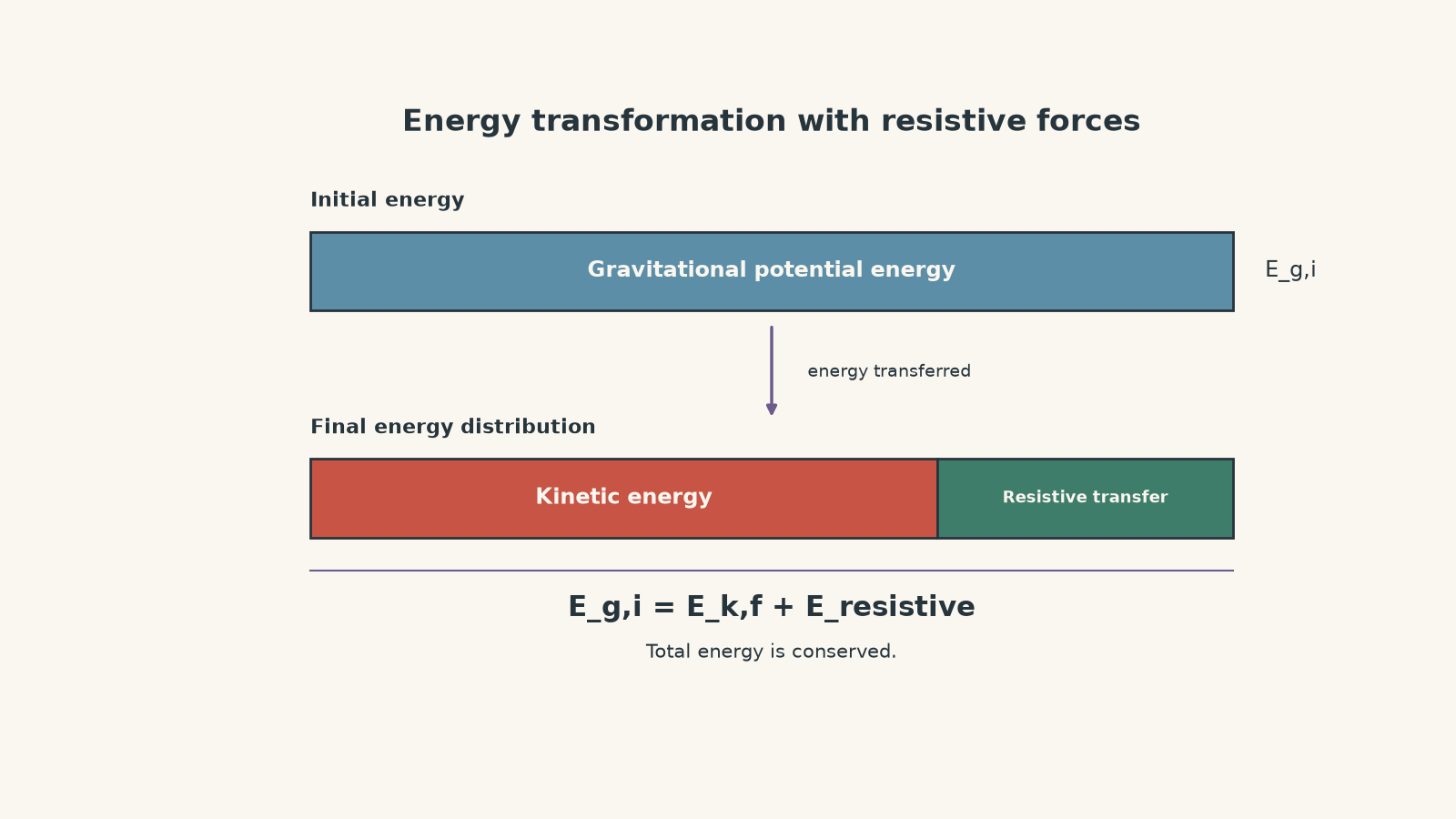
The energy hasn’t disappeared. The skateboarder, wheels, ground, and surrounding air still obey conservation of energy. What has changed is mechanical energy. Friction and drag transfer some of that mechanical energy into other forms, mostly internal energy and thermal energy.
That gives us the central idea:
When resistive forces do work, mechanical energy is not conserved, but total energy still is.
01Start with the frictionless model
Imagine a \(2.0\,\text{kg}\) object released from rest at the top of a smooth ramp.
As it moves down, its gravitational potential energy decreases. Its kinetic energy increases. If there is no friction or drag, the decrease in one exactly matches the increase in the other.
The mechanical energy is
\[
E_{\text{mech}} = K + U
\]
where:
- \(E_{\text{mech}}\) is mechanical energy, measured in joules (\(\text{J}\))
- \(K\) is kinetic energy, measured in joules
- \(U\) is potential energy, measured in joules
For motion near Earth’s surface,
\[
K = \frac{1}{2}mv^2
\]
and
\[
U = mgh
\]
where \(m\) is mass in kilograms (\(\text{kg}\)), \(v\) is speed in metres per second (\(\text{m s}^{-1}\)), \(g\) is gravitational field strength, approximately \(9.8\,\text{m s}^{-2}\), and \(h\) is vertical height in metres (\(\text{m}\)).
If you need to refresh why \(U=mgh\), see gravitational potential energy near Earth.
With no resistive forces,
\[
K_i + U_i = K_f + U_f
\]
The subscripts \(i\) and \(f\) mean initial and final.
This is a useful first model. It is not the model we need for a rough road, air resistance, water resistance, or any other situation where a resistive force does work.
02What friction actually changes
Picture a book sliding across a table.
The friction force points opposite the displacement. The book slows down. You can often feel that the surfaces become slightly warmer.
A useful mental model is to treat friction like a toll collector. The moving object starts with a mechanical-energy budget, and friction takes part of that budget as the object travels.
The analogy is useful because the mechanical energy available for motion decreases. But it has a limit: friction doesn’t literally destroy or store “coins” of energy. Energy is transferred into microscopic motion and deformation in the interacting materials.
The formal way to describe this transfer is with work.
For a constant force,
\[
W = Fd\cos\theta
\]
where \(W\) is work in joules, \(F\) is the force magnitude in newtons (\(\text{N}\)), \(d\) is displacement in metres, and \(\theta\) is the angle between the force and displacement.
A resistive force points opposite the motion, so \(\theta=180^\circ\). Since \(\cos180^\circ=-1\),
\[
W_{\text{res}}=-F_{\text{res}}d
\]
The negative sign matters. It tells us that the resistive force removes mechanical energy from the moving system.
03The mechanical-energy equation with resistance
When a non-conservative force such as friction or drag does work,
\[
K_i+U_i+W_{\text{nc}}=K_f+U_f
\]
where \(W_{\text{nc}}\) is the work done by the non-conservative force.
If the only non-conservative force is a constant resistive force,
\[
K_i+U_i-F_{\text{res}}d=K_f+U_f
\]
There is another equivalent way to write the same idea:
\[
\Delta E_{\text{mech}}=W_{\text{nc}}
\]
where
\[
\Delta E_{\text{mech}}=E_{\text{mech},f}-E_{\text{mech},i}
\]
Because resistive work is normally negative, the final mechanical energy is smaller than the initial mechanical energy.
04Work done by friction versus energy dissipated
This sign convention catches students surprisingly often.
Suppose friction has magnitude \(10\,\text{N}\) and acts over \(3.0\,\text{m}\).
The work done by friction is
\[
W_{\text{friction}}=-(10)(3.0)=-30\,\text{J}
\]
But the energy dissipated by friction is usually reported as a positive amount:
\[
E_{\text{dissipated}}=30\,\text{J}
\]
They describe the same energy transfer from different viewpoints.
| Wording | Typical value |
|---|---|
| Work done by a resistive force | Negative |
| Change in mechanical energy due to resistance | Negative |
| Mechanical energy dissipated | Positive magnitude |
| Energy transferred to thermal or internal energy | Positive magnitude |
So don’t memorise “friction energy is negative”. Energy itself isn’t inherently negative here. The work done by friction is negative because the force opposes the displacement.
05Worked example: Sliding down a rough slope
A \(2.0\,\text{kg}\) sled starts from rest and descends through a vertical height of \(3.0\,\text{m}\). Friction does \(-18\,\text{J}\) of work during the descent. Find the sled’s speed at the bottom. Use \(g=9.8\,\text{m s}^{-2}\).
Step 1
\[
K_i+U_i+W_{\text{friction}}=K_f+U_f
\]
The sled starts from rest, so \(K_i=0\). Choose the bottom of the slope as \(h=0\), so \(U_f=0\).
Therefore,
\[
mgh+W_{\text{friction}}=\frac{1}{2}mv^2
\]
Step 2
\[
U_i=(2.0)(9.8)(3.0)=58.8\,\text{J}
\]
Step 3
\[
58.8-18=\frac{1}{2}(2.0)v^2
\]
So,
\[
40.8=v^2
\]
Step 4
\[
v=\sqrt{40.8}=6.39\,\text{m s}^{-1}
\]
The sled reaches the bottom at approximately
\[
\boxed{6.4\,\text{m s}^{-1}}
\]
The important part is not just the number. Of the original \(58.8\,\text{J}\) of gravitational potential energy, only \(40.8\,\text{J}\) becomes kinetic energy. The other \(18\,\text{J}\) has been transferred out of the sled’s mechanical-energy store by friction.
06Why you cannot just conserve \(K+U\)
A tempting calculation would be
\[
mgh=\frac{1}{2}mv^2
\]
That equation predicts the speed the sled would have if no non-conservative force transferred mechanical energy away.
Why does the mistake feel reasonable? Gravity is still conservative, and gravitational potential energy is still decreasing by \(mgh\). The missing step is that not all of that decrease has to become kinetic energy.
With friction present,
\[
\text{lost gravitational potential energy}
=
\text{gained kinetic energy}
+
\text{energy dissipated}
\]
That sentence is often more useful than memorising another formula.
07Resistive forces can matter while an object moves uphill too
Suppose a car coasts uphill with its engine providing no driving force.
Two things reduce its kinetic energy:
- its gravitational potential energy increases
- resistance transfers mechanical energy to other forms
Students sometimes count only the first effect because “going uphill” immediately suggests \(mgh\). But the resistive work can be just as important.
Worked example: Coasting uphill against resistance
A \(1200\,\text{kg}\) car travels at \(20\,\text{m s}^{-1}\) before coasting uphill with its engine disengaged. It rises through a vertical height of \(8.0\,\text{m}\) while travelling \(120\,\text{m}\) along the road. The combined resistive force from rolling resistance and air drag can be modelled as a constant \(650\,\text{N}\). Find the car’s final speed. Use \(g=9.8\,\text{m s}^{-2}\).
Step 1
The car begins with kinetic energy. As it moves uphill, some kinetic energy becomes gravitational potential energy, while resistance removes additional mechanical energy.
Using the starting height as \(U_i=0\),
\[
K_i+W_{\text{res}}=K_f+U_f
\]
Step 2
\[
K_i=\frac{1}{2}(1200)(20)^2=240000\,\text{J}
\]
Step 3
The resistive force acts opposite the car’s \(120\,\text{m}\) displacement:
\[
W_{\text{res}}=-(650)(120)=-78000\,\text{J}
\]
Step 4
\[
U_f=(1200)(9.8)(8.0)=94080\,\text{J}
\]
Step 5
\[
240000-78000=K_f+94080
\]
so
\[
K_f=67920\,\text{J}
\]
Step 6
\[
67920=\frac{1}{2}(1200)v^2
\]
\[
v^2=\frac{2(67920)}{1200}=113.2
\]
\[
v=\sqrt{113.2}=10.6\,\text{m s}^{-1}
\]
The final speed is approximately
\[
\boxed{10.6\,\text{m s}^{-1}}
\]
Notice that the car loses \(172080\,\text{J}\) of kinetic energy altogether. Of that amount, \(94080\,\text{J}\) becomes gravitational potential energy and \(78000\,\text{J}\) is transferred by resistive forces.
08Friction and drag are not quite the same problem
For many HSC calculations, friction can be treated as approximately constant over the motion. If the friction force has constant magnitude \(F_f\),
\[
W_f=-F_fd
\]
Kinetic friction is sometimes modelled using
\[
F_f=\mu_kN
\]
where \(\mu_k\) is the coefficient of kinetic friction and \(N\) is the normal force.
Drag is trickier.
Air resistance and fluid resistance often depend on speed. That means a falling object might experience a small drag force when moving slowly and a much larger drag force when moving quickly.
So you cannot automatically write
\[
W_{\text{drag}}=-F_{\text{drag}}d
\]
using one instantaneous value of \(F_{\text{drag}}\), unless the problem tells you the drag force can be treated as constant.
If the resistive force varies, the work depends on how the force changes throughout the displacement. On a force-displacement graph, the magnitude of the work is represented by the area under the graph. If an average resistive force is known,
\[
W_{\text{res}}=-F_{\text{avg}}d
\]
where \(F_{\text{avg}}\) is the average resistive-force magnitude.
This gives a useful decision rule:
| Situation | Useful approach |
|---|---|
| No resistance | Set initial and final mechanical energy equal |
| Constant friction or resistance | Include \(W=-Fd\) |
| Average resistance supplied | Use \(W=-F_{\text{avg}}d\) |
| Variable drag, but initial and final energies are known | Find resistive work from \(\Delta E_{\text{mech}}\) |
| Variable force shown against displacement | Use the area under the force-displacement graph |
09Mechanical energy is not the same as total energy
Here is the misconception worth removing completely:
“Friction means energy is not conserved.”
That statement is wrong.
Friction means mechanical energy is not conserved for the chosen mechanical system.
Suppose a box slides to rest on a floor. Initially, the box has kinetic energy. Finally, it has no kinetic energy. If you look only at \(K+U\), energy appears to have vanished.
But the box and floor have gained internal energy. Their particles have more microscopic random motion and deformation. Some energy may also be transferred as sound.
The total energy bookkeeping still works.
A better statement is:
Resistive forces transfer energy out of the mechanical-energy account and into other forms.
That distinction becomes especially important when analysing real machines, braking, collisions, atmospheric motion, and orbital systems with drag.
10A reliable method for resistive-force questions
When a question mixes gravitational potential energy, kinetic energy, and resistance, use this sequence:
- Choose the initial and final states.
- Decide which forms of mechanical energy exist at each state.
- Calculate the work done by any non-conservative forces.
- Use
\[
K_i+U_i+W_{\text{nc}}=K_f+U_f
\]
- Check the sign. Resistance usually does negative work.
- Check whether the answer makes physical sense.
That last step catches many sign errors.
If an object falls from rest while experiencing air resistance, for example, its final speed should be less than the resistance-free prediction. If your calculation gives a greater speed, you have almost certainly added resistive work instead of subtracting it.
11Questions and solutions
Question 1
A \(4.0\,\text{kg}\) trolley moves at \(6.0\,\text{m s}^{-1}\) across a level floor. A constant friction force of \(12\,\text{N}\) acts over \(4.0\,\text{m}\). Find the trolley’s speed after travelling this distance.
Solution 1
The trolley’s final speed is approximately \(\boxed{3.5\,\text{m s}^{-1}}\).
Because the floor is level, there is no change in gravitational potential energy. Friction reduces the trolley’s kinetic energy.
The initial kinetic energy is
\[
K_i=\frac{1}{2}mv_i^2
=\frac{1}{2}(4.0)(6.0)^2
=72\,\text{J}
\]
The work done by friction is
\[
W_f=-F_fd
=-(12)(4.0)
=-48\,\text{J}
\]
Using
\[
K_i+W_f=K_f
\]
gives
\[
72-48=24\,\text{J}
\]
So
\[
24=\frac{1}{2}(4.0)v_f^2
\]
\[
v_f^2=12
\]
\[
v_f=3.46\,\text{m s}^{-1}
\]
Therefore,
\[
\boxed{v_f\approx3.5\,\text{m s}^{-1}}
\]
The friction force has transferred \(48\,\text{J}\) out of the trolley’s mechanical energy.
Question 2
A \(0.50\,\text{kg}\) stone is released from rest \(12\,\text{m}\) above the ground. It reaches the ground at \(13\,\text{m s}^{-1}\). Calculate the work done by air resistance during the fall. Use \(g=9.8\,\text{m s}^{-2}\).
Solution 2
Air resistance does approximately \(\boxed{-16.6\,\text{J}}\) of work, meaning \(16.6\,\text{J}\) of mechanical energy is dissipated.
Take the ground as zero gravitational potential energy.
The stone’s initial mechanical energy is
\[
E_i=mgh
=(0.50)(9.8)(12)
=58.8\,\text{J}
\]
Its final mechanical energy is entirely kinetic:
\[
E_f=\frac{1}{2}mv^2
=\frac{1}{2}(0.50)(13)^2
=42.25\,\text{J}
\]
The work done by air resistance equals the change in mechanical energy:
\[
W_{\text{air}}=E_f-E_i
\]
\[
W_{\text{air}}=42.25-58.8
=-16.55\,\text{J}
\]
Therefore,
\[
\boxed{W_{\text{air}}\approx-16.6\,\text{J}}
\]
The negative sign shows that air resistance removed mechanical energy during the fall. The stone’s speed is therefore lower than it would have been in the resistance-free model.
Question 3
A \(900\,\text{kg}\) vehicle travels downhill through a vertical drop of \(15\,\text{m}\) while covering \(200\,\text{m}\) along the road. Its speed increases from \(5.0\,\text{m s}^{-1}\) to \(14\,\text{m s}^{-1}\). Assuming the combined resistive force is constant, determine its magnitude. Use \(g=9.8\,\text{m s}^{-2}\).
Solution 3
The average resistive-force magnitude is approximately \(\boxed{2.8\times10^2\,\text{N}}\).
The vehicle loses gravitational potential energy while gaining kinetic energy. The difference is dissipated by resistance.
Choose the bottom of the hill as \(U_f=0\).
The initial kinetic energy is
\[
K_i=\frac{1}{2}(900)(5.0)^2
=11250\,\text{J}
\]
The initial gravitational potential energy is
\[
U_i=(900)(9.8)(15)
=132300\,\text{J}
\]
So the initial mechanical energy is
\[
E_i=11250+132300
=143550\,\text{J}
\]
The final kinetic energy is
\[
E_f=\frac{1}{2}(900)(14)^2
=88200\,\text{J}
\]
Therefore the work done by resistance is
\[
W_{\text{res}}=E_f-E_i
=88200-143550
=-55350\,\text{J}
\]
For a constant resistive force,
\[
W_{\text{res}}=-F_{\text{res}}d
\]
so
\[
-55350=-F_{\text{res}}(200)
\]
\[
F_{\text{res}}=276.75\,\text{N}
\]
Hence,
\[
\boxed{F_{\text{res}}\approx277\,\text{N}}
\]
A common mistake is to assume the entire loss in gravitational potential energy becomes kinetic energy. Here, \(55350\,\text{J}\) is instead transferred out of the vehicle’s mechanical energy.
Question 4
Two identical \(2.0\,\text{kg}\) blocks are released from rest at the same vertical height, \(2.0\,\text{m}\) above the ground. Block A travels down a rough path of length \(3.0\,\text{m}\). Block B travels down a different rough path of length \(5.0\,\text{m}\). A constant friction force of \(4.0\,\text{N}\) acts on each block throughout its path.
Which block reaches the ground faster? Calculate both final speeds and explain why starting from the same height is not enough to guarantee the same final speed.
Solution 4
Block A reaches the ground faster. Its speed is approximately \(\boxed{5.2\,\text{m s}^{-1}}\), compared with \(\boxed{4.4\,\text{m s}^{-1}}\) for Block B.
Both blocks begin with the same gravitational potential energy:
\[
U_i=mgh
=(2.0)(9.8)(2.0)
=39.2\,\text{J}
\]
For Block A, the work done by friction is
\[
W_{f,A}=-(4.0)(3.0)=-12\,\text{J}
\]
Therefore,
\[
K_{f,A}=39.2-12
=27.2\,\text{J}
\]
Using \(K=\frac{1}{2}mv^2\),
\[
27.2=\frac{1}{2}(2.0)v_A^2
\]
\[
v_A=\sqrt{27.2}
=5.22\,\text{m s}^{-1}
\]
For Block B,
\[
W_{f,B}=-(4.0)(5.0)=-20\,\text{J}
\]
so
\[
K_{f,B}=39.2-20
=19.2\,\text{J}
\]
and
\[
19.2=\frac{1}{2}(2.0)v_B^2
\]
\[
v_B=\sqrt{19.2}
=4.38\,\text{m s}^{-1}
\]
Thus,
\[
\boxed{v_A\approx5.2\,\text{m s}^{-1}}
\]
and
\[
\boxed{v_B\approx4.4\,\text{m s}^{-1}}
\]
The tempting prediction is that equal starting heights must produce equal final speeds because both blocks lose the same gravitational potential energy. That is true only when mechanical energy is conserved.
Here, friction acts over different distances. The longer path dissipates more mechanical energy, so Block B reaches the bottom with less kinetic energy.
Question 5
A \(0.20\,\text{kg}\) foam ball is launched vertically upward at \(18\,\text{m s}^{-1}\). It reaches a maximum height of \(12\,\text{m}\) above its launch point.
At the instant of launch, the drag force has magnitude \(0.60\,\text{N}\). A student calculates the work done by drag as
\[
W_{\text{drag}}=-(0.60)(12)=-7.2\,\text{J}
\]
Explain why this method is not valid, and determine the actual total work done by drag during the ascent. Use \(g=9.8\,\text{m s}^{-2}\).
Solution 5
The student’s method is not valid because the \(0.60\,\text{N}\) drag force is the force at one instant, not necessarily the force throughout the ascent. The actual work done by drag is \(\boxed{-8.88\,\text{J}}\).
The ball’s initial kinetic energy is
\[
K_i=\frac{1}{2}mv_i^2
=\frac{1}{2}(0.20)(18)^2
=32.4\,\text{J}
\]
At maximum height, the ball’s speed is zero, so its final kinetic energy is
\[
K_f=0
\]
Its gravitational potential energy has increased by
\[
U_f=mgh
=(0.20)(9.8)(12)
=23.52\,\text{J}
\]
Using
\[
K_i+U_i+W_{\text{drag}}=K_f+U_f
\]
and taking \(U_i=0\),
\[
32.4+W_{\text{drag}}=23.52
\]
Therefore,
\[
W_{\text{drag}}=23.52-32.4
=-8.88\,\text{J}
\]
So,
\[
\boxed{W_{\text{drag}}=-8.88\,\text{J}}
\]
The student’s calculation assumes a constant \(0.60\,\text{N}\) drag force for all \(12\,\text{m}\). That assumption is not justified. Drag generally changes as the ball’s speed changes.
The energy method avoids needing to know the drag force at every point. Once the initial and final mechanical energies are known, their difference tells us the total work done by drag.
12Where this idea leads next
Once resistance is included, mechanical-energy questions become more realistic. You can analyse why falling objects move more slowly than the vacuum prediction, how braking distance depends on dissipated energy, and why two paths between the same heights can produce different final speeds.
The next important step is to connect this energy view with the force view. A changing drag force changes an object’s acceleration, while the work done by that same drag force changes its mechanical energy. Following that connection leads naturally to speed-dependent drag, terminal velocity, and more realistic models of motion through fluids.