
Work Done by a Constant Force: HSC Physics Guide
Learn how to use W = Fs cos θ by identifying the force component parallel to displacement, including positive, negative, and zero work.
You drag a suitcase 6 m along an airport floor while pulling its handle upwards at an angle. Your force might be 40 N, but not all 40 N helps move the suitcase forward.
Before calculating anything, predict this: if you pull the handle at a steeper angle while keeping the same 40 N force, will you do more work, less work, or the same work on the suitcase over the same horizontal distance?
You do less work. The reason is the central idea of this guide: only the component of a force parallel to the displacement transfers energy through work.
01Start with the part of the force that matters
Imagine pushing a heavy box straight across the floor.
If you push horizontally and the box moves horizontally, your entire force acts in the direction of motion. That is the simplest case.
If you push diagonally downwards, the force now has two useful components to think about:
- a horizontal component, parallel to the displacement
- a vertical component, perpendicular to the displacement
The horizontal component helps move the box across the floor. The vertical component pushes the box harder into the floor, but the box does not move downwards through the floor.
So, for the work done by your applied force, the horizontal component is the one that transfers energy.
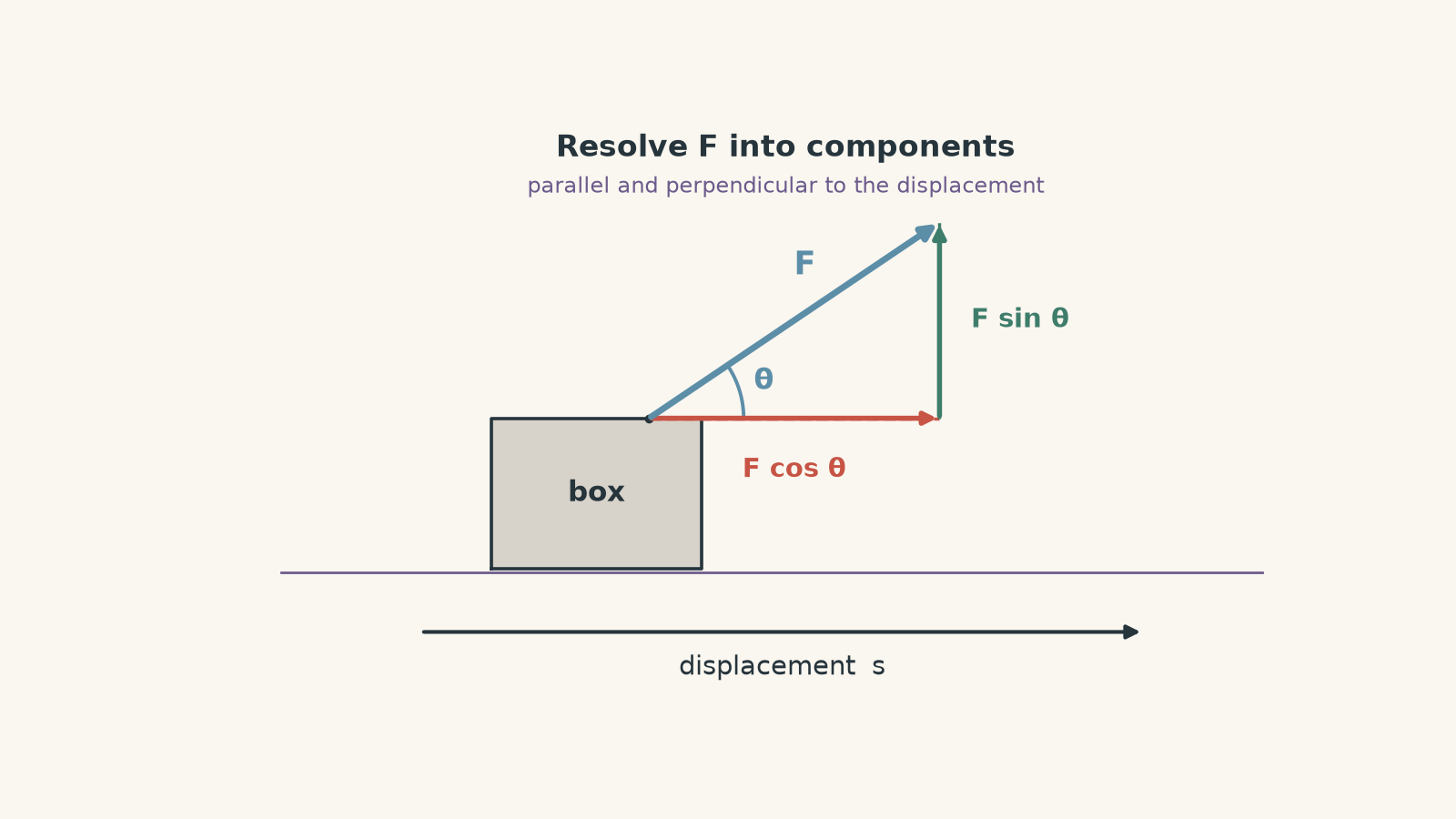
This gives us the first useful mental model:
Work depends on how much force acts along the displacement, and how far the object moves in that direction.
That model is good, but we need to make it precise.
02From force components to the work equation
Suppose a constant force \(F\) acts at an angle \(\theta\) to an object’s displacement \(s\).
The component of the force parallel to the displacement is
\[
F_{\parallel} = F\cos\theta
\]
So the work done by that force is
\[
W = F_{\parallel}s = Fs\cos\theta
\]
where:
- \(W\) is the work done by the force, measured in joules (J)
- \(F\) is the magnitude of the constant force, measured in newtons (N)
- \(s\) is the magnitude of the displacement, measured in metres (m)
- \(\theta\) is the angle between the force and the displacement
That last point causes plenty of mistakes. The angle is not automatically measured from the horizontal. It is specifically the angle between the two vectors involved: force and displacement.
Because \(1\text{ N} = 1\text{ kg m s}^{-2}\),
\[
1\text{ J} = 1\text{ N m}
\]
Work is a scalar quantity. It has a magnitude and can be positive, negative, or zero, but it does not have a direction.
03Why does the cosine appear?
Cosine is not an arbitrary formula trick. It extracts the component of the force pointing along the displacement.
Consider a force arrow of magnitude \(F\) making an angle \(\theta\) with the displacement. Resolving that force gives
\[
F_{\parallel} = F\cos\theta
\]
and
\[
F_{\perp} = F\sin\theta
\]
The perpendicular component does not contribute to the work because there is no displacement in that direction.
A mildly silly way to picture this is two people moving a couch down a narrow hallway. One person pushes along the hallway. The other pushes directly into the wall. The second person might be trying extremely hard, but their force is not helping the couch move down the hallway.
The analogy has a limit. Real couches involve friction, rotation, deformation, and possibly an argument about whose idea this was. The physics statement is cleaner: for translational work by a constant force, only the force component parallel to the displacement contributes to \(W\).
04Positive, negative, and zero work
The value of \(\cos\theta\) tells you whether the force transfers energy to the object, removes energy from it, or transfers no energy through work.
| Angle between force and displacement | Sign of \(\cos\theta\) | Work done | Physical meaning |
|---|---|---|---|
| \(0^\circ\) | Positive, maximum | Positive | Force acts with the motion |
| Between \(0^\circ\) and \(90^\circ\) | Positive | Positive | Part of the force acts with the motion |
| \(90^\circ\) | 0 | Zero | Force is perpendicular to the motion |
| Between \(90^\circ\) and \(180^\circ\) | Negative | Negative | Part of the force opposes the motion |
| \(180^\circ\) | \(-1\) | Negative, maximum magnitude | Force acts directly against the motion |
Positive work
If the force has a component in the same direction as the displacement, then
\[
W>0
\]
The force transfers energy to the object.
For example, if you push a trolley forward and it moves forward, your applied force does positive work.
Negative work
If the force has a component opposite the displacement, then
\[
W<0
\]
The force transfers energy away from the object’s mechanical energy.
Friction often does negative work because it acts opposite the direction of sliding.
Negative work does not mean the calculation has gone wrong. The sign carries physical information.
Zero work
If the force is perpendicular to the displacement,
\[
\theta=90^\circ
\]
so
\[
W=Fs\cos90^\circ=0
\]
A force can therefore be large and still do no work.
That can feel strange at first. Surely a large force must be “doing something”?
It can be doing something without transferring energy through work. For example, the normal force from a level floor can support a moving object while remaining perpendicular to its horizontal displacement.
05Worked example: pulling a crate with a rope
A student pulls a crate 8.0 m across a horizontal floor using a constant force of 50 N directed \(30^\circ\) above the horizontal. Calculate the work done by the student’s force.
Step 1
The crate moves horizontally, while the force is \(30^\circ\) above the horizontal. Therefore,
\[
\theta=30^\circ
\]
Step 2
\[
F_{\parallel}=F\cos\theta
=50\cos30^\circ
\approx43.3\text{ N}
\]
Only about 43.3 N of the 50 N force contributes to the work.
Step 3
\[
W=Fs\cos\theta
=(50)(8.0)\cos30^\circ
\approx346\text{ J}
\]
The student’s force does approximately
\[
\boxed{346\text{ J}}
\]
of positive work on the crate.
This means the applied force transfers 346 J of energy to the crate-system through this displacement. It does not mean the crate necessarily gains 346 J of kinetic energy, because other forces, such as friction, may also be doing work.
06Work done by one force is not automatically the net work
This distinction matters.
Suppose you pull a box forwards while friction acts backwards. Your force does positive work. Friction does negative work.
Each force has its own value of \(W=Fs\cos\theta\).
The net work is the sum of the work done by all forces:
\[
W_{\text{net}}=W_1+W_2+W_3+\cdots
\]
Later, this connects directly to the work-energy theorem,
\[
W_{\text{net}}=\Delta K
\]
where \(\Delta K\) is the change in kinetic energy.
So if a question asks for the work done by the applied force, calculate only that force’s contribution. If it asks for net work, consider every force that does work.
07Worked example: several forces act on a moving sled
A sled moves 12 m horizontally to the right. A person pulls it with a constant force of 90 N at \(40^\circ\) above the horizontal. Friction exerts a constant 25 N force to the left. The weight and normal force act vertically.
Calculate:
- the work done by the pulling force
- the work done by friction
- the work done by the normal force and the weight
- the net work on the sled
Step 1
The angle between the pulling force and the displacement is \(40^\circ\).
\[
W_{\text{pull}}
=Fs\cos\theta
=(90)(12)\cos40^\circ
\approx827\text{ J}
\]
The pulling force does positive work because it has a component in the direction of motion.
Step 2
Friction points directly opposite the displacement, so
\[
\theta=180^\circ
\]
Therefore,
\[
W_{\text{friction}}
=(25)(12)\cos180^\circ
=-300\text{ J}
\]
Friction does negative work.
Step 3
Both the normal force and the weight are vertical, while the displacement is horizontal. Their angle to the displacement is \(90^\circ\).
Therefore,
\[
W_N=0\text{ J}
\]
and
\[
W_g=0\text{ J}
\]
This does not mean weight and the normal force are absent. It means they transfer no energy through work during this horizontal displacement.
Step 4
\[
\begin{aligned}
W_{\text{net}}
&=W_{\text{pull}}+W_{\text{friction}}+W_N+W_g\\
&=827-300+0+0\\
&=527\text{ J}
\end{aligned}
\]
So the net work is approximately
\[
\boxed{527\text{ J}}
\]
The positive result means the sled’s kinetic energy increases by 527 J.
08The most tempting mistake: using the whole force
Suppose a 100 N force acts at \(60^\circ\) to an object’s displacement.
A student might calculate
\[
W=Fs
\]
and use all 100 N.
That feels reasonable because the question says a 100 N force is being applied. But only the component along the displacement transfers energy.
Here,
\[
F_{\parallel}=100\cos60^\circ=50\text{ N}
\]
So the force contributes to the work as though a 50 N force were acting directly along the displacement.
The remaining component is perpendicular to the motion and contributes no work.
A reliable decision rule is:
Before using \(W=Fs\cos\theta\), draw or imagine the force and displacement arrows. Then identify the angle between them.
That one habit prevents several common errors at once.
09What if the object moves but the force does no work?
Consider an object moving in a horizontal circle at constant speed.
At each instant, the centripetal force points towards the centre of the circle. The instantaneous displacement is tangential to the circle.
Those directions are perpendicular.
So, at each instant,
\[
W=Fs\cos90^\circ=0
\]
for the centripetal force.
Yet the force is still changing the object’s velocity because velocity includes direction as well as speed.
This is a useful reminder: a force does not need to do work to change velocity. A perpendicular force can change the direction of velocity without changing the object’s kinetic energy.
10A limitation of \(W=Fs\cos\theta\)
The equation
\[
W=Fs\cos\theta
\]
in this form assumes the force is constant and that the angle between the force and displacement remains constant over the displacement being considered.
If the force changes as the object moves, you cannot necessarily use one value of \(F\) for the entire journey.
For HSC Physics, this is why force-displacement graphs matter. When force varies with displacement, the work done is connected to the area under the force-displacement graph.
The constant-force equation is therefore not a separate trick. It is the simplest case of a broader idea: work measures energy transferred by a force acting through a displacement.
11Questions and solutions
Question 1
A 35 N horizontal force pushes a trolley 4.0 m along a horizontal track. Calculate the work done by the force.
Solution 1
The force does \(\boxed{140\text{ J}}\) of work.
The force and displacement point in the same direction, so \(\theta=0^\circ\).
\[
\begin{aligned}
W&=Fs\cos\theta\\
&=(35)(4.0)\cos0^\circ\\
&=140\text{ J}
\end{aligned}
\]
Because the work is positive, the force transfers 140 J of energy to the trolley through this displacement.
Question 2
A suitcase moves 15 m horizontally while its owner pulls with a constant 60 N force at \(50^\circ\) above the horizontal.
Calculate the work done by the pulling force.
Solution 2
The pulling force does approximately \(\boxed{579\text{ J}}\) of work.
Only the component of the 60 N force parallel to the horizontal displacement contributes.
\[
\begin{aligned}
W&=Fs\cos\theta\\
&=(60)(15)\cos50^\circ\\
&\approx579\text{ J}
\end{aligned}
\]
Equivalently, the parallel component is
\[
F_{\parallel}=60\cos50^\circ\approx38.6\text{ N}
\]
so
\[
W=(38.6)(15)\approx579\text{ J}
\]
The upward part of the pulling force does no work because the suitcase has no vertical displacement.
Question 3
A 2.0 kg block slides 5.0 m to the right across a horizontal surface. Three forces act on it:
- a 24 N force directed \(60^\circ\) above the horizontal towards the right
- an 8.0 N friction force towards the left
- the block’s weight and the normal force
Calculate the work done by each force and hence determine the net work.
Solution 3
The applied force does \(\boxed{60\text{ J}}\), friction does \(\boxed{-40\text{ J}}\), the weight and normal force each do \(\boxed{0\text{ J}}\), and the net work is \(\boxed{20\text{ J}}\).
For the applied force,
\[
\begin{aligned}
W_{\text{applied}}
&=Fs\cos\theta\\
&=(24)(5.0)\cos60^\circ\\
&=60\text{ J}
\end{aligned}
\]
For friction, the angle between force and displacement is \(180^\circ\):
\[
\begin{aligned}
W_{\text{friction}}
&=(8.0)(5.0)\cos180^\circ\\
&=-40\text{ J}
\end{aligned}
\]
The weight and normal force are perpendicular to the horizontal displacement, so
\[
W_g=0\text{ J}
\]
and
\[
W_N=0\text{ J}
\]
Therefore,
\[
\begin{aligned}
W_{\text{net}}
&=60-40+0+0\\
&=20\text{ J}
\end{aligned}
\]
The positive net work means the block’s kinetic energy increases by 20 J.
A common trap here is to assume that every force acting on the object must do work. A force can act on an object while doing zero work if it is perpendicular to the displacement.
Question 4
A student says:
“If an object moves 10 m while a 200 N force acts on it, that force must do 2000 J of work.”
Give a counterexample in which the force acts throughout the 10 m displacement but does zero work. Explain why.
Solution 4
A valid counterexample is a 200 N force that remains perpendicular to the object’s displacement. The work done is then \(\boxed{0\text{ J}}\).
Using the work equation,
\[
\begin{aligned}
W&=Fs\cos\theta\\
&=(200)(10)\cos90^\circ\\
&=0\text{ J}
\end{aligned}
\]
The student’s reasoning incorrectly assumes that the entire force acts along the displacement.
The size of a force and the distance travelled are not enough to determine the work. The relative direction matters. Only the component \(F\cos\theta\) parallel to the displacement transfers energy through work.
Question 5
Two students pull identical boxes through the same horizontal displacement \(s\).
Student A applies a constant force of magnitude \(F\) horizontally.
Student B applies a constant force of magnitude \(2F\) at an angle \(\theta\) above the horizontal.
For what value of \(\theta\) do the two students do the same amount of work on their boxes?
Explain why Student B can apply a larger force without doing more work.
Solution 5
The two students do the same work when \(\boxed{\theta=60^\circ}\).
Student A’s force is parallel to the displacement, so
\[
W_A=Fs
\]
Student B does
\[
W_B=(2F)s\cos\theta
\]
For the work values to be equal,
\[
\begin{aligned}
Fs&=2Fs\cos\theta\\
1&=2\cos\theta\\
\cos\theta&=\frac{1}{2}\\
\theta&=60^\circ
\end{aligned}
\]
Student B applies twice the total force, but at \(60^\circ\) only half of that force acts parallel to the displacement:
\[
F_{\parallel}=2F\cos60^\circ=F
\]
The remaining component is perpendicular to the displacement and contributes no work.
The trap is to compare the magnitudes \(F\) and \(2F\) directly. Work depends on the parallel component, not simply the total force.
Question 6
A puck moves to the right across a level surface. A constant force acts on it at \(120^\circ\) to its displacement.
A student argues that the force must do positive work because it has “some horizontal component”.
Determine whether the student is correct. Then find the work done if the force has magnitude 18 N and the puck moves 7.0 m.
Solution 6
The student is incorrect. The force does negative work, equal to \(\boxed{-63\text{ J}}\).
The important question is not whether a horizontal component exists, but which horizontal direction it points.
Because the angle is \(120^\circ\),
\[
\cos120^\circ=-0.5
\]
so the component parallel to the displacement is
\[
F_{\parallel}=18\cos120^\circ=-9.0\text{ N}
\]
The negative sign means this component points opposite the puck’s displacement.
Therefore,
\[
\begin{aligned}
W&=Fs\cos\theta\\
&=(18)(7.0)\cos120^\circ\\
&=-63\text{ J}
\end{aligned}
\]
The force removes 63 J of mechanical energy from the puck through this displacement.
The tempting mistake is to think “horizontal” automatically means “with the motion”. A component can be parallel to an axis while pointing in either direction along that axis.
12Where this idea leads next
The key question in every constant-force work problem is not simply “How large is the force?” It is:
How much of this force acts along the displacement?
That gives
\[
W=(F\cos\theta)s=Fs\cos\theta
\]
Once that connection is secure, the next step is the work-energy theorem. Instead of calculating each force merely to find an energy transfer, you can connect the net work directly to the change in kinetic energy:
\[
W_{\text{net}}=\Delta K
\]
That is where work becomes especially useful. Forces describe the interaction, while work lets you track what those forces do to the object’s energy.