
Mixing Two Solutions: A Worked Limiting-Reagent Problem
Learn how to calculate the maximum mass of calcium carbonate precipitate when calcium chloride and sodium carbonate solutions are mixed. Follow the mole calculations, identify the limiting reagent, and see why concentration alone cannot determine which reactant runs out first.
Mix 35.0 mL of 0.200 mol L⁻¹ calcium chloride solution with 50.0 mL of 0.120 mol L⁻¹ sodium carbonate solution. The mixture turns cloudy as a white solid forms. Which solution determines the maximum mass of solid: the more concentrated calcium chloride, or the less concentrated sodium carbonate?
Make a prediction before calculating. The tempting answer is calcium chloride, because its concentration is higher. But concentration tells you how many moles are present per litre, not how many moles you actually poured into the beaker. To find the limiting reagent, you need both the concentration and the volume.
Mixing solutions forms a precipitate
- Separate solutions
CaCl₂(aq) + Na₂CO₃(aq)
35.0 mL CaCl₂, 0.200 mol L⁻¹
50.0 mL Na₂CO₃, 0.120 mol L⁻¹
- Mix in one beaker
Ca²⁺(aq) + CO₃²⁻(aq) → CaCO₃(s)
Calcium carbonate forms as a white solid
The mixture becomes cloudy
- Precipitate settles
CaCO₃(s)
White solid collects at the beaker bottom
Na₂CO₃ is limiting; CaCl₂ remains in excess
01What actually happens when the solutions mix?
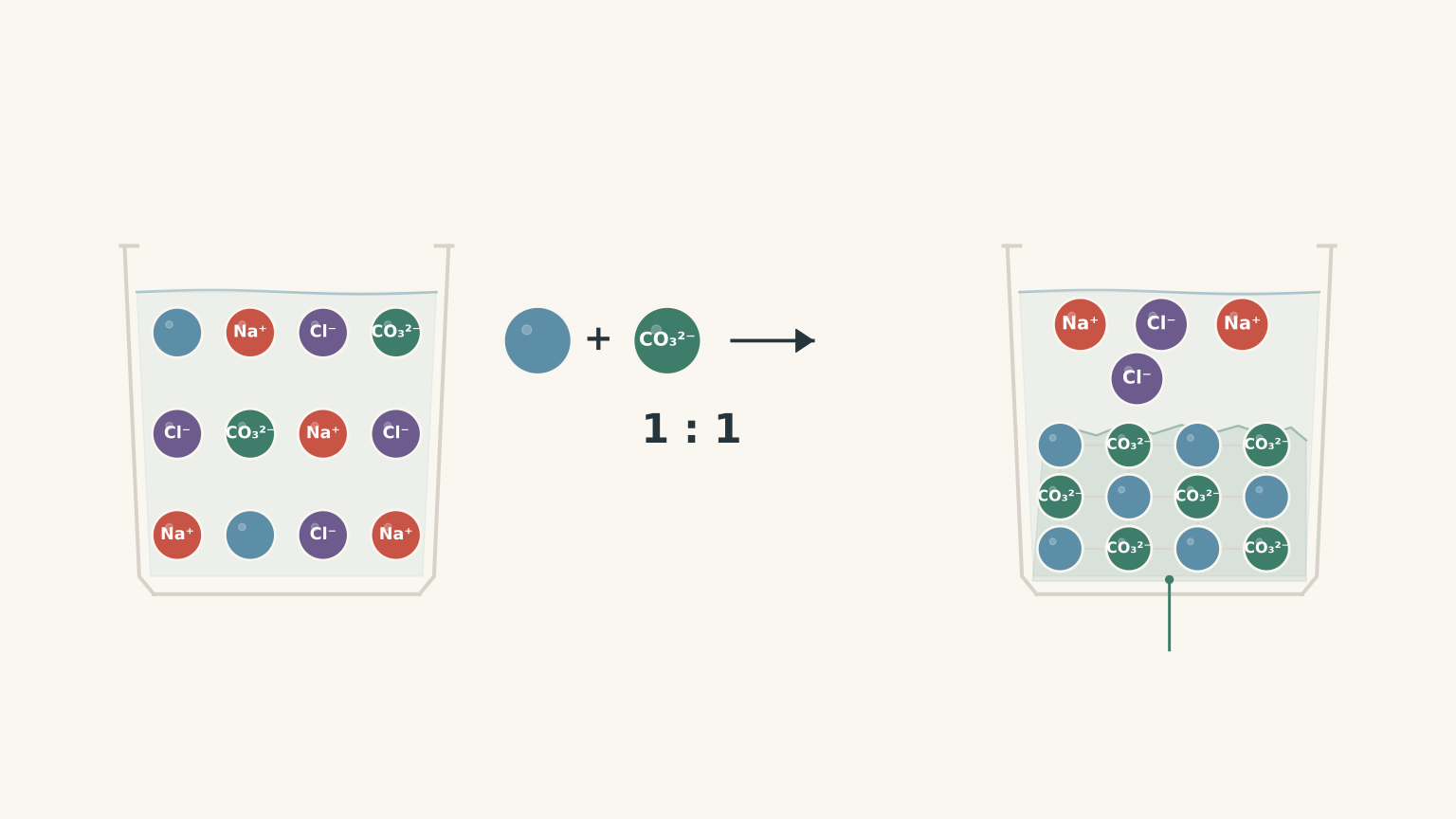
Calcium chloride and sodium carbonate dissolve in water to form ions. When the solutions mix, calcium ions react with carbonate ions to produce solid calcium carbonate.
The balanced chemical equation is:
\[ \ce{CaCl2(aq) + Na2CO3(aq) -> CaCO3(s) + 2NaCl(aq)} \]
The state symbols tell you what’s happening: \((aq)\) means dissolved in water, and \((s)\) means solid.
Notice the coefficients in the equation. One mole of calcium chloride reacts with one mole of sodium carbonate to produce one mole of calcium carbonate.
The essential reaction is:
\[ \ce{Ca^2+(aq) + CO3^2-(aq) -> CaCO3(s)} \]
Each mole of calcium ions needs one mole of carbonate ions to form one mole of calcium carbonate. Sodium and chloride ions remain dissolved in the water, so they don’t determine how much precipitate forms.
Think of it like organising a school formal where everyone needs a partner. If there are 20 people in one group and 15 in the other, you can form only 15 pairs. Having five extra people in the first group doesn’t create five more pairs.
The analogy helps with the 1:1 ratio, but real calcium carbonate forms an extended ionic solid, not a collection of separate couples.
02The method: from solution volumes to precipitate mass
There are five stages to this calculation. Keep them in order, because skipping the mole calculation is one of the easiest ways to identify the wrong limiting reagent.
Step 1: Convert both volumes to litres
Molar concentration is measured in moles per litre, so the volume must be in litres when you use the formula
\[ n=cV \]
Here:
- \(n\) is the amount of substance, in moles.
- \(c\) is the molar concentration, in mol L⁻¹.
- \(V\) is the solution volume, in litres.
To convert millilitres to litres, divide by 1000.
For example, \(35.0\ \mathrm{mL}=0.0350\ \mathrm{L}\).
Step 2: Calculate the moles of each reactant
Use \(n=cV\) separately for each solution. Don’t combine the volumes before calculating the reactant amounts.
Step 3: Apply the balanced equation
Use the coefficients in the balanced equation to determine which reactant runs out first. That reactant is the limiting reagent.
For the calcium chloride and sodium carbonate reaction, the reactant ratio is 1:1. Therefore, the reactant with fewer moles is limiting.
For reactions with unequal coefficients, compare the available moles divided by each reactant’s coefficient. The smallest value identifies the limiting reagent.
Step 4: Calculate the moles of precipitate
Use the balanced equation to convert the amount of limiting reagent into the maximum amount of calcium carbonate that can form.
Step 5: Convert the moles of precipitate into mass
Use
\[ m=nM \]
where \(m\) is mass in grams, \(n\) is the amount in moles, and \(M\) is molar mass in g mol⁻¹.
For calcium carbonate, the molar mass is
\[ \begin{aligned} M(\ce{CaCO3})&=40.08+12.01+3(16.00)\\\ &=100.09\ \mathrm{g\\,mol^{-1}} \end{aligned} \]
This is the value you’ll use to convert the moles of precipitate into grams.
Five steps to calculate precipitate mass
- Convert volume
V(L) = V(mL) ÷ 1000
35.0 → 0.0350 L; 50.0 → 0.0500 L
- Calculate moles
n = cV
CaCl₂: 0.00700 mol; Na₂CO₃: 0.00600 mol
- Find limiting reagent
CaCl₂ + Na₂CO₃ → CaCO₃ + 2NaCl
1:1 ratio; Na₂CO₃ is limiting
- Find precipitate moles
n(CaCO₃) = 0.00600 mol
Use the 1:1 mole ratio
- Calculate mass
m = nM
M = 100.09 g mol⁻¹; m = 0.601 g
03Worked example: Which solution limits the precipitate?
Mix 35.0 mL of 0.200 mol L⁻¹ \(\ce{CaCl2}\) with 50.0 mL of 0.120 mol L⁻¹ \(\ce{Na2CO3}\). Calculate the maximum mass of \(\ce{CaCO3}\) that can form.
Step 1: Convert both volumes to litres.
For calcium chloride:
\[ V= \frac{35.0}{1000} =0.0350\ \mathrm{L} \]
For sodium carbonate:
\[ V=\frac{50.0}{1000} =0.0500\ \mathrm{L} \]
Step 2: Calculate the moles of each reactant.
For calcium chloride, use \(n=cV\):
\[ \begin{aligned} n(\ce{CaCl2})&=0.200\times0.0350\\\ &=0.00700\ \mathrm{mol} \end{aligned} \]
For sodium carbonate:
\[ \begin{aligned} n(\ce{Na2CO3})&=0.120\times0.0500\\\ &=0.00600\ \mathrm{mol} \end{aligned} \]
We now know the actual amounts of both reactants. These are the numbers that determine which one runs out first.
Step 3: Identify the limiting reagent.
The balanced equation requires one mole of calcium chloride for every mole of sodium carbonate.
We have:
- \(\ce{CaCl2}\): 0.00700 mol
- \(\ce{Na2CO3}\): 0.00600 mol
Sodium carbonate is present in the smaller amount, so it is the limiting reagent.
The maximum amount of calcium carbonate is therefore 0.00600 mol. The extra calcium chloride cannot form more solid because there isn’t enough carbonate left to react with it.
Step 4: Calculate the mass of precipitate.
The balanced equation shows that one mole of sodium carbonate produces one mole of calcium carbonate. Therefore,
\[ n(\ce{CaCO3})=0.00600\ \mathrm{mol} \]
Use \(m=nM\):
\[ \begin{aligned} m&=0.00600\times100.09\\\ &=0.60054\ \mathrm{g} \end{aligned} \]
Rounded to three significant figures:
\[ \boxed{m(\ce{CaCO3})=0.601\ \mathrm{g}} \]
The maximum theoretical mass of precipitate is 0.601 g.
This assumes the reaction goes to completion, the precipitate is collected without loss, and the small solubility of calcium carbonate is negligible.
Notice the result: calcium chloride has the higher concentration, yet sodium carbonate is the limiting reagent. Comparing the concentrations alone would have led you to the wrong conclusion.
Finding the limiting reagent
| Calcium chloride — CaCl₂ | 0.00700 mol 0.00600 mol reacts 0.00100 mol remains in excess |
|---|---|
| Sodium carbonate — Na₂CO₃ | 0.00600 mol All 0.00600 mol reacts Limiting reagent; 1:1 mole ratio |
04Worked example: Calculate the precipitate and the excess ions
Mix 30.0 mL of 0.150 mol L⁻¹ \(\ce{CaCl2}\) with 45.0 mL of 0.0800 mol L⁻¹ \(\ce{Na2CO3}\).
Calculate:
- the maximum mass of \(\ce{CaCO3}\) formed;
- the concentration of excess \(\mathrm{Ca}^{2+}\) ions in the final mixture.
Assume the reaction is complete, the solution volumes are additive, and calcium carbonate’s solubility is negligible.
Step 1: Convert the volumes to litres.
\[ \begin{aligned} V(\ce{CaCl2})&=0.0300\ \mathrm{L}\\\ V(\ce{Na2CO3})&=0.0450\ \mathrm{L} \end{aligned} \]
Step 2: Calculate the moles of both reactants.
For calcium chloride:
\[ \begin{aligned} n(\ce{CaCl2})&=0.150\times0.0300\\\ &=0.00450\ \mathrm{mol} \end{aligned} \]
For sodium carbonate:
\[ \begin{aligned} n(\ce{Na2CO3})&=0.0800\times0.0450\\\ &=0.00360\ \mathrm{mol} \end{aligned} \]
Step 3: Identify the limiting reagent.
Sodium carbonate is limiting because it has fewer moles and the reactants react in a 1:1 ratio.
Therefore,
\[ n(\ce{CaCO3})=0.00360\ \mathrm{mol} \]
Step 4: Calculate the maximum mass of precipitate.
\[ \begin{aligned} m&=nM\\\ &=0.00360\times100.09\\\ &=0.360324\ \mathrm{g} \end{aligned} \]
To three significant figures,
\[ \boxed{m(\ce{CaCO3})=0.360\ \mathrm{g}} \]
Step 5: Calculate the excess calcium ions.
The reaction consumes 0.00360 mol of calcium ions, because each mole of calcium carbonate requires one mole of calcium ions.
The initial amount was 0.00450 mol, so the amount remaining is
\[ \begin{aligned} n_{\text{excess}}(\mathrm{Ca}^{2+}) &=0.00450-0.00360\\\ &=0.000900\ \mathrm{mol} \end{aligned} \]
Step 6: Calculate the final concentration of excess calcium ions.
The total solution volume is
\[ V=0.0300+0.0450=0.0750\ \mathrm{L} \]
The excess calcium ions remain dissolved. Using \(c=n/V\),
\[ \begin{aligned} [\mathrm{Ca}^{2+}]&=\frac{0.000900}{0.0750}\\\ &=0.0120\ \mathrm{mol\\,L^{-1}} \end{aligned} \]
The final answers are:
- Maximum precipitate mass: 0.360 g
- Excess calcium ion concentration: 0.0120 mol L⁻¹
After precipitation: dissolved ions and solid
| Liquid above the precipitate | Ca²⁺(aq) Excess calcium ions remain dissolved. Concentration: 0.0120 mol L⁻¹. |
|---|---|
| Solid at the bottom | CaCO₃(s) White calcium carbonate precipitate. Maximum mass: 0.360 g. |
| Limiting reagent | Na₂CO₃(aq) Sodium carbonate is fully consumed. Insufficient carbonate remains to react with excess Ca²⁺. |
05Final check: why concentration alone is not enough
Return to the first example.
| Quantity | Calcium chloride | Sodium carbonate |
|---|---|---|
| Concentration | 0.200 mol L⁻¹ | 0.120 mol L⁻¹ |
| Volume | 0.0350 L | 0.0500 L |
| Amount | 0.00700 mol | 0.00600 mol |
Calcium chloride is more concentrated, but sodium carbonate supplies fewer moles. The volume difference changes the comparison.
The rule is simple:
- Concentration tells you how many moles are present per litre.
- Volume tells you how much solution you have.
- Multiplying them gives the total moles available to react.
- The balanced equation tells you how those moles are used up.
Don’t automatically select the reactant with the lower concentration or even the lower raw mole amount if the balanced equation has unequal coefficients. Always check the stoichiometric ratio.
06Questions and solutions
Question 1
A student mixes 25.0 mL of 0.120 mol L⁻¹ \(\ce{CaCl2}\) with 30.0 mL of 0.0800 mol L⁻¹ \(\ce{Na2CO3}\).
Identify the limiting reagent and calculate the maximum mass of \(\ce{CaCO3}\) produced.
Solution 1
Sodium carbonate is the limiting reagent, and the maximum precipitate mass is 0.240 g.
First, convert the volumes to litres and calculate the moles.
\[ \begin{aligned} n(\ce{CaCl2})&=0.120\times0.0250\\\ &=0.00300\ \mathrm{mol}\\\\[4pt] n(\ce{Na2CO3})&=0.0800\times0.0300\\\ &=0.00240\ \mathrm{mol} \end{aligned} \]
The equation has a 1:1 reactant ratio, so sodium carbonate is limiting.
The maximum amount of calcium carbonate is 0.00240 mol. Converting this to mass gives
\[ \begin{aligned} m&=nM\\\ &=0.00240\times100.09\\\ &=0.240216\ \mathrm{g} \end{aligned} \]
To three significant figures, the maximum mass is 0.240 g.
The important step was calculating the moles before identifying the limiting reagent.
Question 2
Two mixtures are prepared.
- Mixture A: 20.0 mL of 0.300 mol L⁻¹ \(\ce{CaCl2}\) and 50.0 mL of 0.100 mol L⁻¹ \(\ce{Na2CO3}\).
- Mixture B: 40.0 mL of 0.150 mol L⁻¹ \(\ce{CaCl2}\) and 25.0 mL of 0.200 mol L⁻¹ \(\ce{Na2CO3}\).
Which mixture produces the greater maximum mass of calcium carbonate? A student argues that mixture B must produce more because its sodium carbonate is twice as concentrated. Evaluate this claim.
Solution 2
Neither mixture produces more precipitate. Both have a maximum theoretical mass of 0.500 g.
For mixture A:
\[ \begin{aligned} n(\ce{CaCl2})&=0.300\times0.0200\\\ &=0.00600\ \mathrm{mol}\\\ n(\ce{Na2CO3})&=0.100\times0.0500\\\ &=0.00500\ \mathrm{mol} \end{aligned} \]
Sodium carbonate is limiting, so 0.00500 mol of calcium carbonate can form.
For mixture B:
\[ \begin{aligned} n(\ce{CaCl2})&=0.150\times0.0400\\\ &=0.00600\ \mathrm{mol}\\\ n(\ce{Na2CO3})&=0.200\times0.0250\\\ &=0.00500\ \mathrm{mol} \end{aligned} \]
Again, sodium carbonate is limiting, and the maximum amount of precipitate is 0.00500 mol.
For either mixture,
\[ \begin{aligned} m&=0.00500\times100.09\\\ &=0.50045\ \mathrm{g}\\\ &\approx0.500\ \mathrm{g} \end{aligned} \]
The student’s claim fails because mixture B has twice the sodium carbonate concentration but half its volume. Both mixtures contain the same number of moles of each reactant, so both produce the same maximum mass.
Question 3
A student mixes 30.0 mL of 0.200 mol L⁻¹ \(\ce{CaCl2}\) with 20.0 mL of 0.150 mol L⁻¹ \(\ce{Na2CO3}\). After the reaction finishes, another 10.0 mL of 0.100 mol L⁻¹ \(\ce{Na2CO3}\) is added to the same vessel.
No solid is removed between additions. Calculate:
- the final maximum mass of \(\ce{CaCO3}\);
- the number of moles of excess \(\mathrm{Ca}^{2+}\) remaining.
Solution 3
The final maximum precipitate mass is 0.400 g, and 0.00200 mol of calcium ions remain in solution.
Initially, the calcium chloride supplies
\[ n(\ce{CaCl2})=0.200\times0.0300 =0.00600\ \mathrm{mol} \]
The first addition of sodium carbonate supplies
\[ n(\ce{Na2CO3})=0.150\times0.0200 =0.00300\ \mathrm{mol} \]
The initial reaction forms 0.00300 mol of calcium carbonate, leaving 0.00300 mol of calcium ions available.
The second addition supplies another
\[ n(\ce{Na2CO3})=0.100\times0.0100 =0.00100\ \mathrm{mol} \]
The total carbonate supplied is now
\[ n_{\text{total}}(\ce{Na2CO3}) =0.00300+0.00100 =0.00400\ \mathrm{mol} \]
Because the solid is not removed and calcium ions remain available, the extra carbonate forms another 0.00100 mol of precipitate. The total amount of calcium carbonate is therefore 0.00400 mol.
Its mass is
\[ \begin{aligned} m&=0.00400\times100.09\\\ &=0.40036\ \mathrm{g}\\\ &\approx0.400\ \mathrm{g} \end{aligned} \]
The calcium ions remaining are
\[ \begin{aligned} n_{\text{excess}}(\mathrm{Ca}^{2+}) &=0.00600-0.00400\\\ &=0.00200\ \mathrm{mol} \end{aligned} \]
The key is to update the total available moles after the second addition. The first reaction did not use up all the calcium ions, so the new carbonate can still form more precipitate.
Question 4
A 25.0 mL sample of 0.200 mol L⁻¹ \(\ce{CaCl2}\) is mixed with 40.0 mL of a sodium carbonate solution of unknown concentration.
After the reaction, 0.350 g of dry \(\ce{CaCO3}\) is collected. A separate test confirms that calcium ions remain in the filtrate, meaning carbonate was fully consumed.
Calculate:
- the original concentration of the sodium carbonate solution;
- the moles of calcium ions remaining in the filtrate.
Assume the collected solid represents the full precipitate and that its solubility is negligible.
Solution 4
The sodium carbonate concentration is 0.0874 mol L⁻¹, and 0.00150 mol of calcium ions remain in the filtrate.
Start by working backwards from the measured precipitate mass. Using the molar mass of calcium carbonate,
\[ \begin{aligned} n(\ce{CaCO3})&=\frac{m}{M}\\\ &=\frac{0.350}{100.09}\\\ &=0.00349685\ \mathrm{mol} \end{aligned} \]
Keep the extra digits during the calculation and round only the final answers.
The balanced equation gives a 1:1 ratio between sodium carbonate consumed and calcium carbonate formed. Since calcium ions remain in the filtrate, carbonate was the limiting reagent and was fully consumed.
Therefore, the initial sodium carbonate amount was 0.00349685 mol.
Its volume was 0.0400 L, so its concentration was
\[ \begin{aligned} c&=\frac{n}{V}\\\ &=\frac{0.00349685}{0.0400}\\\ &=0.0874\ \mathrm{mol\\,L^{-1}} \end{aligned} \]
Now calculate the initial amount of calcium chloride:
\[ \begin{aligned} n(\ce{CaCl2})&=0.200\times0.0250\\\ &=0.00500\ \mathrm{mol} \end{aligned} \]
Each mole of calcium chloride supplies one mole of calcium ions. The excess calcium ion amount is therefore
\[ \begin{aligned} n_{\text{excess}}(\mathrm{Ca}^{2+}) &=0.00500-0.00349685\\\ &=0.00150\ \mathrm{mol} \end{aligned} \]
This question reverses the usual process. Instead of using the limiting reagent to predict the precipitate mass, you use the measured mass to infer how much reactant was consumed.
Why separating the filtrates reduces precipitate yield
| Method 1: Mix, then filter | Ca²⁺(aq) + CO₃²⁻(aq) → CaCO₃(s) Combine both full solutions in one vessel. Filter after the reaction finishes. CaCO₃ collected: 0.00500 mol = 0.500 g. |
|---|---|
| Method 2: Filter separately | Vessel A + Vessel B A: filtrate retains 0.00300 mol Ca²⁺ in excess. B: filtrate retains 0.00300 mol CO₃²⁻ in excess. Discarding both filtrates limits total CaCO₃ collected to 0.00200 mol = 0.200 g. |
Question 5
A laboratory has 50.0 mL of 0.100 mol L⁻¹ \(\ce{CaCl2}\) and 50.0 mL of 0.100 mol L⁻¹ \(\ce{Na2CO3}\).
Two methods are compared.
- Method 1: Mix both entire solutions in one vessel, allow the reaction to finish, and then filter.
- Method 2: Divide the solutions between two vessels. Vessel A receives 40.0 mL of calcium chloride and 10.0 mL of sodium carbonate. Vessel B receives the remaining 10.0 mL of calcium chloride and 40.0 mL of sodium carbonate. Allow both reactions to finish, filter each vessel separately, and discard both filtrates without combining them.
Calculate the total maximum mass of calcium carbonate collected by each method. Explain why having the same total starting moles of each reactant does not guarantee the same collected mass.
Solution 5
Method 1 collects a maximum of 0.500 g, while Method 2 collects only 0.200 g. The difference arises because the excess reactants in Method 2 remain in separate filtrates that are discarded.
First, consider Method 1. The initial moles of each reactant are
\[ \begin{aligned} n(\ce{CaCl2})&=0.100\times0.0500\\\ &=0.00500\ \mathrm{mol}\\\ n(\ce{Na2CO3})&=0.100\times0.0500\\\ &=0.00500\ \mathrm{mol} \end{aligned} \]
The reactants are present in exactly the required 1:1 ratio. They can form 0.00500 mol of calcium carbonate.
\[ \begin{aligned} m&=0.00500\times100.09\\\ &=0.50045\ \mathrm{g}\\\ &\approx0.500\ \mathrm{g} \end{aligned} \]
Now consider Method 2, where the reactants are split between separate vessels.
In vessel A:
\[ \begin{aligned} n(\ce{CaCl2})&=0.100\times0.0400\\\ &=0.00400\ \mathrm{mol}\\\ n(\ce{Na2CO3})&=0.100\times0.0100\\\ &=0.00100\ \mathrm{mol} \end{aligned} \]
Sodium carbonate is limiting, so vessel A produces 0.00100 mol of calcium carbonate.
In vessel B:
\[ \begin{aligned} n(\ce{CaCl2})&=0.100\times0.0100\\\ &=0.00100\ \mathrm{mol}\\\ n(\ce{Na2CO3})&=0.100\times0.0400\\\ &=0.00400\ \mathrm{mol} \end{aligned} \]
Calcium chloride is limiting, so vessel B also produces 0.00100 mol of calcium carbonate.
The total amount collected is
\[ \begin{aligned} n_{\text{total}}(\ce{CaCO3}) &=0.00100+0.00100\\\ &=0.00200\ \mathrm{mol} \end{aligned} \]
The total mass is
\[ \begin{aligned} m&=0.00200\times100.09\\\ &=0.20018\ \mathrm{g}\\\ &\approx0.200\ \mathrm{g} \end{aligned} \]
Why doesn’t Method 2 collect the same mass? The excess calcium ions in vessel A cannot react with the excess carbonate ions in vessel B while the vessels remain separate. Filtering and discarding the liquids removes those unused reactants from the process.
The crucial constraint is what happens to the filtrates. If the two filtrates were combined and allowed to react before being discarded, the remaining 0.00300 mol of calcium ions and 0.00300 mol of carbonate ions could form another 0.00300 mol of calcium carbonate. The total yield would then return to approximately 0.500 g.
So the total starting moles do determine the maximum possible yield when all the reactants can interact. But the amount actually collected also depends on whether excess reactants are kept together long enough to react.
The maximum mass calculated in these problems is the theoretical yield. In an experiment, you can compare it with the dry mass collected to calculate percentage yield. That is the next step: distinguishing the amount a reaction could produce from the amount it actually produces.