
Dissolution Rate vs Solubility: Fix This HSC Chemistry Mistake
Learn why a solid that dissolves slowly is not necessarily insoluble. This HSC Chemistry guide explains the difference between dissolution rate and equilibrium solubility, with worked examples covering particle size, stirring, temperature, saturation, and Ksp.
You grind a sparingly soluble salt into powder, stir it, and watch it dissolve much faster. In your HSC Chemistry response, you write, “Grinding increases its solubility.” That is the mistake: you have observed a change in how quickly the solid dissolves, then used it to make a claim about how much can dissolve at equilibrium.
Before reading on, predict this: if the same salt is placed in the same solvent at the same temperature, and excess solid remains at equilibrium, will powdered crystals produce a higher equilibrium concentration than larger crystals?
No. Powdering usually helps the solution reach the same equilibrium sooner. At an early time, the powdered sample may have more dissolved solute, but that is a difference in dissolution rate, not solubility.
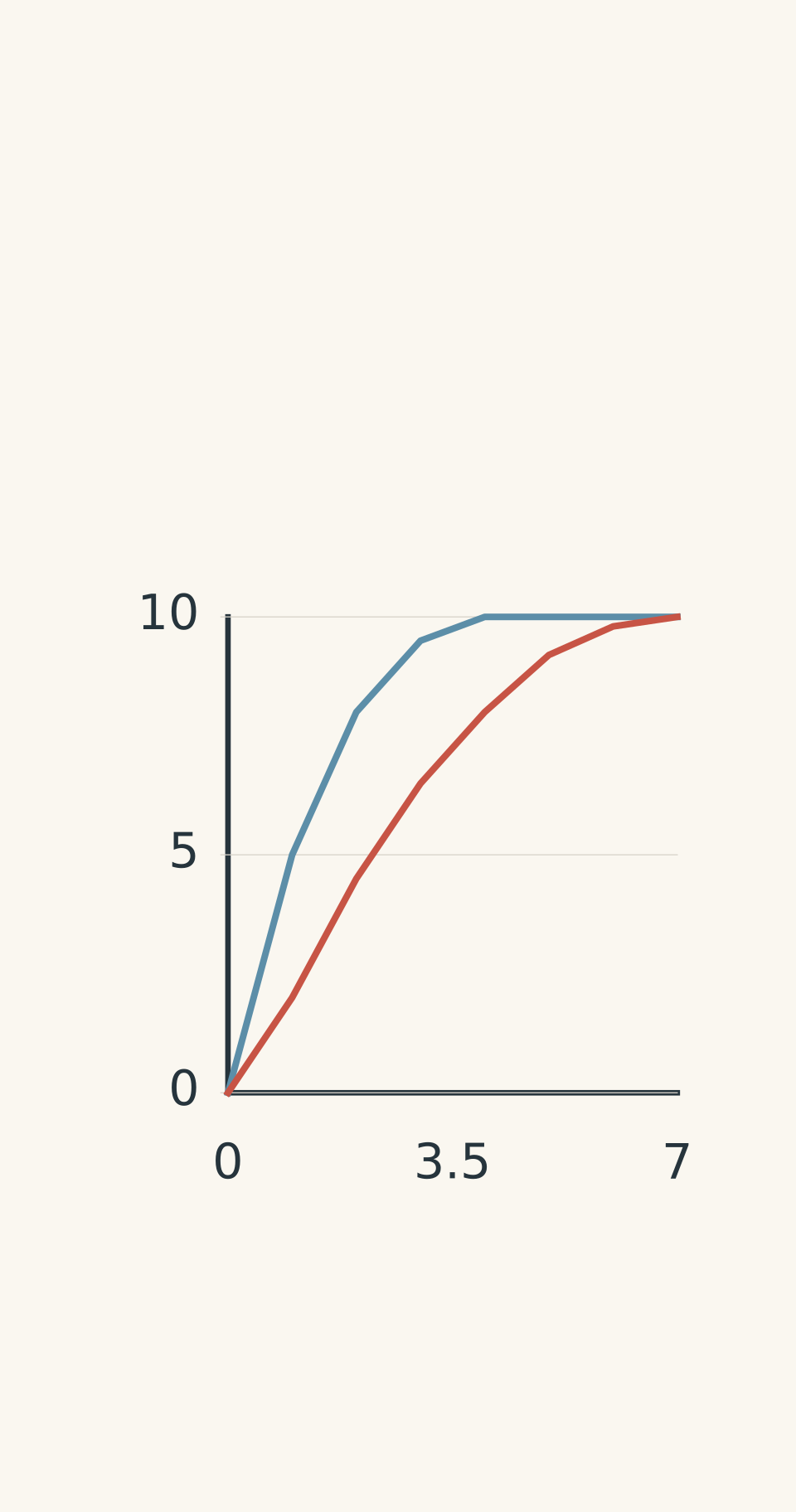
- Powder
- Coarse crystals
The key is to separate two questions: how quickly particles enter the solution, and what dissolved concentration the system reaches when equilibrium is established.
01Identify the mistake before you fix it
Dissolution rate and solubility describe different properties.
Dissolution rate tells you how quickly a solute dissolves. You might measure it by tracking how much dissolves in 10 seconds, 30 seconds, or one minute.
Solubility tells you how much solute can dissolve in a specified amount of solvent under particular conditions, such as a given temperature. For a sparingly soluble ionic solid, the equilibrium ion concentrations in a saturated solution are often the most useful quantities.
Compare the wording in an exam question:
| If the question asks about… | You should think about… |
|---|---|
| How quickly a solid dissolves | Dissolution rate |
| The amount dissolved after 20 seconds | How far dissolution has progressed by that time |
| The maximum amount that dissolves | Solubility under the specified conditions |
| A saturated solution at equilibrium | The equilibrium concentrations |
| The effect of grinding or stirring | Usually the rate of reaching equilibrium |
| The effect of temperature or a common ion | Potential changes to both the rate and the equilibrium state |
The distinction matters because a solution can contain more dissolved solute at one moment simply because dissolution has progressed further. That does not establish that its final equilibrium concentration will be higher.
02Why crushing and stirring make a solid dissolve faster
Imagine two samples containing the same mass of an ionic solid. One consists of a few large crystals. The other consists of many small fragments.
Solvent particles interact with the exposed surfaces of the solid. These interactions allow particles to leave the solid and enter the solution. Particles buried inside a large crystal are not directly exposed to the solvent.
Crushing the solid exposes more surface area. More surface particles can interact with the solvent at once, so the solid can dissolve more quickly.
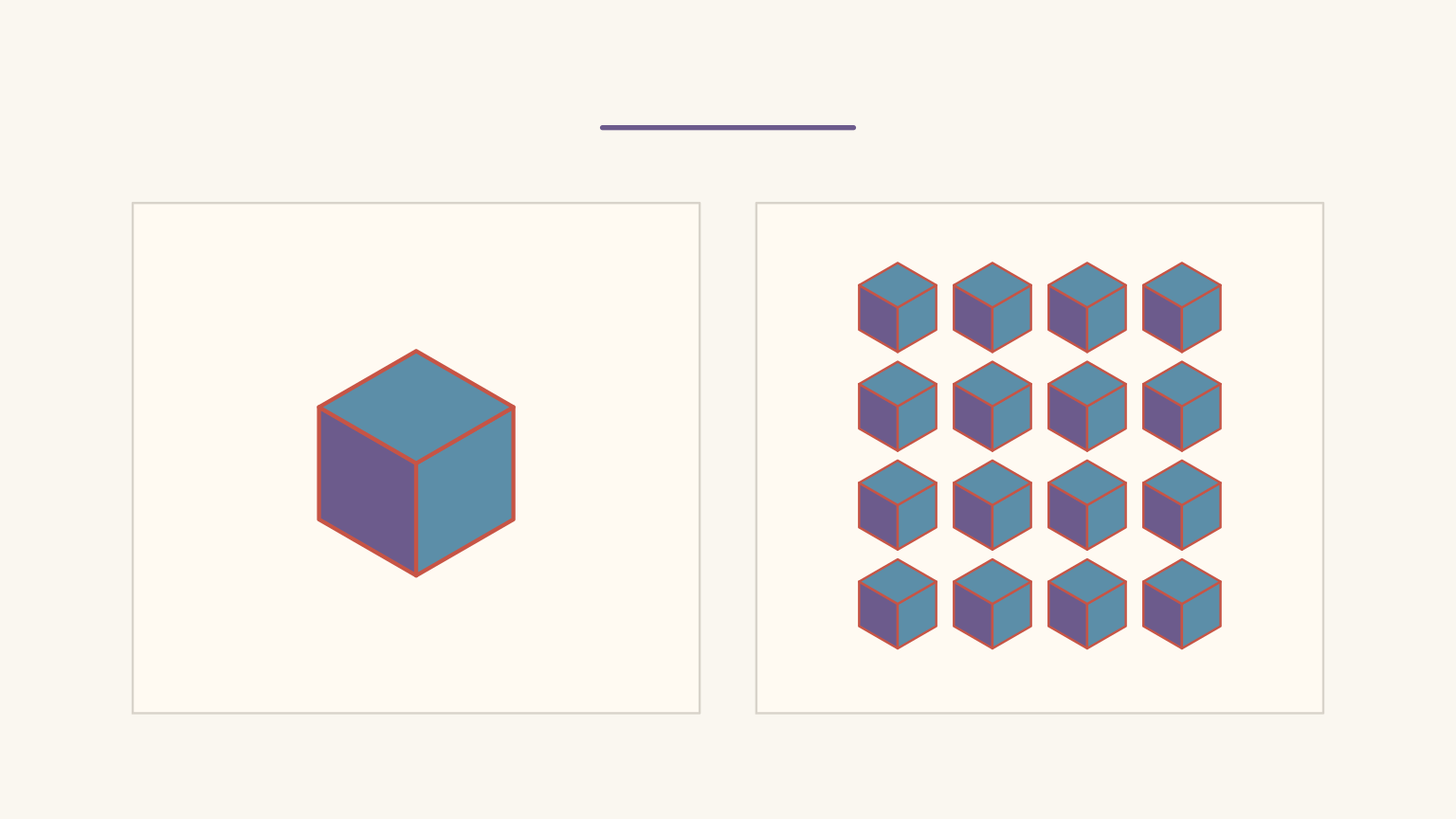
Stirring helps for a different reason. It brings fresh solvent into contact with the solid and carries dissolved particles away from its surface. This reduces the local buildup of dissolved material and helps the solution approach equilibrium more quickly.
Neither change alters the equilibrium solubility of an ordinary crystalline solid at a fixed temperature and with the same solution composition.
Worked example: Does powder have higher solubility?
Two beakers contain equal volumes of water at 25°C and excess amounts of the same sparingly soluble salt. One contains large crystals, while the other contains the same mass of powdered crystals. Both are stirred at the same rate.
After 30 seconds, the powdered sample has less visible solid remaining. After 10 minutes, both beakers reach the same equilibrium ion concentrations and still contain undissolved solid.
A student concludes that the powdered salt is more soluble. Diagnose the error and rewrite the conclusion.
Step 1
After 30 seconds, more solid has dissolved in the powdered sample. This shows that dissolution has progressed further in the same amount of time, so the powdered sample has dissolved faster over that interval.
Step 2
The powdered sample has a greater total exposed surface area. More surface particles can interact with the solvent at once, increasing the rate of dissolution.
Step 3
After 10 minutes, both solutions have the same equilibrium ion concentrations. Both also contain excess undissolved solid, confirming that each solution is saturated.
The temperature and solution composition are the same, so the equilibrium solubility is the same.
Step 4
The powdered salt dissolves faster because it has a greater exposed surface area. It does not have a higher equilibrium solubility.
The tempting error was to treat “more dissolved after 30 seconds” as equivalent to “more can dissolve at equilibrium”. The first is a statement about progress; the second is a statement about the equilibrium state.
03What saturation actually means
A saturated solution is not a solution in which particles have stopped dissolving. It is a solution in which the dissolved solute is at its equilibrium concentration under the specified conditions.
For a saturated solution in contact with excess solid, two processes continue:
- Dissolution: particles leave the solid and enter the solution.
- Recrystallisation: dissolved particles return to the solid.
At dynamic equilibrium, these processes occur at equal rates. The dissolved concentration remains constant because there is no net change.
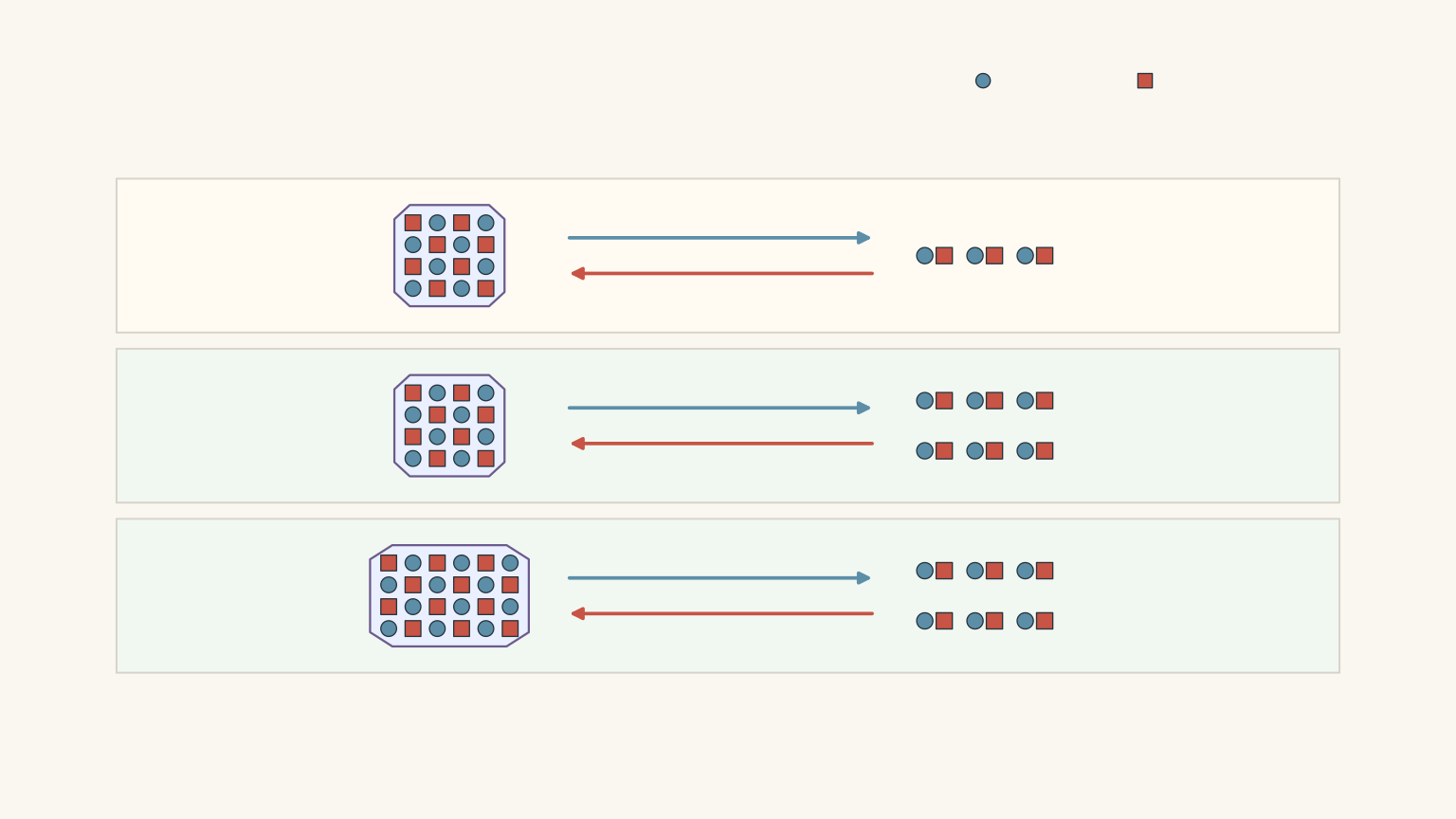
This gives you a useful test for exam questions.
If a saturated solution already contains excess solid, adding more of the same solid does not increase the equilibrium concentration of dissolved ions at the same temperature. It simply increases the amount of undissolved solid available.
However, if the solution is unsaturated, adding more solute can allow more to dissolve. If all the solid disappears, that still does not prove the solution is saturated. You may simply have added less solute than the solvent could dissolve.
Always check whether the question states that the solution is saturated, that excess solid remains, or that equilibrium has been reached.
04Which changes affect rate, and which affect solubility?
This is the comparison to remember.
| Change | Effect on dissolution rate | Effect on equilibrium solubility |
|---|---|---|
| Crushing a solid | Usually increases the rate by exposing more surface area | No change at fixed temperature and solution composition |
| Stirring | Usually speeds up the approach to equilibrium | No change to the final equilibrium concentration |
| Adding more of the same solid | May change the rate by changing the available surface area | Does not change the saturation concentration |
| Adding pure water while excess solid remains | Initially makes net dissolution favourable | At the same temperature, saturation concentrations return to their original values, but more total solute can dissolve |
| Changing temperature | Usually changes the rates of microscopic processes | Can increase or decrease solubility |
| Adding a common ion | Can trigger precipitation or change the direction of net dissolution | Usually decreases the solubility of a sparingly soluble ionic salt |
The last three rows need a little more care. They involve changes to the conditions that determine the equilibrium state, not merely changes to the speed of reaching it.
05Temperature can affect both rate and solubility
Temperature is a particularly tempting source of mistakes because students often learn that solids dissolve faster in warmer water.
That is usually a reasonable prediction about rate. At a higher temperature, particles generally move faster, and the rates of microscopic processes often increase.
But the equilibrium solubility of a solid can increase or decrease with temperature.
The direction depends on the energetics of the dissolution process. For the usual HSC equilibrium model:
- If dissolution is endothermic, heating generally favours dissolution and increases equilibrium solubility.
- If dissolution is exothermic, heating generally favours the reverse process and decreases equilibrium solubility.
This follows from Le Chatelier’s principle. You cannot assume that every salt becomes more soluble when warmed.
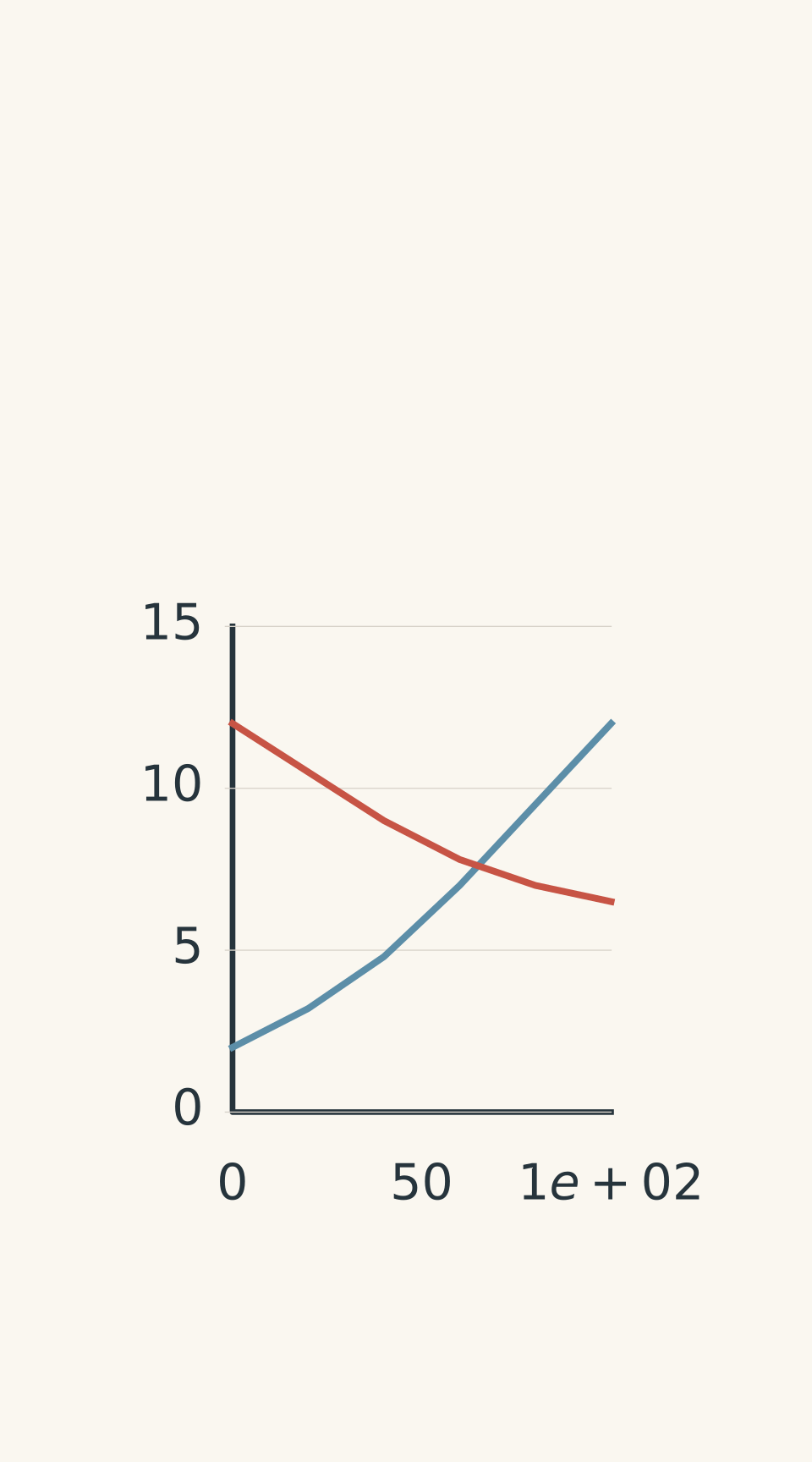
- Hypothetical solid A — increasing
- Hypothetical solid B — decreasing
Here is the important edge case.
Suppose a saturated solution is prepared at 20°C. The salt becomes less soluble when warmed to 40°C. When the solution is heated, its existing dissolved-ion concentrations are now too high for the new equilibrium.
The system favours precipitation until it reaches the new equilibrium state.
The temperature may increase the rates of microscopic dissolution and recrystallisation, yet the net process is precipitation. The direction of the net change is determined by the equilibrium conditions, not by the claim that warm water makes solids dissolve faster.
This is why you must not use a general rule about temperature and rate to predict the final amount dissolved.
06Where \(K_{sp}\) fits into the distinction
For a sparingly soluble ionic solid, the solubility product constant, \(K_{sp}\), describes the equilibrium between the solid and its dissolved ions.
Consider silver chloride:
\[ \ce{AgCl(s) <=> Ag+(aq) + Cl^-(aq)} \]
Its solubility product expression is
\[ K_{sp}=[\mathrm{Ag}^{+}][\mathrm{Cl}^{-}] \]
The square brackets represent equilibrium molar concentrations, measured in mol L\(^{-1}\). The pure solid is omitted from the expression.
At a given temperature, \(K_{sp}\) is constant for this equilibrium under the usual HSC treatment. Grinding the solid or stirring the solution does not change \(K_{sp}\).
That gives you a firm rule:
\(K_{sp}\) describes an equilibrium condition, not how quickly equilibrium is reached.
A salt with a particular \(K_{sp}\) does not necessarily dissolve faster than a salt with a different \(K_{sp}\). Rate depends on kinetic factors such as surface area and mixing, while equilibrium depends on the relevant thermodynamic conditions.
Use the ion product to predict the direction of change
The ion product, \(Q_{sp}\), is calculated using the current ion concentrations in the same way as the \(K_{sp}\) expression.
Compare the two values:
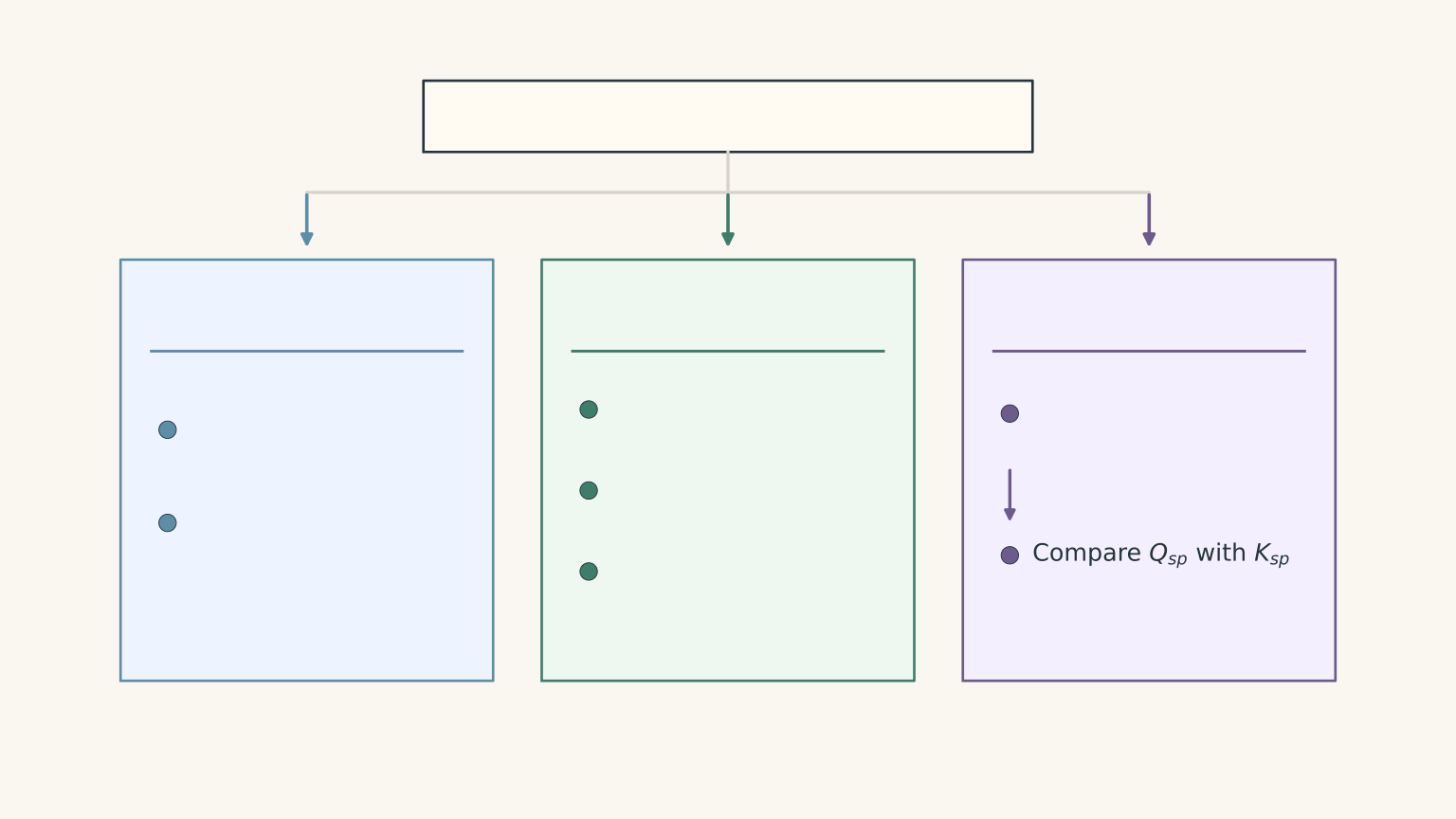
- If \(Q_{sp}<K_{sp}\), net dissolution is favoured if solid is available.
- If \(Q_{sp}=K_{sp}\), the solution is at equilibrium.
- If \(Q_{sp}>K_{sp}\), precipitation is favoured.
For example, adding a soluble chloride salt to a saturated silver chloride solution increases the chloride-ion concentration. Immediately after the addition, \(Q_{sp}\) becomes greater than \(K_{sp}\), assuming the volume change is negligible.
Silver chloride then precipitates until equilibrium is restored. The value of \(K_{sp}\) has not increased; the ion concentrations have changed, so the system moves to a new equilibrium state.
Also, do not compare the numerical \(K_{sp}\) values of different salts as if they were direct measures of molar solubility. The stoichiometry of each dissolution equation determines the relationship between \(K_{sp}\) and solubility.
Worked example: What does a larger \(K_{sp}\) change?
At 25°C, silver chloride has \(K_{sp}=1.8\times10^{-10}\). A saturated solution is prepared in pure water with excess solid present.
(a) Calculate the equilibrium concentrations of \(\mathrm{Ag}^{+}\) and \(\mathrm{Cl}^{-}\).
(b) A student stirs the solution and adds more silver chloride at the same temperature. What happens to the equilibrium concentrations?
(c) The mixture is then warmed to a temperature where \(K_{sp}=7.2\times10^{-10}\). Calculate the new equilibrium concentrations and explain what has changed.
Assume ideal dilute behaviour, a fixed solution volume, and no other dissolved ions.
Step 1
\[ \ce{AgCl(s) <=> Ag+(aq) + Cl^-(aq)} \]
One mole of silver chloride produces one mole of each ion. In pure water, let \(s\) be the molar solubility of silver chloride.
Therefore,
\[ [\mathrm{Ag}^{+}]=[\mathrm{Cl}^{-}]=s \]
Step 2
\[ \begin{aligned} K_{sp}&=[\mathrm{Ag}^{+}][\mathrm{Cl}^{-}]\\ &=s^2 \end{aligned} \]
Hence,
\[ \begin{aligned} s&=\sqrt{K_{sp}}\\ &=\sqrt{1.8\times10^{-10}}\\ &=1.34\times10^{-5}\ \text{mol L}^{-1} \end{aligned} \]
The equilibrium concentrations are therefore
\[ [\mathrm{Ag}^{+}]=[\mathrm{Cl}^{-}] =1.34\times10^{-5}\ \text{mol L}^{-1} \]
Step 3
Neither change alters the equilibrium \(K_{sp}\). Since the solution is already saturated and excess solid is present, the equilibrium ion concentrations remain unchanged.
Stirring may speed up the approach to equilibrium after a disturbance. Adding more solid increases the amount of solid present, not the saturation concentration.
Step 4
The new \(K_{sp}\) is four times the original value. Since this is a 1:1 salt in pure water, \(K_{sp}=s^2\).
\[ \begin{aligned} s&=\sqrt{7.2\times10^{-10}}\\ &=2.68\times10^{-5}\ \text{mol L}^{-1} \end{aligned} \]
Thus,
\[ [\mathrm{Ag}^{+}]=[\mathrm{Cl}^{-}] =2.68\times10^{-5}\ \text{mol L}^{-1} \]
The equilibrium concentrations have doubled. For the same solution volume, the amount of silver chloride dissolved at equilibrium also doubles.
Step 5
Stirring and adding more solid at 25°C do not change the equilibrium concentrations. Warming changes the equilibrium because the specified \(K_{sp}\) is larger at the new temperature.
The new \(K_{sp}\) tells you the new equilibrium condition. It does not tell you exactly how many seconds the system needs to reach it.
07A reliable method for HSC exam questions
When a question mixes dissolution rate, solubility, and equilibrium, use this sequence before writing your answer.
Identify what is being asked. Is it asking how fast something dissolves, how much has dissolved at a particular time, or the final equilibrium concentration?
Check the conditions. Look for temperature, solvent, common ions, saturation, excess solid, and whether equilibrium has been reached.
Classify the change. Particle size and stirring usually affect the rate. Temperature and solution composition can affect the equilibrium state. Adding solvent can change the total amount dissolved even when the saturation concentration stays the same.
Check whether the solution is saturated. If excess solid remains at equilibrium, the dissolved concentrations are constrained by the equilibrium conditions. If all the solid has disappeared, do not automatically assume saturation.
If \(K_{sp}\) appears, write the dissolution equation. Use its stoichiometry to construct the expression. If conditions change, compare the current \(Q_{sp}\) with the \(K_{sp}\) at the relevant temperature.
Write the conclusion using the correct language. Say “dissolves faster” when you mean rate. Say “has a higher equilibrium solubility” only when the equilibrium conditions support that claim.
08Questions and solutions
Question 1
A sample of a sparingly soluble ionic solid is ground into powder and stirred. It reaches saturation in 45 seconds instead of 3 minutes as coarse pieces.
At the same temperature and with excess solid present, has its solubility changed? Explain.
Solution 1
The equilibrium solubility has not changed; the powder reaches saturation faster.
Grinding increases the exposed surface area, allowing more particles to enter the solution per unit time. Stirring improves mixing and helps the system approach equilibrium.
Because the solid, solvent, temperature, and final solution composition are unchanged, the equilibrium solubility is unchanged. The shorter time is evidence of a higher dissolution rate, not a higher solubility.
Question 2
A saturated solution of \(\ce{CaF2}\) at a fixed temperature contains excess solid. Pure water is added, and the system is left until equilibrium is restored. Assume that excess \(\ce{CaF2}\) remains throughout.
Explain:
(a) Why the added water initially favours further dissolution.
(b) How the final equilibrium concentrations of \(\mathrm{Ca}^{2+}\) and \(\mathrm{F}^{-}\) compare with their original concentrations.
(c) How the total amount of dissolved \(\ce{CaF2}\) compares with the original amount.
Solution 2
The final equilibrium ion concentrations return to their original values, but the total amount of dissolved \(\ce{CaF2}\) increases.
(a) Adding water initially dilutes the dissolved ions. The ion product,
\[ Q_{sp}=[\mathrm{Ca}^{2+}][\mathrm{F}^{-}]^2 \]
falls below \(K_{sp}\). Since solid is available, net dissolution is favoured.
(b) After equilibrium is restored, the solution is saturated at the same temperature and has the same composition apart from its increased volume. The equilibrium ion concentrations return to their original saturation values.
(c) More \(\ce{CaF2}\) must dissolve to establish those concentrations throughout the larger volume. Therefore, the total number of moles of dissolved \(\ce{CaF2}\) increases, even though the equilibrium concentrations return to their original values.
This is an important distinction: concentration and total amount are not interchangeable. A larger volume can contain more dissolved solute at the same concentration.
Question 3
A saturated solution of \(\ce{AgCl}\) at 25°C contains excess solid. A small amount of concentrated \(\ce{NaCl}\) solution is added, and the volume change is negligible.
Assume enough \(\ce{NaCl}\) is added that the final chloride-ion concentration remains above its original value.
Explain what happens immediately after the addition and after equilibrium is restored. Discuss \(Q_{sp}\), \(K_{sp}\), the concentrations of \(\mathrm{Ag}^{+}\) and \(\mathrm{Cl}^{-}\), and the direction of the net reaction.
Solution 3
Silver chloride precipitates, the equilibrium \(\mathrm{Ag}^{+}\) concentration decreases, the final \(\mathrm{Cl}^{-}\) concentration is higher than originally, and \(K_{sp}\) remains unchanged.
Immediately after the addition, the chloride-ion concentration increases while the silver-ion concentration has not yet had time to respond. Consequently,
\[ Q_{sp}=[\mathrm{Ag}^{+}][\mathrm{Cl}^{-}]>K_{sp} \]
Precipitation is therefore favoured.
As \(\ce{AgCl}\) forms, dissolved \(\mathrm{Ag}^{+}\) and \(\mathrm{Cl}^{-}\) are removed from the solution. The silver-ion concentration falls until the ion product returns to \(K_{sp}\).
The added chloride remains in the solution, so the final chloride-ion concentration is higher than it was initially. The equilibrium constant itself has not changed because the temperature has not changed.
The trap is to claim that adding a common ion increases \(K_{sp}\). It changes the ion concentrations and shifts the equilibrium; it does not change \(K_{sp}\) at a fixed temperature.
Question 4
A hypothetical salt has a lower equilibrium solubility at 40°C than at 20°C.
A saturated solution prepared at 20°C, with excess solid present, is warmed to 40°C. A student argues that more solid must dissolve because warmer conditions usually increase dissolution rate.
Explain the net change after warming. Distinguish the rates of microscopic processes from the direction of the net reaction.
Solution 4
Net precipitation occurs after warming, even though the higher temperature may increase the rates of microscopic processes.
The solution initially has the ion concentrations required for saturation at 20°C. At 40°C, the salt has a lower equilibrium solubility, so those existing concentrations exceed the new saturation condition.
The ion product is therefore greater than the new \(K_{sp}\), and precipitation is favoured until the system reaches its new equilibrium.
The student’s argument confuses rate with equilibrium. Warming often speeds up microscopic processes, but it does not guarantee that the net reaction will be dissolution. The solubility data determine the direction of the equilibrium change; they do not, by themselves, give the separate forward and reverse reaction rates.
Question 5
A sparingly soluble salt follows the equilibrium
\[ \ce{MX2(s) <=> M^2+(aq) + 2X^-(aq)} \]
At temperature \(T_1\), a solution is saturated and excess \(\ce{MX2}\) is present.
The following changes are made in order, allowing the system to reach equilibrium after each one:
- Stage A: Pure water is added, and excess solid remains.
- Stage B: Concentrated \(\ce{NaX}\) is added. The volume change is negligible, and enough \(\ce{NaX}\) is added that the final \(\mathrm{X}^{-}\) concentration remains higher than its original value.
- Stage C: The mixture is warmed to \(T_2\), where \(K_{sp}\) for \(\ce{MX2}\) is lower than at \(T_1\).
Assume no other reactions occur and some solid remains throughout.
For each stage, explain:
(a) The direction of the net change in the amount of solid.
(b) How the equilibrium concentration of \(\mathrm{M}^{2+}\) changes relative to the preceding stage.
(c) How the total number of moles of dissolved \(\ce{MX2}\) changes relative to the preceding stage.
Finally, can you determine whether the final number of moles of dissolved \(\ce{MX2}\) is greater or less than it was initially? Can \(K_{sp}\) alone tell you whether the solid dissolves faster overall after the sequence?
Solution 5
Stage A increases the total amount of dissolved \(\ce{MX2}\) while restoring the original saturation concentrations. Stages B and C each favour precipitation and reduce the amount of dissolved \(\ce{MX2}\). However, the final amount dissolved relative to the initial amount is indeterminate from the information given, and \(K_{sp}\) alone cannot determine the overall dissolution rate.
Stage A: Adding water
Immediately after dilution, the ion concentrations fall. The ion product becomes smaller than \(K_{sp}\), so net dissolution occurs.
At the same temperature, with excess solid still present, the system returns to its original saturation concentrations. In particular, the equilibrium concentration of \(\mathrm{M}^{2+}\) returns to its original value.
However, the volume is now larger. More moles of \(\ce{MX2}\) must be dissolved to establish the same concentration throughout the solution. The amount of dissolved \(\ce{MX2}\) therefore increases.
Stage B: Adding the common ion
Adding \(\ce{NaX}\) increases the \(\mathrm{X}^{-}\) concentration. Immediately after addition,
\[ Q_{sp}=[\mathrm{M}^{2+}][\mathrm{X}^{-}]^2>K_{sp} \]
Precipitation is favoured.
As \(\ce{MX2}\) forms, dissolved \(\mathrm{M}^{2+}\) is removed. Its equilibrium concentration decreases relative to Stage A, and the total number of moles of dissolved \(\ce{MX2}\) also decreases.
The common ion changes the equilibrium concentrations required for saturation, even though \(K_{sp}\) remains unchanged at \(T_1\).
Stage C: Warming to a lower \(K_{sp}\)
Before warming, the solution is at equilibrium with \(Q_{sp}=K_{sp}(T_1)\). After warming, the new equilibrium constant is lower.
The old ion concentrations therefore give an ion product greater than the new \(K_{sp}\). Net precipitation occurs again.
The equilibrium concentration of \(\mathrm{M}^{2+}\) decreases relative to Stage B, and the total amount of dissolved \(\ce{MX2}\) decreases relative to Stage B.
Notice the important interaction: temperature can increase microscopic reaction rates while the lower equilibrium solubility favours precipitation.
Can the final dissolved amount be compared with the initial amount?
No. The final amount is not determined by the information supplied.
Adding water in Stage A increases the total amount dissolved. Adding a common ion in Stage B and lowering \(K_{sp}\) in Stage C both reduce that amount. Without knowing the volume of water added and the extent of the subsequent precipitation, you cannot tell which effect dominates when comparing the final amount with the initial amount.
This is the key constraint: the direction of change at each stage is predictable, but the overall change in total dissolved moles depends on the magnitudes of the competing effects.
Can \(K_{sp}\) determine the overall rate?
No. \(K_{sp}\) constrains equilibrium, not the time taken to reach it. Temperature can affect microscopic rates, and surface area and mixing also affect the approach to equilibrium. The sequence even changes the direction of the net process: dissolution in Stage A, followed by precipitation in Stages B and C.
You cannot use the equilibrium constants alone to rank the overall rates.
09Before you submit: a quick self-check
Run through these five checks before handing in a response:
- Have I separated the rate of dissolution from equilibrium solubility?
- Have I identified the temperature, solvent composition, and presence of excess solid?
- Have I distinguished equilibrium concentration from the total number of moles dissolved?
- If \(K_{sp}\) is involved, have I written the correct expression and compared \(Q_{sp}\) with \(K_{sp}\) at the relevant temperature?
- Have I explained why the tempting alternative is wrong, rather than simply stating the correct answer?
The next useful decision is to predict whether a change in concentration or temperature favours dissolution or precipitation. Practise writing the dissolution equation, identifying the relevant equilibrium constant, and comparing \(Q_{sp}\) with \(K_{sp}\). For the wider equilibrium framework, see tutorgum’s HSC Chemistry Module 5 Equilibrium: Complete Topic Summary.