
Starting Year 11 Chemistry: A Four-Week Summer Plan
Get ready for NSW Year 11 Chemistry with a practical four-week summer preparation plan. Build confidence with particle models, chemical equations, mole calculations, and laboratory reasoning before your first lessons.
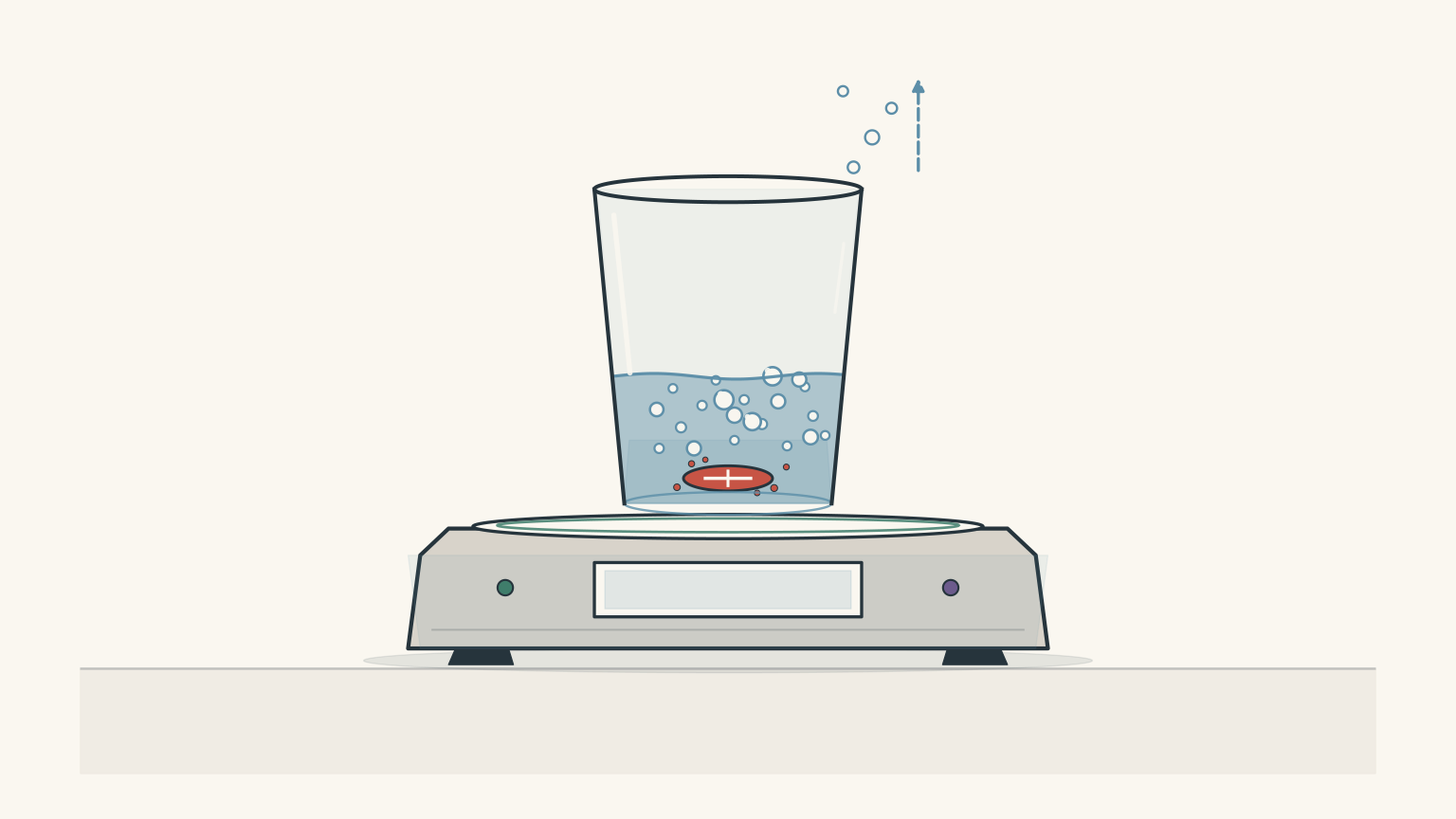
Put an effervescent tablet into a glass of water. Before it fizzes, predict what a balance will read before and after the reaction.
If matter is conserved, shouldn’t the mass stay the same? It should, provided the balance still includes every product. In an open glass, carbon dioxide escapes into the air, so the glass and its contents lose mass even though the atoms haven’t disappeared.
This small puzzle brings together four skills that will make Year 11 Chemistry much easier: understanding particles, writing chemical equations, calculating quantities, and reasoning from experimental evidence.
You don’t need to teach yourself the entire Year 11 course over summer. A focused four-week preparation plan is enough to refresh the foundations and make the first few topics feel familiar.
Due to technical limitations, this figure may display incorrectly or contain inaccuracies. Please check key details against your course materials.
01First, which Chemistry syllabus will you study?
If you’re starting Year 11 in 2027, you’ll study the NSW Chemistry Stage 6 Syllabus (2017).
This matters because NESA has released a new Chemistry 11-12 Syllabus (2025), but it doesn’t begin teaching Year 11 until 2028. Its first HSC examination will be in 2029.
The 2017 syllabus, which applies to the 2027 Year 11 cohort, organises the Year 11 course into four modules:
| Module | Topic |
|---|---|
| 1 | Properties and Structure of Matter |
| 2 | Introduction to Quantitative Chemistry |
| 3 | Reactive Chemistry |
| 4 | Drivers of Reactions |
You can read the official NESA Chemistry Stage 6 syllabus for the complete course requirements.
This summer plan prepares you for the foundations that connect these modules. It doesn’t attempt to teach all four before school starts.
NESA lists no formal prerequisites for Chemistry. However, you’ll use knowledge from Year 10 Science and basic mathematics throughout the course.
02Your four-week preparation plan
Aim for three study sessions per week, with each session lasting approximately 45 minutes. That’s around nine hours of preparation across the entire summer plan.
Use a consistent structure:
- First 5 minutes: Recall what you studied in the previous session without looking at your notes.
- Next 25 minutes: Learn or revise one specific concept.
- Next 10 minutes: Complete practice questions.
- Final 5 minutes: Correct mistakes and write down anything you still find confusing.
Here’s the sequence.
| Week | Main focus | What you should be able to do |
|---|---|---|
| 1 | Particle models and atomic structure | Explain what substances contain and how atoms differ |
| 2 | Chemical formulae and equations | Read formulae and balance simple reactions |
| 3 | Chemical quantities | Calculate molar masses and convert between mass and moles |
| 4 | Experimental and laboratory reasoning | Identify variables, interpret results, and evaluate investigations |
Let’s work through each week.
03Week 1: Understand what matter is made of
Before you can understand a chemical reaction, you need a clear picture of what is actually reacting.
Imagine looking at a glass of water. You see a clear liquid, but you can’t see the individual particles that make it up.
Chemistry asks you to explain the properties and behaviour of substances by thinking about their particles.
Session 1: Elements, compounds, and mixtures
Start with three distinctions.
Elements
An element contains only one type of atom.
Examples include:
- Oxygen (\(\ce{O2}\))
- Hydrogen (\(\ce{H2}\))
- Iron (\(\ce{Fe}\))
- Copper (\(\ce{Cu}\))
Notice that oxygen gas contains two atoms joined together. It is still an element because both atoms are oxygen.
Compounds
A compound contains two or more different elements chemically bonded together in a fixed ratio.
Examples include:
- Water (\(\ce{H2O}\))
- Carbon dioxide (\(\ce{CO2}\))
- Sodium chloride (\(\ce{NaCl}\))
Water always contains hydrogen and oxygen in a 2:1 ratio of atoms.
Mixtures
A mixture contains two or more substances together without all their particles being chemically bonded to one another.
Examples include:
- Air
- Salt water
- Soil
The proportions of substances in a mixture can vary.
Due to technical limitations, this figure may display incorrectly or contain inaccuracies. Please check key details against your course materials.
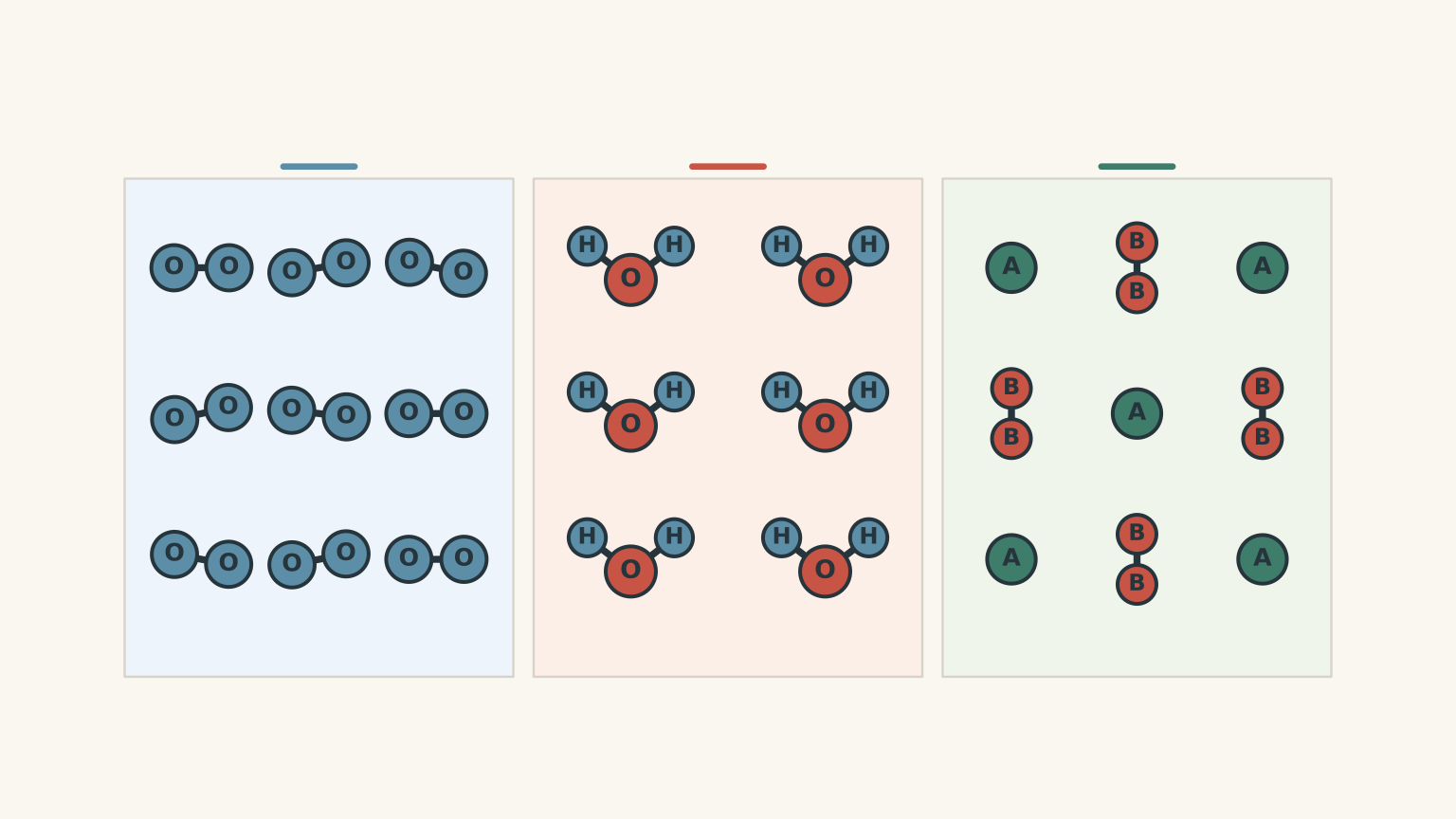
The distinction is easier to remember when you look at the particles rather than the appearance of the material.
A clear liquid could be a pure compound or a mixture. You cannot reliably classify a substance just by looking at it.
Session 2: Atomic structure, isotopes, and ions
An atom contains three main subatomic particles.
| Particle | Charge | Location |
|---|---|---|
| Proton | Positive (+1) | Nucleus |
| Neutron | Neutral (0) | Nucleus |
| Electron | Negative (−1) | Outside the nucleus |
The nucleus contains almost all the mass of an atom. Electrons occupy the surrounding region.
Two numbers are particularly important.
Atomic number is the number of protons in an atom. It determines which element the atom is.
Mass number is the total number of protons and neutrons in a particular atom.
For example, consider sodium-23.
- Protons: 11
- Neutrons: 12
- Electrons: 11 (for a neutral atom)
Its atomic number is 11, and its mass number is 23.
Now consider two related ideas.
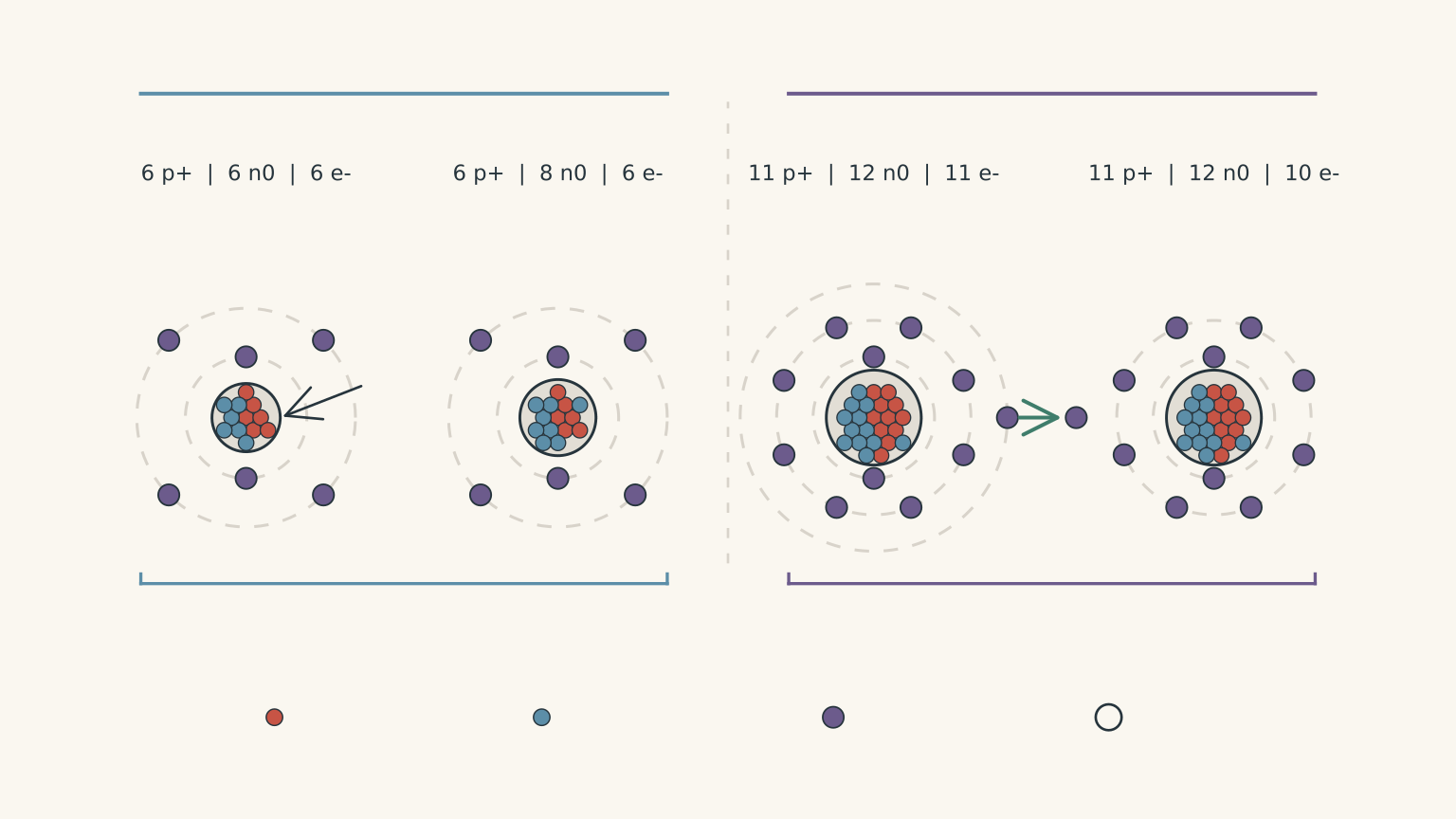
Isotopes are atoms of the same element with different numbers of neutrons.
Carbon-12 and carbon-14 both have six protons, but carbon-12 has six neutrons while carbon-14 has eight.
Ions are atoms or groups of atoms with an electrical charge because they have gained or lost electrons.
A sodium atom becomes a sodium ion, \(\mathrm{Na}^{+}\), when it loses one electron.
It still has 11 protons, but now has 10 electrons.
Due to technical limitations, this figure may display incorrectly or contain inaccuracies. Please check key details against your course materials.
The important distinction is:
- Isotopes differ in neutron number.
- Ions differ in electron number.
Don’t mix these up. They describe different changes to an atom.
Session 3: Become comfortable with the periodic table
You don’t need to memorise the entire periodic table before Year 11.
You do need to know how to read it.
Practise finding:
- The chemical symbol of an element.
- Its atomic number.
- Its relative atomic mass.
- Its position in a group and period.
One detail catches students out regularly.
The relative atomic mass displayed on the periodic table is often a decimal. It is not necessarily the mass number of an individual atom.
That’s because it accounts for the naturally occurring isotopes of the element.
For now, concentrate on using the periodic table as a source of information rather than treating it as a giant memorisation exercise.
End-of-week checkpoint
Without looking at your notes, explain:
- Why is \(\ce{O2}\) an element rather than a compound?
- What is the difference between an isotope and an ion?
- How many neutrons are in an atom of sodium-23?
- Why does a neutral atom have equal numbers of protons and electrons?
If you can explain these ideas in your own words, move on.
04Week 2: Learn to write and balance chemical equations
You now know that substances contain atoms arranged in particular ways.
The next step is understanding what happens when those atoms rearrange during a chemical reaction.
Consider hydrogen reacting with oxygen to form water.
You start with hydrogen and oxygen molecules. Their chemical bonds change, and new water molecules form.
The atoms haven’t vanished. They’ve been rearranged.
Session 1: Read chemical formulae
A chemical formula tells you which elements are present and how many atoms of each element are represented.
Consider water:
\[ \ce{H2O} \]
The small 2 means that each water molecule contains two hydrogen atoms. Oxygen has no subscript, which means there is one oxygen atom.
Now consider:
\[ \ce{2H2O} \]
The large 2 in front is called a coefficient.
It means there are two water molecules, giving:
- Four hydrogen atoms.
- Two oxygen atoms.
This distinction is essential.
| Notation | Meaning |
|---|---|
| \(\ce{H2O}\) | One water molecule |
| \(\ce{2H2O}\) | Two water molecules |
| \(\ce{CO2}\) | One carbon atom and two oxygen atoms |
| \(\ce{3CO2}\) | Three carbon dioxide molecules |
A useful way to think about a chemical formula is as a recipe for the composition of a particle or formula unit.
The analogy has limits: ionic compounds such as sodium chloride form extended ionic lattices rather than separate molecules. However, the formula still tells you the simplest whole-number ratio of ions.
Session 2: Understand chemical equations
A chemical equation represents a reaction.
It identifies the substances that react and the substances that form.
For example:
\[ \ce{H2 + O2 -> H2O} \]
The substances on the left are the reactants. The substance on the right is the product.
However, this equation is not balanced.
There are two oxygen atoms on the left but only one on the right.
Why does this matter?
The law of conservation of mass tells us that matter is conserved during an ordinary chemical reaction in a closed system.
At the particle level, atoms are rearranged as chemical bonds break and form. The number of atoms of each element must therefore remain the same.
We balance an equation to represent this.
Worked example: Balance the formation of water
Balance the following chemical equation:
\[ \ce{H2 + O2 -> H2O} \]
Step 1
On the left:
- Hydrogen: 2
- Oxygen: 2
On the right:
- Hydrogen: 2
- Oxygen: 1
Oxygen is unbalanced.
Step 2
\[ \ce{H2 + O2 -> 2H2O} \]
Now the right side contains four hydrogen atoms and two oxygen atoms.
Step 3
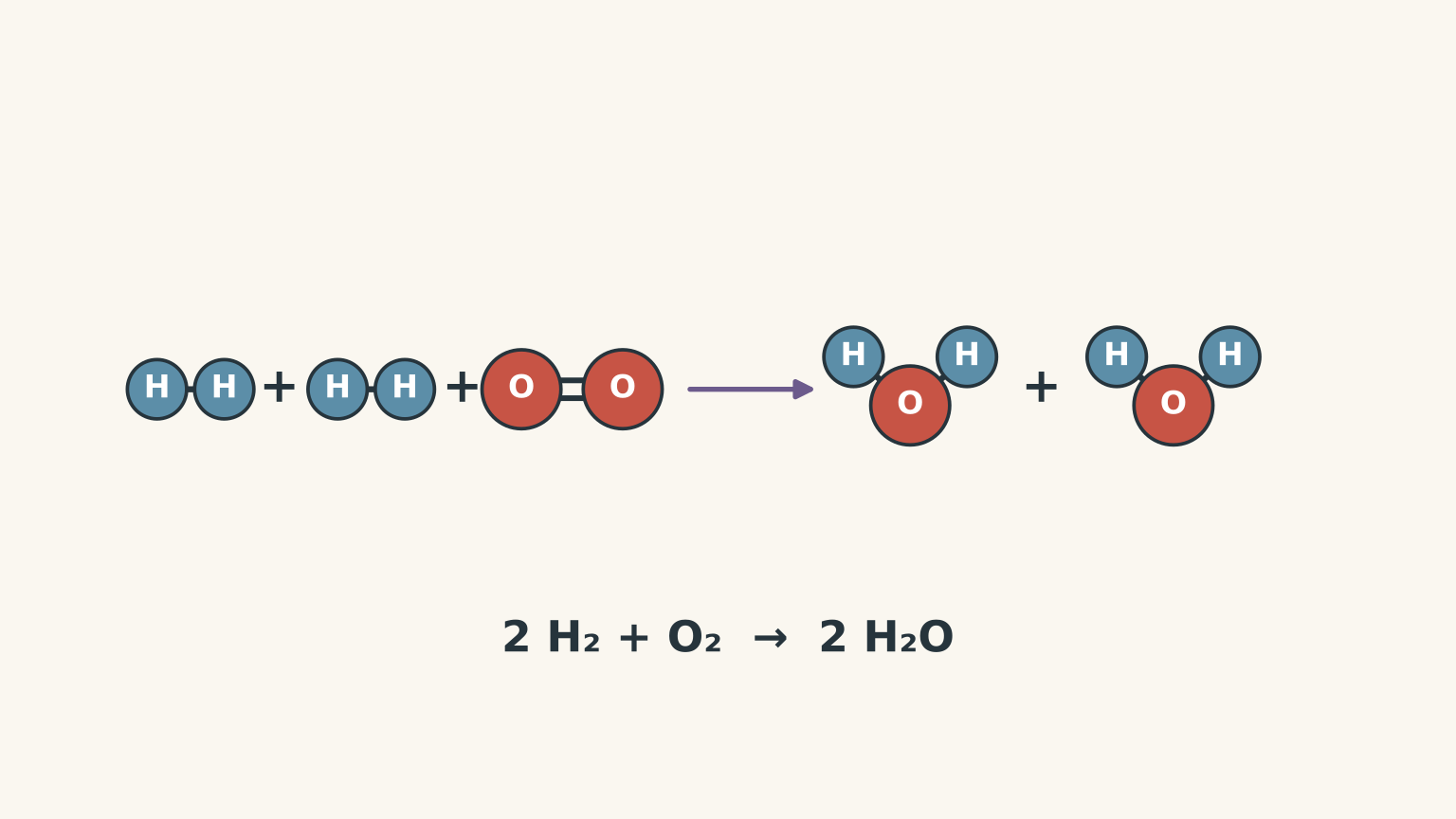
\[ \ce{2H2 + O2 -> 2H2O} \]
Step 4
| Element | Left side | Right side |
|---|---|---|
| Hydrogen | 4 | 4 |
| Oxygen | 2 | 2 |
The equation is balanced.
Notice something important: we changed the coefficients, not the chemical formulae.
If you changed \(\ce{H2O}\) into \(\ce{H2O2}\), you would have created a different substance. That isn’t balancing an equation.
Due to technical limitations, this figure may display incorrectly or contain inaccuracies. Please check key details against your course materials.
Session 3: Practise balancing equations
Work through a few simple reactions.
Try:
\[ \ce{Mg + O2 -> MgO} \]
\[ \ce{N2 + H2 -> NH3} \]
\[ \ce{Al + O2 -> Al2O3} \]
For each equation:
- Count every type of atom on both sides.
- Adjust coefficients to balance the atoms.
- Recount to check your answer.
You should also become comfortable recognising state symbols:
- (s): solid
- (l): liquid
- (g): gas
- (aq): aqueous, meaning dissolved in water
You don’t need to master every type of chemical reaction yet. The priority is understanding what an equation represents and being able to balance it accurately.
End-of-week checkpoint
You should be able to explain why:
- A coefficient changes the number of particles represented.
- A subscript changes the composition of a substance.
- Atoms are conserved during ordinary chemical reactions.
- A balanced equation represents a fixed ratio of reacting particles.
That final point will become particularly important next week.
05Week 3: Build confidence with chemical quantities
Chemistry involves particles that are far too small to count individually.
If you have a sample of water in a beaker, how could you work out how many water molecules it contains?
You can’t count them one by one.
Instead, chemists use a counting unit called the mole.
Session 1: Understand the mole
A mole is a fixed amount of a substance containing:
\[ 6.022 \times 10^{23} \]
specified particles.
This number is called Avogadro’s constant.
It might help to compare a mole with a dozen.
A dozen always means 12 objects, whether you’re counting eggs or pencils. Similarly, a mole always represents the same number of particles, whether you’re counting atoms, molecules, or formula units.
The difference is the enormous size of the number.
One mole of oxygen molecules contains \(6.022 \times 10^{23}\) oxygen molecules.
One mole of water molecules contains \(6.022 \times 10^{23}\) water molecules.
Session 2: Calculate molar mass
The molar mass of a substance is the mass of one mole of that substance.
Its unit is grams per mole, written as \(\mathrm{g\,mol^{-1}}\).
You calculate molar mass by adding the relative atomic masses of the atoms in the chemical formula.
For example, water is \(\ce{H2O}\).
Using approximate atomic masses:
- Hydrogen: 1.01
- Oxygen: 16.00
Therefore:
\[ M(\ce{H2O})=2(1.01)+16.00 \]
\[ M(\ce{H2O})=18.02\ \mathrm{g\,mol^{-1}} \]
The molar mass tells you that one mole of water has a mass of 18.02 g.
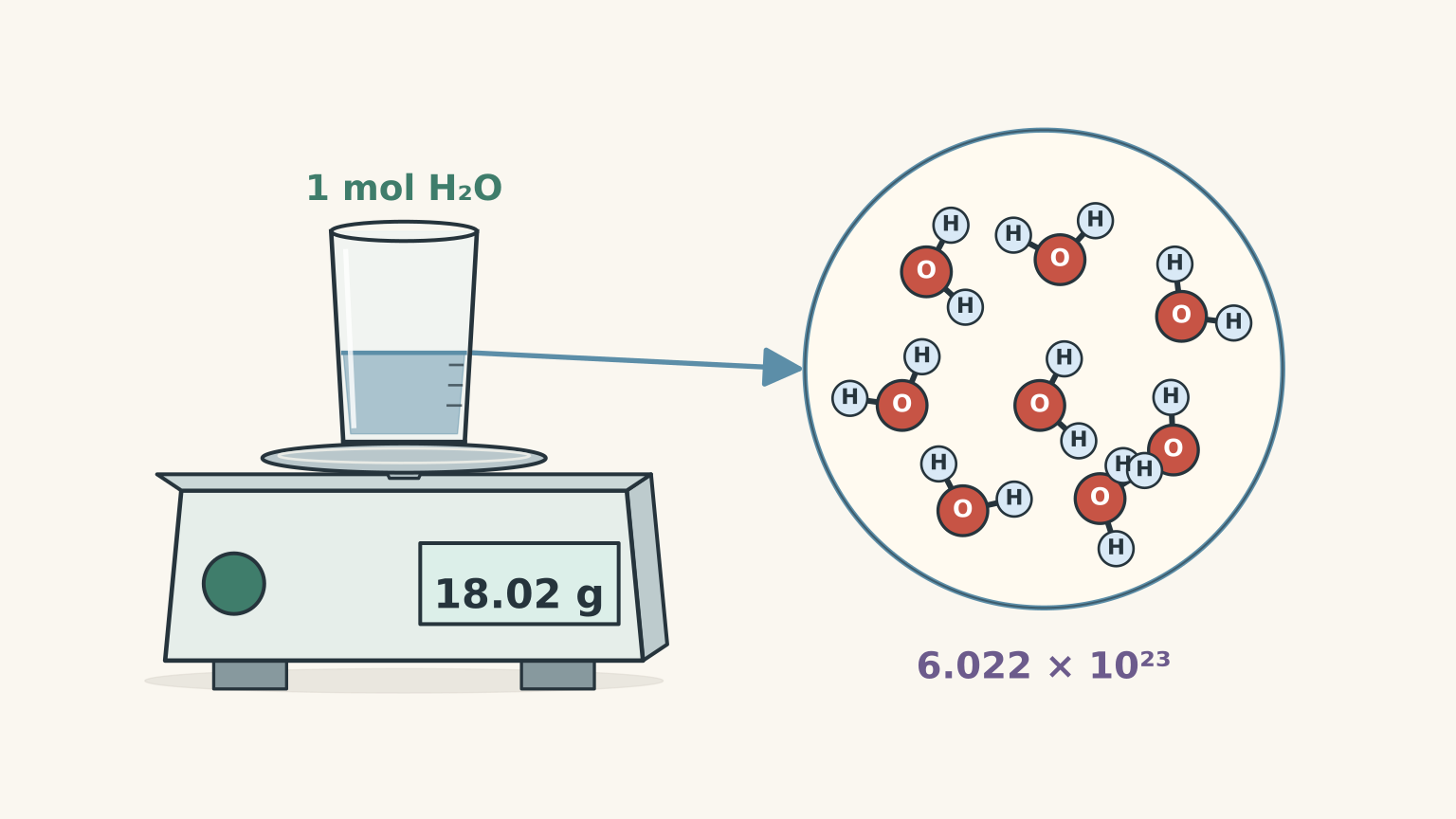
Due to technical limitations, this figure may display incorrectly or contain inaccuracies. Please check key details against your course materials.
Session 3: Convert between mass and moles
This is one of the most useful calculations you’ll encounter in Year 11 Chemistry.
The relationship is:
\[ n=\frac{m}{M} \]
Where:
- \(n\) = amount of substance, measured in mol.
- \(m\) = mass, measured in g.
- \(M\) = molar mass, measured in \(\mathrm{g\,mol^{-1}}\).
You can rearrange the equation to calculate mass:
\[ m=nM \]
Practise both directions.
Worked example: Calculate the amount of water in a sample
A student has 9.00 g of water. Calculate the amount of water, in moles.
Step 1
\[ M(\ce{H2O})=2(1.01)+16.00 \]
\[ M(\ce{H2O})=18.02\ \mathrm{g\,mol^{-1}} \]
Step 2
\[ m=9.00\ \mathrm{g} \]
\[ M=18.02\ \mathrm{g\,mol^{-1}} \]
Step 3
\[ n=\frac{m}{M} \]
\[ n=\frac{9.00}{18.02} \]
\[ n=0.4994\ \mathrm{mol} \]
Step 4
\[ \boxed{n=0.499\ \mathrm{mol}} \]
The sample contains approximately 0.499 moles of water molecules.
This is slightly less than half a mole.
Worked example: Calculate the mass of a reaction product
Magnesium reacts with excess oxygen to form magnesium oxide.
\[ \ce{2Mg + O2 -> 2MgO} \]
A student reacts 4.86 g of magnesium with excess oxygen. Calculate the mass of magnesium oxide produced.
Given:
- \(M(\ce{Mg})=24.3\ \mathrm{g\,mol^{-1}}\)
- \(M(\ce{MgO})=40.3\ \mathrm{g\,mol^{-1}}\)
Step 1
\[ n(\ce{Mg})=\frac{m}{M} \]
\[ n(\ce{Mg})=\frac{4.86}{24.3} \]
\[ n(\ce{Mg})=0.200\ \mathrm{mol} \]
Step 2
The equation tells us that two moles of magnesium produce two moles of magnesium oxide.
Therefore, the ratio is 1:1.
\[ n(\ce{MgO})=0.200\ \mathrm{mol} \]
Step 3
\[ M(\ce{MgO})=24.3+16.0 \]
\[ M(\ce{MgO})=40.3\ \mathrm{g\,mol^{-1}} \]
Step 4
\[ m=nM \]
\[ m=0.200\times40.3 \]
\[ \boxed{m=8.06\ \mathrm{g}} \]
The reaction produces 8.06 g of magnesium oxide.
Notice that the product weighs more than the original magnesium. That’s because oxygen has been incorporated into the product.
The additional mass hasn’t appeared from nowhere. It came from the oxygen that reacted with the magnesium.
This is an important connection between chemical equations, mole ratios, and conservation of mass.
What mathematics should you refresh?
You don’t need advanced mathematics to begin Year 11 Chemistry, but you should be comfortable with:
- Fractions and ratios.
- Rearranging simple equations.
- Substitution into formulae.
- Scientific notation.
- Significant figures.
- Converting between common units.
If these skills are rusty, revise them separately rather than trying to learn algebra and Chemistry at the same time.
End-of-week checkpoint
You should be able to:
- Explain what a mole represents.
- Calculate the molar mass of a compound.
- Convert a mass into moles.
- Convert moles into mass.
- Use coefficients in a balanced equation to establish mole ratios.
You don’t need to master every limiting reagent, concentration, or gas law calculation over summer. Your teacher will build on these foundations during Module 2.
06Week 4: Develop your laboratory and experimental reasoning
Chemistry isn’t just about calculating answers.
You’ll regularly investigate substances, collect measurements, compare results, and decide whether the evidence supports a conclusion.
In fact, practical investigations are a substantial part of the NSW Chemistry course. Under the 2017 syllabus, students must complete at least 35 hours of practical investigations in each year of the course.
The important skill is learning to think carefully about what an experiment actually tells you.
Session 1: Understand experimental variables
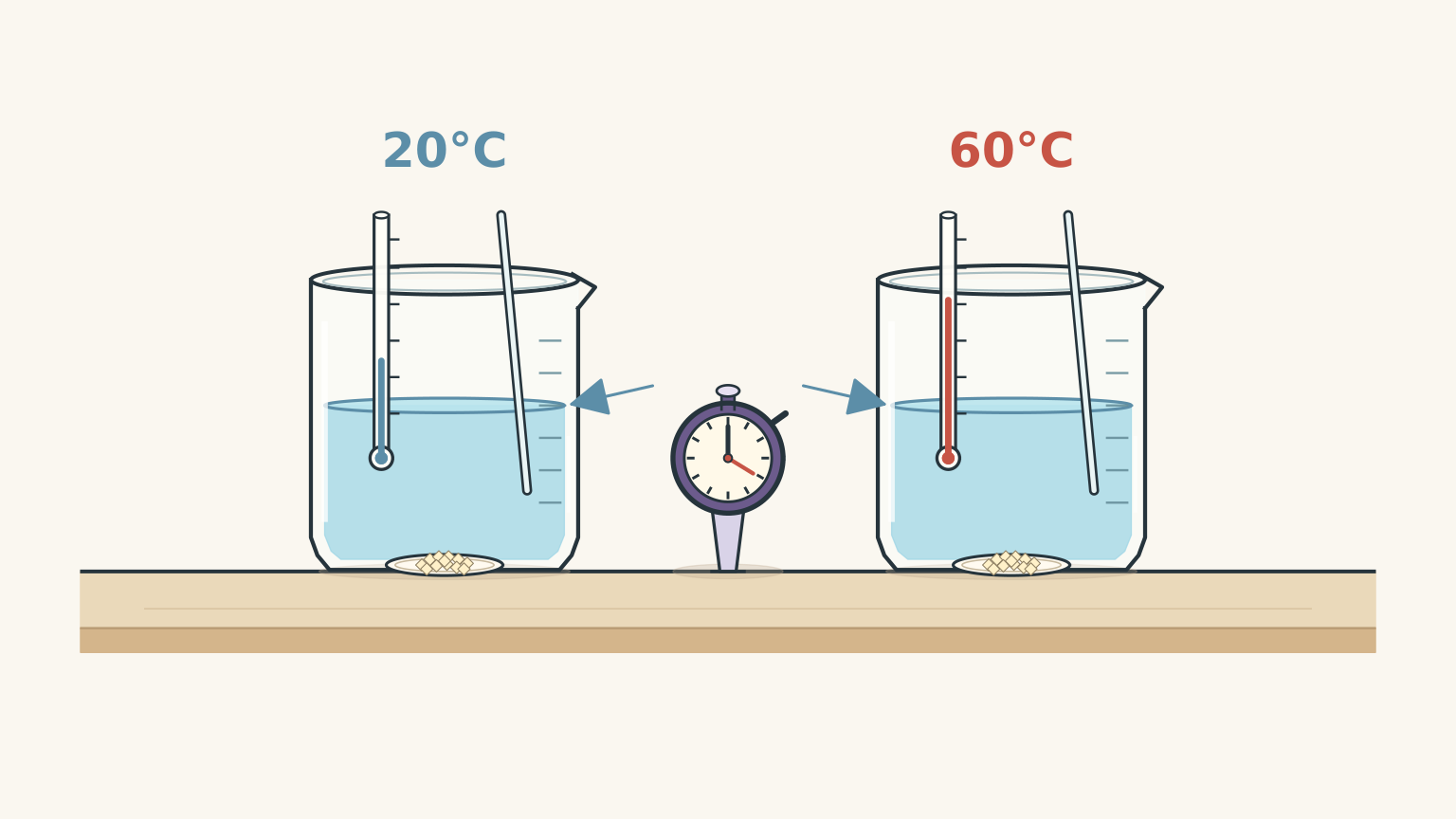
Suppose you want to investigate whether temperature affects how quickly sugar dissolves in water.
You prepare two beakers.
- Beaker A contains 100 mL of water at 20°C.
- Beaker B contains 100 mL of water at 60°C.
You add 5.0 g of sugar to each beaker and measure the time taken for the sugar to dissolve.
Which variable are you changing?
Temperature is the independent variable. It is the factor you deliberately change.
The time taken to dissolve is the dependent variable. It is the quantity you measure.
Other factors should be controlled.
These might include:
- Mass of sugar.
- Volume of water.
- Size of sugar particles.
- Stirring speed.
- Type of container.
Why does this matter?
Imagine using finely granulated sugar in the first beaker and a large sugar cube in the second.
The sugar particle size has changed as well as the temperature.
You now have two possible explanations for any difference in dissolving time.
You cannot confidently attribute the result to temperature alone.
This is why a fair test changes one independent variable while keeping relevant conditions constant.
Session 2: Understand measurements and experimental data
Measurements are not automatically perfect.
Every measuring instrument has limitations.
For example:
- A balance has a limited resolution.
- A measuring cylinder has graduations that restrict how precisely you can read volume.
- A stopwatch introduces uncertainty when a person starts and stops the timing.
Two terms are especially important.
Accuracy describes how close a measurement is to the accepted or true value.
Precision describes how close repeated measurements are to one another.
Imagine measuring the same quantity three times:
\[ 10.1,\quad 10.2,\quad 10.1 \]
These measurements are closely grouped, so they are precise.
However, if the accepted value is 12.0, the measurements are not accurate.
Repeating a measurement can help identify random variation. It does not automatically remove a consistent measurement error.
You should also become comfortable with:
- Recording measurements with appropriate units.
- Organising results in tables.
- Calculating averages.
- Identifying unusual results.
- Drawing graphs with correctly labelled axes.
- Describing trends in data.
Session 3: Learn to evaluate an investigation
Consider a set of results from a properly controlled investigation into sugar dissolving.
| Water temperature | Trial 1 | Trial 2 | Trial 3 | Mean time |
|---|---|---|---|---|
| 20°C | 88 s | 90 s | 92 s | 90 s |
| 60°C | 41 s | 42 s | 43 s | 42 s |
The results suggest that sugar dissolves more quickly at the higher temperature under the tested conditions.
Notice how the repeated measurements are reasonably close together.
That makes the results more repeatable.
However, a good scientific conclusion needs more than saying that one number is smaller than another.
A strong conclusion should:
- State the relationship observed.
- Support it with relevant measurements.
- Connect the evidence to the scientific explanation.
- Identify any limitations in the investigation.
For example:
Increasing the water temperature from 20°C to 60°C reduced the mean dissolving time from 90 seconds to 42 seconds. This suggests that sugar dissolves more quickly at higher temperatures under these experimental conditions.
The data support the conclusion, but they don’t establish that every substance will dissolve faster under every possible temperature condition.
Due to technical limitations, this figure may display incorrectly or contain inaccuracies. Please check key details against your course materials.
A useful structure for analysing practical investigations
Whenever you encounter an unfamiliar experiment, work through these points:
| Question | What to identify |
|---|---|
| What is being investigated? | Aim or research question |
| What is changed? | Independent variable |
| What is measured? | Dependent variable |
| What stays the same? | Controlled variables |
| How are measurements collected? | Equipment and method |
| Are results consistent? | Repeats and variation |
| What do the results show? | Trends and relationships |
| How reliable is the conclusion? | Limitations and improvements |
Don’t forget safety.
You should understand why protective equipment, appropriate handling procedures, and risk controls matter. Never mix chemicals or attempt laboratory reactions at home without appropriate supervision and facilities.
End-of-week checkpoint
You should be able to:
- Identify independent, dependent, and controlled variables.
- Explain the difference between accuracy and precision.
- Calculate a mean from repeated measurements.
- Identify a possible source of experimental error.
- Write a conclusion supported by numerical evidence.
- Suggest a realistic improvement to an investigation.
07Common mistakes to avoid before Year 11
A few misconceptions are worth correcting now.
| Common mistake | What you should understand instead |
|---|---|
| \(\ce{O2}\) is a compound because it contains two atoms. | It is an element because both atoms are oxygen. |
| You can change subscripts to balance an equation. | Change coefficients, not chemical formulae. |
| A larger mass always means more moles. | The molar mass also matters. |
| Mass disappears during a reaction if the balance reading decreases. | Matter may have left the system being weighed. |
| Repeating an unfair experiment makes it valid. | Repeats improve repeatability but don’t remove confounding variables. |
| The relative atomic mass is always the mass number. | Relative atomic mass accounts for naturally occurring isotopes. |
These mistakes often lead to bigger problems later because they affect how you interpret unfamiliar questions.
08Questions and solutions
The following questions test the foundations from all four weeks.
They start with straightforward particle reasoning and build towards calculations and experimental problems that require you to connect several concepts.
Question 1
Three samples are described using particle models.
- Sample A contains only identical pairs of bonded atoms.
- Sample B contains identical particles, each consisting of one black atom bonded to two white atoms.
- Sample C contains black-black pairs and white-white pairs mixed together, with no bonds between the two types of particles.
Classify each sample as an element, compound, or mixture.
Is Sample A a pure substance? Explain your reasoning.
Solution 1
Sample A is an element, Sample B is a compound, and Sample C is a mixture. Both A and B are pure substances.
The key is to identify the types of atoms present and whether they are chemically bonded.
Sample A contains only one type of atom. Even though its atoms are bonded in pairs, it is still an element.
Sample B contains two different types of atoms chemically bonded in a consistent ratio. It is therefore a compound.
Sample C contains two different substances together without being chemically bonded to each other. It is a mixture.
The tempting mistake is to classify anything containing multiple atoms as a compound.
However, oxygen gas contains two bonded oxygen atoms and is still an element.
Question 2
Aluminium reacts with oxygen to form aluminium oxide.
The unbalanced equation is:
\[ \ce{Al + O2 -> Al2O3} \]
(a) Balance the equation.
(b) State the total number of aluminium and oxygen atoms on each side of the balanced equation.
(c) Explain why changing the subscript in \(\ce{Al2O3}\) would not be an acceptable way to balance the equation.
Solution 2
The balanced equation is:
\[ \boxed{\ce{4Al + 3O2 -> 2Al2O3}} \]
There are four aluminium atoms and six oxygen atoms on each side.
Part (a): Balance the equation
Start by considering oxygen.
There are two oxygen atoms in each \(\ce{O2}\) molecule and three oxygen atoms in each \(\ce{Al2O3}\) formula unit.
The lowest common multiple of two and three is six.
Place a coefficient of three in front of oxygen and two in front of aluminium oxide:
\[ \ce{Al + 3O2 -> 2Al2O3} \]
There are now four aluminium atoms on the right, so place a coefficient of four in front of aluminium:
\[ \ce{4Al + 3O2 -> 2Al2O3} \]
Part (b): Count the atoms
| Element | Reactant side | Product side |
|---|---|---|
| Aluminium | 4 | 4 |
| Oxygen | 6 | 6 |
Both elements are balanced.
Part (c): Explain the role of coefficients
Changing the subscript changes the identity and composition of the substance.
For example, \(\ce{Al2O3}\) represents aluminium oxide. Changing it to a different formula would represent a different composition.
Coefficients change the number of particles involved without changing the substances themselves.
This is how a balanced equation represents conservation of atoms.
Question 3
Magnesium reacts with oxygen according to the equation:
\[ \ce{2Mg + O2 -> 2MgO} \]
A student reacts 5.00 g of magnesium with 3.20 g of oxygen.
Assume the reaction proceeds to completion, with no loss of material.
Use the following molar masses:
- \(M(\ce{Mg})=24.3\ \mathrm{g\,mol^{-1}}\)
- \(M(\ce{O2})=32.0\ \mathrm{g\,mol^{-1}}\)
- \(M(\ce{MgO})=40.3\ \mathrm{g\,mol^{-1}}\)
(a) Determine the limiting reactant.
(b) Calculate the mass of magnesium oxide produced.
(c) Calculate the mass of the excess reactant remaining.
Solution 3
Oxygen is the limiting reactant. The reaction produces 8.06 g of magnesium oxide and leaves approximately 0.140 g of magnesium unreacted.
The important step is converting both reactants into moles before comparing them.
Part (a): Identify the limiting reactant
Calculate the amount of magnesium:
\[ n(\ce{Mg})=\frac{5.00}{24.3} \]
\[ n(\ce{Mg})=0.2058\ \mathrm{mol} \]
Calculate the amount of oxygen:
\[ n(\ce{O2})=\frac{3.20}{32.0} \]
\[ n(\ce{O2})=0.100\ \mathrm{mol} \]
The balanced equation tells us that two moles of magnesium react with one mole of oxygen.
Therefore, 0.100 mol of oxygen requires:
\[ n(\ce{Mg})=2(0.100) \]
\[ n(\ce{Mg})=0.200\ \mathrm{mol} \]
We have 0.2058 mol of magnesium available, so there is slightly more magnesium than required.
Oxygen is therefore the limiting reactant.
Part (b): Calculate the mass of magnesium oxide
The equation shows a 2:2 mole ratio between magnesium and magnesium oxide.
Therefore:
\[ n(\ce{MgO})=0.200\ \mathrm{mol} \]
Use the molar mass to calculate the product mass:
\[ m=nM \]
\[ m=0.200\times40.3 \]
\[ \boxed{m=8.06\ \mathrm{g}} \]
Part (c): Calculate the excess magnesium remaining
The reaction consumes 0.200 mol of magnesium.
The original amount was 0.2058 mol.
Therefore:
\[ n_{\text{remaining}}=0.2058-0.200 \]
\[ n_{\text{remaining}}=0.0058\ \mathrm{mol} \]
Convert this amount into mass:
\[ m=0.0058\times24.3 \]
\[ \boxed{m\approx0.140\ \mathrm{g}} \]
A useful final check is to compare the total masses.
Initial mass:
\[ 5.00+3.20=8.20\ \mathrm{g} \]
Final mass:
\[ 8.06+0.14=8.20\ \mathrm{g} \]
The masses agree, supporting conservation of mass.
A common mistake is comparing 5.00 g of magnesium with 3.20 g of oxygen and assuming the smaller mass must be limiting.
That comparison is meaningless without accounting for the mole ratio in the balanced equation.
Question 4
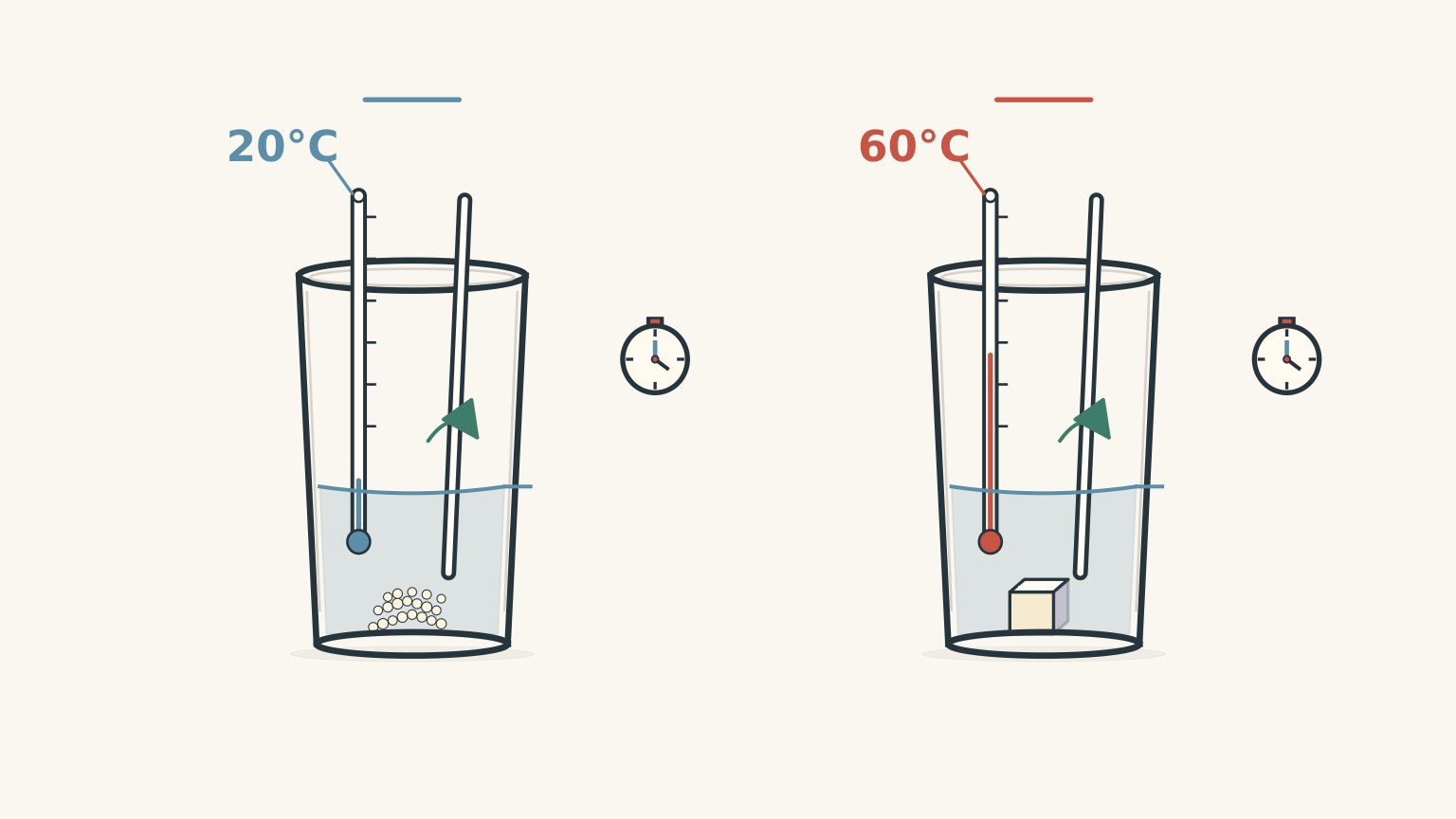
A student investigates whether temperature affects how quickly sugar dissolves in water.
They conduct the following tests:
| Variable | Trial group A | Trial group B |
|---|---|---|
| Water temperature | 20°C | 60°C |
| Water volume | 100 mL | 100 mL |
| Sugar mass | 5.0 g | 5.0 g |
| Sugar type | Granulated | One sugar cube |
| Stirring speed | 10 rotations/min | 10 rotations/min |
The student records the following results:
| Trial | Group A | Group B |
|---|---|---|
| 1 | 88 s | 68 s |
| 2 | 90 s | 70 s |
| 3 | 92 s | 72 s |
The student concludes:
“Higher temperatures cause sugar to dissolve faster.”
(a) Calculate the mean dissolving time for each group.
(b) Explain whether the student’s conclusion is justified.
(c) Identify the variable that prevents this from being a fair test of temperature.
(d) Describe how the investigation should be redesigned. Explain what repeating trials achieves and what it cannot fix.
Due to technical limitations, this figure may display incorrectly or contain inaccuracies. Please check key details against your course materials.
Solution 4
The mean times are 90 seconds for Group A and 70 seconds for Group B. However, the investigation does not isolate the effect of temperature because sugar particle size also changes.
Part (a): Calculate the means
For Group A:
\[ \bar{t}=\frac{88+90+92}{3} \]
\[ \boxed{\bar{t}=90\ \mathrm{s}} \]
For Group B:
\[ \bar{t}=\frac{68+70+72}{3} \]
\[ \boxed{\bar{t}=70\ \mathrm{s}} \]
Group B has a shorter mean dissolving time.
Part (b): Evaluate the conclusion
The results show that the second experimental arrangement dissolved sugar more quickly.
However, we cannot confidently conclude that temperature alone caused the difference.
Two variables changed between the groups:
- Water temperature.
- Sugar particle size.
The student has not isolated the effect of temperature.
Part (c): Identify the confounding variable
The confounding variable is sugar particle size.
Granulated sugar has a greater total exposed surface area than a single sugar cube of the same mass.
This can affect the rate at which sugar dissolves.
The temperature and particle-size effects may therefore influence the measured result together.
Part (d): Improve the investigation
The student should use the same type and particle size of sugar in both groups.
They should also keep constant:
- Sugar mass.
- Water volume.
- Stirring speed.
- Container type.
- Method for deciding when the sugar has completely dissolved.
Only the water temperature should change.
Each temperature should be tested several times, and the mean dissolving time should be calculated.
Repeating trials helps identify random variation and makes it easier to recognise inconsistent results.
However, repeating the same unfair experiment does not remove the confounding variable.
Even 100 repeated trials would not independently establish the effect of temperature if sugar particle size continued to change between groups.
Question 5
A student investigates the reaction between sodium hydrogencarbonate and hydrochloric acid.
The balanced chemical equation is:
\[ \ce{NaHCO3 + HCl -> NaCl + H2O + CO2} \]
The student uses 4.20 g of sodium hydrogencarbonate and an excess of hydrochloric acid.
Two experiments are performed.
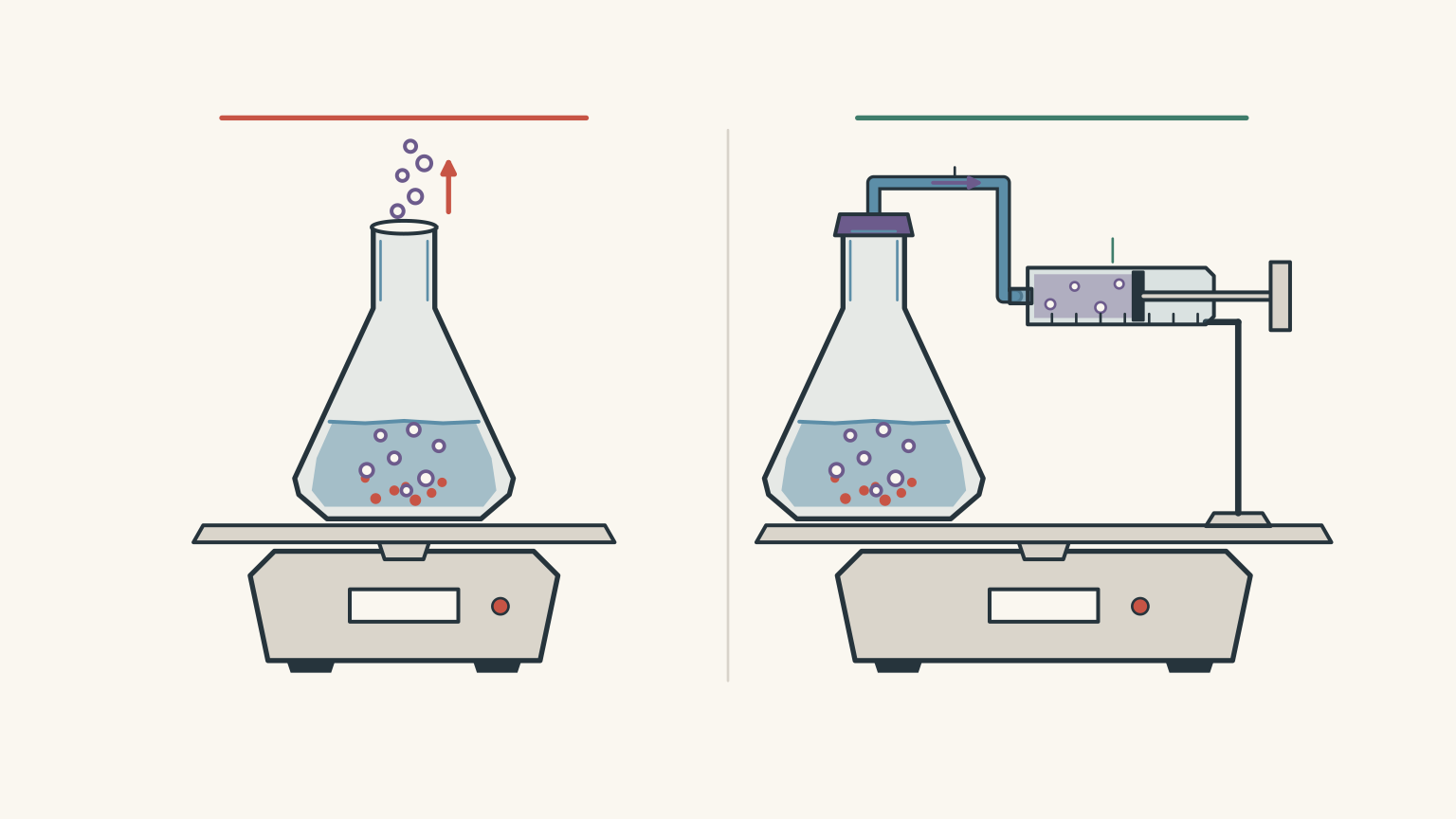
Experiment A: Open system
The initial mass of the open flask and all its contents is 104.20 g.
After the reaction finishes, the mass of the flask and remaining contents is 102.00 g.
Experiment B: Closed system
The same reaction is performed in an airtight apparatus consisting of a flask connected to a gas syringe.
The entire apparatus, including the gas syringe, is placed on a balance.
- Initial mass: 200.00 g.
- Final mass: 200.00 g.
- The gas syringe plunger moves outwards during the reaction.
Assume:
- All sodium hydrogencarbonate reacts.
- Hydrochloric acid is in excess.
- The only gas produced is carbon dioxide.
- No liquid escapes or evaporates.
- The closed apparatus does not leak.
- The apparatus returns to its original temperature before the final measurement.
Use:
- \(M(\ce{NaHCO3})=84.0\ \mathrm{g\,mol^{-1}}\)
- \(M(\ce{CO2})=44.0\ \mathrm{g\,mol^{-1}}\)
A student makes two claims:
- Experiment A proves that matter was destroyed because the mass decreased.
- Experiment B proves that no reaction occurred because the mass stayed constant.
Evaluate both claims.
Calculate the expected mass of carbon dioxide, explain both experimental results, and identify what the movement of the gas syringe tells us.
Due to technical limitations, this figure may display incorrectly or contain inaccuracies. Please check key details against your course materials.
Solution 5
Neither claim is correct. The reaction conserves mass, and both sets of measurements are consistent with the production of carbon dioxide.
The crucial distinction is which matter is included in the system being weighed.
Step 1: Calculate the amount of sodium hydrogencarbonate
Use:
\[ n=\frac{m}{M} \]
Substitute:
\[ n(\ce{NaHCO3})=\frac{4.20}{84.0} \]
\[ n(\ce{NaHCO3})=0.0500\ \mathrm{mol} \]
Step 2: Use the balanced equation to calculate the amount of carbon dioxide
The equation shows a 1:1 mole ratio between sodium hydrogencarbonate and carbon dioxide.
Therefore:
\[ n(\ce{CO2})=0.0500\ \mathrm{mol} \]
Step 3: Calculate the mass of carbon dioxide
\[ m=nM \]
\[ m(\ce{CO2})=0.0500\times44.0 \]
\[ \boxed{m(\ce{CO2})=2.20\ \mathrm{g}} \]
The reaction produces 2.20 g of carbon dioxide.
Step 4: Explain Experiment A
Experiment A is an open system.
The carbon dioxide produced during the reaction escapes into the surrounding air.
The balance only measures the flask and the material remaining inside it. It does not include the escaped gas.
Therefore, the measured mass decreases by 2.20 g.
\[ 104.20-2.20=102.00\ \mathrm{g} \]
This exactly matches the observed final mass.
The apparent loss of mass does not mean matter has been destroyed. The gas has simply crossed the boundary of the system being weighed.
Step 5: Explain Experiment B
Experiment B is a closed system.
The carbon dioxide still forms, but instead of escaping into the surroundings, it enters the gas syringe.
The gas is still part of the apparatus being weighed.
Therefore, the total mass remains:
\[ \boxed{200.00\ \mathrm{g}} \]
The gas syringe expands because gas has been produced and occupies additional volume.
The constant mass does not mean no reaction occurred. It means no measurable matter has entered or left the closed apparatus.
The outward movement of the syringe plunger provides additional evidence that gas has formed.
Step 6: Evaluate the two claims
The first student is wrong because the decrease in Experiment A is explained by carbon dioxide leaving the open system.
The second student is also wrong because a chemical reaction can occur without changing the total mass of a closed system.
If the supposedly closed apparatus showed a decrease in mass, possible explanations would include a leak or a measurement problem. It would not demonstrate that matter had been destroyed.
The deeper lesson is that conservation of mass must be considered alongside the system boundary.
A balance measures the material included in its weighing arrangement. It cannot automatically account for gas that has escaped or material that has moved outside that arrangement.
This is why a correct chemical explanation needs both a particle model and an understanding of the experimental setup.
09Your final preparation checklist
By the end of the four weeks, you should be able to complete the following tasks without relying heavily on your notes.
Week 1: Particle models
- [ ] Distinguish elements, compounds, and mixtures.
- [ ] Identify protons, neutrons, and electrons.
- [ ] Calculate the number of neutrons using mass number and atomic number.
- [ ] Explain the difference between isotopes and ions.
- [ ] Read information from the periodic table.
Week 2: Chemical equations
- [ ] Interpret simple chemical formulae.
- [ ] Distinguish coefficients from subscripts.
- [ ] Identify reactants and products.
- [ ] Balance simple chemical equations.
- [ ] Explain conservation of atoms during chemical reactions.
Week 3: Chemical quantities
- [ ] Explain what a mole represents.
- [ ] Calculate molar masses.
- [ ] Convert between mass and moles.
- [ ] Use balanced equations to establish mole ratios.
- [ ] Explain why mass and moles are not interchangeable.
Week 4: Laboratory reasoning
- [ ] Identify independent, dependent, and controlled variables.
- [ ] Distinguish accuracy from precision.
- [ ] Calculate means from repeated measurements.
- [ ] Interpret experimental data.
- [ ] Identify limitations and suggest improvements.
- [ ] Write conclusions supported by evidence.
If you struggle with a particular section, spend another session on it. There is no advantage in rushing through all four weeks if the foundations aren’t clear.
10What should you study next?
Once you’re comfortable moving between particle models, chemical equations, and quantities, you’re ready to tackle the more demanding parts of Module 2.
The natural next steps are limiting reagent calculations, concentration, dilution, and gas laws. These topics become much easier when you already understand the mole concept and can interpret balanced equations.
Your teacher will introduce these concepts in the order used by your school’s course program, so use this preparation plan as a foundation rather than a replacement for classroom learning.
As you progress towards Year 12, you’ll also need a different kind of preparation: organising your revision around assessments and identifying gaps across the full course. tutorgum’s guide, How to Prepare for HSC Trials: A Realistic Six-Week Plan, covers that later stage.
For now, the most useful thing you can do is arrive at your first Chemistry lesson able to explain what the particles are doing, why an equation must balance, and how a chemist turns a measured mass into an amount of substance. Those three connections will keep appearing throughout the course.