
Why a Catalyst Does Not Change Equilibrium Yield
Learn why a catalyst speeds up both forward and reverse reactions without changing the equilibrium constant or final equilibrium composition. Includes energy diagrams, reaction-rate graphs, worked examples, industrial applications, and challenging HSC Chemistry practice questions.
You add a catalyst to a reversible reaction, see the reaction speed up, and write: “The equilibrium shifts to the right, so the yield increases.” It sounds reasonable, but it’s a common HSC Chemistry mistake. A catalyst speeds up both the forward and reverse reactions. At a fixed temperature, it does not change the equilibrium constant, \(K_c\), or the equilibrium composition.
Before reading on, make a prediction: if both reactions become faster, does the system eventually produce more product?
The key distinction is between reaching equilibrium sooner and changing where equilibrium lies. A catalysed reaction may produce more product in the first few minutes, but if both systems start with the same amounts of substances and have the same conditions, they reach the same equilibrium composition.
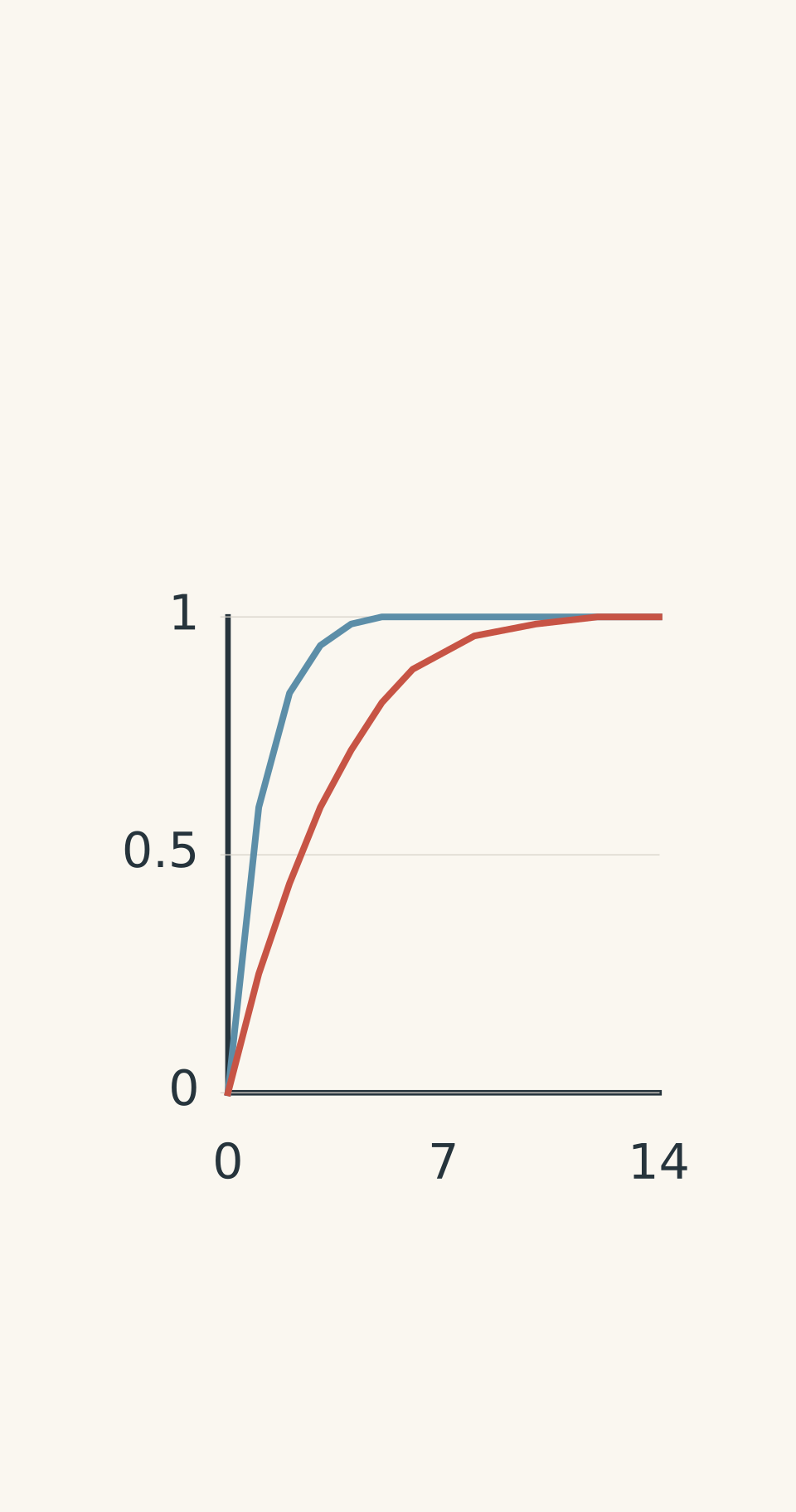
- With catalyst — shorter time to equilibrium
- Without catalyst — longer time to equilibrium
01Why the wrong answer feels right
The mistake usually comes from focusing on just one direction of the reaction.
You know that a catalyst lowers the activation energy, so the forward reaction happens faster. It is tempting to conclude that more reactants must turn into products, shifting the equilibrium to the right.
But the reverse reaction also has a lower-activation-energy pathway. Products can turn back into reactants faster, too.
Imagine two rooms connected by a revolving door. Making the door faster lets people move between the rooms more quickly in both directions. It doesn’t automatically decide which room should end up more crowded.
The analogy has a limit: molecules don’t choose where to go. A catalyst changes the reaction mechanism, allowing successful reaction events to occur more readily in both directions. The equilibrium composition is governed by the equilibrium constant at that temperature, not simply by how quickly molecules react.
The exam mistake is to treat a catalyst as if it pushes the reaction in one direction. A catalyst changes the reaction rate, not the equilibrium position.
02What a catalyst actually changes
1. It provides a lower-activation-energy pathway
The activation energy, \(E_a\), is the energy barrier that reacting particles must overcome for a reaction event to occur.
A catalyst provides an alternative reaction pathway with lower activation barriers. It does not change the energies of the original reactants and products.
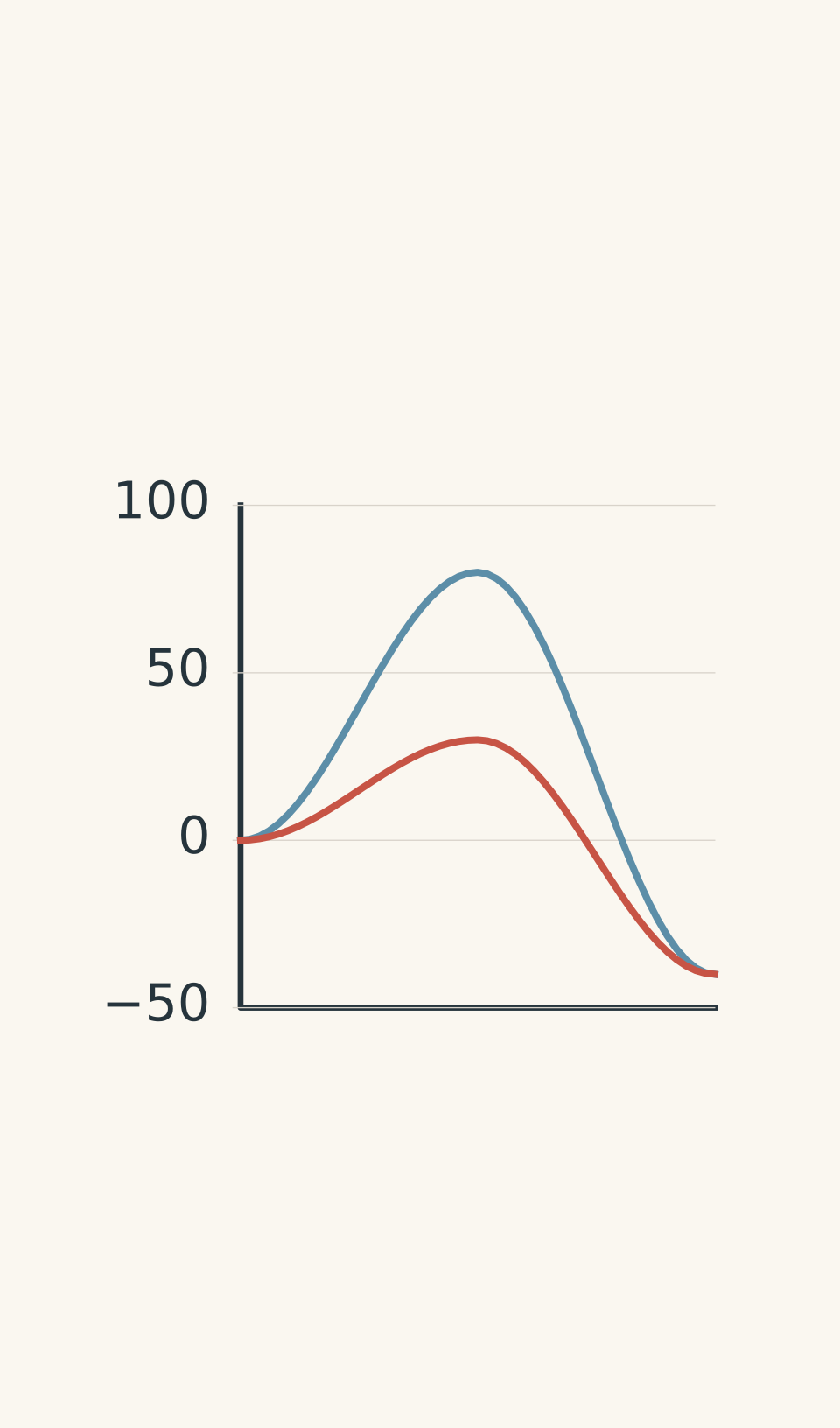
- Uncatalysed pathway
- Catalysed pathway
Notice three things in the diagram:
- The catalysed pathway has a lower activation energy for the forward reaction.
- The reverse reaction also has a lower activation-energy barrier.
- The energy difference between the reactants and products, represented by \(\Delta H\), is unchanged.
That third point matters. The catalyst changes the barrier, not the energy levels at either end of the reaction.
The equilibrium constant is not calculated from activation energy. At a fixed temperature, a catalyst does not change the thermodynamic equilibrium of the reaction, so \(K_c\) remains unchanged.
2. It speeds up both directions
Consider a reversible reaction:
\[ \ce{A(g) <=> B(g)} \]
The forward reaction converts A into B. The reverse reaction converts B into A.
At dynamic equilibrium, the forward and reverse reaction rates are equal. The reactions have not stopped; both continue at the same rate, so the concentrations remain constant.
What happens when a catalyst is introduced?
- The forward reaction becomes faster.
- The reverse reaction becomes faster.
- If the system was already at equilibrium, the two rates remain equal.
- There is no net change in the amounts of A and B.
If the system had not yet reached equilibrium, the catalyst would help it reach equilibrium sooner.
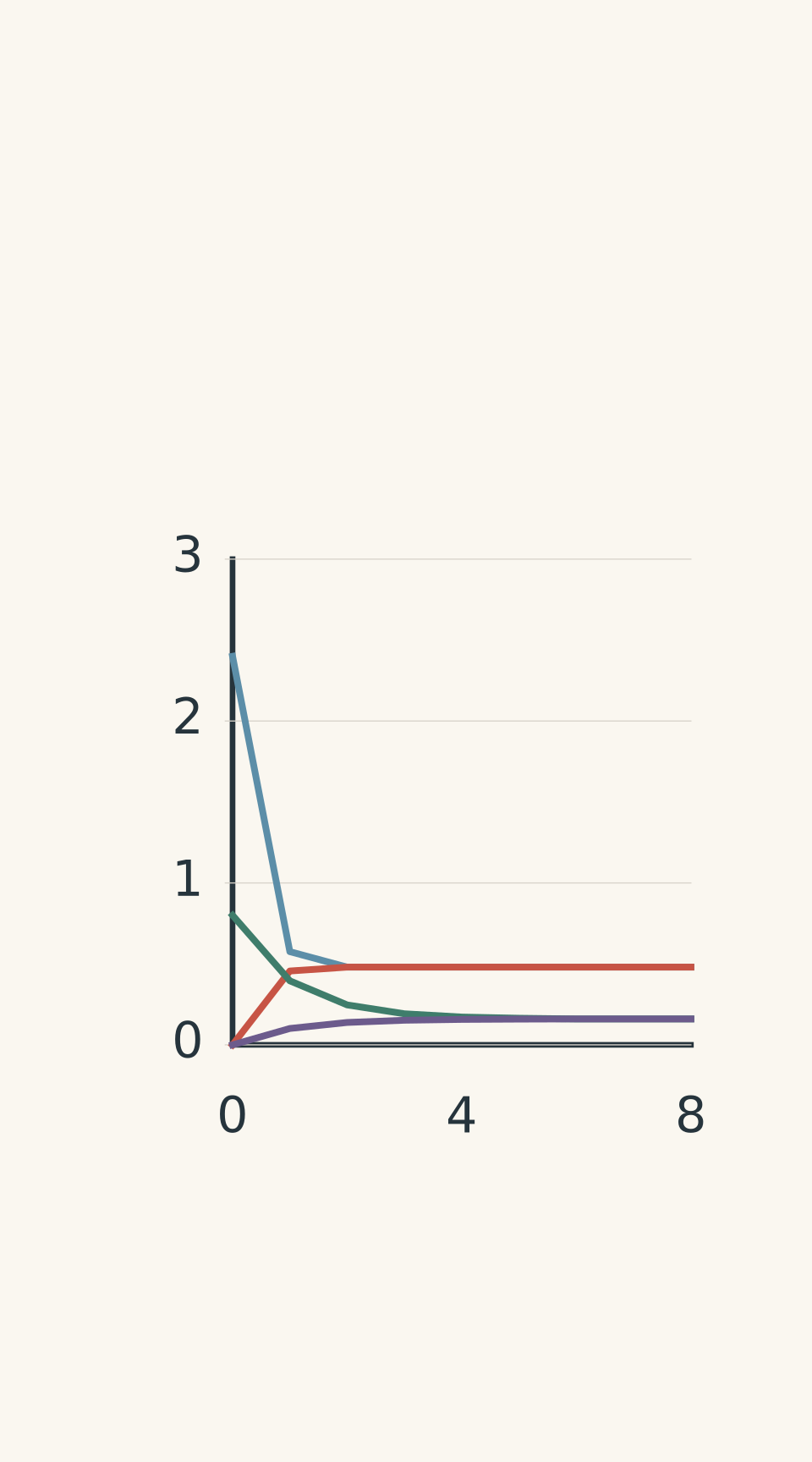
- Catalysed forward
- Catalysed reverse
- Uncatalysed forward
- Uncatalysed reverse
The graph helps expose the misconception. The catalyst does not make the forward rate permanently greater than the reverse rate at equilibrium. Both rates change, and equilibrium is reached when they are equal.
Also, equal rates do not mean equal concentrations. An equilibrium mixture could contain far more reactant than product and still have equal forward and reverse rates.
3. What changes, and what stays the same?
| Property | Effect of adding a catalyst at fixed temperature |
|---|---|
| Forward reaction rate | Increases |
| Reverse reaction rate | Increases |
| Time needed to reach equilibrium | Decreases |
| Equilibrium constant, \(K_c\) | Unchanged |
| Equilibrium composition | Unchanged for the same initial mixture and conditions |
| Enthalpy change, \(\Delta H\) | Unchanged |
This table is useful for revision, but don’t memorise it without understanding the reason. The catalyst changes the kinetics – how quickly reactions occur – rather than the equilibrium position.
03The exam method: separate rate from equilibrium position
When a question mentions a catalyst, don’t immediately write “shifts right” or “shifts left”. Use this decision method instead.
Step 1: Identify what actually changed.
Was a catalyst added, or did the question also change the temperature, concentration, pressure, or volume?
A catalyst alone does not change the equilibrium constant. Other changes can affect the equilibrium composition.
Step 2: Check the temperature.
For a given reaction, \(K_c\) changes when the temperature changes. Adding a catalyst at constant temperature leaves \(K_c\) unchanged.
Step 3: If concentrations are given, calculate the reaction quotient.
The reaction quotient, \(Q_c\), uses the same concentration expression as \(K_c\), but it can be calculated at any moment, not just at equilibrium.
For a general reaction,
\[ aA+bB\rightleftharpoons cC+dD \]
the expression is
\[ K_c=\frac{[C]^c[D]^d}{[A]^a[B]^b} \]
Here, square brackets represent concentrations, usually in \(\mathrm{mol\\,L^{-1}}\). The powers come from the coefficients in the balanced equation.
Compare \(Q_c\) with \(K_c\):
| Comparison | What the system does |
|---|---|
| \(Q_c\<K_c\) | Net forward reaction; more products form |
| \(Q_c>K_c\) | Net reverse reaction; more reactants form |
| \(Q_c=K_c\) | The system is at equilibrium |
Step 4: State the effect of the catalyst separately.
The catalyst speeds up the approach to equilibrium. It does not change the value of \(K_c\) or the final equilibrium composition under otherwise identical conditions.
What changed?
| Temperature changed | Kc may change. |
|---|---|
| Catalyst only | Kc stays unchanged. |
| Concentration, pressure, or volume changed | Calculate Qc and compare with Kc. |
| Interpret Qc | Qc < Kc: forward; Qc > Kc: reverse; Qc = Kc: equilibrium. |
For the wider topic, tutorgum’s HSC Chemistry Module 5 Equilibrium: Complete Topic Summary is a useful place to revise the relationship between reaction rates, equilibrium constants, and changes to equilibrium conditions.
04Worked example: Calculate the equilibrium constant before adding a catalyst
A reversible reaction, \(A(g)\rightleftharpoons B(g)\), is at equilibrium at a fixed temperature. The concentrations are \([A]=0.30\ \mathrm{mol\\,L^{-1}}\) and \([B]=0.90\ \mathrm{mol\\,L^{-1}}\). A catalyst is added without changing the temperature or volume. Calculate \(K_c\), then predict the new equilibrium concentrations.
Step 1: Write the equilibrium expression.
For the reaction \(A(g)\rightleftharpoons B(g)\),
\[ K_c=\frac{[B]}{[A]} \]
Both coefficients are 1, so both concentrations have a power of 1.
Step 2: Substitute the equilibrium concentrations.
\[ \begin{aligned} K_c&=\frac{0.90}{0.30}\\ &=3.0 \end{aligned} \]
The equilibrium constant is \(3.0\).
Step 3: Predict what happens when the catalyst is added.
The system was already at equilibrium, and the catalyst does not change the temperature. Therefore, \(K_c\) remains \(3.0\), and the equilibrium concentrations remain:
\[ [A]=0.30\ \mathrm{mol\\,L^{-1}} \]
\[ [B]=0.90\ \mathrm{mol\\,L^{-1}} \]
The catalyst increases both reaction rates, but they remain equal. No net reaction occurs.
Exam takeaway: Don’t recalculate the equilibrium composition just because a catalyst was added. If nothing else changes, the existing equilibrium remains valid.
05Worked example: Predict the direction of reaction using \(Q_c\) and \(K_c\)
At a fixed temperature, the reaction
\[ \ce{2SO2(g) + O2(g) <=> 2SO3(g)} \]
has \(K_c=40.0\ \mathrm{L\\,mol^{-1}}\). A mixture contains \([\ce{SO2}]=0.20\ \mathrm{mol\\,L^{-1}}\), \([\ce{O2}]=0.10\ \mathrm{mol\\,L^{-1}}\), and \([\ce{SO3}]=0.20\ \mathrm{mol\\,L^{-1}}\). A catalyst is added. Determine the direction of the net reaction and explain the catalyst’s effect.
Step 1: Write the reaction quotient expression.
Use the balanced equation to obtain the powers:
\[ Q_c=\frac{[\ce{SO3}]^2} {[\ce{SO2}]^2[\ce{O2}]} \]
Step 2: Substitute the current concentrations.
\[ \begin{aligned} Q_c&=\frac{(0.20)^2} {(0.20)^2(0.10)}\\ &=\frac{0.040}{0.0040}\\ &=10.0\ \mathrm{L\\,mol^{-1}} \end{aligned} \]
Step 3: Compare \(Q_c\) with \(K_c\).
\[ Q_c=10.0\<K_c=40.0 \]
The net reaction proceeds forwards, producing more \(\ce{SO3}\), until \(Q_c=K_c\).
Step 4: Explain the catalyst’s role.
Adding the catalyst does not instantly change the concentrations, so it does not instantly change \(Q_c\). It also does not change \(K_c\). It speeds up the approach to the same final equilibrium composition that would be reached without the catalyst.
Exam takeaway: The comparison between \(Q_c\) and \(K_c\) predicts the direction of the net reaction. The catalyst affects how quickly the system gets there.
06Edge cases that break memorised shortcuts
The basic rule is reliable, but exam questions often change one extra condition. Read the wording carefully.
A catalyst is added before equilibrium is reached
The catalysed reaction can produce more product than the uncatalysed reaction after the same short time, provided the system is progressing towards products.
That does not establish a higher equilibrium yield. The uncatalysed system may simply need longer to reach the same final composition.
The temperature changes as well
A catalyst does not change \(K_c\) at a fixed temperature. But if the temperature changes, the equilibrium constant may change.
For an exothermic forward reaction, lowering the temperature favours products at equilibrium. The increased equilibrium yield comes from the temperature change, not directly from the catalyst.
Pressure or concentration changes
Changing the pressure, volume, or concentration can disturb an equilibrium and cause the composition to change, even though \(K_c\) stays the same at a fixed temperature.
The catalyst then helps the system reach its new equilibrium faster. It does not cause the shift.
An inert gas is added
For a gas equilibrium, adding an inert gas at constant volume and temperature increases the total pressure but leaves the partial pressures of the reacting gases unchanged. The equilibrium position therefore does not shift just because the total pressure rises.
If the inert gas is added at constant pressure instead, the volume changes. The reacting gases’ partial pressures change, so the equilibrium response can be different.
The lesson is simple: don’t react to a single keyword. Identify the actual change in conditions before predicting the equilibrium response.
07Why catalysts still matter in industry
If a catalyst doesn’t increase equilibrium yield, why do chemical plants use them?
Because a commercially useful process needs to produce a large amount of product in a practical time. Waiting for an uncatalysed reaction to approach equilibrium may require a much longer residence time, larger equipment, or an uneconomically low production rate.
The Haber process illustrates this distinction.
Nitrogen and hydrogen react reversibly to form ammonia:
\[ \ce{N2(g) + 3H2(g) <=> 2NH3(g)} \]
The forward reaction is exothermic. Industrial production uses an iron catalyst, high pressure, and a moderate operating temperature that balances reaction rate against equilibrium yield.
Unsupported construction: Haber process flow schematic
| Required diagram | Connected reactor, cooler, separator, and feed lines. Closed recycle loop for unreacted nitrogen and hydrogen. |
|---|
At a fixed temperature, pressure, and starting composition, the catalyst does not increase the equilibrium proportion of ammonia. With or without the catalyst, the same equilibrium composition is reached.
The industrial advantage is the rate of production. The catalyst allows the plant to approach equilibrium more quickly, supporting greater throughput and making productive use of the reactor.
Other design choices affect the process, too:
- High pressure favours ammonia because the balanced equation has four moles of gaseous reactants for every two moles of gaseous product.
- Lower temperature favours the exothermic forward reaction at equilibrium, but it also slows the reaction.
- The catalyst helps the reaction proceed at a useful rate under the selected operating conditions.
- Separating ammonia and recycling unreacted gases improves overall feed utilisation across repeated passes.
A catalyst can help make a lower operating temperature practical by providing a faster reaction pathway. If that lower temperature improves equilibrium yield, however, the yield improvement comes from changing the temperature. The catalyst helps the reaction proceed at a useful rate at the new temperature.
This is the industrial distinction worth remembering: a catalyst can improve production economics without changing the equilibrium constant.
08Self-check before an exam answer
Before you submit an answer about a catalyst, check these five points:
- Have I stated that both forward and reverse reactions speed up?
- Have I kept \(K_c\) unchanged if the temperature is constant?
- Have I distinguished reaction rate from equilibrium composition?
- If the conditions changed, have I identified which change caused the equilibrium shift?
- Have I explained whether the system reaches equilibrium sooner, rather than claiming the catalyst increases equilibrium yield?
Now apply the method to the questions below. They move from a direct application towards situations where several changes interact.
09Questions and solutions
Question 1
A reversible reaction is at equilibrium at a constant temperature. A catalyst is added, with no other changes.
State what happens to:
- the forward reaction rate,
- the reverse reaction rate,
- \(K_c\), and
- the equilibrium composition.
Solution 1
Both reaction rates increase, but \(K_c\) and the equilibrium composition remain unchanged.
The catalyst provides lower-activation-energy pathways for both the forward and reverse reactions. Since the system was already at equilibrium, its forward and reverse rates were equal. They remain equal after the catalyst is added, so there is no net reaction and no change in composition.
Question 2
An exothermic reaction, \(A(g)\rightleftharpoons B(g)\), has an enthalpy change of \(\Delta H=-35\ \mathrm{kJ\\,mol^{-1}}\). Its uncatalysed forward activation energy is \(70\ \mathrm{kJ\\,mol^{-1}}\).
Assume a single-peak energy profile. A catalyst provides a pathway whose transition-state energy is \(30\ \mathrm{kJ\\,mol^{-1}}\) lower than the uncatalysed transition state.
Calculate the reverse activation energy for both pathways, and state whether \(K_c\) changes at a fixed temperature.
Solution 2
The uncatalysed reverse activation energy is \(105\ \mathrm{kJ\\,mol^{-1}}\), and the catalysed reverse activation energy is \(75\ \mathrm{kJ\\,mol^{-1}}\). The equilibrium constant remains unchanged at a fixed temperature.
Step 1: Relate the activation energies to the enthalpy change.
For a single-peak energy profile,
\[ \Delta H=E_{a,\mathrm{forward}} -E_{a,\mathrm{reverse}} \]
Rearranging gives
\[ E_{a,\mathrm{reverse}} =E_{a,\mathrm{forward}}-\Delta H \]
Step 2: Calculate the uncatalysed reverse activation energy.
\[ \begin{aligned} E_{a,\mathrm{reverse}} &=70-(-35)\\ &=105\ \mathrm{kJ\\,mol^{-1}} \end{aligned} \]
The reverse activation energy is \(105\ \mathrm{kJ\\,mol^{-1}}\).
Step 3: Calculate the catalysed activation energies.
The transition-state energy falls by \(30\ \mathrm{kJ\\,mol^{-1}}\), so the forward activation energy becomes
\[ E_{a,\mathrm{forward}}=70-30=40 \ \mathrm{kJ\\,mol^{-1}} \]
The reverse activation energy is therefore
\[ \begin{aligned} E_{a,\mathrm{reverse}} &=40-(-35)\\ &=75\ \mathrm{kJ\\,mol^{-1}} \end{aligned} \]
Step 4: Explain the equilibrium effect.
Both activation energies decrease by \(30\ \mathrm{kJ\\,mol^{-1}}\), while \(\Delta H\) remains unchanged. The catalyst changes the energy barrier, not the energy difference between reactants and products. Therefore, \(K_c\) is unchanged at the same temperature.
Question 3
A mixture at equilibrium contains \(\ce{N2O4(g)}\) and \(\ce{NO2(g)}\), which react according to
\[ \ce{N2O4(g) <=> 2NO2(g)} \]
A technician adds argon at constant temperature and constant container volume. A catalyst is also added.
A student predicts that the equilibrium shifts to the left because the total pressure increases and the left side contains fewer moles of gas.
Evaluate the student’s prediction.
Solution 3
The equilibrium does not shift under these conditions. The student’s prediction confuses an increase in total pressure with a change in the partial pressures of the reacting gases.
At constant volume and temperature, adding argon does not change the concentrations or partial pressures of \(\ce{N2O4}\) and \(\ce{NO2}\). Therefore, the reaction quotient remains equal to the equilibrium constant:
\[ Q_c=K_c \]
The catalyst increases the forward and reverse reaction rates, but the rates remain equal because the mixture is already at equilibrium. No net reaction occurs.
The wording matters. If argon were added at constant pressure, the volume would increase, changing the partial pressures of the reacting gases. The equilibrium response could then be different.
Question 4
The Haber process uses the reversible reaction
\[ \ce{N2(g) + 3H2(g) <=> 2NH3(g)} \]
Two reactors operate at the same temperature and pressure with the same initial feed. One contains an iron catalyst; the other does not.
After 10 minutes, the catalysed reactor contains more ammonia. A manager concludes that the catalyst has increased \(K_c\) and proposes lowering the operating temperature to increase the equilibrium yield.
Explain whether the manager’s reasoning is correct. Include the effects of the catalyst and temperature, and explain why catalysts are economically useful.
Solution 4
The manager is incorrect about the catalyst increasing \(K_c\), although lowering the temperature can increase the equilibrium yield of ammonia.
After 10 minutes, the catalysed reactor may contain more ammonia because it has progressed further towards equilibrium. This is a difference in reaction rate, not necessarily a difference in equilibrium composition.
If both reactors reach equilibrium at the same temperature and pressure, with the same initial feed and other conditions, they reach the same equilibrium composition. The catalyst does not change \(K_c\).
Lowering the temperature has a different effect. The forward Haber reaction is exothermic, so lowering the temperature favours ammonia at equilibrium and increases the equilibrium constant for the forward reaction. However, lowering the temperature also slows the reaction.
The iron catalyst helps the reaction proceed at a useful rate under the chosen operating conditions. This can support greater throughput and better use of the reactor. The catalyst improves production economics through its effect on reaction rate, while the temperature and pressure determine the equilibrium conditions.
Question 5
At a fixed temperature, the gas-phase equilibrium
\[ \ce{2A(g) <=> B(g)} \]
has \(K_c=1.00\ \mathrm{L\\,mol^{-1}}\). A vessel of volume \(V\) is initially at equilibrium with
\[ [A]=[B]=1.00\ \mathrm{mol\\,L^{-1}} \]
A catalyst is added without changing the temperature or volume. The vessel is then compressed rapidly to half its original volume, \(V/2\), without adding or removing any gas.
Assume ideal gases and allow the system to reach equilibrium again.
(a) Explain what the catalyst does before compression.
(b) Calculate \(Q_c\) immediately after compression and predict the direction of the net reaction.
(c) Calculate the new equilibrium concentrations of A and B.
(d) Compare the final number of moles of B with the original number of moles. Explain why any increase does not contradict the rule that a catalyst does not change equilibrium yield.
Solution 5
The final amount of B is \(12.5\%\) greater than its original amount, but the increase is caused by the compression and the resulting equilibrium shift, not by the catalyst. The catalyst speeds up the approach to the new equilibrium; it does not change \(K_c\).
Step 1: Establish what the catalyst does before compression.
The mixture is initially at equilibrium. Adding the catalyst increases both reaction rates, but the rates remain equal, so the composition does not change.
The equilibrium constant remains
\[ K_c=1.00\ \mathrm{L\\,mol^{-1}} \]
Step 2: Calculate the concentrations immediately after compression.
Halving the volume instantly doubles the concentrations of both gases because no gas is added or removed.
Therefore,
\[ [A]=2.00\ \mathrm{mol\\,L^{-1}} \]
\[ [B]=2.00\ \mathrm{mol\\,L^{-1}} \]
These are the concentrations immediately after compression, before the reaction has had time to respond.
Step 3: Calculate \(Q_c\) and predict the direction of reaction.
For the reaction \(\ce{2A(g) <=> B(g)}\),
\[ Q_c=\frac{[B]}{[A]^2} \]
Substituting the new concentrations gives
\[ \begin{aligned} Q_c&=\frac{2.00}{(2.00)^2}\\ &=0.500\ \mathrm{L\\,mol^{-1}} \end{aligned} \]
Since
\[ Q_c=0.500\<K_c=1.00 \]
the net reaction proceeds forwards. More B forms, and A is consumed, until \(Q_c=K_c\).
The important point is that compression changes \(Q_c\), not \(K_c\). The catalyst helps the system respond more quickly to that change.
Step 4: Calculate the new equilibrium concentrations.
Let \(x\), measured in \(\mathrm{mol\\,L^{-1}}\), be the increase in the concentration of B after compression.
From the balanced equation, two moles of A are consumed for every mole of B formed. The equilibrium concentrations are therefore
\[ [A]=2.00-2x \]
\[ [B]=2.00+x \]
Substitute these expressions into the equilibrium constant equation:
\[ 1.00=\frac{2.00+x}{(2.00-2x)^2} \]
Using the numerical concentration values in \(\mathrm{mol\\,L^{-1}}\),
\[ \begin{aligned} 2.00+x&=(2.00-2x)^2\\\ 2.00+x&=4.00-8x+4x^2\\\ 4x^2-9x+2&=0 \end{aligned} \]
Factorising gives
\[ (4x-1)(x-2)=0 \]
So the possible roots are \(x=0.250\) and \(x=2.00\).
The second root is physically impossible because it would give a negative concentration of A. Therefore,
\[ x=0.250\ \mathrm{mol\\,L^{-1}} \]
The new equilibrium concentrations are
\[ \begin{aligned} [A]&=2.00-2(0.250)\\ &=1.50\ \mathrm{mol\\,L^{-1}} \end{aligned} \]
and
\[ \begin{aligned} [B]&=2.00+0.250\\ &=2.25\ \mathrm{mol\\,L^{-1}} \end{aligned} \]
Check the result:
\[ K_c=\frac{2.25}{(1.50)^2} =1.00\ \mathrm{L\\,mol^{-1}} \]
The calculated concentrations satisfy the original equilibrium constant, as they should.
Step 5: Compare the actual amounts of B, not just their concentrations.
Initially, the vessel has volume \(V\) and B concentration \(1.00\ \mathrm{mol\\,L^{-1}}\). The original amount of B is
\[ n_{\mathrm{initial}}=(1.00)V \]
where \(V\) is measured in litres, giving the amount in moles.
After compression, the vessel has volume \(V/2\). At the new equilibrium, the amount of B is
\[ \begin{aligned} n_{\mathrm{final}} &=(2.25)\frac{V}{2}\\ &=1.125V \end{aligned} \]
The ratio of final to initial amounts is
\[ \frac{n_{\mathrm{final}}}{n_{\mathrm{initial}}} =\frac{1.125V}{1.00V}=1.125 \]
So the final amount of B is \(1.125\) times the original amount: a \(12.5\%\) increase.
This is the subtle part. The concentration of B rises to \(2.25\ \mathrm{mol\\,L^{-1}}\), but the volume has halved. Looking at concentration alone would obscure how much B is actually present.
The increase in the amount of B comes from compressing the system, which favours the side with fewer moles of gas, followed by the forward reaction. The catalyst merely helps the system reach that new equilibrium faster. The equilibrium constant never changes.
The next useful skill is to calculate \(Q_c\) after each disturbance and compare it with \(K_c\). That lets you identify which change affects the equilibrium position and which change only affects the rate.