
Why Esterification Can Give a Low Isolated Yield
A low isolated yield doesn't necessarily mean your esterification reaction failed. Learn how equilibrium, side reactions, and losses during separation and purification affect yield, with worked calculations and a practical troubleshooting method.
You reflux ethanoic acid with ethanol, then separate, wash, dry, and purify the mixture. The final sample contains only 4.2 g of ethyl ethanoate. Does that mean the reaction barely happened?
Not necessarily. The 4.2 g tells you how much purified ester you recovered, not how much ester was present before you started separating the mixture.
Before blaming the reaction, consider three possibilities. Perhaps little ester formed. Perhaps ester formed but some reacted back into the original substances. Or perhaps plenty of ester formed and you lost much of it during the practical. All three can produce a low isolated yield, but they require different solutions.
From reactants to isolated ester
- Starting reactants
CH₃COOH + CH₃CH₂OH
Ethanoic acid and ethanol are mixed.
- Reaction mixture
CH₃COOH + CH₃CH₂OH ⇌ CH₃COOCH₂CH₃ + H₂O
Ester forms, but reactants and water remain.
- Crude separated fraction
Ester is recovered with some impurities; some product may be lost.
- Purified dry ester
CH₃COOCH₂CH₃
A smaller amount of pure ester remains after work-up.
01Reaction yield and isolated yield are different measurements
A reaction mixture can contain the desired product alongside unreacted starting materials, water, the acid catalyst, and other substances. Your job in the practical is not finished when the ester forms. You still need to recover it and establish that the final sample is sufficiently pure.
Think of these as two separate jobs: making the ester and recovering the ester.
What does isolated yield actually measure?
The theoretical yield is the maximum amount of product calculated from the limiting reagent and the balanced equation, assuming complete conversion to the desired product.
The isolated yield measures how much pure, dry product you actually collect compared with that theoretical maximum.
\[ \begin{aligned} \%\text{ isolated yield} &=\frac{\text{mass of pure, dry ester collected}}{\text{theoretical mass of ester}}\times100\% \end{aligned} \]
Both masses must use the same units, usually grams.
A low isolated yield tells you that the final amount is small relative to the theoretical maximum. By itself, it does not tell you why.
| Measurement | What it tells you |
|---|---|
| Conversion | How much of a starting reactant has reacted |
| Selectivity | How much of the reacted material has formed the desired ester rather than other products |
| Recovery | How much of the ester formed survives separation and purification to reach the final sample |
| Isolated yield | How much pure ester you collected relative to the theoretical maximum |
These are different ways of describing the process. In a simple diagnostic model, the isolated-yield fraction is approximately the product of the conversion, selectivity, and recovery fractions.
\[ \text{Isolated-yield fraction} \approx XSR \]
Here, \(X\) is the conversion fraction, \(S\) is the selectivity fraction, and \(R\) is the recovery fraction. Each is expressed as a decimal, not a percentage.
For example, suppose 80% of the limiting reactant reacts, 90% of the reacted material forms the desired ester, and you recover 75% of the ester formed.
\[ \begin{aligned} \text{Isolated-yield fraction} &=0.80\times0.90\times0.75\\ &=0.54 \end{aligned} \]
The isolated yield is 54%.
Notice that no single stage had to be disastrous for the final yield to fall substantially. Losses at different stages compound one another.
Three factors controlling isolated yield
| Conversion | Fraction of limiting reactant that reacts. Lower conversion means less product can form. |
|---|---|
| Selectivity | Fraction of reacted material forming the desired ester. Side reactions reduce desired product. |
| Recovery | Fraction of ester formed collected as pure, dry product. Separation and purification losses reduce the final amount. |
02Why the reaction may not form all the ester you expect
Consider the esterification of ethanoic acid with ethanol, which produces ethyl ethanoate and water.
\[ \ce{CH3COOH + CH3CH2OH <=> CH3COOCH2CH3 + H2O} \]
Esterification and hydrolysis are reversible
| Reversible esterification | CH₃COOH + CH₃CH₂OH ⇌ CH₃COOCH₂CH₃ + H₂O Forward (left → right): esterification. Reverse (right → left): hydrolysis. |
|---|
The forward reaction forms the ester. The reverse reaction is ester hydrolysis, which converts the ester and water back into a carboxylic acid and an alcohol.
The double arrow is important. Esterification is reversible, so the reaction does not necessarily consume all the starting materials.
Equilibrium does not mean that the reaction has stopped
As the reaction proceeds, ester and water accumulate. These products can react to regenerate the original acid and alcohol.
Eventually, the system may reach dynamic equilibrium. At this point, the forward and reverse reactions occur at equal rates, so the concentrations of the substances remain constant.
Predict what happens to the reactants at equilibrium. Have they all disappeared?
No. Reactants can remain in substantial amounts. Equilibrium means that the forward and reverse rates are equal, not that all substances are present in equal amounts or that the reaction has gone to completion.
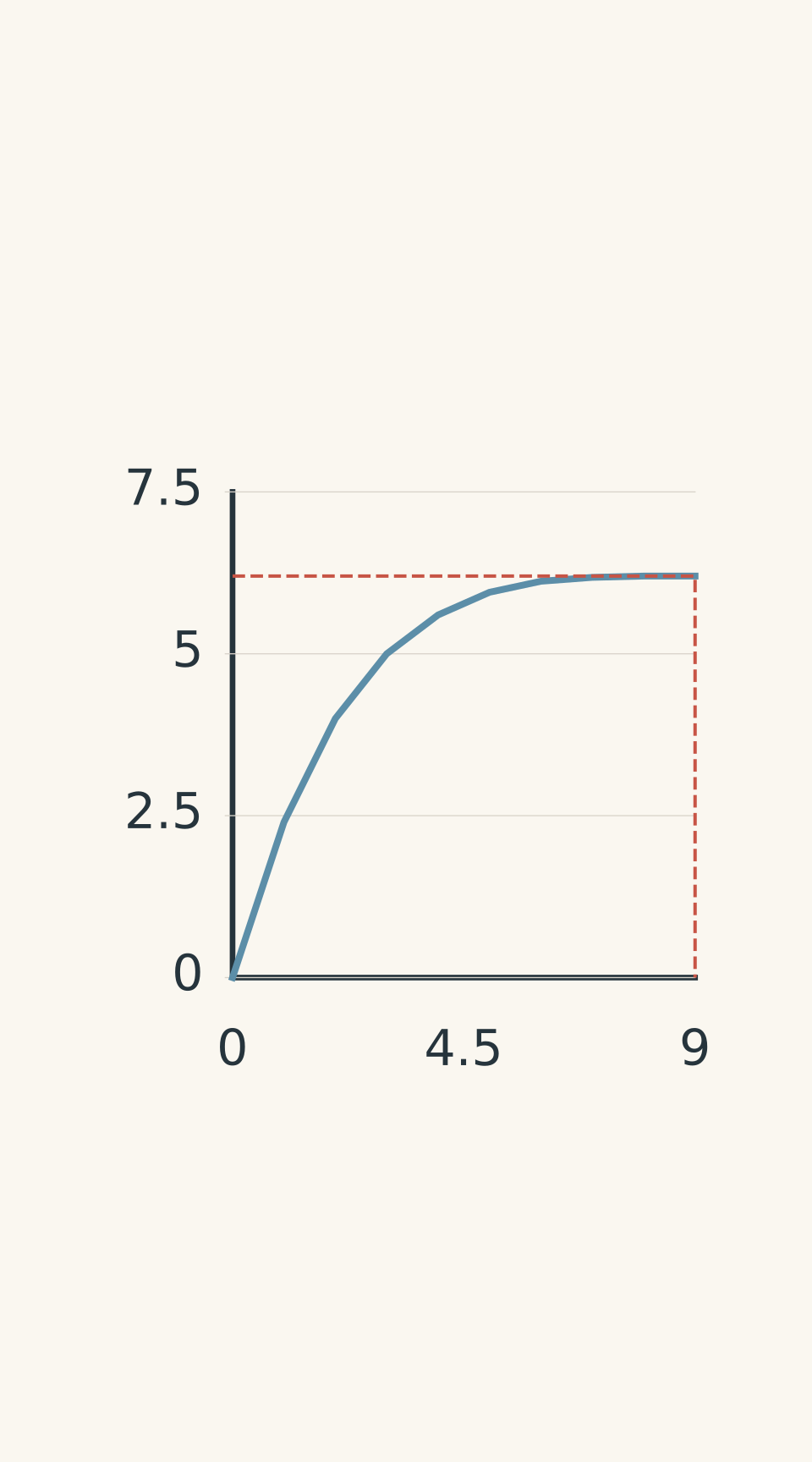
- Ester amount
- Equilibrium plateau: forward rate = reverse rate
This explains one possible cause of a low isolated yield: the reaction may have formed ester but reached equilibrium before converting much of the limiting reactant into product.
How can you favour ester formation?
There are several ways to improve the reaction-stage yield, depending on the conditions.
- Use an excess of one reactant. Increasing the amount of an alcohol or carboxylic acid can shift the equilibrium towards the ester and water.
- Remove water where the method allows it. Water is a product of esterification. Removing it can favour further ester formation.
- Use an appropriate acid catalyst. The catalyst speeds up the reaction, helping the system approach equilibrium more quickly.
- Heat under reflux. Reflux allows the mixture to be heated while much of the vapour condenses and returns to the reaction mixture, reducing the loss of volatile substances.
There is a crucial distinction between reaction rate and equilibrium position.
An acid catalyst speeds up both the forward and reverse reactions. It does not change the equilibrium composition at a given temperature. If the reaction has not yet reached equilibrium, more catalyst or more reaction time may increase the amount of ester present when you finish. Once equilibrium has been reached, adding more catalyst will not push it further towards the products.
Reflux has a similar limitation. It helps maintain a suitable reaction temperature and reduces the escape of volatile substances, but it does not force the reaction to completion.
Also, do not automatically claim that increasing temperature shifts esterification towards the products. Heating increases reaction rates, but the direction of an equilibrium shift depends on the reaction’s enthalpy change.
03Other chemical processes can reduce the amount of ester
Equilibrium is not the only possible chemical explanation for a low yield.
1. Ester hydrolysis
Water is produced during esterification, so it is already present in the reaction mixture. In the presence of an acid catalyst, water can also promote the reverse reaction.
If the mixture contains excess water and remains hot and acidic, some ester may hydrolyse back into the original reactants.
This does not mean that every esterification practical suffers extensive hydrolysis. Under a brief, cool work-up, physical losses may be more important. The conditions and evidence should determine your explanation.
2. Unwanted side reactions
Under unsuitable conditions, some starting material may undergo a competing reaction instead of forming the desired ester. For example, strongly acidic conditions and excessive heating can promote dehydration of an alcohol, producing other organic compounds.
However, do not invent a side reaction simply because the yield is low. In a typical school esterification practical, first investigate the equilibrium conditions and the recovery steps. A competing reaction becomes a stronger explanation when the conditions or experimental evidence support it.
3. Water already present in the reactants
Wet reagents or water introduced into the reaction mixture can affect the equilibrium because water is a product of esterification. Adding more water can favour the reverse reaction.
This is one reason why the condition of the reagents and the order of the practical steps matter.
04Where ester can be lost during work-up
Suppose the reaction mixture contains a reasonable amount of ester. You still need to separate the ester from the other substances, wash it, dry it, and purify it.
Every one of these steps creates an opportunity for product loss.
Separation: some ester may end up in the wrong fraction
An ester does not necessarily dissolve exclusively in an organic layer. Some esters have appreciable solubility in water, so a proportion of the product can remain in the aqueous layer after separation.
If that layer is discarded, any ester dissolved in it is lost from the final sample.
The position of the product layer also depends on the substances involved and their densities. Never assume that the product must be the top layer without checking the method and identifying the layers correctly.
Washing: removing impurities can also remove product
A wash may remove excess carboxylic acid, catalyst, or other water-soluble impurities. That is useful, but some ester may dissolve in the wash solution or become trapped in an emulsion.
A decrease in the mass of the organic fraction after washing does not automatically mean that the same mass of ester has been lost. The wash may have removed impurities that were contributing to the original mass.
If a carbonate or hydrogencarbonate wash is used, neutralisation can also release carbon dioxide. Follow the practical’s safety instructions when carrying out this step.
Drying: the product can remain with the drying agent
An anhydrous drying agent removes residual water from the organic fraction. However, some liquid may remain attached to or trapped among the solid particles.
If you discard the drying agent without following the prescribed separation procedure, you may lose some product along with it.
Purification: the final collection may be incomplete
During distillation or another purification step, ester can be lost through evaporation, incomplete condensation, transfer losses, or material left behind in the equipment.
Collecting the wrong fraction can also reduce the amount of desired ester recovered. Purification depends on separating the ester from impurities, so collecting more liquid is not necessarily better if that liquid is contaminated.
Where ester is lost during work-up
- Transfer
Liquid remains on glassware or in vessels.
- Wash
Impurities are removed: a useful mass decrease.
Ester may remain in aqueous layers or emulsions.
- Dry
Liquid ester may be retained with the drying solid.
- Purify
Ester may remain in equipment or go uncollected.
- Interpret the final mass
Less mass may mean impurity removal, product loss, or both.
Why crude product mass can be misleading
A crude organic fraction can contain ester, residual alcohol, water, unreacted acid, and other impurities. Its total mass is not necessarily the mass of ester.
This creates two different errors:
- If you use the crude mass to calculate the yield, you may overestimate the amount of ester because impurities contribute to the mass.
- If purification removes impurities and the mass falls, you cannot assume that all of the decrease represents ester lost. Some of the decrease may be successful impurity removal.
For a meaningful isolated yield, use the mass of the pure, dry ester actually collected. If the sample is not pure, its ester content must be established before the amount of ester can be calculated accurately.
05Worked examples
Worked example: calculate an isolated yield
A student reacts 0.0800 mol of ethanol with 0.100 mol of ethanoic acid. After separation and purification, the student collects 4.23 g of pure, dry ethyl ethanoate. Calculate the isolated yield.
Step 1
The balanced equation has a 1:1 mole ratio between ethanol and ethyl ethanoate. There is less ethanol than ethanoic acid, so ethanol is the limiting reagent.
The maximum amount of ester is therefore 0.0800 mol.
Step 2
The molar mass of ethyl ethanoate, \(\ce{C4H8O2}\), is \(88.11\ \mathrm{g\,mol^{-1}}\).
Using \(m=nM\), where \(m\) is mass, \(n\) is amount in moles, and \(M\) is molar mass:
\[ \begin{aligned} m_{\text{theoretical}} &=nM\\ &=0.0800\ \mathrm{mol} \times88.11\ \mathrm{g\,mol^{-1}}\\ &=7.05\ \mathrm{g} \end{aligned} \]
Step 3
\[ \begin{aligned} \%\text{ yield} &=\frac{4.23\ \mathrm{g}}{7.05\ \mathrm{g}}\times100\%\\ &=60.0\% \end{aligned} \]
The isolated yield is 60.0%.
This means that the student recovered 60.0% of the theoretical mass as pure, dry ester. It does not prove that exactly 40.0% of the ethanol remained unreacted. Some ester may have formed and subsequently been lost during the work-up.
Worked example: account for the limiting reagent and crude product
A student reacts 10.0 g of butanoic acid with 6.40 g of methanol to produce methyl butanoate. The crude organic fraction weighs 7.10 g, but only 6.30 g of pure, dry ester is collected after purification. Calculate the isolated yield.
Step 1
The molar masses are:
- Butanoic acid: \(88.11\ \mathrm{g\,mol^{-1}}\)
- Methanol: \(32.04\ \mathrm{g\,mol^{-1}}\)
For butanoic acid:
\[ \begin{aligned} n&=\frac{m}{M}\\ &=\frac{10.0\ \mathrm{g}}{88.11\ \mathrm{g\,mol^{-1}}}\\ &=0.1135\ \mathrm{mol} \end{aligned} \]
For methanol:
\[ \begin{aligned} n&=\frac{6.40\ \mathrm{g}}{32.04\ \mathrm{g\,mol^{-1}}}\\ &=0.1998\ \mathrm{mol} \end{aligned} \]
The reaction uses a 1:1 mole ratio. Butanoic acid is the limiting reagent because it has the smaller amount in moles.
Step 2
The equation produces one mole of ester for each mole of butanoic acid consumed. The theoretical amount of ester is therefore 0.1135 mol.
The molar mass of methyl butanoate, \(\ce{C5H10O2}\), is \(102.13\ \mathrm{g\,mol^{-1}}\).
\[ \begin{aligned} m_{\text{theoretical}} &=nM\\ &=0.1135\ \mathrm{mol} \times102.13\ \mathrm{g\,mol^{-1}}\\ &\approx11.59\ \mathrm{g} \end{aligned} \]
Step 3
The correct mass for the isolated-yield calculation is 6.30 g.
\[ \begin{aligned} \%\text{ isolated yield} &=\frac{6.30\ \mathrm{g}}{11.59\ \mathrm{g}}\times100\%\\ &=54.4\% \end{aligned} \]
The isolated yield is 54.4%.
Using the crude mass of 7.10 g would give an apparent ratio of about 61.3%, but this would not be a valid isolated yield because the crude fraction may contain impurities.
The decrease from 7.10 g to 6.30 g is 0.80 g. You cannot assume that all 0.80 g was impurity removed: some ester may also have been lost during purification. The mass difference alone cannot tell you how much of each was involved.
06A practical troubleshooting sequence
When an esterification practical gives a low isolated yield, work through the problem in a consistent order. Do not immediately increase the amount of catalyst or extend the heating time.
Diagnose a low isolated yield
| Little ester before work-up | Check reactant ratios, limiting reagent, catalyst, and reaction time. Check water content and equilibrium; a catalyst speeds both directions but does not shift equilibrium. |
|---|---|
| Plenty of ester before work-up, little pure ester after | Check discarded layers, transfers, and aqueous washes for lost ester. Check drying solids, purification, and uncollected fractions. |
1. Check the calculation first
Confirm the balanced equation, the mole ratio, the limiting reagent, the theoretical yield, and the mass of pure, dry ester collected.
A calculation error can make a reasonable experimental result appear poor.
2. Find out how much ester was present before work-up
If a suitable analytical method is available, analyse a sample of the reaction mixture before separation and compare the result with the final isolated amount.
If little ester is present before work-up, focus on the reaction itself. Check the reactant proportions, catalyst, heating conditions, reaction time, water content, and equilibrium.
If plenty of ester is present before work-up but little is recovered, focus on the separation and purification steps instead.
3. Check where the product went
Keep the relevant fractions until you have confirmed which ones contain the ester. Review the aqueous washes, discarded layers, material retained with the drying agent, and purification fractions.
Where suitable analysis is available, testing these fractions can help identify the main source of loss.
4. Improve one stage at a time
If the reaction is the limiting stage, consider an appropriate change to the reaction conditions or equilibrium strategy.
If recovery is the limiting stage, improve the separation, transfer, washing, drying, or purification procedure responsible for the loss.
Changing several variables at once makes it difficult to determine which change actually improved the result.
The aim is to distinguish a reaction that produces little ester from a reaction that produces plenty but recovers little. Those are different problems, and they need different solutions.
07Questions and solutions
Question 1
A student starts with 0.0500 mol of ethanol and excess ethanoic acid. After purification, 2.64 g of pure, dry ethyl ethanoate is collected. The molar mass of ethyl ethanoate is \(88.11\ \mathrm{g\,mol^{-1}}\).
Calculate the isolated yield. Does the result prove that exactly 40.1% of the ethanol remained unreacted?
Solution 1
The isolated yield is 59.9%, but this does not establish how much ethanol remained unreacted.
Step 1: Calculate the theoretical mass.
The reaction has a 1:1 mole ratio, and ethanol is the limiting reagent.
\[ \begin{aligned} m_{\text{theoretical}} &=nM\\ &=0.0500\ \mathrm{mol} \times88.11\ \mathrm{g\,mol^{-1}}\\ &=4.4055\ \mathrm{g} \end{aligned} \]
Step 2: Calculate the isolated yield.
\[ \begin{aligned} \%\text{ yield} &=\frac{2.64\ \mathrm{g}}{4.4055\ \mathrm{g}}\times100\%\\ &=59.9\% \end{aligned} \]
The result describes the proportion of the theoretical ester mass recovered as pure, dry product.
The tempting interpretation is that the remaining 40.1% of the ethanol must be unreacted. However, the isolated yield also depends on equilibrium, competing reactions, and recovery losses. Without further evidence, you cannot determine how much ethanol actually reacted.
Question 2
A student doubles the amount of acid catalyst and increases the reflux time from 30 minutes to 60 minutes. The isolated yield rises from 42% to 58%.
The student concludes that doubling the catalyst shifted the equilibrium towards the ester.
Evaluate this conclusion. Explain how a fair experiment could distinguish an effect on reaction progress from an effect on product recovery.
Solution 2
The conclusion is not justified: the increase in isolated yield does not prove that the catalyst shifted the equilibrium.
An acid catalyst increases the rates of both the forward esterification and the reverse hydrolysis. It does not change the equilibrium composition at a given temperature.
However, the original reaction may not have reached equilibrium after 30 minutes. More catalyst, longer reflux, or both could allow the mixture to approach equilibrium more closely, increasing the amount of ester present when the reaction is stopped.
There is another complication: isolated yield also depends on recovery. A difference in handling or purification could change the final mass even if the reaction mixtures contained similar amounts of ester.
The student changed two reaction variables simultaneously, so the separate effects of catalyst amount and reaction time cannot be identified.
A fair investigation would vary one reaction condition at a time while holding the reactant amounts, temperature, and work-up procedure constant. Measuring the amount of ester in the reaction mixture before work-up, as well as the final isolated amount, would help distinguish changes in reaction progress from changes in recovery.
Question 3
After washing a crude organic fraction, a student records a decrease in mass from 8.2 g to 5.4 g. The student claims that 2.8 g of ester was lost during washing.
Explain why this conclusion is unsupported. Identify two possible explanations for the mass decrease and describe one useful check before discarding the wash layers.
Solution 3
The 2.8 g decrease does not prove that 2.8 g of ester was lost.
The crude fraction can contain substances other than the desired ester. Washing is intended to remove impurities, so some of the decrease may represent successful purification rather than product loss.
Two plausible explanations are:
- Water-soluble impurities, such as residual acid, were removed from the organic fraction.
- Some ester dissolved in the aqueous wash or became trapped in an emulsion and was lost when the layers were separated.
Both processes could occur in the same practical.
A useful check is to retain the wash layers and determine whether they contain ester, using an appropriate analytical method if available. This helps distinguish ester loss from the removal of impurities.
The key principle is that a change in total mass does not identify the chemical composition of the material removed.
Question 4
An esterification reaction has a theoretical maximum of 0.100 mol of ethyl ethanoate. A quantitative analysis immediately before work-up finds 0.0720 mol of ester.
After work-up, the student collects 5.00 g of pure, dry ethyl ethanoate. Its molar mass is \(88.11\ \mathrm{g\,mol^{-1}}\).
Assume that side reactions are negligible and no additional ester forms during work-up.
Calculate:
- The reaction-stage yield, expressed as a percentage of the theoretical amount.
- The recovery fraction, expressed as a percentage of the ester present before work-up.
- The overall isolated yield.
- The shortfall from the theoretical amount before work-up and the amount of ester lost during work-up, in moles.
Which stage accounts for the larger difference from the theoretical maximum?
Solution 4
The reaction-stage yield is 72.0%, the recovery is 78.8%, and the overall isolated yield is 56.7%. The reaction-stage shortfall is larger than the amount of ester lost during work-up.
Step 1: Calculate the reaction-stage yield.
The reaction mixture contains 0.0720 mol of ester out of a theoretical maximum of 0.100 mol.
\[ \begin{aligned} \%\text{ reaction-stage yield} &=\frac{0.0720\ \mathrm{mol}}{0.100\ \mathrm{mol}}\times100\%\\ &=72.0\% \end{aligned} \]
This means that 72.0% of the theoretical amount of ester is present before work-up.
Step 2: Convert the isolated mass into moles.
\[ \begin{aligned} n_{\text{isolated}} &=\frac{m}{M}\\ &=\frac{5.00\ \mathrm{g}}{88.11\ \mathrm{g\,mol^{-1}}}\\ &=0.05675\ \mathrm{mol} \end{aligned} \]
Step 3: Calculate recovery.
Recovery compares the amount isolated with the amount present before work-up.
\[ \begin{aligned} \%\text{ recovery} &=\frac{0.05675\ \mathrm{mol}}{0.0720\ \mathrm{mol}}\times100\%\\ &=78.8\% \end{aligned} \]
Thus, 78.8% of the ester present before work-up reaches the final sample.
Step 4: Calculate the overall isolated yield.
\[ \begin{aligned} \%\text{ isolated yield} &=\frac{0.05675\ \mathrm{mol}}{0.100\ \mathrm{mol}}\times100\%\\ &=56.7\% \end{aligned} \]
The isolated yield is 56.7%, which is lower than either the reaction-stage yield or the recovery percentage because it accounts for both stages together.
Step 5: Compare the two shortfalls.
The amount of theoretical product not present before work-up is:
\[ \begin{aligned} n_{\text{shortfall}} &=0.100-0.0720\\ &=0.0280\ \mathrm{mol} \end{aligned} \]
The amount of ester lost between the reaction mixture and the final sample is:
\[ \begin{aligned} n_{\text{work-up loss}} &=0.0720-0.05675\\ &=0.01525\ \mathrm{mol}\\ &\approx0.0153\ \mathrm{mol} \end{aligned} \]
The reaction-stage shortfall is larger: 0.0280 mol compared with 0.0153 mol lost during work-up.
This suggests that improving the reaction-stage yield may offer the greater opportunity to increase the final amount. However, the shortfall is not proof of a particular mechanism. It could reflect equilibrium, incomplete reaction, or other chemical effects; further evidence would be needed to distinguish them.
Question 5
Two groups esterify ethanoic acid with ethanol at the same temperature. Both start with 0.100 mol of ethanoic acid, which is the limiting reagent. Assume a 1:1 mole ratio, negligible side reactions, and that both reactions reach equilibrium.
The groups obtain the following results:
| Measurement | Run A | Run B |
|---|---|---|
| Initial ethanol | 0.100 mol | 0.300 mol |
| Ester present at equilibrium | 0.0500 mol | 0.0750 mol |
| Fraction of ester recovered during work-up | 90% | 55% |
The molar mass of ethyl ethanoate is \(88.11\ \mathrm{g\,mol^{-1}}\). Assume the final samples are pure and dry.
(a) Calculate the isolated amount of ester, in moles and grams, for each run.
(b) Calculate the isolated yield for each run and determine which produces more isolated ester.
(c) Calculate the minimum recovery percentage Run B would need to exceed Run A’s isolated amount.
(d) A student argues that Run B must produce a higher isolated yield because excess ethanol favours ester formation. Explain precisely why the argument fails. Would adding more catalyst or refluxing longer after equilibrium has been confirmed solve the problem?
(e) Recommend the next practical investigation that would most directly address the difference between the two results.
Solution 5
Run A produces more isolated ester and has the higher isolated yield, despite forming less ester at equilibrium. Run B benefits from using excess ethanol, but its lower recovery reverses the advantage.
Step 1: Calculate the theoretical yield for both runs.
Both runs start with 0.100 mol of the limiting reagent, ethanoic acid. The theoretical amount of ester is therefore 0.100 mol for each run.
\[ \begin{aligned} m_{\text{theoretical}} &=nM\\ &=0.100\ \mathrm{mol} \times88.11\ \mathrm{g\,mol^{-1}}\\ &=8.811\ \mathrm{g} \end{aligned} \]
The theoretical mass is 8.81 g for both runs. Using excess ethanol does not increase the theoretical maximum because the amount of limiting reagent is unchanged.
Step 2: Calculate the isolated amount for Run A.
Run A has 0.0500 mol of ester at equilibrium and recovers 90% of it.
\[ \begin{aligned} n_{\text{isolated,A}} &=0.0500\ \mathrm{mol}\times0.90\\ &=0.0450\ \mathrm{mol} \end{aligned} \]
Convert this amount into mass:
\[ \begin{aligned} m_{\text{isolated,A}} &=0.0450\ \mathrm{mol} \times88.11\ \mathrm{g\,mol^{-1}}\\ &=3.96\ \mathrm{g} \end{aligned} \]
Run A therefore produces 0.0450 mol, or 3.96 g, of isolated ester.
Its isolated yield is:
\[ \begin{aligned} \%\text{ yield}_A &=\frac{0.0450\ \mathrm{mol}}{0.100\ \mathrm{mol}}\times100\%\\ &=45.0\% \end{aligned} \]
Step 3: Calculate the isolated amount for Run B.
Run B has 0.0750 mol of ester at equilibrium but recovers only 55%.
\[ \begin{aligned} n_{\text{isolated,B}} &=0.0750\ \mathrm{mol}\times0.55\\ &=0.04125\ \mathrm{mol} \end{aligned} \]
Convert this amount into mass:
\[ \begin{aligned} m_{\text{isolated,B}} &=0.04125\ \mathrm{mol} \times88.11\ \mathrm{g\,mol^{-1}}\\ &=3.63\ \mathrm{g} \end{aligned} \]
Run B produces 0.04125 mol, or 3.63 g, of isolated ester.
Its isolated yield is:
\[ \begin{aligned} \%\text{ yield}_B &=\frac{0.04125\ \mathrm{mol}}{0.100\ \mathrm{mol}}\times100\%\\ &=41.3\% \end{aligned} \]
Run A has the higher isolated yield: 45.0% compared with 41.3%.
Step 4: Find the recovery Run B needs to beat Run A.
Run A isolates 0.0450 mol of ester. Run B forms 0.0750 mol before work-up.
Let \(R_B\) be the recovery fraction required for Run B to match Run A.
\[ \begin{aligned} 0.0750\ \mathrm{mol}\times R_B &=0.0450\ \mathrm{mol}\\ R_B&=\frac{0.0450}{0.0750}\\ &=0.600 \end{aligned} \]
A recovery of 60.0% would make the runs equal. Run B must recover more than 60.0% of its ester to produce a greater isolated amount than Run A.
Its current recovery is only 55%, so it falls short.
Step 5: Explain why the student’s argument fails.
Excess ethanol favours ester formation in Run B, which is reflected in its greater equilibrium amount: 0.0750 mol rather than 0.0500 mol.
However, isolated yield depends on both the amount formed and the fraction recovered. Run B forms more ester but loses a larger proportion during work-up.
Adding more catalyst or extending reflux after equilibrium has been confirmed will not increase the equilibrium amount of ester under the stated conditions. Those changes do not address the lower recovery fraction.
Step 6: Choose the next investigation.
The next step is to identify where Run B loses its ester. Compare the amounts present before and after work-up, and investigate the relevant aqueous washes, discarded fractions, transfer steps, drying procedure, and purification stage.
The results do not reveal which specific handling step is responsible, so changing the work-up blindly would be premature. First locate the loss, then adjust the step responsible while keeping the reaction conditions controlled.
This is the central practical decision: if the reaction mixture contains too little ester, investigate the reaction chemistry; if it contains plenty but the final sample is small, investigate recovery. Understanding that distinction also helps you decide when to use an equilibrium strategy, such as excess reactant or water removal, and when to focus on improving separation and purification instead.