
Newton’s Law of Universal Gravitation for HSC Physics
Learn how to apply Newton's law of universal gravitation to two-body interactions, including centre-to-centre distance, inverse-square reasoning, forces, and accelerations.
A 1000 kg satellite is 400 km above Earth. If Newton’s law of universal gravitation contains a distance \(r\), should you use \(400\ \mathrm{km}\), or the distance from Earth’s centre to the satellite?
Using \(400\ \mathrm{km}\) gives a gravitational force of about \(2.49\times10^6\ \mathrm{N}\). That would accelerate the satellite at nearly \(2500\ \mathrm{m\,s^{-2}}\), which clearly does not match near-Earth gravity. The equation is fine. The distance is wrong.
For gravity, \(r\) is the distance between the centres of the two masses. A satellite 400 km above Earth is about \(6370+400=6770\ \mathrm{km}\) from Earth’s centre. That one detail fixes a large fraction of mistakes with this law.
There is another prediction worth making before we calculate anything. Earth is enormously more massive than the satellite. Does Earth therefore pull harder on the satellite than the satellite pulls on Earth?
No. The gravitational forces have exactly the same magnitude. What differs is the acceleration of each object.
01Gravity is an interaction between two masses
Picture two people sitting on wheeled office chairs and pulling on opposite ends of a rope. The rope pulls each person with the same force. The lighter person accelerates more, so it can look as though they are being “pulled harder”, but that is not what is happening. The same force is producing different accelerations because the masses are different.
Gravity works similarly. Two masses attract each other with an equal force in opposite directions. A small satellite accelerates noticeably towards Earth. Earth also accelerates towards the satellite, but its enormous mass makes that acceleration tiny.
The analogy has an important limit. Gravity does not involve a physical rope or contact between the objects. Its strength also changes with the separation between the masses.
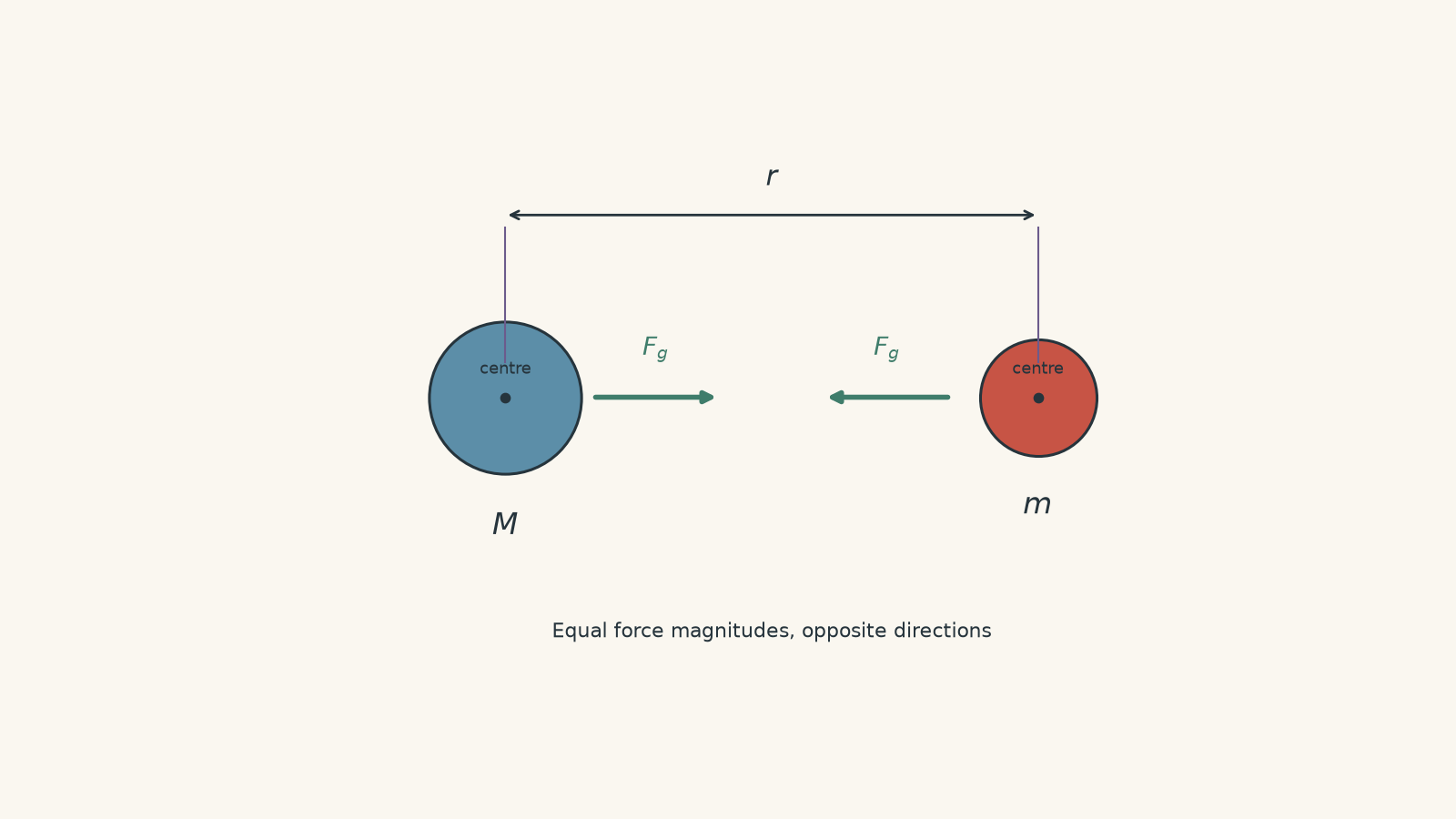
Newton’s law of universal gravitation gives the magnitude of the force:
\[ F_g=\frac{GMm}{r^2} \]
where:
| Symbol | Meaning | SI unit |
|---|---|---|
| \(F_g\) | magnitude of the gravitational force between the two masses | newton, \(\mathrm{N}\) |
| \(G\) | universal gravitational constant, \(6.67\times10^{-11}\ \mathrm{N\,m^2\,kg^{-2}}\) | \(\mathrm{N\,m^2\,kg^{-2}}\) |
| \(M\) | mass of one object | kilogram, \(\mathrm{kg}\) |
| \(m\) | mass of the other object | kilogram, \(\mathrm{kg}\) |
| \(r\) | centre-to-centre separation of the two objects | metre, \(\mathrm{m}\) |
The letters \(M\) and \(m\) do not mean “the object doing the pulling” and “the object being pulled”. Gravity is mutual. Swapping \(M\) and \(m\) does nothing to the equation because the product \(Mm\) is unchanged.
The equation gives the magnitude of the force. Its direction is along the line joining the two centres, towards the other mass.
02Get \(r\) right before touching the calculator
For a satellite at altitude \(h\) above a spherical planet of radius \(R\),
\[ r=R+h \]
not \(r=h\).
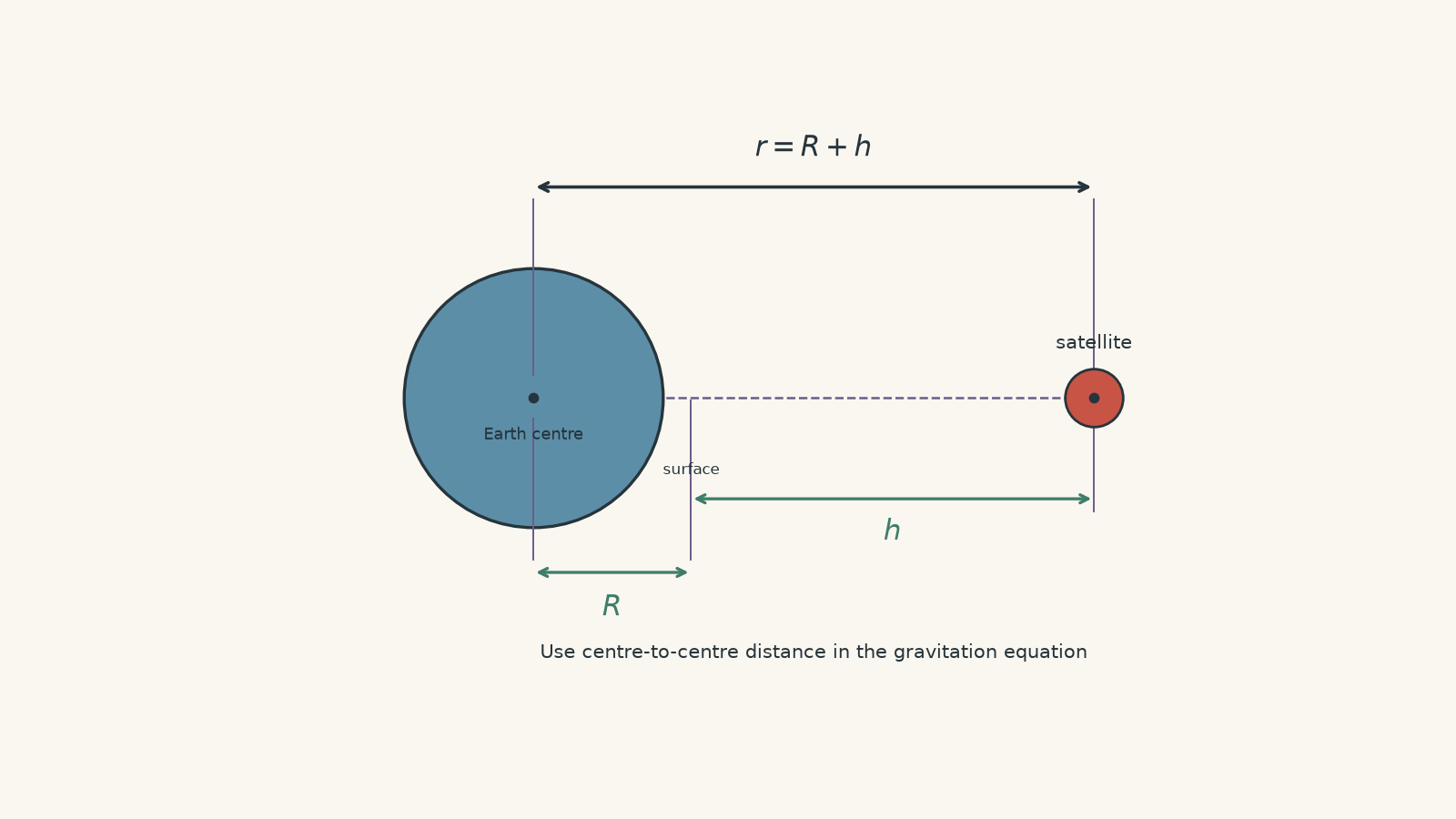
For the satellite from the opening problem,
\[ r=6.37\times10^6+4.00\times10^5 =6.77\times10^6\ \mathrm{m} \]
The radius of Earth is part of the separation.
Newton’s equation is fundamentally a law for point masses. For a spherically symmetric body and an object outside it, however, the body’s gravitational effect is the same as though all its mass were concentrated at its centre. That is why HSC problems can use Earth’s centre when applying the law.
For irregular extended objects that are very close together, treating all the mass as one point may not be exact. HSC questions will normally give you a situation where the point-mass or spherical-body model is appropriate.
03The inverse-square part is doing most of the interesting work
The masses appear directly in the numerator:
\[ F_g\propto Mm \]
So, if one mass doubles while everything else stays fixed, the gravitational force doubles. If both masses double, the force becomes four times larger.
Distance behaves differently:
\[ F_g\propto\frac{1}{r^2} \]
Before reading on, predict what happens if the separation doubles.
It does not halve. It becomes one-quarter as large because
\[ \frac{1}{(2r)^2}=\frac{1}{4r^2} \]
Some useful changes are:
| Change | New gravitational force |
|---|---|
| one mass doubles | \(2F\) |
| both masses double | \(4F\) |
| separation doubles | \(F/4\) |
| separation triples | \(F/9\) |
| separation halves | \(4F\) |
When you are comparing two situations, it is often cleaner to use a ratio instead of calculating two large forces separately.
If \(F_1\) is the original force and \(F_2\) is the new force,
\[ \frac{F_2}{F_1} = \frac{M_2m_2}{M_1m_1} \left(\frac{r_1}{r_2}\right)^2 \]
Here, the subscripts 1 and 2 simply mean the first and second situations. The constant \(G\) disappears because it is the same in both.
Worked example: gravitational force on a satellite
A \(1000\ \mathrm{kg}\) satellite orbits \(400\ \mathrm{km}\) above Earth’s surface. Take Earth’s mass as \(5.97\times10^{24}\ \mathrm{kg}\) and radius as \(6.37\times10^6\ \mathrm{m}\). Calculate the gravitational force on the satellite.
Step 1
The altitude must first be converted to metres:
\[ 400\ \mathrm{km}=4.00\times10^5\ \mathrm{m} \]
Therefore,
\[ r=6.37\times10^6+4.00\times10^5 =6.77\times10^6\ \mathrm{m} \]
Step 2
\[ \begin{aligned} F_g &=\frac{GMm}{r^2}\\ &=\frac{(6.67\times10^{-11})(5.97\times10^{24})(1000)} {(6.77\times10^6)^2}\\ &=8.69\times10^3\ \mathrm{N} \end{aligned} \]
Step 3
The satellite experiences a gravitational force of approximately
\[ F_g=8.69\times10^3\ \mathrm{N} \]
directed towards Earth’s centre.
Dividing by the satellite’s mass gives an acceleration of about \(8.69\ \mathrm{m\,s^{-2}}\). That is lower than the familiar \(9.8\ \mathrm{m\,s^{-2}}\) at Earth’s surface because the satellite is farther from Earth’s centre.
Worked example: two asteroids both accelerate
Asteroid A has mass \(2.0\times10^{12}\ \mathrm{kg}\), and asteroid B has mass \(8.0\times10^{12}\ \mathrm{kg}\). Their centres are \(10.0\ \mathrm{km}\) apart. Calculate the gravitational force between them and the acceleration of each asteroid.
Step 1
\[ r=10.0\ \mathrm{km}=1.00\times10^4\ \mathrm{m} \]
Step 2
\[ \begin{aligned} F_g &=\frac{GM_Am_B}{r^2}\\ &=\frac{(6.67\times10^{-11})(2.0\times10^{12})(8.0\times10^{12})} {(1.00\times10^4)^2}\\ &=1.07\times10^7\ \mathrm{N} \end{aligned} \]
Each asteroid experiences a force of \(1.07\times10^7\ \mathrm{N}\), directed towards the other asteroid.
Step 3
\[ \begin{aligned} a_A &=\frac{F_g}{m_A}\\ &=\frac{1.07\times10^7}{2.0\times10^{12}}\\ &=5.34\times10^{-6}\ \mathrm{m\,s^{-2}} \end{aligned} \]
Step 4
\[ \begin{aligned} a_B &=\frac{F_g}{m_B}\\ &=\frac{1.07\times10^7}{8.0\times10^{12}}\\ &=1.33\times10^{-6}\ \mathrm{m\,s^{-2}} \end{aligned} \]
The forces are equal. The accelerations are not.
Asteroid A has one-quarter the mass of asteroid B, so the same force gives it four times the acceleration.
04The most tempting misconception: the bigger mass feels the bigger force
Suppose a \(1\ \mathrm{kg}\) object is attracted towards Earth.
It is tempting to say Earth’s enormous mass means Earth exerts a huge force on the object, while the object exerts only a tiny force on Earth. That sounds reasonable because we can see the small object fall while Earth appears not to move.
But Newton’s third law requires the forces in the interaction to have equal magnitude:
\[ F_{\text{Earth on object}} = F_{\text{object on Earth}} \]
Newton’s gravitation equation says the same thing. In either direction, the magnitude is
\[ F_g=\frac{GM_{\text{Earth}}m}{r^2} \]
What changes is the acceleration:
\[ a=\frac{F}{m} \]
The small object’s mass is tiny compared with Earth’s, so it has a much larger acceleration.
A useful decision rule is:
- compare forces using Newton’s third law: the two forces are equal in magnitude;
- compare accelerations using \(a=F/m\): the smaller mass accelerates more.
Do not mix those two questions.
05A reliable method for gravitational-force problems
Before substituting numbers, make four decisions.
- Identify the two interacting masses.
- Find their centre-to-centre separation \(r\), in metres.
- Decide whether you need an absolute force or only a comparison. For comparisons, a ratio may be faster.
- After finding the force, state its direction and check whether the result makes physical sense.
A calculation can be perfectly typed into a calculator and still be physically wrong. Using altitude instead of centre-to-centre distance is the classic example.
Other common slips are worth catching early:
| Tempting move | What is actually required |
|---|---|
| Use altitude as \(r\) | Use centre-to-centre separation |
| Leave distance in kilometres | Convert to metres before using \(G\) |
| Double \(r\), then halve \(F\) | Doubling \(r\) makes \(F\) one-quarter |
| Give the heavier body the larger force | The two interaction forces have equal magnitude |
| Treat \(F_g\) as acceleration | Use \(a=F_g/m\) if acceleration is required |
| Forget that \(r\) is squared | Write \(r^2\) before entering values |
06Questions and solutions
Question 1
A \(750\ \mathrm{kg}\) satellite is \(500\ \mathrm{km}\) above Earth’s surface. Use \(M_E=5.97\times10^{24}\ \mathrm{kg}\), \(R_E=6.37\times10^6\ \mathrm{m}\), and \(G=6.67\times10^{-11}\ \mathrm{N\,m^2\,kg^{-2}}\).
Calculate the gravitational force exerted by Earth on the satellite.
Solution 1
The gravitational force is \(6.33\times10^3\ \mathrm{N}\), directed towards Earth’s centre.
The key step is to use the satellite’s distance from Earth’s centre, not its altitude.
Convert the altitude:
\[ 500\ \mathrm{km}=5.00\times10^5\ \mathrm{m} \]
Hence,
\[ r=6.37\times10^6+5.00\times10^5 =6.87\times10^6\ \mathrm{m} \]
Now apply Newton’s law:
\[ \begin{aligned} F_g &=\frac{GM_Em}{r^2}\\ &=\frac{(6.67\times10^{-11})(5.97\times10^{24})(750)} {(6.87\times10^6)^2}\\ &=6.33\times10^3\ \mathrm{N} \end{aligned} \]
The tempting mistake is to substitute \(5.00\times10^5\ \mathrm{m}\) for \(r\). That is only the distance above Earth’s surface. Gravity depends on the centre-to-centre separation.
Question 2
A \(1200\ \mathrm{kg}\) satellite is initially \(2.00\times10^6\ \mathrm{m}\) above Earth’s surface. It is moved directly away from Earth until the gravitational force on it is exactly half its initial value.
Using \(R_E=6.37\times10^6\ \mathrm{m}\):
- calculate the initial gravitational force;
- determine the satellite’s new distance from Earth’s centre; and
- determine its new altitude above Earth’s surface.
Use \(M_E=5.97\times10^{24}\ \mathrm{kg}\) and \(G=6.67\times10^{-11}\ \mathrm{N\,m^2\,kg^{-2}}\).
Solution 2
The initial force is \(6.82\times10^3\ \mathrm{N}\), and halving it requires a new centre-to-centre distance of \(1.18\times10^7\ \mathrm{m}\), corresponding to an altitude of \(5.47\times10^6\ \mathrm{m}\).
Initially,
\[ r_1=6.37\times10^6+2.00\times10^6 =8.37\times10^6\ \mathrm{m} \]
Therefore,
\[ \begin{aligned} F_1 &=\frac{GM_Em}{r_1^2}\\ &=\frac{(6.67\times10^{-11})(5.97\times10^{24})(1200)} {(8.37\times10^6)^2}\\ &=6.82\times10^3\ \mathrm{N} \end{aligned} \]
The final force is half this value:
\[ F_2=3.41\times10^3\ \mathrm{N} \]
Because the masses have not changed,
\[ \frac{F_2}{F_1} = \left(\frac{r_1}{r_2}\right)^2 \]
Substitute \(F_2/F_1=1/2\):
\[ \begin{aligned} \frac{1}{2} &=\left(\frac{r_1}{r_2}\right)^2\\ r_2 &=\sqrt{2}\,r_1\\ &=\sqrt{2}(8.37\times10^6)\\ &=1.18\times10^7\ \mathrm{m} \end{aligned} \]
The altitude is the distance from the surface:
\[ \begin{aligned} h_2 &=r_2-R_E\\ &=1.1837\times10^7-6.37\times10^6\\ &=5.47\times10^6\ \mathrm{m} \end{aligned} \]
A tempting route is to double the distance because the force has halved. That would be correct for an inverse relationship, but gravity follows an inverse-square relationship. The distance only needs to increase by a factor of \(\sqrt{2}\).
Question 3
A \(100\ \mathrm{kg}\) probe is placed somewhere on the straight line between Earth and the Moon. Ignore the motion of Earth and the Moon and ignore all other gravitational influences.
Use:
- Earth mass \(M_E=5.97\times10^{24}\ \mathrm{kg}\);
- Moon mass \(M_M=7.35\times10^{22}\ \mathrm{kg}\); and
- Earth-Moon centre-to-centre separation \(d=3.84\times10^8\ \mathrm{m}\).
Find the point at which Earth’s gravitational force on the probe has the same magnitude as the Moon’s gravitational force on it. State the distance from Earth’s centre and explain why the point is not halfway between Earth and the Moon.
Solution 3
The equal-force point is \(3.46\times10^8\ \mathrm{m}\) from Earth’s centre, leaving the probe about \(3.84\times10^7\ \mathrm{m}\) from the Moon. In this simplified model, the two opposite gravitational forces cancel there.
Let \(x\) be the probe’s distance from Earth’s centre. Its distance from the Moon is then \(d-x\).
For the force magnitudes to be equal,
\[ \frac{GM_Em}{x^2} = \frac{GM_Mm}{(d-x)^2} \]
The factors \(G\) and the probe mass \(m\) cancel:
\[ \frac{M_E}{x^2} = \frac{M_M}{(d-x)^2} \]
Taking the positive square root gives
\[ \frac{x}{d-x} = \sqrt{\frac{M_E}{M_M}} \]
Substituting the masses,
\[ \sqrt{\frac{5.97\times10^{24}}{7.35\times10^{22}}} =9.01 \]
so
\[ \begin{aligned} \frac{x}{d-x}&=9.01\\ x&=9.01(d-x)\\ 10.01x&=9.01d\\ x&=0.900d\\ &=3.46\times10^8\ \mathrm{m} \end{aligned} \]
The remaining distance to the Moon is
\[ d-x = 3.84\times10^8-3.46\times10^8 \approx3.84\times10^7\ \mathrm{m} \]
As a check, each gravitational force is about \(0.333\ \mathrm{N}\).
The midpoint is tempting because the distances would be equal there. But the source masses are not equal. Earth is much more massive than the Moon, so the probe must be much closer to the Moon before the Moon’s weaker gravitational attraction can match Earth’s.
Question 4
Two isolated point masses start from rest. Object A has mass \(M\), object B has mass \(4M\), and their initial separation is \(d\). The only forces acting are their mutual gravitational forces.
At a later instant, their separation has fallen to \(d/2\).
- By what factor has the gravitational force changed?
- What is the ratio of the magnitudes of their accelerations, \(a_A:a_B\)?
- How far has each object moved from its starting position by that instant?
Solution 4
The gravitational force has become four times larger, object A’s acceleration is four times object B’s, and A has moved \(2d/5\) while B has moved \(d/10\).
Initially,
\[ F_1=\frac{G(M)(4M)}{d^2} \]
When the separation is \(d/2\),
\[ \begin{aligned} F_2 &=\frac{G(M)(4M)}{(d/2)^2}\\ &=4F_1 \end{aligned} \]
So the force has increased by a factor of 4.
At any instant the two gravitational forces are equal in magnitude. Therefore,
\[ a_A=\frac{F}{M} \]
while
\[ a_B=\frac{F}{4M} \]
Hence,
\[ a_A:a_B=4:1 \]
Now consider their motion. Because the system started from rest and has no external force, its total momentum remains zero. The momentum magnitudes must therefore satisfy
\[ Mv_A=4Mv_B \]
so
\[ v_A=4v_B \]
This relationship holds throughout the motion. Object A therefore travels four times as far as object B over the same time interval.
Let their distances travelled be \(x_A\) and \(x_B\). The separation has decreased from \(d\) to \(d/2\), so together they have closed a distance of \(d/2\):
\[ x_A+x_B=\frac d2 \]
Since \(x_A=4x_B\),
\[ \begin{aligned} 4x_B+x_B&=\frac d2\\ 5x_B&=\frac d2\\ x_B&=\frac d{10} \end{aligned} \]
and therefore
\[ x_A=\frac{2d}{5} \]
The tempting claim is that equal gravitational forces should make the two objects move equal distances. Equal force does not mean equal acceleration. Object A has one-quarter the mass, so it responds four times as strongly to the same force.
Question 5
Two isolated spherical bodies are released from rest.
Body A has mass \(M\) and radius \(R\). Body B has mass \(8M\) and radius \(2R\). Their centres initially lie \(4R\) apart. Assume both bodies remain spherical and that Newton’s gravitational law for spherical bodies applies until their surfaces first touch.
A student argues:
As the objects approach, \(F_g\propto1/r^2\), so the force will eventually become twice its initial value before they collide.
Determine whether this claim is possible. Then:
- find the largest gravitational force reached before first contact, as a multiple of the initial force;
- determine how far the centre of each body moves before contact; and
- compare the gravitational force and acceleration experienced by the two bodies at contact.
Solution 5
The claim is not possible. The bodies touch before the gravitational force can double. At first contact the force is only \(16/9\), or about \(1.78\), times its initial value. Body A has moved \(8R/9\), body B has moved \(R/9\), the forces on them are equal, and A’s acceleration is eight times B’s.
Initially, the centre-to-centre separation is
\[ r_i=4R \]
so the force is
\[ \begin{aligned} F_i &=\frac{G(M)(8M)}{(4R)^2}\\ &=\frac{8GM^2}{16R^2}\\ &=\frac12\frac{GM^2}{R^2} \end{aligned} \]
The surfaces touch when the centre-to-centre separation equals the sum of the radii:
\[ r_c=R+2R=3R \]
Therefore the gravitational force at contact is
\[ F_c=\frac{G(M)(8M)}{(3R)^2} =\frac89\frac{GM^2}{R^2} \]
Comparing this with the initial force,
\[ \begin{aligned} \frac{F_c}{F_i} &= \frac{\frac89GM^2/R^2} {\frac12GM^2/R^2}\\ &=\frac{16}{9}\\ &\approx1.78 \end{aligned} \]
So the bodies collide before the force doubles.
We can expose the student’s mistake another way. For the force to double while the masses remain unchanged,
\[ 2=\left(\frac{r_i}{r}\right)^2 \]
giving
\[ r=\frac{4R}{\sqrt2}\approx2.83R \]
But the bodies touch when \(r=3R\). A separation of \(2.83R\) would require the two spherical bodies to overlap.
The inverse-square law was not the mistake. The mistake was allowing \(r\) to take a value that the geometry of the physical system cannot reach before collision.
Now find how far each centre moves. The total centre separation falls from \(4R\) to \(3R\), so the two bodies close a total distance of
\[ R \]
Because the mutual forces have equal magnitudes,
\[ a_A=\frac{F}{M} \]
and
\[ a_B=\frac{F}{8M} \]
so
\[ a_A=8a_B \]
Starting from rest, the lighter body consequently travels eight times as far as the heavier one before contact.
If the distances are \(x_A\) and \(x_B\),
\[ x_A=8x_B \]
and
\[ x_A+x_B=R \]
Therefore,
\[ \begin{aligned} 9x_B&=R\\ x_B&=\frac R9 \end{aligned} \]
and
\[ x_A=\frac{8R}{9} \]
At contact, Newton’s third law still applies:
\[ F_{A\text{ on }B}=F_{B\text{ on }A} \]
in magnitude.
But their accelerations are not equal. Since body B has eight times the mass,
\[ a_A=8a_B \]
The final trap is subtle: the inverse-square law can be applied correctly and still produce an impossible prediction if you forget another constraint on the system. Here, the missing constraint is that two finite spherical bodies cannot reduce their centre separation below the sum of their radii without overlapping.
07What this allows you to understand next
Once the centre-to-centre distance, inverse-square relationship, and equal-force interaction are secure, orbital motion becomes much easier to reason about.
For a circular orbit, gravity supplies the centripetal force. Equating
\[ F_g=\frac{GMm}{r^2} \]
with the required centripetal force
\[ F_c=\frac{mv^2}{r} \]
links Newton’s gravitation directly to orbital speed and period. It also explains why many orbital relationships depend on the mass of the central body and the orbital radius, but not on the mass of the satellite.
That connection leads naturally into Kepler’s three laws of planetary motion, where the patterns Kepler described can be understood using the gravitational interaction Newton later modelled mathematically.