
Naming Methyl and Ethyl Branched Chains for HSC Chemistry
Learn how to choose the correct parent chain, assign locants, and name or draw simple methyl- and ethyl-branched alkanes.
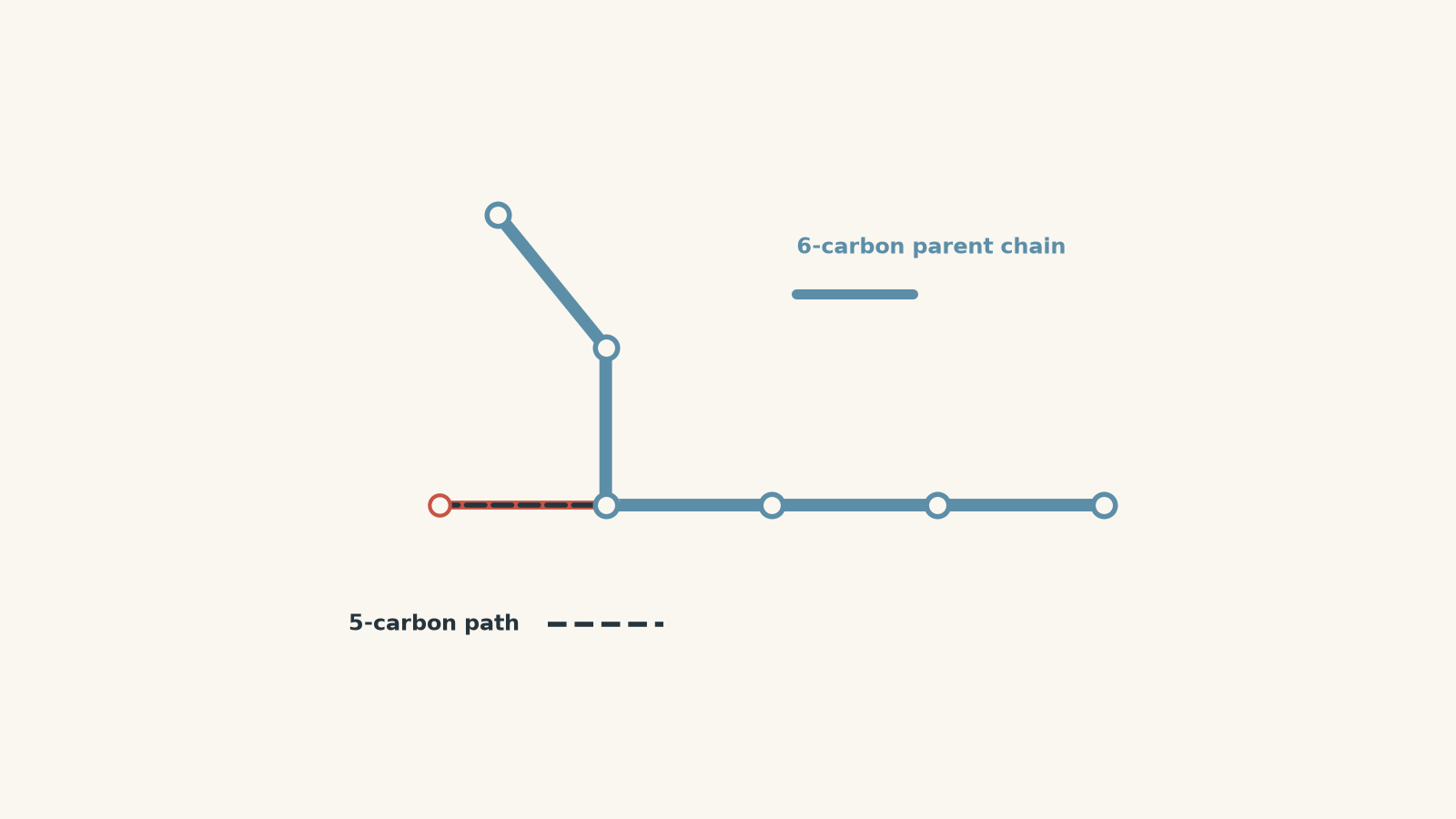
A structure can contain eight carbon atoms and still have a five-carbon parent chain. Another eight-carbon structure, drawn almost the same way, might have a six-carbon parent chain. That is where branched-chain naming usually goes wrong: students start naming the branches before deciding which carbon chain actually counts.
Consider a chain that looks horizontal on the page with an ethyl group hanging off it. Would you automatically call that two-carbon piece an ethyl branch? Don’t. First ask a more important question: what is the longest continuous path you can trace through carbon atoms? Sometimes the piece that looks like a branch belongs in the parent chain instead.
Once that decision is right, methyl and ethyl nomenclature becomes much more mechanical.
01Start with the carbon path, not the branches
Imagine every carbon atom is a person holding hands with neighbouring carbons. Your job is to find the longest line of people you can trace without jumping between people who are not connected.
The line does not need to be straight on the page. It can turn through what looks like a branch.
That analogy has one limit: molecules do not actually have a preferred left, right, horizontal, or vertical direction. A structural formula is just a convenient drawing. Rotating the molecule on the page does not create a different molecule.
This is why the apparent “main line” of a drawing is not automatically the parent chain.
For the simple branched alkanes in this guide, use this order:
- Find the longest continuous carbon chain.
- Name that chain.
- Identify the carbon groups attached to it.
- Number the parent chain from the end that gives the substituents the lowest possible locants.
- Put the substituent names and locants together.
That order matters. A low branch number cannot rescue the wrong parent chain.
02What methyl and ethyl actually mean
Suppose you have already chosen the parent chain. Any carbon group attached to it but not included in it is a substituent.
Two common substituents are:
| Substituent | Structure | Number of carbons |
|---|---|---|
| methyl | \(\ce{-CH3}\) | 1 |
| ethyl | \(\ce{-CH2CH3}\) | 2 |
A methyl group is therefore a one-carbon branch. An ethyl group is a two-carbon branch.
The important phrase is after the parent chain has been chosen. You cannot see a two-carbon piece sticking sideways and immediately declare it to be ethyl. If including those two carbons produces a longer continuous chain, they belong to the parent instead.
For the parent-chain names used most often here:
| Parent carbons | Parent alkane |
|---|---|
| 3 | propane |
| 4 | butane |
| 5 | pentane |
| 6 | hexane |
| 7 | heptane |
| 8 | octane |
For a broader treatment of parent chains and IUPAC naming, see IUPAC Naming of Organic Compounds to C8 for HSC Chemistry.
03Locants tell you where the branches are
A locant is simply a number giving the position of a substituent on the parent chain.
Suppose a methyl group could be described as being on carbon 2 when numbered from one end, or carbon 4 when numbered from the other.
Which direction should you use?
Carbon 2. We number from the end that gives the substituent the lower locant.
So
\[ \ce{CH3-CH(CH3)-CH2-CH2-CH3} \]
is 2-methylpentane, not 4-methylpentane.
The carbon skeleton itself has not changed. Only the numbering direction has.
With several substituents, compare the complete sets of locants in order. Use the direction that gives the lower number at the first point where the two sets differ.
For example, if the possibilities were \(2,3,5\) and \(2,4,5\), choose \(2,3,5\). The first locants tie at 2, but the next comparison is 3 against 4.
Do not use the sum of the locants as your general rule. Comparing them in order is safer and matches the naming logic you need.
04How the final name is assembled
Once the parent and locants are fixed:
- write a locant immediately before its substituent name
- separate two numbers with commas
- separate numbers and words with hyphens
- do not put spaces inside the chemical name
- if the same substituent appears twice, use
di-; three times usestri- - when different substituents are present, list them alphabetically
For methyl and ethyl, ethyl comes before methyl alphabetically.
The prefixes di- and tri- do not change alphabetical order.
So a compound with an ethyl group at carbon 3 and methyl groups at carbons 2 and 4 would be named:
3-ethyl-2,4-dimethylhexane
not:
2,4-dimethyl-3-ethylhexane
The numbers are determined by the numbering rules. Alphabetical order controls how the substituent names are written afterwards.
Worked example: Name a single methyl branch
Name the following compound:
\[ \ce{CH3-CH(CH3)-CH2-CH2-CH3} \]
Step 1
The longest path contains five carbon atoms:
\[ \ce{C-C-C-C-C} \]
A five-carbon alkane has the parent name pentane.
Step 2
There is one carbon outside the parent chain. It is a \(\ce{-CH3}\) group, so it is methyl.
Step 3
From the left, the methyl group is on carbon 2.
From the right, it would be on carbon 4.
Choose carbon 2 because it gives the lower locant.
Step 4
The compound is 2-methylpentane.
The 2 tells us where the methyl branch is attached. Pentane tells us that the longest continuous chain contains five carbons.
05Drawing a name works in the opposite direction
When you are given a name rather than a structure, do not try to draw the whole molecule at once.
Build it in layers.
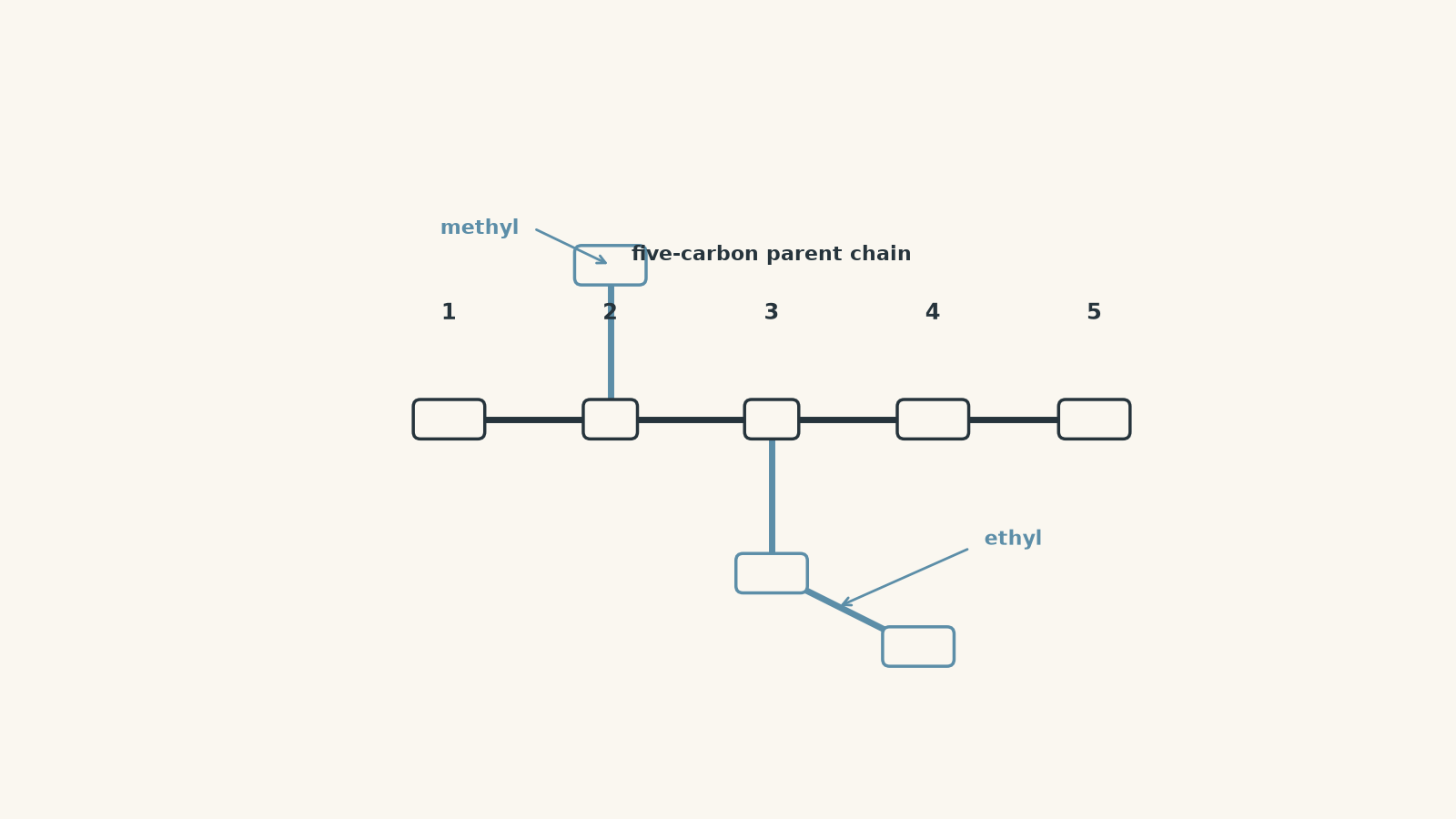
For 3-ethyl-2-methylpentane:
pentanetells you to draw a five-carbon parent chain2-methyltells you to attach \(\ce{-CH3}\) to carbon 23-ethyltells you to attach \(\ce{-CH2CH3}\) to carbon 3- add enough hydrogen atoms for every carbon to have four bonds
The parent chain is therefore:
\[ \ce{C-C-C-C-C} \]
Number it:
\[ \ce{C1-C2-C3-C4-C5} \]
Then attach the substituents at the stated locants.
Worked example: Draw 3-ethyl-2-methylpentane
Draw a condensed structural formula for 3-ethyl-2-methylpentane and check that the stated parent chain is valid.
Step 1
Pentane means five connected carbon atoms:
\[ \ce{C-C-C-C-C} \]
Step 2
Attach one carbon to carbon 2.
That gives a \(\ce{-CH3}\) branch.
Step 3
Attach two connected carbons to carbon 3.
That branch is \(\ce{-CH2CH3}\).
Step 4
A condensed structural formula is:
\[ \ce{CH3-CH(CH3)-CH(CH2CH3)-CH2-CH3} \]
Step 5
The obvious horizontal route contains five carbons. Could you make a six-carbon route by travelling through the ethyl branch instead?
Starting at the end of the ethyl branch and travelling towards either end of the original chain still gives at most five carbons. There is no six-carbon continuous path.
So pentane really is a valid longest parent chain.
Step 6
From the chosen end, the substituents occur at carbons 2 and 3. Numbering from the other end would put them at carbons 3 and 4.
The lower set is \(2,3\).
The correct name is therefore 3-ethyl-2-methylpentane.
Notice one slightly odd-looking feature: the locant 3 appears before locant 2 in the written name. That is fine. Ethyl is written before methyl because substituents are listed alphabetically.
06The most tempting mistake: treating a visible ethyl group as a branch
Now compare this proposed structure:
\[ \ce{CH3-CH(CH2CH3)-CH(CH3)-CH2-CH3} \]
It is tempting to read the horizontal line as pentane and call the molecule 2-ethyl-3-methylpentane.
That feels reasonable. There are five carbons drawn across the page, and two carbons appear to hang from carbon 2.
But trace a path from the end of that two-carbon section through the molecule:
\[ \ce{CH3-CH2-CH-CH-CH2-CH3} \]
That path contains six carbons.
So the five-carbon chain was never allowed to be the parent.
Using the six-carbon chain leaves two one-carbon branches. Both are methyl groups, giving:
3,4-dimethylhexane
The surprising part is that the “ethyl group” disappears completely from the correct name. Nothing has vanished from the molecule. We simply chose a better parent chain.
This gives you a useful warning sign:
If an ethyl group appears very close to the end of your proposed parent chain, check carefully whether that ethyl group can be absorbed into a longer chain.
07Why parent-chain choice comes before low locants
Suppose one possible chain has five carbons and gives beautiful low locants such as 2 and 3.
Another continuous chain has six carbons but produces locants 3 and 4.
You still choose the six-carbon chain.
The hierarchy is:
longest parent chain first, then numbering.
You do not compare locants until you have a valid parent chain.
A common mistake is to choose whichever route gives the smallest-looking numbers. That reverses the logic. Locants tell you how to number the parent; they do not decide whether a shorter chain can replace a longer one.
08A compact method for exams
When naming a methyl- or ethyl-branched alkane, use this sequence.
1. Trace, don’t stare
Physically trace possible carbon paths with your finger or pencil.
Do not assume the longest chain is horizontal.
2. Count the parent carbons
Convert that count into the alkane name: pentane, hexane, heptane, and so on.
3. Circle the carbons outside the parent
A one-carbon branch is methyl.
A two-carbon branch is ethyl.
If what looked like an ethyl branch has become part of the parent chain, rename whatever remains.
4. Number from both ends
Write the possible locant sets before committing.
Choose the direction with the lower set at the first point of difference.
5. Write substituents alphabetically
Ethyl comes before methyl.
This happens after the numbering has been settled.
6. Check the punctuation
For example:
3-ethyl-2,4-dimethylhexane
Numbers separated by commas. Numbers and words separated by hyphens. No spaces.
09Questions and solutions
Question 1
Name the following compound:
\[ \ce{CH3-CH2-CH(CH3)-CH2-CH3} \]
Solution 1
The correct name is 3-methylpentane.
The longest continuous chain contains five carbons, so the parent is pentane.
The only carbon outside that chain is a \(\ce{-CH3}\) group, so the substituent is methyl.
Numbering from either end places the methyl group on carbon 3:
\[ \ce{CH3-CH2-CH(CH3)-CH2-CH3} \]
Therefore the locant is 3, giving 3-methylpentane.
A tempting mistake is to count all six carbons and try to call the parent hexane. That does not work because the six carbons cannot be traced as one continuous, unbranched path. The parent-chain rule depends on connectivity, not the total number of carbon atoms in the molecule.
Question 2
Name the following compound:
\[ \ce{CH3-CH(CH3)-CH(CH2CH3)-CH2-CH3} \]
Explain how you know that the apparent ethyl group does not produce a longer parent chain.
Solution 2
The correct name is 3-ethyl-2-methylpentane.
First find the longest continuous carbon path. The horizontal route contains five carbons.
Now test the possible route through the apparent ethyl branch. Starting from its terminal \(\ce{CH3}\), you can trace through its \(\ce{CH2}\), through the attachment carbon, and towards one end of the original chain. The longest such route still contains five carbons.
So the parent remains pentane.
Using the horizontal five-carbon chain, the substituents are:
- methyl on carbon 2
- ethyl on carbon 3
Numbering from the opposite end would give locants 3 and 4, so \(2,3\) is preferred.
Finally, substituent names are listed alphabetically. Ethyl comes before methyl.
Therefore:
3-ethyl-2-methylpentane
The tempting route is to think, “If I include the ethyl branch, surely the chain becomes longer.” Including a branch can make the parent longer, but only if the resulting continuous path actually contains more carbon atoms. Here it does not.
Question 3
Two students write the following condensed structural formulae.
Student A:
\[ \ce{CH3-CH(CH3)-CH(CH3)-CH2-CH2-CH3} \]
Student B:
\[ \ce{CH3-CH2-CH2-CH(CH3)-CH(CH3)-CH3} \]
Are these different structural isomers, or are they two ways of writing the same molecule? Give the correct IUPAC name and justify the numbering.
Solution 3
They are the same molecule, and its correct name is 2,3-dimethylhexane.
Student B has simply written the same six-carbon parent chain from the opposite direction.
For Student A’s orientation, the methyl substituents occur at carbons 2 and 3:
\[ 2,3 \]
If the same molecule is numbered from the other end, they occur at carbons 4 and 5:
\[ 4,5 \]
Compare the sets at the first point of difference. Since \(2<4\), the \(2,3\) numbering is required.
There are two methyl substituents, so the prefix di- is used.
The full name is therefore 2,3-dimethylhexane.
The tempting conclusion is that changing the written order of the condensed formula must change the substance. It does not. Carbon chains can be written from either end. Connectivity is what matters.
A useful check is to imagine physically rotating the molecule through \(180^\circ\). No bonds break, so no new structural isomer has been created.
Question 4
Compare these two compounds.
Compound A:
\[ \ce{CH3-CH(CH3)-CH(CH2CH3)-CH2-CH3} \]
Compound B:
\[ \ce{CH3-CH(CH2CH3)-CH(CH3)-CH2-CH3} \]
They differ only in whether the apparent ethyl group is attached to the second or third carbon of the horizontal five-carbon row.
Name both compounds correctly. Then explain why moving the apparent ethyl group by one carbon changes the parent-chain name in one case.
Solution 4
Compound A is 3-ethyl-2-methylpentane, whereas Compound B is 3,4-dimethylhexane. The parent changes because Compound B contains a six-carbon continuous path, while Compound A does not.
For Compound A:
\[ \ce{CH3-CH(CH3)-CH(CH2CH3)-CH2-CH3} \]
The horizontal route contains five carbons.
Try instead to begin at the terminal carbon of the ethyl branch. The longest path you can construct still contains only five carbon atoms.
So a five-carbon parent is valid.
Numbering gives methyl at carbon 2 and ethyl at carbon 3, producing:
3-ethyl-2-methylpentane
Now consider Compound B:
\[ \ce{CH3-CH(CH2CH3)-CH(CH3)-CH2-CH3} \]
If you accept the horizontal five-carbon row immediately, you might propose 2-ethyl-3-methylpentane.
But start at the terminal carbon of the apparent ethyl branch and trace through its second carbon, through the attachment point, and along the longer side of the horizontal chain.
You obtain a six-carbon path:
\[ \ce{C-C-C-C-C-C} \]
So pentane cannot be the parent. The parent must be hexane.
Once that six-carbon chain is selected, the carbons that remain outside it are both one-carbon groups. They are therefore two methyl substituents.
They occur at carbons 3 and 4, giving:
3,4-dimethylhexane
The tempting assumption is that shifting one branch by one position should merely change a locant. But parent-chain selection happens before locants exist. Moving the attachment point can change which continuous paths are possible, and that can change the parent itself.
This is why nomenclature is really a connectivity problem before it becomes a naming problem.
Question 5
A student makes the following general claim:
“A correct IUPAC name for an open-chain alkane could contain
2-ethyl-as long as the ethyl group really is bonded to carbon 2 of the chain.”
Assume the proposed parent chain contains \(n\) carbon atoms, where \(n\geq4\), and an ethyl group is attached to carbon 2.
Without relying on a particular drawing, determine whether 2-ethyl- can be part of a correct name when that proposed parent is supposed to be the longest continuous carbon chain. Justify your answer by constructing a longer carbon path.
Then use your reasoning to explain why the proposed name 2-ethyl-3-methylpentane must be wrong before you even work out its correct name.
Solution 5
No. For an open-chain alkane of this type, an ethyl substituent on carbon 2 proves that the proposed parent chain is not the longest possible chain. Therefore a name beginning with 2-ethyl- cannot satisfy the longest-chain rule in this situation.
Suppose the proposed parent contains \(n\) carbons:
\[ \ce{C1-C2-C3-\dots-C_n} \]
An ethyl group attached to carbon 2 contains two more connected carbons. Call them \(E_1\) and \(E_2\), with \(E_1\) bonded directly to carbon 2:
\[ \ce{E2-E1-C2-C3-\dots-C_n} \]
Now ignore carbon 1 and trace a new continuous path beginning at \(E_2\).
The path contains:
- the two ethyl carbons, \(E_2\) and \(E_1\)
- carbon 2
- every parent carbon from carbon 3 through carbon \(n\)
The original proposed parent contained \(n\) carbons.
The new route replaces carbon 1 with two carbons from the apparent ethyl group. It therefore contains:
\[ n+1 \]
carbon atoms.
That is one carbon longer than the supposedly longest parent chain.
This is a contradiction. If a longer chain exists, the original \(n\)-carbon chain cannot be the parent.
Now consider 2-ethyl-3-methylpentane.
The word pentane claims that the longest chain contains five carbons. But 2-ethyl tells us that a two-carbon branch is attached to carbon 2.
Tracing from the end of that supposed ethyl group through carbon 2 and towards carbon 5 immediately creates a six-carbon continuous path.
So the name fails before we need to inspect the rest of it.
Drawing the structure confirms that the proper parent is hexane:
\[ \ce{CH3-CH(CH2CH3)-CH(CH3)-CH2-CH3} \]
Using the six-carbon path leaves two methyl groups at carbons 3 and 4.
The actual name is therefore 3,4-dimethylhexane.
The tempting argument was, “The ethyl group really is connected to carbon 2, so 2-ethyl describes the drawing accurately.” Locally, that description is true. Globally, it fails the nomenclature rules because choosing that carbon as part of an ethyl substituent throws away a longer possible parent chain.
That same idea is useful well beyond methyl and ethyl groups. Before naming any branch, ask whether some or all of that apparent branch belongs in a longer parent chain. Once parent-chain selection is automatic, later organic nomenclature becomes much easier because functional groups, multiple bonds, and more complicated substituents all build on the same habit: establish the parent correctly before assigning positions.